Flag of MoroccoFlag of AlgeriaFlag of TunisiaFlag of Libya New report · North Africa

Tamazgha

Your North African Roots

For people with roots in Morocco, Algeria, Tunisia, Libya and Western Sahara, Amazigh and Arabic-speaking alike. We model your DNA against the ancient regional core (the Iberomaurusians of Taforalt, Neolithic farmers and Green Sahara herders, the Numidians, Carthage, Roman Africa) and the outside layers of later history (Arab conquest, Andalusi, Ottoman, colonial, Sahelian), then show which of 15 communities you most resemble, with an AI narrative.

  • 🏺 Ancient regional core (Taforalt, Neolithic Maghreb, Numidians, Carthage)
  • 🌍 Later layers (Arab conquest, Andalusi, Ottoman, Pied-Noir proxy, Sahelian)
  • 🏜️ 15 Amazigh and Arabic-speaking communities compared directly
  • 🧬 Y-DNA & mtDNA haplogroup classification
  • 📊 8 periods, from the Deep past to the Modern era
  • 🤖 Claude AI narrative, also in French and Arabic
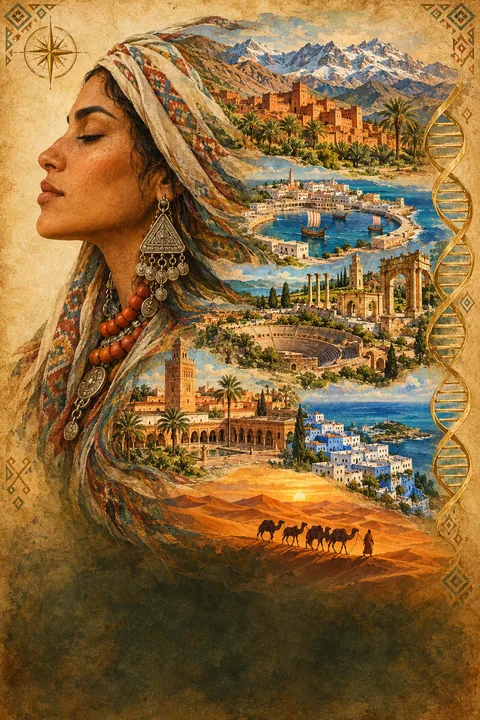
Tamazgha report cover
⚠️ Designed for people with roots in North Africa (the Maghreb and the Sahara). Works for any of the 15 communities, Amazigh and Arabic-speaking, from the Rif and the Souss to Kabylia, the Aures, the M'zab, Tunisia, Libya, Western Sahara and the Tuareg Sahara. If your roots are Levantine (Lebanese, Syrian, Palestinian) our Ararat report fits better; for Spain and Portugal see Hesperia; for Maghrebi Jewish families Am Yisrael is built for you. Egyptians and Sudanese are not among the communities. If you are mostly of other ancestry, our Advanced Ancestry Report is a better choice. Not sure? The free Report Finder tells you.

Who it is for

  • Moroccans: Arabic speakers of the plains and cities, Riffians, the Amazigh of the Middle Atlas and the Shilha of the Souss.
  • Algerians: Arabic speakers of the coast and the high plateaus, Kabyles, Chaoui of the Aures, Mozabites and the Gourara oases.
  • Tunisians: from Tunis, the Sahel and Sfax to the southern oases, Djerba, Chenini and Matmata.
  • Libyans of Tripolitania, Cyrenaica and the Fezzan.
  • Saharawi and Tuareg families of Western Sahara, the central Sahara and the Sahel.
  • The North African diaspora in France, Belgium, the Netherlands, Spain, Italy, Germany and beyond.

1. Choose your community

Pick the community your family comes from. Not sure, or mixed origins? Choose "Let the model decide" and we compare you to every community automatically.

Moroccan Arab

Arabic-speaking Moroccans of the Atlantic plains and the old cities (Fez, Rabat, Casablanca, Marrakesh): a local Amazigh base with a variable Near Eastern layer from the Arab conquest and later Arab tribes, plus Andalusi and trans-Saharan contributions

Riffian Amazigh (Morocco)

the Riffians, Tarifit-speaking Amazigh of the Rif mountains on the Mediterranean coast facing Spain, with old ties across the Strait of Gibraltar

Middle Atlas Amazigh (Morocco)

the Amazigh of the Middle Atlas, speakers of Central Atlas Tamazight in the cedar highlands of central Morocco, with strong continuity of the native North African population

Souss Shilha Amazigh (Morocco)

the Shilha (Ishelhin) of the Souss valley and the Anti-Atlas, Tashelhit speakers of southern Morocco, at the northern end of the trans-Saharan caravan routes

Saharawi

the Saharawi of Western Sahara, Hassaniya-speaking descendants of Sanhaja Amazigh and of the Beni Hassan Arab tribes, with West African ancestry from centuries of Saharan and Sahelian contact

Algerian Arab

Arabic-speaking Algerians of the coast and the high plateaus (Algiers, Oran, Constantine): a local Amazigh base with layers from the Arab conquest, Andalusi refugees and the Ottoman regency

Kabyle (Algeria)

the Kabyles of the Djurdjura mountains east of Algiers, Taqbaylit speakers and one of the most conservative Amazigh populations of North Africa

Chaoui (Shawiya) Amazigh, Aures (Algeria)

the Chaoui (Shawiya) of the Aures mountains, Tachawit speakers in the old Numidian heartland, where Queen Dihya (the Kahina) led the resistance to the Arab conquest (small reference sample)

Mozabite (Algeria)

the Mozabites, Ibadi Amazigh of the M'zab valley oases around Ghardaia, a long-endogamous Saharan community with some Sub-Saharan ancestry

Tunisian Arab

Arabic-speaking Tunisians of Tunis, the Sahel and Sfax, the land of Carthage and of Ifriqiya, with layers from Punic, Roman, Arab-conquest, Andalusi and Ottoman times over a local base

Southern Tunisian Amazigh (Djerba, Chenini, Matmata)

the Amazigh of southern Tunisia (Djerba, Chenini, Matmata), the last Amazigh-speaking villages of Tunisia, small and long-isolated communities

Libyan Arab

Arabic-speaking Libyans of Tripolitania, Cyrenaica and the Fezzan: an Amazigh base with a larger Arab-tribal layer (Banu Hilal and Banu Sulaym) and Sub-Saharan ancestry from the trans-Saharan routes

Southern Tunisian Arab (Douz, R'Baya)

Arabic-speaking Tunisians of the southern oases and steppe (Douz, the Nefzaoua and the R'Baya), with a stronger Arab-tribal (Banu Hilal and Banu Sulaym) and trans-Saharan layer than the northern Tunisians

Tuareg (Sahara and Sahel)

the Tuareg (Kel Tamasheq) of the central Sahara and the Sahel, Amazigh-speaking camel nomads of Algeria, Mali and Niger, with substantial West African ancestry from centuries of Sahelian life (small reference sample)

Gourara oasis Amazigh, Timimoun (Algeria)

the Zenati Amazigh of the Gourara oases around Timimoun in the Algerian Sahara, an oasis community at the crossroads of the trans-Saharan routes (small reference sample)

🔎 Let the model decide (auto)

We detect which community you are genetically closest to.

What your report models, era by era

🦴 Deep ancestry

The Iberomaurusian hunter-gatherers of Taforalt, Morocco, the oldest North African genomes, with Natufian, Anatolian, Iranian and Western Hunter-Gatherer sources, and steppe, East African, West African and East Asian proxies.

🌾 Neolithic

The autochthonous farmers of Ifri n'Amr ou Moussa, the Iberian-derived Cardial farmers of Kaf Taht el-Ghar, Kelif el Boroud, Doukanet el-Khoutifa in Tunisia and the Green Sahara herders of Takarkori, Libya.

⚱️ Bronze Age

North African farmers and herders of Kelif el Boroud and Hergla, with Bell Beaker Iberia, Old Kingdom Egypt and Canaanite proxies for the contacts across the Strait and along the coast.

🐎 Iron Age

The Libyan and Numidian natives of Kerkouane and Khenchela and Punic Carthage, with Phoenician, Egyptian, Iberian and Celtic proxies.

🏛️ Roman Africa

The Roman-period Amazigh of Algeria and a North African settler buried in the Roman Danube provinces, with Imperial Roman Italian and Roman Levant proxies.

⚔️ Late Antiquity

The Vandal kingdom (East Germanic proxy), Byzantine Africa (Early Byzantine proxy) and the Guanches of the Canary Islands, island Amazigh who kept the pre-Islamic North African profile.

🕌 Medieval

The Arab conquest and the later Banu Hilal and Banu Sulaym tribes, the Andalusi and Morisco return from Iberia, the Sephardic and Maghrebi Jewish communities, and the trans-Saharan trade (Sahelian and Nubian proxies).

🕰️ Modern era (1516 to 1962)

The Ottoman period and the Kouloughlis (Ottoman Turkish proxy), the colonial period (Pied-Noir settler proxy: French, Spanish, Sicilian and Maltese settlers) and continued Sahelian contact.

🏜️ Community profile

Which of the 15 communities your DNA most closely resembles, modelled directly against each community's modern reference population.

🧬 Y-DNA & mtDNA lineages

If your raw DNA file is available, we classify your paternal and maternal haplogroups in a North African context (e.g. E-M81, the most characteristic Amazigh paternal line, E-M78, J1, R1b-V88; maternal U6, M1, H1 and L lineages).

84 reference populations

Your DNA is modelled against ancient regional proxies, modern community reference populations, and non-regional outside proxies (Arabian, Levantine, Iberian, Ottoman, European settler and Sahelian).

Amerindian proxy

Amerindian (North) proxy · Amerindian (South) proxy

Bronze Age sources

Bell Beaker, France, steppe-rich (Bronze Age, non-regional proxy) · Bell Beaker-period Iberia, steppe-free (Chalcolithic, non-regional proxy) · Canaanites, Southern Levant and Lebanon (Middle/Late Bronze Age, non-regional proxy) · Han Bronze Age proxy (East Asian) · North African farmers and herders, Kelif el Boroud, Hergla and Camino de las Yeseras (Late Neolithic/Bronze Age) · Old Kingdom Egyptian, Nuwayrat (Early Bronze Age, Nile Valley, non-regional proxy) · Yoruba Bronze Age proxy (West African)

Classical/Roman sources

Han Classical proxy (East Asian) · Imperial Roman Italian (Classical) · Roman Levant, Lebanon (Classical, non-regional proxy) · Roman-period Amazigh, Algeria, and a North African settler at Ovilava, Austria (Classical) · Yoruba Classical proxy (West African)

Deep ancestral sources

Anatolian Neolithic farmer · Han (East Asian proxy) · Iberomaurusian hunter-gatherers, Taforalt, Morocco (Late Paleolithic) · Iranian Neolithic farmer · Natufian hunter-gatherers, Levant (Epipaleolithic) · Nilotic East African proxy (Dinka) · Steppe (Yamnaya) · Western Hunter-Gatherer (WHG) · Yoruba (West African proxy)

European host

NW European · S European · SE European · SW European · West European

Iron Age sources

Celtic (Ancient Gaul) · Han Iron Age proxy (East Asian) · Iberian Iron Age, Spain (Iron Age, non-regional proxy) · Libyan and Numidian natives, Kerkouane, Tunisia and Khenchela, Algeria (Iron Age) · Phoenicians, Lebanese homeland (Iron Age, non-regional proxy) · Punic Carthage and Kerkouane, Tunisia (Iron Age) · Third Intermediate to Late Period Egyptians, Abusir el-Meleq (Iron Age, Nile Valley, non-regional proxy) · Yoruba Iron Age proxy (West African)

Late Antiquity sources

Byzantine-period Levant, Lebanon (Late Antiquity, non-regional proxy) · Early Byzantines, Anatolia and Aegean, proxy for Byzantine Africa (Late Antiquity, non-regional proxy) · East Germanic Goths, Pannonia, proxy for the Vandals (Late Antiquity, non-regional proxy) · Guanches, Canary Islands, island Amazigh (Late Antiquity) · Han Late Antiquity proxy (East Asian) · Hispano-Romans of Visigothic Spain (Late Antiquity, non-regional proxy) · Yoruba Late Antiquity proxy (West African)

Medieval sources

Arabian Peninsula Arabs, Saudi proxy for the Arab conquest and the Banu Hilal (Medieval, non-regional proxy) · Christian Nubians, Kulubnarti, Sudan (Medieval) · Early Islamic Syria, Tell Qarassa and Tell Masaikh (Medieval, non-regional proxy) · Guanches, Canary Islands, Amazigh untouched by the Arab conquest (Medieval) · Han Medieval proxy (East Asian) · Maghrebi Jewish communities (Moroccan, Algerian, Tunisian and Libyan Jews, modern proxy) · Medieval Iberians, proxy for the Andalusi and Morisco migrations (Medieval, non-regional proxy) · Medieval Sephardic Jews, Tarrega, Catalonia (1348, non-regional proxy) · Merovingian and Carolingian Belgium (Germanic, Medieval, non-regional proxy) · Sahelian West Africans, Mandinka proxy for the trans-Saharan trade (Medieval)

Modern era sources

Central and Eastern Maghreb (Algeria, Tunisia and Libya) (modern era) · French and Spanish settlers (Pied-Noir proxy, colonial period) · Han Modern era proxy (East Asian) · Ottoman Turkish (Anatolia, Ottoman period) · Saharan Maghreb (Saharawi and Mozabite) (modern era) · Sahelian West Africans (trans-Saharan trade, modern era proxy) · Sicilian, South Italian and Maltese settlers (colonial period) · Western Maghreb (Morocco, Arab and Amazigh) (modern era)

Modern North African communities

Algerian Arab · Chaoui (Shawiya) Amazigh, Aures (Algeria) · Gourara oasis Amazigh, Timimoun (Algeria) · Kabyle (Algeria) · Libyan Arab · Middle Atlas Amazigh (Morocco) · Moroccan Arab · Mozabite (Algeria) · Riffian Amazigh (Morocco) · Saharawi · Souss Shilha Amazigh (Morocco) · Southern Tunisian Amazigh (Djerba, Chenini, Matmata) · Southern Tunisian Arab (Douz, R'Baya) · Tuareg (Sahara and Sahel) · Tunisian Arab

Neolithic and Chalcolithic sources

Doukanet el-Khoutifa, Tunisia (Early/Middle Neolithic) · Green Sahara herders, Takarkori, Libya (Pastoral Neolithic) · Han Neolithic proxy (East Asian) · Ifri n'Amr ou Moussa, Morocco, autochthonous Maghrebi farmers (Early Neolithic) · Kaf Taht el-Ghar Cardial farmers, Morocco, Iberian-derived (Early Neolithic) · Kelif el Boroud, Morocco (Late Neolithic) · Levantine Neolithic farmers, Jordan PPNB (Neolithic, non-regional proxy) · Yoruba Neolithic proxy (West African)

How it works, and its limits

🔬 How to read your results (please read)

Your result is computed by genetic similarity (Global25): we place your DNA in a 25-dimension genetic space and find the mixture of reference populations that best reproduces your profile, era by era. Every reference population uses real, official G25 coordinates (published ancient-DNA studies and the official Global25 dataset); none of our reference data is simulated.

Reference populations are statistical proxies: "Arab conquest" is modelled with modern Arabian and early Islamic Syrian samples, the Vandals with East Germanic Goths and the Pied-Noir settlers with modern French, Spanish, Sicilian and Maltese references. A percentage is a similarity to those samples, not a list of named ancestors.

Amazigh and Arab are described neutrally, by language and region. Being Amazigh or Arab is a matter of language, culture, history and self-identification, not a DNA percentage: most North Africans, whatever language they speak, share the same deep local ancestry, in different proportions with the later layers. Because those later layers (Arab conquest, Andalusi, Ottoman, colonial, Sahelian) are counted as outside admixture, Arabic-speaking communities normally read a lower regional core. That is expected, not a mismatch.

Genetics is not identity: this report is not a national, ethnic or political determination, and neighbouring communities can overlap closely in G25, so the closest community is a best-fit estimate. Some communities (Chaoui, Tuareg, Gourara) rest on small reference samples.

⚠️ Designed for people with roots in North Africa, Amazigh and Arabic-speaking alike. If you are mostly of other ancestry, the models are calibrated for fully-regional profiles and the fit will be poor.

Get your Tamazgha report

Select your community above, then confirm your email. We send you a secure link to upload your DNA (raw file or G25 coordinates) and generate your personalised report.

Secure checkout after email verification. Your DNA is processed automatically and deleted; no human sees it.

📖 What is raw DNA & G25?

Frequently asked questions

Who is the Tamazgha report for?

It is built for people with roots in North Africa (Morocco, Algeria, Tunisia, Libya and Western Sahara), Amazigh and Arabic-speaking alike, across 15 communities, and for the North African diaspora. For Levantine roots Ararat fits better, for Maghrebi Jewish families Am Yisrael, and for other ancestry the Advanced Ancestry Report.

Why "Tamazgha"?

Tamazgha is the Amazigh name for the lands of North Africa, from the Canary Islands and the Atlantic to the Siwa oasis in Egypt, and from the Mediterranean to the Sahara. The report covers all of its peoples, Amazigh and Arabic-speaking, because they share the same deep local ancestry.

Why is my regional core lower than expected?

The Arab conquest, Andalusi, Ottoman, colonial and Sahelian layers are modelled as outside admixture, so Arabic-speaking North Africans, and southern communities with more Sahelian ancestry, normally read a lower regional core than the Amazigh mountain communities. That is expected and is part of your story, not a sign that the report does not fit.

Not sure it fits me. Can I check first?

Yes. The free Report Finder reads your raw DNA file (or your G25) and tells you honestly whether Tamazgha is a good match for you, before you spend anything.

Do I need to have taken a DNA test already?

Yes. Upload your raw DNA file from 23andMe, AncestryDNA, MyHeritage, FamilyTreeDNA or LivingDNA, or paste your G25 coordinates.

What is the "ancient regional core" in the report?

We model your DNA against the Iberomaurusians of Taforalt, the Neolithic farmers of Morocco and Tunisia and the Green Sahara herders, the Bronze Age North Africans, the Libyan and Numidian natives and Punic Carthage, the Roman-period Amazigh and the Guanches of the Canary Islands.

Is the report available in Arabic?

Yes. The report is available in English, French, Arabic (with a right-to-left layout), Spanish, German, Dutch and Italian.

How much does it cost and what do I get?

€15. A full PDF report with your ancient regional core %, outside admixture breakdown, eight period-by-period breakdowns, closest modern community reference populations, Y-DNA and mtDNA haplogroups (if raw file provided), and a narrative interpreted by Claude AI, in the language of your choice.

A DNA report for North Africa

Tamazgha is a G25 ancestry report built specifically for people with roots in the Maghreb and the Sahara. Upload your raw DNA file from 23andMe, AncestryDNA, MyHeritage or FamilyTreeDNA, pick your community, and we model your genome against the ancient regional core plus the outside layers of later history, era by era, from Taforalt to the colonial period.

Whether you are Moroccan from Fez, the Rif, the Middle Atlas or the Souss, Algerian from Algiers, Oran, Kabylia, the Aures or the M'zab, Tunisian from Tunis, the Sahel, Djerba or the southern oases, Libyan, Saharawi or Tuareg: Tamazgha models the specific genetic layers of your region's history.

The report uses the Global25 (G25) system developed by geneticist Davidski, placing your DNA in a 25-dimension genetic space alongside ancient and modern reference populations, all sourced from Davidski's official Global25 datasheets and published ancient-DNA studies.

👁 Sample reports

See two real Tamazgha reports

Full example reports, flip through every page: cover, ancient regional core, period breakdowns, closest communities, and the AI narrative.

PDF

🇲🇦 Moroccan sample, French

A Moroccan profile, report written in French: the regional core, the eight periods from Taforalt to the colonial era, the later layers and the closest communities.

PDF

🇹🇳 Tunisian sample, Arabic

A Tunisian profile, report written in Arabic with a right-to-left layout: Punic, Roman and Arab-conquest layers over the local base, and the closest communities.

Report
Loading...
Loading report...
Page of -

We use cookies to enhance your experience. By continuing to visit this site you agree to our use of cookies. Learn more

🧭 Find your report
📬 Stay in the loop

New tools and new reports, straight to your inbox. No spam, unsubscribe anytime.