
Mauritanian (Beidane) DNA
Genetic origins and closest populations · Mauritania · North Africa
The Beidane are a Hassaniya Arabic-speaking community of Mauritania, a country that spans the western Sahara down to the Senegal River, where the desert meets West Africa. Their society took shape over several centuries as Arab Beni Hassan tribes and Sanhaja Berber groups, the people behind the medieval Almoravid movement, came together. In our model, the Beidane average comes out at 39.5% Anatolian Neolithic farmer, 34.6% North African hunter-gatherer (Iberomaurusian), 12.3% West African, 6.6% steppe, 5.8% Natufian and 1.2% Iranian Neolithic. The low Natufian share is what stands out: despite the Arabic language, it is well below that of the Sahrawi (14.5%) or Moroccan Arabs (15.6%). Two Berber samples from Errachidia in southeastern Morocco are its nearest modern neighbours (0.0132 and 0.0139), then Shilha from Ouarzazate and the Sahrawi. For ancient matches, the Guanches of the Canary Islands follow the North African-profile people of Iron Age Kerkouane in Tunisia, the closest at 0.0442.
- Largest ancient components in our model: Anatolian Neolithic farmers 39.5%, North African hunter-gatherers (Iberomaurusian) 34.6%, West African 12.3%
- Closest modern population in our data: Berber (MAR ERR), distance 0.0132
- Closest ancient group in our data: Tunisia IA Phoenician/Punic Kerkouane (North African Profile), distance 0.0442
This page sums up what the DNA of the Mauritanian (Beidane) sample tells us about deep origins. It is built from the averaged Global25 (G25) coordinates of individuals sampled in Mauritania, listed in the G25 sheet as "Mauritanian_Arab_Beidan", and it is one of 335 populations in our atlas. An average describes the group as a whole, not any single person in it.
Ancient make-up of the Mauritanian (Beidane) average
The ancient make-up of the Mauritanian (Beidane) average is led by Anatolian Neolithic farmers (39.5%), followed by North African hunter-gatherers (Iberomaurusian) (34.6%) and West African (12.3%). The Anatolian Neolithic farmers component reflects the Neolithic farmers of Anatolia, who carried agriculture into Europe from about 6500 BC. The North African hunter-gatherers (Iberomaurusian) share (34.6%) reflects the Late Stone Age North Africans known from the Taforalt cave in Morocco.
Smaller traces of Iranian Neolithic farmers (under 5%) also appear. At that level they can reflect real minor ancestry, but also simple model noise, so they should not be over-read. The model fits well (fit distance 0.020), so these proportions are a reasonable summary. The model draws on West Eurasian ancient genomes, with modern West African and East Asian stand-ins.
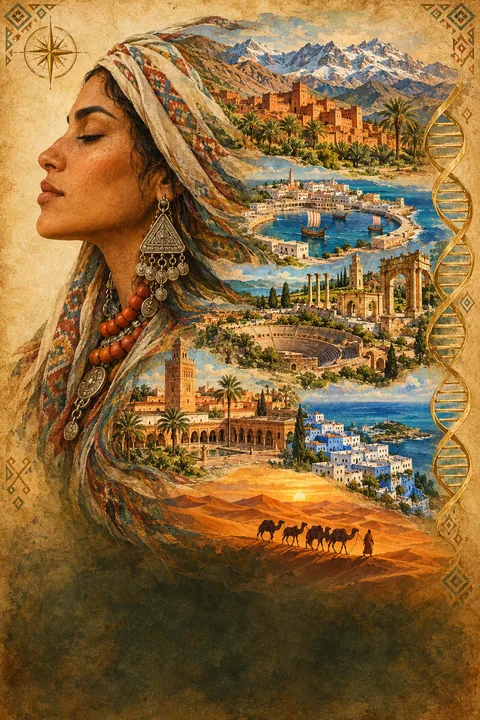
Tamazgha – North African Ancestry Report
Closest modern populations to Mauritanian (Beidane)
Among the modern populations in the G25 data, the closest to the Mauritanian (Beidane) average is Berber (MAR ERR), at a distance of 0.013 (very close). Next come Berber (Morocco Central Atlas Tamazight Errachidia) at 0.014 and Berber (Morocco Shilha Ouarzazate) at 0.022. By the tenth closest (Algerian) the distance grows to 0.037, a common pattern for a population that shares ancestry with its neighbours while keeping a profile of its own.
| # | Population | Distance | Closeness |
|---|---|---|---|
| 1 | Berber (MAR ERR) | 0.0132 | Very close |
| 2 | Berber (Morocco Central Atlas Tamazight Errachidia) | 0.0139 | Very close |
| 3 | Berber (Morocco Shilha Ouarzazate) | 0.0219 | Very close |
| 4 | Sahrawi | 0.0244 | Very close |
| 5 | Mozabite (other sample set) | 0.0246 | Very close |
| 6 | Moroccan | 0.0268 | Close |
| 7 | Moroccan Arab (Casablanca) | 0.0270 | Close |
| 8 | Moroccan Arab | 0.0318 | Close |
| 9 | Moroccan Arab (Zagora) | 0.0355 | Close |
| 10 | Algerian | 0.0372 | Close |
Distances are Euclidean distances between averaged G25 coordinates. On our scale, below 0.025 is very close, below 0.050 close, below 0.080 moderate, and beyond that distant.
Closest ancient populations to Mauritanian (Beidane)
Looking back in time, the ancient sample that most resembles the Mauritanian (Beidane) average is Tunisia IA Phoenician/Punic Kerkouane (North African Profile) (Iron Age), at 0.044. Canary Islands High-Late Medieval Guanche and Canary Islands Guanche come next. That is a close match: much of the modern profile was already present then, while later movements of people added further layers. A close ancient match is not proof of direct descent: it means those individuals carried a similar overall mix of ancestry.
| # | Ancient sample or group | Period | Distance |
|---|---|---|---|
| 1 | Tunisia IA Phoenician/Punic Kerkouane (North African Profile) | Iron Age | 0.0442 |
| 2 | Canary Islands High-Late Medieval Guanche | High to Late Medieval, c. 1000-1500 AD | 0.0504 |
| 3 | Canary Islands Guanche | Pre-Hispanic Canary Islands, before c. 1500 AD | 0.0515 |
| 4 | Hungary Late Antiquity Roman (North African Profile) | Late Antiquity, c. 250-600 AD | 0.0550 |
| 5 | Canary Islands Early Medieval Guanche | Early Medieval, c. 500-1000 AD | 0.0554 |
| 6 | Canary Islands High Medieval Guanche | High Medieval, c. 1000-1300 AD | 0.0597 |
| 7 | Canary Islands Late Medieval Guanche | Late Medieval, c. 1300-1500 AD | 0.0612 |
| 8 | Canary Islands Late Medieval-Early Modern Guanche | Late Medieval to Early Modern, c. 1300-1800 AD | 0.0614 |
| 9 | Italy Sardinia CA (North African Profile) | Copper Age (Chalcolithic) | 0.0642 |
| 10 | Algeria EIA Khenchela | Early Iron Age | 0.0644 |
Compare yourself with Mauritanian (Beidane)
Paste your G25 coordinates (scaled, one line, with or without a name in front) and we compute your genetic distance to the Mauritanian (Beidane) average and to its closest neighbours, right in your browser. Nothing is uploaded or stored.
| # | Population | Your distance | Closeness |
|---|
This list only covers Mauritanian (Beidane) and its neighbours. To find out which of our reports actually fits your DNA, run the free Report Finder: it runs the same fit test that every report uses before an order.
No G25 coordinates yet? Get a free simulated G25 from your raw DNA file, or order G25 coordinates.
About these numbers
Keep in mind that a population average is a statistical summary of a limited number of sampled individuals. Real people inside any group vary, some carry more of one ancestry and some less, and no genetic profile decides who is or is not Mauritanian (Beidane). Use these numbers as a map of deep ancestry, not as a label.
Method: averaged G25 coordinates, Euclidean distances to other modern and ancient averages, and a non-negative least-squares model against deep ancestral reference populations (data generated 2026-10-01). Read the full method.
Go deeper than the average
This page describes the Mauritanian (Beidane) average. Your own DNA has its own story: Tamazgha – North African Ancestry Report (15€) models your genome against the ancient sources and modern communities of the region, era by era, in a personal PDF report.
A report built for people with roots in North Africa: ancient regional core (Iberomaurusian and Taforalt, Neolithic farmers and Green Sahara herders, Numidians and Libyan natives, Carthage, Roman Africa, Vandal and Byzantine Africa, the...
More populations from North Africa
Frequently asked questions
What is the ancient genetic make-up of Mauritanian (Beidane)?
Modelled with deep ancestral reference populations, the Mauritanian (Beidane) average is about 39.5% Anatolian Neolithic farmers, 34.6% North African hunter-gatherers (Iberomaurusian) and 12.3% West African. These proportions are model estimates for a group average, not exact values for any one person.
Which populations are genetically closest to Mauritanian (Beidane)?
In the G25 data, the closest modern populations to the Mauritanian (Beidane) average are Berber (MAR ERR), Berber (Morocco Central Atlas Tamazight Errachidia) and Berber (Morocco Shilha Ouarzazate). The closest ancient matches are Tunisia IA Phoenician/Punic Kerkouane (North African Profile), Canary Islands High-Late Medieval Guanche and Canary Islands Guanche.
Can a DNA test tell me if I am Mauritanian (Beidane)?
No DNA test can confirm an ethnicity or a nationality. What DNA can show is how similar your genome is to the sampled Mauritanian (Beidane) average and to its neighbours. If you have G25 coordinates, paste them in the comparison box on this page to check that for free.
Which ExploreYourDNA report suits Mauritanian (Beidane) ancestry?
For the Mauritanian (Beidane) average, the regional report to choose is Tamazgha – North African Ancestry Report, which our fit test rates as an excellent match. Your own DNA may differ from the average, so the free Report Finder checks every report against your file before you buy.
Where does the data on this page come from?
From the averaged Global25 (G25) coordinates of the sampled individuals: genetic distances to other modern and ancient population averages, and a non-negative least-squares model against deep ancestral reference populations. The full method is described at https://www.exploreyourdna.com/populations#method.