
Libyan DNA
Genetic origins and closest populations · Libya · North Africa
Libya links the Maghreb and Egypt along the southern Mediterranean coast, with Tripolitania in the west, Cyrenaica in the east and the Fezzan deep in the Sahara. Greek Cyrene and Roman Leptis Magna flourished here, and from the 11th century Arab tribes such as the Banu Sulaym and Banu Hilal settled widely. In our model, the ancestry is 27.3% Natufian, 17.1% Levantine Neolithic farmer, 15.1% Anatolian Neolithic farmer, 12.3% West African, 11.2% North African hunter-gatherer (Iberomaurusian), 8.0% steppe, 6.1% Iranian Neolithic and 2.9% Caucasus hunter-gatherer. That is the most eastern-leaning profile of the Maghreb in our atlas: the Iberomaurusian layer is about half the Tunisian share (20.5%), while Near Eastern-related ancestry rises toward Egyptian levels. The closest modern averages are another Libyan Arab sample, Libyan and Algerian Bedouin, Tunisians from Douz and the Hawwara of Egypt. The nearest ancient group, people of North African profile buried at Roman-era Wels in Austria, is at a moderate distance (0.0519).
- Largest ancient components in our model: Natufian hunter-gatherers (Levant) 27.3%, Levantine Neolithic farmers 17.1%, Anatolian Neolithic farmers 15.1%
- Closest other population in our data: Bedouin (Libya), distance 0.0200
- Closest ancient group in our data: Austria Roman Empire Wels (North African Profile), distance 0.0519
Libyan is one of the 335 modern populations in our population genetics atlas. The numbers on this page describe the average Global25 (G25) genome of the Libyan individuals sampled in Libya. Like every population average, it smooths over a lot of variation between individuals.
Ancient make-up of the Libyan average
Modelled as a mix of deep ancestral reference populations, the Libyan average comes out as 27.3% Natufian hunter-gatherers (Levant), 17.1% Levantine Neolithic farmers and 15.1% Anatolian Neolithic farmers. The Natufian hunter-gatherers (Levant) component reflects the early farmers of the Levant and the Natufian foragers who came before them. No single source dominates, so the profile is best read as a balanced blend of several ancient ancestries.
Smaller traces of Caucasus hunter-gatherers (under 5%) also appear. At that level they can reflect real minor ancestry, but also simple model noise, so they should not be over-read. The model fits well (fit distance 0.019), so these proportions are a reasonable summary. The model draws on West Eurasian ancient genomes, with modern West African and East Asian stand-ins.
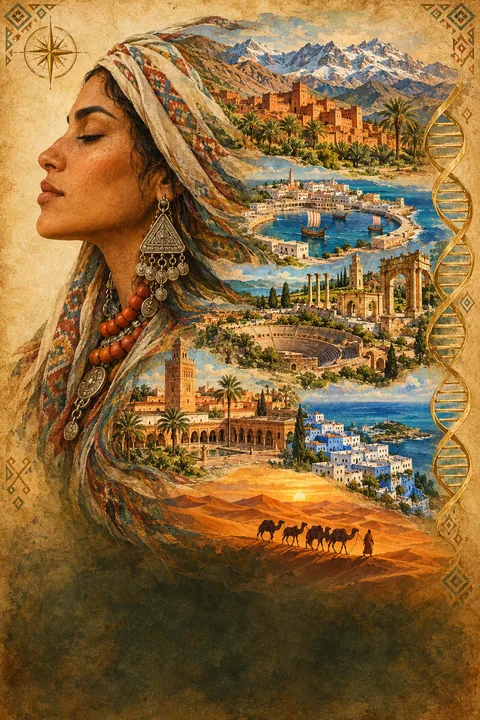
Tamazgha – North African Ancestry Report
Closest modern populations to Libyan
Genetically, the Libyan average sits nearest to Libyan Arab at 0.020, Bedouin (Libya) at 0.020 and Tunisian Arab (Douz) at 0.020. On our scale, a distance of 0.020 counts as very close. Leaving aside the other regional samples listed under the same name in the G25 sheet, the nearest other populations are Bedouin (Libya) (0.020), Tunisian Arab (Douz) (0.020) and Bedouin (Algeria) (0.024). By the tenth closest (Tunisian (Douz)) the distance grows to 0.031, a common pattern for a population that shares ancestry with its neighbours while keeping a profile of its own.
| # | Population | Distance | Closeness |
|---|---|---|---|
| 1 | Libyan Arab | 0.0195 | Very close |
| 2 | Bedouin (Libya) | 0.0200 | Very close |
| 3 | Tunisian Arab (Douz) | 0.0203 | Very close |
| 4 | Bedouin (Algeria) | 0.0238 | Very close |
| 5 | Berber (Egypt Hawwara) | 0.0249 | Very close |
| 6 | Berber (Tunisia Sen) | 0.0270 | Close |
| 7 | Libyan Arab (Tripoli) | 0.0283 | Close |
| 8 | Tunisian | 0.0284 | Close |
| 9 | Tunisian Arab (Tunis) | 0.0297 | Close |
| 10 | Tunisian (Douz) | 0.0307 | Close |
Distances are Euclidean distances between averaged G25 coordinates. On our scale, below 0.025 is very close, below 0.050 close, below 0.080 moderate, and beyond that distant.
Closest ancient populations to Libyan
Among ancient genomes, the closest match to the modern Libyan average is Austria Roman Empire Wels (North African Profile) (Roman era, c. 1-400 AD), at 0.052, followed by Canary Islands Late Antiquity Guanche and Spain Valencia Early Modern (North African Profile). That is only a moderate match: part of the modern profile was already present then, but later movements of people added substantial layers. A close ancient match is not proof of direct descent: it means those individuals carried a similar overall mix of ancestry.
| # | Ancient sample or group | Period | Distance |
|---|---|---|---|
| 1 | Austria Roman Empire Wels (North African Profile) | Roman era, c. 1-400 AD | 0.0519 |
| 2 | Canary Islands Late Antiquity Guanche | Late Antiquity, c. 250-600 AD | 0.0649 |
| 3 | Spain Valencia Early Modern (North African Profile) | Early Modern, c. 1500-1800 AD | 0.0654 |
| 4 | Canary Islands Guanche | Pre-Hispanic Canary Islands, before c. 1500 AD | 0.0668 |
| 5 | Canary Islands Late Medieval Guanche | Late Medieval, c. 1300-1500 AD | 0.0674 |
| 6 | Canary Islands High-Late Medieval Guanche | High to Late Medieval, c. 1000-1500 AD | 0.0689 |
| 7 | Canary Islands Early Medieval Guanche | Early Medieval, c. 500-1000 AD | 0.0700 |
| 8 | Canary Islands High Medieval Guanche | High Medieval, c. 1000-1300 AD | 0.0713 |
| 9 | France Late Antiquity-Early Medieval Chausse Saint-Pierre (North African Profile) | Late Antiquity to Early Medieval, c. 250-1000 AD | 0.0739 |
| 10 | Canary Islands Late Medieval-Early Modern Guanche | Late Medieval to Early Modern, c. 1300-1800 AD | 0.0802 |
Ancient DNA from Libya
Our ancient DNA database holds 3 individuals excavated in present-day Libya, dated from about 5,027 BC to 4,465 BC. The most frequent mtDNA haplogroups among them are N (2). These are people who lived on the same land in the past, not necessarily ancestors of today's Libyan population.
Most frequent mtDNA haplogroups
| Haplogroup | Individuals | Examples |
|---|---|---|
| N | 2 |
Browse them in our ancient DNA database: 3 from Libya.
Compare yourself with Libyan
Paste your G25 coordinates (scaled, one line, with or without a name in front) and we compute your genetic distance to the Libyan average and to its closest neighbours, right in your browser. Nothing is uploaded or stored.
| # | Population | Your distance | Closeness |
|---|
This list only covers Libyan and its neighbours. To find out which of our reports actually fits your DNA, run the free Report Finder: it runs the same fit test that every report uses before an order.
No G25 coordinates yet? Get a free simulated G25 from your raw DNA file, or order G25 coordinates.
About these numbers
Keep in mind that a population average is a statistical summary of a limited number of sampled individuals. Real people inside any group vary, some carry more of one ancestry and some less, and no genetic profile decides who is or is not Libyan. Use these numbers as a map of deep ancestry, not as a label.
Method: averaged G25 coordinates, Euclidean distances to other modern and ancient averages, and a non-negative least-squares model against deep ancestral reference populations (data generated 2026-10-01). Read the full method.
Go deeper than the average
This page describes the Libyan average. Your own DNA has its own story: Tamazgha – North African Ancestry Report (15€) models your genome against the ancient sources and modern communities of the region, era by era, in a personal PDF report.
A report built for people with roots in North Africa: ancient regional core (Iberomaurusian and Taforalt, Neolithic farmers and Green Sahara herders, Numidians and Libyan natives, Carthage, Roman Africa, Vandal and Byzantine Africa, the...
More populations from North Africa
Frequently asked questions
What is the ancient genetic make-up of Libyan?
Modelled with deep ancestral reference populations, the Libyan average is about 27.3% Natufian hunter-gatherers (Levant), 17.1% Levantine Neolithic farmers and 15.1% Anatolian Neolithic farmers. These proportions are model estimates for a group average, not exact values for any one person.
Which populations are genetically closest to Libyan?
Leaving aside other regional samples listed under the same name in the G25 sheet (such as Libyan Arab), the closest modern populations to the Libyan average are Bedouin (Libya), Tunisian Arab (Douz) and Bedouin (Algeria). The closest ancient matches are Austria Roman Empire Wels (North African Profile), Canary Islands Late Antiquity Guanche and Spain Valencia Early Modern (North African Profile).
Can a DNA test tell me if I am Libyan?
No DNA test can confirm an ethnicity or a nationality. What DNA can show is how similar your genome is to the sampled Libyan average and to its neighbours. If you have G25 coordinates, paste them in the comparison box on this page to check that for free.
Which ExploreYourDNA report suits Libyan ancestry?
For the Libyan average, the regional report to choose is Tamazgha – North African Ancestry Report, which our fit test rates as an excellent match. Your own DNA may differ from the average, so the free Report Finder checks every report against your file before you buy.
Where does the data on this page come from?
From the averaged Global25 (G25) coordinates of the sampled individuals: genetic distances to other modern and ancient population averages, and a non-negative least-squares model against deep ancestral reference populations. The full method is described at https://www.exploreyourdna.com/populations#method.