
Jat (Haryana) DNA
Genetic origins and closest populations · India · South Asia
Jats are a large, traditionally farming community of the northwestern plains of South Asia, in Haryana, Punjab, Rajasthan and western Uttar Pradesh in India and in Punjab and Sindh in Pakistan, and they follow Hindu, Sikh and Muslim traditions. This page uses the Haryana average. Its most striking feature is the size of the steppe-related share: at 36.4%, steppe herders (Yamnaya) form the largest single component, just ahead of South Asian hunter-gatherer related ancestry (35.1%, Irula proxy), with Iranian Neolithic farmers at 20.1% and Anatolian Neolithic farmers at 7.3%. That is about twice the steppe share of our Punjabi (Pakistan) average. Steppe-related ancestry reached South Asia in the second millennium BC and is strongest in the northwest. The closest modern averages are other Jat samples, from Haryana, Punjab (Sikh), Uttar Pradesh and Rajasthan, together with the Ror, so Jats cluster together across religious lines. The closest ancient groups are medieval people from Barikot in the Swat valley (distance 0.0428).
- Largest ancient components in our model: Steppe herders (Yamnaya) 36.4%, South Asian hunter-gatherer related (Irula proxy) 35.1%, Iranian Neolithic farmers 20.1%
- Closest modern population in our data: Haryanvi (Jat), distance 0.0146
- Closest ancient group in our data: Pakistan High Medieval Barikot, distance 0.0428
Jat (Haryana) is one of the 335 modern populations in our population genetics atlas. The numbers on this page describe the average Global25 (G25) genome of the Jat (Haryana) individuals sampled in India, listed in the G25 sheet as "Jat_Haryana". Like every population average, it smooths over a lot of variation between individuals.
Ancient make-up of the Jat (Haryana) average
Modelled as a mix of deep ancestral reference populations, the Jat (Haryana) average comes out as 36.4% Steppe herders (Yamnaya), 35.1% South Asian hunter-gatherer related (Irula proxy) and 20.1% Iranian Neolithic farmers. The Steppe herders (Yamnaya) component reflects the Bronze Age herders of the Pontic-Caspian steppe (Yamnaya and related groups), whose ancestry spread across Europe and into Asia from about 3000 BC. The South Asian hunter-gatherer related (Irula proxy) share (35.1%) reflects the deep hunter-gatherer ancestry of South Asia (Ancient Ancestral South Indians).
Smaller traces of Ancient North Eurasians (under 5%) also appear. At that level they can reflect real minor ancestry, but also simple model noise, so they should not be over-read. The fit is acceptable (fit distance 0.030): treat the proportions as a good approximation rather than exact values. This population was modelled with a global set of reference populations (ancient genomes, plus modern stand-ins where no suitable ancient genome exists), because West Eurasian sources alone cannot describe it.
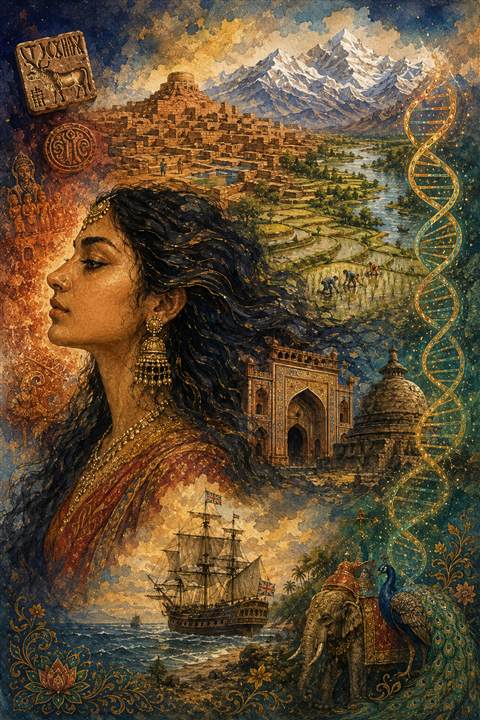
Sindhu – South Asian Report
Closest modern populations to Jat (Haryana)
Genetically, the Jat (Haryana) average sits nearest to Haryanvi (Jat) at 0.015, Ror at 0.017 and Punjabi (Jat Sikh) at 0.018. On our scale, a distance of 0.015 counts as very close. Even the tenth closest, Jat (Punjab Sikh), is only 0.025 away: Jat (Haryana) belongs to a dense cluster of related populations, so small differences inside that cluster should not be over-interpreted.
| # | Population | Distance | Closeness |
|---|---|---|---|
| 1 | Haryanvi (Jat) | 0.0146 | Very close |
| 2 | Ror | 0.0170 | Very close |
| 3 | Punjabi (Jat Sikh) | 0.0184 | Very close |
| 4 | Uttar (Pradeshi Jat Hindu) | 0.0192 | Very close |
| 5 | Jat (Uttar Pradesh) | 0.0193 | Very close |
| 6 | Jatt (Pathak) | 0.0206 | Very close |
| 7 | Rajasthani (Jat) | 0.0212 | Very close |
| 8 | Gujarati (Jat) | 0.0220 | Very close |
| 9 | Uttar (Pradeshi Jat) | 0.0224 | Very close |
| 10 | Jat (Punjab Sikh) | 0.0253 | Close |
Distances are Euclidean distances between averaged G25 coordinates. On our scale, below 0.025 is very close, below 0.050 close, below 0.080 moderate, and beyond that distant.
Closest ancient populations to Jat (Haryana)
Looking back in time, the ancient sample that most resembles the Jat (Haryana) average is Pakistan High Medieval Barikot (High Medieval, c. 1000-1300 AD), at 0.043. Pakistan Late Medieval Barikot and Pakistan HP Saidu Sharif come next. That is a close match: much of the modern profile was already present then, while later movements of people added further layers. A close ancient match is not proof of direct descent: it means those individuals carried a similar overall mix of ancestry.
| # | Ancient sample or group | Period | Distance |
|---|---|---|---|
| 1 | Pakistan High Medieval Barikot | High Medieval, c. 1000-1300 AD | 0.0428 |
| 2 | Pakistan Late Medieval Barikot | Late Medieval, c. 1300-1500 AD | 0.0445 |
| 3 | Pakistan HP Saidu Sharif | Historical period | 0.0468 |
| 4 | Pakistan IA Udegram | Iron Age | 0.0486 |
| 5 | Pakistan IA Gogdara | Iron Age | 0.0505 |
| 6 | Pakistan IA Barikot | Iron Age | 0.0512 |
| 7 | Pakistan IA Katelai | Iron Age | 0.0516 |
| 8 | Pakistan HP Barikot | Historical period | 0.0523 |
| 9 | Pakistan IA Loebanr | Iron Age | 0.0527 |
| 10 | Pakistan Early Modern Singoor | Early Modern, c. 1500-1800 AD | 0.0541 |
Ancient DNA from India
Our ancient DNA database holds 59 individuals excavated in present-day India, dated from about 2,350 BC to 1860 AD. The most frequent Y-DNA haplogroups among them are R2a (4), H1a (3) and J2b (3), and the most frequent mtDNA haplogroups are M3 (6), H1 (4) and U2 (4). These are people who lived on the same land in the past, not necessarily ancestors of today's Jat (Haryana) population.
Most frequent Y-DNA haplogroups
Ancient DNA studies on India
- Blending borders: reconstructing the genetic history of the Sindhi population (2026)
- Blending borders: reconstructing the genetic history of the Sindhi population (2026)
- The Old Lady spider cave skeletons in Ladakh have diverse maternal genetic origin (2026)
- Layers in the sand: The genetic imprint of migration, culture, and Indus craft in the Thar desert (2026)
- Admixture and Genetic Connectivity: Autosomal Insights Into Indo-Aryan Speakers at the Eastern Edge of the Indian Subcontinent (2026)
- Novel 4400-year-old ancestral component in a tribe speaking a Dravidian language (2025)
- Ancient mitogenomes from Neolithic, megalithic and medieval burials suggest complex genetic history of Kashmir valley, India (2025)
- 50,000 years of evolutionary history of India: Impact on health and disease variation (2025)
Browse them in our ancient DNA database: 59 from India.
Compare yourself with Jat (Haryana)
Paste your G25 coordinates (scaled, one line, with or without a name in front) and we compute your genetic distance to the Jat (Haryana) average and to its closest neighbours, right in your browser. Nothing is uploaded or stored.
| # | Population | Your distance | Closeness |
|---|
This list only covers Jat (Haryana) and its neighbours. To find out which of our reports actually fits your DNA, run the free Report Finder: it runs the same fit test that every report uses before an order.
No G25 coordinates yet? Get a free simulated G25 from your raw DNA file, or order G25 coordinates.
About these numbers
Keep in mind that a population average is a statistical summary of a limited number of sampled individuals. Real people inside any group vary, some carry more of one ancestry and some less, and no genetic profile decides who is or is not Jat (Haryana). Use these numbers as a map of deep ancestry, not as a label.
Method: averaged G25 coordinates, Euclidean distances to other modern and ancient averages, and a non-negative least-squares model against deep ancestral reference populations (data generated 2026-10-01). Read the full method.
Go deeper than the average
This page describes the Jat (Haryana) average. Your own DNA has its own story: Sindhu – South Asian Report (15€) models your genome against the ancient sources and modern communities of the region, era by era, in a personal PDF report.
A report built for people of South Asian ancestry: ancient regional core (Indus Valley Civilization, BMAC, Steppe migration, Himalayan Iron Age & Classical layers) versus non-regional outside admixture, across 13 communities (Punjabi...
More populations from South Asia
Frequently asked questions
What is the ancient genetic make-up of Jat (Haryana)?
Modelled with deep ancestral reference populations, the Jat (Haryana) average is about 36.4% Steppe herders (Yamnaya), 35.1% South Asian hunter-gatherer related (Irula proxy) and 20.1% Iranian Neolithic farmers. These proportions are model estimates for a group average, not exact values for any one person.
Which populations are genetically closest to Jat (Haryana)?
In the G25 data, the closest modern populations to the Jat (Haryana) average are Haryanvi (Jat), Ror and Punjabi (Jat Sikh). The closest ancient matches are Pakistan High Medieval Barikot, Pakistan Late Medieval Barikot and Pakistan HP Saidu Sharif.
Can a DNA test tell me if I am Jat (Haryana)?
No DNA test can confirm an ethnicity or a nationality. What DNA can show is how similar your genome is to the sampled Jat (Haryana) average and to its neighbours. If you have G25 coordinates, paste them in the comparison box on this page to check that for free.
Which ExploreYourDNA report suits Jat (Haryana) ancestry?
For the Jat (Haryana) average, the regional report to choose is Sindhu – South Asian Report, which our fit test rates as an excellent match. Your own DNA may differ from the average, so the free Report Finder checks every report against your file before you buy.
Where does the data on this page come from?
From the averaged Global25 (G25) coordinates of the sampled individuals: genetic distances to other modern and ancient population averages, and a non-negative least-squares model against deep ancestral reference populations. The full method is described at https://www.exploreyourdna.com/populations#method.