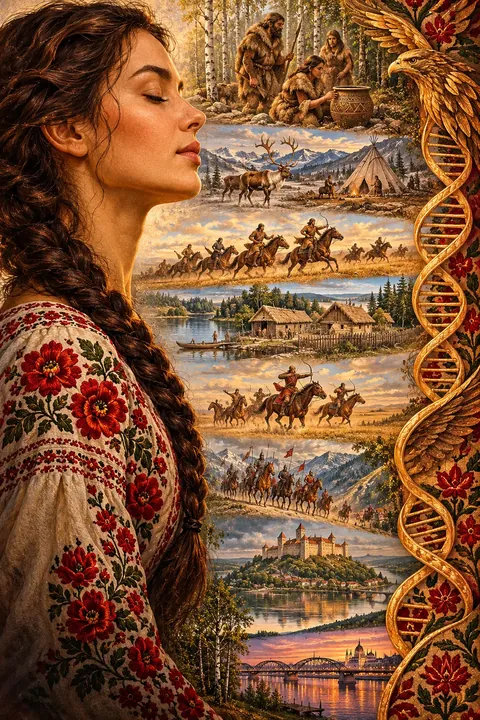
Your DNA is modelled against ancient populations of the Uralic world and the Carpathian Basin, modern community reference populations, and non-regional outside proxies (later layers, Scandinavian, Hun, Avar, Slavic and steppe sources).
Amerindian proxy
Amerindian (North) proxy · Amerindian (South) proxy
Asian host
Central Asian Turkic (Kazakh, Kyrgyz, Nogai)
Bronze Age sources
Bolshoy Oleni Ostrov, Kola Peninsula (c. 1800-1500 BC), the first Siberian-related arrivals in the far north · Carpathian Basin Bronze Age (Mako, Nagyrev, Kisapostag, Vatya, Fuzesabony, Maros, Tumulus and Urnfield; c. 2500-900 BC) · Corded Ware and Fatyanovo, the first steppe-related farmers of the eastern Baltic and the Upper Volga (c. 2900-2300 BC) · Late Bronze Age of the eastern Baltic (Estonia, Latvia, Lithuania; c. 1200-500 BC) · Later layer: medieval Turkic steppe ancestry (Kipchak and Golden Horde), Bronze Age model · Later layer: Siberian-related ancestry of the forest zone (Nganasan-like), Bronze Age model · Mezhovskaya and Maklasheevka, Late Bronze Age forest-steppe of the Urals and the Kama (c. 1300-900 BC) · Scandinavians of the Bronze and Iron Ages (Iron Age Sweden and Norway; non-regional proxy), Bronze Age model · Seima-Turbino-period western Siberia (Satyga, Rostovka; c. 2500-1900 BC) · Sintashta, Srubnaya and Andronovo-horizon herders of the Volga-Ural steppe (c. 2100-1400 BC) · Yoruba Bronze Age proxy (West African)
Deep ancestral sources
Anatolian Neolithic farmer · Ancient North Eurasians (ANE: Mal'ta, Afontova Gora) · Baltic and Danubian hunter-gatherers (Western Hunter-Gatherer-related: Zvejnieki, Kunda, Latvia and Lithuania Mesolithic) · Caucasus Hunter-Gatherer (CHG, Kotias) · Eastern Hunter-Gatherers (EHG: Yuzhniy Oleniy Ostrov in Karelia, Samara, Sidelkino, Minino) · Nganasan-like Siberian stream (Late Neolithic and Bronze Age Yakutia and the Yenisei: Ymyyakhtakh, Kolyma, Tatarka Hill) · Siberian forager stream, Ancient Northeast Asian (Baikal Neolithic: Shamanka, Lokomotiv, Fofonovo, Kitoi) · Steppe pastoralist (Yamnaya, Samara) · Yoruba (West African proxy)
European host
NW European · Scandinavian (Swedish, Norwegian) · West European
Iron Age sources
Ananyino and Pyanobor horizon, Iron Age of the Kama and the Cis-Urals (c. 600 BC - AD 300) · Early Sarmatians of the Southern Urals (Prokhorovka horizon, c. 500-100 BC) · Iron Age Estonia and Ostrobothnia, the Baltic Finnic coast (tarand graves of Estonia, Kaldamaki; c. 650-150 BC) · La Tene Celts of the Carpathian Basin (c. 400-50 BC) · Later layer: medieval Turkic steppe ancestry (Kipchak and Golden Horde), Iron Age model · Later layer: Siberian-related ancestry of the forest zone (Nganasan-like), Iron Age model · Sargatka, Iron Age forest-steppe of western Siberia (c. 500-100 BC) · Scandinavians of the Bronze and Iron Ages (Iron Age Sweden and Norway; non-regional proxy), Iron Age model · Scythian-period Carpathian Basin (Mezocsat, Vekerzug, Scythians of the Great Hungarian Plain; c. 800-300 BC) · Yoruba Iron Age proxy (West African)
Medieval sources
Chiyalik culture of the Cis-Urals (11th-14th c.) · Conquest-period and Arpad-age commoners of the Carpathian Basin (10th-13th c.) · Golden Horde and Kipchak steppe (non-regional proxy) · Historical Sami of Kola and Kuusamo (16th-18th c.) · Hungarian Conquerors of Early Magyar profile (10th c., the incomers nearest the Southern Urals horizon) · Medieval East Slavs (Rus heartland: Smolensk, Pskov, Vologda, Vladimir; non-regional proxy) · Medieval Estonia (11th-15th c.) · Medieval Finland (Tampere and Pirkanmaa, 12th-15th c.) · Medieval Slavs of the Carpathians and the Balkans (Croatia, Slovakia, Galicia; non-regional proxy) · Medieval Volga-Oka Finnic lands (Shekshovo, Gorokhovets, Krasnoe; 9th-13th c.) · Medieval western Siberia (Ust-Ishim on the Irtysh, 11th-17th c.) · Polom and Lomovatovo, early medieval Udmurt and Perm lands (10th c.) · Viking Age and medieval Swedes (Salme in Estonia, Sigtuna; non-regional proxy) · Volga Bulgars (Tatarstan and Ulyanovsk, 10th-13th c.) · Yoruba Medieval proxy (West African)
Migration-period sources
Avar-period Carpathian Basin, local and European profile (568-800) · Avars, Eurasian steppe elite (East Asian and East Asian-mixed profiles, 568-800; non-regional proxy) · Baltic Finnic Migration-period Iron Age (Ostrobothnia and Ingria, AD 40-480) · Early medieval western Siberia (Nizhneobskaya, Potchevash; 4th-9th c.) · Gepids and Lombards, Germanic-period Carpathian Basin (5th-6th c.) · Hun-period Carpathian Basin, local profile (5th c.) · Huns and steppe nomads (steppe and East Asian-mixed profiles, 5th c.; non-regional proxy) · Kushnarenkovo and Karayakupovo, early medieval Southern Urals (6th-9th c.), the proposed Magyar ancestral horizon · Levanluhta, Iron Age western Finland (c. AD 550), Sami-related profile · Nevolino and Bolshie Tigany, forest-steppe of the Kama and Perm (6th-9th c.) · Scandinavians of the Bronze and Iron Ages (Iron Age Sweden and Norway; non-regional proxy), Migration-period model · Yoruba Late Antiquity proxy (West African)
Modern Uralic and Volga communities
Bashkir · Chuvash · Eastern Finnish (East and Southeast Finland, Savo and Finnish Karelia) · Estonian · Hungarian · Karelian and Veps · Komi · Mari · Mordvin (Erzya and Moksha) · Ob-Ugric (Mansi and Khanty) · Sami (Norway, Sweden, Finland and Kola) · Udmurt and Besermyan · Volga Tatar (Kazan and Mishar) · Western Finnish (Southwest, Central and North Finland)
Neolithic and Copper Age sources
Carpathian Basin farmers of the Neolithic and Copper Age (Koros, Starcevo, Alfold Linear Pottery, Tisza, Lengyel, Tiszapolgar, Baden; c. 6000-2800 BC) · Corded Ware of the eastern Baltic and Fatyanovo, the Final Neolithic arrival of steppe-related farmers (c. 2900-2300 BC) · Forest hunter-gatherers of the Upper Volga and the Kama (Lyalovo, Volosovo, Murzikha; c. 5000-2800 BC) · Later layer: Siberian-related ancestry of the forest zone (Nganasan-like), Neolithic model · Narva and Comb Ceramic hunter-fishers of the eastern Baltic (Estonia, Latvia, Lithuania; c. 5000-3200 BC) · West Siberian forest hunter-gatherers (Comb-Pit Ware of the Irtysh and the Ob; c. 4500-2800 BC) · Yamnaya herders of the Volga-Ural steppe and the Great Hungarian Plain (Samara, Orenburg, Chelyabinsk, Hungary; c. 3300-2600 BC) · Yoruba Neolithic proxy (West African)
Proxies for ancestry from outside the region (mixed profiles only)
Armenian proxy (modern; non-regional proxy for ancestry from outside the region) · Ashkenazi Jewish proxy (modern; non-regional proxy for ancestry from outside the region) · Levantine proxy (modern Lebanese Christian; non-regional proxy for ancestry from outside the region) · North Caucasian proxy (modern Circassian; non-regional proxy for ancestry from outside the region) · South-eastern European proxy (modern Balkan and Aegean; non-regional proxy for ancestry from outside the region) · South-western European proxy (modern Iberian; non-regional proxy for ancestry from outside the region) · Southern European proxy (modern Italian; non-regional proxy for ancestry from outside the region)
Roman-era sources
Baltic Finnic Roman Iron Age (Ingria and Ostrobothnia, AD 40-480) · Late Sargatka of the Tobol and the Irtysh (c. 100 BC - AD 300) · Later layer: medieval Turkic steppe ancestry (Kipchak and Golden Horde), Roman-era model · Later layer: Siberian-related ancestry of the forest zone (Nganasan-like), Roman-era model · Mazunino culture of the Kama and the Belaya (c. AD 200-500) · Roman Pannonia and the Danube frontier (Mursa, Klosterneuburg; 1st-4th c.) · Sarmatian-period Great Hungarian Plain (Iazyges and the local population, c. AD 100-400) · Sarmatians of the Volga and the Pontic-Caspian steppe (c. 100 BC - AD 400) · Scandinavians of the Bronze and Iron Ages (Iron Age Sweden and Norway; non-regional proxy), Roman-era model · Yoruba Classical proxy (West African)