🌾 New report · Balto-Slavic

Sarmatia

Your Balto-Slavic Roots

For people from Eastern and Central-Eastern Europe. We model your DNA against the ancient regional core (Corded Ware, Scythians and Sarmatians, Przeworsk and Chernyakhiv, the Early Slavs, Kievan Rus, the Baltic peoples) and non-regional outside admixture, then show which of 7 communities you most resemble, with an AI narrative.

  • 🏺 Ancient regional core (Corded Ware, Scythians, Sarmatians, Early Slavs)
  • 🌍 Non-regional layer (Caucasus, Central Asia, Golden Horde, Finnic)
  • 🌾 7 Balto-Slavic communities compared directly
  • 🧬 Y-DNA & mtDNA haplogroup classification
  • 📊 Deep / Neolithic / Bronze / Iron / Classical / Medieval breakdowns
  • 🤖 Results interpreted by Claude AI
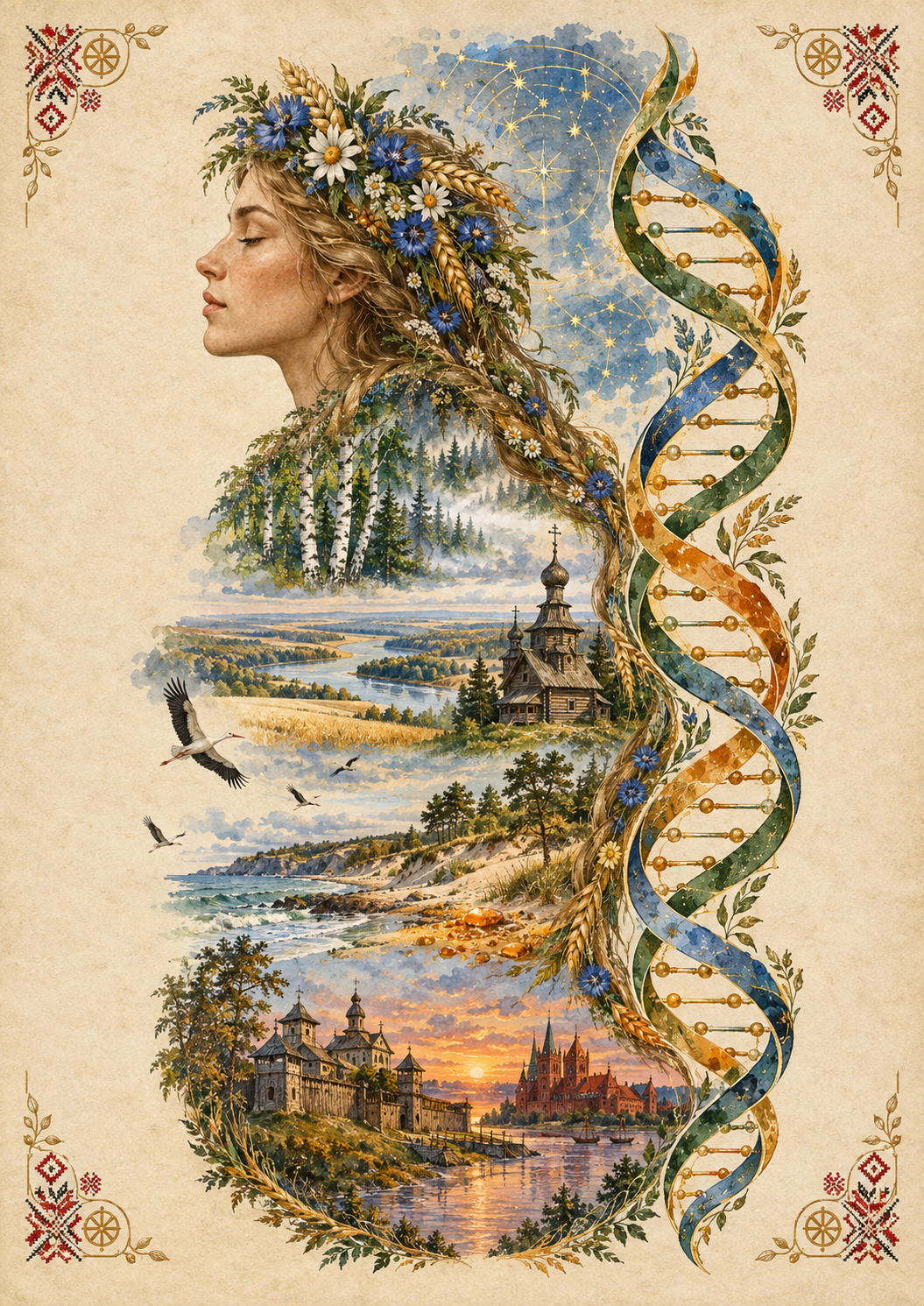
Sarmatia report cover
⚠️ Designed for people from Eastern and Central-Eastern Europe, of predominantly Balto-Slavic ancestry. Works for any of the 7 communities: Russian, Ukrainian, Belarusian, Polish, Czech and Slovak, Lithuanian and Latvian. If your roots are South Slavic (Serbian, Croatian, Bulgarian...) our Balkan Frontier report fits you better; if you are mostly of other ancestry, the fit will be poor and our Advanced Ancestry Report is a better choice. Not sure? The free Report Finder tells you.

1. Choose your community

Pick the community your family belongs to. Not sure? Choose "Let the model decide" and we compare you to every community automatically.

Russian

Russia, the East Slavic heartland of the Rus, with a Finnic and Volga-Turkic substrate in the north and east and a steppe and Caucasus frontier in the south

Ukrainian

Ukraine, the Kievan Rus core on the Pontic steppe frontier, layered over Trypillian, Scythian and Sarmatian ancestors

Belarusian

Belarus, an East Slavic population layered over an older Baltic substrate, at the forest crossroads between Poland, Lithuania and Russia

Polish

Poland, the West Slavic heartland with Lusatian, Przeworsk and Wielbark predecessors and a strong Baltic border

Czech and Slovak

Czechia, Slovakia and Lusatia, the West Slavic Central European belt, with a Celtic and Germanic older substrate

Lithuanian

Lithuania, the most conservative Baltic-speaking population, with a strong Corded Ware and hunter-gatherer heritage

Latvian

Latvia, a Baltic population layered with Finnic (Livonian) and Norse Viking Age influence

🔎 Let the model decide (auto)

We detect which community you are genetically closest to.

What your report models

🏺 Neolithic and Bronze Age

Trypillia farmers, Yamnaya and Sredni Stog steppe herders, Globular Amphora and Funnelbeaker, then Corded Ware, Fatyanovo, Trzciniec, Unetice and Lusatian cultures and the Baltic Bronze Age.

⚔️ Iron Age and Classical era

The Scythians and Cimmerians of the Pontic steppe, the Lusatian and Baltic Iron Age, and the Przeworsk, Wielbark and Chernyakhiv cultures of the Roman-period frontier, with the Sarmatians of the steppe.

🏰 Medieval ancestry

The Early Slavs of Czechia and Slovakia, the West and Polabian Slavs, Kievan Rus, the East Slavic heartland, the Norse-Slavic Varangian layer and the Baltic peoples.

🌍 Non-regional outside admixture

Even for people fully from the region, we include Caucasus, Central Asian, Golden Horde and Finnic proxies alongside wider European, East Asian and West African ones, so any real outside ancestry is detected honestly instead of being force-fit onto the wrong regional population.

🌾 Community profile

Which of the 7 Balto-Slavic communities your DNA most closely resembles, modelled directly against each community's modern reference population.

🧬 Y-DNA & mtDNA lineages

If your raw DNA file is available, we classify your paternal and maternal haplogroups in a Balto-Slavic context (e.g. R1a Steppe-born Slavic and Baltic lineages, I2 Eastern European, N Baltic-Finnic).

85 reference populations

Your DNA is modelled against ancient regional proxies, modern community reference populations, and non-regional outside proxies (Caucasus, Central Asia, Golden Horde, Finnic and wider European).

Amerindian proxy

Amerindian (North) proxy · Amerindian (South) proxy

Bronze Age sources

Baltic Bronze Age (Latvia, Lithuania, Estonia) · Corded Ware, Baltic (Lithuania, Latvia, Estonia) (Bronze Age) · Corded Ware, Poland and Czechia (Late Neolithic/Bronze Age) · Fatyanovo, Upper Volga (Bronze Age) · Han Bronze Age proxy (East Asian) · Lusatian Urnfield, Poland (Late Bronze Age) · Srubnaya, Pontic-Volga steppe (Bronze Age) · Trzciniec, Poland (Middle Bronze Age) · Ukraine Middle Bronze Age (Catacomb, Multi-Cordoned Ware, Komarow) · Unetice, Czechia and Poland (Early Bronze Age) · Yoruba Bronze Age proxy (West African)

Classical sources

Baltic Roman Iron Age (Lithuania, Classical) · Caucasus proxy, Circassian/Kabardin (Classical) · Central Asian steppe proxy, Kazakh/Kalmyk (Classical) · Chernyakhiv, Ukraine (Roman period, Classical) · Finnic proxy, Finnish/Karelian/Estonian (Classical) · North Caucasus proxy, Ossetian/Chechen (Classical) · Przeworsk, Poland (Roman period, Classical) · Sarmatian, Pontic-Caspian steppe (Classical) · Wielbark, Poland (Roman period, Classical)

Classical/Roman sources

Han Classical proxy (East Asian) · Imperial Roman Italian (Classical) · Yoruba Classical proxy (West African)

Deep ancestral sources

Anatolian Neolithic farmer · Caucasus Hunter-Gatherer (CHG) · Eastern Hunter-Gatherer (EHG) · Han (East Asian proxy) · Iranian Neolithic farmer · Steppe (Yamnaya) · Western Hunter-Gatherer (WHG) · Yoruba (West African proxy)

European host

Celtic (Ancient Gaul) · NW European · S European · SE European · SW European · West European

Iron Age sources

Baltic Iron Age (Lithuania, Latvia, Estonia) · Caucasus proxy, Circassian/Kabardin (Iron Age) · Central Asian steppe proxy, Kazakh/Kalmyk (Iron Age) · Cimmerian, Pontic steppe (Iron Age) · Finnic proxy, Finnish/Karelian/Estonian (Iron Age) · Hallstatt and La Tene, Czechia (Celtic, Iron Age, non-regional proxy) · Han Iron Age proxy (East Asian) · Lusatian and Pomeranian, Poland (Iron Age) · North Caucasus proxy, Ossetian/Chechen (Iron Age) · Scythian, Ukraine and Pontic steppe (Iron Age) · Yoruba Iron Age proxy (West African)

Medieval sources

Alan and Saltovo-Mayaki, Pontic and Caucasus (Medieval) · Ashkenazi Jewish Medieval proxy · Baltic Viking Age (Latvia, Lithuania) (Medieval) · Caucasus proxy, Circassian/Kabardin (Medieval) · Central Asian steppe proxy, Kazakh/Kalmyk (Medieval) · Cossack, Ukraine (Early Modern, Medieval) · Early Slavs, Czechia and Slovakia (Medieval) · East Slavs, Rus heartland (Smolensk, Pskov, Vologda, Vladimir) (Medieval) · Finnic proxy, Finnish/Karelian/Estonian (Medieval) · Golden Horde and Kipchak steppe proxy (Medieval) · Han Medieval proxy (East Asian) · Kievan Rus, Ukraine (Medieval) · Norse-Slavic Varangian layer, Ladoga and Gnezdovo (Medieval) · North Caucasus proxy, Ossetian/Chechen (Medieval) · Polabian Slavs, Elbe (Medieval) · Volga Turkic proxy, Tatar/Bashkir (Medieval) · West Slavs, Poland (Medieval) · Yoruba Medieval proxy (West African)

Modern Balto-Slavic communities

Belarusian · Czech and Slovak · Latvian · Lithuanian · Polish · Russian · Ukrainian

Neolithic and Eneolithic sources

Baltic hunter-gatherers, Narva and Comb Ceramic (Neolithic) · Dnieper-Donets and Dereivka hunter-gatherers, Ukraine (Neolithic) · Early farmers, LBK and Lengyel, Central Europe (Neolithic) · Funnelbeaker (TRB), Poland and Czechia (Neolithic) · Globular Amphora, Poland and Ukraine (Neolithic) · Han Neolithic proxy (East Asian) · Trypillia, Ukraine (Eneolithic) · Usatove, Ukraine (Eneolithic) · Yamnaya and Sredni Stog, Ukrainian steppe (Eneolithic) · Yoruba Neolithic proxy (West African)

Being honest about the method

🔬 How to read your results (please read)

Your result is computed by genetic similarity (Global25): we place your DNA in a 25-dimension genetic space and find the mixture that best reproduces your profile. Every reference population in our panel uses real, official G25 coordinates (published academic ancient-DNA studies and the official Global25 dataset), none of our reference data is simulated or synthetic.

This is not a national or political determination of identity, and it is not a proof of belonging to any specific community. Fine distinctions between neighbouring communities can overlap in G25 and are best-fit estimates.

Why group these 7 communities in one report? They share the same Balto-Slavic formation story: Corded Ware and steppe ancestry, the Bronze and Iron Age cultures of the Vistula, Dnieper and Baltic lands, the Slavic expansion and the medieval states that followed, with the Baltic peoples preserving the oldest layer.

⚠️ Designed for people from Eastern and Central-Eastern Europe, of predominantly Balto-Slavic ancestry. If you are mostly of other ancestry, the models are calibrated for fully-regional profiles and the fit will be poor.

Get your Sarmatia report

Select your community above, then confirm your email. We send you a secure link to upload your DNA (raw file or G25 coordinates) and generate your personalised report.

Secure checkout after email verification. Your DNA is processed automatically and deleted; no human sees it.

📖 What is raw DNA & G25?

Frequently asked questions

Who is the Sarmatia report for?

It is built for people from Eastern and Central-Eastern Europe of predominantly Balto-Slavic ancestry, across any of 7 communities: Russian, Ukrainian, Belarusian, Polish, Czech and Slovak, Lithuanian and Latvian. If your roots are South Slavic (Serbian, Croatian, Bulgarian...) our Balkan Frontier report fits you better, and for other ancestry the Advanced Ancestry Report works better.

Why group Russians, Poles and Balts in one report?

They share the same deep story: the Corded Ware and steppe expansions, the Scythians and Sarmatians of the Pontic plain, the Przeworsk, Wielbark and Chernyakhiv cultures on the Roman frontier, the Slavic expansion of the early Middle Ages and the Baltic peoples who kept their older forest-zone ancestry the longest.

Not sure it fits me. Can I check first?

Yes. The free Report Finder reads your raw DNA file (or your G25) and tells you honestly whether Sarmatia is a good match for you, before you spend anything.

Do I need to have taken a DNA test already?

Yes. Upload your raw DNA file from 23andMe, AncestryDNA, MyHeritage, FamilyTreeDNA or LivingDNA, or paste your G25 coordinates.

What is the "ancient regional core" in the report?

We model your DNA against the Neolithic and Eneolithic peoples of the region, Corded Ware, Fatyanovo, Trzciniec, Unetice and Lusatian Bronze Age cultures, the Scythians, Sarmatians and Baltic Iron Age, Przeworsk, Wielbark and Chernyakhiv, and the Early Slavs, Kievan Rus, West and Polabian Slavs and Baltic peoples of the Middle Ages.

How much does it cost and what do I get?

€15. A full PDF report with your ancient regional core %, non-regional outside admixture breakdown, period-by-period breakdowns, closest modern community reference populations, Y-DNA and mtDNA haplogroups (if raw file provided), and a narrative interpreted by Claude AI, in the language of your choice.

A DNA report for the Balto-Slavic world

Sarmatia is a G25 ancestry report built specifically for people from Eastern and Central-Eastern Europe. Upload your raw DNA file from 23andMe, AncestryDNA, MyHeritage or FamilyTreeDNA, pick your community, and we model your genome against the ancient regional core plus non-regional outside admixture, era by era, from the Neolithic to the Middle Ages.

Whether you are Russian with a Fatyanovo and Finnic-touched northern past, Ukrainian from the Trypillia, Scythian and Kievan Rus heartland, Belarusian at the Baltic-Slavic frontier, Polish from the Przeworsk, Wielbark and West Slavic lands, Czech or Slovak at the Early Slavic crossroads, Lithuanian or Latvian from the most conservative Baltic populations of Europe: Sarmatia models the specific genetic layers of your region's history.

The report uses the Global25 (G25) system developed by geneticist Davidski, placing your DNA in a 25-dimension genetic space alongside ancient and modern reference populations, all sourced from Davidski's official Global25 datasheets and published ancient-DNA studies.

👁 Sample reports

See two real Sarmatia reports

Full example reports, flip through every page: cover, ancient regional core, period breakdowns, closest communities, and the AI narrative.

PDF

🇵🇱 M. · Polish

89% regional core, a Przeworsk and Polabian Slavic layer, and Polish as the closest community, with Czech and Slovak as its nearest neighbour.

PDF

🇷🇺 V. · Russian

92% regional core and a textbook Baltic and East Slavic borderland signature, sitting between the Lithuanian, Russian and Belarusian communities.

Report
Loading...
Loading report...
Page of -

We use cookies to enhance your experience. By continuing to visit this site you agree to our use of cookies. Learn more

🧭 Find your report
📬 Stay in the loop

New tools and new reports, straight to your inbox. No spam, unsubscribe anytime.