ᚱ New report · Scandinavia

Norrøn

Scandinavia and the Vikings, Era by Era

For people with roots in Denmark, Norway, Sweden, Iceland and the Faroe Islands, and for Scandinavian families abroad. We model your DNA against the ancient regional core (the Funnel Beaker farmers, the Pitted Ware seal hunters and the Battle Axe people, the Nordic Bronze Age, the Iron Age of the bog bodies and the Roman contacts, the Migration and Vendel periods, the Viking Age of Denmark, Norway, Sweden and Iceland, and medieval Scandinavia) and non-regional outside admixture, then show which of 6 communities is your closest reference, with an AI narrative.

  • 🏺 Ancient regional core (first farmers, Pitted Ware, Battle Axe)
  • ⚓ Nordic Bronze Age, Iron Age and the Vendel period
  • 🛡️ Viking Age Denmark, Norway, Sweden and Iceland
  • 🧬 Y-DNA & mtDNA haplogroup classification
  • 📊 7 periods, from the Deep past to the Middle Ages
  • 🤖 Results interpreted by Claude AI, in 10 languages, Norwegian, Swedish, Danish and Icelandic included
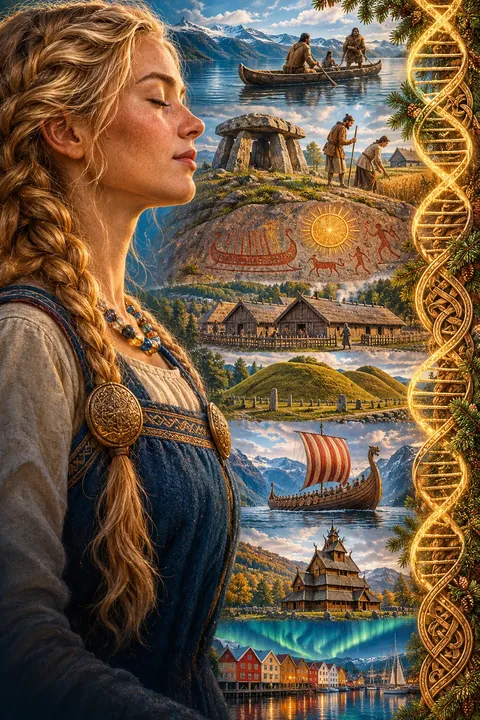
Norrøn report cover
⚠️ Designed for people with roots in Scandinavia. Works for any of the 6 communities, Danish, Norwegian, Swedish, Central Swedish (Dalarna), Icelandic and Faroese, and for Scandinavian families abroad (Norwegian-, Swedish- and Danish-Americans, Icelandic-Canadians, Scandinavian-descended families in Britain, Australia and elsewhere). If your roots are mainly in the Netherlands, Frisia or northern Germany, Nordsee describes the North Sea coast in depth; for Britain and Ireland, Orkney and Shetland included, see Isles, for Germany, Austria and Switzerland Mitteleuropa, for Poland and the Baltic states Sarmatia. If you are mostly of other ancestry, the fit will be poor and our Advanced Ancestry Report is a better choice. Not sure? The free Report Finder tells you.

Who it is for

  • Danes from Jutland, Funen, Zealand and the islands, and families from Scania and the old Danish lands.
  • Norwegians, from the western fjords and Bergen to Trøndelag and the north.
  • Swedes, from Scania and Götaland to the Mälaren valley, Dalarna and Norrland.
  • Icelanders and Faroese, the North Atlantic children of the Viking Age.
  • Diaspora families in the United States (the Midwest above all), Canada, Britain, Australia, New Zealand, Argentina and Brazil whose DNA is mostly Scandinavian.
  • People with one Scandinavian side: the report reads the Scandinavian part of a mixed profile, and says how much of it there is.

1. Choose your community

Pick the community your family comes from. Not sure, or mixed origins (a Norwegian grandfather, a Swedish grandmother)? Choose "Let the model decide" and we compare you to every community automatically. Scandinavian communities are genetically very close to each other, so the result is always a closest reference, never a national or regional call.

Danish

Denmark: Jutland, Funen, Zealand and the smaller islands; the Funnel Beaker farmers and the Single Grave culture, the Nordic Bronze Age, the bog bodies of the Iron Age, the Danish Viking kings, the Danelaw and Normandy; Davidski reference samples

Norwegian

Norway, from the fjords of the west to Trøndelag and the north: the Norse chieftaincies, the Viking Age voyages to the British Isles, the Faroes and Iceland; Davidski reference samples with Bergen in western Norway

Swedish

Sweden, from Scania and Götaland to the Mälaren valley and Norrland: the Pitted Ware and Battle Axe cultures, Vendel and Viking Age Uppland, Birka and Sigtuna, and the eastern Viking routes; Davidski reference samples from unspecified regions

Central Swedish (Dalarna)

Dalarna (Falun) in central Sweden, a mining region with its own old dialects; an average of 48 individuals from a public collection, a closest reference only

Icelandic

Iceland, settled from about AD 870 by Norse settlers, largely from western Norway, and by people of Gaelic ancestry from Ireland and Scotland; Davidski reference samples

Faroese

The Faroe Islands, settled by Norse people in the Viking Age, with Gaelic ties like Iceland; an average of 13 modern individuals from a public collection, a closest reference only

🔎 Let the model decide (auto)

We detect which community you are genetically closest to.

What your report models, era by era

🦴 Deep ancestry

The hunter-gatherers who followed the retreating ice into Scandinavia, from the south (Maglemose, Kongemose, Ertebølle) and from the north-east along the Norwegian coast, the Anatolian farmers and the steppe herders: the prehistoric building blocks of every profile.

🌾 Neolithic

The Funnel Beaker farmers who brought farming and built the dolmens from about 4000 BC, the Pitted Ware seal hunters of Gotland and the Baltic coast, and the Battle Axe and Single Grave people who brought the first steppe ancestry from about 2800 BC.

☀️ Late Neolithic and Bronze Age

The Dagger period and the Nordic Bronze Age of the sun chariot of Trundholm, the rock carvings and the oak-coffin burials, with the Bronze Age of Trøndelag and Nordland, and outside proxies for the Siberian-related ancestry of the far north.

🛡️ Pre-Roman Iron Age

The Iron Age of Jutland and its bog bodies and of the Danish islands, the time of the Hjortspring boat and of the Cimbri and Teutones, with Celtic, British and Baltic proxies.

🏺 Roman Iron Age

Denmark, Scania and Öland, and Norway in the centuries when Roman silver and glass reached Scandinavian chieftains and the first runes were carved, with Roman provincial and Baltic proxies.

⚔️ Migration and Vendel periods

The gold of the age of migrations, the massacre at Sandby borg on Öland, the Vendel boat graves of Uppland and the Salme ship burials of Swedish warriors in Estonia, c. AD 400 to 750, with Sami-related and Baltic proxies.

⛵ Viking Age and Middle Ages

Viking Age Denmark, Norway and Sweden, Iceland's founders with their Norse and Gaelic sides, and medieval Scandinavia, with the Vikings' neighbours (Gaelic, Finnic, Slavic, Sami) and the Hanseatic towns as outside proxies.

🌍 Non-regional outside admixture

Even for people fully from Scandinavia, we include British and Irish, German, Finnic, Sami, Baltic and Slavic, wider European, Sub-Saharan, East Asian and Amerindian proxies, so any real outside ancestry is detected honestly instead of being force-fit onto the wrong regional population.

🧭 Closest communities

Which of the 6 communities your DNA most closely resembles, ranked by distance. Scandinavian communities are very close genetically, so this is a closest reference: near-ties are shown as ties.

🧬 Y-DNA & mtDNA lineages

If your raw DNA file is available, we classify your paternal and maternal haplogroups in a Scandinavian context (e.g. I1, R1a-Z284, R1b-U106, R1b-L21, N1c; maternal H, U5b1, V, U4, K), always as one line among thousands of ancestors.

71 reference populations

Your DNA is modelled against ancient Scandinavian populations, modern community reference populations, and non-regional outside proxies (steppe, Celtic, Roman provincial, Gaelic, Finnic, Sami, Baltic, Slavic and wider European sources).

Amerindian proxy

Amerindian (North) proxy · Amerindian (South) proxy

Deep ancestral sources

Anatolian Neolithic farmer · Eastern Hunter-Gatherer (EHG) · Han (East Asian proxy) · Scandinavian hunter-gatherers (SHG: Mesolithic Sweden and Norway, a western and eastern hunter-gatherer mix, c. 7900-5600 BC) · Steppe pastoralist (Yamnaya, Samara) · Western hunter-gatherers of southern Scandinavia (Maglemose, Kongemose and Ertebølle cultures, Denmark and Scania, c. 8500-4300 BC) · Yoruba (West African proxy)

European host

Baltic and West Slavic (Lithuanian, Latvian, Polish) · British and Irish (English, Scottish, Irish) · Finnic (Finnish, Estonian) · German (continental West Germanic) · S European (Italian) · Sami (modern Saami) · SE European (Balkan and Aegean) · SW European · West European

Late Neolithic and Bronze Age sources

Bronze Age of the eastern Baltic (Estonia, non-regional proxy) · Bronze Age of the Kola Peninsula (Bolshoy Oleny Ostrov, Siberian-related ancestry, non-regional proxy) · Han Bronze Age proxy (East Asian) · Late Neolithic and Bronze Age Norway (Trøndelag and Nordland, c. 2400-1200 BC) · Late Neolithic southern Scandinavia (the Dagger period of Denmark and Sweden, c. 2300-1700 BC) · Nordic Bronze Age of Denmark and southern Sweden (c. 1800-500 BC) · Steppe pastoralist (Yamnaya) outside source · Yoruba Bronze Age proxy (West African)

Migration and Vendel period sources

Baltic Iron Age, Migration period (Lithuania, Latvia, Estonia; non-regional proxy) · Han Late Antiquity proxy (East Asian) · Iron Age Finland, Sami-related (Levänluhta, non-regional proxy) · Migration and Merovingian-period Norway (Trøndelag, Nordland and Troms; Rogaland and Sogn og Fjordane; AD 350-750) · Migration and Vendel-period Sweden (Sandby borg on Öland, Uppland, Gotland, and the Salme ship burials of Swedish warriors, AD 475-750) · Migration-period and Germanic Iron Age Denmark (Zealand, Møn, Funen, Jutland, AD 400-750) · Yoruba Late Antiquity proxy (West African)

Modern Scandinavian communities

Central Swedish (Dalarna) · Danish · Faroese · Icelandic · Norwegian · Swedish

Neolithic sources

Battle Axe and Single Grave cultures (the Corded Ware of Sweden and Denmark, first steppe ancestry, c. 2800-2300 BC) · Funnel Beaker farmers of Denmark and Sweden (TRB, with the megalith builders of Västergötland and Gotland, c. 4000-2800 BC) · Han Neolithic proxy (East Asian) · Pitted Ware hunter-gatherers (Ajvide, Västerbjers and Hemmor on Gotland, and the Swedish mainland, c. 3300-2300 BC) · Steppe pastoralist (Yamnaya), Neolithic outside source · Yoruba Neolithic proxy (West African)

Pre-Roman Iron Age sources

Baltic Iron Age (Lithuania, Latvia, Estonia; non-regional proxy) · Hallstatt and La Tene Celts (Burgundy, Champagne; non-regional proxy) · Han Iron Age proxy (East Asian) · Iron Age Britain (non-regional proxy) · Pre-Roman Iron Age Jutland (with the bog bodies, c. 600 BC - AD 1) · Pre-Roman Iron Age of the Danish islands and Västergötland (Zealand, Funen, Lolland, Falster; Falbygden, c. 500 BC - AD 1) · Yoruba Iron Age proxy (West African)

Roman Iron Age sources

Baltic Roman Iron Age (Lithuania, non-regional proxy) · Han Classical proxy (East Asian) · Roman Gaul and the Danube provinces (non-regional proxy) · Roman Iron Age Denmark (Zealand, Jutland, Funen and Lolland, AD 1-400) · Roman Iron Age Norway (mostly Trøndelag and Nordland; Rogaland, Sogn og Fjordane, Buskerud; AD 1-400) · Roman Iron Age Sweden (Scania and Öland, AD 1-400) · Yoruba Classical proxy (West African)

Viking Age and medieval sources

Gaelic Ireland (Early to High Medieval, non-regional proxy) · Han Medieval proxy (East Asian) · Iceland's founders (pre-Christian and early Christian Iceland, Norse and Gaelic settlers, AD 870-1100) · Medieval Finns and Estonians (Tampere, Estonia, Finnic, non-regional proxy) · Medieval northern Germany (Schleswig and Lübeck, Hanseatic towns, non-regional proxy) · Medieval Scandinavia (Denmark, Sweden and Trondheim, AD 1050-1500) · Sami (Iron Age and historical Sami-related individuals of Finland and Kola, non-regional proxy) · Viking Age Denmark (Jutland, Funen, Langeland, Zealand, AD 750-1050) · Viking Age Norway (AD 750-1100) · Viking Age Sweden (Uppland and the Mälaren valley with Birka and Sigtuna, Östergötland, Gotland, AD 800-1100) · West Slavs of medieval Poland (non-regional proxy) · Yoruba Medieval proxy (West African)
How it works, and its limits

🔬 How to read your results (please read)

Your result is computed by genetic similarity (Global25): we place your DNA in a 25-dimension genetic space and find the mixture of reference populations that best reproduces your profile, era by era. The reference populations use G25 coordinates built from published ancient-DNA studies and modern reference samples; none of our reference data is simulated.

Reference populations are statistical proxies: "Viking Age Norway" or "Iceland's founders" means a few dozen individuals sampled at a handful of sites, not a whole people. A Viking-like percentage is a similarity to those samples, not proof of an ethnicity or of a raider in the family tree. "Norse", "Viking", "Danish", "Swedish" and "Norwegian" are labels of language, culture and history, not genetic categories: there is no Viking DNA.

Genetics is not identity: this report is not a national or political determination. Scandinavian communities are very close in G25 (each about 0.009 to 0.011 from its nearest neighbour), so the closest community is a best-fit reference and not a proven origin. Some periods are sampled unevenly: the Pre-Roman Iron Age almost only in Denmark, and ancient Norway mostly in Trøndelag and the north. The report says so when it matters for you.

Why one report for all of Scandinavia? Danes, Norwegians, Swedes, Icelanders and Faroese share the same story, the first farmers, the Battle Axe people, the Nordic Bronze Age, the Germanic Iron Age and the Viking Age, with their own emphases: more North Sea and continental contacts in the south and west, more eastern Baltic, Finnic and Sami contacts in the east and north, and a Gaelic side in the North Atlantic.

Free check · no email needed

Is Norrøn right for your DNA?

Paste your G25 coordinates or drop your raw DNA file. We run the same fit test as our free Report Finder, for Norrøn only, and show you your verdict, your regional core and your 3 closest communities before you spend anything.

Click or drop your raw DNA file here 23andMe, AncestryDNA, MyHeritage, FTDNA, LivingDNA or a chip VCF (Genotek, Atlas): .txt, .csv, .vcf, .zip or .gz

A raw file takes 1 to 3 minutes: we first estimate your G25 coordinates from it.

🔒 Your file is processed for this check only and immediately deleted.

⚠️ Designed for people with roots in Scandinavia (including Scandinavian families abroad). If you are mostly of other ancestry, the models are calibrated for fully-regional profiles and the fit will be poor.

Get your Norrøn report

Select your community above, then confirm your email. We send you a secure link to upload your DNA (raw file or G25 coordinates) and generate your personalised report.

Secure checkout after email verification. Your DNA is processed automatically and deleted; no human sees it.

📖 What is raw DNA & G25?

Explore these populations in our free Population Genetics Atlas

No DNA file needed. Each free page shows a population's ancient make-up, its closest modern and ancient neighbours, and ancient DNA from the same country when we have some.

See the Northern Europe section of the atlasBrowse the full atlas (335 populations)

Frequently asked questions

Who is the Norrøn report for?

It is built for people with roots in Scandinavia: Denmark, Norway, Sweden (with a Central Swedish reference for Dalarna), Iceland and the Faroe Islands, across 6 communities. Families of Scandinavian descent in North America, Britain, Australia and elsewhere can use it too. For other ancestry the Advanced Ancestry Report works better.

Does it tell me how much Viking DNA I have?

No, and no honest test can: there is no such thing as Viking DNA. A Viking was a raider, trader or settler of the Viking Age, while most Scandinavians of the time were farmers. The report shows how much you resemble the people buried in Viking Age Denmark, Norway, Sweden and Iceland, alongside the farmers, Bronze Age and Iron Age peoples before them, and it never links you to a named king, jarl or saga hero.

Can it tell Danish, Norwegian and Swedish ancestry apart?

Only roughly. Scandinavian populations are very close to each other in G25 (each community about 0.009 to 0.011 from its nearest neighbour), and in our tests only about half of Danes, Norwegians, Swedes and Icelanders came out closest to their own community. The closest community is a closest reference, never a proven origin, and when two or more communities are tied, the report says so.

My ancestors were Norwegian. Why do Danish references appear in my older periods?

Most ancient genomes from Norway come from Trøndelag and the north, where people carried a little more eastern ancestry than most Norwegians today, and the Pre-Roman Iron Age is sampled almost only in Denmark. Modern Norwegians, Icelanders and Faroese often sit closer to the ancient references of southern Scandinavia, across the Skagerrak, so these appear in their pre-Viking periods. The report explains it in the sections concerned: read them as the shared Scandinavian population of the period, not as Danish descent.

Does it detect Sami or Finnish ancestry?

It measures your resemblance to Sami-related, Finnic and Kola Peninsula references, shown as outside ancestry only because the report models the Norse-speaking population of Scandinavia. The Sami are the indigenous people of the north, and Sami and Finnic families have lived beside and married into Norwegian and Swedish ones for centuries: the report treats that ancestry as part of your heritage.

My family is Icelandic or Faroese. Is the Gaelic side included?

Yes. The Viking Age model includes Iceland's founders, built from the genomes of the first Icelanders, who were Norse people, largely from western Norway, and people of Gaelic ancestry from Ireland and Scotland. The report explains both sides, and shows a Gaelic Ireland proxy when your profile needs it.

Not sure it fits me. Can I check first?

Yes. The free Report Finder reads your raw DNA file (or your G25) and tells you honestly whether Norrøn is a good match for you, before you spend anything.

Do I need to have taken a DNA test already?

Yes. Upload your raw DNA file from 23andMe, AncestryDNA, MyHeritage, FamilyTreeDNA or LivingDNA, or paste your G25 coordinates.

How much does it cost and what do I get?

€15. A full PDF report with your ancient regional core %, non-regional outside admixture breakdown, seven period-by-period breakdowns, closest modern community reference populations, Y-DNA and mtDNA haplogroups (if raw file provided), and a narrative interpreted by Claude AI, in English, Norwegian, Swedish, Danish, Icelandic, Finnish, German, Dutch, French or Spanish.

A DNA report for Scandinavian ancestry

Norrøn is a G25 ancestry report built specifically for people with roots in Scandinavia. Upload your raw DNA file from 23andMe, AncestryDNA, MyHeritage or FamilyTreeDNA, pick your community, and we model your genome against the ancient regional core plus non-regional outside admixture, era by era, from the first hunters to the Middle Ages.

Whether your family is Danish, Norwegian or Swedish, from Dalarna, Iceland or the Faroe Islands, or Scandinavian-American, Norrøn models the genetic layers of your region's history, from the Funnel Beaker farmers and the Pitted Ware seal hunters to the Nordic Bronze Age, the Iron Age of the bog bodies, the Vendel period and the Viking Age world that reached from Dublin and Iceland to Kyiv.

The report uses the Global25 (G25) system developed by geneticist Davidski, placing your DNA in a 25-dimension genetic space alongside ancient and modern reference populations built from published ancient-DNA studies.

👁 Sample reports

See three real Norrøn reports

Full example reports, flip through every page: cover, regional core, the seven periods, closest communities and the AI narrative.

PDF

🇳🇴 Norwegian sample

A Norwegian profile: the first farmers and the Battle Axe people, the Nordic Bronze Age, the Iron Age and the Viking Age, with honest notes on how ancient Norway is sampled.

PDF

🇸🇪 Swedish sample

A Swedish profile: the Pitted Ware seal hunters, the Vendel period and the Salme ships, Viking Age Uppland and the closest communities of the east.

PDF

🇩🇰 Danish sample

A Danish profile: the Funnel Beaker farmers, the bog bodies of Jutland, the Roman Iron Age chieftains, Viking Age Denmark and medieval Scandinavia.

Report
Loading...
Loading report...
Page of -

We use cookies to enhance your experience. By continuing to visit this site you agree to our use of cookies. Read our privacy policy

🧭 Find your report
📬 Stay in the loop

New tools and new reports, straight to your inbox. No spam, unsubscribe anytime.