🏝️ New report · British and Irish Isles

Isles

Your British and Irish Roots

For people with roots in England, Cornwall, Wales, Scotland, Orkney and Shetland, Ireland and Northern Ireland, and for British and Irish families abroad. We model your DNA against the ancient regional core (the first farmers, the Beaker arrival, Iron Age Britain, Roman Britain, the post-Roman Britons and the Anglo-Saxon migration period, Viking Age settlers and Gaelic Ireland) and non-regional outside admixture, then show which of 7 communities is your closest reference, with an AI narrative.

  • 🏺 Ancient regional core (Neolithic farmers, the Beaker transition, Iron Age Britain)
  • 🌍 Non-regional layer (Gaulish, Scandinavian, Roman-period and wider European sources)
  • 🏝️ 7 communities of the Isles compared directly
  • 🧬 Y-DNA & mtDNA haplogroup classification
  • 📊 7 periods, from the Deep past to the Middle Ages
  • 🤖 Results interpreted by Claude AI, in 9 languages including Welsh and Irish
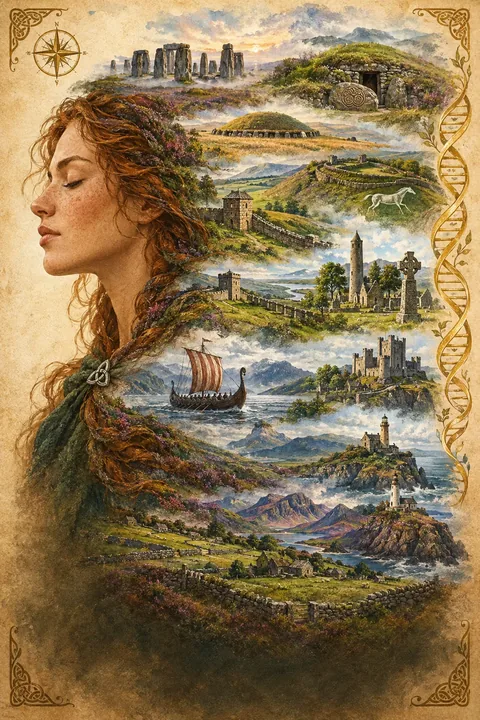
Isles report cover
⚠️ Designed for people with roots in the British and Irish Isles. Works for any of the 7 communities, from Cornwall and Wales to Scotland, Orkney and Shetland, Ireland and Northern Ireland, and for British and Irish families in North America, Australia and elsewhere. If your roots are in the Netherlands, Denmark, Germany or Scandinavia, Nordsee fits better; for France see France Profonde, for Spain and Portugal Hesperia. If you are mostly of other ancestry, the fit will be poor and our Advanced Ancestry Report is a better choice. Not sure? The free Report Finder tells you.

Who it is for

  • English families from any county, with their layers of Roman Britain, the Anglo-Saxon period, Vikings and Normans.
  • Welsh and Cornish families, where Brittonic languages survived the longest.
  • Scots of the Highlands, the Lowlands and the old Pictish east.
  • Orcadians and Shetlanders, where an Insular Celtic base meets Norse settlement.
  • Irish families, in the Republic and in Northern Ireland, including Ulster-Scots.
  • Diaspora families in the United States, Canada, Australia and New Zealand whose DNA is mostly British or Irish.

1. Choose your community

Pick the community your family comes from. Not sure, or mixed origins? Choose "Let the model decide" and we compare you to every community automatically. The communities of the Isles are genetically very close to each other, so the result is always a closest reference, never a county call.

English

England, with a reference sample from many counties: Iron Age and Roman-period Britons overlaid by the Anglo-Saxon migration of the 5th to 7th centuries, then Viking Age settlement in the north and east and the Norman conquest; published studies estimate that the continental contribution varies by region

Cornish

Cornwall, the south-western peninsula where a Brittonic language survived into the 18th century, whose reference sample sits very close to the English one

Welsh

Wales, where Brittonic speech continued without a break, and where published studies find less Anglo-Saxon-period continental ancestry than in eastern England

Scottish (mainland, Lowlands and Highlands)

mainland Scotland, from the Gaelic Highlands and the old Pictish east to the Brittonic and Anglian south, with Norse settlement along the western seaboard

Northern Isles (Orkney and Shetland)

Orkney and Shetland, an Insular Celtic and Pictish base over which Norse settlement from the 9th century brought a Scandinavian-related component, known from the Norse language of the islands that lasted until the 18th century

Irish

the island of Ireland as a whole, Gaelic since the Iron Age and the early medieval period, with Atlantic Bronze Age roots, Viking Age towns such as Dublin and, much later, the Norman and English settlements

Ulster (Northern Ireland, Irish and Ulster-Scots)

Northern Ireland, with Gaelic Irish roots and the Ulster-Scots whose forebears came from Scotland in the 17th century (a very small reference sample)

🔎 Let the model decide (auto)

We detect which community you are genetically closest to.

What your report models, era by era

🦴 Deep ancestry

The Mesolithic hunter-gatherers of Britain and Ireland (the Cheddar Man type), Western Hunter-Gatherers, Anatolian and Iranian farmers and steppe herders: the prehistoric building blocks of every profile.

🌾 Neolithic

The farmers who reached Britain around 4000 BC with Anatolian-derived ancestry, and the megalith builders of Orkney, Hazleton North and Newgrange, modelled as one merged reference.

⚱️ Bronze Age

The Beaker transition from about 2450 BC, which brought steppe-rich ancestry and replaced most of Britain's earlier ancestry, the Irish Early Bronze Age (two individuals from Rathlin Island), Middle and Late Bronze Age gene flow from France, and Orkney.

🛡️ Iron Age

Iron Age England and Wales and Iron Age Scotland. No Iron Age genomes exist from Ireland, so the report says plainly that Irish ancestry has a data gap between the Early Bronze Age and the early medieval period.

🏛️ Roman Britain

The Romano-Britons of Durotriges, York and Winchester, with Italian, North African and Levantine proxies for the people who moved within the Empire. Roman Britain was diverse, yet the great majority of sampled Romano-Britons are local.

⚔️ Late Antiquity

The post-Roman and Brittonic-profile Britons and the Early Anglo-Saxon population of England, c. AD 300 to 700. These cemeteries sit extremely close to their continental North Sea homelands, so the model cannot separate migrants from their descendants, and says so.

🛶 Medieval

Middle Saxon England, Viking Age settlers in England and Ireland (many of them born in Scandinavia), the Pictish and Norse world of Orkney and the Isle of Man, Gaelic Ireland and High Medieval England, with Danish and Norwegian Viking Age proxies.

🌍 Non-regional outside admixture

Even for people fully from the Isles, we include Gaulish, Danish, Norwegian, Roman-period, wider European, Sub-Saharan, East Asian and Amerindian proxies, so any real outside ancestry is detected honestly instead of being force-fit onto the wrong regional population.

🏝️ Closest communities

Which of the 7 communities your DNA most closely resembles, ranked by distance. They are close genetically, so this is a closest reference: near-ties are shown as ties.

🧬 Y-DNA & mtDNA lineages

If your raw DNA file is available, we classify your paternal and maternal haplogroups in a British and Irish context (e.g. R1b-L21, R1b-U106, I1, I2a1; maternal H, U5, J, T2, X2b), always as one line among many ancestors.

64 reference populations

Your DNA is modelled against ancient regional proxies, modern community reference populations, and non-regional outside proxies (Gaulish, Scandinavian, Roman-period and wider European).

Amerindian proxy

Amerindian (North) proxy · Amerindian (South) proxy

Bronze Age sources

Beaker-period Britain, arrival of steppe ancestry (England, Scotland and Wales, c. 2500-1800 BC) · Bell Beaker, Central Europe (Germany) · Bell Beaker, France · Han Bronze Age proxy (East Asian) · Irish Early Bronze Age (Rathlin Island) · Middle and Late Bronze Age Britain (Cranborne Chase era, new gene flow from France) · Orkney Bronze Age · Steppe pastoralist (Yamnaya) outside source · Yoruba Bronze Age proxy (West African)

Classical/Roman sources

Celtic Gaul (Classical, non-regional proxy) · Han Classical proxy (East Asian) · Imperial Roman Italian (Classical) · Roman Britain, Romano-Britons (Durotriges, York, Winchester) · Roman Levant (Classical) · Roman North Africa, Numido-Roman Berber (Sitifis, Mauretania) · Yoruba Classical proxy (West African)

Deep ancestral sources

Anatolian Neolithic farmer · British and Irish Mesolithic hunter-gatherer (Cheddar Man, Kendrick's Cave, Wales, Ireland) · Caucasus Hunter-Gatherer (CHG, Kotias) · Eastern Hunter-Gatherer (EHG) · Han (East Asian proxy) · Iranian Neolithic farmer (Ganj Dareh) · Steppe pastoralist (Yamnaya, Samara) · Western Hunter-Gatherer (WHG, Villabruna) · Yoruba (West African proxy)

European host

S European (Italian) · SE European (Balkan and Aegean)

Iron Age sources

Celtic Gaul (Iron Age, non-regional proxy) · Danish Iron Age (non-regional proxy) · England and Wales Iron Age (Wessex, Durotriges, Kent, East Yorkshire Arras culture, Wales) · Gaulish, Belgic Gaul (Iron Age, non-regional proxy) · Han Iron Age proxy (East Asian) · Scottish Iron Age (brochs, Orkney, Hebrides) · Yoruba Iron Age proxy (West African)

Late Antiquity sources

Early Anglo-Saxon England (Dover Buckland, West Heslerton, Oakington, Lakenheath, 5th-7th c.; largely continental North Sea ancestry) · Han Late Antiquity proxy (East Asian) · Late Antique Italy (non-regional proxy) · Post-Roman and Brittonic-profile Britons (England, 4th-9th c.) · Roman-period North Africa, Numido-Roman Berber (non-regional proxy) · Yoruba Late Antiquity proxy (West African)

Medieval sources

Anglo-Saxon England, middle Saxon cemeteries (Sedgeford, Norton, Polhill, Rookery Hill, Hollow Banks, 7th-11th c.) · Danish Viking Age (non-regional proxy) · Gaelic Ireland (Kilteasheen and Ballyhanna, Early to High Medieval) · Han Medieval proxy (East Asian) · High Medieval to early modern England (Cambridge, Lincoln, East Anglia, 17th-century Maryland colonists) · Medieval Jews of Norwich (Tzarfati, 12th c., non-regional proxy) · Norwegian Viking Age (non-regional proxy) · Orkney and the Isle of Man, Pictish and Viking Age (Scotland and Man, Insular Celtic and Norse mix) · Viking Age England and Ireland (Oxford, Ridgeway Hill, Dublin, Norse profile) · Yoruba Medieval proxy (West African)

Modern British and Irish communities

Cornish · English · Irish · Northern Isles (Orkney and Shetland) · Scottish (mainland, Lowlands and Highlands) · Ulster (Northern Ireland, Irish and Ulster-Scots) · Welsh

Neolithic and Chalcolithic sources

Anatolian Neolithic farmer (outside source) · Corded Ware, Central Europe (Late Neolithic, steppe-related, non-regional proxy) · Han Neolithic proxy (East Asian) · Neolithic farmers of Britain and Ireland (Hazleton North, Orkney, Newgrange, Ballynahatty, megalith builders) · Yoruba Neolithic proxy (West African)
How it works, and its limits

🔬 How to read your results (please read)

Your result is computed by genetic similarity (Global25): we place your DNA in a 25-dimension genetic space and find the mixture of reference populations that best reproduces your profile, era by era. The reference populations use G25 coordinates built from published ancient-DNA studies and modern reference samples; none of our reference data is simulated.

Reference populations are statistical proxies: "Early Anglo-Saxon England" or "Viking Age England and Ireland" means a few hundred individuals sampled at a handful of sites, not a whole people. A Viking-like or Anglo-Saxon-like percentage is a similarity to those samples, not proof of an ethnicity or a specific ancestor. "Celtic" is a language and culture label, not a genetic category, and the report does not give a Celtic versus Anglo-Saxon percentage.

Genetics is not identity: this report is not a national, regional or political determination. The seven communities are very close in G25 (typically 0.005 to 0.019 apart), so the closest community is a best-fit reference and not a precise origin.

Why group these 7 communities in one report? They share the same formation story: Neolithic farmers, the Beaker steppe arrival, Iron Age Britain, Rome in the south, the post-Roman world, the Anglo-Saxon and Viking Ages and Gaelic Ireland, with their own regional emphases.

Free check · no email needed

Is Isles right for your DNA?

Paste your G25 coordinates or drop your raw DNA file. We run the same fit test as our free Report Finder, for Isles only, and show you your verdict, your regional core and your 3 closest communities before you spend anything.

Click or drop your raw DNA file here 23andMe, AncestryDNA, MyHeritage, FTDNA, LivingDNA or a chip VCF (Genotek, Atlas): .txt, .csv, .vcf, .zip or .gz

A raw file takes 1 to 3 minutes: we first estimate your G25 coordinates from it.

🔒 Your file is processed for this check only and immediately deleted.

⚠️ Designed for people with roots in the British and Irish Isles (including British and Irish families abroad). If you are mostly of other ancestry, the models are calibrated for fully-regional profiles and the fit will be poor.

Get your Isles report

Select your community above, then confirm your email. We send you a secure link to upload your DNA (raw file or G25 coordinates) and generate your personalised report.

Secure checkout after email verification. Your DNA is processed automatically and deleted; no human sees it.

📖 What is raw DNA & G25?

Explore these populations in our free Population Genetics Atlas

No DNA file needed. Each free page shows a population's ancient make-up, its closest modern and ancient neighbours, and ancient DNA from the same country when we have some.

See the Northern Europe section of the atlasBrowse the full atlas (335 populations)

Frequently asked questions

Who is the Isles report for?

It is built for people with roots in the British and Irish Isles: England, Cornwall, Wales, Scotland, Orkney and Shetland, Ireland and Northern Ireland, across 7 communities. British and Irish families in North America, Australia and elsewhere can use it too. For other ancestry the Advanced Ancestry Report works better.

Does it tell me how Celtic or how Anglo-Saxon I am?

No, and no honest test can. "Celtic" is a language and culture label, not a genetic one, and the Anglo-Saxon cemeteries sit extremely close to their continental North Sea homelands in G25, so one profile cannot separate migrants from their descendants. The report shows which period populations of the Isles you resemble, and says plainly where the data cannot go further.

Can it detect Viking ancestry?

It measures your resemblance to Viking Age individuals buried in England and Ireland, many of them born in Scandinavia, and to Danish and Norwegian Viking Age proxies. A share is compatible with Viking, Danelaw or later Scandinavian ancestry, but the Anglo-Saxons were themselves close to Scandinavians, so it is a resemblance and never proof of a Viking ancestor.

I am Irish. What about the Iron Age?

No Iron Age genomes have been published from Ireland, so there is a data gap between the Early Bronze Age (two individuals from Rathlin Island) and the early medieval period (Kilteasheen and Ballyhanna). The report states this clearly and never invents an Irish Iron Age result.

How precise is the community match?

The seven communities are genetically very close to each other, so the closest community is a closest reference and not a precise origin or a county call. When two or more communities are tied, the report says so.

Not sure it fits me. Can I check first?

Yes. The free Report Finder reads your raw DNA file (or your G25) and tells you honestly whether Isles is a good match for you, before you spend anything.

Do I need to have taken a DNA test already?

Yes. Upload your raw DNA file from 23andMe, AncestryDNA, MyHeritage, FamilyTreeDNA or LivingDNA, or paste your G25 coordinates.

How much does it cost and what do I get?

€15. A full PDF report with your ancient regional core %, non-regional outside admixture breakdown, seven period-by-period breakdowns, closest modern community reference populations, Y-DNA and mtDNA haplogroups (if raw file provided), and a narrative interpreted by Claude AI, in English, French, Spanish, German, Dutch, Italian, Portuguese, Welsh or Irish.

A DNA report for British and Irish ancestry

Isles is a G25 ancestry report built specifically for people with roots in the British and Irish Isles. Upload your raw DNA file from 23andMe, AncestryDNA, MyHeritage or FamilyTreeDNA, pick your community, and we model your genome against the ancient regional core plus non-regional outside admixture, era by era, from the first hunters to the Middle Ages.

Whether you are English, Welsh or Cornish from the old Brittonic west, Scottish from the Highlands or the Lowlands, Orcadian or Shetlander with a Norse layer, or Irish from the Gaelic world, Isles models the specific genetic layers of your region's history, from Neolithic farmers and the Beaker transition to Roman Britain, the Anglo-Saxon and Viking Ages and Gaelic Ireland.

The report uses the Global25 (G25) system developed by geneticist Davidski, placing your DNA in a 25-dimension genetic space alongside ancient and modern reference populations built from published ancient-DNA studies.

👁 Sample reports

See three real Isles reports

Full example reports, flip through every page: cover, regional core, the seven periods, closest communities and the AI narrative.

PDF

🏴󠁧󠁢󠁷󠁬󠁳󠁿 Welsh sample

A Welsh profile: 100% British and Irish regional core, the old Brittonic west from the first farmers to the Middle Ages, and Welsh as the closest community.

PDF

🇮🇪 Irish sample

An Irish profile: the Gaelic and Norse layers of medieval Ireland, the honest data gap of the Irish Iron Age, and Irish as the closest community.

PDF

🏴󠁧󠁢󠁳󠁣󠁴󠁿 Scottish sample

A Scottish profile: Iron Age brochs, the Picts and the Norse of Orkney, and a near tie between the Scottish and Northern Isles communities.

Report
Loading...
Loading report...
Page of -

We use cookies to enhance your experience. By continuing to visit this site you agree to our use of cookies. Learn more

🧭 Find your report
📬 Stay in the loop

New tools and new reports, straight to your inbox. No spam, unsubscribe anytime.