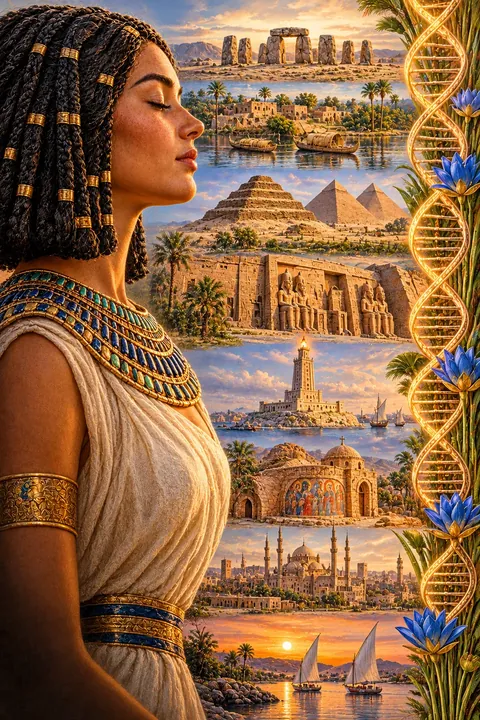
🦴 Deep ancestry
The Natufian hunter-gatherers of the Levant, the Iberomaurusians of Taforalt in Morocco, the Anatolian and Iranian farmers with the Caucasus hunter-gatherers, and on the African side the forager genome of Mota in Ethiopia and the Nilotic reference: the prehistoric building blocks of every profile.
🌾 Neolithic
The Levantine farmers of Jordan, the North African farmers of Morocco, the herders of the Green Sahara at Takarkori in Libya, when the desert was grassland and lakes, and the East African Pastoral Neolithic of Kenya and Tanzania. The Nile corridor is where these worlds met.
⚱️ Bronze Age
The age of the Old and Middle Kingdoms and of Kerma in Nubia. Here the report rests on a single individual, the Old Kingdom man of Nuwayrat (Morez Jacobs and colleagues 2025), with the Levantine, Canaanite and Mesopotamian references as period proxies. One person cannot stand for a population, and the report repeats that next to the number.
🛡️ Iron Age
The Third Intermediate Period, the Kushite 25th dynasty from Napata that ruled Egypt, the Saite revival and Persian rule. The Egyptian reference is two individuals from Abusir el-Meleq (Schuenemann and colleagues 2017), with the Iron Age Levant and the Phoenicians of the Levantine coast as period proxies.
🏛️ Hellenistic and Roman era
Alexander, the Ptolemies, Alexandria as a Mediterranean city, Roman and Byzantine Egypt, and the rise of Christianity with the Coptic church. The thinnest-evidenced section of the report: no published Egyptian genome of these centuries meets the quality rules used here, so the Egyptian row is openly the earlier Abusir reference standing for continuity.
⚔️ Late Antiquity
Christian Nubia and the kingdoms of Nobatia, Makuria and Alodia, through the cemeteries of Kulubnarti and the Early Christian sites of Sudan: 46 individuals (Sirak and colleagues 2021), by far the best-sampled ancient reference in this report, with the Byzantine Levant and Aegean as period proxies.
🏰 Medieval
The Arab conquest of 641 and the spread of Arabic and Islam over centuries rather than at once, the Fatimid and Mamluk states, the Baqt treaty that left Christian Nubia independent for six hundred years more, the later Arab tribal migrations into Sudan, the Funj and Darfur sultanates, and the Nile, Red Sea and Saharan trade routes.
🌍 Non-regional outside admixture
Even for people fully of the valley, we include Levantine, Arabian, Maghrebi, Anatolian, European, West and Central African, East Asian and Amerindian proxies, so any real outside ancestry is detected honestly instead of being force-fit onto the wrong regional population.
🏺 Closest references
Which of the 5 modern references your DNA most closely resembles, ranked by distance: Egyptian, Copt, Nubian, Sudanese Arabic-speaking, Beja. They lie along one long cline and neighbouring ones overlap, so this is a closest reference and near-ties are shown as ties.
🧬 Y-DNA & mtDNA lineages
If your raw DNA file is available, we classify your paternal and maternal haplogroups in a Nile Valley context (E-M78 with its V12 and V22 branches, E-M123, J1-P58, J2, T, R1b-V88, G2a, A and B; maternal M1, the L lineages, N1, J, H, T, U6 and R0a), always as one line among thousands of ancestors.