
Kazakh DNA
Genetic origins and closest populations · Kazakhstan · Central Asia
Kazakhstan covers the vast steppe between the Caspian Sea and the Altai, and Kazakhs were for centuries mounted pastoralists moving their herds between seasonal pastures. Kazakh is a Kipchak Turkic language, and the Kazakh Khanate emerged in the 15th century. In our model, the Kazakh average is 47.6% Ancient Northeast Asian, 25.7% steppe, 9.8% Anatolian Neolithic farmer, 6.2% East Asian, 5.4% Arctic Siberian, 3.8% Iranian Neolithic and 1.4% South Asian proxy. More than half of the ancestry is East Eurasian-related, layered over a Bronze Age steppe base, a mix shaped by Turkic and Mongolic groups arriving from the east over the last two thousand years. Compared with the settled Uzbeks to the south (15.0% Iranian Neolithic), Kazakhs carry little Iranian-related ancestry. The nearest ancient genomes are Early Modern people from Kuygenzhar in Kazakhstan itself (0.0211). After other Kazakh samples, the closest modern averages are the Sart-Kalmyks of Kyrgyzstan (0.0159) and Kyrgyz from Tajikistan.
- Largest ancient components in our model: Ancient Northeast Asians 47.6%, Steppe herders (Yamnaya) 25.7%, Anatolian Neolithic farmers 9.8%
- Closest other population in our data: Sart (Kalmyk), distance 0.0159
- Closest ancient group in our data: Kazakhstan Early Modern Kuygenzhar, distance 0.0211
Kazakh is one of the 335 modern populations in our population genetics atlas. The numbers on this page describe the average Global25 (G25) genome of the Kazakh individuals sampled in Kazakhstan. Like every population average, it smooths over a lot of variation between individuals.
Ancient make-up of the Kazakh average
The ancient make-up of the Kazakh average is led by Ancient Northeast Asians (47.6%), followed by Steppe herders (Yamnaya) (25.7%) and Anatolian Neolithic farmers (9.8%). The Ancient Northeast Asians component reflects ancestry most common today in East Asia. The Steppe herders (Yamnaya) share (25.7%) reflects the Bronze Age herders of the Pontic-Caspian steppe (Yamnaya and related groups), whose ancestry spread across Europe and into Asia from about 3000 BC.
Smaller traces of Iranian Neolithic farmers and South Asian hunter-gatherer related (Irula proxy) (under 5% each) also appear. At that level they can reflect real minor ancestry, but also simple model noise, so they should not be over-read. The fit is acceptable (fit distance 0.028): treat the proportions as a good approximation rather than exact values. This population was modelled with a global set of reference populations (ancient genomes, plus modern stand-ins where no suitable ancient genome exists), because West Eurasian sources alone cannot describe it.
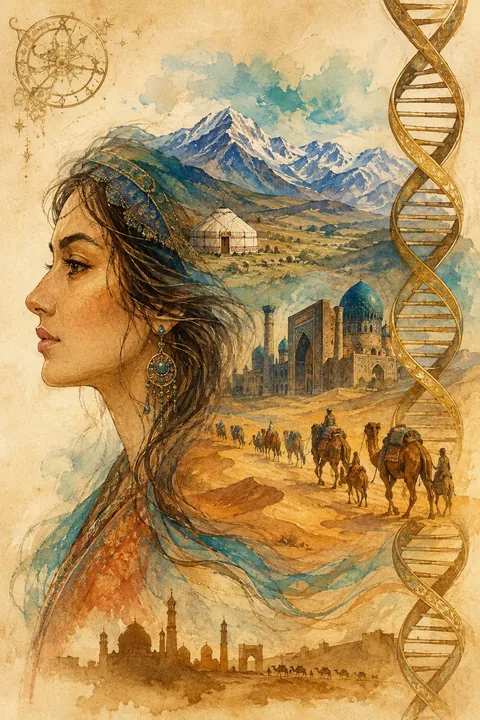
Turan – Silk Road & Central Asian Ancestry Report
Closest modern populations to Kazakh
Genetically, the Kazakh average sits nearest to Kazakh (Kazakhstan Kostanay) at 0.007, Kazakh (Kazakhstan Jambyl) at 0.007 and Sart (Kalmyk) at 0.016. On our scale, a distance of 0.007 counts as very close. Leaving aside the other regional samples listed under the same name in the G25 sheet, the nearest other populations are Sart (Kalmyk) (0.016), Kyrgyz (Tajikistan) (0.026) and Kirghiz (0.039). By the tenth closest (Kyrgyz) the distance grows to 0.048, a common pattern for a population that shares ancestry with its neighbours while keeping a profile of its own.
| # | Population | Distance | Closeness |
|---|---|---|---|
| 1 | Kazakh (Kazakhstan Kostanay) | 0.0069 | Very close |
| 2 | Kazakh (Kazakhstan Jambyl) | 0.0072 | Very close |
| 3 | Sart (Kalmyk) | 0.0159 | Very close |
| 4 | Kyrgyz (Tajikistan) | 0.0260 | Close |
| 5 | Kirghiz | 0.0394 | Close |
| 6 | Karakalpak | 0.0406 | Close |
| 7 | Kirghiz (China) | 0.0410 | Close |
| 8 | Kyrgyz (Bishkek) | 0.0416 | Close |
| 9 | Kyrgyz (China) | 0.0437 | Close |
| 10 | Kyrgyz | 0.0479 | Close |
Distances are Euclidean distances between averaged G25 coordinates. On our scale, below 0.025 is very close, below 0.050 close, below 0.080 moderate, and beyond that distant.
Closest ancient populations to Kazakh
Among ancient genomes, the closest match to the modern Kazakh average is Kazakhstan Early Modern Kuygenzhar (Early Modern, c. 1500-1800 AD), at 0.021, followed by Ukraine Early Medieval Saltovo-Mayaki Verkhnii Saltiv (Alan, Central Asian Turkic Profile) and Xinjiang IA Kalatasi. That is a very close match, which suggests strong genetic continuity between those ancient people (or close relatives of theirs) and the modern population. A close ancient match is not proof of direct descent: it means those individuals carried a similar overall mix of ancestry.
| # | Ancient sample or group | Period | Distance |
|---|---|---|---|
| 1 | Kazakhstan Early Modern Kuygenzhar | Early Modern, c. 1500-1800 AD | 0.0211 |
| 2 | Ukraine Early Medieval Saltovo-Mayaki Verkhnii Saltiv (Alan, Central Asian Turkic Profile) | Early Medieval, c. 500-1000 AD | 0.0253 |
| 3 | Xinjiang IA Kalatasi | Iron Age | 0.0272 |
| 4 | Ukraine Late Medieval Crimean Khanate Mamay-Gora (Nogai, Central Asian Turkic Profile) | Late Medieval, c. 1300-1500 AD | 0.0313 |
| 5 | Ukraine Early Medieval Saltovo-Mayaki Bochkove (Bulgar, Central Asian Turkic Profile) | Early Medieval, c. 500-1000 AD | 0.0371 |
| 6 | Xinjiang HP Kafulang | Historical period | 0.0422 |
| 7 | Russia Bashkortostan High-Late Medieval Chiyalik Nizhne-Khozyatovo (Central Asian Turkic Profile) | High to Late Medieval, c. 1000-1500 AD | 0.0432 |
| 8 | Mongolia LBA DSKC Khovsgol (Altai MLBA-Turan Profile) | Late Bronze Age | 0.0462 |
| 9 | Xinjiang HP Jirentaigoukou | Historical period | 0.0473 |
| 10 | Kazakhstan High Medieval Kipchak Lisakovsk | High Medieval, c. 1000-1300 AD | 0.0474 |
Ancient DNA from Kazakhstan
Our ancient DNA database holds 358 individuals excavated in present-day Kazakhstan, dated from about 5,428 BC to 1798 AD. The most frequent Y-DNA haplogroups among them are R1a (80), Q1b (17) and R1b (12), and the most frequent mtDNA haplogroups are U5 (31), D4 (28) and C4 (23). These are people who lived on the same land in the past, not necessarily ancestors of today's Kazakh population.
Most frequent Y-DNA haplogroups
Ancient DNA studies on Kazakhstan
- Ancient genomes from eastern Kazakhstan reveal dynamic genetic legacy of Inner Eurasian hunter-gatherers (2025)
- The newly discovered bronze age site of Koken: Merging micro-regions with major study zones in the high steppes of Kazakhstan (2025)
- Genomic Analysis of 18th-Century Kazakh Individuals and Their Oral Microbiome (2021)
Browse them in our ancient DNA database: 358 from Kazakhstan.
Compare yourself with Kazakh
Paste your G25 coordinates (scaled, one line, with or without a name in front) and we compute your genetic distance to the Kazakh average and to its closest neighbours, right in your browser. Nothing is uploaded or stored.
| # | Population | Your distance | Closeness |
|---|
This list only covers Kazakh and its neighbours. To find out which of our reports actually fits your DNA, run the free Report Finder: it runs the same fit test that every report uses before an order.
No G25 coordinates yet? Get a free simulated G25 from your raw DNA file, or order G25 coordinates.
About these numbers
A word of caution: these figures describe the average of the Kazakh individuals who were sampled, not every person who identifies as Kazakh. Individuals vary around that average, and identity is about history, language and family, not about a genetic score. Read this page as a map of deep ancestry, not as a definition.
Method: averaged G25 coordinates, Euclidean distances to other modern and ancient averages, and a non-negative least-squares model against deep ancestral reference populations (data generated 2026-10-01). Read the full method.
Go deeper than the average
This page describes the Kazakh average. Your own DNA has its own story: Turan – Silk Road & Central Asian Ancestry Report (15€) models your genome against the ancient sources and modern communities of the region, era by era, in a personal PDF report.
A report built for people of Central Asian / Silk Road Turkic ancestry: ancient regional core (Botai, Andronovo, BMAC Bactria-Margiana, Saka/Scythian, Wusun, Kushan Empire, Xiongnu, Turkic Khaganate, Golden Horde) versus non-regional...
Frequently asked questions
What is the ancient genetic make-up of Kazakh?
Modelled with deep ancestral reference populations, the Kazakh average is about 47.6% Ancient Northeast Asians, 25.7% Steppe herders (Yamnaya) and 9.8% Anatolian Neolithic farmers. These proportions are model estimates for a group average, not exact values for any one person.
Which populations are genetically closest to Kazakh?
Leaving aside other regional samples listed under the same name in the G25 sheet (such as Kazakh (Kazakhstan Kostanay)), the closest modern populations to the Kazakh average are Sart (Kalmyk), Kyrgyz (Tajikistan) and Kirghiz. The closest ancient matches are Kazakhstan Early Modern Kuygenzhar, Ukraine Early Medieval Saltovo-Mayaki Verkhnii Saltiv (Alan, Central Asian Turkic Profile) and Xinjiang IA Kalatasi.
Can a DNA test tell me if I am Kazakh?
No DNA test can confirm an ethnicity or a nationality. What DNA can show is how similar your genome is to the sampled Kazakh average and to its neighbours. If you have G25 coordinates, paste them in the comparison box on this page to check that for free.
Which ExploreYourDNA report suits Kazakh ancestry?
For the Kazakh average, the regional report to choose is Turan – Silk Road & Central Asian Ancestry Report, which our fit test rates as an excellent match. Your own DNA may differ from the average, so the free Report Finder checks every report against your file before you buy.
Where does the data on this page come from?
From the averaged Global25 (G25) coordinates of the sampled individuals: genetic distances to other modern and ancient population averages, and a non-negative least-squares model against deep ancestral reference populations. The full method is described at https://www.exploreyourdna.com/populations#method.