
Iranian Zoroastrian DNA
Genetic origins and closest populations · Iran · West Asia
Iran's Zoroastrians follow one of the oldest living religions of the region, and their main communities have long been centred on Yazd and Kerman. After the Arab conquest of the 7th century, most Iranians gradually converted to Islam, while Zoroastrians remained a small community; the Parsis of India trace their history to Zoroastrians who left Iran. In our model, the Iranian Zoroastrian average is 37.2% Iranian Neolithic farmer, 22.7% Anatolian Neolithic farmer, 20.1% steppe, 10.1% Levantine Neolithic, 6.2% Caucasus hunter-gatherer and 3.7% Natufian. Its steppe share is higher than that of the Fars average on our Persian page (16.7%), and it shows no East Asian component above the 1% threshold, against 2.9% for Fars. Even so, the closest modern averages are Persians from Fars and Yazd, followed by Yazidis from Turkey and Armenia. Three Iron Age sites in northwestern Iran give the closest ancient groups: Hasanlu (distance 0.0197), Dinkha Tepe and Hajji Firuz.
- Largest ancient components in our model: Iranian Neolithic farmers 37.2%, Anatolian Neolithic farmers 22.7%, Steppe herders (Yamnaya) 20.1%
- Closest modern population in our data: Iranian (Persian Fars), distance 0.0109
- Closest ancient group in our data: Iran IA Hasanlu (Iranian Plateau Profile), distance 0.0197
Where does Iranian Zoroastrian DNA sit on the genetic map of the world? To answer, we take the averaged Global25 (G25) coordinates of the Iranian Zoroastrian individuals sampled in Iran, listed in the G25 sheet as "Iranian_Zoroastrian" and compare them with deep ancestral reference populations, with other modern groups and with ancient genomes. It is one of 335 populations in our atlas.
Ancient make-up of the Iranian Zoroastrian average
The ancient make-up of the Iranian Zoroastrian average is led by Iranian Neolithic farmers (37.2%), followed by Anatolian Neolithic farmers (22.7%) and Steppe herders (Yamnaya) (20.1%). The Iranian Neolithic farmers component reflects the early farmers and herders of the Zagros mountains in Iran. The Anatolian Neolithic farmers share (22.7%) reflects the Neolithic farmers of Anatolia, who carried agriculture into Europe from about 6500 BC.
Smaller traces of Natufian hunter-gatherers (Levant) (under 5%) also appear. At that level they can reflect real minor ancestry, but also simple model noise, so they should not be over-read. The model fits well (fit distance 0.024), so these proportions are a reasonable summary. The model draws on West Eurasian ancient genomes, with modern West African and East Asian stand-ins.
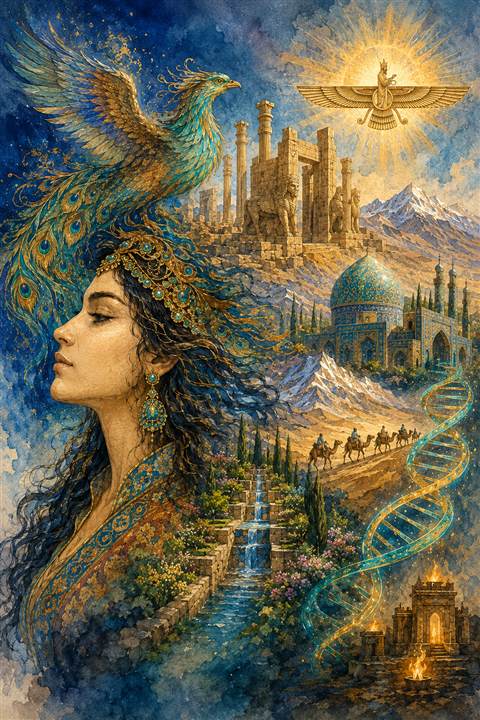
Simorgh – Iranian Plateau Report
Closest modern populations to Iranian Zoroastrian
Among the modern populations in the G25 data, the closest to the Iranian Zoroastrian average is Iranian (Persian Fars), at a distance of 0.011 (very close). Next come Iranian (Persian Yazd) at 0.012 and Persian (Fars) at 0.014. Leaving aside the other regional samples listed under the same name in the G25 sheet, the nearest other populations are Persian (Fars) (0.014), Persian (Yazd) (0.014) and Persian (Iranian) (0.015). Even the tenth closest, Yazidi (Armenia), is only 0.019 away: Iranian Zoroastrian belongs to a dense cluster of related populations, so small differences inside that cluster should not be over-interpreted.
| # | Population | Distance | Closeness |
|---|---|---|---|
| 1 | Iranian (Persian Fars) | 0.0109 | Very close |
| 2 | Iranian (Persian Yazd) | 0.0120 | Very close |
| 3 | Persian (Fars) | 0.0137 | Very close |
| 4 | Persian (Yazd) | 0.0140 | Very close |
| 5 | Persian (Iranian) | 0.0146 | Very close |
| 6 | Yazidi (Turkey) | 0.0157 | Very close |
| 7 | Persian (India Hyderabad Muslim Shia) | 0.0177 | Very close |
| 8 | Ezid | 0.0185 | Very close |
| 9 | Lak (Iran) | 0.0187 | Very close |
| 10 | Yazidi (Armenia) | 0.0191 | Very close |
Distances are Euclidean distances between averaged G25 coordinates. On our scale, below 0.025 is very close, below 0.050 close, below 0.080 moderate, and beyond that distant.
Closest ancient populations to Iranian Zoroastrian
Among ancient genomes, the closest match to the modern Iranian Zoroastrian average is Iran IA Hasanlu (Iranian Plateau Profile) (Iron Age), at 0.020, followed by Iran IA Dinkha Tepe (Iranian Plateau Profile) and Iran IA Hajji Firuz (Iranian Plateau Profile). That is a very close match, which suggests strong genetic continuity between those ancient people (or close relatives of theirs) and the modern population. A close ancient match is not proof of direct descent: it means those individuals carried a similar overall mix of ancestry.
| # | Ancient sample or group | Period | Distance |
|---|---|---|---|
| 1 | Iran IA Hasanlu (Iranian Plateau Profile) | Iron Age | 0.0197 |
| 2 | Iran IA Dinkha Tepe (Iranian Plateau Profile) | Iron Age | 0.0222 |
| 3 | Iran IA Hajji Firuz (Iranian Plateau Profile) | Iron Age | 0.0256 |
| 4 | Iran Medieval Ganj Dareh | Medieval, c. 500-1500 AD | 0.0338 |
| 5 | Iran LBA Dinkha Tepe (Iranian Plateau Profile) | Late Bronze Age | 0.0350 |
| 6 | Iran MBA-IA Dinkha Tepe (Iranian Plateau Profile) | Iron Age | 0.0356 |
| 7 | Iraq Achaemenid Bakr Awa (Zagrosian Profile) | Achaemenid era, c. 550-330 BC | 0.0367 |
| 8 | Azerbaijan Roman Empire-Late Antiquity Shamakhi | Late Antiquity, c. 250-600 AD | 0.0406 |
| 9 | Iran IA Hasanlu (Irano-Mesopotamian Profile) | Iron Age | 0.0408 |
| 10 | Iran High Medieval Khwarazmian-Ilkhanate Kalmakareh Cave | High Medieval, c. 1000-1300 AD | 0.0412 |
Ancient DNA from Iran
Our ancient DNA database holds 184 individuals excavated in present-day Iran, dated from about 10,000 BC to 1561 AD. The most frequent Y-DNA haplogroups among them are J2a (17), R1b (12) and J2b (8), and the most frequent mtDNA haplogroups are J1 (15), K1 (10) and U1 (10). These are people who lived on the same land in the past, not necessarily ancestors of today's Iranian Zoroastrian population.
Most frequent Y-DNA haplogroups
Ancient DNA studies on Iran
- Ancient DNA indicates 3,000 years of genetic continuity in the Northern Iranian Plateau, from the Copper Age to the Sassanid Empire (2025)
- Large-Scale Assessment of the Iranian population structure of Mitochondrial and Y-chromosome Haplogroups (2024)
- The Genetic Legacy of Zoroastrianism in Iran and India: Insights into Population Structure, Gene Flow, and Selection (2017)
Browse them in our ancient DNA database: 184 from Iran.
Compare yourself with Iranian Zoroastrian
Paste your G25 coordinates (scaled, one line, with or without a name in front) and we compute your genetic distance to the Iranian Zoroastrian average and to its closest neighbours, right in your browser. Nothing is uploaded or stored.
| # | Population | Your distance | Closeness |
|---|
This list only covers Iranian Zoroastrian and its neighbours. To find out which of our reports actually fits your DNA, run the free Report Finder: it runs the same fit test that every report uses before an order.
No G25 coordinates yet? Get a free simulated G25 from your raw DNA file, or order G25 coordinates.
About these numbers
Keep in mind that a population average is a statistical summary of a limited number of sampled individuals. Real people inside any group vary, some carry more of one ancestry and some less, and no genetic profile decides who is or is not Iranian Zoroastrian. Use these numbers as a map of deep ancestry, not as a label.
Method: averaged G25 coordinates, Euclidean distances to other modern and ancient averages, and a non-negative least-squares model against deep ancestral reference populations (data generated 2026-10-01). Read the full method.
Go deeper than the average
This page describes the Iranian Zoroastrian average. Your own DNA has its own story: Simorgh – Iranian Plateau Report (15€) models your genome against the ancient sources and modern communities of the region, era by era, in a personal PDF report.
A report built for people of Iranian-plateau ancestry: ancient regional core (Bronze/Iron Age Iranian Plateau, Achaemenid, Parthian, Sassanid Persia) versus non-regional outside admixture, across 10 communities (Persian, Lur/Bakhtiari...
More populations from West Asia
Frequently asked questions
What is the ancient genetic make-up of Iranian Zoroastrian?
Modelled with deep ancestral reference populations, the Iranian Zoroastrian average is about 37.2% Iranian Neolithic farmers, 22.7% Anatolian Neolithic farmers and 20.1% Steppe herders (Yamnaya). These proportions are model estimates for a group average, not exact values for any one person.
Which populations are genetically closest to Iranian Zoroastrian?
Leaving aside other regional samples listed under the same name in the G25 sheet (such as Iranian (Persian Fars)), the closest modern populations to the Iranian Zoroastrian average are Persian (Fars), Persian (Yazd) and Persian (Iranian). The closest ancient matches are Iran IA Hasanlu (Iranian Plateau Profile), Iran IA Dinkha Tepe (Iranian Plateau Profile) and Iran IA Hajji Firuz (Iranian Plateau Profile).
Can a DNA test tell me if I am Iranian Zoroastrian?
No DNA test can confirm an ethnicity or a nationality. What DNA can show is how similar your genome is to the sampled Iranian Zoroastrian average and to its neighbours. If you have G25 coordinates, paste them in the comparison box on this page to check that for free.
Which ExploreYourDNA report suits Iranian Zoroastrian ancestry?
For the Iranian Zoroastrian average, the regional report to choose is Simorgh – Iranian Plateau Report, which our fit test rates as an excellent match. Your own DNA may differ from the average, so the free Report Finder checks every report against your file before you buy.
Where does the data on this page come from?
From the averaged Global25 (G25) coordinates of the sampled individuals: genetic distances to other modern and ancient population averages, and a non-negative least-squares model against deep ancestral reference populations. The full method is described at https://www.exploreyourdna.com/populations#method.