⚜️ New report · French North AmericaNouveau rapport · Amérique française

Nouvelle-France

Your French North American rootsVos racines en Amérique française

For Quebecois and French Canadians, Acadians, Cajuns, Franco-Americans and Metis. One model rebuilds your DNA from the founding regions of France, the Native American peoples of Canada (Wendat, Mi'kmaq-region Algonquian, Subarctic Dene) and the other colonial streams of your family (British Isles, German, Spanish and Canary Islander, Italian, African). Then we place your French side on a map of France and trace its deep roots, from the first farmers and the Gauls to Roman Gaul, the Franks and early modern France, with an AI narrative.Pour les Québécois et les Canadiens français, les Acadiens, les Cajuns, les Franco-Américains et les Métis. Un seul modèle reconstruit votre ADN à partir des régions fondatrices de France, des peuples autochtones du Canada (Wendat, Algonquien de la région mi'kmaq, Dénés subarctiques) et des autres courants coloniaux de votre famille (îles Britanniques, allemand, espagnol et canarien, italien, africain). Puis nous plaçons votre côté français sur une carte de la France et retraçons ses racines profondes, des premiers agriculteurs et des Gaulois à la Gaule romaine, aux Francs et à la France du XVIIe siècle, avec une narration par IA.

  • ⚜️ Your founding regions of FranceVos régions fondatrices de France
  • 🪶 Native American share, measured honestlyPart amérindienne, mesurée honnêtement
  • 🗺️ Your French side on a map of FranceVotre côté français sur une carte de France
  • ⛵ Other colonial streams of your familyAutres courants coloniaux de votre famille
  • 🏺 7 eras: Gauls, Roman Gaul, Franks, early modern France7 époques : Gaulois, Gaule romaine, Francs, France moderne
  • 🤖 Results interpreted by Claude AI, in English or FrenchRésultats interprétés par Claude AI, en français ou en anglais
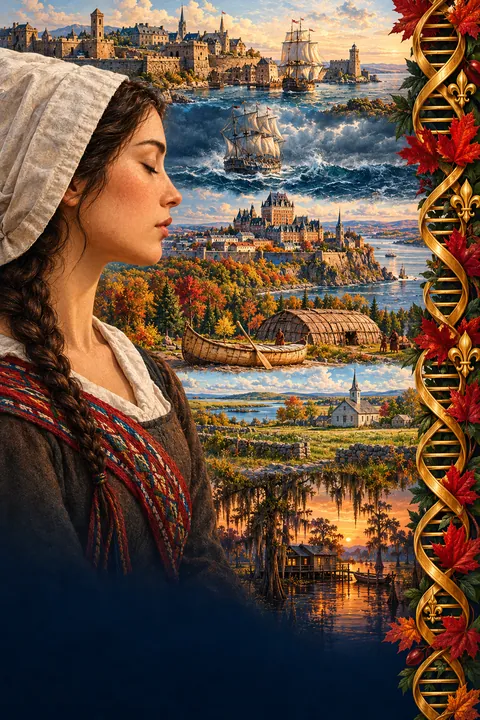
Nouvelle-France report cover
⚠️ Designed for people of French North American colonial descent.Conçu pour les descendants des colons de l'Amérique française. Works for Quebecois, Acadians, Cajuns, Franco-Americans and Metis, including mixed families. If your roots are in France itself, France Profonde tells the regions of France in more depth. If your North American family is mostly British, German or a mix of many origins, El Gringo fits better; for Britain and Ireland see Isles. Not sure? The free Report Finder tells you.Convient aux Québécois, Acadiens, Cajuns, Franco-Américains et Métis, y compris les familles métissées. Si vos racines sont en France même, France Profonde raconte les régions de France plus en détail. Si votre famille nord-américaine est surtout britannique, allemande ou d'origines multiples, El Gringo convient mieux ; pour la Grande-Bretagne et l'Irlande, voyez Isles. Pas sûr ? Le Report Finder gratuit vous le dit.

Who it is forPour qui

  • Quebecois and French Canadians, descendants of the St. Lawrence pioneers and the Filles du Roi.Québécois et Canadiens français, descendants des pionniers du Saint-Laurent et des Filles du Roi.
  • Acadians of the Maritimes, Quebec, New England and France, whose ancestors lived through the Grand Derangement of 1755.Acadiens des Maritimes, du Québec, de la Nouvelle-Angleterre et de France, dont les ancêtres ont vécu le Grand Dérangement de 1755.
  • Cajuns and Louisiana French, Acadian exiles and French colonists of Louisiana, with their German Coast, Isleno and Creole neighbours.Cajuns et Louisianais francophones, exilés acadiens et colons français de la Louisiane, avec leurs voisins de la Côte des Allemands, isleños et créoles.
  • Franco-Americans of New England and the Midwest, and Metis families of the fur trade and the prairies.Franco-Américains de la Nouvelle-Angleterre et du Midwest, et familles métisses de la traite des fourrures et des Prairies.

1. Choose your community1. Choisissez votre communauté

Pick the community your family belongs to: it sets the focus of your story. The models are the same for everyone. Mixed or unsure? Choose Let the report decide.Choisissez la communauté de votre famille : elle oriente votre récit. Les modèles sont les mêmes pour tous. Origines mêlées ou incertaines ? Choisissez Laisser le rapport décider.

Quebecois (French Canadian)Québécois (Canadien français)

Quebec and the St. Lawrence valley: fewer than 10,000 founding settlers arrived between 1608 and 1760, among them nearly 800 Filles du Roi (1663-1673), and most French Canadians today descend from themQuébec et la vallée du Saint-Laurent : moins de 10 000 pionniers arrivés entre 1608 et 1760, dont près de 800 Filles du Roi (1663-1673), ancêtres de la plupart des Canadiens français d'aujourd'hui

Acadian (Maritimes)Acadien (Maritimes)

Acadia, today Nova Scotia, New Brunswick and Prince Edward Island: settled from the 1630s, mostly from the Centre-Ouest of France; the Grand Derangement, the expulsion of 1755, scattered the Acadians to the Thirteen Colonies, France, Quebec and LouisianaL'Acadie, aujourd'hui Nouvelle-Écosse, Nouveau-Brunswick et Île-du-Prince-Édouard : peuplée à partir des années 1630, surtout depuis le Centre-Ouest de la France ; le Grand Dérangement de 1755 a dispersé les Acadiens jusqu'en France, au Québec et en Louisiane

Cajun and Louisiana FrenchCajun et Louisiane française

Louisiana: a French colony from 1699 (New Orleans, 1718), joined by Acadian exiles from 1765 who became the Cajuns; Louisiana families may also carry German Coast, Spanish and Canary Islander (Isleno), African and Native American ancestryLa Louisiane : colonie française dès 1699 (La Nouvelle-Orléans, 1718), rejointe à partir de 1765 par les exilés acadiens devenus les Cajuns ; les familles louisianaises peuvent aussi porter des ascendances de la Côte des Allemands, espagnoles et canariennes (Isleños), africaines et amérindiennes

Franco-AmericanFranco-Américain

Franco-Americans: close to a million French Canadians left Quebec for the mill towns of New England and for the Midwest between 1840 and 1930; their descendants often married into Irish, Italian, Polish and other familiesLes Franco-Américains : près d'un million de Canadiens français ont quitté le Québec pour les villes manufacturières de la Nouvelle-Angleterre et le Midwest entre 1840 et 1930 ; leurs descendants se sont souvent mariés avec des familles irlandaises, italiennes, polonaises et autres

MetisMétis

The Metis Nation grew from fur-trade families of French Canadian (and Scottish) voyageurs and Cree, Ojibwe and Saulteaux women, centred on the Red River and the prairies; Metis identity is a matter of kinship, community and nationhood that DNA cannot determineLa Nation métisse est née des familles de la traite des fourrures, entre voyageurs canadiens-français (et écossais) et femmes cries, ojibwées et saulteuses, autour de la rivière Rouge et des Prairies ; l'identité métisse relève de la parenté, de la communauté et de la nation, ce que l'ADN ne peut pas déterminer

🔎 Let the report decide (auto)Laisser le rapport décider (auto)

A story for French North American roots in general.Un récit pour les racines de l'Amérique française en général.

Your founding regions of FranceVos régions fondatrices de France

Your DNA is compared with eleven regional references of France. Because neighbouring French regions are genetically very close, the report groups them into four broad parts of France, the finest split that we could reproduce reliably for one person, and also places your French side on a map of France.Votre ADN est comparé à onze références régionales de France. Comme les régions voisines sont génétiquement très proches, le rapport les regroupe en quatre grandes parties de la France, la division la plus fine que nous ayons pu reproduire de façon fiable pour une personne, et place aussi votre côté français sur une carte de France.

Normandy and BrittanyNormandie et Bretagne

  • Normandy: Normandy, one of the leading provinces of origin of the Quebec pioneers; the ports of Dieppe, Honfleur and Rouen sent many of the first ships to New France. Its reference also covers the Orne, home of part of the Perche
  • Brittany: Brittany: Saint-Malo, home port of Jacques Cartier (1534), Breton sailors and fishermen, and a steady stream of settlers; after 1765 some Acadian exiles were resettled at Belle-Ile-en-Mer

Paris Basin, the North and the LoireBassin parisien, Nord et Loire

  • Loire Valley west (Anjou, Maine, Touraine and Berry, beside the Perche): Anjou, Maine, Touraine and Berry in the western Loire Valley, beside the Perche (no Perche sample has been published; the Loire Valley west and Normandy are its closest references), the cradle of the Perche recruitment of the 1630s to 1660s led by Robert Giffard and the Juchereau brothers
  • Ile-de-France (Paris): Paris and the Ile-de-France: a large share of the Filles du Roi of 1663-1673 came from Paris, many from the Salpetriere, along with soldiers, craftsmen and officials
  • Picardy, Artois and French Flanders: Picardy, Artois and French Flanders, a smaller stream of soldiers and settlers to New France; the reference also includes the Nord department, with its Flemish-influenced profile
  • Champagne, Lorraine and Alsace (north-east): Champagne, Lorraine and Alsace: Marguerite Bourgeoys, founder of the Congregation de Notre-Dame of Montreal, came from Troyes in Champagne, and Alsatians and Lorrainers were among the German Coast settlers of Louisiana in the 1720s

Centre-Ouest and the southCentre-Ouest et Midi

  • Poitou, Aunis and Saintonge (Centre-Ouest, La Rochelle hinterland): Poitou, Aunis and Saintonge, the Centre-Ouest behind La Rochelle, the main port of departure to New France: the largest single origin of the Quebec pioneers and the main origin of the Acadians, many of them from the Loudun area recruited in the 1630s and 1640s
  • Burgundy, Franche-Comte and the Lyonnais: Burgundy, Franche-Comte and the Lyonnais, a smaller stream of soldiers and settlers from eastern and east-central France
  • Auvergne, Limousin and the Occitan south (Languedoc, Provence): Auvergne, Limousin and the Occitan south (Languedoc, Provence), a modest share of the soldiers and settlers, more frequent among the colonial troops of the 1700s and in French Louisiana

South-WestSud-Ouest

  • Aquitaine and Gascony (Bordeaux, Landes, Bearn, Bigorre): Aquitaine and Gascony: Bordeaux merchants and sailors traded with Quebec and Louisiana, and Gascon soldiers served in the colonial troops
  • Basque Country (French side: Labourd, Lower Navarre, Soule): The Basque Country: Basque whalers and cod fishermen worked the Gulf of St. Lawrence and Newfoundland from the 1500s, before New France was founded, and some Basques settled at Plaisance, in Acadia and in Quebec

What your report modelsCe que votre rapport modélise

⚜️ Your founding regionsVos régions fondatrices

One mixture of the four broad parts of France, the Native American references and the other colonial streams, read like a family recipe, with its real precision stated.Un seul mélange des quatre grandes parties de la France, des références amérindiennes et des autres courants coloniaux, lu comme une recette de famille, avec sa vraie précision.

🪶 Native American ancestryAscendance amérindienne

Measured to about one percentage point against Wendat, Mi'kmaq-region and Subarctic Dene genomes. The total is always shown; the split by Indigenous reference only from 25%, where our tests show it becomes reliable.Mesurée à environ un point de pourcentage près contre des génomes wendat, de la région mi'kmaq et dénés subarctiques. Le total est toujours affiché ; la répartition par référence autochtone seulement à partir de 25 %, là où nos tests la montrent fiable.

🗺️ Your French side on the mapVotre côté français sur la carte

Your French side, with the rest set aside, placed between northern and south-western France and between the Atlantic and inland France, with the regions compatible with it.Votre côté français, le reste mis de côté, placé entre le nord et le sud-ouest de la France et entre l'Atlantique et l'intérieur, avec les régions compatibles.

⛵ Other colonial streamsAutres courants coloniaux

British Isles, German, Spanish and Canary Islander (the Islenos of Louisiana), Southern Italian, Eastern European, West African and East Asian references, shown when they clearly improve the fit.Références des îles Britanniques, allemande, espagnole et canarienne (les Isleños de Louisiane), d'Italie du Sud, d'Europe de l'Est, d'Afrique de l'Ouest et d'Asie de l'Est, affichées quand elles améliorent clairement l'ajustement.

🏺 Deep roots of your French sideRacines profondes de votre côté français

Seven eras: the hunter-gatherers and first farmers of France, the Bell Beaker arrival of steppe ancestry, the Bronze Age, the Gauls, Roman Gaul, the Franks and Merovingian Gaul, medieval and early modern France.Sept époques : chasseurs-cueilleurs et premiers agriculteurs de France, arrivée de l'ascendance des steppes avec le Campaniforme, âge du Bronze, Gaulois, Gaule romaine, Francs et Gaule mérovingienne, France médiévale et moderne.

🧬 Y-DNA and mtDNA lineagesLignées Y et ADNmt

If your raw DNA file is available, your paternal and maternal haplogroups are classified in a French and North American context, including Indigenous American lines such as mtDNA A2, C1 or X2a and Y-DNA Q-M3 or C-P39.Si votre fichier ADN brut est disponible, vos haplogroupes paternel et maternel sont classés dans un contexte français et nord-américain, y compris les lignées autochtones comme l'ADNmt A2, C1 ou X2a et l'ADN-Y Q-M3 ou C-P39.

76 reference populationspopulations de référence

Ancient and modern French references, Indigenous genomes of Canada, the colonial streams of French North America and small published samples of modern Quebecois, Acadians and Cajuns.Références françaises anciennes et modernes, génomes autochtones du Canada, courants coloniaux de l'Amérique française et petits échantillons publiés de Québécois, d'Acadiens et de Cajuns d'aujourd'hui.

Bronze Age sources

Bell Beaker France (c. 2500-2100 BC, arrival of steppe ancestry) · Early Bronze Age France (Grand Est, Burgundy, Brittany, Occitanie, c. 2200-1600 BC) · Han Bronze Age proxy (East Asian) · Middle and Late Bronze Age France (Champagne, Lorraine, Languedoc, c. 1600-800 BC) · Steppe pastoralist (Yamnaya) outside source · Yoruba Bronze Age proxy (West African)

Deep ancestral sources

Anatolian Neolithic farmer · Caucasus Hunter-Gatherer (CHG, Kotias) · Eastern Hunter-Gatherer (EHG) · French Mesolithic hunter-gatherer (Hoedic, Teviec, Rochedane, Ranchot) · Han (East Asian proxy) · Iranian Neolithic farmer (Ganj Dareh) · Steppe pastoralist (Yamnaya, Samara) · Yoruba (West African proxy)

Frankish and Merovingian sources

Franks of Merovingian northern Gaul (Koksijde, Sint-Truiden, Camp du Chateau, Northwest European profile, 5th-8th c.) · Gallo-Roman population of Merovingian Gaul (Pays de la Loire, Burgundy, Metz, Koksijde, Western European profile) · Han Late Antiquity proxy (East Asian) · Late Antique Italy (non-regional proxy) · Post-Roman Britons, settlers of Brittany (Brittonic profile, non-regional proxy) · Visigoths and other Gothic peoples (Wielbark/Chernyakhiv proxy, non-regional) · Yoruba Late Antiquity proxy (West African)

French regions of origin

Aquitaine and Gascony (Bordeaux, Landes, Bearn, Bigorre) · Auvergne, Limousin and the Occitan south (Languedoc, Provence) · Basque Country (French side: Labourd, Lower Navarre, Soule) · Brittany · Burgundy, Franche-Comte and the Lyonnais · Champagne, Lorraine and Alsace (north-east) · Ile-de-France (Paris) · Loire Valley west (Anjou, Maine, Touraine and Berry, beside the Perche) · Normandy · Picardy, Artois and French Flanders · Poitou, Aunis and Saintonge (Centre-Ouest, La Rochelle hinterland)

Iron Age sources (Gaul)

Celtiberians of the upper Ebro and Basque country (Iron Age, non-regional proxy) · Danish Iron Age (Germanic North, non-regional proxy) · Gauls of the south (Languedoc and Provence: Volcae and Celto-Ligurians, c. 500-50 BC) · Hallstatt and early La Tene Gauls (Burgundy, Champagne, Picardy, c. 800-400 BC) · Han Iron Age proxy (East Asian) · Iron Age Britain (Britons, non-regional proxy) · La Tene Gauls of northern Gaul (Belgae and Celtae: Champagne, Picardy, Normandy, c. 450-50 BC) · Yoruba Iron Age proxy (West African)

Medieval and early modern France sources

Al-Andalus, Islamic Iberia (non-regional proxy) · Early modern western France (Vendeen soldiers of 1793, Paris, 17th-18th c.) · Han Medieval proxy (East Asian) · Medieval and early modern England (non-regional proxy) · Medieval Flanders and the Low Countries (Sint-Truiden, Wulpen, St. Rombout's, 10th-16th c.) · Medieval France (Paris, Pays de la Loire, Burgundy, Lorraine, Brittany, 9th-15th c.) · Viking Age Scandinavians (Danish Viking Age, proxy for the Norse settlers of Normandy) · Yoruba Medieval proxy (West African)

Modern French North American references

Acadian (modern reference) · Cajun (Louisiana, modern reference) · Quebecois (French Canadian, modern reference)

Native American proxies

Mi'kmaq-region Algonquian of the Maritimes (Atholville, New Brunswick, c. AD 1550-1600) · Subarctic First Nations of the North-West (Chipewyan and Canadian Athabaskan, Dene) · Wendat (Huron), Iroquoian of the Great Lakes and St. Lawrence (Ontario, c. AD 1450-1550)

Neolithic sources

Anatolian Neolithic farmer (outside source) · Corded Ware, Central Europe (steppe-related, non-regional proxy) · Early Neolithic farmers of France (Cardial and LBK pioneers, Villeneuve-Saint-Germain, c. 5800-4800 BC) · Han Neolithic proxy (East Asian) · Late Neolithic farmers and megalith builders of France (Paris Basin collective graves, Mont-Aime, Aven de la Boucle, c. 3500-2600 BC) · Middle Neolithic farmers of France (Cerny, Chasseen, Gurgy, Fleury-sur-Orne in Normandy, Prisse-la-Charriere in Poitou) · Yoruba Neolithic proxy (West African)

Other colonial streams

British Isles (Irish, Scottish and English) · Canary Islander (the Islenos of Louisiana) · East Asian (Han Chinese reference) · Eastern European (Polish and Ukrainian) · German (Rhineland, Palatinate and southern Germany) · Senegambian (Mandinka) · Southern Italian and Sicilian · Spanish (Castile and Andalusia) · West African (Yoruba, Bight of Benin)

Roman Gaul sources

Gallo-Romans of northern and eastern Gaul (Metz, Sarrebourg, Tongeren, 1st-5th c.) · Germanic peoples beyond the Rhine (Roman Iron Age, non-regional proxy) · Han Classical proxy (East Asian) · Imperial Roman Italian (Classical) · Roman Levant (Classical) · Yoruba Classical proxy (West African)
How it works, and its limitsComment ça marche, et ses limites

🔬 How to read your results (please read)Comment lire vos résultats (à lire)

Your result is computed by genetic similarity (Global25), not by a lookup of your ancestors. It is compatible with your family tree, never a substitute for it: the PRDH, the Drouin collection and your parish records remain the source for individual founders.Votre résultat est calculé par similarité génétique (Global25), pas par une recherche de vos ancêtres. Il est compatible avec votre arbre, jamais un substitut : le PRDH, la collection Drouin et vos registres paroissiaux restent la source pour chaque pionnier.

We tested every result before showing it. Your Native American share comes out right to about one point. The four founding regions are broad: for one person the largest is right about 6 to 7 times in 10, the South-West about 9 times in 10, and each share is uncertain by about 20 points. Irish, Scottish and English ancestry looks like northern French ancestry in Global25, so a modest share is usually counted with your French side: the report says so instead of printing an unreliable number.Nous avons testé chaque résultat avant de l'afficher. Votre part amérindienne sort juste à environ un point près. Les quatre régions fondatrices sont larges : pour une personne, la plus grande est la bonne environ 6 à 7 fois sur 10, le Sud-Ouest environ 9 fois sur 10, et chaque part est incertaine d'environ 20 points. L'ascendance irlandaise, écossaise et anglaise ressemble à celle du nord de la France en Global25 : une part modeste est donc souvent comptée avec votre côté français, et le rapport le dit au lieu d'afficher un chiffre peu fiable.

Genetics is not identity: this report never determines a national, ethnic or Indigenous identity. First Nations, Inuit and Metis identity is a matter of kinship, community and nationhood, which DNA cannot decide.La génétique n'est pas l'identité : ce rapport ne détermine jamais une identité nationale, ethnique ou autochtone. L'identité des Premières Nations, des Inuits et des Métis relève de la parenté, de la communauté et de la nation, ce que l'ADN ne peut trancher.

Free check · no email needed

Is Nouvelle-France right for your DNA?

Paste your G25 coordinates or drop your raw DNA file. We run the same fit test as our free Report Finder, for Nouvelle-France only, and show you your verdict, your regional core and your 3 closest communities before you spend anything.

Click or drop your raw DNA file here 23andMe, AncestryDNA, MyHeritage, FTDNA, LivingDNA or a chip VCF (Genotek, Atlas): .txt, .csv, .vcf, .zip or .gz

A raw file takes 1 to 3 minutes: we first estimate your G25 coordinates from it.

🔒 Your file is processed for this check only and immediately deleted.

⚠️ Designed for people of French North American colonial descent (including mixed families). If your roots are mainly in France itself, France Profonde fits you better.Conçu pour les descendants des colons de l'Amérique française (familles métissées comprises). Si vos racines sont surtout en France même, France Profonde vous convient mieux.

Get your Nouvelle-France reportObtenez votre rapport Nouvelle-France

Select your community above, then confirm your email. We send you a secure link to upload your DNA (raw file or G25 coordinates) and generate your personalised report.Choisissez votre communauté ci-dessus, puis confirmez votre courriel. Nous vous envoyons un lien sécurisé pour téléverser votre ADN (fichier brut ou coordonnées G25) et générer votre rapport personnalisé.

Secure checkout after email verification. Your DNA is processed automatically and deleted; no human sees it.Paiement sécurisé après vérification du courriel. Votre ADN est traité automatiquement puis supprimé ; personne ne le voit.

📖 What is raw DNA & G25?Qu'est-ce que l'ADN brut et le G25 ?

Frequently asked questionsQuestions fréquentes

Who is the Nouvelle-France report for?À qui s'adresse le rapport Nouvelle-France ?

It is built for people of French North American colonial descent: Quebecois and French Canadians, Acadians, Cajuns and Louisiana French, Franco-Americans and Metis, including mixed families. If your roots are in France itself, France Profonde describes the regions of France in more depth.Il est conçu pour les descendants des colons de l'Amérique française : Québécois et Canadiens français, Acadiens, Cajuns et Louisianais francophones, Franco-Américains et Métis, familles métissées comprises. Si vos racines sont en France même, France Profonde décrit les régions de France plus en détail.

Can it tell which French province my ancestors came from?Peut-il dire de quelle province française venaient mes ancêtres ?

Only broadly, and we tell you exactly how broadly. French regions are genetically very close, so the report groups them into four broad parts of France and places your French side on a map. On our tests, the largest group is right about 6 to 7 times in 10 for one person, and the South-West about 9 times in 10. Your genealogy remains the source for individual ancestors.Seulement à grands traits, et nous vous disons exactement à quel point. Les régions françaises sont génétiquement très proches : le rapport les regroupe donc en quatre grandes parties de la France et place votre côté français sur une carte. Dans nos tests, la plus grande partie est la bonne environ 6 à 7 fois sur 10 pour une personne, et le Sud-Ouest environ 9 fois sur 10. Votre généalogie reste la source pour chaque ancêtre.

Can it detect Native American ancestry such as Mi'kmaq or Wendat?Peut-il détecter une ascendance amérindienne, mi'kmaq ou wendat ?

It measures your Native American share to about one percentage point. Very small amounts, from one Indigenous ancestor many generations back, are below what Global25 can see, so a result of zero never means that your tree has no Indigenous ancestor. The split between the Wendat, Mi'kmaq-region and Subarctic references is only shown from 25% upwards, where our tests show it becomes reliable, and it never names a tribe or nation. DNA never determines First Nations, Inuit or Metis identity.Il mesure votre part amérindienne à environ un point de pourcentage près. Les très petites parts, venant d'un ancêtre autochtone lointain, sont sous le seuil de Global25 : un résultat nul ne veut donc jamais dire que votre arbre n'a aucun ancêtre autochtone. La répartition entre les références wendat, de la région mi'kmaq et subarctique n'est affichée qu'à partir de 25 %, là où nos tests la montrent fiable, et ne nomme jamais une nation. L'ADN ne détermine jamais l'identité des Premières Nations, des Inuits ou des Métis.

Will it show my Irish or Scottish ancestors?Montrera-t-il mes ancêtres irlandais ou écossais ?

Not reliably, and the report says so. Irish, Scottish and English ancestry cannot be told apart from one another for one person, and they look like northern French ancestry in Global25. The report shows a British Isles stream only when it clearly improves the fit, so a modest share is usually counted with your French side.Pas de façon fiable, et le rapport le dit. Les ascendances irlandaise, écossaise et anglaise ne se distinguent pas entre elles pour une personne, et ressemblent à celle du nord de la France en Global25. Le rapport n'affiche un courant des îles Britanniques que s'il améliore clairement l'ajustement : une part modeste est donc souvent comptée avec votre côté français.

Not sure it fits me. Can I check first?Pas sûr que ce soit pour moi. Puis-je vérifier avant ?

Yes. The free Report Finder reads your raw DNA file (or your G25) and tells you honestly which report fits you best, before you spend anything.Oui. Le Report Finder gratuit lit votre fichier ADN brut (ou votre G25) et vous dit honnêtement quel rapport vous convient le mieux, avant toute dépense.

Do I need to have taken a DNA test already?Dois-je déjà avoir fait un test ADN ?

Yes. Upload your raw DNA file from 23andMe, AncestryDNA, MyHeritage, FamilyTreeDNA or LivingDNA, or paste your G25 coordinates.Oui. Téléversez votre fichier ADN brut de 23andMe, AncestryDNA, MyHeritage, FamilyTreeDNA ou LivingDNA, ou collez vos coordonnées G25.

How much does it cost and what do I get?Combien ça coûte et qu'est-ce que j'obtiens ?

€15. A full PDF report with your founding regions, your Native American share, your French side on a map of France with its closest regions, the other colonial streams of your family, seven era-by-era breakdowns of your French roots, Y-DNA and mtDNA haplogroups (if a raw file is provided) and a narrative interpreted by Claude AI, in English, French, Spanish, Portuguese, German or Italian.15 €. Un rapport PDF complet avec vos régions fondatrices, votre part amérindienne, votre côté français sur une carte de France avec ses régions les plus proches, les autres courants coloniaux de votre famille, sept analyses époque par époque de vos racines françaises, vos haplogroupes Y et ADNmt (si un fichier brut est fourni) et une narration interprétée par Claude AI, en français, anglais, espagnol, portugais, allemand ou italien.

A DNA report for French Canadian, Acadian and Cajun ancestryUn rapport ADN pour les ascendances canadienne-française, acadienne et cajun

Nouvelle-France is a G25 ancestry report built for the descendants of the colonists of New France. Upload your raw DNA file from 23andMe, AncestryDNA, MyHeritage or FamilyTreeDNA, pick your community, and we model your genome against the founding regions of France, the Indigenous peoples of Canada and the other colonial streams of French North America.Nouvelle-France est un rapport d'ascendance G25 conçu pour les descendants des colons de la Nouvelle-France. Téléversez votre fichier ADN brut de 23andMe, AncestryDNA, MyHeritage ou FamilyTreeDNA, choisissez votre communauté, et nous modélisons votre génome contre les régions fondatrices de France, les peuples autochtones du Canada et les autres courants coloniaux de l'Amérique française.

Whether your ancestors sailed from La Rochelle, Dieppe or Saint-Malo, settled the St. Lawrence, Port-Royal or the bayous of Louisiana, or worked the mills of New England, the report reads the layers of your history, from the founders of the 1600s back to the Gauls and the first farmers of France.Que vos ancêtres soient partis de La Rochelle, de Dieppe ou de Saint-Malo, qu'ils se soient établis sur le Saint-Laurent, à Port-Royal ou dans les bayous de Louisiane, ou qu'ils aient travaillé dans les filatures de la Nouvelle-Angleterre, le rapport lit les couches de votre histoire, des pionniers du XVIIe siècle jusqu'aux Gaulois et aux premiers agriculteurs de France.

The report uses the Global25 (G25) system developed by geneticist Davidski, placing your DNA in a 25-dimension genetic space alongside ancient and modern reference populations built from published genomes.Le rapport utilise le système Global25 (G25) développé par le généticien Davidski, qui place votre ADN dans un espace génétique à 25 dimensions aux côtés de populations de référence anciennes et modernes issues de génomes publiés.

👁 Sample reportsRapports d'exemple

See three real Nouvelle-France reportsVoyez trois vrais rapports Nouvelle-France

Full example reports, flip through every page: cover, founding regions, Native American share, the map of France, the seven eras and the AI narrative.Rapports d'exemple complets, feuilletez chaque page : couverture, régions fondatrices, part amérindienne, carte de France, les sept époques et la narration par IA.

PDF

⚜️ Quebecois sample 1

A Quebecois profile leaning to the Paris Basin, the North and the Loire: the founding regions of the St. Lawrence pioneers, the Native American share measured honestly, and the French roots from the Gauls to early modern France.

PDF

⚜️ Quebecois sample 2

A Quebecois profile leaning to Normandy and Brittany: the ports of Dieppe, Honfleur and Saint-Malo, the founding regions on the map of France, and the layers of French history behind them.

PDF

⚜️ Quebecois sample 3

A Quebecois profile leaning to the Centre-Ouest and the south: Poitou, Aunis and Saintonge behind La Rochelle, the Native American question read with its real precision, and the deep French roots.

Report
Loading...
Loading report...
Page of -

We use cookies to enhance your experience. By continuing to visit this site you agree to our use of cookies. Read our privacy policy

🧭 Find your report
📬 Stay in the loop

New tools and new reports, straight to your inbox. No spam, unsubscribe anytime.