๐Ÿ›๏ธ New report ยท in collaboration with Samuel Marques

Mediterranean Bronze & Iron Age

Which ancient peoples rebuild your DNA, from 3000 BC to the Roman conquest?

Etruscans, Celts, Iberians, Greeks, Phoenicians and Canaanites, Illyrians, Hittites, Nuragic Sardinians and many more. We compute your K47 admixture from your raw DNA file and compare it, individual by individual, with 1,029 ancient genomes from 120 Bronze and Iron Age populations, with the panel and the method built in collaboration with Samuel Marques. Your result comes with a map, your paternal and maternal lines in context and an AI narrative.

  • ๐Ÿงฎ K47 admixture computed from your raw file
  • ๐Ÿบ Compared to each ancient individual, not to averages
  • ๐Ÿ—บ๏ธ Your populations on a map of the ancient world
  • ๐Ÿงฌ Y-DNA & mtDNA lines among the ancient carriers
  • ๐Ÿ“Š Populations and regions, with the quality of the fit
  • ๐Ÿค– Results interpreted by Claude AI, in 9 languages
Get my report ยท โ‚ฌ16 Raw DNA file required
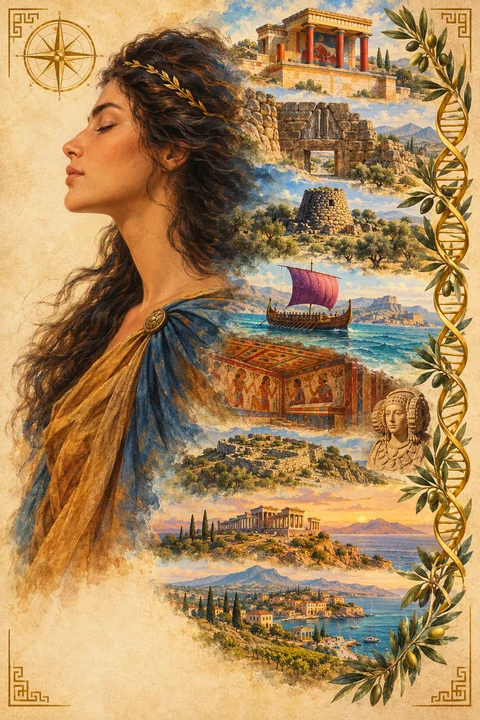
Mediterranean Bronze and Iron Age report cover
๐Ÿ“ This report needs your raw DNA file. Your K47 profile is computed from the genotypes in your raw DNA file (23andMe, AncestryDNA, MyHeritage, FamilyTreeDNA, LivingDNA). G25 coordinates cannot be used: they are a different system and cannot be turned into K47. Do not have your file yet? Our raw DNA guide shows how to download it in two minutes. Looking for your medieval and modern roots instead? See the Medieval & Modern report, built on the same method.

The method, step by step

This report is a collaboration with Samuel Marques, author of the K47 (Marques47) calculator, who selected the ancient individuals and peoples of the panel, drew the map and wrote the presentations of each people. It is the method we already use for the Medieval & Modern report, applied here to the Bronze and Iron Age.

  1. Your K47 admixture. From your raw DNA file we compute your profile on the 47 ancestral components of K47. Each component stands for an ancient ancestral source, and together they draw a precise portrait of your genome.
  2. 1,029 ancient individuals, one by one. Every ancient genome of the panel, taken from published ancient-DNA studies, has its own K47 profile. A non-negative least squares model (NNLS) finds the mixture of individuals that rebuilds your profile best. Working with individuals instead of population averages keeps the real diversity of each ancient people.
  3. Added up by population, then by region. The shares of the individuals are summed into their population (120 populations, from the Celts of Britain to the Hittites), then into large regions: Iberia, Gaul and the Alps, Britain and Ireland, Italy, the Balkans, the Aegean and Anatolia, the Levant, North Africa and Egypt, and the neighbours of the Mediterranean world.
  4. Placed on the map. Your populations are drawn on Samuel Marques' map of the Bronze and Iron Age peoples, so you see where your ancient matches lived.
  5. Checked and explained. The report gives the distance of the fit (how closely the mixture rebuilds you), places your Y-DNA and mtDNA haplogroups among the ancient carriers, and Claude AI writes a narrative of your result in your language.
Why K47 for this period? Neighbouring Bronze and Iron Age peoples are often genetically close (Etruscans and Latins, Iberians and Celtiberians, Canaanites of different cities). K47 was built with many components precisely to tell such close ancient groups apart, and comparing you to individuals rather than averages avoids blurring them together.

Real results, anonymous examples

Results of the report for volunteers of different origins (names removed). Top regions, then the main ancient populations behind each result.

🇫🇷 Breton (Finistère)

From a K47 profile
Britain & Ireland 42.1% Northern Europe 24.4% Iberia 22.0%
  • Celt Britanni & Ireland40.5%
  • Scando-Germanic24.4%
  • Cantabrian20.6%
  • Continental Celt3.8%

🇬🇧 English

From a K47 profile
Britain & Ireland 34.7% Northern Europe 27.6% Gaul & the Alps 10.3%
  • Scando-Germanic27.6%
  • Pict18.8%
  • Celt Britanni & Ireland15.9%
  • Continental Celt9.5%
  • Iberian Catalonia9.2%

🇪🇸 Asturian and British

From a K47 profile
Iberia 50.6% Gaul & the Alps 26.2% Italy & the Tyrrhenian 9.5%
  • Continental Celt26.2%
  • Cantabrian22.5%
  • El Argar Culture9.7%
  • Iberian Valencia7.5%
  • Ligurian5.9%

🇮🇹 Italian and Romanian

From a raw DNA file
Aegean & Anatolia 26.9% Gaul & the Alps 26.2% Iberia 13.7%
  • Greek Settlers of the Western Mediterranean21.2%
  • Letobici14.3%
  • Tartessian12.3%
  • Continental Celt8.5%
  • Mannean8.2%
๐Ÿงฌ Y-DNA R1b1a1b1a1a · mtDNA U4b

🇵🇱 Polish

From a K47 profile
Eastern Europe 61.8% Northern Europe 19.4% Britain & Ireland 5.7%
  • Baltic & Eastern Europe (Bronze & Iron Age)61.8%
  • Scando-Germanic19.4%
  • Celt Britanni & Ireland5.5%
  • Continental Celt5.2%

🇪🇬 Egyptian

From a K47 profile
Levant & Mesopotamia 40.1% North Africa & Egypt 20.5% Horn of Africa 17.3%
  • Canaanite Sidon18.4%
  • Cushitic17.3%
  • Hittite13.0%
  • Ancient Western Berber11.6%
  • Amorite8.3%

🇫🇷 French, one quarter Ashkenazi

From a K47 profile
Gaul & the Alps 54.0% Levant & Mesopotamia 12.8% Iberia 11.2%
  • Continental Celt45.5%
  • Canaanite Megiddo11.5%
  • Iberian Catalonia10.0%
  • Scando-Germanic6.9%
  • Latin4.3%

Most of these examples were run from K47 profiles supplied by the volunteers, which carry no haplogroups. With your raw DNA file, your report also gives your Y-DNA and mtDNA lines, as in the Italian and Romanian example. Percentages are resemblances to ancient individuals, not proof of descent.

What is in your report

๐Ÿบ Your ancient populations

Every Bronze and Iron Age population that takes part in your result, with its percentage, the number of ancient individuals behind it, and an illustrated presentation of that people written by Samuel Marques.

๐ŸŒ Your regions

The same result grouped into large regions of the ancient world (Iberia, Gaul and the Alps, Britain and Ireland, Italy, the Balkans, the Aegean and Anatolia, the Levant, North Africa and Egypt and their neighbours), shown as a chart.

๐Ÿ—บ๏ธ The map

Your populations highlighted on the map of Bronze and Iron Age peoples drawn by Samuel Marques, from the Atlantic to Mesopotamia.

๐Ÿงฌ Paternal and maternal lines in context

Your Y-DNA and mtDNA haplogroups, read from your raw file, placed in Bronze and Iron Age context (for example R1b with the Bell Beakers and the Celts, J2 and G2 in the Aegean and Anatolia, E-V13 in the Balkans), with a timeline of the ancient individuals who carried your lines.

๐Ÿค– Your story, by Claude AI

A narrative interpretation of your result: which ancient worlds meet in your DNA, how they relate to the history of the Mediterranean, and how much weight each part can carry. In English, French, Spanish, Italian, Portuguese, German, Greek, Turkish or Arabic.

๐Ÿ“‘ A clear, clickable report

A designed PDF with a cover, a clickable table of contents, summary tiles, the fit distance and a short guide on how to read your results.

120 ancient populations, 1,029 individuals

The reference panel, grouped by region. The number in brackets is the number of ancient individuals in each population.

Iberia

Ancient Ibiza/Formentera (1) · Cantabrian (3) · Celtiberian (4) · Cogotas Culture (3) · El Argar Culture (23) · Iberian Catalonia (7) · Iberian Valencia (3) · Lusitanian (4) · Punic Ibiza (1) · Punic-Andalucia (1) · Talayotic Culture (1) · Tartessian (1) · Vascon (1)

Gaul & the Alps

Celto Ligurian (4) · Continental Celt (28) · Iapodes (1) · Letobici (6) · Liburnian (7) · Raeti (1)

Britain & Ireland

Artic (18) · Celt Britanni & Ireland (13) · Pict (5)

Italy & the Tyrrhenian

Daunian (1) · Etruscan (25) · Hellenic Roman (5) · Latin (6) · Ligurian (1) · Nuragic (10) · Picentini (17) · Punic Sardinia (4) · Punic-Sicily (7) · Sicules (4)

Balkans

Catari (1) · Daco-Getae (4) · Illyrian Albanoi (7) · Illyrian Ardiaei (6) · Illyrian Dardani (2) · Illyrian Dassaretii (5) · Illyrian Delmatae (7) · Peonian (6) · Thracian Bessi (1) · Thracian Odrysian (12)

Aegean & Anatolia

Ancient Greek Cyclades (3) · Ancient Greek Greece (18) · Carian (4) · Greek Settlers Levant (1) · Greek Settlers Sicily (7) · Greek Settlers Western Mediterranée (4) · Hittite (5) · Minoan (12) · Phrygian (6)

Levant & Mesopotamia

Amorrite (12) · Anatolian/Cypriot Settlers Levant (1) · Assyrian (6) · Cananean Galilee (4) · Cananean Jordan (13) · Cananean Megiddo (15) · Cananean Philistin (2) · Cananean Sidon (5) · Cananean Yehud (1) · Eblaïte (11) · Mannean (16) · Phoenician (10) · Urartian (3)

Iran & Caucasus

Cimmerian (1) · Eastern Caucasus Antiquity (1) · Pontic Anatolia (1) · Western Caucasus Antiquity (2)

North Africa & Egypt

Ancient Eastern Berber (3) · Ancient Egyptian (5) · Ancient Western Berber (6) · Mandenka (5) · Mende (5) · Nubian (9) · Punic Tunisia (4)

Arabia

Ancient Arab (2) · Ancient Persian Gulf (3)

Horn of Africa

Cushitic (16)

Northern Europe

Proto-Saami (2) · Scando-Germanic (28)

Eastern Europe

Baltic & Eastern Europe (Bronze & Iron Age) (18) · Pontic Steppe Scythian (4) · Proto-Finnic (1) · Sarmatian (13) · Volgan Finn (1)

Steppe & Central Asia

Iranic-Central Asia (7) · Sargat Culture (10) · Tagar Culture (8)

Sub-Saharan Africa

Esan (4) · Igbo (2) · Khoisan (5) · Nilotic (2) · Proto-Bantu Central Africa (2) · Proto-Bantu East Africa (3) · Proto-Bantu South Africa (4) · Pygmy (10) · Yoruba (5)

South Asia

Ancestral South Indian (2) · Gandhara (12) · Proto-Indian (1)

East Asia & Pacific

Ancient Eastern Siberia (2) · Ancient Southern China (3) · Australian Arborigenal (4) · Indochina Peninsula Antiquity (10) · Kofun Japan (3) · Melanesian (6) · Proto-Austronesian (22) · Proto-Korean (6) · Proto-Micronesian (7) · Proto-Polynesian (1) · Proto-Tibetan (5) · Sinitic (7) · Xiongnu (13)

Americas

Mesoamerica Maya (7) · Native Andean (26) · Native Caribbean & Amazonia (202) · Native Central America (4) · Native Mexico & South-USA (45) · Native Patagonia (17) · North Amerindian (6)

How to read it, and its limits

๐Ÿ”ฌ Please read

Your result is a genetic resemblance: the ancient individuals whose K47 profiles, mixed together, rebuild yours best. A share of "Etruscan" or "Continental Celt" means your DNA resembles those ancient individuals; it is compatible with a family history, never proof of it, and it says nothing about language, religion or identity.

Ancient populations are known only through the genomes found so far. Some are represented by many individuals, others by one or two: the report shows the number of individuals for each population, and results resting on very few genomes are less reliable. The panel stops at the Roman conquest: later movements (the Slavic expansion, the Germanic Migration Period, the Arab conquests) are represented by the closest earlier populations; the Medieval & Modern report covers those later periods.

Haplogroups describe one paternal and one maternal line among thousands of ancestors. Meeting your haplogroup in an ancient individual shows that the line existed there, not that this person is your ancestor.

๐Ÿ“ Raw DNA file required. After you confirm your email, you upload your raw DNA file (23andMe, AncestryDNA, MyHeritage, FamilyTreeDNA, LivingDNA). G25 coordinates cannot be used for this report.

Get your Mediterranean Bronze & Iron Age report

Confirm your email and we send you a secure link to upload your raw DNA file and generate your personalised report.

Secure checkout after email verification. Your DNA is processed automatically and deleted; no human sees it.

๐Ÿ“– How to download your raw DNA file

Frequently asked questions

Who is this report for?

Anyone with roots in Europe, the Near East or North Africa who wants to know which peoples of about 3000 BC to the Roman conquest rebuild their DNA best. It works for mixed families too: every part of your profile is compared with the whole panel. For East Asian, Sub-Saharan or Native American ancestry the panel holds only a few distant references, so the Advanced Ancestry Report is a better choice.

Why do I need a raw DNA file and not G25 coordinates?

The report runs on Samuel Marques' K47 calculator, and your K47 profile is computed from the genotypes in your raw DNA file. G25 coordinates are a different system and cannot be converted into K47. The raw file also gives us your Y-DNA and mtDNA haplogroups.

What exactly is K47?

K47 (Marques47) is an admixture calculator with 47 ancestral components, designed by Samuel Marques to separate closely related ancient peoples. Every ancient individual of the panel has its own K47 profile, and a non-negative least squares model finds the mixture of individuals that rebuilds your profile best. Their shares are then added up by population and by region.

Does "30% Etruscan" mean one of my ancestors was Etruscan?

Not necessarily. It means that ancient Etruscan individuals take a large part in the mixture that rebuilds your DNA. Neighbouring peoples shared much of their ancestry, and later populations carried it on, so the result is a resemblance to those genomes, compatible with a family history but never proof of it.

Will it detect my haplogroups?

Yes. From your raw file we read your Y-DNA (men only) and mtDNA haplogroups and place them in Bronze and Iron Age context, with the ancient individuals who carried them. The precision depends on the markers your test includes.

How does it differ from the Medieval & Modern report?

Both use Samuel Marques' K47 method. This report compares you with peoples of the Bronze and Iron Age, before the Roman conquest. The Medieval & Modern report compares you with medieval and modern populations, closer to your recent family history. They answer different questions and complete each other.

How much does it cost and what do I get?

โ‚ฌ16. A full PDF report with your ancient populations and regions, the map, the fit distance, your Y-DNA and mtDNA lines in context (from your raw file) and a narrative interpreted by Claude AI, in English, French, Spanish, Italian, Portuguese, German, Greek, Turkish or Arabic.

A Bronze and Iron Age DNA test for the Mediterranean world

The Mediterranean Bronze & Iron Age report compares your DNA with the peoples who lived around the Mediterranean between about 3000 BC and the Roman conquest: the Etruscans and the peoples of ancient Italy, the Celts of Gaul and Britain, the Iberians, Celtiberians and the El Argar culture, the Greeks of the Aegean and their colonies, the Phoenicians and Canaanites, the Illyrians and Thracians, the Hittites and the peoples of Anatolia, the Nuragic Sardinians and the ancient Berbers.

Upload your raw DNA file from 23andMe, AncestryDNA, MyHeritage, FamilyTreeDNA or LivingDNA: we compute your K47 admixture, compare it with each ancient individual of Samuel Marques' panel, and show your result by population, by region and on the map, with your paternal and maternal lines in context.

๐Ÿ‘ Sample reports

See real Mediterranean Bronze & Iron Age reports

Full anonymous example reports, flip through every page: populations, regions, the map, paternal and maternal lines and the AI narrative.

PDF

🇫🇷 Breton sample

A Breton profile from Finistère: the Celts of Britain and Ireland in the lead, then the Scando-Germanic peoples and the Cantabrians of northern Iberia.

PDF

🇮🇹 Italian and Romanian sample

From a raw DNA file, with the Y-DNA (R1b) and mtDNA (U4b) lines placed among the ancient carriers of the Bronze and Iron Age.

PDF

🇪🇬 Egyptian sample

An Egyptian profile: Levantine, Anatolian, North African and Cushitic sources, from Canaanite Sidon to the ancient Berbers.

Report
Loading...
Loading report...
Page of -

We use cookies to enhance your experience. By continuing to visit this site you agree to our use of cookies. Read our privacy policy

๐Ÿงญ Find your report
๐Ÿ“ฌ Stay in the loop

New tools and new reports, straight to your inbox. No spam, unsubscribe anytime.