
The settlement of Iceland in the late 9th century CE is one of the few European foundation events for which contemporary written sources, archaeological data, and ancient genetic data converge on a remarkably detailed picture. The Norse settlement traditionally dated to 874 CE with the arrival of Ingolfr Arnarson at Reykjavik (Landnamabok, written in the 12th-13th centuries) is recorded as a primarily Scandinavian event, with Norwegian, Swedish, and Danish settlers fleeing political consolidation under the early Norwegian kings and seeking land in the unsettled North Atlantic. The genetic evidence (Helgason et al. 2000, 2001, Ebenesersdottir et al. 2018, and most comprehensively the 2018 Margaryan et al. study of Viking-period genomes published in Science) has confirmed and elaborated this picture. Iceland's founding population was assembled from two distinct ancestral streams: Norse (predominantly Norwegian) men and Gaelic (predominantly Irish and Scottish) women. The Y-chromosome lineages of modern Icelanders are approximately 70 percent of Norse origin; the mitochondrial DNA lineages are approximately 60 percent of Gaelic origin. The asymmetry is the genetic signature of how the settlement actually happened: Norse raiders, traders, and settlers brought Gaelic women (some as wives, some as concubines, some as slaves) from raids and trading expeditions in Ireland and the Hebrides during the late 9th and 10th centuries, then settled together in the previously uninhabited Icelandic landscape. The early Icelandic burials, sampled in the Margaryan et al. study from sites across the island, capture this dual-origin demography directly in the individual genomes.
Key Points
- The 2018 Margaryan et al. study (Science) sequenced over 400 Viking-period genomes from across the North Atlantic and Scandinavia, including a substantial set of early Icelandic burials from cemeteries dated to the 10th-13th centuries.
- The Icelandic founding population was assembled from Norse (predominantly Norwegian) men and Gaelic (predominantly Irish and Scottish) women, reflecting the documented historical reality of Viking-Age North Atlantic raiding and trading.
- Y-chromosome lineages in modern Icelanders are approximately 70 percent of Norse origin (haplogroups I1, R1a-Z284, and Norse-specific R1b subclades), with 30 percent of Gaelic origin (R1b-L21 and related Atlantic lineages).
- Mitochondrial DNA lineages show the opposite pattern: approximately 60 percent of Gaelic origin (Atlantic Celtic mtDNA haplogroups) and 40 percent of Norse origin (Scandinavian mtDNA haplogroups).
- The sex-biased asymmetry indicates that Norse men brought Gaelic women to Iceland through a combination of raids, slavery, marriages, and consensual unions during the late 9th and 10th centuries.
- Individual burials sampled in the Margaryan et al. study show a spectrum of ancestry profiles, from predominantly Norse to predominantly Gaelic to fully admixed, indicating that intermarriage between the two streams was rapid and extensive.
- The modern Icelandic population's genetic uniqueness (low effective population size, distinctive disease-allele frequencies, well-documented founder effects) derives from this small founding population (estimated 4,000 to 10,000 individuals total during the 9th-10th centuries) and the relative isolation of Iceland thereafter.
- The Icelandic case is a textbook example of sex-biased founding demography, with a long historical paper trail (sagas, genealogies, Landnamabok), an unusually preserved archaeological record, and now a comprehensive genetic confirmation.
1. The historical context: Landnam and the early settlement period
The traditional dating of Iceland's settlement begins with Ingolfr Arnarson at Reykjavik in 874 CE, though sporadic Norse contact and possibly Irish hermit ("papar") presence on the island predated this by several decades. The main settlement phase, called Landnam in Icelandic tradition, ran approximately from 870 to 930 CE. By the establishment of the Althing parliament in 930, the inhabitable parts of Iceland had been claimed and settled by a roughly stable population. The total Landnam population is estimated by historians and demographers at 4,000 to 10,000 individuals, with the larger estimates more likely correct.
The settler population came primarily from western Norway, particularly the southwestern regions (Rogaland, Hordaland), with smaller contingents from other parts of Scandinavia. But a substantial fraction of the settlers arrived from the Norse-controlled territories of the British Isles: the Hebrides, Orkney, Shetland, the Isle of Man, and the Norse settlements in Ireland (particularly the Dublin area). The latter regions had been under various degrees of Norse political control since the late 8th century and were heavily admixed with the local Gaelic-speaking populations. Many of the "Norse" settlers arriving in Iceland from these regions were actually already mixed-ancestry individuals, born in Gaelic-Norse marriages or partnerships in the British Isles.
Additional Gaelic women arrived in Iceland directly through Viking raids on Ireland and the western British Isles, as captives, slaves, or marriage partners. The combination of these direct and indirect routes produced the sex-biased dual-ancestry pattern that the genetic data has revealed.
2. The Margaryan et al. 2018 study: sampling the founders
The 2018 Margaryan et al. paper, "Population genomics of the Viking world" (Science), was the most comprehensive Viking-Age genetic study to date. It sequenced over 400 Viking-period individuals from across the North Atlantic and Scandinavia, including 70+ individuals from Iceland dated to the 10th-13th centuries (i.e., from the immediate post-Landnam generations through the early medieval period).
The Icelandic individuals were sampled from cemeteries across the island, including the Pre-Christian period (before the 1000 CE conversion) and the Early Christian period (11th-13th centuries). The team applied autosomal ancestry analysis, Y-chromosome haplogroup determination, and mitochondrial DNA characterization to each individual. The aggregate results, combined with the comparison Norse and British Isles samples, allowed direct estimation of the ancestry composition of the founding population.
3. Individual ancestry profiles: a spectrum
The individual Icelandic burials in the Margaryan et al. dataset show a striking spectrum of ancestry profiles. Some individuals (predominantly males) carry strong Norwegian Norse ancestry with little or no Gaelic admixture, fitting the profile of a first-generation male settler arriving directly from western Norway. Others (often females, but also some males) carry strong Gaelic ancestry with little Norse admixture, fitting the profile of a first-generation Gaelic woman brought to Iceland from Ireland or the Hebrides. A larger middle group shows clear admixture between the two profiles, fitting the profile of children and grandchildren of mixed unions.
The named individuals in the original article each illustrate different points on this spectrum.
Individual interpretations
DAV-A8 (Dalvik, North Iceland), male: Predominantly Scandinavian ancestry; Y-DNA likely I1 or R1a (common Norse male haplogroups); minor Gaelic maternal influence. Probably the son of two Norse parents, typical of elite male burials in the early Pre-Christian period.

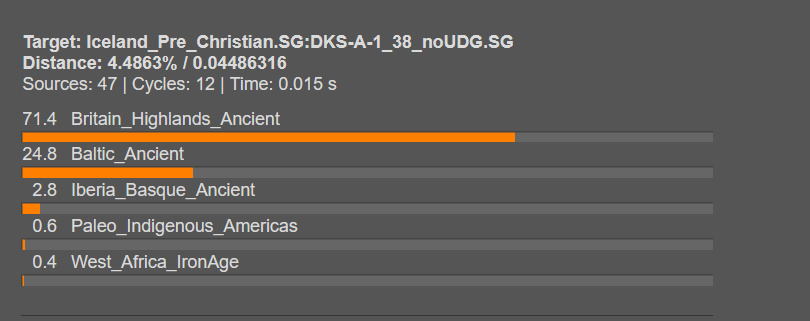
DKS-A1 (Dyrafjordur, Westfjords), female: Strong Gaelic ancestry, particularly on the maternal side; mtDNA U5 or J1 (haplogroups common in the British Isles). A woman with clear Celtic roots, probably brought to Iceland from Ireland or the Hebrides during early Norse expansion or as part of a marriage arrangement.
FOV-A1 (Fossvogur, near Reykjavik), male: Admixed ancestry, approximately 50 percent Norse and 50 percent Gaelic. A true first-generation Icelander, the son of mixed parentage characteristic of the early Landnam population.
GRS-A1 (Grensas, southwestern Iceland), female: Strong Gaelic signal; mtDNA likely H1 or J1. Part of the Gaelic maternal contribution that shaped the Icelandic gene pool.
HSJ-A1 (Husafell), male: Norse paternal line, Gaelic maternal line. The canonical pattern of a Scandinavian father and a Gaelic mother, embodying the sex-biased founding demography.
KNS-A1 (Kornsa), female: Mainly Gaelic ancestry. Probably a woman of direct maternal Gaelic descent, possibly first-generation Irish or Hebridean.
KOV-A2 (Kopavogur), male: Balanced admixture between Norse and Gaelic. Representative of the early Iceland-born generations from mixed unions.
NNM-A1 (Nes, North Iceland), female: mtDNA U5b or H6; predominantly Gaelic ancestry. Part of the early maternal gene pool.
NTR-A2 (Nupur, Northwest Iceland), male: Predominantly Norse ancestry; Scandinavian Y-DNA. Possibly a recently arrived settler from Norway.
ORE-A1 (Oraefi region), female: mtDNA K or T; shared ancestry between Norse and Gaelic maternal lines.
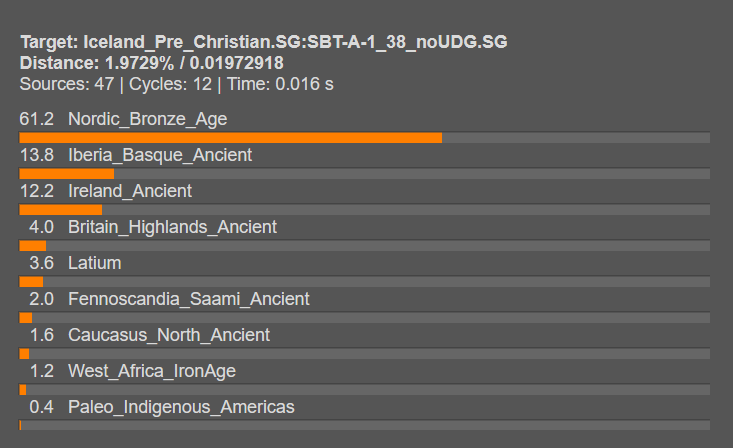
SBT-A1 (Skagafjordur), male: Mixed ancestry, reflecting intermarriage within the first two generations of settlement.
SSG-A2 and SSG-A4 (Skriduklaustur site): One predominantly Norse, one predominantly Gaelic. These two may represent two ends of the ancestral spectrum within the same community.
STT-A2 (Stodvarfjordur), male: Balanced Norse-Gaelic ancestry. Example of deep genetic integration by the 10th century.
SVK-A1 (Svalbard), female: mtDNA J1c3 or U5a; very likely Gaelic maternal origin.
TGS-A1 (Thingeyrar), male: Y-DNA likely I1 (Scandinavian); purely Norse paternal line, with potential Gaelic maternal admixture.
TSK-A26 (Thorskafjordur), female: mtDNA H1 or K1; may reflect cultural assimilation of Gaelic women into Norse Iceland.
VDP-A5, A6, A7 (Vididalstunga): A range from Norse-dominant to 50/50 admixture. These samples from the same site show ongoing mixing of Norse and Gaelic groups into the second century of settlement.
YGS-B2 (Ytra-Gardshorn), male: Predominantly Gaelic ancestry, a relatively rare pattern in male burials. Possibly a Gaelic man brought to Iceland as a slave or free settler.
4. The genetic legacy in modern Icelanders
Modern Icelanders carry the genetic signature of the dual-origin founding directly. The Y-chromosome composition is approximately 70 percent of Norse origin (with high frequencies of I1, R1a-Z284, and Norse-specific R1b subclades), with 30 percent of Gaelic origin (predominantly R1b-L21). The mitochondrial DNA composition is the opposite: approximately 60 percent of Gaelic origin (Atlantic mtDNA haplogroups including H1, J1, U5, K1) and 40 percent of Norse origin. The autosomal ancestry, which averages across both sexes, sits intermediate between Norway and Ireland, with the exact balance varying by region within Iceland.
The modern Icelandic population has been studied intensively in the genetic epidemiology literature (deCODE Genetics, Iceland, has assembled comprehensive genealogical and genotype data on most of the country's population). The dual-origin founding, combined with the small founding population size (estimated 4,000 to 10,000 individuals), the relative geographic isolation of Iceland through the medieval and early modern periods, and the dramatic population bottlenecks (including the volcanic Laki eruption of 1783-84 which killed approximately a quarter of the population), produced a distinctive genetic landscape with elevated frequencies of certain founder mutations, well-documented IBD (identity-by-descent) patterns, and an unusual genealogical-historical record.
5. Why the language survived as Old Norse
The persistence of Old Norse (which became modern Icelandic) as the language of Iceland, despite the substantial Gaelic genetic contribution, illustrates the same asymmetry between linguistic and demographic outcomes seen in many migration events. The settling Norse men controlled the political, economic, and institutional structures of the new Iceland. The Gaelic women, even where they were a numerical majority of the female founders, were absorbed into a Norse-speaking household and community structure. Within a generation, the language of childhood and household was Old Norse, and the language has been spoken in Iceland continuously since the Landnam.
The Gaelic linguistic legacy in modern Icelandic is restricted to a small number of personal names (Njall, Kjartan, etc., which are Gaelic in origin), some place names, and isolated loanwords. The genealogies preserved in Landnamabok and the family sagas record numerous instances of Gaelic mothers, wives, and ancestors, but the dominant cultural memory of Iceland was Norse, and remains so today. The pattern is the same one documented for the Hunnic, Avar, and Magyar elites in Central Europe: small migrating groups that absorbed larger local populations preserved their language despite demographic dilution, because they controlled the institutional channels through which language was transmitted across generations.
6. The Icelandic founding in five phases
The Viking Age opened with the raid on Lindisfarne in 793 CE, but Norse expansion in the North Atlantic had been building for decades. By 870, Norse populations had established themselves across the Hebrides, Orkney, Shetland, Faroes, parts of Ireland (Dublin from 841), and were probing the unsettled North Atlantic islands beyond.
The main Icelandic settlement period. Norse settlers (predominantly Norwegian, with substantial contingents from Norse-controlled British Isles) arrived with Gaelic women through direct migration, raids, slavery, and marriage. By 930 the inhabitable parts of Iceland were claimed; the Althing parliament was established.
Iceland organized as a chieftaincy-based commonwealth without a central monarchy. The genetic intermixing of Norse and Gaelic streams accelerated, producing the admixed first and second-generation Icelandic burials sampled in Margaryan et al. 2018.
Iceland converted to Christianity in 1000 CE through a famous political compromise at the Althing. The Early Christian cemeteries (FOV-A1, KOV-A2, TSK-A26, and others) capture the post-conversion Icelandic population in the burial archaeology. The Commonwealth ended in 1262 with the submission to the Norwegian crown.
Iceland remained under Norwegian, then Danish, sovereignty until independence in 1944 (full sovereignty) or 1918 (kingdom under Danish crown). The genetic legacy of the Landnam population persisted with limited subsequent migration, producing the modern Icelandic gene pool with its distinctive founder-effect characteristics.
7. References
- Margaryan, A., Lawson, D. J., Sikora, M., Rasmussen, S., Cassidy, L. M., Jessen, M., et al. (2020). Population genomics of the Viking world. Nature, 585(7825), 390-396. DOI: 10.1038/s41586-020-2688-8 Viking Iceland
- Ebenesersdottir, S. S., Sandoval-Velasco, M., Gunnarsdottir, E. D., Jagadeesan, A., Guethmundsdottir, V. B., Thordardottir, E. L., et al. (2018). Ancient genomes from Iceland reveal the making of a human population. Science, 360(6392), 1028-1032. DOI: 10.1126/science.aar2625 Iceland aDNA
- Helgason, A., Sigurethardottir, S., Nicholson, J., Sykes, B., Hill, E. W., Bradley, D. G., et al. (2000). Estimating Scandinavian and Gaelic ancestry in the male settlers of Iceland. American Journal of Human Genetics, 67(3), 697-717. DOI: 10.1086/303046 Y-DNA
- Helgason, A., Hickey, E., Goodacre, S., Bosnes, V., Stefansson, K., Ward, R., et al. (2001). mtDNA and the islands of the North Atlantic: estimating the proportions of Norse and Gaelic ancestry. American Journal of Human Genetics, 68(3), 723-737. DOI: 10.1086/318785 mtDNA
- Landnamabok (Book of Settlements). 12th-13th century compilation; standard primary historical source for the Icelandic Landnam. Edited by Jakob Benediktsson, 1968. Primary source
- Davidski, A. (ongoing). Global25 PCA modern and ancient population averages. eurogenes.blogspot.com G25 panel
Iceland_Pre_Christian.SG:DAV-A-8_38_noUDG.SG,0.124067,0.122879,0.073916,0.073644,0.0437,0.023148,0.00423,0.013846,0,-0.006196,-0.008119,0.000749,0.000892,-0.009358,0.016015,0.021612,0.007041,-0.000887,0.006536,0.009004,0.013351,-0.003586,0.000739,0.004579,0.001916
Iceland_Pre_Christian.SG:DKS-A-1_38_noUDG.SG,0.126344,0.142174,0.092395,0.056848,0.031083,0.016733,-0.009165,0.004384,0.010022,-0.005103,-0.002923,-0.001199,0.002379,-0.000413,0.024701,-0.015513,-0.018906,0.007348,0.002137,-0.004127,-0.004367,0.004204,-0.008134,0.009519,0.010658
Iceland_Early_Christian.SG:FOV-A-1_38_noUDG.SG,0.117238,0.126941,0.073916,0.0646,0.028005,0.021475,-0.00188,0.003692,0.006545,-0.007472,-0.002761,0.003897,-0.010258,-0.024359,0.014251,0.001989,-0.00352,0.003674,0.01081,0.008754,-0.001248,0.015086,0.008751,0.016147,-0.008143
Iceland_Pre_Christian.SG:FSS-A-1_38_noUDG.SG,0.126344,0.129988,0.057699,0.045543,0.039392,0.007251,0.003525,0.00923,0.009817,0.00656,-0.005034,0.007493,-0.021556,-0.011836,0.021715,0.004375,-0.003781,-0.002787,0.001131,0.006628,-0.001123,0.003586,0.005423,0.013616,-0.0097
Iceland_Pre_Christian.SG:GRS-A-1_38_noUDG.SG,0.125205,0.132019,0.066373,0.050065,0.036314,0.008088,0.00705,0.000231,0.013499,0,0.002111,0.005695,0.000743,0.001101,0.002036,-0.002917,-0.00352,0.006588,0.003897,-0.001876,-0.000749,-0.000989,-0.006286,0.001325,-0.015208
Iceland_Pre_Christian.SG:HSJ-A-1_38_noUDG.SG,0.134311,0.127957,0.070522,0.06137,0.040007,0.022032,0.00752,0.004384,-0.002045,-0.007472,0.005359,0.001499,-0.012487,-0.020231,0.025515,0.020154,0.005737,0.005194,0.005279,0.01038,0.010606,0.00915,-0.003821,0.007591,0
Iceland_Pre_Christian.SG:KNS-A-1_38_noUDG.SG,0.126344,0.126941,0.058077,0.060078,0.041238,0.008367,-0.00376,0.002769,-0.001023,0.012574,-0.012179,-0.002548,-0.021704,-0.019955,0.016965,0.011933,-0.005867,0.004181,-0.003017,0.013131,-0.006239,0.00779,0.003451,0.018918,0
Iceland_Early_Christian_o.SG:KOV-A-2_38_noUDG.SG,0.124067,0.133034,0.063356,0.04522,0.04647,0.01757,0.004465,0.017538,-0.000614,0.000547,0.003085,0.004196,-0.011447,-0.006468,0.018051,-0.001591,-0.011474,0.014062,0.012193,0.001876,0.006114,-0.011129,0.012325,0.015785,-0.010777
Iceland_Pre_Christian.SG:NNM-A-1_38_noUDG.SG,0.138864,0.118817,0.078818,0.075582,0.053241,0.010598,0.00235,0.011307,-0.001023,-0.011845,-0.004222,-0.008093,0.010406,-0.01101,0.022394,0.007955,-0.004824,-0.002027,0.010307,-0.000375,0.003119,0.009274,-0.000246,0.028558,0.011137
Iceland_Pre_Christian.SG:NTR-A-2_38_noUDG.SG,0.120652,0.128972,0.052797,0.048773,0.032314,0.023427,-0.000235,-0.004846,0.008999,0.027153,-0.000325,0.008093,-0.014569,-0.013212,0.026465,-0.012331,-0.015125,-0.000633,0.000251,-0.000625,-0.002496,-0.000618,-0.013311,0.012773,0.001437
Iceland_Pre_Christian.SG:ORE-A-1_38_noUDG.SG,0.135449,0.136081,0.055814,0.043282,0.036007,0.03012,0.008225,0.015692,0.015339,0.003098,-0.011854,-0.010041,-0.030921,-0.016652,0.025244,-0.005436,-0.036116,-0.00228,0.003645,0.002251,-0.002745,0.007048,0.007518,-0.006025,-0.000718
Iceland_Pre_Christian.SG:SBT-A-1_38_noUDG.SG,0.120652,0.127957,0.062602,0.044251,0.038776,0.016733,0.001175,0.005077,0.003068,0.006378,0.000812,0.013038,-0.008622,-0.013074,0.017101,0.009944,-0.002738,-0.00228,0.003017,0.002876,0.006364,0.015457,0.004683,0.00976,0.000599
Iceland_Pre_Christian.SG:SSG-A-2_38_noUDG.SG,0.122929,0.125926,0.053928,0.053295,0.0397,0.011992,0.006345,0.008538,0.002045,-0.006925,-0.000162,0.005995,-0.016947,-0.009358,0.018729,0.002121,-0.004042,0.006081,0,0.001,0.007736,0.001855,-0.00986,0.015665,-0.003832
Iceland_Pre_Christian.SG:SSG-A-4_38_noUDG.SG,0.121791,0.135065,0.068636,0.055556,0.036622,0.023427,-0.00094,0.009,0.008181,0.009659,-0.008607,0.010191,-0.015461,-0.027249,0.02443,0.001856,-0.000261,0.0019,0.009679,0.001376,0.007487,0.002102,0.002342,0.0194,0.007784
Iceland_Pre_Christian.SG:STT-A-2_38_noUDG.SG,0.12862,0.137096,0.063356,0.065892,0.036622,0.016733,0.00752,0.008077,-0.001432,0.001276,-0.004547,0.007493,-0.014271,-0.021056,0.035694,0.016971,0.006128,0.004941,0.001634,0.004877,0.001996,0,-0.006655,0.008555,0.000239
Iceland_Pre_Christian.SG:SVK-A-1_38_noUDG.SG,0.12862,0.136081,0.071653,0.062339,0.037238,0.023706,0.00752,0.011538,0.000818,-0.000911,-0.009581,0.019333,-0.012339,-0.008395,0.012622,0.013789,0.011343,-0.001394,-0.001131,0.006003,0.008235,-0.002844,-0.003451,0.026389,-0.008023
Iceland_Pre_Christian.SG:TGS-A-1_38_noUDG.SG,0.124067,0.127957,0.073539,0.066215,0.036007,0.017849,0.00564,0.011769,-0.000614,-0.003098,0.004384,-0.000749,-0.012487,-0.009358,0.014794,0.013922,-0.000391,0.004814,0.010056,-0.004627,0.015972,-0.004451,0.00037,0.003253,0.00934
Iceland_Early_Christian.SG:TSK-A-26_38_noUDG.SG,0.140002,0.127957,0.070522,0.055233,0.041854,0.020638,0.00141,0.005307,0.011044,0.003462,-0.008931,0.007793,-0.016947,-0.01734,0.011401,0.018297,0.017211,0.001014,-0.000251,0.00075,0.005116,0.005812,-0.001972,0.009519,-0.001197
Iceland_Pre_Christian.SG:VDP-A-5_38_noUDG.SG,0.125205,0.128972,0.078441,0.065246,0.028928,0.019243,0.0094,0.011307,0.006749,-0.011481,0.000162,0.007643,-0.005054,-0.017478,0.02443,0.020817,0.014733,0.004561,-0.003897,0.005878,0.009982,0.004328,0.004683,0.013014,-0.004431
Iceland_Pre_Christian.SG:VDP-A-6_38_noUDG.SG,0.122929,0.135065,0.064111,0.051357,0.033545,0.015339,0.008225,0.006923,0.002045,0.001458,-0.008931,0.01139,-0.017096,-0.011698,0.018458,0.004906,-0.007171,-0.002787,0.001383,0.009129,0.006988,-0.000742,0.001232,0.015183,0.004191
Iceland_Pre_Christian.SG:VDP-A-7_38_noUDG.SG,0.125205,0.120848,0.074293,0.062016,0.027082,0.029005,0.00188,0.003461,-0.009817,-0.006196,-0.012666,0.008393,-0.014866,-0.004404,0.029994,0.003447,-0.017602,0.005954,0.005154,0.006378,0.010232,-0.000866,0.004067,0.008555,-0.000838
Iceland_Pre_Christian.SG:YGS-B-2_38_noUDG.SG,0.120652,0.126941,0.07467,0.053295,0.037853,0.022032,0.00141,0.007846,0.009817,-0.005649,-0.003897,0.004196,-0.015609,-0.012111,0.028908,0.01127,-0.005867,-0.000253,0.004777,0.011506,0.00574,0.012489,0.001109,0.017352,0.002036
Early Icelandic individuals - G25 distance to Norwegian vs Irish modern populations
Each early Icelandic individual is shown by its G25 distance to modern Norwegian and modern Irish. Individuals closer to Norwegian carry more Norse ancestry; closer to Irish, more Gaelic ancestry; intermediate, admixed.