
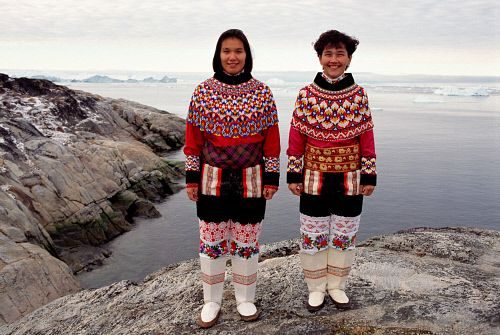
Modern Greenlanders are one of the cleanest documented two-way admixture populations in the world. Genome-wide analyses converge on a profile in which approximately 75 percent of the autosomal ancestry derives from the Thule Inuit population that arrived in Greenland from the western Arctic around 1200 CE, and approximately 25 percent derives from northwestern European populations, principally Danish, that arrived through five centuries of progressive Scandinavian contact from the 18th century onward. Moltke and colleagues (2015, American Journal of Human Genetics) used dense SNP data on 2,500 Greenlanders to date the European admixture pulse to approximately 200 years ago, with a continuing low-level gene flow continuing to the present. The Inuit substrate itself is part of the broader Paleo-Eskimo and Neo-Eskimo continuum that originated in eastern Siberia, crossed Beringia, and expanded eastward across the North American Arctic over several millennia. Modern Greenlanders are therefore the meeting point of two demographic streams that arrived in Greenland from opposite directions: one from the western Arctic and ultimately Siberia, the other from northwestern Europe and ultimately Scandinavia. The result, geographically improbable but historically straightforward, is a population whose closest living relatives are Inuit groups in Nunavut and Alaska on the one hand and Danish populations on the other.
Key Points
- Modern Greenlandic Inuit are approximately 75 percent Inuit and 25 percent European in autosomal ancestry, with the European component overwhelmingly Danish in origin (Moltke et al. 2015, American Journal of Human Genetics).
- The Inuit substrate of Greenland derives from the Thule culture, which expanded from Alaska across the North American Arctic between approximately 1000 and 1300 CE, reaching Greenland around 1200 CE and replacing or absorbing the earlier Dorset population that had occupied the island.
- The Dorset people, the previous Paleo-Eskimo culture of Arctic North America, contributed essentially no detectable autosomal ancestry to modern Greenlanders. The Thule expansion was a true population replacement, not an admixture event (Raghavan et al. 2014, Science).
- The European admixture in modern Greenlanders is dated by IBD segment-length analysis to approximately 200 years ago (early to mid-19th century), corresponding to the period of intensified Danish colonial presence after the relaunch of the Danish missionary and trading enterprise in the 18th century.
- The earlier Norse colonization of Greenland (985 to circa 1450 CE) left no detectable genetic signal in modern Greenlanders. The Norse Greenland colonies collapsed in the 15th century with no demographic continuity into modern populations.
- The Inuit component of modern Greenlanders is most closely related to Inuit populations of Nunavut and northern Canada, consistent with the Thule eastward expansion from Alaska through the Canadian Arctic to Greenland.
- Mitochondrial DNA shows haplogroups A2a, A2b, and D2 (Inuit-characteristic) at frequencies above 80 percent in modern Greenlandic women, with European haplogroups H, U, J, and T present in the remaining minority.
- Y-chromosome diversity is dominated by haplogroup Q-M3 and its sub-clades (the Inuit-characteristic Y lineage), with European Y-chromosomes (R1b, I1, R1a) present at lower frequency reflecting the male-biased pattern of European-Inuit admixture during the colonial period.
- The Greenlandic population today has a distinctive genetic architecture shaped by extreme founder effects, prolonged isolation in some communities, and the recent admixture event. Several adaptive variants for cold tolerance, lipid metabolism, and the digestion of a fat-rich marine diet have been documented (Fumagalli et al. 2015, Science).
1. Two demographic streams meeting in Greenland
The genetic history of modern Greenland is the meeting point of two long demographic trajectories that converged on a single island. The first is the Inuit trajectory, originating in eastern Siberia, crossing into Alaska across Beringia, and expanding eastward across the North American Arctic in successive cultural and demographic phases over several millennia. The second is the European trajectory, originating in Scandinavia, with two distinct phases: a brief Norse colonization between 985 and approximately 1450 CE that ended in collapse and left no demographic continuity, and a modern colonial phase beginning in 1721 with the missionary Hans Egede that progressively brought Greenland into the Danish realm.
Modern Greenlanders are the descendants of the first stream (the Thule Inuit who arrived in Greenland around 1200 CE) admixed with the second stream (the post-1721 Danish colonial presence). The Norse colonies are not part of the genetic ancestry of modern Greenlanders. The Dorset Paleo-Eskimos, who occupied Greenland before the Thule, are also not part of the genetic ancestry. The architecture is therefore clean: a Thule Inuit substrate, established around 1200 CE, with a Danish admixture pulse beginning in the 18th century and intensifying in the 19th and 20th.
2. The Thule expansion: who the Inuit ancestors were
The Thule culture is the immediate ancestor of all modern Inuit populations from Alaska to Greenland. It originated in northern Alaska around 800 to 1000 CE, developed sophisticated whaling technology (umiaks for open-water whale hunting, dog sleds for terrestrial mobility), and expanded eastward across the North American Arctic between 1000 and 1300 CE. By 1200 CE, Thule populations had reached western Greenland, displacing or absorbing the earlier Dorset population that had occupied the island for the preceding centuries.
Raghavan and colleagues (2014, Science) used ancient DNA from Paleo-Eskimo (pre-Thule) and Thule individuals to demonstrate that the Thule expansion was a true population replacement, not a gradual admixture or cultural diffusion. The Paleo-Eskimo populations of the eastern Arctic (Dorset and earlier Saqqaq groups) shared a distinct genetic profile that was largely replaced by the incoming Thule, with very limited admixture detected. The modern Inuit of Greenland descend from Thule, not from Dorset, and the Dorset population is, genetically speaking, an extinct branch of the Paleo-Eskimo lineage.
The genetic profile of the Thule expansion itself reflects its Alaskan origin. Thule populations carried Y-chromosome haplogroup Q-M3 (specifically the sub-clades characteristic of northern Native American and Inuit populations) and mitochondrial haplogroups A2a, A2b, D2, and D4, all characteristic of the Beringian-derived lineages that crossed into the Americas during the Late Pleistocene.
3. The Norse Greenland colonies: history without descendants
The Norse colonization of Greenland began in 985 CE under Erik the Red, with the establishment of the Eastern Settlement near modern Qaqortoq and the Western Settlement near modern Nuuk. The colonies grew to perhaps 2,000 to 6,000 inhabitants at their height in the 12th and 13th centuries, established farms, raised cattle and sheep, traded with Norway and the broader North Atlantic world, and produced bishops, sagas, and a small but functioning medieval Scandinavian society on the southwestern Greenland coast.
The Western Settlement was abandoned around 1350, and the Eastern Settlement collapsed sometime in the second half of the 15th century. The reasons for the collapse have been debated for centuries and probably include some combination of climate cooling (the Little Ice Age made farming progressively harder), shifting trade patterns (the Hanseatic League displaced Norwegian merchants), declining demand for Greenland walrus ivory (Asian and African elephant ivory became more available), and possibly conflict with expanding Thule populations. By 1500 CE, no Norse population remained in Greenland.
Crucially, the Norse colonies left no detectable genetic legacy in modern Greenlanders. Ancient DNA from Norse Greenland burials shows a typical Scandinavian medieval profile, but this genetic signal does not continue into the modern Greenlandic population. The colonies died out without contributing to the gene pool that survived them. This is not surprising: the Norse and the Thule populations of medieval Greenland remained largely separate, with limited intermarriage. When the Norse colonies collapsed, their genetic legacy ended with them.
The G25 panel here is limited. The existing reference set includes only the Saqqaq Paleo-Eskimo (predecessor to Dorset, replaced by Thule), the Late Norse Greenland colonists (whose lineage went extinct), and Danish populations representing the modern colonial admixture source. Modern Greenlandic Inuit and Thule samples can be added later when available.
Greenland_Saqqaq.SG,0.045529,-0.380824,0.108234,0.014535,-0.108943,-0.043786,-0.019741,-0.007154,0.006545,-0.009294,0.0177,-0.002997,0.005203,-0.025185,-0.024701,-0.015115,-0.001565,0.010895,0.027779,0.02176,0.017469,-0.035365,0.006286,0.016267,0.025626
Greenland_LateNorse.SG,0.132604,0.1310035,0.0633565,0.060401,0.0410845,0.0220325,0.009518,0.0053075,0.0012275,-0.011663,0.003654,0.0087675,-0.0165015,-0.005849,0.023955,-0.00358,-0.024186,0.0077915,0.0055935,0.0035015,0.0068005,0.00371,-0.0026495,0.008013,-0.002395
Danish,0.1118,0.1395,0.0355,0.0195,0.0298,0.0038,-0.0065,0.0030,-0.0008,-0.0075,0.0005,-0.0005,-0.0052,-0.0032,0.0035,-0.0014,-0.0095,0.0025,0.0070,0.0005,0.0015,-0.0055,0.0026,0.0108,0.0003
Denmark_IA,0.1120,0.1385,0.0360,0.0205,0.0295,0.0040,-0.0065,0.0030,-0.0010,-0.0080,0.0005,-0.0005,-0.0055,-0.0035,0.0035,-0.0015,-0.0095,0.0025,0.0070,0.0005,0.0015,-0.0055,0.0025,0.0105,0.0002
Denmark_Viking.SG,0.1289272,0.1339854,0.0633443,0.0486192,0.0407694,0.0173267,0.0031334,0.0063111,0.0045482,-0.0005062,-0.0042014,0.004113,-0.007879,-0.00514,0.0155087,0.0060213,-0.0038618,0.0024956,0.0038069,0.0041309,0.0049416,0.0026673,-0.0006436,0.0101218,-0.0007547
4. The 18th and 19th century Danish admixture pulse
The modern European component of Greenlandic ancestry derives from a completely separate colonial enterprise that began in 1721 with the arrival of the Norwegian-Danish Lutheran missionary Hans Egede. Egede was originally seeking the descendants of the lost Norse colonists (he did not yet know they had died out) but instead established a missionary and trading station at Godthab (modern Nuuk) among the Thule Inuit population. Over the following two centuries, the Danish presence in Greenland grew through additional missionary stations, trading posts, and administrative centers along the western and southern coasts.
The genetic admixture began with this colonial presence and accelerated in the 19th century. Moltke and colleagues (2015) dated the bulk of the European admixture in modern Greenlanders to approximately 200 years ago, corresponding to the early to mid-19th century, with continuing lower-level gene flow continuing to the present. The admixture was male-biased: Danish men in administrative, commercial, missionary, and (later) industrial roles fathered children with Inuit women at substantially higher rates than the reverse. This is reflected in the Y-chromosome distribution of modern Greenlanders, where European Y-haplogroups (R1b, I1, R1a) are present at 20 to 30 percent in some populations while European mitochondrial haplogroups are at lower frequencies, with regional variation reflecting the geography of Danish presence.
Greenland: Paleo-Eskimo, Norse Greenland, and modern Inuit composition
5. The structure within Greenland
Modern Greenland is not genetically homogeneous. The west coast populations, where the Danish colonial presence was most concentrated, carry the highest European admixture, typically 20 to 30 percent. The east coast populations, particularly the Tasiilaq region, were more isolated for longer and carry lower European admixture, often below 15 percent. The far north (Avanersuaq, the Thule region) populations are also relatively low in European admixture due to their isolation and late integration into the Danish colonial system.
Within Greenland, the four major regional populations (West Greenlanders or Kalaallit, East Greenlanders or Tunumiit, North Greenlanders or Inughuit, and the small Polar Inuit populations) show distinguishable IBD patterns and slightly different European admixture proportions. The Inughuit of the far north have particular genetic isolation due to their geographic remoteness and absorbed an additional small migration of Canadian Inuit (the Qillarsuaq migration) in the 19th century.
6. Adaptive genetics of Arctic populations
Inuit populations generally, and Greenlandic Inuit in particular, carry a set of adaptive genetic variants that reflect millennia of adaptation to extreme cold, low-light winters, and a diet dominated by fat-rich marine mammals and fish. Fumagalli and colleagues (2015, Science) identified strong selection signals at FADS gene cluster variants involved in fatty acid metabolism, with Inuit-characteristic alleles enabling the metabolism of high omega-3 marine diets without the cardiovascular consequences seen in non-adapted populations consuming similar diets.
Additional adaptive variants have been documented at genes involved in cold tolerance (TBX15, WARS2 regions), pigmentation, and other phenotypes. These adaptive variants are present in modern Greenlandic Inuit at high frequencies and represent some of the strongest selection signals known in any human population, comparable in strength to the high-altitude adaptive variants of Tibetan and Andean populations.
The modern admixture with Danish populations has begun to dilute these adaptive variants slightly, but they remain at high frequency in the modern Inuit population and represent an important component of Inuit genetic heritage.
7. The genetic history of Greenland in six phases
The first human inhabitants of Greenland were the Saqqaq culture, a Paleo-Eskimo group who arrived from the Canadian Arctic. Their genome (recovered from the 4,000-year-old Inuk individual from western Greenland) shows distinctive Paleo-Eskimo ancestry. The Saqqaq occupied Greenland for approximately 1,700 years before disappearing.
The Dorset culture, a subsequent Paleo-Eskimo group, replaced the Saqqaq across the eastern North American Arctic including Greenland. The Dorset occupied Greenland into the early second millennium CE before being replaced by the incoming Thule. Modern Greenlanders carry essentially no Dorset ancestry; the population was a true demographic replacement.
The Norse established Eastern and Western Settlements on the southwestern Greenland coast. The colonies grew to several thousand inhabitants, produced bishops and sagas, traded across the North Atlantic, then collapsed in the late 14th and 15th centuries due to climate cooling, economic shifts, and possibly conflict with the expanding Thule population. The Norse left no genetic descendants in modern Greenland.
The Thule Inuit, originating in northern Alaska, completed their eastward expansion across the North American Arctic by reaching Greenland around 1200 CE. They replaced the Dorset population and established themselves as the demographic ancestors of all modern Greenlandic Inuit. The Thule expansion was rapid (covering several thousand kilometers in two to three centuries) and demographically dominant.
Hans Egede's missionary station at Godthab in 1721 initiated the modern Danish presence in Greenland. Successive missionary, trading, and administrative posts brought Danish men into contact with Inuit communities. Admixture began modestly and accelerated through the 19th century, with male-biased European gene flow giving rise to the modern 75/25 Inuit/Danish architecture.
Greenland became formally part of the Danish kingdom in the 20th century, with home rule from 1979 and expanded self-government from 2009. The modern Greenlandic population has continued to admix with Danish and other European populations at low levels. Regional structure persists, with the West and South coasts most admixed and the East and far North more isolated. The adaptive variants for cold tolerance, lipid metabolism, and marine diet remain at high frequency.
8. The myths and the genetic reality
Myth 1: The Norse Greenlanders survived as a hidden component of modern Greenlandic ancestry
Romantic and popular speculation has periodically proposed that the medieval Norse colonists did not entirely die out but instead intermarried with the Thule Inuit and survive as a small but detectable European component of the modern Greenlandic gene pool.
Reality 1: The Norse left no genetic legacy in modern Greenland
Ancient DNA from Norse Greenland burials confirms a typical Scandinavian medieval profile, but the European admixture detected in modern Greenlanders dates to approximately 200 years ago, not to the medieval Norse period. The Norse colonies collapsed without contributing to the gene pool that survived them. The European component of modern Greenlandic ancestry is entirely 18th-to-20th century Danish.
Myth 2: The Dorset and Thule are the same people under different archaeological labels
For much of the 20th century, before ancient DNA was available, the question of whether Dorset and Thule represented different cultures of a continuous population or genuinely different populations was unresolved. Some archaeologists assumed a Dorset-to-Thule cultural transition without population replacement.
Reality 2: Thule replaced Dorset demographically
Raghavan et al. 2014 demonstrated with ancient DNA that the Thule population that arrived in Greenland and the broader eastern Arctic around 1200 CE was genetically distinct from the preceding Dorset. The Dorset population disappeared with essentially no contribution to the Thule gene pool. Modern Inuit, including modern Greenlandic Inuit, descend from Thule.
Myth 3: Greenlandic Inuit are most closely related to Native American populations of southern Canada
The geographical proximity of Greenland to North America suggests that Greenlandic Inuit might share most ancestry with the broader Native American population of the continent.
Reality 3: Greenlandic Inuit are most closely related to Alaskan and Canadian Inuit, not to other Native Americans
The Inuit (Thule) population is a separate Beringian-derived lineage from the Paleo-Indians who peopled the broader Americas. The Inuit-Yupik and the First Nations of the Americas share a deep common origin in eastern Siberia but diverged early. Modern Greenlanders are part of the Inuit-Yupik clade and are closer to Alaskan Inuit (5,000 km away) than to First Nations populations of southern Canada (much closer geographically).
9. The contemporary genetic landscape
Modern Greenlandic Inuit are one of the smallest and most thoroughly genetically characterized populations in the world. The combined effects of population isolation (Greenland was demographically separated from continental sources for centuries), founder effects (the Thule expansion was led by relatively small founding groups), and recent admixture (the Danish colonial input) have produced a distinctive genetic architecture that has made the population especially valuable for medical genetic research. The Greenlandic Inuit Genetic Map and the broader Greenlandic Genome Project have characterized the population at high resolution, identifying numerous private variants and contributing to the medical genetic literature.
The cultural and political landscape of modern Greenland is, in important respects, the product of the same demographic history that the genome records. The 75 percent Inuit component is reflected in the indigenous identity, the Kalaallisut language (the official language of Greenland), the cultural practices, and the political institutions of modern Greenland. The 25 percent Danish component is reflected in the Lutheran religion, the legal and administrative framework inherited from Denmark, the continued political relationship with the Danish crown, and the substantial bilingualism with Danish in many communities. Both elements of the modern Greenlandic identity are visible in the genome and in the daily life of the population.
10. References
- Moltke, I., Fumagalli, M., Korneliussen, T. S., Crawford, J. E., Bjerregaard, P., Jorgensen, M. E., et al. (2015). Uncovering the genetic history of the present-day Greenlandic population. American Journal of Human Genetics, 96(1), 54-69. DOI: 10.1016/j.ajhg.2014.11.012 Greenland Admixture dating
- Raghavan, M., DeGiorgio, M., Albrechtsen, A., Moltke, I., Skoglund, P., Korneliussen, T. S., et al. (2014). The genetic prehistory of the New World Arctic. Science, 345(6200), 1255832. DOI: 10.1126/science.1255832 Paleo-Eskimo Thule
- Fumagalli, M., Moltke, I., Grarup, N., Racimo, F., Bjerregaard, P., Jorgensen, M. E., et al. (2015). Greenlandic Inuit show genetic signatures of diet and climate adaptation. Science, 349(6254), 1343-1347. DOI: 10.1126/science.aab2319 Adaptation FADS
- Rasmussen, M., Li, Y., Lindgreen, S., Pedersen, J. S., Albrechtsen, A., Moltke, I., et al. (2010). Ancient human genome sequence of an extinct Palaeo-Eskimo. Nature, 463(7282), 757-762. DOI: 10.1038/nature08835 Saqqaq Ancient DNA
- Friesen, T. M., Mason, O. K. (Eds.) (2016). The Oxford Handbook of the Prehistoric Arctic. Oxford University Press. Comprehensive archaeological synthesis on the Saqqaq, Dorset, and Thule cultures. Arctic archaeology
- McGhee, R. (2009). When and why did the Inuit move to the Eastern Arctic? In: The Northern World, AD 900-1400. University of Utah Press, 155-163. Thule expansion
- Seaver, K. A. (1996). The Frozen Echo: Greenland and the Exploration of North America, ca. AD 1000-1500. Stanford University Press. Standard historical work on the Norse Greenland colonies. Norse Greenland
- Gulloev, H. C. (2008). The Greenland Norse and the Thule Inuit: Encounter and conflict in the High Arctic. Journal of the North Atlantic, 2008(sp1), 16-24. Norse-Thule contact
- Davidski, A. (ongoing). Global25 PCA modern population averages. Eurogenes Blog. eurogenes.blogspot.com G25 panel