
Independent research | Ancient DNA
Who Were the Goths?
What the ancient DNA of the Gothic period shows when it is read region by region
Hero image: AI generated illustration of a Late Antique cemetery on the lower Danube. It is not a reconstruction of a documented site and is not a portrait of any real person.
Independent research by Ilian Yordanov. This article is published as written by its author. Independent research represents the views of its authors and does not necessarily reflect the editorial position of ExploreYourDNA.
Dozens of skeletons from the 3rd to the 8th century, from Ukraine to Portugal, have been published as "Gothic". If these people were one population, they should share one genetic profile. They do not: the Gothic-labelled samples are among the most heterogeneous groups in the ancient DNA record. This article asks a simple question - is there a profile among them that behaves like a real population, and if so, where does it come from? As in our previous article, every number here can be reproduced by anyone with the same coordinates.
1. What the problem is
Most of the debate about the Goths is really a debate about labels. A burial is called "Gothic" when it falls in the right period and contains the right kind of grave goods. The label tells us when a person was buried and in what material culture - not who their ancestors were. A cemetery of the Gothic period can contain locals, newcomers from elsewhere, people of mixed descent, and, somewhere among them, the Goths themselves.
This is why the published results look contradictory. Samples from the Wielbark culture in Poland, often presented as proto-Gothic, come out as northern Europeans. Samples from the Black Sea region come out Pontic and Balkan. Visigoths in Spain look partly Iberian, partly eastern. Each result is correct for the samples it describes; the confusion arises when all of them are treated as one people.
The mainstream reconstruction derives the Goths from the Wielbark culture of northern Poland, from where they are supposed to have moved to the Black Sea in the 2nd-3rd centuries. The ancient and early medieval authors, on the other hand, consistently call the Goths Getae - the name of the northern Thracian population of the Lower Danube. The usual explanation is that this was a literary archaism: an old, prestigious name applied to a new people. That explanation is an interpretation, and no evidence is offered for it. We neither accept nor reject it in advance. This article looks only at the genes.
2. How it is calculated
Each ancient individual is described by 25 numbers - coordinates that summarise its genetic position relative to everyone else (the system is called G25). Two people with similar coordinates are genetically similar; the distance between their coordinates measures how different they are.
We use two tools. The first is distance: for each Gothic-period sample we ask which of several reference populations it stands closest to. The second is mixture modelling, as in our previous article: can a sample be represented as, say, "50% of population A plus 30% of B plus 20% of C"? The computer finds the best combination and reports what remains unexplained - the residual.
Key for reading below: a small residual (around 0.01) means the model works. A large residual (0.03 and above) means a source is missing, and the percentages should not be read literally. When a source is offered and receives zero, it is not because we excluded it - it was given a place and did not improve the fit.
2.1 The Gothic-period samples
We include every available sample associated with the Goths, with genome coverage of at least 15%. Low-coverage samples give noisy coordinates and are excluded (MJ-36, MJ-37 and UKR047 from Chernyakhiv, and six Iberian samples). This leaves 53 individuals.
| Region | Sites | Date | n |
|---|---|---|---|
| Chernyakhiv culture | Poltava, Cherkasy, Kharkiv, Chernivtsi regions (Ukraine) | 228-413 AD | 11 |
| Serbia | Viminacium, Mediana | Late Antiquity | 2 |
| Bulgaria (AKO) | Han Krum, later the Aula of Khan Omurtag | 350-489 AD | 16 |
| Iberia | Granada, Girona (Pla de l'Horta), Barcelona, Madrid, Menorca, Valencia, Estremadura | 283-797 AD | 22 |
| Crimea | Migration-period Goths | 328 and 550 AD | 2 |
AKO is included because the authors of its publication themselves associate it with Gothic material culture. Aquae Calidae, a cemetery of the same period near Burgas, is not used: it turned out to be a cosmopolitan imperial sample and does not represent the local population.
2.2 Reference poles, defined without the Goths
If "Balkan" were defined using the Gothic samples themselves, the test would be circular. So the reference populations - which we call poles - are all Iron Age groups that take no part in the classification:
| Pole | Samples | Date | Distance to modern Bulgarian |
|---|---|---|---|
| Pontic-Balkan Iron Age | UKR002, UKR007 (Thracian Hallstatt, Odesa region); UKR089, UKR090, UKR091 (local element among the Poltava Scythians) | 913-350 BC | 0.035 |
| Northern Pontic Scythians | UKR000, UKR035AB, UKR042, UKR043, UKR044, UKR095, UKR111 | 850-296 BC | 0.076 |
| Wielbark (Poland) | nine individuals from Weklice | 1st-2nd c. AD | 0.095 |
| Iberian Iron Age | ten Spain_IA individuals | 600-200 BC | 0.085 |
| Anatolian Iron Age | six Turkey_IA individuals | 800-550 BC | 0.136 |
The two Pontic poles are the western Scythian sample used in our previous article, split into its Balkan-like and northern-leaning individuals. The Iberian and Anatolian poles are there to catch two kinds of people who are certainly not Goths: the local population of the place of burial, and imperial newcomers from the eastern Mediterranean.
A note for readers of the previous article. There, "Balkan Iron Age" was the average of seven interior Balkan groups (Albania, Croatia, Slovenia, North Macedonia, Bulgaria), at 0.049 from the modern Bulgarian. The Pontic-Balkan pole here is a different group: Thracian and local samples from the northern Black Sea coast, at 0.035. The two numbers do not contradict each other - they describe two different parts of the Iron Age Balkan world, and the northern, Pontic one is closer to modern Bulgarians. For the mixture models in section 8 we return to the seven-group average, so that those results are directly comparable with the previous article.
2.3 How to recognise a real population behind a label
A population that stands behind a label should meet three conditions:
1. It recurs across regions - in more than one cemetery, in more than one country.
2. It is not simply the local population of the place where it was buried.
3. It has genetic continuity in the region with which the written sources connect it.
Locals of the burial place fail the second condition. Isolated individuals fail the first. A profile that meets all three is the best candidate for the people who carried the name.
3. First result: who is buried in the Gothic-period cemeteries
| Region | Pontic-Balkan | N. Pontic Scythian | Iberian | Wielbark | Anatolian |
|---|---|---|---|---|---|
| Chernyakhiv (11) | 5 | 3 | - | 2 | 1 |
| Serbia (2) | 1 | 1 | - | - | - |
| Bulgaria, AKO (16) | 11 | 5 | - | - | - |
| Iberia (22) | 8 | 1 | 11 | 2 | - |
| Crimea (2) | - | 2 | - | - | - |
| Total (53) | 25 | 12 | 11 | 4 | 1 |
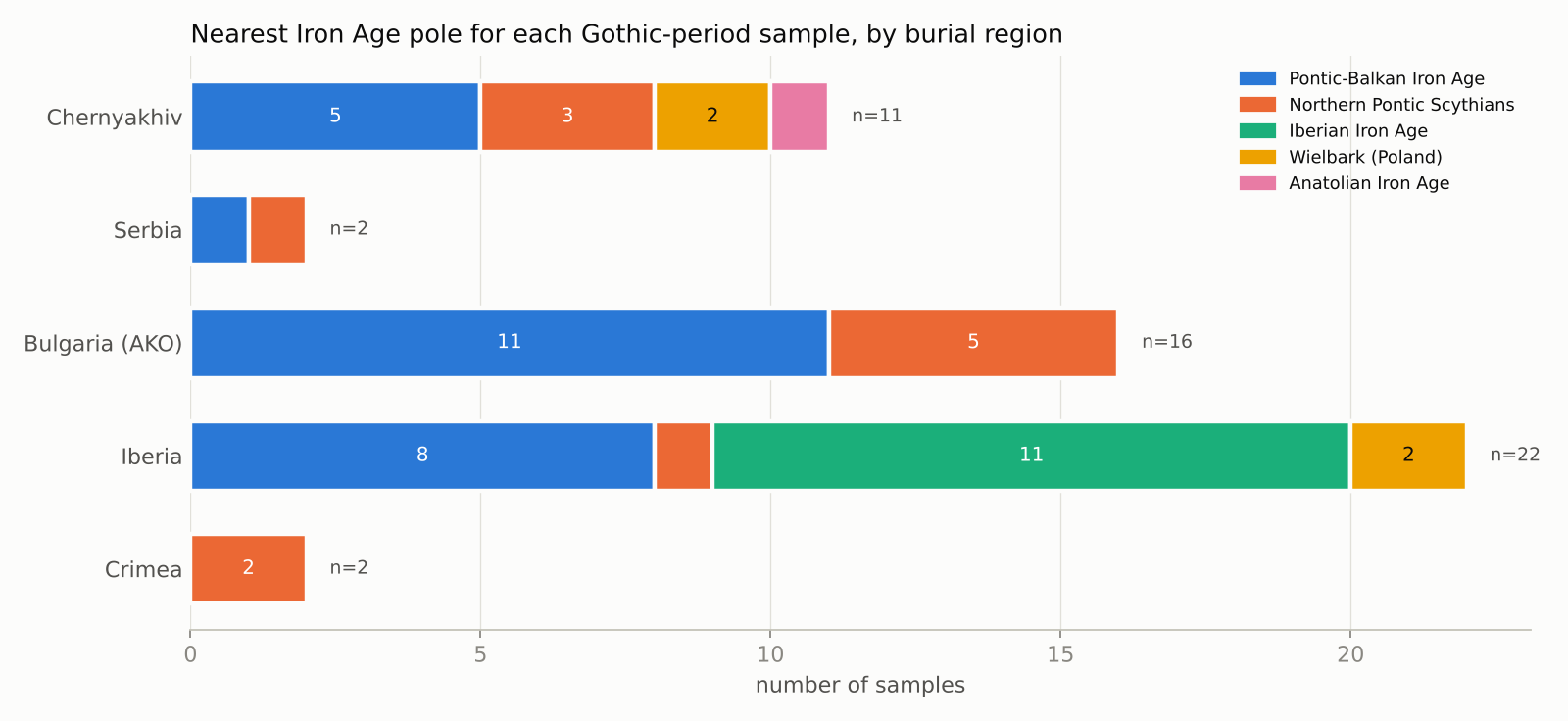
Figure 1. The nearest Iron Age pole for each Gothic-period sample, by burial region.
Applied to the three conditions, the picture separates cleanly:
- Pontic-Balkan cluster. 25 samples, in four of five regions. It recurs, it is not the local population of Iberia, and it has continuity to the present day (section 9).
- Northern Pontic stream. 12 samples, in all five regions, including both Crimean Goths. It recurs and is local to the Black Sea region since the Iron Age.
- Iberians. 11 samples, only in Iberia. These are local people buried under a Visigothic label; the profile does not recur outside the peninsula.
- Wielbark. 4 samples: two from Chernyakhiv (UKR125, UKR129) and two Visigoths (I12162, I12032).
- Anatolian. 1 sample (UKR049).
37 of 53 Gothic-period individuals (70%) stand closest to the Iron Age population of the Pontic-Balkan region - the zone in which the written sources first place the Goths. The Polish pole, the supposed homeland, is closest to four.
4. Chernyakhiv: a crossroads, not a homeland
The Chernyakhiv culture of the 3rd-4th centuries is usually treated as the Gothic culture of the Black Sea region. Genetically it is a crossroads: its eleven usable samples spread over four poles. Remarkably, the split matches the sub-labels that the compilers of the dataset had assigned independently, before any of this analysis:
| Dataset sub-label | Samples | Nearest pole |
|---|---|---|
| Chernyakhiv_2 (Poltava, Cherkasy, Kharkiv) | UKR045, UKR102, UKR121, UKR123, UKR128 | all Pontic-Balkan |
| Chernyakhiv_3 (Chernivtsi) | UKR049 | Anatolian |
| Chernyakhiv_1 (Poltava) | UKR125, UKR129 | Wielbark |
| Chernyakhiv_1 (Poltava) | UKR122, UKR126 | Northern Pontic Scythians |
| Chernyakhiv (shotgun data) | MJ-19 | Northern Pontic Scythians |
So the northern-looking part of Chernyakhiv is itself mixed. Only two individuals lean towards Poland; the others are closest to the Scythian population that had lived in the same forest-steppe since the Iron Age. The same holds for the group as a whole: the Iron Age Scythians of the Kyiv region (labelled "Illyrian-Thracian" in the dataset) stand at 0.028 from the northern Chernyakhiv samples - closer than Wielbark (0.033). The northern profile in Chernyakhiv has a local Iron Age precedent and does not need a migration from Poland to be explained.
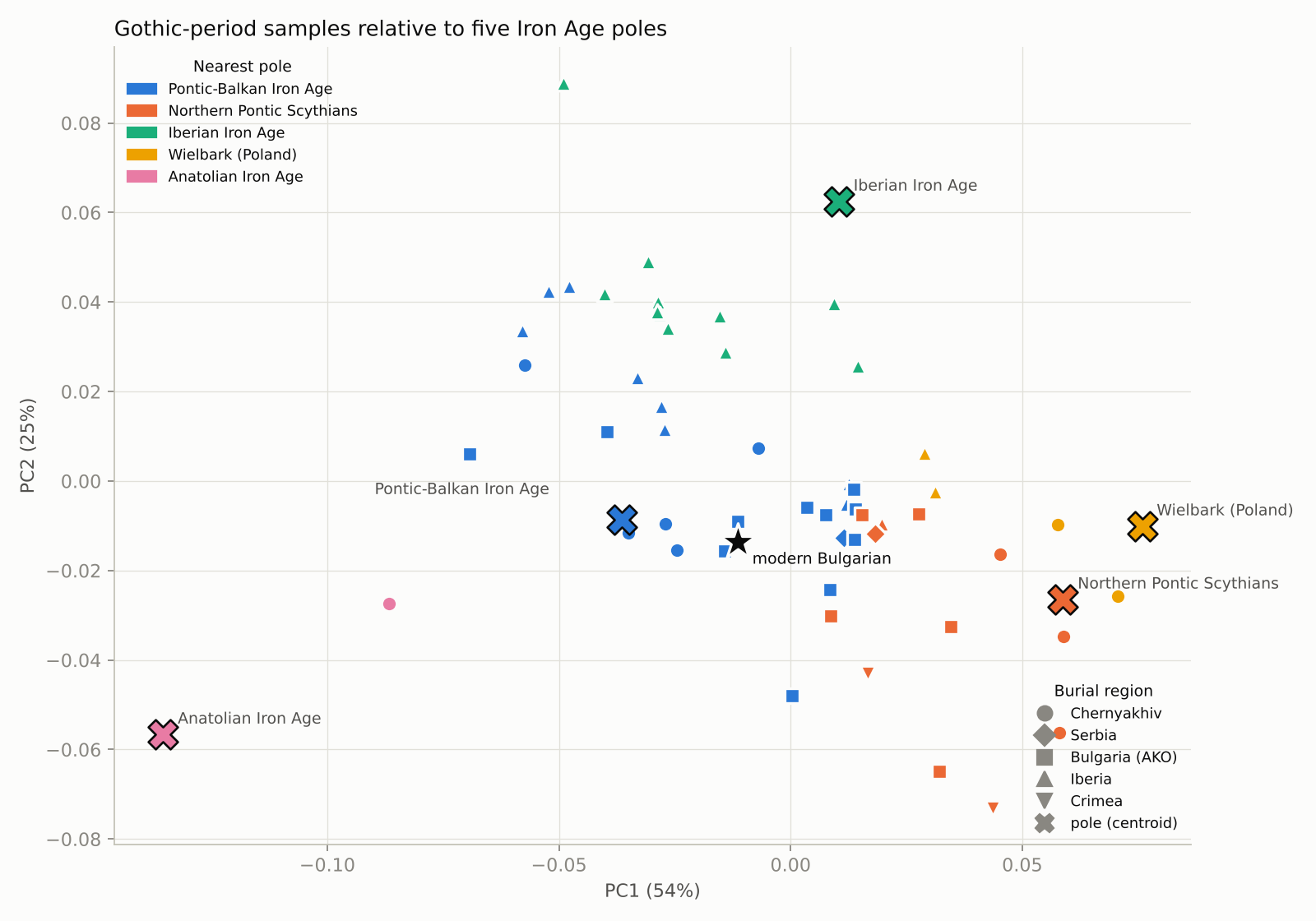
Figure 2. All Gothic-period samples (colour: nearest pole; shape: burial region) and the five Iron Age poles (crosses). The modern Bulgarian (star) sits next to the Pontic-Balkan pole.
5. Iberia: the Visigoths and the Goths of the East
The Visigoths buried in Iberia are separated from the Goths of the Black Sea and the Balkans by two to four centuries and by a journey across the whole of southern Europe - through the Balkans, Italy and Gaul - with mixing at every stage and, finally, with the local population of Spain. No one should expect them to match any single eastern population exactly. The right question is a different one: outside Iberia, whom do they still resemble most?
5.1 Distance to the Goths of the East
We measure the distance from each of the 22 Iberian Visigoths to the Gothic-period groups of the east, and to the other candidate sources:
| Group | Median distance from the 22 Iberian Visigoths |
|---|---|
| Chernyakhiv, Balkan group (UKR045, UKR102, UKR121, UKR123, UKR128) | 0.066 |
| AKO, Bulgaria (16) | 0.069 |
| Iberian Iron Age - their own local ancestors | 0.072 |
| Gothic-period Serbia (I15522, I15549) | 0.073 |
| Roman-era Serbia (35) | 0.075 |
| Chernyakhiv, northern group (UKR122, UKR125, UKR126, UKR129) | 0.108 |
| Crimean Goths (2) | 0.113 |
| Wielbark (9) | 0.118 |
| Anatolian Iron Age (6) | 0.154 |
After centuries of travel and mixing, the Iberian Visigoths stand closer to the Balkan Goths of Chernyakhiv and to AKO in Bulgaria than to their own Iberian Iron Age ancestors. Wielbark and Anatolia are the most distant of all candidate sources.
The same holds individual by individual. For 20 of the 22 Visigoths, the nearest person outside Iberia is an eastern Goth - from AKO or from the Balkan group of Chernyakhiv - and is closer than the nearest Roman-era Serb; in the remaining two the distances are equal or slightly reversed. None of them comes near an Anatolian (0.127-0.170). The clearest case is I12031 from Pla de l'Horta (Girona): it stands 0.021 from an AKO individual buried at Han Krum, as close as AKO people stand to each other.
Mixture models confirm this for the individuals with clearly non-local ancestry. Modelled as local Iberians plus one eastern group at a time, they are best explained by the Goths of the east:
| Visigoth | Site | Best eastern source | Share | Residual | With Wielbark instead |
|---|---|---|---|---|---|
| I12031 | Pla de l'Horta | AKO | 87% | 0.022 | 0.051 |
| CGG022053 | Madrid | AKO | 79% | 0.031 | 0.052 |
| I3777 | Barcelona | AKO | 47% | 0.027 | 0.032 |
| I12163 | Pla de l'Horta | Gothic-period Serbia | 91% | 0.035 | 0.052 |
| I12034 | Pla de l'Horta | Gothic-period Serbia | 28% | 0.028 | 0.031 |
| I12162 | Pla de l'Horta | Chernyakhiv, northern group | 67% | 0.033 | 0.042 |
| I12032 | Pla de l'Horta | Chernyakhiv, northern group | 55% | 0.035 | 0.037 |
Even the two Visigoths with the most northern profile, I12162 and I12032, fit better with the northern Chernyakhiv people of the Black Sea region than with Wielbark itself. For the group as a whole, local Iberians plus the Balkan group of Chernyakhiv (56%) fit practically as well as the best combination (residual 0.029 against 0.028); local Iberians plus Wielbark fit worst of all (0.051).
5.2 Why proportion models alone miss it
If the same test is run with abstract reference populations instead of the eastern Goths, 14 of the 22 Visigoths come out as "local Iberians plus about 25% Anatolian Iron Age". This does not mean they were Anatolians - they are 0.154 from the Anatolian reference and 0.069 from AKO. It is a side-effect of how correlated the references are. The Roman-era Balkan population already contained eastern Mediterranean ancestry: Roman-era Serbia stands at 0.103 from the Anatolian Iron Age, the interior Balkan Iron Age at 0.147. A Balkan newcomer arriving in Spain would therefore look partly "Anatolian" in a proportion test.
We measured how serious this is with artificial mixtures: a real Iberian Iron Age individual plus a real individual from a known source, in proportions of 50:50 and 70:30, with added noise, identified by the same test:
| True added source | Correctly identified | Attributed to Anatolian | Attributed to any Balkan reference |
|---|---|---|---|
| Anatolian Iron Age | 84-97% | - | 3-16% |
| Southern Thracians (Bulgaria IA/LIA) | 70-99% | 0-4% | 96-100% |
| Interior Balkan Iron Age | 28-48% | 1-14% | 69-88% |
| Pontic-Balkan Iron Age | 43-59% | 7-12% | 80-93% |
| Roman-era Serbia (contemporary) | 13-14% | 15-22% | 65% |
A contemporary Roman-Balkan admixture is recognised correctly in only one case out of seven, and is attributed to Anatolia in up to one case out of five. Proportion models with abstract references are nearly blind to it. Distances to real people of the period, as in section 5.1, are the more appropriate tool - and they make the Balkan-Pontic signal visible.
5.3 The local share
Half of the Visigothic samples (11 of 22) are nearest to the local Iberian Iron Age population. After two to four centuries in the peninsula this is expected: the Visigothic kingdom buried locals in the same cemeteries, and the newcomers themselves married into the local population.
One qualification. AKO and the Balkan Goths of Chernyakhiv also carry part of the Roman-era Mediterranean ancestry that was widespread in the Empire; part of their similarity to the Visigoths may reflect that shared layer. But the ordering of the distances is unambiguous: outside Iberia, the Visigoths resemble the Goths of the Balkans and the Black Sea most - not Poland, and not Anatolia.
6. Crimea and Serbia
The two Crimean individuals of the Migration Period (CGG017681, 328 AD; CGG017683, 550 AD) belong to the Gothic community that survived in Crimea longest. Both stand closest to the northern Pontic Scythians, not to Wielbark. Their northern profile is local to the Black Sea region and does not require a source in Poland. The mixture model for them works poorly (residual 0.053), so the exact proportions should not be over-read; but Wielbark receives zero.
The two Serbian samples (I15522 from Viminacium and I15549 from Mediana) divide between the two Pontic poles, one in each. With only two individuals, no more should be said.
7. AKO and the Iron Age Scythians
AKO - sixteen individuals buried at Han Krum between 350 and 489 AD - is the closest to modern Bulgarians of all ancient populations tested in either article (0.026). It is also a combination of the two Pontic streams: 11 individuals in the Pontic-Balkan pole and 5 in the northern Scythian one.
The average of the twelve Iron Age Scythians, Balkan and northern together, stands at 0.023 from AKO. Individual Scythians stand as close to individual AKO people as Gothic-period samples stand to each other:
| Iron Age individual | Date | Nearest AKO individual | Distance |
|---|---|---|---|
| UKR002 (Thracian Hallstatt, Odesa region) | ~800 BC | I41140 | 0.027 |
| UKR091 (Poltava, local element) | ~450 BC | I40926 | 0.029 |
| UKR089 (Poltava, local element) | ~400 BC | I40926 | 0.038 |
The composition of AKO repeats the composition of the Pontic Iron Age population, eight to twelve centuries earlier. The Balkan and the northern components did not arrive together with the Goths - both were already present in the Pontic-Balkan region in the Iron Age.
8. Mixture models: is Wielbark needed?
Distance tells us which pole a whole individual is closest to. A mixture model asks a finer question: how much of each source does a group contain? We use the same sources as in the previous article - the Balkan Iron Age (seven-group average), the northern Pontic Scythians, and the Anatolian Iron Age - and add the Iberian Iron Age and Wielbark. Wielbark is offered in every model, as Gródek was in the previous article. The last column shows how the fit changes if Wielbark is removed.
| Group | Balkan IA | N. Pont. Scyth. | Anatolian | Iberian | Wielbark | Residual | Without Wielbark |
|---|---|---|---|---|---|---|---|
| Chernyakhiv, group 2 (5) | 53% | 8% | 21% | 5% | 13% | 0.013 | 0.014 |
| Chernyakhiv, group 1 (4) | 0% | 45% | 6% | 0% | 49% | 0.018 | 0.027 |
| Serbia (2) | 28% | 25% | 12% | 0% | 35% | 0.023 | 0.026 |
| AKO (16) | 30% | 37% | 16% | 0% | 16% | 0.011 | 0.012 |
| Iberian Visigoths (22) | 0% | 13% | 22% | 65% | 0% | 0.025 | 0.025 |
| Crimean Goths (2) | 0% | 83% | 17% | 0% | 0% | 0.053 | 0.053 |
| Modern Bulgarian | 41% | 42% | 16% | 0% | 0% | 0.020 | 0.020 |
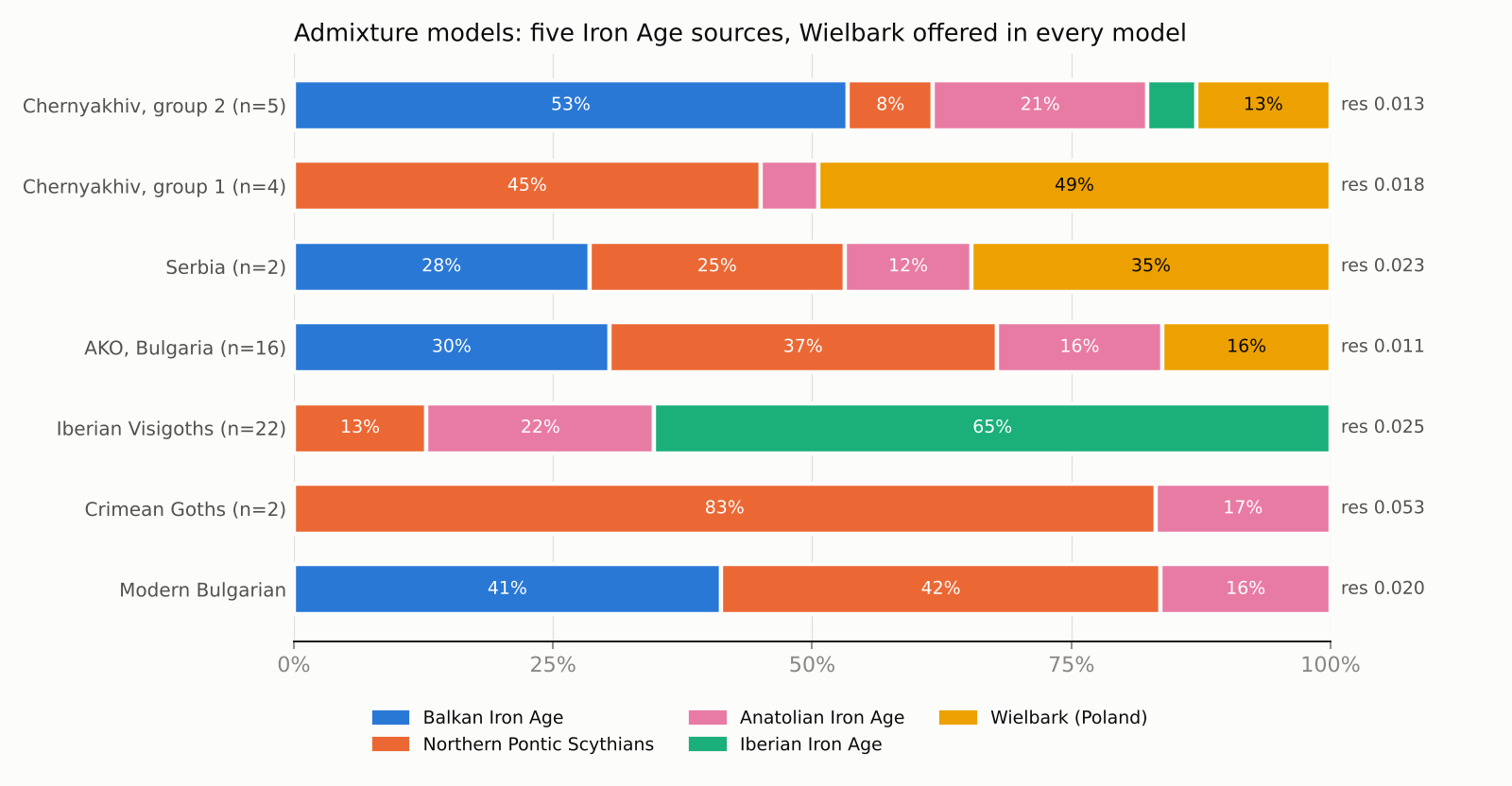
Figure 3. Mixture models with five Iron Age sources. Wielbark is offered in every model; the residual is shown on the right.
Three things follow:
- Wielbark is not needed for the endpoint. Whenever the Scythian source is offered alongside it, the modern Bulgarian receives 0% Wielbark, and so do the Iberian Visigoths and the Crimean Goths. If Wielbark is the only northern source offered, it takes about a third of the modern Bulgarian - but the fit is clearly worse (residual 0.029 instead of 0.020).
- It is optional for the Pontic-Balkan groups. For AKO, Chernyakhiv group 2 and Serbia, Wielbark receives a share, but removing it changes the fit only marginally (for AKO, from 0.011 to 0.012). These groups are explained just as well without it.
- It is needed in one place. The four individuals of Chernyakhiv group 1 are the only case where removing Wielbark clearly worsens the fit (from 0.018 to 0.027). This is the genuinely northern-European element in Chernyakhiv - two to four people out of fourteen.
Why does Wielbark take a share at all, if it is not needed? Because the northern Pontic Scythians and Wielbark are genetically close (0.044 apart). When both are offered, the model splits the northern component between them almost arbitrarily. For most individuals, these coordinates cannot tell a steppe origin from a Polish one. This is also why the Wielbark share for AKO depends on the source set: 0-8% in the previous article, 16% (90% interval 6-28%) here.
9. The chain to the present day
The last condition is continuity. Distances are measured to the average modern Bulgarian:
| Population | Date | Distance to modern Bulgarian |
|---|---|---|
| Pontic-Balkan Iron Age (5) | 913-350 BC | 0.035 |
| Gothic-period, Pontic-Balkan cluster (25) | 3rd-8th c. AD | 0.031 |
| Gothic-period, both Pontic streams (37) | 3rd-8th c. AD | 0.028 |
| AKO (16) | 350-489 AD | 0.026 |
| Medieval Bulgaria (I10548) | 1125 AD | 0.029 |
| Medieval Bulgaria (I17980) | 1153 AD | 0.047 |
| control: southern Thracians (Bulgaria_IA, I5769) | 642 BC | 0.080 |
| control: southern Thracians (Bulgaria_LIA, I19500) | 250 BC | 0.085 |
| control: Wielbark (9) | 1st-2nd c. AD | 0.095 |
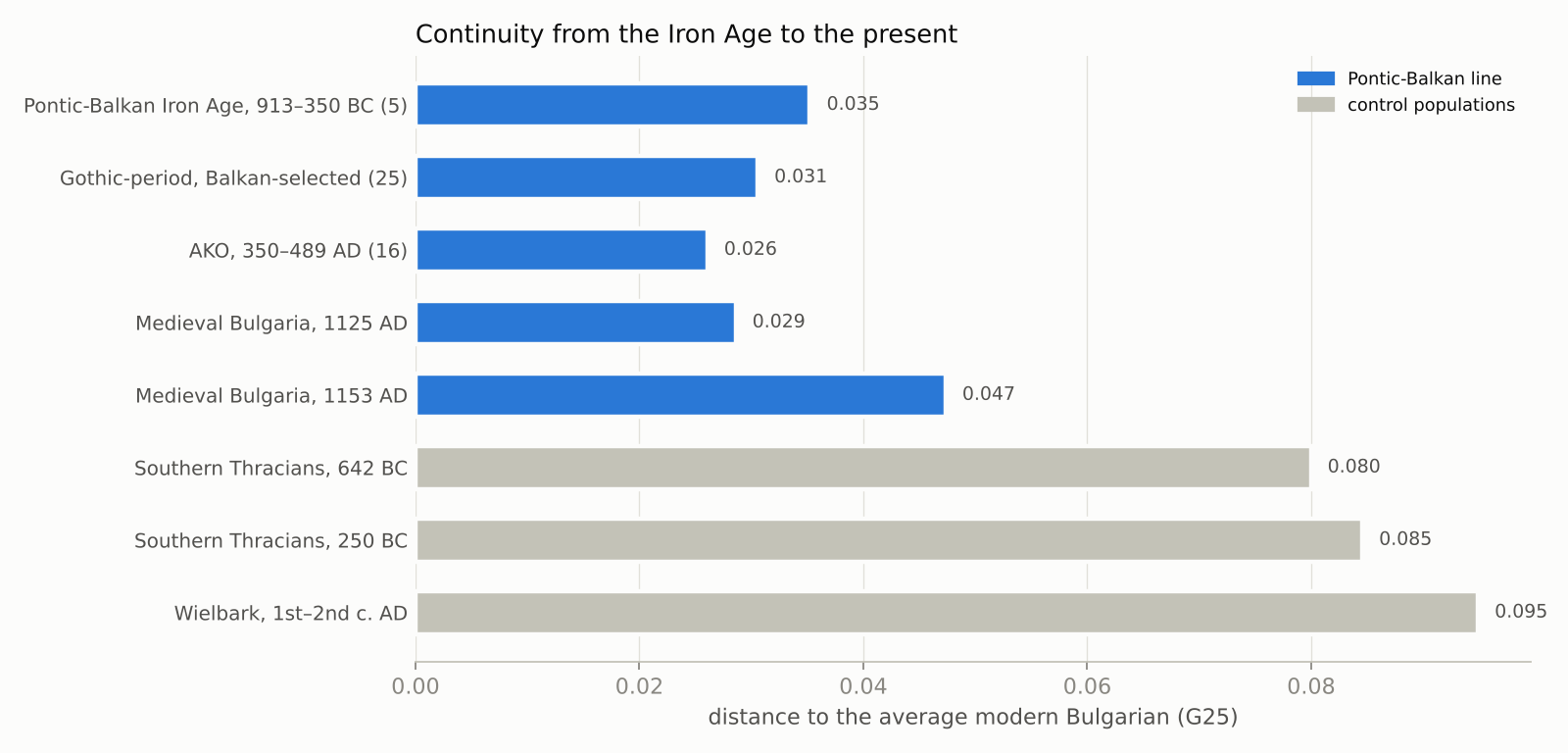
Figure 4. Distance to the modern Bulgarian: the Pontic-Balkan line against the control populations.
From the Iron Age through the Gothic period to the Middle Ages, the Pontic-Balkan line stays within a narrow range (0.026-0.047). The controls - the southern Thracians of the interior and Wielbark - are two to three times further away. The population ancestral to modern Bulgarians is the northern, Lower Danube and Pontic one - not the southern Thracian one, and not the Polish one.
10. What follows from all this
Follows
1. Gothic-period cemeteries contain genetically different people. The label "Goth" is a period and material-culture label, not a biological one.
2. Of 53 Gothic-period individuals, 37 stand closest to the Iron Age population of the Pontic-Balkan region; 11 are local Iberians; 4 are closest to Wielbark.
3. After two to four centuries of migration across southern Europe, the Iberian Visigoths still stand closest to the Goths of the Balkans and the Black Sea (Chernyakhiv, AKO) - closer than to their own Iberian ancestors, and far from Wielbark and Anatolia.
4. Among all profiles found in Gothic-period cemeteries, only the Pontic-Balkan one meets all three conditions: it recurs across regions, it is not the local population of the burial place, and it has continuity from the Iron Age to today in the region with which the sources connect the Goths. Within it, the Balkan cluster is the leading component. If the Gothic label corresponds to a real population, this is the most logical candidate.
5. This is consistent with the written sources, which call the Goths Getae - the northern Thracian population of the Lower Danube and the northern Black Sea coast.
6. The Wielbark hypothesis is not needed to explain the Gothic-period samples. It is needed for two to four individuals in Chernyakhiv, and for none of the modern population.
Does NOT follow
- that no one from Poland ever reached the Black Sea. Two to four Chernyakhiv individuals are genuinely northern-European; people moved in this region in every direction.
- that every Pontic-Balkan individual buried in a Gothic-period cemetery was a Goth. The analysis identifies the most likely population behind the label, not the identity of each person.
- that every Visigoth in Iberia descended from the eastern Goths. Half of them are local Iberians, and part of the similarity to the eastern Goths may reflect a shared Roman-era Mediterranean layer.
11. What we do not know
- Whether the northern component in AKO and in the Pontic-Balkan Gothic samples came from the steppe or partly from the Wielbark region cannot be decided with G25 coordinates. The two sources are too similar. This needs formal methods on raw genotypes.
- There are no Iron Age samples from the interior of Moesia and Dacia, the heartland of the Getae. The Pontic-Balkan pole comes from the northern Black Sea periphery of the Thracian world.
- We have no samples from Novae or from Nicopolis ad Istrum - settlements south of the Danube, where the Goths are best documented in the 4th-5th centuries.
12. Limitations of the method
- Euclidean distances and non-negative least squares (NNLS) on G25 coordinates are approximations, not formal qpAdm or f-statistics. Bootstrap intervals are wide: for AKO the Balkan share ranges 16-45% and the Scythian share 22-49%.
- The poles are small (5 to 10 individuals). The Pontic-Balkan pole contains only five samples, two of them Thracian Hallstatt and three the local element among the Poltava Scythians.
- The Pontic-Balkan and the Iberian poles are 0.089 apart; several Iberian samples are almost equidistant from both.
- Sample sizes for Serbia and Crimea are two each. Three AKO samples (I41231, I41233, I41236) were converted from raw genotype files and carry extra uncertainty.
- The coverage threshold (15%) excludes nine samples, including MJ-37, a key Chernyakhiv individual in earlier discussions.
13. Appendix: data, methods and literature
Samples used, by group
- Chernyakhiv (used): UKR045, UKR049, UKR102, UKR121, UKR122, UKR123, UKR125, UKR126, UKR128, UKR129, MJ-19. Excluded for low coverage: MJ-36, MJ-37, UKR047.
- Serbia: I15522 (Viminacium), I15549 (Mediana).
- Bulgaria, AKO (350-489 AD): I40357, I40926, I40932, I41140, I41198, I41199, I41200, I41201, I41203, I41205, I41206, I41230, I41231, I41233, I41235, I41236.
- Iberian Visigoths (used): CGG022041 (Menorca); CGG022051, CGG022053, CGG022031, CGG022052, CGG022028, CGG022026 (Madrid); I3576, I3575, I3581, I3582, I3585 (Granada); I12031, I12032, I12034, I12162, I12163 (Pla de l'Horta, Girona); I3777 (Barcelona); GOG034, GOG035 (Valencia); CGG018559, CGG018558 (Estremadura). Excluded for low coverage: I3574, I3578, I3579, I3583, I3866, I3775.
- Crimea: CGG017681, CGG017683.
- Pontic-Balkan Iron Age pole: UKR002, UKR007, UKR089, UKR090, UKR091.
- Northern Pontic Scythian pole: UKR000, UKR035AB, UKR042, UKR043, UKR044, UKR095, UKR111.
- Wielbark pole (Weklice): R10618, R10620, R10625, R10626, R10631, R10633, R10634, R10636, R11391.
- Iberian Iron Age pole: I4556, I3322, I12879, I12410, I3323, I3758, I3759, I3327, I3320, I3321.
- Anatolian Iron Age pole: I14765, I19612, I20577, I14644, I14635, I14734.
- Roman-era Serbia (sections 5.1-5.2): Serbia_Roman, 35 individuals with coverage of at least 15% (Olalde et al. 2023).
- Balkan Iron Age (seven-group average, mixture models): Albania_IA, Croatia_EIA, Croatia_LIA, Slovenia_EIA, Macedonia_IA, Bulgaria_IA, Bulgaria_LIA.
- Continuity and controls: I10548 (1125 AD), I17980 (1153 AD), I5769 (Bulgaria_IA), I19500 (Bulgaria_LIA).
Methods
Distance is the Euclidean distance between 25-dimensional G25 coordinates. A pole is the average of its member samples. Each Gothic-period sample is assigned to the pole at the smallest distance. Mixture models use non-negative least squares (NNLS) with coefficients constrained to sum to 1; the residual is the Euclidean norm of the difference between the observed coordinates and the model. Two-source tests (section 5) fit local population plus one outside source, for each candidate source in turn. The simulation in section 5.2 mixes a randomly drawn Iberian Iron Age individual with a randomly drawn individual of the tested source, adds Gaussian noise equal to half the within-group spread of the Iberian pole, and repeats the two-source test 300 times per scenario. Bootstrap intervals (90%) resample both the target individuals and the individuals of each source pole, 500 replicates. The modern Bulgarian is the standard G25 population average. Scripts and the full table of coordinates can be provided on request.
Literature and data sources
- Global25 (G25) coordinates: Eurogenes Global25 datasets (Davidski), standard ancient and modern sheets.
- Olalde I. et al. 2019. The genomic history of the Iberian Peninsula over the past 8000 years. Science 363.
- Olalde I. et al. 2023. A genetic history of the Balkans from Roman frontier to Slavic migrations. Cell 186.
- North Pontic crossroads: Mobility in Ukraine from the Bronze Age to the early modern period. Science Advances, 2025 (doi:10.1126/sciadv.adr0695) - Chernyakhiv and Scythian UKR samples.
- Järve M. et al. 2019. Shifts in the genetic landscape of the Western Eurasian Steppe associated with the beginning and end of the Scythian dominance. Current Biology 29 - MJ samples.
- Stamov S., Chobanov T. et al. Ethnic assemblages under Gothic material culture in Late Antiquity (preprint) - AKO and Aquae Calidae.
- Andreeva et al. - western Scythian sample, as used in the previous article.
- Allen Ancient DNA Resource (AADR) - Iron Age reference groups from the Balkans, Iberia and Anatolia.
- Yordanov I. 2026. The Redundant Hypothesis: What Ancient DNA Reveals About the Origins of the Bulgarians. ExploreYourDNA.
- Lawson C. L., Hanson R. J. 1974. Solving Least Squares Problems. Prentice-Hall - the NNLS algorithm.
Anyone with the same coordinates can reproduce these calculations. As before, the invitation to the reader is the same: do not accept the conclusions - check them.