
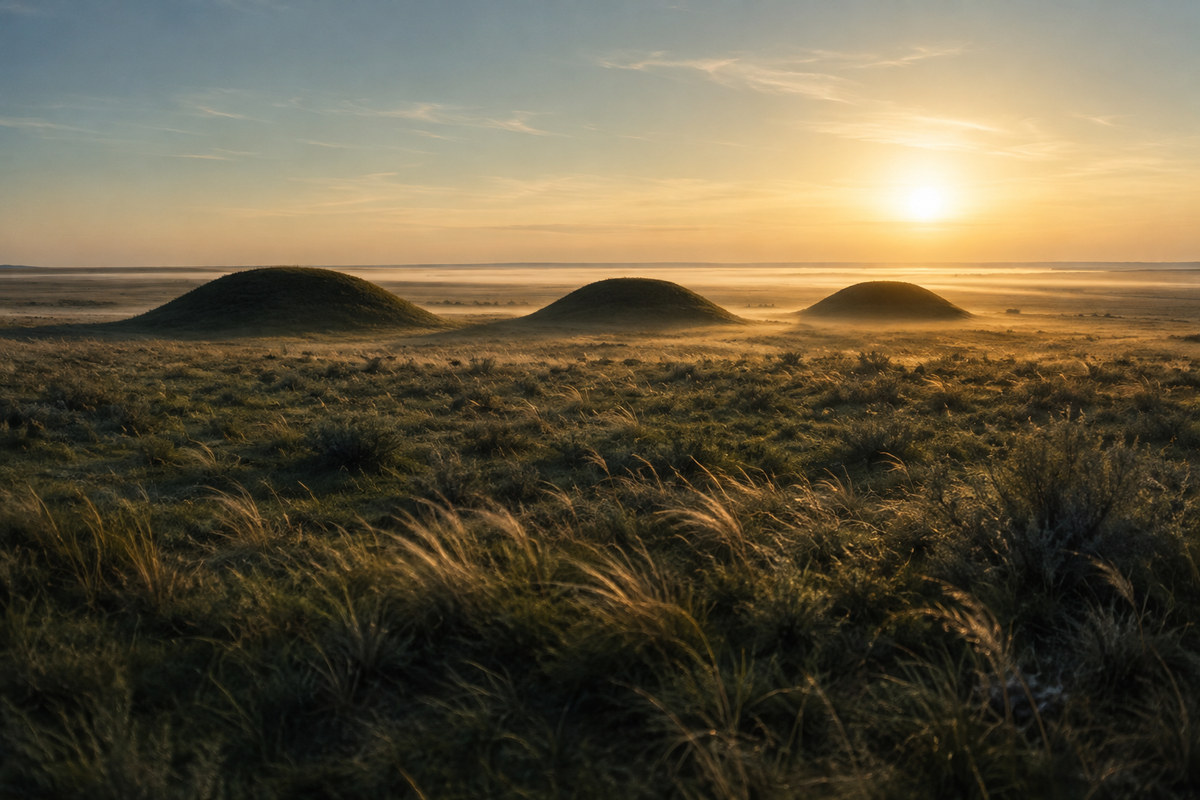
Around 3300 BC a burial rite appeared on the steppe north of the Black and Caspian seas: a single body, on its back with the knees raised, painted with red ochre, under a round mound of earth. Within three centuries the same rite, and the people under it, ran from the Tisza in Hungary to the Ural river and beyond it into the Altai. Half the ancestry of every population in northern Europe today comes from them. This article measures three things about that population that are usually asserted rather than counted: how uniform it actually was across four thousand kilometres, what it was assembled from, and how much of the farming world it passed through it absorbed on the way. The first answer is that it was more uniform than the inhabitants of a single French region are today. The second is that the textbook model of it is wrong in a way that a calculator can demonstrate. The third is a number that changes by a factor of two between the Danube and the Urals.
A culture defined by a hole in the ground
Yamnaya is a Russian word meaning of the pit, and the pit is the definition. The archaeological complex is a burial practice before it is anything else: a rectangular shaft grave, one adult, supine with flexed legs, ochre on the bones, few or no pots, occasionally a wagon or its wheels, under a kurgan. There are almost no settlements. For a population that occupied something like two million square kilometres of grassland, the physical record is a landscape of mounds and very little else.
That is not an accident of preservation. The Yamnaya were mobile pastoralists in a way that had no precedent in western Eurasia. What made it possible was a combination of the ox-drawn wagon, which appears in the fourth millennium and is buried with them, and a herding economy dominated by cattle and sheep. Shevan Wilkin and colleagues settled the dietary half of that in 2021 by recovering milk proteins from the dental calculus of steppe individuals: the Eneolithic populations of the same region show essentially none, and the Yamnaya show them almost universally. Dairying is the economic hinge, and it appears at the same moment as the expansion.
The horse is more complicated than the popular version allows. Botai in Kazakhstan, the site with the earliest strong evidence of horse husbandry, turns out to belong to a population deeply diverged from the Yamnaya and to a horse lineage that did not father the modern domestic horse. What the Yamnaya themselves show is skeletal: Martin Trautmann and colleagues in 2023 examined 156 individuals for a set of six traits associated with habitual riding, and found the pattern in five Yamnaya men convincingly and in a handful of others partially. That is not a nation of cavalry. It is evidence that some of them rode, in a society whose bulk transport was on wheels.
The chronology matters for everything below. The Yamnaya horizon runs from roughly 3300 to 2600 BC. Its western outposts in Hungary, Serbia, Romania and Bulgaria are late in that range, mostly after 3000 BC. Its eastern offshoot, the Afanasievo of the Altai and the Yenisei, is early, and by some radiocarbon readings very early indeed.
The question that changed in 2025
For a decade the standard account of Yamnaya origins was a two-way mixture. Wolfgang Haak, Iosif Lazaridis, Morten Allentoft and colleagues in 2015 modelled them as roughly half eastern European hunter-gatherer and half something Caucasus-related, and the phrase fifty per cent EHG and fifty per cent CHG entered every popular summary of European prehistory. It has been repeated ever since, including on hobbyist forums where it is treated as settled.
It was never quite right, and in February 2025 it was replaced. Lazaridis, Nick Patterson, David Anthony, David Reich and a very large collaboration published ancient DNA from 435 individuals of the Eneolithic steppe and its margins and resolved the preceding period into three clines rather than two poles. A Caucasus-lower Volga cline ran between a Caucasus Neolithic southern end and a northern end at Berezhnovka on the lower Volga. A Volga cline formed where those people mixed upriver with eastern hunter-gatherers, producing the hypervariable cemetery at Khvalynsk. A Dnipro cline formed where they moved west and mixed with Ukrainian Neolithic hunter-gatherers along the Dnipro and the Don, producing the Serednii Stih groups. Yamnaya ancestors formed out of that western movement around 4000 BC and expanded explosively after about 3750 to 3350 BC.
The headline figure from that paper is the one this article tests. The Caucasus-lower Volga people contributed about four fifths of the ancestry of the Yamnaya. The same population, entering Anatolia probably from the east, contributed at least a tenth of the ancestry of the Bronze Age central Anatolians who spoke Hittite, which is how a single source can sit ancestral to both branches of the language family without the Hittites carrying any Yamnaya ancestry at all.
A Global25 calculator is a much blunter instrument than the f-statistics and haplotype methods that result rests on. What it can do is check whether the geometry of the coordinates independently supports the proportion, and whether the older two-way model can be shown to fail on its own terms. Both turn out to be answerable.
What the uniparental markers already said
The Yamnaya Y chromosome record is the most extreme in European prehistory and it is worth stating precisely.
Sampled Yamnaya males are overwhelmingly R1b, and specifically R1b-M269 and its downstream branch Z2103, which runs at something like seventy to eighty per cent of typed individuals depending on which series is counted. A minority carry I2a and other lineages. The preceding Eneolithic populations of the same region were nothing like that uniform: Khvalynsk males carry R1b, R1a, Q1a, J and I2a in a scatter that looks like an ordinary population. Between Khvalynsk and Yamnaya, one paternal lineage went from being one option among many to near fixation across a continent.
The maternal record does not cooperate with any simple reading. Yamnaya mitochondrial pools are diverse, dominated by the ordinary west Eurasian set of U, H, T, J, K and W, with U4 and U5a prominent, which is what a steppe hunter-gatherer substratum looks like, plus lineages that are more plausibly southern. One set of chromosomes was funnelled through a bottleneck. The other was not.
The awkward part, and it will recur in the section on what this method cannot do, is that a Global25 coordinate is an autosomal summary. It is inherited equally from both parents and it carries no label saying which side anything came from. Everything in this article about proportions is silent on the question the uniparental data is shouting about.
One more detail deserves flagging because it complicates the neat story of Yamnaya paternal descent in Europe. The lineage that dominates western Europe today is R1b-L51 and its subclade P312, and L51 has still not been found in a sampled Yamnaya individual. The Corded Ware of Bohemia carry it early, as we set out in our article on that culture, and the sampled Yamnaya do not. Whatever the relationship between the two populations is, it does not run father to son from the graves we have.
Data and method
Everything below uses Global25 scaled coordinates, with population averages merged from Davidski's published files and the Moriopoulos 2026 collection. Ancestry proportions come from non-negative least squares with a sum-to-one constraint imposed by appending a heavily weighted row of ones, with the resulting weights normalised. Distances are scaled Euclidean distances multiplied by one thousand, the convention used throughout this site.
The pooled Yamnaya target is a weighted average of twenty-six regional groups totalling 135 individuals: Samara, Saratov, Volgograd, Orenburg, Chelyabinsk, Rostov, Kalmykia, Stavropol and Krasnodar in Russia, eight site-level groups in Ukraine, Moldova, Romania, Bulgaria, Hungary, Serbia and two in Kazakhstan. Groups flagged as outliers in the source files are excluded from the pool and two of them are discussed separately later. Alongside the group averages, 169 individually dated Yamnaya genomes passing a fifteen per cent coverage threshold were pulled from the ancient sample file, of which 166 also clear a sanity check on distance to the pooled mean.
Two reference panels do the work, and the difference between them is the subject of an entire section. The deep panel is the familiar one: eastern hunter-gatherers from Karelia, the Caucasus hunter-gatherer genome from Kotias Klde, the Anatolian Neolithic of Barcin and the western hunter-gatherer genome from Loschbour. The proximal panel is the piedmont Eneolithic of Progress in Stavropol, standing for the Caucasus-lower Volga population, the Ukrainian Neolithic of Dereivka I, and Barcin again. Its condition number is 2.37 and its pole separations are 232, 356 and 387 units, all of them far above the hundred-unit threshold below which we treat two-source separation as unreliable on this site.
Two cross-checks on the merge, because this article shares poles with the previous one. Yamnaya of Samara, Barcin and Loschbour separate by 338, 410 and 494 units with a condition number of 2.44, reproducing the panel used in our article on the Corded Ware exactly. Rebuilding that article's pooled Corded Ware target and pushing it through the same three sources returns 71.4 per cent steppe against the 71.7 published there, a difference of one individual in the pool. The series is internally consistent.
Where the Yamnaya sit
The simplest measurement sets up everything else.
Every population within reach of the pooled Yamnaya average, ranked by Global25 distance. The Afanasievo of the Altai sit closer than the Yamnaya of Bulgaria do.
The first thing to notice is what is not on that chart. There is no gap between the eastern and western Yamnaya. Samara sits 9.1 units from the pooled average, Kalmykia 9.8, Moldova 13.2, Hungary 13.4, Chelyabinsk 13.8. Those five groups span the Tisza to the southern Urals, something on the order of three thousand kilometres, and they fall inside a five-unit band.
The second is the Afanasievo. A group of twenty-one individuals buried in the Gorno-Altai, four and a half thousand kilometres east of Hungary, on the other side of Kazakhstan, sit 14.2 units from the pooled Yamnaya average and 7.9 from the Yamnaya of Samara. They are closer to a Yamnaya than the Yamnaya of Bulgaria are. Whatever the Afanasievo were culturally, genetically they are the same population moved east.
The third is the Don. The twenty Yamnaya of Rostov sit at 30.1 units, three times further out than anything else with a comparable sample size, and they are the only regional group that behaves like a distinct thing. That is the Dnipro cline of the 2025 paper showing up as a lump in a distance ranking, and the next sections quantify it.
Below the Yamnaya block, the ordering is a chronology. Poltavka, the middle Volga culture that succeeds them in place, sits at 12.6. The Catacomb culture, which succeeds them on the lower Don and in Kalmykia, sits at 19.8. Then the Eneolithic predecessors, in the order the 2025 model predicts: Sredni Stog of Igren at 40.3, proto-Yamnaya of Mykhailivka at 49.6, the piedmont Eneolithic of Progress at 55.6, Berezhnovka on the lower Volga at 59.8, Sredni Stog of Dereivka II at 75.1, Khvalynsk at 78.2.
Then the successors in Europe, and the numbers are larger than most readers expect. The Corded Ware of Germany sits at 62.5, of Bohemia at 66.3, of Estonia at 73.1. The late Bell Beaker of Bohemia sits at 138.8. Sintashta, the chariot-building culture of the southern Urals whose descendants carried Indo-Iranian into Asia, sits at 82.9.
And then the moderns, where there is a genuine surprise. The living population closest to the Yamnaya is not Baltic and not Scandinavian. It is the Mordvins of the middle Volga, at 120.7 units, ahead of Russians at 129.2, Estonians at 131.8 and Swedes at 133.4. Poles sit at 139.6, Irish at 140.6, French at 172.4. The Volga Finnic populations of the forest zone are the ones that happen to sit closest, which has nothing to do with any special Yamnaya descent and everything to do with the fact that they combine high steppe ancestry with a low farming component. That kind of coincidence is exactly why a distance ranking is a starting point and not an argument.
Four thousand kilometres and thirty units
The internal uniformity is worth its own measurement, because it is the single most remarkable thing in the dataset and it is very easy to state loosely.
Pooling the regional groups into five blocks by geography gives: a western block of Hungary, Serbia, Bulgaria and Romania, twenty individuals; a north Pontic block of Ukraine and Moldova, twenty-six; a Don and Caucasus block of Rostov, Kalmykia, Stavropol and Krasnodar, forty-three; a Volga and Ural block of Samara, Saratov, Volgograd, Orenburg and Chelyabinsk, forty-four; and Kazakhstan, two. The largest distance between any two of those blocks is 32.1 units, between the west and Kazakhstan. The largest between two well-sampled blocks is 23.8, between the west and the Don and Caucasus. The Volga and Ural block sits 9.2 units from the pooled mean.
Set that against the comparisons this site has already published. The Corded Ware, an offshoot of this population occupying a much smaller area, runs from 96 per cent steppe in the eastern Baltic to 59 in Switzerland and spreads 42.3 units from Estonia to Switzerland. The typical individual Frenchman sits about 25 units from the mean of his own region. Of the 166 dated Yamnaya genomes used here, the median distance to the pooled mean is 30.2 units, with a mean of 33.3.
So a Yamnaya individual picked at random from anywhere between Hungary and the Urals sits about as far from the Yamnaya average as a Frenchman sits from the average of his own department, allowing for the fact that ancient genomes are noisier. A population that had been in place for three centuries at most, across a range larger than the Roman empire at its height, had not yet differentiated. That is what an explosive expansion from a small source looks like in coordinate space, and it is consistent with the demographic inference from the 2025 paper, where a haplotype-based method puts the effective population size of Yamnaya ancestors in the low thousands until somewhere between 3642 and 3374 BC and an order of magnitude larger afterwards.
The panel that does not work
Now the methodological centre of the article, and the reason the textbook fifty-fifty model deserves to be retired.
Nine source panels applied to the same target. The deep panels cannot get under fifty-four units; every proximal panel built on the lower Volga can.
Model the pooled Yamnaya average as a two-way mixture of eastern hunter-gatherers and the Caucasus hunter-gatherer genome from Kotias and it returns 59.1 and 40.9 per cent, with a fit of 65.1 units. That is not fifty-fifty, and more importantly it is a bad fit. For comparison, the three-source model in our Corded Ware article fits its targets at 20 to 34 units, and the proximal panel below fits the same Yamnaya target at 28.8.
Adding sources does not rescue it. Eastern hunter-gatherers with Kotias, Barcin and Loschbour together give 57.2. Replacing Kotias with the Aknashen Neolithic of Armenia gives 65.4. Offering all five poles at once gives 55.7. To make sure this was not an artefact of one badly chosen proxy, every combination of six eastern hunter-gatherer sources and five Caucasus or Iranian sources was tried against the same target. The best of the thirty is 54.2 units. There is a floor at about fifty-four, and no arrangement of the standard deep west Eurasian poles gets under it.
Now switch to the proximal panel. The piedmont Eneolithic of Progress plus the Ukrainian Neolithic of Dereivka I, two sources only, fits at 36.2. Berezhnovka on the lower Volga plus the same Ukrainian source fits at 41.7. Add Barcin as a third source and Progress reaches 28.8, Berezhnovka 31.5.
The interpretation is not that eastern hunter-gatherer and Caucasus hunter-gatherer ancestry are absent from the Yamnaya. They are obviously present, and the deep model recovers them in roughly the right proportions. It is that the Yamnaya are not a first-generation mixture of those two things. The Caucasus-related component reached them already combined with something else, through a chain of populations on the lower Volga and in the Caucasus piedmont, and the residue of that history is a displacement in the coordinate space that no two-way deep model can absorb. Give the model the actual intermediate population and the residue halves.
The panel that does
With the proximal panel established, the proportions can be read off.
The proximal three-source panel applied to the Yamnaya, to the Eneolithic populations behind them, to their eastern offshoots and to their successors.
The pooled Yamnaya average comes out at 77.3 per cent Caucasus-lower Volga, 16.4 per cent Ukrainian Neolithic hunter-gatherer and 6.3 per cent Anatolian Neolithic farmer, with a fit of 28.8 units. Four fifths, one sixth and a small farming remainder.
That first figure is the one to hold on to, because it was arrived at independently. Lazaridis and colleagues reported around four fifths from haplotype and f-statistic methods on a completely different analytical basis. A coordinate calculator with a three-source non-negative least squares fit returns 77.3. This is the second time in this series that a Global25 model has reproduced a much more powerful method closely enough to be worth pointing at, and as with the first, the agreement is on the proportion rather than on the second decimal place.
It is also robust in the way a real result should be. Substituting the Caucasus-lower Volga pole through five alternatives gives 73.4 for Vonyuchka, 76.2 for the piedmont-profile outlier at Khvalynsk, 76.3 for Berezhnovka, 76.6 for Kurganniy and 77.3 for Progress. Substituting the hunter-gatherer pole through four different Ukrainian Neolithic and Mesolithic groups gives 73.7 to 77.9. The ranking and the magnitude do not move.
What does move, and informatively, is what happens when the hunter-gatherer pole is replaced by something that is not Ukrainian. Offer eastern hunter-gatherers from Karelia instead and the fit degrades from 28.8 to 33.8. Offer the western hunter-gatherer Loschbour and it degrades to 34.0. The second source of the Yamnaya is specifically the hunter-gatherer population of the Dnipro basin, and the model can tell the difference. That is the Dnipro cline of the 2025 paper, confirmed from the other side.
Read down the chart and the rest of the steppe sequence falls into place. Berezhnovka is 99 per cent Caucasus-lower Volga, which is close to the definition of the pole. Khvalynsk is 72 and 28 with no farmer component at all, sitting on the Volga cline. The Sredni Stog of Igren is 69 and 27; the Sredni Stog of Dereivka II is 51 and 46, far out along the Dnipro cline. The Yamnaya of Stavropol, deepest into the Caucasus piedmont, is the most CLV-shifted group at 88.5. The Yamnaya of the Don is the least, at 65.8, with 29.1 per cent Ukrainian Neolithic.
That Don figure is not a rounding artefact. Taking the twenty-nine individually dated Rostov genomes against the 137 others gives 29.25 per cent Ukrainian Neolithic ancestry with a standard deviation of 9.62, against 13.91 with a standard deviation of 4.52. A test of the means returns a p-value of about two in a billion. The Don Yamnaya really are a different mixture from everybody else who was buried under the same kind of mound.
The farmers on the western edge
Which brings us to the six per cent, and to a long-running argument.
David Anthony has argued for years that the Yamnaya expansion into the Danube basin involved sustained contact with the Trypillian and other farming populations of the forest steppe, and that this contact is part of the mechanism by which steppe ancestry entered Europe rather than a footnote to it. The counter-position has been that core Yamnaya carry essentially no farmer ancestry and that the mixing all happens later, in the Corded Ware. Both positions can be tested here because the model has a farmer pole in it.
Anatolian farmer weight under the identical panel, from the Danube to the southern Urals, with the Eneolithic predecessors and two successor cultures for scale.
The gradient is real and it runs west to east. The Yamnaya of Bulgaria return 10.9 per cent Anatolian Neolithic, Romania 9.2, Moldova 8.5, Hungary 7.8. The steppe groups return between 4.0 and 5.5: Kalmykia 5.5, the Don 5.1, Orenburg 4.8, Samara and Stavropol 4.2, Chelyabinsk 4.0. The Afanasievo of the Altai return 4.0 and Poltavka 4.1. Khvalynsk and Berezhnovka, the Eneolithic predecessors, return zero.
Two things follow. The Yamnaya as a whole carry a small but non-zero farming component that their own ancestors did not have, so something was absorbed between the Eneolithic and the Bronze Age everywhere on the steppe, not only on the Danube. And the western groups carry roughly twice as much of it as the eastern ones, which is what Anthony's picture predicts.
Before that is taken seriously, the method has to be shown capable of resolving differences of a few points at that level.
Synthetic Yamnaya genomes built by adding a known amount of Anatolian farmer ancestry to the real average, then pushed back through the same model.
Synthetic genomes were built by adding a known quantity of Anatolian Neolithic ancestry to the real pooled Yamnaya average and pushing each one back through the same model. The baseline is 6.28. Injecting half a per cent returns 6.75, one per cent returns 7.22, two returns 8.15, three returns 9.09, five returns 10.97, ten returns 15.65. Recovery is close to one to one from about one per cent upwards. A four-point difference between the western and eastern groups is therefore four times the resolution of the instrument, not noise.
The individual-level data confirms it rather than complicating it.
One hundred and sixty-six Yamnaya individuals under the identical model. Dots are offset vertically only to stop them overlapping.
One hundred and sixty-six Yamnaya individuals pass the coverage threshold. The forty-two from the Danube basin and the north Pontic zone return a mean of 9.41 per cent farmer ancestry with a standard deviation of 5.15; the one hundred and twenty-four from the steppe proper return 5.19 with a standard deviation of 2.97. A test of the means returns a p-value of about six in a million. The whole distribution is shifted, not one or two individuals dragging an average.
There are also one or two individuals, and they are worth naming. I1917 from Ozera on the Danube, buried around 3005 BC, returns 29.7 per cent farmer ancestry and sits 98.9 units from his own community. I18794 from Boyanovo in Bulgaria, around 2807 BC, returns 26.0 and sits 78.1 units out. These are people with a farming parent or grandparent buried under a Yamnaya kurgan, and they are the western mirror of the four women buried with Corded Ware rites in Bohemia carrying no steppe ancestry at all that we described in the previous article. The traffic went both ways, and in both directions it is visible as a handful of individuals rather than as a shift in the group mean.
Three individuals do not appear on that chart and should be mentioned rather than quietly dropped. The burials at Kumsay in western Kazakhstan, I26230, I26303 and I26302, sit between 130 and 143 units from the pooled Yamnaya average with 93 to 95 per cent Caucasus-lower Volga and no farmer component at all. They are a genuinely different profile at the eastern margin and they need a panel with a Siberian pole in it, which this one does not have. They are flagged here and left for another article.
The same population, three thousand kilometres east
The Afanasievo deserve a paragraph of their own because they are the cleanest natural experiment in the dataset.
Somewhere around 3300 to 3000 BC, a group left the western steppe and turned up in the Altai and the Minusinsk basin, on the upper Yenisei, having crossed the whole of Kazakhstan. They buried their dead under mounds in shaft graves with ochre. Their descendants are the eastern end of the Indo-European world and the ancestors, at some remove, of the Tocharian speakers of the Tarim basin.
The Gorno-Altai group of twenty-one individuals returns 82.8 per cent Caucasus-lower Volga, 13.2 per cent Ukrainian Neolithic and 4.0 per cent farmer. The Khakassia group of nineteen returns 84.0, 11.5 and 4.5. The Yamnaya of Samara return 80.3, 15.5 and 4.2. To the resolution of this method they are the same population, and the Afanasievo sit closer to the Samara Yamnaya, at 7.9 units, than the Yamnaya of Bulgaria do at 24.5. A migration of four thousand kilometres left less genetic trace than a migration of eight hundred, because the eastern route ran through empty grassland and the western one ran through farmers.
What is left today
The last measurement is the one everybody actually wants.
Steppe weight in present-day Europe under the same three-source panel used for the Corded Ware, so that the two articles are directly comparable.
Using the same three-source panel as our Corded Ware article, so that the numbers are directly comparable across the series, the steppe weight in present-day Europe runs from 61.6 per cent in the Mordvins down to 5.6 in Sardinians. Latvians return 58.0, Estonians 57.2, Russians 57.0, Belarusians 54.3, Lithuanians 54.1, Ukrainians 53.4, Swedes 52.0, Poles 51.8, Norwegians 51.0, Irish 50.7, Scots 49.8, Czechs 49.7, Dutch 48.8, English 48.0, Germans 46.9, French 40.0, Greeks of Thessaly 39.3, Basques of France 26.4.
Three warnings attach to that chart, and they matter more than the ordering does.
The first is that the pole is labelled Yamnaya for convenience and does not mean descent from the Yamnaya specifically. What reached northern Europe was the Corded Ware, whose steppe ancestry is Yamnaya-like without the sampled Yamnaya being its demonstrable parent population. The weight measures ancestry from the third-millennium steppe pastoralist cluster, which is a wider thing than one archaeological culture.
The second is that these are inflated relative to what the deep literature reports, because the Yamnaya pole itself already contains a farming component of about six per cent and a hunter-gatherer component of sixteen. A figure of fifty per cent on this panel is not fifty per cent of the genome traceable to the steppe in the sense a qpAdm paper would mean it. The ordering is what the chart supports.
The third is the hard one. This panel is a European instrument and nothing else. Applied outside Europe its fits collapse: 112 units for Armenians, 122 for Kurds of Iraq, 167 for the Kalash, 226 for Pathans, 246 for Brahmins of eastern Uttar Pradesh. Those numbers are three to eight times worse than any usable row in this article, and any steppe percentage read off them would be an artefact. The question of how much steppe ancestry there is in South Asia is a real one with a substantial published literature behind it, it involves Sintashta and Andronovo rather than the Yamnaya, and it cannot be answered with this panel. We will come back to it with a proper one.
What the calculator cannot see
Four things about this population are established, important, and completely invisible to the method used above. They are set out here because the alternative is leaving readers with the impression that a coordinate file is the whole of the evidence.
The first is the shape of the expansion. Harald Ringbauer's identity-by-descent methods, applied to steppe and Corded Ware genomes, find long shared segments between individuals separated by great distances, which means recent common ancestry measured in generations rather than millennia, and a high density of close relatives within the sampled communities, which means a small effective population. The haplotype-based estimate in the 2025 paper puts the effective size of Yamnaya ancestors in the low thousands before the expansion. The uniformity measured in this article is the coordinate-space shadow of that bottleneck, but it cannot date it and IBD can.
The second is the sex bias. The near-fixation of one Y lineage against a diverse maternal pool is the strongest possible statement about who was moving and who was marrying in, and no autosomal summary can measure it. Amy Goldberg and colleagues attempted it in 2017 by comparing X-chromosome and autosomal ancestry in Bronze Age central Europeans and inferred something between five and fourteen migrating males per migrating female; Iosif Lazaridis and David Reich contested both the method and the magnitude, and the exchange was never resolved. The direction is not in doubt, the size is.
The third is disease. Yersinia pestis has been recovered from Late Neolithic and Bronze Age individuals across Eurasia including steppe contexts, in lineages that lack the flea-transmission adaptations of the later plagues. Whether epidemics emptied the farming landscapes that the steppe populations then occupied is one of the more attractive and less demonstrated hypotheses in the field. It is not visible in an ancestry proportion.
The fourth is the thing everyone assumes. The Yamnaya were a dairying population and they were not lactase persistent. The European persistence allele appears in the ancient record at negligible frequencies in this period, and no individual directly affiliated with Yamnaya-associated cultures has yet been reported carrying it. They drank milk, probably soured or fermented, and their descendants selected for the ability to drink it fresh over the following three thousand years. An admixture model has nothing to say about a single locus.
The Yamnaya were half EHG and half CHG
A two-source model of those poles fits the pooled average at 65.1 units and returns 59 to 41, not 50 to 50. Thirty combinations of deep sources were tried and none gets below 54. The proximal Caucasus-lower Volga panel fits at 28.8.
They were a single uniform people
Broadly true, and unusually so. Five geographic blocks from Hungary to Kazakhstan sit within 32 units of each other, and the median individual is 30 units from the pooled mean. But the Don group carries twice the Ukrainian hunter-gatherer ancestry of everyone else, at p of about two in a billion.
Core Yamnaya carry no farmer ancestry
They carry about six per cent, against zero in Khvalynsk and Berezhnovka. On the Danube it is nine to eleven, on the steppe four to five, and a spike-in test puts the resolution of the method at about one per cent.
They were horse-riding nomad warriors
Some of them rode: five of 156 individuals show the skeletal pattern convincingly. Their bulk transport was ox-drawn wagons and their economy was cattle and sheep dairying. The earliest horse husbandry at Botai belongs to a different population and a different horse lineage.
They were lactose tolerant
They were not. The persistence allele is effectively absent from the Bronze Age steppe record. Dairying came three thousand years before the mutation that makes fresh milk easy.
Modern Europeans are half Yamnaya
Half is the weight taken by a Yamnaya pole on a three-source European panel, which is not the same statement. The pole itself is 6 per cent farmer and 16 per cent Ukrainian hunter-gatherer, and what reached northern Europe was the Corded Ware, not the sampled Yamnaya.
What the numbers add up to
A population formed on the Dnipro and the Don around 4000 BC out of two ingredients: four fifths of it from a people who had been mixing along a line between the north Caucasus and the lower Volga for at least a thousand years before that, and one sixth from the hunter-gatherers who were already living on the Dnipro. It stayed small for several centuries. Then, somewhere between 3642 and 3374 BC, it grew by an order of magnitude, and within another three hundred years its burials run from Hungary to the Yenisei with no appreciable regional differentiation.
On the way west it absorbed a small amount of the farming populations it passed through, twice as much on the Danube as on the Volga, and it absorbed individuals as well as ancestry: at least two of the people buried under western kurgans had a farming parent. On the way east it absorbed essentially nothing, because there was essentially nobody, and the Afanasievo of the Altai are the Yamnaya of Samara to within eight units.
What it left behind is between forty and sixty per cent of the ancestry of every population in northern Europe, one paternal lineage in overwhelming majority across a continent, and a language family. The last of those three is the only one this method cannot see at all, and it is the reason anybody cares.
Yamnaya_pooled_135,0.121411,0.089592,0.044151,0.110586,-0.024002,0.043769,0.004082,-0.002101,-0.051399,-0.070523,-0.000010,0.000041,-0.000852,-0.020321,0.034289,0.011756,-0.005645,-0.001428,-0.002481,0.009221,-0.002779,0.002570,0.008618,0.017267,-0.004118
Yamnaya_Samara_29,0.122654,0.088981,0.044110,0.114466,-0.027262,0.045546,0.004027,-0.002379,-0.054728,-0.074654,0.000974,-0.000548,-0.000974,-0.021706,0.036808,0.012134,-0.006488,-0.001747,-0.002514,0.010928,-0.003808,0.001262,0.009800,0.019886,-0.004480
Yamnaya_Kalmykia_12,0.122645,0.088774,0.044752,0.110817,-0.028108,0.044994,0.002468,-0.004519,-0.053347,-0.073319,-0.000623,-0.000400,-0.001932,-0.024600,0.032245,0.013159,-0.005096,-0.000961,-0.001246,0.007806,-0.005948,0.004575,0.010538,0.019762,-0.003034
Yamnaya_Don_Rostov_20,0.122303,0.089824,0.059170,0.119786,-0.011571,0.043772,0.004301,0.001131,-0.042193,-0.068603,0.000942,-0.003507,0.004378,-0.022784,0.034290,0.018304,-0.000124,0.000386,-0.003463,0.013200,0.002558,0.005360,0.003938,0.005260,-0.003940
Yamnaya_Hungary_6,0.122929,0.093598,0.040038,0.106321,-0.022414,0.043368,0.004073,-0.002846,-0.053994,-0.068885,0.001597,0.000799,0.000248,-0.017753,0.034066,0.008618,-0.011995,-0.000485,-0.000084,0.004502,-0.001601,-0.000289,0.010065,0.016368,-0.007265
Yamnaya_Moldova_14,0.121059,0.093936,0.042157,0.105714,-0.024356,0.041674,0.001863,-0.002786,-0.050225,-0.067336,0.000151,0.000064,-0.002145,-0.016161,0.034172,0.005531,-0.011213,-0.002443,0.000422,0.007861,-0.003529,0.000592,0.008055,0.017541,-0.004858
Yamnaya_Bulgaria_Boyanovo_5,0.115189,0.088554,0.039296,0.098967,-0.020989,0.039882,0.004371,0.003600,-0.043809,-0.059409,-0.003118,0.001139,-0.001665,-0.018964,0.034446,0.007876,-0.016324,-0.002154,-0.000679,0.007654,-0.001548,0.001039,0.006039,0.015906,-0.003257
Afanasievo_Gorno-Altai_21,0.123742,0.088690,0.041914,0.112928,-0.029646,0.045632,0.002898,-0.002275,-0.057004,-0.076331,0.000541,0.000592,0.001416,-0.020742,0.038506,0.011377,-0.006650,-0.001629,-0.001694,0.008909,-0.004516,0.002650,0.011650,0.023899,-0.003330
Poltavka,0.125368,0.088496,0.048487,0.116650,-0.024180,0.047650,0.004196,0.000264,-0.051862,-0.072686,0.001647,-0.002805,0.001699,-0.019287,0.035520,0.012369,-0.002850,-0.002552,-0.004184,0.008236,-0.003601,0.000548,0.012571,0.019659,-0.003627
Piedmont_Eneolithic_Progress_2,0.114392,0.075657,0.016216,0.115796,-0.054317,0.049642,0.000705,-0.008308,-0.073526,-0.083829,0.007145,0.001649,-0.003568,-0.025047,0.031351,0.002718,-0.012386,-0.003357,-0.002200,0.006753,-0.006613,0.002968,0.009798,0.006145,-0.002874
Berezhnovka_LowerVolga_4,0.112685,0.071341,0.021590,0.118542,-0.060858,0.049085,0.000646,-0.015807,-0.073220,-0.083373,0.009743,-0.000712,-0.007247,-0.026183,0.037764,0.008519,-0.002640,-0.001267,-0.004180,0.010318,-0.001778,0.001144,0.013804,0.006025,-0.002155
Khvalynsk_Samara_22,0.119876,0.053084,0.069047,0.157669,-0.036440,0.052736,-0.008930,-0.016426,-0.048240,-0.085808,0.012260,-0.005327,0.012656,-0.036107,0.031796,0.016031,-0.007230,-0.002868,-0.006062,0.010880,-0.005865,0.007369,0.011804,-0.002372,-0.005704
SredniStog_Igren_2,0.114961,0.084796,0.048837,0.125325,-0.022773,0.046714,0.000235,-0.006115,-0.039371,-0.064785,0.008444,-0.001798,0.004534,-0.020299,0.027959,0.011137,0.000847,-0.005131,-0.007228,0.013944,0.008610,0.012118,0.008443,-0.007893,-0.002035
Ukraine_Neolithic_Dereivka_I_20,0.123896,0.087894,0.143740,0.174922,0.063658,0.055164,-0.001586,0.011273,0.019788,-0.048320,0.000089,-0.015646,0.025287,-0.018008,0.026221,0.034917,0.003833,0.002825,-0.006241,0.031678,0.029598,0.011654,-0.009792,-0.059273,0.000862
Anatolia_Neolithic_Barcin_22,0.118842,0.181041,0.003548,-0.100835,0.051744,-0.046397,-0.005191,-0.007321,0.036861,0.080971,0.009190,0.012064,-0.023279,0.000982,-0.041820,-0.009106,0.021590,0.000697,0.011753,-0.009470,-0.013102,0.006750,-0.004667,-0.003451,-0.005465
EHG_Karelia_15,0.120045,0.032361,0.129679,0.206032,-0.009704,0.057340,-0.021746,-0.022984,-0.008699,-0.082188,0.021803,-0.016036,0.030515,-0.043902,0.025054,0.026368,-0.004529,-0.003159,-0.004274,0.014840,-0.003203,0.016446,0.008997,-0.019521,-0.008087
CHG_Kotias,0.091058,0.102568,-0.083344,-0.003230,-0.086170,0.020638,0.024911,-0.001846,-0.128236,-0.074717,-0.006333,0.023979,-0.054856,0.004404,0.026601,-0.032750,0.023860,-0.013429,-0.022249,0.034767,0.033815,-0.007048,0.006532,-0.025787,-0.002036
WHG_Loschbour,0.130897,0.109677,0.203645,0.198000,0.162492,0.059125,0.015041,0.038075,0.100217,0.016219,-0.015427,-0.017235,0.019921,-0.001239,0.061346,0.070670,0.002608,0.007348,-0.008925,0.065406,0.117543,0.010387,-0.049422,-0.173639,0.019519
Paste the block above into Vahaduo (the Global25 tool) to reproduce every model in this article. The pooled Yamnaya average is the weighted mean of twenty-six regional groups totalling 135 individuals. The Global25 dataset is the work of Davidski at the Eurogenes Blog; the 2026 collection of averages is compiled by Piotr Kapuscinski.
References
- 2025 Lazaridis, I., Patterson, N., Anthony, D., et al. The genetic origin of the Indo-Europeans. Nature 639, 132 to 142.
- 2015 Haak, W., Lazaridis, I., Patterson, N., et al. Massive migration from the steppe was a source for Indo-European languages in Europe. Nature 522, 207 to 211.
- 2015 Allentoft, M. E., Sikora, M., Sjogren, K.-G., et al. Population genomics of Bronze Age Eurasia. Nature 522, 167 to 172.
- 2024 Ringbauer, H., Huang, Y., Akbari, A., et al. Accurate detection of identity-by-descent segments in human ancient DNA. Nature Genetics 56, 143 to 151.
- 2021 Wilkin, S., Ventresca Miller, A., Fernandes, R., et al. Dairying enabled Early Bronze Age Yamnaya steppe expansions. Nature 598, 629 to 633.
- 2023 Trautmann, M., Frinculeasa, A., Preda-Balanica, B., et al. First bioanthropological evidence for Yamnaya horsemanship. Science Advances 9, eade2451.
- 2018 de Barros Damgaard, P., Marchi, N., Rasmussen, S., et al. 137 ancient human genomes from across the Eurasian steppes. Nature 557, 369 to 374.
- 2017 Goldberg, A., Gunther, T., Rosenberg, N. A., Jakobsson, M. Ancient X chromosomes reveal contrasting sex bias in Neolithic and Bronze Age Eurasian migrations. PNAS 114, 2657 to 2662.
- 2017 Lazaridis, I., Reich, D. Failure to replicate a genetic signal for sex bias in the steppe migration into central Europe. PNAS 114, E3873 to E3874.
- 2022 Andrades Valtuena, A., Neumann, G. U., Spyrou, M. A., et al. Stone Age Yersinia pestis genomes shed light on the early evolution, diversity, and ecology of plague. PNAS 119, e2116722119.
- 2020 Segurel, L., Guarino-Vignon, P., Marchi, N., et al. Why and when was lactase persistence selected for? Insights from Central Asian herders and ancient DNA. PLOS Biology 18, e3000742.
- 2021 Papac, L., Ernee, M., Dobes, M., et al. Dynamic changes in genomic and social structures in third millennium BCE central Europe. Science Advances 7, eabi6941.
- 2019 Anthony, D. W. Archaeology, genetics, and language in the steppes: a comment on Bomhard. Journal of Indo-European Studies 47, 175 to 186.
- data Davidski. Global25 scaled coordinates. Eurogenes Blog.
- data Kapuscinski, P. Moriopoulos Collection 2026, population averages, ancient and modern.