
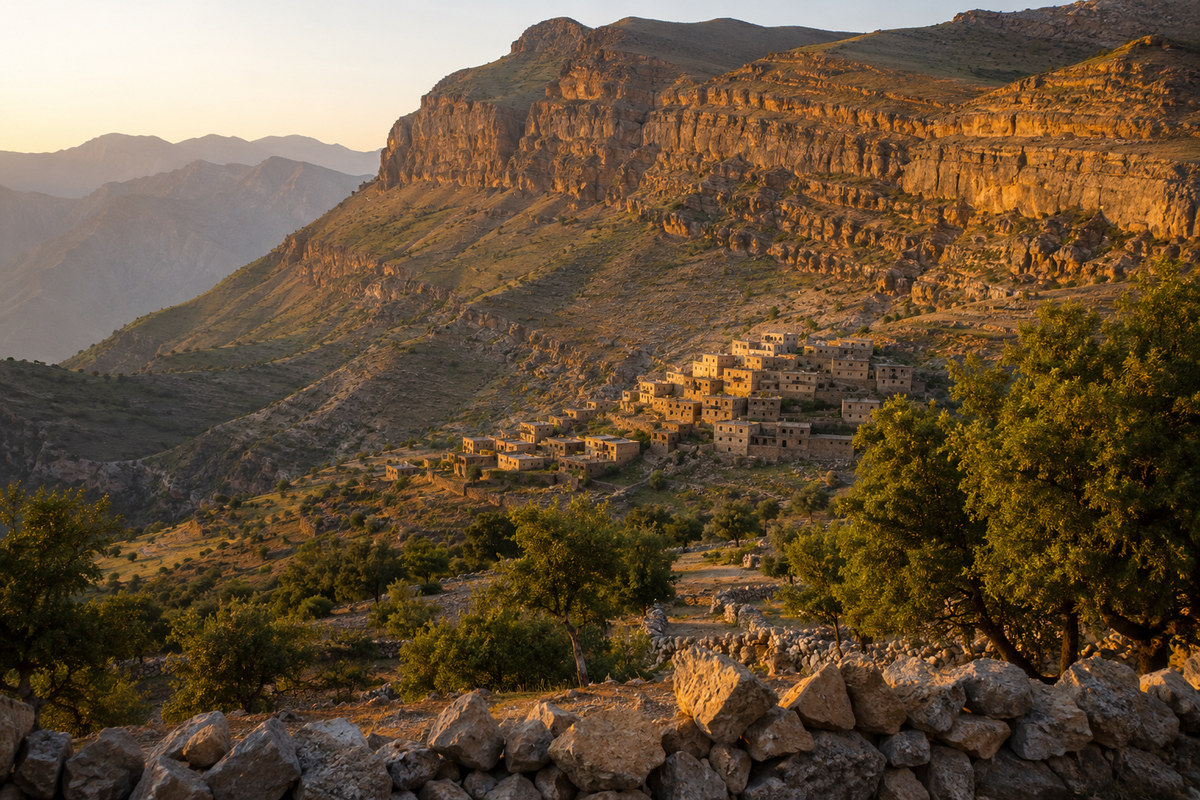
The Kurds are usually introduced through their politics, and after that through their language, and only rarely through the thing that actually distinguishes them in the genetic record: they live on top of the place where their ancestors have been living for a very long time. This article puts a number on that. Using Global25 coordinates and a pooled average of 342 Kurdish individuals from forty-seven regional samples, it finds that the nearest ancient population on earth to a modern Kurd is a group of people buried at Hasanlu in northwestern Iran between about 1250 and 630 BC, and that essentially nothing has been added to the Kurdish gene pool since. The one thing that was added, a modest steppe layer of about fifteen per cent, was already in place before the Medes are first mentioned in an Assyrian inscription.
An old question with an unusually long list of candidate answers
Almost every ancient people who ever lived in the northern Zagros has at some point been proposed as the ancestor of the Kurds. The Guti, who came down from the mountains and broke the Akkadian empire in the twenty-second century BC. The Lullubi of the Zagros passes. The Turukkaeans, known only from Old Babylonian letters complaining about them. The Hurrians, whose language was neither Semitic nor Indo-European and whose successor state of Mitanni ruled northern Mesopotamia in the fifteenth century BC. The Mannaeans of Lake Urmia. The Carduchi, whom Xenophon's ten thousand had to fight their way past in 401 BC and whose name is the one usually pointed at as the ancestor of the word Kurd. And, most persistently, the Medes, whose empire fell to Cyrus in 550 BC and whose name has been carried by Kurdish nationalist historiography for a century.
The list is long because the evidence is thin. What is not thin is the linguistic evidence. Kurdish is Northwestern Iranian, part of the Iranian branch of Indo-European, closely related to Zazaki, Gorani, Balochi and Talysh, and more distantly to Persian. Whoever the Kurds are, an Iranian language reached the Zagros at some point and stayed. The question this article can actually address is what came with it, and the answer is: much less than the language, and much earlier than most reconstructions assume.
What the uniparental markers already said
Kurdish Y chromosomes have been typed repeatedly since Nasidze and colleagues sampled Kurmanji and Zaza speakers in Turkey in 2005, and the picture has been stable since. The dominant lineage is J2-M172, running at roughly a fifth to a quarter across most samples and reaching about twenty-eight per cent in a recent Sorani series from Sulaymaniyah, with E1b1b at about sixteen and J1 at about fourteen. J2 is the flagship lineage of the Neolithic northern Fertile Crescent and of the Zagros in particular. R1a-M17, the lineage most often associated with the Indo-Iranian expansions, is present but minority, running at roughly ten to twelve per cent in most Kurdish samples and concentrated in specific tribes rather than spread evenly. R1b, G2a, T and I appear at low frequencies. Haplogroups C2, N and Q, the markers of Central and Inner Asian steppe nomads of the historic period, are effectively absent.
The maternal picture is the same story from the other side. Kurdish mitochondrial pools are dominated by haplogroups H, U, J, T and K, the standard West Eurasian set, with the U subclades in particular reflecting a deep Near Eastern hunter-gatherer and early farming substratum. There is no meaningful East Eurasian maternal component.
So the uniparental evidence points at a population that is overwhelmingly of local Near Eastern descent with a real but minority paternal input from somewhere north. That is a hypothesis, not a measurement. The autosomal data can measure it.
Data and method
Everything below uses Global25 scaled coordinates, with population averages merged from Davidski's published files and the Moriopoulos 2026 collection. Ancestry proportions come from non-negative least squares with a sum-to-one constraint imposed by appending a heavily weighted row of ones, with the resulting weights normalised. Distances are scaled Euclidean distances multiplied by one thousand, the convention used throughout this site.
The Kurdish target is a pooled average built from forty-seven regional samples covering Kurmanji, Sorani, Zaza and Feyli speakers in Turkey, Iraq, Iran, Syria and the Caucasus, weighted by sample size, for a total of 342 individuals. That is by a wide margin the largest Kurdish average this site has worked with, and it matters, because much of the older literature rests on samples of a few dozen. The individual branch averages are reported separately in a later section.
One panel does the work in every chart, so that rows are directly comparable: the Zagros Neolithic of Ganj Dareh, the Anatolian Neolithic, the Levantine Neolithic of the pre-pottery B horizon, the Caucasus hunter-gatherer profile from Kotias Klde, a Yamnaya steppe source from Samara, and a Northeast Asian pole. The condition number of that source matrix is 7.76. Pole separations run from 125 units between Anatolian and Levantine Neolithic, and 184 between the Zagros Neolithic and the Caucasus hunter-gatherers, up to 375 at the far end. Both of the tight pairs sit above the hundred-unit threshold below which we treat two-source separation as unreliable, but the reader should keep the first of them in mind: Anatolian and Levantine farmers are the closest pair in this model and the split between them is the least certain number in every decomposition below.
A word on the Northeast Asian pole, since readers of our Bulgar and Gagauz articles will expect one. It is included so that Turkic-speaking comparison populations fit properly rather than pushing their eastern ancestry into the steppe column. For Kurds it takes 1.6 per cent, which is the ordinary West Asian background.
Where the Kurds sit
The simplest measurement is the one that sets up everything else.
Every population within reach of the Kurds, ranked by Global25 distance. An Iron Age group from Hasanlu sits closer than any living non-Kurdish population except the Talysh and the Lurs.
The nearest populations to the pooled Kurdish average are, unsurprisingly, other Kurds: Kurmanji speakers at 8, Zaza speakers of Dersim at 8, Sorani speakers of Sulaymaniyah at 10. Then the Yazidis of Armenia at 11, who speak Kurmanji, and the Talysh of Azerbaijan at 12, who speak a closely related Northwestern Iranian language. The Lurs sit at 18.
And then, at 19 units, comes a group of nineteen people excavated from the citadel and cemetery of Hasanlu in the Solduz valley of West Azerbaijan province, radiocarbon-dated between 1248 and 632 BC. They are closer to the modern Kurdish average than the Feyli Kurds are. They are closer than Persians of Fars, at 26. They are far closer than Armenians at 44, Assyrians of Hakkari at 42, or Kurdish Jews at 54, all of whom are or were the Kurds' immediate neighbours.
An Iron Age population from the same mountains is a nearer genetic relative of the modern Kurds than almost any living population that is not itself Kurdish. That is the central fact of this article, and the rest of it is an attempt to establish that the fact is not an artifact.
Two further points on that chart deserve attention. The first is that the Neolithic itself is far away: Ganj Dareh at 189 units, Hajji Firuz Neolithic at 52, Seh Gabi Chalcolithic at 67. Continuity in the Zagros does not mean that modern Kurds are Neolithic Zagros farmers unchanged. It means that the population that had formed there by the end of the Bronze Age has stayed put. The second is the entry at 30 units: an individual excavated at Ganj Dareh but buried there in AD 1561, four and a half thousand years after the Neolithic village was abandoned. The same site, ten millennia apart, and the later burial is six times closer to modern Kurds than the earlier one.
The deep decomposition
Breaking the same populations into ancient components gives the shape of the Kurdish gene pool.
Every population within reach of the Kurds, ranked by Global25 distance. An Iron Age group from Hasanlu sits closer than any living non-Kurdish population except the Talysh and the Lurs.
Kurds come out at 30.2 per cent Zagros Neolithic, 25.3 per cent Anatolian Neolithic, 16.0 per cent Levantine Neolithic, 11.4 per cent Caucasus hunter-gatherer, 15.4 per cent steppe and 1.6 per cent Northeast Asian. Eighty-three per cent of the modern Kurdish genome therefore comes from populations that were already in western Asia before the Bronze Age, which is squarely inside the seventy-five to eighty per cent indigenous Near Eastern figure that a recent review of the Kurdish literature reports from published qpAdm work.
The Iron Age Hasanlu profile is 31.5, 21.4, 21.1, 14.5 and 11.6. The differences from the modern Kurdish profile are a few points of Levantine Neolithic traded for a few points of Anatolian, and four points of extra steppe. Given that the Levantine and Anatolian poles are the closest pair in the panel, most of that first difference is within the noise of the model. The steppe difference is not, and the next two sections are about it.
Set against that, the Armenians at 19.3 per cent Zagros Neolithic and 23.6 per cent Caucasus hunter-gatherer are a visibly different population, shifted north and west. The Assyrians of Hakkari, who lived in the same mountains as the Kurds for as long as there have been Kurds, sit at 26.8, 26.0 and 25.6 per cent for the three farming components: a Mesopotamian profile, not a Zagros one.
The steppe layer is real, and it is modest
This is the section where the article departs from the pattern of most of our previous pieces on migration claims. On the Bulgars, on the Gagauz, on the Mongols, the recurring finding was that a famous migration left essentially nothing measurable. Here it left something, and the something is measurable, and it tracks language.
Steppe ancestry across the region. Iranic-speaking populations cluster between 13 and 20 per cent; their non-Iranic neighbours in the same mountains sit between 5 and 6.
Kurds take 15.4 per cent. So do the other Iranian-speaking populations of the region: Persians of Fars 17.0, Zoroastrian Persians 20.3, Talysh 13.0, Lurs 12.8, Mazandaranis 13.2, Yazidis 16.7. And so do the Iranian-speaking populations' Turkic-speaking neighbours who sit on an Iranian substrate: Azerbaijanis of eastern Iran 15.0.
Against that, the non-Iranian-speaking populations of the same mountains: Armenians 6.2, Assyrians of Iraq 6.4, Assyrians of Hakkari 6.0, Kurdish Jews 4.6. That is a factor of roughly two and a half, and the gap of nine points is three times larger than the smallest difference this model can reliably see, as the spike-in test below establishes.
The Assyrian comparison is the useful one, because it removes almost every confound at once. Assyrians of Hakkari and Kurds of Hakkari lived in the same valleys, farmed the same slopes and were subject to the same states for as long as anyone can document. What separates them is confession and language. The Kurds carry two and a half times the steppe ancestry. Whatever brought Iranian speech into these mountains brought people with it, and those people did not join the Christian communities.
Two honest caveats. The Mesopotamian Arabs of Iraq come out at 12.6 per cent, which is higher than one would predict on a simple Iranian-speakers-only story, and the fit for that population is poor because it is Levant-dominated in a panel not built for it. And the Zoroastrian Persian figure of 20.3 per cent rests on a highly endogamous community whose drift makes its absolute numbers less trustworthy than its position.
When did the steppe layer arrive?
The Zagros and its northern approaches have one of the better ancient DNA transects in western Asia, and it answers the timing question directly rather than by inference.
The steppe layer through time in northwest Iran. Nothing before the Bronze Age, one nearly undiluted arrival at 2360 BC, and the modern level reached by the Iron Age.
Through the Neolithic and Chalcolithic there is nothing. Ganj Dareh at about 8000 BC, Tepe Abdul Hosein at about 7900 BC, Hajji Firuz at about 5900 BC and Seh Gabi at about 4300 BC all return a flat zero. Then, at Hajji Firuz in the Bronze Age, one man buried around 2360 BC returns 54.2 per cent. He is the individual that other analysts have modelled as roughly half Zagros native and half Catacomb culture, and on our panel he looks the same: a first- or second-generation product of an incoming steppe population, sitting in a Zagros cemetery. He is 103 units from modern Kurds, which is to say he does not look like a Kurd at all.
By the Iron Age the layer has been absorbed and diluted into the local population. Dinkha Tepe returns 10.5 per cent, Hasanlu 11.6, Hajji Firuz in the Iron Age 13.0. And there it stays. The Parthian burials at Liar-Sang-Bon return 5.9, the Sassanid individual from Vestemin 9.5, the medieval individual from Ganj Dareh 19.1, the man buried at Ganj Dareh in AD 1561 18.4. Modern Kurds return 15.4.
The scatter in those later figures is what one expects from single genomes and small groups drawn from different corners of a large plateau, and none of it moves outside the band established by the Iron Age. The conclusion is not subtle. The steppe contribution to northwestern Iran arrived in the Bronze Age, was absorbed within a few centuries, and had reached its modern level before the Neo-Assyrian scribes first wrote down the name of the Medes in 836 BC. Every subsequent event in the history of these mountains, and the list is long, added essentially nothing that this model can see: the Median and Achaemenid empires, the Seleucids, the Parthians, the Sassanids, the Arab conquest, the Seljuks, the Mongol invasions of the 1250s, Timur, the Safavid and Ottoman wars that ran across Kurdistan for three centuries.
Does the choice of steppe source matter?
This is the objection that has to be answered with numbers, because the steppe pole is the load-bearing part of the argument. If the fifteen per cent is really an artifact of choosing Yamnaya specifically, swapping the source should move it.
Seven steppe reference populations, spanning the whole range from a pure forest hunter-gatherer source to full pastoralist profiles. The ranking never changes.
It does not. Under Yamnaya from Samara the Kurdish figure is 15.4; under Yamnaya from the North Caucasus 17.3; under Catacomb from Kalmykia 16.9; under Sintashta 16.3; under Srubnaya 16.4; under Andronovo 16.6. The ranking is identical under every one of them: Persians above Kurds, Kurds above Lurs, Lurs alongside Talysh, all of them far above Armenians, Assyrians and Kurdish Jews.
The last row is a deliberate stress test. Eastern hunter-gatherers from Russia are not a steppe pastoralist population at all; they are the northern forest component that the steppe cultures were partly built from. Substituting them halves every number, Kurds to 8.2 and Assyrians to 2.4, because a source that is further from the western poles has to be admitted in smaller quantities to explain the same displacement. The ratio between the two groups does not change. What the choice of source controls is the scale, not the order.
The trap that catches most home modelling
Having said that the answer is robust, it is worth showing exactly how easy it is to get a wildly different one, because this is the single most common way that Global25 hobbyist modelling produces confident nonsense about Kurds specifically.
Offer the model only two sources, the Zagros Neolithic and Sintashta, and ask it to fit the Kurds. It returns 51.7 per cent steppe. Half the Kurdish genome, apparently, from the Indo-Iranian expansion. That number has been posted on forums more than once.
Zagros Neolithic plus Sintashta, two sources only. The controls take more than the target does, which is how you know the number is worthless.
Run the identical model on the controls and it falls apart. Armenians, who speak an Indo-European language of a completely different branch and who are not descended from Indo-Iranian nomads on anyone's account, take 54.9 per cent. Assyrians of Iraq take 52.0. Kurdish Jews take 50.1. Iraqi Arabs take 48.8. A model that assigns more Indo-Iranian steppe ancestry to Assyrians than to Kurds is not measuring Indo-Iranian steppe ancestry.
What it is doing is obvious once stated. Every population in the northern Near East carries Anatolian farmer, Levantine farmer and Caucasus hunter-gatherer ancestry, and none of those three is on offer. The only source in the model that pulls in anything like the right direction is Sintashta, which is itself part Caucasus hunter-gatherer and part European farmer, so non-negative least squares hands it forty to fifty per cent for everybody. The fit distances give the game away, running from 91 to 157 units against 26 for the six-source panel, but a hobbyist reading a percentage off a screen does not usually look at the fit.
This is the same failure mode we documented in the Bulgar article, where a source labelled Bulgar gave Romanians more Bulgar ancestry than Bulgarians. The defence is the same and it is cheap: run the model on a population that cannot have the ancestry in question, and see what happens.
What is missing from Iron Age Hasanlu?
Now the continuity claim itself. Take the Iron Age Hasanlu average as a single source and ask what has to be added to it to produce modern Kurds.
Thirteen candidate second sources added to an Iron Age Hasanlu baseline. Only steppe improves anything at all.
Hasanlu alone sits 18.8 units from the modern Kurdish average. Adding a steppe source improves that by between 22 and 28 per cent, with Srubnaya, Sintashta and Andronovo doing best at around 27 and taking weights of six to seven per cent. Adding the Northeast Asian pole improves it by 22 per cent for a weight of 1.9. Everything else takes nothing at all. Anatolian Neolithic: 0.4 per cent weight, 0.1 per cent improvement. Levantine Neolithic, Caucasus hunter-gatherers, the Zagros Neolithic itself, Bronze Age Canaanites, Chalcolithic Seh Gabi, Bronze Age Mesopotamia from Bakr Awa: zero weight, zero improvement, every one of them.
The best proximal model is therefore 94.6 per cent Iron Age Hasanlu and 5.4 per cent Yamnaya, or 93.3 and 6.7 with Sintashta, at a fit distance of 14 units. Read plainly: with the exception of a small further steppe top-up, everything in the modern Kurdish gene pool was already present in a cemetery in northwestern Iran before 632 BC, and no other ancient source in the dataset adds anything.
The residual of 14 units is not zero and should not be presented as zero. It reflects genuine drift over eighty generations, the roughly two per cent of Anatolian and Northeast Asian input that later centuries did contribute, and the fact that Hasanlu is a sample of nineteen people from one valley standing in for the whole northern Zagros. What it does not reflect is a missing population, because if one were missing the ladder above would have found it.
How small a difference could we have seen?
A quantitative claim is worth nothing unless the method's resolution is measured rather than assumed. Synthetic Kurdish genomes were built by mixing the real pooled average with known quantities of Yamnaya, and each was pushed back through the same six-source model.
Synthetic Kurdish genomes built by adding a known amount of Yamnaya ancestry to the real pooled average, then pushed back through the same model.
Recovery is linear on top of the 15.37 per cent baseline, at a slope of about 0.85. Inject one per cent and the model reports 16.21; inject three and it reports 17.91; inject five and it reports 19.60. Running the identical test on the Assyrian average, which starts at 6.36, gives a slope of 0.94. So a real difference of two or three points in steppe ancestry between two populations would be plainly visible on this instrument, and the nine-point gap between Kurds and Assyrians is far outside anything the method could manufacture.
Kurmanji, Sorani, Zaza: one people or three?
Zazaki is not mutually intelligible with Kurmanji, and the question of whether Zaza speakers are Kurds has been argued in Kurdish politics for a century, sometimes bitterly. Some accounts derive them from a separate migration out of Daylam on the Caspian in the early Islamic centuries. The Global25 data has an opinion.
Twenty Kurdish and Kurdish-speaking regional samples. Kurmanji, Sorani and Zaza are interleaved across the whole range with no separation.
It does not see three peoples. Twenty regional samples covering all four branches produce steppe values from 12.4 to 17.0 per cent, and the branches are interleaved throughout the range with no separation whatsoever. Zaza samples from Bingol and Diyarbakir sit at the bottom next to Kurmanji samples from Van; Zaza samples from Dersim and Erzincan sit in the middle next to Kurmanji samples from Sivas and Mardin; the top of the range is occupied by Kurmanji speakers from Konya and Afrin and Sorani speakers from Iranian Kurdistan. On raw distance, Zaza speakers of Dersim are 8 units from the pooled Kurdish average, which is closer than the Sorani of Sulaymaniyah at 10 and much closer than the Feyli at 20.
What structure there is looks geographic rather than linguistic. The lowest values cluster in the southwestern part of the range, around Diyarbakir, Bingol and Van; the highest sit either far to the west in Anatolia, where Kurdish communities were resettled in the Ottoman period, or far to the east in Iranian Kurdistan. That is a cline across a thousand kilometres, and it is a shallow one.
The published Y chromosome work says the same thing, reporting that intra-Kurdish variation is structured by tribal endogamy and mountain geography rather than by which language a village speaks. Whatever separates Zazaki from Kurmanji happened to the language and not to the people.
The Kurdish Jews are the exception that proves the rule
There has been a Jewish population in Kurdistan for a very long time, traditionally traced to the Assyrian deportations of the eighth century BC, and it spoke Aramaic rather than Kurdish. If two and a half thousand years of shared mountains produced a shared gene pool, the Kurdish Jews should look Kurdish. They do not: they sit 54 units away, which is further than Armenians, Assyrians or Turks.
Distance to Iron Age northwest Iran against distance to Bronze Age Mesopotamia. The Kurds and the Kurdish Jews are exact opposites.
The two-distance test makes it stark. Modern Kurds sit 19 units from Iron Age Hasanlu and 65 from Bronze Age Mesopotamia at Bakr Awa. The Kurdish Jews sit 45 from Hasanlu and 23 from Bakr Awa. The relationship is exactly inverted. The Yazidis, the Lurs and the Talysh line up with the Kurds; the Assyrians and the Mandaeans sit close to both poles, which is what one expects of populations of the Mesopotamian piedmont; and the Kurdish Jews line up with the Iraqi Jews, whose nearest neighbours in the whole dataset they are at 14 units.
So the Kurdish Jews are a Mesopotamian population that spent two and a half millennia in the Zagros without becoming a Zagros population. That is a striking demonstration of how little geography does on its own, and it is the mirror image of the Gagauz case we published in June, where a population kept a foreign language while its genome stayed entirely local. Here a population kept a foreign genome while living inside somebody else's mountains. In both cases the variable that governed gene flow was confessional community, not territory.
So are the Kurds the Medes?
The honest answer is that the question is not well posed, and the data explains why.
There is no Median genome. Not one securely identified individual from the Median heartland in the Median period has been sequenced, and until that changes no direct test is possible. What the data does say is that by the time the Medes appear in the historical record in the ninth century BC, the population of the northern Zagros already looked essentially the way modern Kurds look, steppe layer and all. If the Medes were the Iranian-speaking elite of that population, then modern Kurds descend from the people the Medes ruled and probably from the Medes as well, along with everyone else in the region. If the Medes were a distinct incoming group, they were absorbed into a population that was already in place and they did not change it measurably.
Either way the nationalist version and the sceptical version converge on the same genetic picture, which is that the continuity is with the landscape rather than with any named polity. The people who buried their dead at Hasanlu did not call themselves Kurds, and neither did the Guti or the Lullubi or the Mannaeans. But they are, on this evidence, the ancestors of the people who do.
One consequence is worth stating because it cuts against a claim sometimes made in the other direction. The idea that the Kurds are a recent construct, assembled out of medieval Arab and Turkic nomad confederations, does not survive contact with the numbers. The Northeast Asian component that five centuries of Seljuk, Mongol and Turkmen presence would have left is 1.6 per cent, against 7.6 for Anatolian Turks. The Arabian component that would show up as a Levantine and Arabian shift is absent: Iraqi Arabs sit 68 units away and take zero weight in the Hasanlu ladder. Whatever the Kurdish ethnic identity is as a political fact, the population carrying it is old.
Limits
Six caveats matter, and the first two are the serious ones.
First, Hasanlu is one site. Nineteen individuals from a single valley in West Azerbaijan province are standing in for the whole northern Zagros across six centuries, and the site itself is famous for a violent destruction around 800 BC that may have changed who was buried there. The Dinkha Tepe and Hajji Firuz Iron Age samples support the picture, but the ancient reference set for the Zagros proper, as opposed to its northwestern fringe, is thin, and there is nothing at all from the Kurdish heartland of southeastern Turkey and northern Iraq.
Second, the Levantine and Anatolian Neolithic poles are 125 units apart, which is close to our working threshold. The split between them in every decomposition above should be read as a single northwestern farming component rather than as two independently measured quantities.
Third, the pooled Kurdish average is heavily weighted towards Kurmanji speakers in Turkey and Syria, who supply about two thirds of the 342 individuals. Sorani and Feyli speakers in Iran and Iraq are represented but thinly, and Gorani speakers not at all.
Fourth, the absolute steppe percentages depend on the pole chosen and move by two points across the sources tested. They should be read as a calibration scale, not as point estimates, and the ranking rather than the value is what carries the argument.
Fifth, several of the later ancient comparisons rest on one or two genomes each, including the Sassanid individual and the two Ganj Dareh burials from the medieval and early modern periods. They are consistent with each other and with the Iron Age level, which is the most that can be said.
Sixth, NNLS on Global25 coordinates is a directional tool. The qualitative conclusions here, that Kurds sit closest to Iron Age northwestern Iran among all sampled ancient populations, that their steppe layer is real and roughly two and a half times that of their non-Iranian-speaking neighbours, and that it was in place by the Iron Age, are robust across every model tried. The individual percentages should not be quoted to two decimal places as though they were qpAdm point estimates.
Conclusion
Modern Kurds are the descendants of the population that had formed in the northern Zagros and its approaches by the end of the Bronze Age: a mixture of Zagros Neolithic farmers, Anatolian and Levantine farmers and Caucasus hunter-gatherers, with a steppe layer of roughly fifteen per cent that arrived during the Bronze Age and was fully absorbed before the Iron Age began. Eighty-three per cent of that genome predates the steppe entirely.
The Iron Age population of Hasanlu models them at ninety-five per cent with nothing required from any direction except a small further steppe supplement, and no Anatolian, Levantine, Caucasian, Mesopotamian or Arabian source improves the fit by so much as a tenth of a per cent. Their non-Iranian-speaking neighbours in the same mountains, Assyrians and Armenians and Kurdish Jews, carry a third of the steppe ancestry and are not descended from Hasanlu at all.
Twenty-six centuries of empires ran over these mountains and the sequence of names on the map changed almost every century. The people underneath did not.
Kurdish_pooled_(n=342),0.095629,0.110830,-0.056572,-0.036978,-0.037850,-0.005713,0.003848,-0.004616,-0.028785,-0.011310,0.001099,-0.000657,0.001277,-0.001814,0.002450,0.008760,-0.001554,0.001798,0.003502,-0.007547,-0.000773,-0.002077,-0.000334,-0.002523,0.003103
Iran_Hasanlu_IA,0.091576,0.121679,-0.064625,-0.043106,-0.041742,-0.011536,0.003589,-0.006587,-0.032017,-0.012326,0.003838,-0.000150,0.003946,-0.003941,-0.000247,0.010185,-0.001138,0.000691,0.001863,-0.005537,0.001860,-0.000989,-0.002387,-0.003713,0.001502
Iran_HajjiFiruz_IA,0.096750,0.111708,-0.073916,-0.035207,-0.048624,0.005020,-0.001410,-0.000231,-0.041314,-0.018224,0.003735,0.000300,0.009514,-0.002890,0.001357,0.011138,-0.008214,0.010388,0.004651,-0.003502,-0.001747,-0.012365,-0.002588,-0.008194,0.006706
Iran_DinkhaTepe_BA_IA_2,0.081952,0.110185,-0.072784,-0.036014,-0.051855,0.003207,-0.001645,-0.005884,-0.042541,-0.020593,0.002923,0.002622,-0.001264,-0.003096,0.006854,0.010474,-0.004237,-0.001584,0.008547,-0.010505,0.004867,-0.001422,-0.005670,-0.007110,0.012094
Iran_HajjiFiruz_BA,0.116100,0.116786,-0.002263,0.032623,-0.021850,0.017570,0.006345,0.001385,-0.046222,-0.034260,0.013803,0.005695,-0.000595,-0.012661,0.015065,0.004508,-0.004303,-0.001774,-0.001257,0.004002,0.000749,-0.002226,-0.000370,0.004940,0.001317
Iran_C_SehGabi,0.081042,0.116989,-0.103180,-0.055039,-0.067089,-0.011490,0.006298,-0.007384,-0.047163,-0.018005,0.000325,0.001319,-0.001160,-0.000330,0.002334,0.017661,-0.002842,0.003750,0.008799,-0.014707,0.006464,-0.005614,-0.003081,-0.014797,0.006443
Iran_HajjiFiruz_N,0.089351,0.133288,-0.079101,-0.067265,-0.043008,-0.020638,0.008930,-0.007038,-0.036303,-0.003827,0.003857,-0.001161,-0.001412,-0.001548,-0.005938,0.007027,0.000358,-0.000032,0.003520,-0.006347,0.006988,-0.003215,-0.009120,-0.013466,0.000210
Iran_GanjDareh_N,0.043025,0.067431,-0.153488,0.005556,-0.123962,0.024375,0.015464,0.000277,-0.081605,-0.054270,-0.003248,-0.001619,0.005382,-0.007845,0.031949,0.056775,-0.005815,0.007576,0.014405,-0.032741,0.007661,-0.030048,-0.010920,-0.038777,0.022944
Iran_GanjDareh_Historic,0.096750,0.109677,-0.051288,-0.028424,-0.047393,-0.002789,0.000940,-0.010153,-0.032315,-0.012939,0.008931,-0.007194,0.005946,0.005505,0.002036,-0.001989,-0.020210,-0.004561,0.001760,-0.010755,-0.005366,-0.000989,0.004437,-0.008555,0.004071
Turkey_N,0.117902,0.180087,0.003426,-0.101059,0.051240,-0.047969,-0.003799,-0.006846,0.036167,0.080678,0.008261,0.011309,-0.024164,0.000579,-0.042712,-0.010370,0.022556,0.001388,0.013649,-0.010448,-0.014261,0.005693,-0.004904,-0.003750,-0.004436
Israel_PPNB,0.070570,0.174671,-0.032809,-0.147612,0.036930,-0.068886,-0.018331,-0.009230,0.077719,0.043554,0.011205,-0.012589,0.027800,-0.006744,-0.023480,0.009944,0.020340,-0.008742,-0.001885,0.024637,0.000749,0.007048,-0.004807,-0.005422,-0.008742
Georgia_Kotias.SG,0.089920,0.103584,-0.088246,-0.004845,-0.089555,0.020359,0.023266,-0.001154,-0.130486,-0.080002,-0.007632,0.024878,-0.052626,0.007707,0.026465,-0.029700,0.027772,-0.010769,-0.023757,0.037518,0.030945,-0.006677,0.005300,-0.020846,0.001557
Russia_Samara_EBA_Yamnaya,0.125838,0.089254,0.042908,0.115456,-0.027868,0.044685,0.004491,-0.002949,-0.054858,-0.072996,0.001858,0.000350,-0.001652,-0.023610,0.037263,0.015734,0.000000,-0.001478,-0.001704,0.012506,-0.003120,0.001374,0.011229,0.018436,-0.004524
Russia_MLBA_Sintashta,0.125888,0.116617,0.057448,0.078640,0.011335,0.029098,0.005820,0.004361,-0.017425,-0.028271,-0.002306,0.001219,-0.002190,-0.021230,0.022878,0.012450,-0.005011,0.000338,-0.000352,-0.000338,-0.005889,0.001822,0.002674,0.006929,-0.003660
Mongolia_Early_Medieval_Rouran_(n=1),0.043253,-0.459019,0.064865,-0.036822,-0.077245,-0.058288,0.026086,0.004846,-0.014521,0.007654,-0.047742,0.000300,-0.005798,0.020919,-0.000814,0.005171,0.013821,-0.003674,0.019232,0.002751,-0.035562,-0.035117,-0.033154,-0.007350,-0.014609
Kurdish_Kurmanji_Turkey_(n=21),0.097446,0.114009,-0.058277,-0.038955,-0.038504,-0.006245,0.004203,-0.004355,-0.028092,-0.009536,0.001069,-0.000480,0.001440,-0.004573,0.003966,0.011722,0.001391,0.002667,0.004330,-0.008055,-0.000429,-0.002946,-0.001387,-0.001385,0.003583
Kurdish_Sorani_Iraq_Sulaymaniyah_(n=13),0.092495,0.110047,-0.060270,-0.036000,-0.040243,-0.003162,0.004969,-0.006589,-0.025346,-0.012637,0.002186,-0.001144,0.002924,-0.000302,0.002757,0.010064,-0.005304,0.000867,0.006350,-0.009969,0.001276,-0.001156,-0.001117,-0.001198,0.001883
Kurdish_Zaza_Dersim_(n=21),0.098283,0.114162,-0.057672,-0.038372,-0.038993,-0.007553,0.004325,-0.005796,-0.029398,-0.010672,0.001201,-0.000128,0.001042,-0.001570,0.001635,0.003960,-0.004888,0.002933,0.004702,-0.008854,0.000781,-0.002563,-0.000357,-0.002390,0.002764
Kurdish_Feyli_(n=8),0.091628,0.111327,-0.067316,-0.035328,-0.043816,-0.003242,0.006228,-0.005077,-0.031855,-0.013280,-0.000568,-0.000880,0.003401,-0.004989,0.005225,0.017651,0.007236,0.000127,0.001791,-0.006738,0.001107,-0.002056,0.000570,-0.002485,0.002410
Kurdish_Jew_(n=8),0.092054,0.134558,-0.065572,-0.073927,-0.030736,-0.021684,0.002526,-0.006519,-0.013729,-0.001891,0.005054,-0.007268,0.011596,0.002890,-0.005225,0.011336,-0.000407,0.001251,0.003205,-0.004346,0.001825,0.001793,-0.001294,-0.000241,0.001886
Assyrian_Turkey_Hakkari_(n=14),0.097400,0.133977,-0.062440,-0.065361,-0.031698,-0.016953,0.002719,-0.008011,-0.022688,-0.002760,0.006449,-0.001092,0.005766,-0.000020,-0.002075,0.007056,0.000065,0.001683,0.004390,-0.005270,0.001239,0.002994,-0.000678,-0.000990,0.002720
Armenian_(n=19),0.104583,0.137746,-0.054989,-0.060475,-0.029358,-0.015262,0.003533,-0.007079,-0.030132,-0.003317,0.002838,0.000725,-0.003098,0.003112,-0.004878,-0.002903,-0.000969,0.000739,0.001581,-0.001969,0.001386,0.002432,-0.003391,-0.001484,-0.000047
Persian_Fars_(n=13),0.084667,0.101826,-0.068491,-0.025180,-0.044174,0.001309,0.003724,-0.003195,-0.027997,-0.016611,0.001037,-0.000795,0.002722,-0.001948,0.006567,0.012392,-0.004824,0.001608,0.002031,-0.010938,0.001152,-0.003481,0.000303,-0.004523,0.004044
Lur_(n=17),0.088782,0.108960,-0.067615,-0.036404,-0.045963,-0.006398,0.003815,-0.004547,-0.028657,-0.013464,0.002703,-0.001745,0.003480,-0.001044,0.005173,0.009539,-0.006281,0.003130,0.006913,-0.011197,-0.000477,-0.004321,-0.001327,-0.004706,0.005361
Talysh_Azerbaijan_(n=24),0.095816,0.104235,-0.061113,-0.034898,-0.042115,-0.005641,0.003895,-0.004012,-0.034104,-0.013334,-0.000705,0.000534,-0.001478,-0.000934,0.000472,0.005944,0.000311,0.001016,0.001561,-0.006820,0.000210,-0.002480,-0.000694,-0.002541,0.003960
Yazidi_Armenia_(n=9),0.090552,0.111708,-0.060549,-0.032192,-0.038058,-0.002541,0.001384,-0.005256,-0.024634,-0.009577,0.000000,-0.001049,0.002659,-0.002615,0.003061,0.011005,-0.001608,0.002914,0.002710,-0.004766,-0.000125,-0.000659,-0.000397,-0.004833,0.003299
Iraqi_Arab_(Mesopotamian_Arab_Profile)_(n=22),0.051893,0.117063,-0.062294,-0.060959,-0.028341,-0.018318,-0.003194,-0.004080,0.003644,-0.006105,0.004222,-0.010511,0.019671,-0.001326,0.001832,0.015127,-0.005411,0.003282,0.001160,0.000892,0.003261,0.002338,-0.003109,0.000833,0.000528
Global25 coordinates by Davidski (Eurogenes). Population averages from the Moriopoulos Collection 2026. Models can be reproduced in Vahaduo using the blocks above.
References
- 2016 Broushaki F., Thomas M.G., Link V., et al. Early Neolithic genomes from the eastern Fertile Crescent. Science 353(6298): 499-503.
- 2016 Lazaridis I., Nadel D., Rollefson G., et al. Genomic insights into the origin of farming in the ancient Near East. Nature 536: 419-424.
- 2019 Narasimhan V.M., Patterson N., Moorjani P., et al. The formation of human populations in South and Central Asia. Science 365(6457): eaat7487.
- 2020 Skourtanioti E., Erdal Y.S., Frangipane M., et al. Genomic History of Neolithic to Bronze Age Anatolia, Northern Levant, and Southern Caucasus. Cell 181(5): 1158-1175.
- 2025 Amjadi M.A., Ozdemir Y.C., Ramezani M., et al. Ancient DNA indicates 3,000 years of genetic continuity in the Northern Iranian Plateau, from the Copper Age to the Sassanid Empire. Scientific Reports 15: 16530.
- 2005 Nasidze I., Quinque D., Ozturk M., Bendukidze N., Stoneking M. MtDNA and Y-chromosome variation in Kurdish groups. Annals of Human Genetics 69(4): 401-412.
- 2012 Grugni V., Battaglia V., Hooshiar Kashani B., et al. Ancient migratory events in the Middle East: new clues from the Y-chromosome variation of modern Iranians. PLoS ONE 7(7): e41252.
- 2013 Malyarchuk B., Derenko M., Denisova G., et al. Y-chromosome diversity in the Kurds of Iran. Annals of Human Genetics 77(6): 519-529.
- 2001 Nebel A., Filon D., Brinkmann B., et al. The Y chromosome pool of Jews as part of the genetic landscape of the Middle East. American Journal of Human Genetics 69(5): 1095-1112.
- 2010 Behar D.M., Yunusbayev B., Metspalu M., et al. The genome-wide structure of the Jewish people. Nature 466: 238-242.
- 2015 Yunusbayev B., Metspalu M., Metspalu E., et al. The Genetic Legacy of the Expansion of Turkic-Speaking Nomads across Eurasia. PLoS Genetics 11(4): e1005068.
- 2026 The Phylogeny of Kurdish Populations: A Genetic and Historical Review. Rojava Journal of Science and Technology.
- Data Global25 coordinates by Davidski (Eurogenes). Population averages from the Moriopoulos Collection 2026. Modelling with Vahaduo and scipy NNLS.