
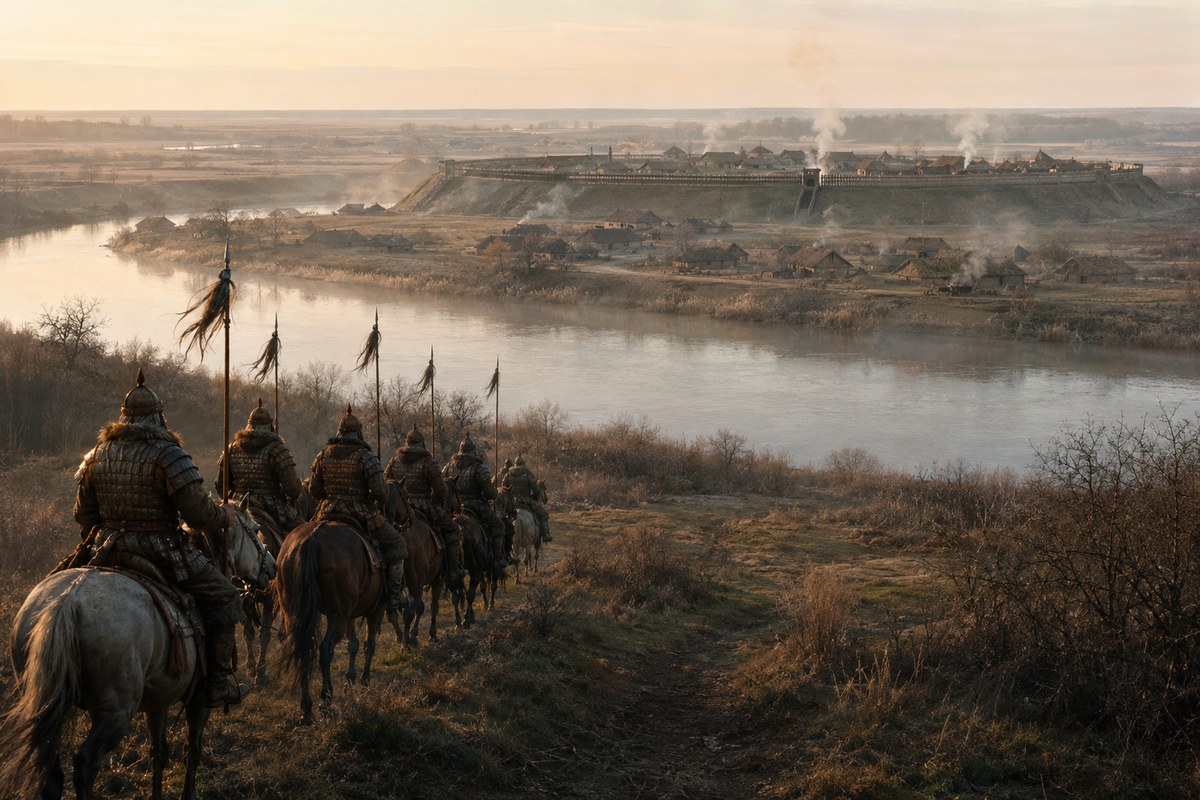
In the summer of 681 the Byzantine emperor Constantine IV signed a treaty with a nomad chieftain named Asparukh and agreed, humiliatingly, to pay him tribute. The state that grew out of that treaty is the one that still carries Asparukh's name. His people spoke an Oghuric Turkic language, buried their dead under kurgans and counted years by an animal cycle borrowed from the eastern steppe. Thirteen centuries later, their supposed descendants are among the least East Eurasian populations in eastern Europe. This article asks what happened to the Bulgars, and it does so with numbers rather than adjectives.
A question that is not really about genetics
Few topics in Balkan population history generate as much heat as the origin of the Bulgars, or, as Bulgarian scholarship prefers, the proto-Bulgarians. The debate has run for more than a century and it has always been about more than ancestry. If the Bulgars were a Turkic people, then the founding dynasty of the Bulgarian state came out of the same world as the Khazars, the Avars and the Gokturks. If they were an Iranian or Ciscaucasian people, as a long and respectable school of Bulgarian historiography has argued, the founding dynasty belongs to a different and more comfortable neighbourhood.
Readers write to us about this more often than about any other Balkan topic, and the objection is almost always the same. A Bulgarian runs a Global25 calculator, sees a sample labelled as a proto-Bulgar or a Turkic steppe group appear at two or three per cent, and reasonably asks whether the label is doing the work rather than the data. It is a good objection. It deserves a proper answer, and the answer turns out to be more interesting than a simple yes or no.
The historical record itself is not seriously in doubt on the language question. The Nominalia of the Bulgarian Khans preserves calendar terms that are recognisably Oghuric Turkic, the same branch that survives today only in Chuvash. Byzantine and Arab authors placed Old Great Bulgaria, founded by Kubrat around 632, in the steppe and piedmont zone north of the Caucasus. After Kubrat's death the confederation split. One group went east and founded Volga Bulgaria on the middle Volga. Another, under Asparukh, went west across the Danube. Two branches of the same people, sent in opposite directions in the same decade. That is an almost experimental setup, and it is the backbone of everything that follows.
What the recent literature established
Three papers frame the problem. Olalde and colleagues published genome-wide data from 136 Balkan individuals of the first millennium CE in 2023 and documented two things clearly: a large influx of Anatolian-related ancestry during the Roman imperial period, and, after roughly 700 CE, the arrival across the whole Balkan region of people genetically similar to present-day Slavic speakers. The Bulgarian medieval individuals in that dataset carried between forty and sixty per cent of this Central and Eastern European early medieval ancestry.
Sarno and colleagues followed in 2025 with a study focused specifically on Bulgaria, genotyping samples from seven regions including the Kapantsi and Vayatsi, two ethnographic groups who consider themselves direct descendants of the seventh-century Bulgars. Their proximate qpAdm model gave present-day Bulgarians roughly fifty-six per cent medieval Central and Eastern European ancestry, about twenty-two per cent Roman and Byzantine Western Anatolian, twelve to fifteen per cent local Bulgarian Iron Age, and about eight and a half per cent Ottoman-era Anatolian. No Bulgar source appears in that model at all, for the simple reason that none was needed to fit the data.
The third paper is the control. Gnecchi-Ruscone and colleagues showed in 2022 that the Avar elite who settled the Carpathian Basin in 567 carried Northeast Asian ancestry matching preceding Mongolian steppe populations, closely resembling a genome from the Rouran period. The Avars arrived a century before Asparukh, from a similar direction, into a similar landscape. Their genetic signature is unmistakable. This tells us the method works. When a steppe elite arrives and leaves descendants, ancient DNA sees it.
How the analysis was built
All modelling here uses Global25 scaled coordinates, with population averages merged from Davidski's published files and the Moriopoulos 2026 collection. Ancestry proportions come from non-negative least squares with a sum-to-one constraint, implemented in scipy, with the resulting weights normalised. Every model reports its fit distance and every source set was checked for condition number before the results were trusted.
The baseline three-source model uses a local Thracian Iron Age population from Kapitan Andreevo, an early medieval Byzantine Anatolian group from Nicaea, and an early medieval Balto-Slavic group from Niemcza in Poland. Pole separations between these three range from 0.066 to 0.202, and the condition number of the source matrix is 8.3. That is a well-behaved system.
For the Bulgar question two additional sources were tested. The first is the Rouran individual from Mongolia, the same profile that identifies the Avar elite. It is used strictly as a geometric reference for Northeast Asian ancestry and no ethnic or linguistic claim is attached to it. The Rouran were not a Turkic people; their khaganate was overthrown by the Gokturks in 552, and their language is generally held to have been Mongolic or para-Mongolic. That is precisely why the sample is useful here. What an admixture model needs from an eastern source is maximum separation from the western ones, not the correct ethnonym, and the section below tests the result against genuinely Turkic populations to show the point is not academic. The second is the Bulgar community from Bochkove in Ukraine, a Saltovo-Mayaki cemetery of the eighth to tenth centuries, which is as close as the record currently comes to the actual ancestral population of Asparukh's followers.
What modern Bulgarians are made of
Three nested models for the modern Bulgarian average. Adding an Ottoman-era Anatolian source removes the East Eurasian component entirely and gives the best fit of the three.
The three-source model fits present-day Bulgarians at a distance of 0.0156 with forty-nine per cent early Slavic, thirty-one per cent Byzantine Anatolian and twenty per cent Thracian Iron Age. The agreement with Sarno's published qpAdm figures is close enough to be reassuring: the Slavic share is the largest single component, the Anatolian share sits in the twenties, and the local Iron Age contribution is real but minority.
Adding the Rouran pole as a fourth source moves the fit to 0.0141 and assigns 1.11 per cent. That is the entire measurable East Eurasian ancestry of the modern Bulgarian population. It is worth pausing on how small that is. It is the same order of magnitude as the uniparental evidence: Karachanak and colleagues found Y-chromosome haplogroups C, N and Q together at 1.5 per cent in 808 Bulgarian men, and East Eurasian mitochondrial lineages C, D and Z at 0.7 per cent combined. Three independent lines of evidence, autosomal, paternal and maternal, converge on about one per cent.
Is the local anchor doing any work?
A Bulgarian reader objected that the Kapitan Andreevo group is a thin reed to call Thracian. He is right about that. The site produced a small number of individuals, the burial treatment is irregular, and there is a reasonable case that some of them were not locals at all. If the whole analysis rested on those six people being representative Thracians, it would deserve the scepticism.
It does not rest on them. The local Iron Age source is an anchor for pre-Slavic Balkan ancestry, not an ethnic claim, and any Bulgarian group of roughly the right period serves the same function. To show that, the model was rerun with eight alternative local sources spanning the Middle Bronze Age to Late Antiquity.
Eight candidate local sources, from the Middle Bronze Age to Late Antiquity. The choice moves the number by less than a percentage point.
The East Eurasian figure ranges from 0.53 to 1.45 per cent across all eight, and the Slavic share stays between 47 and 51 per cent in every one of them. Bulgarians come out below Romanians under seven of the eight, the exception being the Bronze Age source where both fall to half a per cent and the difference is smaller than the noise. Whether the Kapitan Andreevo individuals were Thracians, Anatolian incomers or executed prisoners is an interesting archaeological question and it does not touch the result.
The signal that dissolves when you look at it
Here is where the analysis becomes interesting rather than merely confirmatory. If you put the Bochkove Bulgar community into the model as a fourth source instead of the Rouran pole, it takes four per cent. That looks like a result. A Bulgarian reader running a similar model at home would see the same number and might reasonably conclude that four per cent of their ancestry traces to Asparukh's followers.
It does not. The test that breaks it is simple: run exactly the same model on populations that were never part of the First Bulgarian Empire's founding demography. Romanians take 4.43 per cent, more than Bulgarians. Hungarians take 3.37. Greeks from Central Macedonia and Thessaly take about 2.6 to 2.7. Central Anatolian Greeks take 9.67. A source that assigns more weight to Romanians than to Bulgarians is not measuring Bulgar ancestry. It is absorbing a broad Caucasus-to-eastern-Mediterranean gradient that runs across the whole region, and the label on the sample is doing the persuading.
This is the collinearity trap, and it is the single most common way that Global25 hobbyist models produce confident nonsense. When a source overlaps substantially with the target's existing baseline, non-negative least squares will hand it weight because doing so shaves a little off the residual. The weight is real arithmetic. The ancestry it appears to describe is not. The only defence is a control population, and controls are exactly what most casual modelling lacks.
The Rouran pole survives this test better because it is genuinely far from everything in the Balkans, but even there the ordering is instructive: Romanian 1.17, Bulgarian 1.11, Hungarian 0.76, Greek 0.65, Serbian 0.26, Macedonian and Polish 0.00. Bulgarians are not distinguishable from their neighbours.
The eastern and western branches of the Bulgar confederation, thirteen centuries later. Bulgarians sit in the ordinary eastern European range; the Volga descendants do not.
Does the choice of eastern source matter?
A reader raised a fair objection to an earlier version of this article: if the question is whether the Bulgars were Turkic, why measure it against the Rouran, who were not Turkic? The answer is that the model is not being asked an ethnic question. It is being asked a geometric one, namely how much ancestry the target shares with a population maximally distant from the western sources. But the objection is worth answering with numbers rather than with an explanation, so every model was rerun with five alternative eastern sources, three of them from unambiguously Turkic contexts.
Eight eastern reference populations spanning almost the whole range of East Eurasian ancestry, one of them supplied by a reader who disagreed with the article. Bulgarians fall below Romanians under every one.
The most demanding of these is the Gokturk elite from Mongolia, dated to 587 and 592 CE, which is about as close as ancient DNA comes to the founding population of the First Turkic Khaganate and roughly contemporary with Kubrat's generation. Under that source Bulgarians take 1.09 per cent and Romanians 1.20. Under the Rouran, 1.11 and 1.17. The two clean sources agree to within four hundredths of a point.
A second reader objected, correctly, that the Mongolian Gokturk genomes are not representative of the medieval Turkic world as a whole. They carry unusually high East Eurasian ancestry for their period, above ninety per cent, whereas most Gokturk-period individuals now available run between fifty and sixty, and a genome at seventy-two per cent is already treated as an outlier. If the model only worked with an extreme source, that would be a real problem.
It does not depend on the source. The figure above spans almost the entire available range, from a South Central Asian Turkic group at thirteen per cent East Eurasian up to the Rouran at effectively a hundred. Two of the sources, the Central Asian Turkic profiles from the Saltovo-Mayaki Alans and from the Bochkove Bulgars themselves, sit at fifty-five and fifty-four per cent, squarely in the band the objection describes. They give Bulgarians 2.01 and 1.96 per cent, against 2.22 and 2.17 for Romanians.
The sixth row deserves its own note, because that source did not come from us. The same reader assembled his own panel of fourteen medieval Turkic individuals, dated between 691 and 1500 CE and drawn from the Central Asian steppe series, and sent it over as a fairer instrument than anything used here. It averages 45.6 per cent East Eurasian. Run as the fourth source it gives Bulgarians 2.49 per cent and Romanians 2.75, with Hungarians at 2.26 and Macedonians at 0.05. Applied to the eastern branch it gives the Chuvash 46.5 per cent and the Volga Bulgars 56.4. His panel, our conclusion. Its coordinates are included in the block at the end of this article so that anyone can check both.
What the eastern fraction of the source controls is the scale of the numbers, not their order. A source that is only thirteen per cent East Eurasian has to be admitted in much larger quantities to explain the same amount of eastern ancestry, so everyone's figure rises: Bulgarians to 7.47 per cent under it, but Romanians to 8.15 and Hungarians to 5.28. Across all eight sources the ranking is identical every time. Romanians above Bulgarians, Bulgarians above Hungarians, Macedonians at or near zero. Eight different instruments, one answer.
The same substitution applied to the eastern branch produces the mirror image. Under the Gokturk source the Volga Bulgars of Tankeyevka take 27.8 per cent and the Chuvash 24.2, against 26.1 and 22.7 under the Rouran. Whichever instrument is used, the gap between the two branches of the confederation is between twenty and twenty-five points. That gap is the finding, and it does not depend on the label attached to the ruler.
There is a general lesson here that is worth more than the specific result. Choosing an admixture source by its ethnonym rather than by its position in the coordinate space is one of the reliable ways to get a wrong answer. The culturally Turkic sources listed above sit between 0.27 and 0.36 from the western sources used in this model; the Rouran and Gokturk samples sit at 0.59 and 0.62. The closer a source is to the rest of the model, the more of the model's noise it will quietly absorb, which is the same failure mode that made the Bochkove Bulgar source appear to give Romanians more Bulgar ancestry than Bulgarians.
What if the Bulgar source is not eastern at all?
A second objection follows naturally from the first, and it is the better of the two. By the time Asparukh crossed the Danube, the Bulgars were no longer a predominantly East Eurasian population. The Bochkove community averages 24.6 per cent East Eurasian, which makes it about three quarters West Eurasian, and the Volga Bulgars are much the same at 22.7. So measuring modern Bulgarians against a pure Northeast Asian pole will systematically understate Bulgar ancestry, because only a quarter of a Bulgar's genome would register on that instrument at all.
This is correct, and it is why the ceiling calculation earlier in this article divides the observed excess by 0.246 rather than reading it off directly. But the objection can be answered more directly than by arithmetic. Instead of a distant eastern pole, put the Bulgars themselves into the model, in all their three-quarters West Eurasian reality, and see what happens.
Five Bulgar and Bulgar-related sources, none of them a distant eastern pole. Romanians outscore Bulgarians on all five.
The Bochkove Bulgars give Bulgarians 4.00 per cent and Romanians 4.43. The Volga Bulgars give 4.90 and 5.22. The Chuvash, the only surviving speakers of the Oghuric branch and the closest living relatives of the Danube Bulgars by language, give 4.39 and 4.43. The Central Asian Turkic profile from the Saltovo-Mayaki Alans gives 2.01 and 2.22. In every case Romanians take more than Bulgarians.
The final row is the most instructive. Here the source is not a distant steppe population at all but I2525 himself, the one man buried in medieval Bulgaria with genuine steppe ancestry, a person who actually lived and died in the First Bulgarian Empire. Modelled as a source, he gives Bulgarians 8.11 per cent, Romanians 10.44 and Hungarians 10.99. A source that makes Hungarians more Bulgar than Bulgarians is not measuring descent from Asparukh. It is measuring a broad regional gradient that runs across the Carpathian Basin and the lower Danube alike, and the Bulgarian share of it is unremarkable.
Macedonians are the useful floor throughout. They take between zero and 0.59 per cent from every one of these sources, which shows that the numbers are not simply an artefact that any Balkan population would generate. The gradient is real; it is just not Bulgar, and it is not strongest in Bulgaria.
The Ottoman confound
There is one further test, and it is the one that changes the conclusion from a negative to something sharper. Add a modern Anatolian Turkish source to the model, representing the demographic effect of five centuries of Ottoman rule, and the East Eurasian component drops to exactly zero. The five-source model fits best of all, at distance 0.0132, with 45.3 per cent early Slavic, 26.5 per cent Thracian Iron Age, 19.1 per cent Byzantine Anatolian and 9.1 per cent Ottoman-era Anatolian.
That Ottoman figure of 9.1 per cent is within half a point of Sarno's independently derived qpAdm estimate of 8.5 per cent, which is a good sign that the model is doing something real. And the implication is direct: the small East Eurasian trace in the Bulgarian gene pool is better explained by the Ottoman centuries, during which Anatolian Turks carrying their own modest Central Asian component settled in Bulgarian lands, than by a seventh-century steppe migration. Whatever the Bulgars contributed, it is not what is showing up in the calculators.
Geography has nothing to say either
If Asparukh's followers had left a demographic legacy, it should be visible in space. The Bulgar power centre was in the north-east, around Pliska and Preslav. The south-west, around Blagoevgrad, was peripheral to the First Empire and was later heavily shaped by other populations. A real Bulgar contribution ought to produce a north-east to south-west gradient.
No geographic structure. The old Bulgar heartland in the north-east is indistinguishable from the periphery.
It does not. Regional Bulgarian averages give values ranging from zero to 1.97 per cent with no geographic structure whatsoever. The highest value belongs to Pernik in the far west. Blagoevgrad in the south-west and Vidin in the north-west both give zero. Varna and Targovishte, in the heart of the old Bulgar territory, give 0.63 and 0.90. This is scatter around a floor, not a gradient. Sarno's team reached the same conclusion by different means, finding no significant genetic substructure among Bulgarian regions at all, and specifically no distinctiveness in the Kapantsi and Vayatsi despite their traditional claim of direct Bulgar descent.
What ancient DNA does show
None of this means the Bulgars are invisible in the archaeological record. They are not, and this is the part of the story that deserves the most care, because the honest answer is neither that nothing happened nor that the steppe left a broad demographic mark.
A caution first, because it bears directly on how the next figure should be read. The merged Global25 files in circulation contain the same medieval Bulgarian genomes under more than one label. The Davidski average called Bulgaria_Medieval_oEastAsia and the Moriopoulos entry called Samovodene are not two people; they are two renderings of one genome, I2525. Likewise the two-individual average called Bulgaria_Medieval and the one called Ryahovets are the same pair, I10548 and I17980. Anyone stacking these labels in a chart will count three individuals as five or six. We are grateful to a Bulgarian reader for catching exactly this in an earlier draft of this article, and the figure below has been rebuilt to show one row per person.
Every medieval genome so far recovered from Bulgaria, modelled one by one. The steppe signal belongs to a single man buried at Samovodene.
So the entire medieval genome-wide record from Bulgaria currently amounts to three individuals, all from two neighbouring sites in the Veliko Tarnovo region. One of them, the man I2525 buried at Samovodene and radiocarbon-dated to 889-989 calCE, carries a genuine East Eurasian signal of about eleven per cent, depending slightly on which rendering of his coordinates is used. He is the individual Reich's team flagged as an ancestry outlier, and he is almost certainly what a man of Bulgar descent looked like at the height of the First Empire.
His Y-chromosome sharpens the picture and complicates the attribution. I2525 belongs to haplogroup Q, and on the current phylogeny his closest ancient relatives are not Bulgars at all. They are Avar-period individuals from the Carpathian Basin, together with samples from the Altai reaching back to the Pazyryk and Odintsovo horizons. Q is a lineage of the Inner Asian steppe generally, carried by Xiongnu, Huns, Avars and Siberians, and it is not diagnostic of Turkic speech any more than the Rouran are. So the one man in the medieval Bulgarian record with steppe ancestry may descend from Asparukh's followers, or he may descend from the Avar world that bordered and overlapped Bulgaria to the north-west, or from Kuber's Bulgars who came out of the Avar Khaganate in the 680s. The honest position is that a single individual cannot be assigned to a confederation, and this is one more reason not to build an argument on him in either direction.
The same reader pointed out what that Avar connection may mean historically, and the point is a good one. Asparukh was not the only Bulgar leader of his generation. Alcek took a following west into Italy by way of Bavaria, where they settled in what is now Molise. Kuber remained inside the Avar Khaganate, contended for its throne, lost, and led his people south of the Danube into Macedonia in the 680s. Avar-period cemeteries in Hungary and Austria have produced individuals who lived in Avar material culture without carrying the East Asian ancestry of the Avar core, and Kuber's Bulgars would have looked much like them. If a substantial part of the Bulgar element that entered the Balkans arrived by that route rather than directly off the steppe, it would have been West Eurasian on arrival and no eastern-source model would ever see it.
That objection cannot be dismissed and it should not be. But notice where it leads. If the Bulgars who entered the Balkans were already genetically Balkan and Central European, then they were not a steppe contribution in any meaningful sense, and the question this article asks, whether Turkic-speaking nomads left a demographic mark on Bulgaria, is answered in the negative twice over rather than once. What the Bulgars brought would have been a name, a dynasty and a language, carried by people who already resembled their new neighbours. That is a cultural veneer by a different route, not an alternative to one.
And that is the whole of it. Even he is only eleven per cent East Eurasian. Two or three centuries after the crossing of the Danube, the descendants of Asparukh's warriors were already close to nine-tenths Balkan and Slavic in ancestry. Whatever the Bulgar element had been on the steppe, it had been diluted almost out of existence within the lifetime of the state it founded.
The two women from Ryahovets, dated to the eleventh to thirteenth centuries, model at 1.74 and 1.24 per cent, which is the modern Bulgarian value. The genetic distance between the Ryahovets pair and present-day Bulgarians is 0.0258, smaller than the distance between modern Bulgarians and modern Serbians. Nine hundred years ago the population was already what it is now.
It has to be said plainly that three individuals is a thin record on which to hang any argument, and this is the single biggest limitation of everything above. One outlier out of three could mean that roughly a third of tenth-century Bulgarians carried steppe ancestry, or it could mean that the excavators happened to sample the one man in the district who did. The modern data, where sample sizes are in the hundreds, is what actually constrains the answer; the medieval individuals only illustrate it.
The homeland was not one people
There is a further complication, and it cuts in favour of the Bulgarian sceptics rather than against them. The Bulgar homeland population itself was not genetically homogeneous.
Three burials from a single Bulgar cemetery at Bochkove, Ukraine. The confederation was politically defined, not genealogically.
Three burials from the Bochkove cemetery, all attributed to the Bulgar component of the Saltovo-Mayaki culture, produce three different ancestry profiles. One is 92.6 per cent North Caucasus with no detectable East Eurasian ancestry at all. One is a Central Asian Turkic profile at 53.5 per cent East Eurasian. One sits between them at 23.6. Averaged, the community comes out at roughly 53 per cent North Caucasus, 25 per cent East Eurasian and the remainder eastern European and Anatolian.
This matters for the old Bulgarian debate. The Ciscaucasian school, which has argued for decades that the proto-Bulgarians were fundamentally a North Caucasian and Sarmato-Alanic population rather than an Altaic one, turns out to have been substantially right about the biology. The Turkic component in the Bulgar confederation was real but it was a minority even at home, in the steppe, before anyone crossed the Danube. The Khazar-period burials from Anapa in the Krasnodar region tell the same story: 93.5 per cent North Caucasus, one per cent East Eurasian. These steppe polities were confederations. The unit of belonging was political, not genealogical.
So when a Bulgarian reader objects that the proto-Bulgarians were not really a Turkic people, they are making a defensible claim about ancestry and a much weaker one about language. The linguistic evidence for Oghuric Turkic among the Bulgar elite is solid. The genetic evidence says that speaking Oghuric Turkic and descending mostly from Mongolia were two different things, even in the eighth century, even on the Don.
How much could still be hiding?
A negative result is only as good as its resolution. To establish what the model can actually detect, known quantities of East Eurasian ancestry were injected into the modern Bulgarian average and the model was asked to recover them.
The detection floor. Injected East Eurasian ancestry is recovered linearly, so the absence of a signal is a real absence.
Recovery is linear across the whole tested range with a constant offset of about one percentage point, which is simply the background the model already assigns. A two per cent injection returns 3.09, a five per cent injection returns 6.05, a ten per cent injection returns 11.00. There is no threshold below which the signal vanishes and no compression at the low end. The method is not failing to see something.
This lets us put a ceiling on the Bulgar contribution. The Bochkove community averages about 24.6 per cent East Eurasian. If Bulgarians carry at most 0.8 percentage points of East Eurasian ancestry above the Balkan background, and none at all once the Ottoman source is admitted, then the maximum possible Bulgar demographic contribution to the modern Bulgarian gene pool is somewhere around three per cent, and the most economical reading of the data is that it is close to zero.
The other branch
The comparison that settles the argument is not with Serbs or Greeks. It is with the Bulgars themselves, or rather with the half of them who went east instead of west.
Volga Bulgar individuals from Tankeyevka in Tatarstan, dated to the seventh to eleventh centuries, model at 22.7 per cent East Eurasian. Their modern linguistic descendants, the Chuvash, who still speak the only surviving Oghuric Turkic language, model at 22.66. Kazan Tatars come in at 19.9. The genetic distance from modern Bulgarians to the Volga Bulgars is 0.1918, roughly fourteen times the distance from Bulgarians to Romanians.
Two branches of one confederation, separated around 660 CE. The eastern branch kept its language and kept a quarter of its steppe ancestry. The western branch lost the language by the tenth century and, on the evidence available, lost essentially all of the ancestry too. This is not a story about the method failing to detect Bulgars. It is a story about two genuinely different outcomes.
So was it a veneer?
Yes, and the word is not an insult. The Bulgar contribution to Bulgaria was political and institutional rather than demographic. Asparukh's followers were a military aristocracy numbering perhaps tens of thousands, arriving in a landscape already substantially resettled by Slavic-speaking populations and still holding a large provincial Roman and Thracian substrate. They supplied a dynasty, a state structure, a name and a set of titles. Within two centuries they had adopted Slavic speech, Christianity and the Cyrillic literary culture that the state they founded went on to export across the Orthodox world.
This is not an unusual outcome. It is what happened to the Franks in Gaul, to the Rus among the eastern Slavs, to the Normans in Sicily and to the Lombards in Italy. Conquest elites are typically small, and small groups that intermarry into a large sedentary population disappear genetically within a handful of generations. The Avars are the exception, not the rule, and they were an exception because they arrived in larger numbers and maintained endogamous elite communities in a defined core territory for two centuries.
For a Bulgarian looking at their own results, the practical implication is straightforward. Any Central Asian or Turkic component appearing at two or three per cent in a hobbyist calculator is almost certainly one of three things: an artefact of a collinear source, a trace of the Ottoman period, or the ordinary eastern European background that Romanians, Hungarians and Russians share. It is not Asparukh. The ancestry that shows up as Slavic, as Balkan, as Byzantine Anatolian and as Thracian is the real inheritance, and it is a considerably older and deeper one than the seventh century.
Reproduce this yourself
The coordinates below are the exact averages used in every model in this article. Paste them into the Source and Target panes of Vahaduo, or into any Global25 tool you prefer, and check the numbers. The controls matter more than the target: run the Bulgar source against Romanians and Greeks before you believe anything it says about Bulgarians.
Bulgarian,0.124750,0.134862,0.025644,0.005362,0.024620,-0.000837,0.005499,0.003046,-0.000286,0.006998,-0.003345,0.000899,0.002111,0.008643,-0.014305,-0.002228,0.007093,0.002002,0.003142,-0.003702,-0.004617,-0.000544,0.002810,-0.002482,-0.001078
Thracian_IA_Kapitan_Andreevo,0.120652,0.161469,0.008359,-0.052703,0.032314,-0.025890,0.001645,-0.002923,0.012033,0.048050,0.001868,0.009692,-0.018260,0.001652,-0.023525,-0.010055,0.011213,0.004096,0.011208,-0.008754,-0.010024,0.001422,-0.003369,0.001044,-0.006866
Byzantine_Anatolian_Nicaea,0.112685,0.154970,-0.033489,-0.068088,0.003754,-0.026885,0.000705,-0.008584,-0.005522,0.021649,0.003119,0.002878,-0.008712,0.003606,-0.016992,-0.013471,-0.001695,0.002027,0.006184,-0.007028,-0.006489,0.006974,-0.002046,-0.000169,-0.002491
Early_Slav_Niemcza,0.125348,0.123895,0.075094,0.067951,0.043662,0.031480,0.011104,0.012374,-0.006366,-0.025148,-0.002253,-0.006838,0.011094,0.024428,-0.014047,-0.002851,0.002624,0.002011,-0.000031,0.006081,-0.000874,0.002056,0.006008,-0.007938,0.003742
Rouran_NE_Asian_pole,0.043253,-0.459019,0.064865,-0.036822,-0.077245,-0.058288,0.026086,0.004846,-0.014521,0.007654,-0.047742,0.000300,-0.005798,0.020919,-0.000814,0.005171,0.013821,-0.003674,0.019232,0.002751,-0.035562,-0.035117,-0.033154,-0.007350,-0.014609
Ottoman_Anatolian_Balikesir,0.098213,0.056579,-0.008997,-0.027363,-0.018025,-0.012391,0.007554,0.003527,-0.016391,0.003202,-0.001299,0.003447,-0.003271,0.002536,-0.000077,-0.001250,-0.001583,0.001104,0.003879,-0.001679,-0.004742,-0.000124,-0.000264,-0.000293,-0.000291
Bulgar_Bochkove_CentralAsianTurkic,0.059188,-0.195997,0.040352,-0.015504,-0.037853,-0.019522,0.014101,0.017076,-0.009408,0.000729,-0.010880,-0.002398,0.000892,0.003716,0.002036,0.000796,0.002217,-0.001140,0.001383,-0.000125,-0.007612,-0.000989,-0.006286,0.002410,0.013891
Bulgar_Bochkove_Ciscaucasian,0.096750,0.101553,-0.030547,-0.018734,-0.036007,0.008925,0.004230,0.004846,-0.048268,-0.028976,-0.000162,0.001499,-0.008771,0.007294,0.014115,-0.010342,0.000522,0.002027,-0.012821,-0.008129,0.000873,-0.002597,-0.005669,-0.000843,0.005628
Bulgar_Bochkove_EastAsianMixed,0.079676,-0.019295,0.018102,-0.005491,-0.036007,-0.012271,0.008930,0.012923,-0.010635,-0.000182,0.002761,-0.003147,0.001635,0.007156,0.009229,-0.001326,-0.000261,-0.000887,-0.010936,-0.013882,-0.006738,0.000247,-0.001109,0.001084,-0.003832
Bulgaria_Medieval_I2525_AD936,0.109270,0.072103,0.042992,0.010982,0.008001,-0.000837,0.007050,0.003692,-0.000205,0.002187,-0.001137,0.005245,0.001635,0.004404,-0.004614,-0.013524,-0.014603,0.003927,0.003645,0.006003,-0.012353,0.000866,-0.000986,-0.001687,0.001317
Bulgaria_Medieval_12thC,0.122360,0.133542,0.013010,-0.004038,0.011695,0.004322,-0.000353,0.001615,-0.005215,0.002551,0.000568,0.002848,0.006096,0.006399,-0.007736,0.004972,0.007562,0.000253,0.001571,-0.002626,-0.005490,-0.001051,0.006901,0.001808,-0.003593
Volga_Bulgar_Tankeyevka,0.096180,-0.022680,0.051917,0.046996,-0.043034,0.004230,0.009831,0.006192,-0.018169,-0.028915,0.015292,-0.005345,0.011843,-0.028167,-0.002646,-0.002608,-0.005693,-0.001330,-0.007710,-0.007754,0.000167,0.004863,-0.006347,0.006226,-0.003213
Chuvash,0.110083,-0.009067,0.082428,0.055648,-0.012002,0.006853,0.012523,0.015230,-0.008868,-0.033102,0.017631,-0.010855,0.026111,-0.021214,-0.025360,-0.014841,0.000112,-0.004914,-0.025229,-0.020474,0.007603,0.003409,-0.031411,0.006343,-0.001206
North_Caucasus_Kabardian,0.108891,0.082961,-0.021941,-0.016647,-0.030909,-0.000308,0.008864,-0.002574,-0.046338,-0.022780,-0.002686,0.007190,-0.014668,0.003825,0.002506,-0.017135,0.004356,-0.003352,-0.007558,0.013593,0.005721,0.000504,0.001624,-0.006976,-0.001360
Medieval_Turkic_panel_avg_n14,0.070814,-0.156609,0.039193,0.011467,-0.047613,-0.006315,0.006698,0.006494,-0.013572,-0.012067,-0.013641,-0.002623,-0.000297,-0.012425,0.006515,0.003731,-0.006454,0.001249,0.003134,0.001617,-0.016052,0.000080,-0.006541,-0.000456,-0.001523
A note on limits
Three caveats are worth stating plainly. First, the Bochkove Bulgar sample is three individuals. Three individuals from one cemetery cannot fully characterise a confederation that stretched from the Kuban to the Danube, and a better-sampled Bulgar source could change the ceiling estimate in either direction. Second, no genome-wide data yet exists from the earliest Danube Bulgar burials of the late seventh and eighth centuries, the generation that actually crossed. The one East Eurasian individual discussed here is already several generations downstream, and three medieval genomes from a single district cannot represent a kingdom. Third, the cultural attribution of ancient individuals from Mongolia between roughly 500 and 800 CE is genuinely unsettled. The same genome is sometimes published as Turkic in one study and as Xianbei, Rouran or otherwise Mongolic in another, and the archaeological and historical context of a burial carries as much weight in that decision as the genetics do. This is a real limitation on any argument that leans on what a sample is called. It is not a limitation on the argument made here, because nothing above depends on the label: the eastern sources were chosen by their position in the coordinate space, seven of them were tested across almost the entire range of East Eurasian ancestry, and the ranking of the target populations was identical under all seven. Relabelling the Rouran individual as Turkic tomorrow would not move a single figure in this article. Fourth, non-negative least squares on Global25 coordinates is a fitting exercise, not a formal statistical test. The published qpAdm figures from Olalde and Sarno remain the authoritative numbers; the work here corroborates their direction and adds controls and a detection floor that those papers did not need to report.
Fifth, and most seriously, this article is written on the eve of a much larger dataset. Akbari and colleagues released aligned data for more than ten thousand ancient individuals in April 2026, but anonymised and in the service of a paper about natural selection, with the population-history analysis withheld by agreement with the archaeologists who supplied the material. A substantial Bulgarian tranche is expected to be among it. When those individuals receive their archaeological and geographical context, every quantitative claim made here becomes revisable, and some of them will be revised. The argument for publishing now rather than waiting is not that the present answer is final. It is that a falsifiable number, reported with its controls and its detection floor, is the thing that lets better data prove it wrong cleanly.
What none of these caveats touch is the central comparison. Whatever uncertainty attaches to the exact Bulgar percentage in modern Bulgarians, the gap between one per cent and the twenty-three per cent carried by the Volga branch is not a measurement problem. It is the finding.
References
- Cell 2023 Olalde, I., Carrion, P., Mikic, I. et al. A genetic history of the Balkans from Roman frontier to Slavic migrations. Cell 186(25): 5472-5485.
- AJBA 2025 Sarno, S., Piccini, F., Abondio, P. et al. The Genetic Variability of Present-Day Bulgarians Captures Ancient and Recent Ancestral Contributions. American Journal of Biological Anthropology 186(4): e70037.
- Cell 2022 Gnecchi-Ruscone, G.A., Szecsenyi-Nagy, A., Koncz, I. et al. Ancient genomes reveal origin and rapid trans-Eurasian migration of 7th century Avar elites. Cell 185(8): 1402-1413.
- PLoS ONE 2013 Karachanak, S., Grugni, V., Fornarino, S. et al. Y-Chromosome Diversity in Modern Bulgarians: New Clues about Their Ancestry. PLoS ONE 8(3): e56779.
- Int J Legal Med 2012 Karachanak, S., Carossa, V., Nesheva, D. et al. Bulgarians vs the other European populations: a mitochondrial DNA perspective. International Journal of Legal Medicine 126(4): 497-503.
- Hum Biol 2015 Nesheva, D.V., Karachanak-Yankova, S., Lari, M. et al. Mitochondrial DNA Suggests a Western Eurasian Origin for Ancient (Proto-) Bulgarians. Human Biology 87(1): 19-28.
- Adv Anthropol 2015 Karachanak-Yankova, S., Nesheva, D., Galabov, A.S., Toncheva, D. Distribution of East Eurasian Y-Chromosome and Mitochondrial DNA Haplogroups across Eurasia: Insights into the Genetic Ancestry of Bulgarians. Advances in Anthropology 5: 205-266.
- Papers of BAS 2019 Chobanov, T. Archaeological and genetic data suggest Ciscaucasian origin for the Proto-Bulgarians. Papers of BAS Humanities and Social Sciences 6(1).
- Nature 2026 Akbari, A., Perry, A., Barton, A.R. et al. Ancient DNA reveals pervasive directional selection across West Eurasia. Nature 654: 419-428.
- Front Genet 2026 Stamov, S., Chobanov, T., Wang, T. et al. Paleogenomic evidence for genetic heterogeneity and prior admixture in Gothic-associated communities of late antique Bulgaria. Frontiers in Genetics, advance online.
- Nature 2018 Mathieson, I., Alpaslan-Roodenberg, S., Posth, C. et al. The genomic history of Southeastern Europe. Nature 555: 197-203.
- Sci Rep 2019 Modi, A., Nesheva, D., Sarno, S. et al. Ancient human mitochondrial genomes from Bronze Age Bulgaria: new insights into the genetic history of Thracians. Scientific Reports 9: 5412.
- Sci Data 2024 Mallick, S., Micco, A., Mah, M. et al. The Allen Ancient DNA Resource (AADR): a curated compendium of ancient human genomes. Scientific Data 11: 182.
Global25 coordinates by Davidski (Eurogenes). Population averages from the Moriopoulos Collection 2026. Admixture modelling carried out with scipy non-negative least squares; charts computed and rendered for this article. Analysis performed with Vahaduo-compatible scaled coordinates. Thanks to Greta Dimitrova for identifying a duplicated sample label in an earlier version of the chronological figure, and for pressing the objection that produced the robustness section on the choice of eastern source. Thanks also to Alper for three objections, on the West Eurasian composition of the medieval Bulgars, on the representativeness of the Mongolian Gokturk genomes, on the instability of cultural attributions for Mongolian samples of the 6th to 9th centuries, and for supplying the medieval Turkic panel used as the sixth eastern source. Thanks to Kostadin Tonev for challenging the Thracian attribution of the local anchor, which produced the substrate test, and for the Kuber and Alcek argument.