
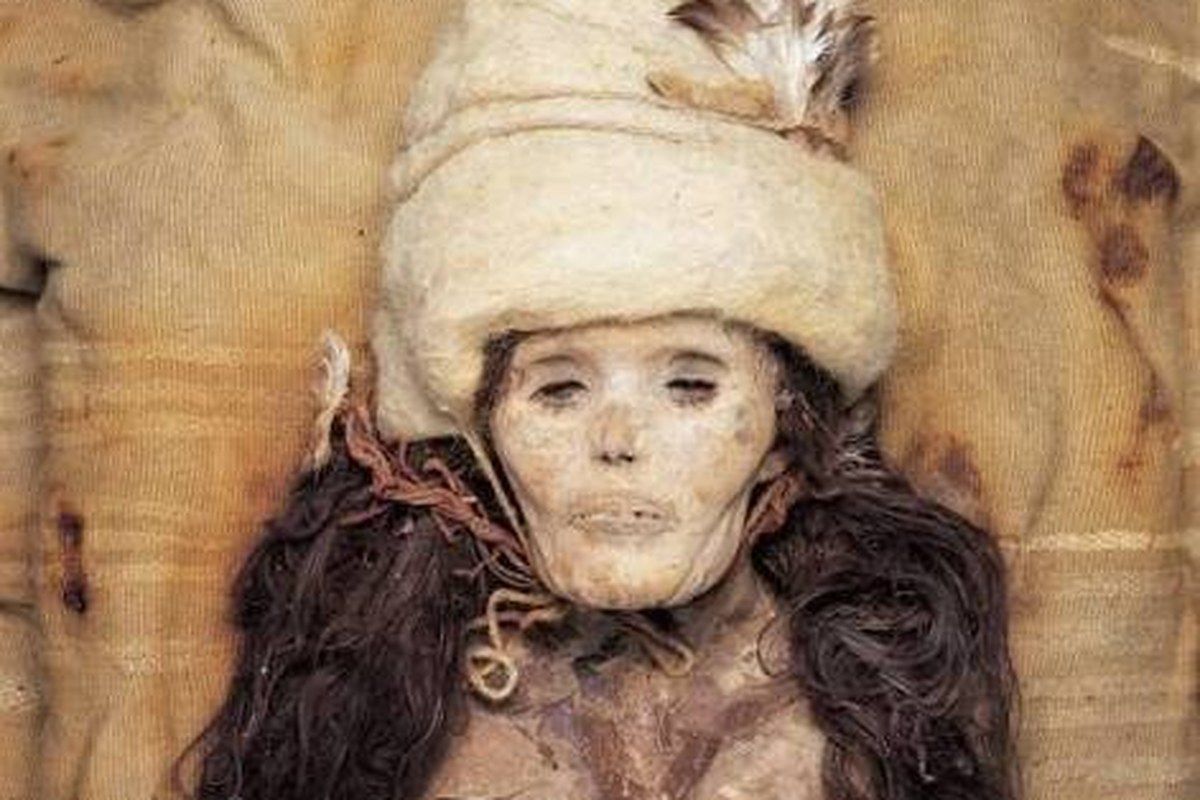
They wore felt hats and tartan-style wool, some had brown or reddish hair and deep-set faces, and a thousand years after the last of them was buried, the oasis towns around their cemeteries spoke an Indo-European language called Tocharian. For a century that bundle of clues pointed one way: the Bronze Age mummies of the Tarim Basin must have been migrants out of the western steppe, the easternmost edge of the great Indo-European expansion. Then someone read their DNA. The mummies were not migrants at all. They were a local population descended from an Ice Age Siberian lineage that had quietly vanished almost everywhere else on Earth, and they carried not a single percent of steppe ancestry.
Key points
- The Bronze Age Tarim Basin mummies (Xiaohe and related sites, around 2100 to 1700 BCE) descend overwhelmingly from Ancient North Eurasian (ANE) ancestry, the lineage of Ice Age Siberians such as the Afontova Gora and Mal'ta individuals. Modelled by the original study, they are about 72 percent ANE and 28 percent an ancient Northeast Asian source related to Lake Baikal hunter-gatherers.
- In Global25 they sit closest to ANE-rich points: about 60 scaled units from Botai and 99 from Afontova Gora 3, the same ANE pole, but 258 from steppe Yamnaya and Afanasievo, and 356 from the BMAC oasis farmers. They are far from every living population tested.
- When a mixture model is offered both a steppe source (Yamnaya) and an oasis source (BMAC), it takes zero percent of each. Neither of the two classic hypotheses for the mummies, the steppe hypothesis and the oasis hypothesis, is needed to explain them.
- Their neighbours tell the opposite story. The Bronze Age people of the Dzungarian Basin, just to the north, model as roughly three quarters steppe Afanasievo ancestry. The Tocharian language may well have entered the region with those Afanasievo herders. The Tarim mummies simply did not mix with them.
- They were genetically isolated but culturally cosmopolitan. Milk proteins in their dental calculus show dairy pastoralism, including kefir-style cheese, from the founding of the sites, and they farmed wheat from the west and millet from the east. They borrowed technology without borrowing genes.
- Their "Western" or Caucasoid look is retained ANE ancestry, a deep Pleistocene signal, not a sign of recent European or Near Eastern input. Their position as an outlier on a genetic plot reflects that deep ancestry plus a severe founder bottleneck and drift, not exotic recent admixture.
- Modern Uyghurs are not their direct descendants. A modern Uyghur models as a later mixture of East Asian, Iranian-farmer and steppe ancestry, with no detectable direct Tarim component.
1. A puzzle wrapped in wool
Along the dried riverbeds of the Taklamakan Desert, the salt and the cold preserved the dead with extraordinary completeness. The cemeteries of the Tarim Basin have yielded hundreds of naturally mummified people from the Bronze Age, clothed in woven wool, laid in boat-shaped coffins, some buried under forests of carved wooden posts. The faces look striking to modern eyes, and from the moment the mummies entered scholarship they were read as people who looked out of place, Westerners somehow stranded in the heart of Asia.
Two facts hardened that reading into a theory. First, the felt hats, the twill weaves and the physical appearance all recalled the prehistoric peoples of the western steppe. Second, when written records finally arrive in these same oases more than a thousand years later, the language of the towns of Kucha and Turfan is Tocharian, a genuinely Indo-European tongue, sitting on the eastern frontier of a family whose homeland lay far to the west. The natural conclusion was that the mummies were proto-Tocharians, the descendants of Bronze Age migrants who had carried an Indo-European language and steppe genes deep into the Tarim. A rival idea, the oasis hypothesis, derived them instead from the irrigation farmers of the Bactria-Margiana complex (BMAC) to the south-west. Both ideas had the mummies coming from somewhere else.
2. Closest to a people who had all but disappeared
The cleanest way to test where a population came from is to measure genetic distance. Using Global25, the coordinate system published by Davidski of the Eurogenes blog, each population becomes a point in a twenty-five dimensional space, and the scaled Euclidean distance between two points measures how far apart they are. The chart below gives those distances, multiplied by one thousand, from the Tarim Xiaohe mummies to a spread of ancient and modern populations.
Scaled Global25 distance (multiplied by 1000) from the Tarim Xiaohe mummies. The two closest points are the other Tarim group and Botai, followed by the Afontova Gora and Mal'ta ANE poles. The pure steppe populations sit more than twice as far, the BMAC oasis farmers farther still, and every modern population, including the Uyghurs of the same desert, is more distant than the Ice Age Siberians.
The order is the whole argument. After their own kin at Beifang, the nearest population to the Tarim mummies is Botai, a fifth-millennium group from the Kazakh steppe that is itself unusually rich in Ancient North Eurasian ancestry. Right behind it sit Afontova Gora 3 and Mal'ta, the two canonical ANE individuals, hunter-gatherers who lived in Siberia during and just after the last Ice Age. The steppe pastoralists of the Yamnaya and Afanasievo cultures, the supposed source of the mummies, are more than twice as far away. The BMAC oasis farmers, the other proposed source, are farther still. The mummies are closest to a kind of ancestry that, by the Bronze Age, had been diluted almost out of existence everywhere on the planet. In the Tarim Basin it survived in near-pure form.
3. The recipe, and the test that breaks both old theories
The study that sequenced these genomes modelled the Tarim mummies as a mixture of two deep Asian sources: Ancient North Eurasian, represented by the Afontova Gora individual, at about 72 percent, and an ancient Northeast Asian component related to Lake Baikal hunter-gatherers, at about 28 percent. Both are local to northern and inner Asia. Neither is western, and neither is a farmer. A non-negative least squares model on the Global25 coordinates points the same way, returning an ANE-dominated blend on the order of four fifths ANE to one fifth Baikal-related. The exact split shifts with the method, because Afontova Gora is a single low-coverage Ice Age genome and a noisy point to lean on, so the published estimate of roughly 72 to 28 is the figure to trust, with the model serving as corroboration of the direction.
The decisive test is what happens when you offer the model a way out. Add a steppe source, Yamnaya, and an oasis source, BMAC, to the same fit and allow it to use them if they help. It uses neither. Both come back at zero percent, and the quality of the fit does not improve at all. The two ancestries that a century of scholarship proposed for the Tarim mummies are, genetically, completely unnecessary. The mummies can be built entirely out of ancestries that were already present in inner Asia long before any steppe migration.
Three populations, three different worlds
The Tarim mummies are built from two deep inner-Asian sources with no steppe and no oasis input (the 72/28 split is the published qpAdm estimate). Their Bronze Age neighbours in Dzungaria, by contrast, are about three quarters steppe Afanasievo. A modern Uyghur is a later mixture of East Asian, Iranian-farmer and steppe ancestry with no direct Tarim signal. Figures for the lower two rows are proxy-dependent Global25 model outputs and read as directions, not exact percentages.
4. The neighbours who did take the steppe
If the steppe migration into the region was real, where did it land? Not in the Tarim, but just over the mountains. The Bronze Age people of the Dzungarian Basin, only a few hundred kilometres to the north, model as roughly three quarters Afanasievo steppe ancestry, with the remainder local. The Afanasievo were the easternmost Yamnaya-derived pastoralists, and their arrival in Dzungaria is exactly the kind of event the old theory imagined for the Tarim. The crucial point is the contrast. Two Bronze Age populations, close in space and overlapping in time, sit on opposite sides of the steppe question. The Dzungarians are mostly steppe. The Tarim mummies are zero percent steppe.
This actually rescues the kernel of truth in the Tocharian story while overturning its body. The Tocharian language is genuinely Indo-European, and it most plausibly entered the wider region with those Afanasievo herders of Dzungaria. Language and genes simply parted company. A tongue can travel down a trade route or a chain of oases and be adopted by people who share none of the ancestry of its first speakers. The Tarim mummies may have ended up speaking an ancestor of Tocharian, or they may not have. What the DNA shows is that they did not inherit it the way you inherit a genome.
5. Isolated in blood, open to the world
The most human part of the story is the gap between how cut off these people were genetically and how connected they were culturally. Genetically they were a closed book. They descend from a small founding group, show the signs of a sharp population bottleneck, and carry little of the diversity you would expect if they had been mixing with their neighbours. And yet their graves are full of imported ideas. Milk proteins in their dental calculus reveal dairy pastoralism, including kefir-style fermented cheese, from the very founding of the Xiaohe site. They grew wheat and barley, crops domesticated far to the west, alongside broomcorn millet, a crop domesticated far to the east. Their basketry, their wool technology and their cattle all came from outside.
So the Tarim mummies were the opposite of what they first appeared. Not migrants who carried a foreign genome into Asia, but a deeply local, deeply isolated population that reached out and pulled in the best technologies of the steppe and the oasis worlds around them, learning to thrive on the shifting river deltas of one of the harshest deserts on Earth. They borrowed everything except ancestry.
6. The outlier trap, again
It is tempting to look at the mummies' striking appearance and their odd, isolated position on a genetic plot and read both as evidence of some exotic or especially ancient western origin. This is the same trap that catches readers of every isolated population, and it is worth naming directly. Their Caucasoid look is not a recent western import. It is retained Ancient North Eurasian ancestry, a Pleistocene signal carried down with very little dilution, and ANE peoples did not look East Asian. Their outlier status on a plot is the combined effect of that deep ancestry and a severe founder bottleneck followed by generations of drift in isolation. Drift does not add exotic ancestry. It concentrates and exaggerates what a small founding group already carried. An outlier is a measure of isolation and antiquity of lineage, not of a journey from somewhere glamorous.
7. Are modern Uyghurs the descendants of the mummies?
This question gets asked in a charged way from several directions, so it is worth answering plainly with the data. Modern Uyghurs are not the direct descendants of the Tarim mummies in any simple sense. A modern Uyghur models as a later mixture, roughly a third East Asian ancestry of the kind carried by Han populations, with the rest split between an Iranian-farmer component of the BMAC type, a steppe component, and a Siberian component. When the Tarim mummy profile is offered to that model as a possible source, it contributes nothing detectable. The modern population of the oases is a Silk Road blend assembled over the last two to three thousand years, layered on top of the desert long after the mummies were buried. The mummies are part of the deep prehistory of the region, not the recent family tree of any single modern group, and they belong, if anything, to the shared inner-Asian past rather than to any present-day national story.
8. So, Indo-Europeans of Asia?
The honest verdict is that the romantic version is wrong and the real version is stranger. The Bronze Age Tarim mummies were not Indo-European migrants from the western steppe, and they were not oasis farmers from the south. They were a genetically isolated local population, descended chiefly from an Ice Age Siberian lineage that had been all but erased everywhere else, who borrowed the dress, the dairy and the crops of their neighbours without ever merging with them. The Tocharian language, when it finally surfaces in these oases, is a separate thread that most likely arrived with the steppe peoples of Dzungaria. The faces in the salt are not the faces of lost Westerners. They are the faces of one of the last strongholds of the oldest Eurasian ancestry, preserved by isolation and the desert, and they are far more interesting for it.
The story in five steps
Claim and reality
The Tarim mummies were Indo-European, proto-Tocharian migrants from the western steppe.
They carry zero detectable steppe ancestry. They are a local population built from Ancient North Eurasian and Northeast Asian sources. The Tocharian language most likely arrived separately, with the Afanasievo of Dzungaria.
Their Western, Caucasoid appearance proves a recent European or Near Eastern origin.
The signal is retained Ancient North Eurasian ancestry, a deep Pleistocene Siberian lineage, not recent western input. Appearance is not ancestry.
They descend from the BMAC oasis farmers to the south-west.
BMAC is one of the farthest points from the mummies, about 356 scaled units, and contributes zero percent when offered to the model.
Modern Uyghurs are the direct descendants of the Tarim mummies.
A modern Uyghur is a later East-West blend of East Asian, Iranian-farmer and steppe ancestry, with no direct Tarim signal detectable.
Being a genetic outlier means deep, exotic or unusually ancient foreign ancestry.
The outlier position comes from retained ANE ancestry plus a severe founder bottleneck and drift in isolation, not from any exotic recent admixture.
Reproduce it yourself
Paste the coordinates below into Vahaduo, the Global25 spreadsheet tool, to rebuild the comparisons in this article: the two Tarim mummy groups, the ANE poles of Afontova Gora and Mal'ta, the Baikal-related source, Botai, the steppe Yamnaya and Afanasievo references, the Dzungarian and Tian Shan neighbours, the BMAC oasis source, and several modern populations of the same region. All coordinates are scaled Global25 from the Moriopoulos 2025 collection and the public Global25 datasheets.
Xinjiang_EMBA_Xiaohe_Xiaohe_(n=10),0.1032375,-0.1000296,0.0729729,0.2033941,-0.1152215,0.0476904,-0.0494226,-0.0607589,-0.041866,-0.0962024,0.028548,-0.0133681,0.024529,-0.0713986,0.0262482,0.0227259,-0.018997,-0.0013684,0.0019986,-0.0065281,-0.0511972,0.0078272,0.02391,0.0143755,-0.0085381
Xinjiang_EMBA_Xiaohe_Beifang_(n=2),0.099595,-0.1203405,0.072784,0.196385,-0.100788,0.045459,-0.0421845,-0.0572285,-0.0407,-0.0933045,0.0235465,-0.013938,0.024529,-0.060554,0.012622,0.026982,-0.014473,0.0015205,-0.0052795,-0.0056905,-0.0493505,0.006368,0.020829,0.0175925,-0.0037725
Krasnoyarsk_UP_Afontova_Gora_(n=1),0.093335,-0.01828,0.083344,0.231592,-0.091402,0.042949,-0.063688,-0.078228,-0.035383,-0.096221,0.047417,-0.010491,0.023637,-0.074454,0.020358,0.02254,-0.012908,0.003801,-0.003394,0.000625,-0.03706,0.015209,0.013927,0.009278,-0.005149
Irkutsk_UP_Mal'ta'-Buret'_(n=1),0.078538,-0.025388,0.039598,0.186049,-0.068936,0.04518,-0.048412,-0.056998,-0.019839,-0.069432,0.029879,-0.009591,0.015312,-0.045553,0.014251,0.021082,-0.007693,0,-0.003645,0.000625,-0.027327,0.002844,0.011339,-0.008314,-0.001437
Irkutsk_EBA_Shamanka_(n=7),0.044878857,-0.374005,0.103385,0.020256714,-0.10674529,-0.052112714,-0.0059088571,0.0030988571,0.011219571,-0.0019265714,0.0046395714,0.00087785714,0.0010405714,-0.034484429,0.0047888571,0.00039785714,-0.0043398571,-0.0053572857,0.014204,0.018062429,-0.039876,0.016145429,0.0087858571,-0.013065286,-0.0090495714
Kazakhstan_CA_Botai_(n=3),0.102441,-0.083273667,0.090257667,0.17614367,-0.082169,0.039416333,-0.043633667,-0.050613,-0.029247,-0.081338,0.027281,-0.0073933333,0.024033333,-0.069499667,0.021941333,0.020595333,-0.011604,-0.00114,0.00016766667,-0.0028343333,-0.034772333,0.017765,0.023787,0.0040566667,-0.0082623333
Gorno-Altai_EBA_Afanasievo_(n=21),0.12374195,0.088689571,0.041914286,0.1129279,-0.029646429,0.045631905,0.0028983333,-0.0022745714,-0.057003667,-0.076330905,0.00054128571,0.0005922381,0.0014158095,-0.020741619,0.03850581,0.011377429,-0.0066495714,-0.0016288571,-0.0016938571,0.0089090476,-0.0045158571,0.0026496667,0.011649952,0.023898857,-0.0033300476
Russia_Samara_EBA_Yamnaya_(n=29),0.12265421,0.08898131,0.044110172,0.11446552,-0.027262276,0.045545793,0.0040274483,-0.0023793448,-0.054727793,-0.074653966,0.00097427586,-0.0005477931,-0.00097403448,-0.021706448,0.036808138,0.012134207,-0.0064877586,-0.0017474828,-0.002513931,0.01092769,-0.003807931,0.001262069,0.0098003448,0.019886379,-0.0044801724
Xinjiang_EBA_Afanasievo_Dzungaria_(n=4),0.11040825,0.0203105,0.0511,0.12039925,-0.05062475,0.04274,-0.011222,-0.0118265,-0.04698925,-0.07348675,0.0048715,-0.00453325,0.00735825,-0.03681375,0.035762,0.0169385,-0.01414675,-0.0020905,-0.002514,0.002939,-0.01085575,0.004328,0.01257125,0.01921925,-0.00628675
Xinjiang_EBA_Afanasievo_Tian_Shan_(n=4),0.10585525,-0.00939375,0.05402225,0.120157,-0.05854925,0.03855675,-0.01292575,-0.02146075,-0.04034225,-0.0721655,0.00426275,-0.00146125,0.0115955,-0.04001375,0.02795825,0.01733625,-0.01017,0.001647,-0.00348825,0.00253275,-0.01812425,0.00905725,0.01478975,0.01937,-0.0012875
Turkmenistan_BA_Gonur_Tepe_(n=12),0.079771083,0.078872833,-0.11099925,0.00831725,-0.098582333,0.021033083,0.0070111667,-0.006269,-0.063879583,-0.0407905,-0.0022328333,0.0026475833,-0.0055005,-0.0064683333,0.018310833,0.02489375,-0.0047915833,0.00073891667,0.0045461667,-0.023250833,-0.0020796667,-0.01431275,-0.0016536667,-0.015755167,0.011176667
Uygur,0.06575,-0.167443,0.001797,-0.00228,-0.026539,0.007415,0.006262,0.003312,-0.013667,-0.009583,-0.028504,-0.002759,0.001443,-0.006727,0.003744,0.007784,0.001764,-0.001222,-0.000843,0.000434,-0.008103,-0.000015,-0.00066,0.00202,0.002649
Kazakh_Xinjiang,0.062717,-0.24129,0.047932,-0.009787,-0.03893,-0.014809,0.010787,0.014122,-0.007015,0.001021,-0.024602,-0.001499,0.000297,-0.000014,0.000964,0.004428,0.001969,0.000266,0.004814,0.006641,-0.01123,-0.00481,-0.009712,-0.000699,-0.001209
Han_Shandong,0.022132,-0.448639,0.005363,-0.060114,0.051531,0.021258,0.006189,0.000436,-0.010726,0.003564,-0.07349,-0.008742,0.010291,-0.008762,-0.007842,-0.000044,0.001434,0.001337,-0.001201,-0.008449,0.010967,0.006608,0.011613,0.001058,-0.000492
Mongol_Xinjiang,0.048517,-0.322938,0.055012,-0.018371,-0.047317,-0.021858,0.014394,0.016182,-0.002378,0.002369,-0.029697,-0.000824,0.001208,-0.000637,0.004564,0.002337,-0.004009,-0.00285,0.002545,0.010474,-0.01201,-0.008285,-0.01157,-0.001702,0.001467
References and sources
- 1 Zhang, F., Ning, C., Scott, A., Fu, Q., et al. The genomic origins of the Bronze Age Tarim Basin mummies. Nature 599, 256-261 (2021). The core study, modelling the Tarim mummies as a genetically isolated local population of about 72 percent ANE and 28 percent Baikal-related ancestry, with dairy pastoralism and no steppe or BMAC input. link
- 2 Raghavan, M., et al. Upper Palaeolithic Siberian genome reveals dual ancestry of Native Americans. Nature 505, 87-91 (2014). Defines the Ancient North Eurasian lineage through the Mal'ta (MA1) individual. link
- 3 Kumar, V., et al. Bronze and Iron Age population movements underlie Xinjiang population history. Science 376, 62-69 (2022). Broader genetic history of Xinjiang, including the later layering of ancestries over the region. link
- 4 Mallory, J. P., and Mair, V. H. The Tarim Mummies: Ancient China and the Mystery of the Earliest Peoples from the West. Thames and Hudson (2000). The classic statement of the western-migration and Tocharian hypotheses that the ancient DNA tests. B
- 5 Ancient genomes reveal the origin and evolutionary history of Chinese populations. Frontiers in Earth Science (2022). Review placing the Tarim local-origin result against the steppe and oasis hypotheses. link
- 6 Global25 coordinates: Davidski (Eurogenes), with ancient and modern averages drawn from the Moriopoulos 2025 collection and the public Global25 datasheets. Global25 spreadsheet tooling: Vahaduo. G25
Ancient and modern Global25 coordinates: Davidski (Global25), with averages from the Moriopoulos 2025 collection and the public Global25 datasheets. The Tarim, ANE, Baikal, Botai, steppe, neighbour, BMAC and modern points are scaled Global25 averages. Global25 spreadsheet tooling: Vahaduo. Analysis: scaled Global25 Euclidean distances and non-negative least squares modelling in Python. The headline 72/28 split for the Tarim mummies is the published qpAdm estimate from Zhang et al. 2021; the ancestry figures for the Dzungarian and modern rows are proxy-dependent Global25 model outputs and are best read as directions rather than exact percentages.