
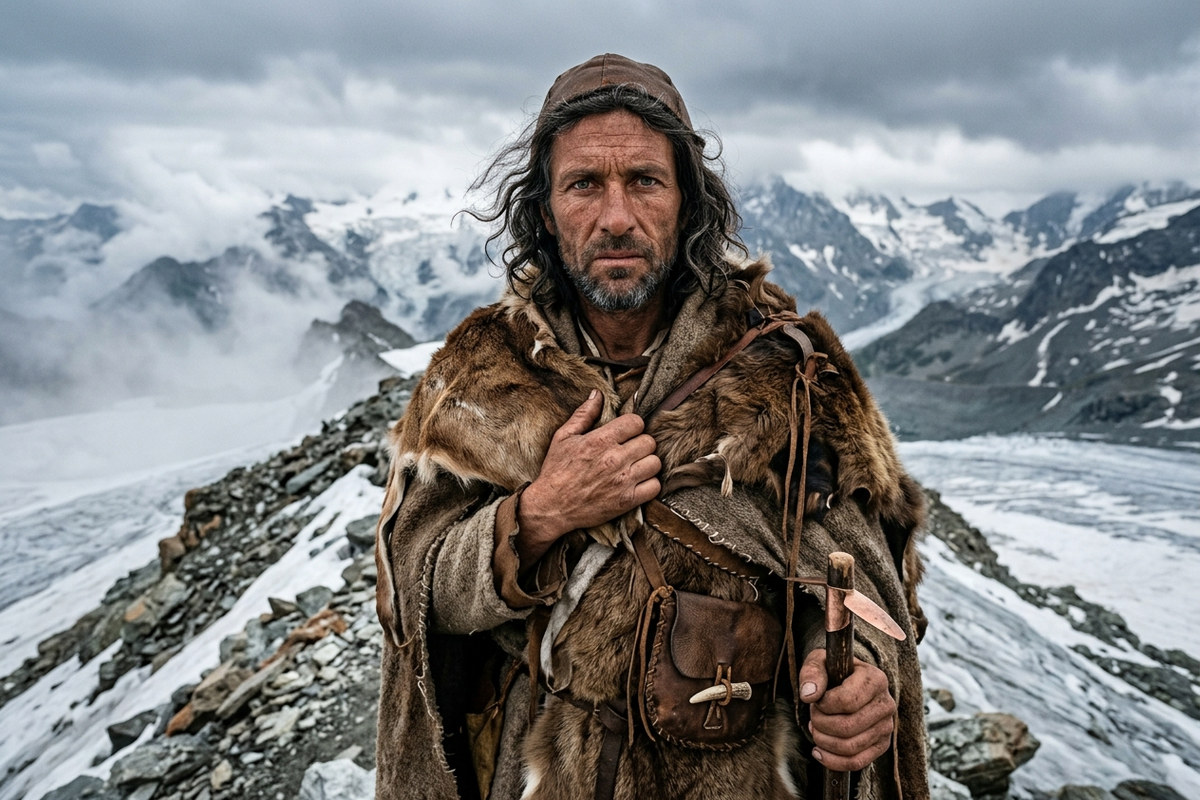
He died on a rock shelf at 3,210 metres, shot from behind with an arrow that tore his subclavian artery, and he lay in the ice for roughly 5,300 years before two hikers found him in the Oetztal Alps in 1991. In the years since, two separate studies have been folded into one convenient headline: that Otzi's genetic parents still live in Tyrol today. One half of that sentence is true and comes from nineteen Tyrolean blood donors who share his Y-chromosome lineage. The other half is not, and comes from an autosomal signal that this article reproduces directly: on ninety percent of his genome, Otzi is not close to modern Tyroleans at all. He is closer to Sardinia, because Sardinia is the one part of Europe that never received the wave of steppe ancestry that reshaped everyone else, Tyroleans included.
Two different studies, one convenient sentence
The murder is not in dispute. Forensic reconstruction of the wound, including a 2023 three-dimensional animation of the arrow's trajectory, confirms an arrowhead entered below the left shoulder blade, lacerated the subclavian artery, and produced a hematoma of roughly 110 millilitres. Death would not have been instant, but it was not survivable either. Otzi was killed, not lost.
What is in dispute, or at least badly compressed, is the claim about his living relatives. It comes from two studies that have almost nothing in common except the mummy. In 2013 a team led by Walther Parson at Innsbruck screened the Y-chromosome, the part of the genome passed only from father to son, in 3,700 blood donors from Tyrol. Nineteen of them carried the same rare marker as Otzi, a subtype of haplogroup G called G-L91. Parson was careful about what that meant: the shared ancestor lived some 10,000 to 12,000 years ago, long before Otzi himself, and the nineteen men are not his descendants so much as his very distant cousins on one single line of inheritance out of many thousands.
Separately, in 2012 and again with a much higher-coverage genome in 2023, autosomal comparisons, meaning the 22 non-sex chromosomes that make up the overwhelming majority of the genome, placed Otzi closest to modern Sardinians, not modern Tyroleans. The 2023 reanalysis by Wang and colleagues went further: Otzi carries more Anatolian farmer ancestry than any other known individual from his period, and the team found no detectable steppe pastoralist ancestry in his genome at all. That is the finding this article reproduces independently below, and it is also the finding that explains why the popular sentence falls apart. Whatever a single shared Y-chromosome marker says about deep paternal ancestry, it says nothing about the other twenty-two chromosomes, and on those, Tyrol looks nothing like Otzi.
Data and method
Everything below uses Global25 scaled coordinates, merged first occurrence wins from the published Davidski files and the Moriopoulos 2026 collection, giving 30,076 entries. Ancestry proportions come from non negative least squares with a sum to one constraint imposed by appending a heavily weighted row of ones, the resulting weights normalised. Distances are scaled Euclidean distances multiplied by one thousand, the convention used throughout this site.
Otzi is represented by the realigned high-coverage genome at 97.61 per cent SNP coverage, one individual. The three ancestral sources are Anatolia_N, the Neolithic farmer population of central Turkey; Loschbour, an eight-thousand-year-old western hunter-gatherer from Luxembourg, cross-checked against the Villabruna hunter-gatherer of Italy; and a Yamnaya steppe pastoralist average from Samara on the middle Volga, the population that carried the steppe-related ancestry into Europe from around 3000 BCE onward. Every model below runs the sum-to-one NNLS system described above.
Three honest notes before any number is used. Otzi is one individual, and a single genome carries all the usual risks of individual level noise that a population average does not. The Yamnaya and hunter-gatherer poles are not fully independent of each other in Global25 space, since steppe ancestry is itself partly derived from an eastern hunter-gatherer lineage, and the condition numbers below are reported honestly rather than hidden. And a Global25 coordinate is an autosomal summary with no dates attached and no way to distinguish paternal from maternal contribution, so nothing in the modelling below can touch the Y-chromosome question at all; that is addressed on its own terms in a later section.
Where the Iceman actually sits
The simplest measurement first. Rank every population in the merged panel, ancient and modern, by Global25 distance from Otzi.
Global25 distance from Otzi to every relevant population, ancient and modern. Orange marks unadmixed fourth-millennium BCE farmer populations, green marks living populations.
Behind two Copper Age populations from Iberia and Sardinia, both from his own era, the nearest living population on earth is the modern Sardinians, at 71.4 units. Corsicans follow at 139.8, then Tuscans, Trentino, Basques, French Occitans and Swiss Germans, all clustered between 140 and 185. Austrians, the population the popular claim points to, sit at 204.9, and Germans further still at 208.5. Trentino, the Italian province immediately south of the Alps he died in, is closer than Austria but still more than twice as far as Sardinia. On raw distance alone, the myth is backwards: the closer you get to the Alps, the further you get from Otzi.
Ninety per cent farmer, and a wave that had not arrived yet
Raw distance says where Otzi sits. A source model says why. Modelled as a mixture of Anatolian farmer and hunter-gatherer ancestry, Otzi comes out at 90.0 per cent Anatolia_N and 10.0 per cent Loschbour-related hunter-gatherer, a result that barely moves when Loschbour is swapped for Villabruna (89.4 and 10.6 per cent). That is close to the 92 per cent-plus Anatolian figure Wang and colleagues reported in 2023 using entirely different statistical machinery, f4-statistics and qpAdm rather than a Global25 NNLS fit, on a higher-coverage genome than the one merged into this panel. A different method, on different markers, landing within a couple of points, is a genuine cross-validation rather than a coincidence.
Three-source NNLS model, Anatolian farmer plus hunter-gatherer plus Yamnaya steppe, run identically on Otzi and three modern comparison populations.
Add a third source, Yamnaya steppe pastoralist ancestry, as a direct placebo test, and the model assigns it exactly 0.00 per cent. That reproduces the headline result of the 2023 reanalysis: no detectable steppe ancestry in Otzi's genome. His death, some time between 3350 and 3120 BCE, comes roughly two centuries before the steppe migrations that swept into central Europe from around 3000 BCE. He was not resistant to that ancestry. He simply predates it.
Run the identical three-source model on the modern populations the myth invokes, and the contrast becomes the whole explanation. Modern Austrians come out at 42.9 per cent Anatolian farmer, 10.9 per cent hunter-gatherer and 46.2 per cent steppe. Modern Sardinians sit at 82.9, 11.8 and 5.2, carrying only a small amount of steppe ancestry, because Sardinia received the smallest subsequent dose of any region in this comparison. Trentino, closer to the Alps Otzi actually died in, sits at 57.6, 7.4 and 35.0. Otzi's own population, at 0.0 per cent steppe, has no living twin anywhere in continental Europe. Sardinia is simply the closest surviving approximation, precisely because it is the region that stayed furthest from that later wave.
What we would have seen
A model that returns exactly 0.00 per cent for something is only informative if it could have detected a smaller number. So the same test used throughout this site: take Otzi's coordinates, mathematically inject a known fraction of Yamnaya ancestry, and rerun the identical three-source model.
Synthetic Yamnaya ancestry injected into Otzi and re-estimated by the identical three-source model.
The floor here is honestly high. The model stays at zero through 12 per cent injected steppe and only begins registering anything at 14 per cent, reaching 8.3 per cent recovered at a 20 per cent injection, well short of a one-to-one line. That is a considerably worse floor than the one to three per cent this site usually reports, and the reason is stated in the method section above: a two-pole Yamnaya source is partly collinear with the hunter-gatherer source in this particular three-pole system, so a modest steppe injection gets partly absorbed into the hunter-gatherer term rather than showing up as steppe. The published finding of no detectable steppe ancestry rests on qpAdm and f-statistics run against dozens of contemporaneous genomes, a far more sensitive instrument than a three-pole NNLS fit on Global25 coordinates. What this test does establish is that even a comparatively blunt instrument finds nothing until well past ten per cent, which is a reasonable floor on how large any undetected steppe component in Otzi's genome could possibly be.
The other Otzi, the one who really does have relatives in Tyrol
None of the modelling above can touch the part of the popular claim that is actually true. Autosomal coordinates like Global25 collapse maternal and paternal contributions together into a single summary and say nothing about the Y-chromosome or the mitochondria on their own. The 2013 Innsbruck study worked on entirely different material: a single-marker Y-chromosome test, G-L91, run across 3,700 Tyrolean blood donors. Nineteen of them carried it. Parson's own framing is worth repeating rather than rounding up: those nineteen men share a common ancestor with Otzi who lived 10,000 to 12,000 years ago, several thousand years before Otzi was even born, which makes them distant cousins along one single unbroken male line rather than descendants of Otzi himself. Parson put the odds of direct descent as low enough that he would be tempted to say no.
The maternal side tells the opposite story. When Otzi's mitochondrial DNA was first sequenced in 2008, his subhaplogroup matched no sample in any reference database available at the time, consistent with a maternal lineage that has since gone extinct or become vanishingly rare. Barring an undiscovered isolated pocket somewhere in the Alps, nobody alive today can trace an unbroken maternal line back to Otzi's mother the way nineteen Tyrolean men can trace a paternal line back toward one of his distant male-line cousins. Genetic parents plural, then, overstates a story that is really about one chromosome out of forty-six, and about a common ancestor so far back that the Neolithic farmers who would become Otzi's own immediate ancestors had not yet finished arriving in Anatolia.
What this method cannot say
Four limits, stated before anyone else states them. Otzi is one individual, and every claim above concerns his genome specifically rather than a population he may or may not represent; Johannes Krause, one of the authors of the 2023 reanalysis, has said openly that it remains unclear whether Otzi was typical of his time and place. A Global25 coordinate carries no date and no chromosome-of-origin information, so nothing above can independently confirm or contest the Y-chromosome or mitochondrial findings, which come entirely from published work using other methods. The steppe detection floor in the three-source model here is unusually high, around 13 to 14 per cent, because of the Yamnaya and hunter-gatherer collinearity described above, and that is a limit of this particular Global25 setup rather than of the published qpAdm result it is cross-checking. And distance and admixture share are two different things: a population can sit far from Otzi in raw coordinate space and still carry a real minority share of his ancestry profile, which is why the source model, not the ranking chart, carries the weight of the ancestry claims in this article.
Myth and measurement
| The claim | What the evidence shows |
|---|---|
| Otzi's genetic parents still live in Tyrol today, full stop. | This conflates two unrelated studies. On the Y-chromosome, nineteen Tyrolean men share a marker with Otzi through a common ancestor 10,000 to 12,000 years ago. On the other 22 chromosomes, his closest living population is Sardinian. |
| Modern Austrians and Tyroleans should be Otzi's closest genetic match, since he died in their mountains. | Austrians sit at 204.9 Global25 units from Otzi, further than Corsicans, Tuscans, Basques or the French. Geography of death is not genetic continuity. |
| Otzi's ancestry should resemble other Copper Age Alpine farmers of his time. | He carries more Anatolian farmer ancestry, about 90 per cent, than almost any other known individual from the fourth millennium BCE, and zero detectable steppe ancestry, an unusually isolated profile even for his own era. |
| His mitochondrial line, like his Y-line, should have living representatives somewhere. | His 2008-sequenced mitochondrial subhaplogroup matched nothing in the reference databases available, consistent with a maternal lineage that did not survive to the present. |
References
- 2023 Wang K, Prufer K, Krause-Kyora B, Childebaya A, Schuenemann VJ, Coia V, Maixner F, Zink A, Schiffels S, Krause J. "High-coverage genome of the Tyrolean Iceman reveals unusually high Anatolian farmer ancestry." Cell Genomics, 2023. Read the paper
- 2012 Keller A, Graefen A, Ball M, Matzas M, Boisguerin V, Maixner F, et al. "New insights into the Tyrolean Iceman's origin and phenotype as inferred by whole-genome sequencing." Nature Communications 3:698, 2012. Read the paper
- 2013 Berger B, Niederstatter H, Erhart D, Gassner C, Schennach H, Parson W. "High resolution mapping of Y haplogroup G in Tyrol (Austria)." Forensic Science International: Genetics 7(6):624-631, 2013. Read the paper
- 2016 Coia V, Cipollini G, Anagnostou P, Maixner F, Battaggia C, Brisighelli F, Gomez-Carballa A, Destro Bisol G, Salas A, Zink A. "Whole mitochondrial DNA sequencing in Alpine populations and the genetic history of the Neolithic Tyrolean Iceman." Scientific Reports 6:18932, 2016. Read the paper
- 2025 Villa C, Larsen S, Zink A, Lynnerup N. "Otzi the Iceman: forensic 3D reconstructions of a 5300-year-ago murder case." International Journal of Legal Medicine 139:2263-2271, 2025. Read the paper
The coordinates
Global25 scaled coordinates for the Iceman and the reference populations used above, for anyone who wants to reproduce the models in Vahaduo.
Italy_Iceman,0.121791,0.179749,0.026021,-0.069445,0.074783,-0.038487,-0.006815,0.003461,0.067902,0.112622,0.00065,0.021131,-0.040733,-0.017616,-0.033794,-0.010475,0.025295,-0.00038,0.022123,-0.014507,-0.012603,0.019537,-0.022185,-0.035909,0.010418
Turkey_N,0.1179017,0.1800873,0.0034255,-0.1010589,0.0512402,-0.0479692,-0.0037992,-0.006846,0.0361667,0.0806776,0.0082614,0.0113088,-0.0241636,0.0005791,-0.0427122,-0.0103696,0.0225564,0.0013883,0.0136487,-0.0104478,-0.0142612,0.0056932,-0.0049042,-0.0037505,-0.0044357
Luxembourg_Loschbour,0.130897,0.109677,0.203645,0.198,0.162492,0.059125,0.015041,0.038075,0.100217,0.016219,-0.015427,-0.017235,0.019921,-0.001239,0.061346,0.07067,0.002608,0.007348,-0.008925,0.065406,0.117543,0.010387,-0.049422,-0.173639,0.019519
Russia_Samara_Yamnaya,0.1258378,0.0892539,0.0429079,0.1154556,-0.0278684,0.0446846,0.0044911,-0.0029487,-0.0548579,-0.0729957,0.0018583,0.0003497,-0.0016518,-0.0236099,0.0372629,0.015734,0.0000001,-0.001478,-0.001704,0.0125059,-0.0031197,0.001374,0.0112292,0.0184362,-0.0045237
Sardinian_modern,0.1213354,0.1677655,0.0281332,-0.0510017,0.0603804,-0.0222275,-0.0039245,0.0021691,0.0419071,0.0775597,-0.0003734,0.0165302,-0.0284536,-0.0124135,-0.0142506,-0.0043621,0.0104308,-0.0010642,0.00225,-0.0134063,-0.0021461,-0.0011749,-0.0102297,-0.021039,0.0011137
Trentino_modern,0.12504286,0.14594614,0.034641143,-0.0035068571,0.037237714,-0.0033864286,0.0033571429,0.0029997143,0.011307,0.023872857,-0.0030157143,0.0050098571,-0.013443143,-0.002831,-0.00052371429,-0.0018751429,0.00059614286,0.001665,0.0042738571,-0.0030194286,-0.0014258571,0.0028085714,-0.00051057143,0.000637,-0.0036781429
Austrian_modern,0.12912583,0.13512178,0.054284333,0.0331075,0.034946611,0.012751611,0.0071285556,0.0062048889,0.003193,0.0022982778,-0.0035543889,0.00060788889,-0.0016269444,0.0028442222,0.00046744444,0.0047363333,0.0013254444,0.00092205556,0.0031842222,0.0012226667,-0.00062388889,-0.0020745556,0.0019035,0.003501,-0.0011441667