
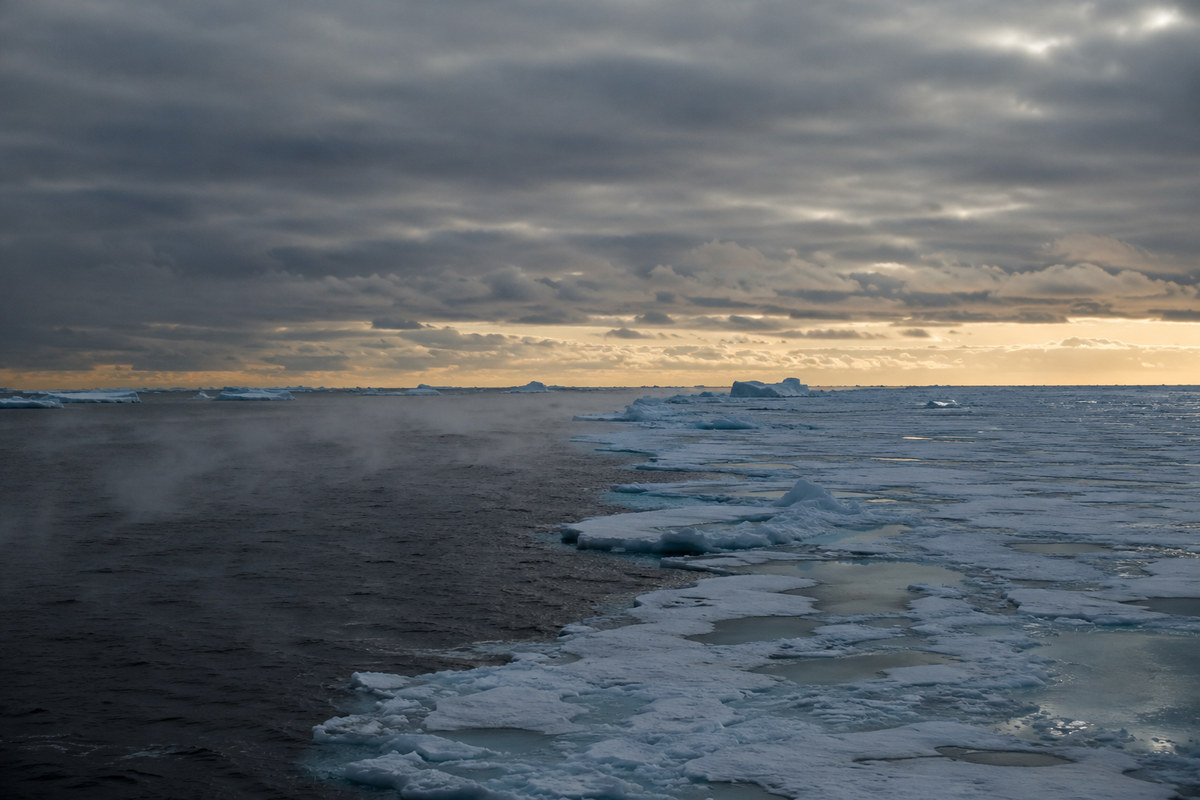
The idea is that people from Ice Age France and Spain crossed the North Atlantic along the edge of the pack ice, landed on the American seaboard, and founded the Clovis culture. It has been argued on stone tools since the 1990s and defended on genetics since 2014, and the genetic defence rested on one honest point: nobody had a Solutrean genome to test it against. That is no longer true. This article tests the hypothesis against the Solutrean-associated genomes that now exist, and it does so with an instrument whose detection floor is stated rather than assumed. The result is that the western ancestry in the only Clovis genome is real, is about half of it, and is Siberian. The single most European-shifted pre-contact genome on the continent belongs to a man buried on the Seward Peninsula, the point in North America furthest from the Atlantic Ocean.
A hypothesis with a testable shape
The Solutrean hypothesis in its modern form belongs to Dennis Stanford and Bruce Bradley, and their 2012 book Across Atlantic Ice is the fullest statement of it. The Solutrean technocomplex of southwestern France and Iberia, running roughly from 24,000 to 19,000 years ago, produced thin bifacial points made partly by a thinning technique called overshot flaking. Clovis points, made in North America around 13,000 years ago, are also thin bifaces and also show overshot flakes. Stanford and Bradley argued that the resemblance is too specific to be coincidence, and that Solutrean people reached North America by boat along the southern margin of the glacial ice, provisioned by seals and seabirds, landing somewhere on the mid-Atlantic or Labrador coast.
The archaeological objections are old and well rehearsed. There is a gap of some six thousand years between the end of the Solutrean and the appearance of Clovis. There is no Solutrean site on the American side and no American site in Europe. Metin Eren and colleagues argued in 2013 that overshot flaking is not an efficient thinning method and that its appearance in both traditions is more likely convergence than descent, a point Bradley disputed with replication experiments in 2016. That argument is not settled by genetics and this article does not try to settle it.
What genetics can settle is narrower and more useful. If a population from Solutrean Europe contributed to the ancestry of the people who made Clovis tools, that contribution should be visible in the one genome we have from a Clovis burial. It should also be visible as a geographic gradient, strongest near the proposed landfall and weaker further away, because a founding population arriving on one coast does not distribute itself evenly across two continents in the few centuries before Clovis begins.
The 2014 defence of the hypothesis, by Stephen Oppenheimer, Bruce Bradley and Dennis Stanford in World Archaeology, made a point that was entirely fair at the time. The Anzick paper had announced that its genome analysis refuted a European origin for Clovis, without showing the test that did the refuting, and the West Eurasian-related ancestry that everyone agreed was present in Native Americans had simply been assumed to have arrived through Siberia rather than across the Atlantic. Their complaint was that the alternative had not been examined. It could not be examined properly, because there was no Solutrean genome in the world to examine it with.
Data and method
Everything below uses Global25 scaled coordinates, merged first occurrence wins from the published Davidski files, the Moriopoulos 2026 collection and the dated ancient sample file, giving 49,192 entries once individual level genotypes are included. Ancestry proportions come from non negative least squares with a sum to one constraint imposed by appending a heavily weighted row of ones, the resulting weights normalised. Distances are scaled Euclidean distances multiplied by one thousand, the convention used throughout this site.
The target is Anzick-1, the male infant buried around 12,700 years ago at the Anzick site in western Montana with more than a hundred Clovis artefacts, sequenced by Morten Rasmussen and colleagues in 2014. It remains the only genome from a Clovis burial. The coordinate entry used here is the realigned version at 98.97 per cent coverage, which is about as good as ancient DNA gets.
Three honest notes before any number is used. The comparison of a single infant against population averages carries all the usual risks of individual level noise, which is why the continental test below uses eleven separate genomes rather than one. Frequencies in ancient DNA are frequencies in cemeteries and excavators do not sample at random. And a Global25 coordinate is an autosomal summary with no dates attached and no way to distinguish maternal from paternal contribution, so nothing below speaks to sex bias or to admixture timing, and every statement about dates comes from published work using other methods.
Two of the three Solutrean genomes are unusable
The panel contains three entries labelled as Solutrean, and the first job is to find out whether any of them can be trusted. The answer is one.
Cueva del Malalmuerzo, in Granada, produced two teeth radiocarbon dated to between about 23,000 and 22,600 years ago, published by Vanessa Villalba-Mouco and colleagues in 2023 as the oldest Upper Palaeolithic genomic data from Iberia. Their conclusion was that the Malalmuerzo individual carries ancestry linking the earlier Aurignacian-associated people of western Europe to the later Magdalenian ones. Run a nearest neighbour scan on the Malalmuerzo coordinates and that is exactly what comes back: after its own population average, the closest entries are Gravettian burials from Serinya in Catalonia, Goyet in Belgium, Krems in Austria and Paglicci in Italy. The sample behaves.
The other two do not. Le Piage II in the Lot, dated to about 23,500 years ago, and a Spanish Solutrean individual dated to about 20,900 years ago, are both flagged as contaminated in the source file, and the flag is correct. The nearest neighbours of the Le Piage entry are Iron Age Hallstatt burials from Germany and Bourgogne. The nearest neighbours of the Spanish entry are modern Occitans, modern Spaniards from Alicante and a Late Bronze Age Urnfield cemetery in Germany. These are not twenty thousand year old hunter gatherers in coordinate space. They are recent Europeans, and using them as Solutrean poles would have handed the hypothesis a spurious victory in every model below.
Why this matters more than it looks
A contaminated Palaeolithic sample does not fail loudly. It sits quietly in the file with a plausible label and a plausible date, and it drifts toward whatever modern population contributed the contamination. If someone runs a Solutrean model using the Le Piage entry against a modern Native American population with post-colonial European admixture, the model will return a healthy Solutrean percentage and the percentage will be entirely an artefact of two separate contaminations meeting in the middle. The check that catches it takes about a second and consists of asking what the sample is nearest to. Anyone reproducing this analysis should run that check before anything else.
So the Solutrean pole below is Malalmuerzo. That is one individual, at 18.7 per cent coverage, and resting an argument on it alone would be unwise. The way around that is the finding of Cosimo Posth and colleagues in their 2023 survey of 356 hunter gatherer genomes: the Solutrean individuals they sequenced group with the western Gravettian cluster they call Fournol and show some affinity to the later Magdalenian cluster, which is to say the Solutreans were the western European population of their time, continuous with what came before and after them in the same region. Every model below is therefore run against a spread of western European Upper Palaeolithic sources as well, from Aurignacian Goyet at 35,000 years ago to Magdalenian El Miron at 19,000 to the modern Basques. If a Solutrean contribution existed, one of those would catch it.
Where Anzick-1 actually sits
The simplest measurement first.
Global25 distance from Anzick-1 to every relevant population, ancient and modern. The Americas, then Siberia, then the Ancient North Eurasians, and only then Europe.
Spirit Cave in Nevada sits 38.9 units away, Lauricocha in Peru 61.0, the Huron-Wendat of Ontario 64.4, Kennewick Man 73.3, and the Karitiana of Brazil 90.5. The Ancient Beringian genome from Upward Sun River in Alaska, which represents the branch that never came south, sits at 214.9. Then northeastern Siberia at 358 to 363, the Ancient North Eurasians of Mal'ta and Afontova Gora at 469, and the whole of Upper Palaeolithic Europe beyond 545.
Malalmuerzo, the Solutrean genome, sits at 573.9. That is nine times further from Anzick-1 than a Peruvian who died 8,600 years ago, and further than the Yana genome from the Arctic coast of Siberia. The Basques, whom the older literature liked to invoke as an Ice Age European relict, sit at 649.7, further than everything except Villabruna.
This does not by itself settle anything. Two populations can be far apart and one can still carry a few per cent of the other, and the Black Irish article on this site is an extended demonstration of exactly that point. What the ranking establishes is the geometry the rest of the article works in.
The obvious test does not work, and saying so is the point
The natural move is a two source model: take Anzick-1, offer it the Ancient Beringian genome as its American baseline and Malalmuerzo as a Solutrean source, and see what the model does with the Solutrean source. It gives it zero. Exactly 0.00 per cent.
That number is worthless, and here is how we know. Take the Anzick coordinates, mathematically inject a known quantity of Malalmuerzo ancestry, and rerun the identical model. Inject one per cent and the model returns zero. Inject five per cent and it returns zero. Inject ten per cent and it still returns zero. Only at a twenty per cent injection does anything appear at all, and what appears is 2.56 per cent.
The reason is geometric. Anzick-1 sits 214.9 units from the Ancient Beringian baseline in a direction that has almost nothing to do with Iberia, because the two are cousins separated by several thousand years of divergence on separate branches. The residual the model is trying to minimise is dominated by that offset, and adding a Solutrean source barely touches it, so the fitting routine never picks the source up. A model that cannot see ten per cent of something will report zero per cent of it with total confidence, and reporting that zero as a finding would be dishonest.
This is the single most common failure in amateur admixture modelling and it is invisible unless you test for it. So the analysis below abandons the two source fit and uses a projection instead, which has a detection floor that can be measured.
The axis that can fail
Take the vector running from the Ancient Beringian genome to the Solutrean individual of Malalmuerzo. Score every population by where it falls along that line, with Beringia at zero and the Solutrean at one hundred. The two poles sit 444.1 units apart, which is an enormous separation, comfortably above anything that has caused trouble in earlier articles here. This throws away twenty four of the twenty five dimensions, which is a real loss, but the projection is linear, so displacement toward the Solutrean pole shows up in exact proportion to how much of it a genome carries.
Projection onto the axis from the Ancient Beringian genome to the Solutrean individual of Malalmuerzo. The pre-contact American cloud sits far below zero. The Solutrean pole is at one hundred.
The Solutrean pole is at 100 by construction. Gravettian Fournol in France sits at 91.4, Magdalenian El Miron at 111.8, and modern Basques at 112.5, which is the reassuring part: the whole western European Upper Palaeolithic and its modern descendants occupy the top of the axis together, so the axis is measuring something real about western European ancestry rather than something idiosyncratic to one low coverage genome.
The Ancient North Eurasians sit in the middle, Mal'ta at 62.0 and Afontova Gora 3 at 55.3, which is what a population with genuine but partial West Eurasian affinity should do.
Every pre-contact American genome sits below zero. Anzick-1 is at minus 21.8. Kennewick is at minus 17.0. The Huron-Wendat individual from southwestern Ontario, buried around 1450 and about as close to the proposed landfall as the pre-contact record gets, is at minus 17.8. Lauricocha in Peru is at minus 30.9. Across 406 separately genotyped indigenous American individuals the mean is minus 31.06 with a standard deviation of 1.39, and the entire range from most to least is 8.3 points.
What we would have seen
A null result is worth nothing until you know what the instrument could detect. On this axis the calculation is direct: injecting one per cent of Malalmuerzo ancestry into Anzick-1 moves it 1.22 points toward the Solutrean pole. Injecting Gravettian Fournol instead moves it 1.13 points, so the figure is not an artefact of the particular source.
The limit is therefore not the estimator, which is exact. The limit is the natural scatter of the American cloud, and that scatter is 1.39 points. A one per cent Solutrean component is roughly one standard deviation of the entire indigenous American distribution. A three per cent component would be 3.7 points, which is more than two and a half standard deviations of the indigenous American cloud.
Detection floor on the left, and on the right the same axis reading populations whose European ancestry is a matter of historical record rather than simulation.
The right hand panel is the part that matters most, because it is not a simulation. The Aymara of Bolivia appear in the panel twice, once as an unmixed average and once as an average of individuals with documented post-1492 European admixture. The unmixed average sits at minus 29.84. The admixed average sits at plus 6.95. The axis reads a real European component, of the kind Latin American demographic history is full of, as a shift of 36.8 points. The Wichi of Argentina show the same thing at 25.3 points, and the Sioux and Lakota at 8.4.
So the instrument detects European ancestry in Native American genomes easily, immediately, and at a scale that leaves no room for doubt when the ancestry is there. It is finding nothing comparable in any pre-contact genome on the continent.
The western ancestry is real, and it is Siberian
Here the analysis has to be careful, because the pro-Solutrean argument has never denied that Native Americans carry West Eurasian-related ancestry. It has accepted that and disputed the route. So the question is not whether the ancestry exists. It is which source explains it best.
The test is a horse race. Model Anzick-1 as a mixture of an East Asian source, the Neolithic population of Devil's Gate Cave in Primorye, and one candidate western source, and rank the candidates by how well they fit. Better fit means smaller residual.
Two source models of Anzick-1 with a fixed East Asian source and one candidate western source. Every Siberian candidate outperforms every European one.
The East Asian source alone leaves a residual of 0.4885. Adding Afontova Gora 3 from the Yenisei brings it to 0.3819. Adding the Mal'ta boy brings it to 0.3991. Adding Yana from the Arctic coast brings it to 0.4430. Then, and only then, the European candidates: Gravettian Fournol at 0.4511, Kostenki 14 at 0.4520, Aurignacian Goyet at 0.4532, the Solutrean of Malalmuerzo at 0.4570, Magdalenian El Miron at 0.4599, modern Basques at 0.4604 and Villabruna at 0.4661.
Every Siberian source beats every European source, and the gap between the best Siberian and the best European is larger than the gap between the best European and the worst. The condition numbers run from 1.3 to 4.3, which is about as well conditioned as this method gets, so this is not a collinearity artefact.
The decisive version is the three source model. Offer Anzick-1 the East Asian source, the Mal'ta boy and the Solutrean of Malalmuerzo simultaneously. The model takes 46.7 per cent East Asian, 53.3 per cent Mal'ta and 0.00 per cent Solutrean, and the residual is identical to the two source Mal'ta model at every decimal place printed. Substituting Fournol, El Miron or the Malalmuerzo population average for the Solutrean source changes nothing. Once a Siberian Ancient North Eurasian source is in the model there is nothing left for Europe to explain.
This reproduces with a different method what Maanasa Raghavan and colleagues established in 2014 from the Mal'ta genome itself, and it is worth being precise about what that paper found, because it is the paper the pro-Solutrean argument leans on. Mal'ta shares ancestry with both West Eurasians and Native Americans, and the best fitting model made Native Americans a mixture of a Mal'ta-related lineage and an East Asian one. The West Eurasian affinity in Native American genomes is therefore not evidence of contact with Europe. It is evidence of contact with a Siberian population that itself had deep western affinities, four thousand kilometres from the Atlantic and on the wrong side of the continent.
The gradient the hypothesis requires
There is a second prediction, and Jennifer Raff and Deborah Bolnick stated it clearly in 2015. A founding population that entered the Americas from Beringia would distribute its ancestry evenly, because everything downstream descends from it. A population that landed on the Atlantic coast after people were already present would not. Its ancestry would form a gradient, highest near the landing point and thinning westward. Raff and Bolnick pointed out that the West Eurasian signature in Native Americans is uniform rather than graded, which is the Beringian pattern, and that the argument had never been answered.
The axis built above lets us look at the gradient directly, using pre-contact genomes only. This matters, because every modern Algonquian-speaking population, the group in which the mitochondrial lineage X2a reaches its highest frequencies and around which much of the Solutrean genetic argument is built, carries documented European admixture from the last four centuries. Testing the hypothesis on modern northeastern populations would measure the fur trade.
Position on the Beringian to Solutrean axis against longitude, for eleven pre-contact North American genomes.
Across all eleven sites the Spearman correlation between longitude and position on the axis is minus 0.636 with a p value of 0.035. That is a significant slope pointing the wrong way: the western genomes are more Solutrean-shifted than the eastern ones. Excluding the two Alaskan sites nearest the Beringian pole, which are high for the trivial reason that they are closest to the population defining zero, the correlation is minus 0.071 with a p value of 0.87, which is no slope at all.
The highest score in North America belongs to the Trail Creek individual from the Seward Peninsula in Alaska, at plus 8.84, roughly six thousand kilometres from the nearest point at which a boat coming from Iberia could have made landfall. The Huron-Wendat individual from Ontario, the easternmost genome available and the one the hypothesis would predict to be highest, sits at minus 17.8, below Kennewick Man from the Columbia River.
What the ordering actually tracks is distance from the Beringian founder population, in ancestry rather than in kilometres. Alaska is high, British Columbia next, the Columbia Plateau and the Great Lakes next, Montana and the Great Basin lower, Peru lowest. That is a Beringia-outward gradient, and it is what the standard model predicts.
The number that means nothing
One more test, because a reader who runs these models will eventually produce a Solutrean percentage that is not zero and deserves to know what it is.
Model Anzick-1 against a drifted modern American population as the baseline, say the Karitiana of Brazil, with a European source as the second component. The model returns 12.20 per cent Solutrean. That looks like a finding. Now replace the second source with populations that could not conceivably have contributed to Clovis.
| Second source | vs Ancient Beringian | vs Kennewick | vs Lauricocha | vs Karitiana |
|---|---|---|---|---|
| Solutrean, Malalmuerzo | 0.00% | 0.00% | 8.16% | 12.20% |
| Gravettian, Fournol | 0.00% | 0.00% | 8.62% | 12.85% |
| Magdalenian, El Miron | 0.00% | 0.00% | 7.30% | 10.89% |
| Basque, modern | 0.00% | 0.00% | 6.98% | 10.36% |
| Onge of the Andaman Islands | 0.00% | 0.00% | 8.48% | 13.05% |
| Yoruba, Nigeria | 0.00% | 0.00% | 3.57% | 6.19% |
| Papuan Highland | 0.00% | 0.00% | 3.21% | 5.64% |
The Onge of the Andaman Islands score higher than the Solutrean. Against the Karitiana baseline every distant population returns something between five and thirteen per cent, and the ordering has nothing to do with history and everything to do with how far the source sits from the centre of the coordinate space. What the model is doing is compensating for the drift that separates the Karitiana from Anzick-1, and any sufficiently remote source will serve.
Against a properly ancient American baseline, the Ancient Beringian genome or Kennewick Man, every one of these sources returns exactly zero. The lesson is that the baseline choice, not the European source, is doing all the work, and a Solutrean percentage quoted without its baseline and its placebo controls is not a result.
What this method cannot say, and what settles it instead
Four limits, stated before anyone else states them.
The Solutrean pole is one individual at 18.7 per cent coverage. Low coverage in Global25 pulls a sample toward the centre of the space, which shrinks its distance from everything, and if that is happening here it makes the Solutrean look more like Anzick-1 than it really is. The direction of the bias favours the hypothesis and the hypothesis still fails, but a second high coverage Solutrean genome would settle the matter properly.
A Global25 coordinate cannot date an admixture event. Everything above measures whether ancestry is present, not when it arrived. The dating comes from published work, and it is the dating that does most of the real damage to the hypothesis, as the next section shows.
Autosomal coordinates say nothing about uniparental lineages. The mitochondrial haplogroup X2a, which is the oldest and most persistent genetic argument for a transatlantic route, cannot be examined with this method at all. What can be said is what the mitochondrial specialists have said. X2a is not found in Europe or the Near East, and none of the X2 lineages that are found there is ancestral to it. The oldest and most basal X2a sequence yet recovered belongs to Kennewick Man, in Washington state, on the Pacific side of the continent, which by the logic of the argument itself points to a Beringian rather than an Atlantic origin. And Anzick-1 himself carries D4h3a, a lineage nobody disputes is East Eurasian.
Finally, none of this touches the stone tools. If the overshot flaking resemblance is real and not convergent, it needs an explanation, and the explanation will have to be one that moves a technique without moving a population. That is not an exotic requirement. Our article on the Silk Road corridor found five thousand years of goods and techniques crossing a route that left no detectable genetic trace at all, and the Polynesian article found a Bell Beaker pottery style that travelled from Portugal to Ireland while the ancestry travelled the other way round.
The chronology, which is the harder problem
Set the genetics aside and lay the dates next to each other.
| Event | Date | Where |
|---|---|---|
| Ancestral Native Americans diverge from Siberians and East Asians | about 23,000 years ago | northeast Asia |
| Ancient North Eurasian ancestry enters the ancestral American lineage | 25,000 to 20,000 years ago | northeast Asia |
| Solutrean technocomplex | 24,000 to 19,000 years ago | southwest France and Iberia |
| Ancient Beringians split from the American branch | 22,000 to 18,000 years ago | Beringia |
| Northern and southern Native American branches split | 17,500 to 14,600 years ago | south of the ice sheets |
| Clovis technocomplex | about 13,050 to 12,750 years ago | North America |
| Anzick-1 buried | about 12,700 years ago | Montana |
The two highlighted rows are contemporaries, and that coincidence is the whole reason the hypothesis has survived as long as it has. The West Eurasian-related ancestry in Native Americans did enter their ancestors during the centuries when Solutrean knappers were working in the Dordogne and Andalusia. It entered them in northeast Asia.
The structural problem is the third row from the bottom. The northern and southern American branches separated between 17,500 and 14,600 years ago, south of the ice sheets, and every subsequent population on both continents descends from one side or the other of that split. Ancestry that arrived on the Atlantic coast after people were already present would sit above that split, in one branch and one region. The West Eurasian-related component sits below it, at the same proportion in a Peruvian as in a Montanan, which means it was already present in the common ancestral population before it entered the Americas at all.
Myth and measurement
| The claim | What the genomes record |
|---|---|
| Clovis descends from Solutrean people who crossed the North Atlantic. | The only Clovis genome sits 573.9 units from the only usable Solutrean genome, nine times further than it sits from a Peruvian of 8,600 years ago, and every model that can detect a one per cent contribution finds none. |
| There is no genetic test of the hypothesis, only an assumption that the route ran through Siberia. | That was true in 2014. Solutrean-associated genomes were published in 2023, and in a direct horse race every Siberian source fits Anzick-1 better than every European one. |
| The West Eurasian ancestry in Native Americans could have come across the Atlantic. | Adding a Solutrean source alongside a Mal'ta source returns 0.00 per cent and does not move the residual. It is also present at the same level in South America, which an Atlantic arrival cannot produce. |
| Northeastern North America should show the strongest signal, near the landfall. | The correlation with longitude runs the wrong way and vanishes when Alaska is excluded. The most European-shifted pre-contact genome on the continent is from the Seward Peninsula. |
| Haplogroup X2a is a European lineage in America. | X2a is absent from Europe and the Near East, no European X2 lineage is ancestral to it, and its most basal known sequence belongs to Kennewick Man in Washington state. |
| Modelling shows a Solutrean component of around ten per cent. | It shows the same for the Onge of the Andaman Islands. That number is a function of the baseline, not of history. |
The thing worth holding onto is not that the hypothesis is wrong, which has been the consensus for a decade. It is that the version of the argument that was hardest to answer, the one that said the alternative had never been tested, was correct when it was made and has now been overtaken by data. Three Solutrean-associated genomes exist. Two of them are contaminated and the third clusters with the Gravettian population of western Europe, exactly where the archaeology said it should. Offered to the only Clovis genome as a source, alongside a Siberian source, it takes nothing.
The people who made Clovis points came from Asia. What their ancestors carried with them, and the reason the whole confusion arose, was a stretch of ancestry from a population living beside Lake Baikal twenty four thousand years ago whose relatives also ended up in Europe. The affinity is real. The direction is not.
The coordinates
Every population referenced above, in Global25 scaled format, for anyone who wants to reproduce the models in Vahaduo. Coordinates are merged first occurrence wins from the Davidski Global25 files, the Moriopoulos 2026 collection and the dated ancient sample file. The two contaminated Solutrean entries are included so that the nearest neighbour check can be repeated.
Anzick_1_Clovis_Montana_12700BP,0.05122,-0.298566,0.11653,0.097546,-0.101557,-0.01255,-0.263682,-0.319371,-0.011044,-0.025331,0.005359,-0.003597,0.000743,0.01101,-0.010043,0.006629,0.007432,0.000887,-0.004902,0.003627,-0.004991,0.002102,-0.008504,0.000361,0.002515
Ancient_Beringian_USR1_Alaska_11500BP,0.037562,-0.305674,0.088623,0.087533,-0.086478,-0.018407,-0.129256,-0.158763,-0.012271,-0.025149,0.003085,-0.006744,0.008176,-0.007982,-0.009093,0.001326,0.001173,0.008742,0.006285,0.013632,-0.009358,0.003957,0.002465,0.003133,0.002275
Trail_Creek_Alaska_9000BP,0.036423,-0.281302,0.086738,0.086887,-0.074783,-0.01004,-0.118445,-0.126226,-0.001227,-0.021139,-0.00065,-0.007643,0.005203,-0.015276,0.0057,0.003713,0.002868,-0.00266,0.008673,0.011631,-0.010981,0.002844,0.008134,0.006266,-0.010658
Ancient_Athabaskan_Alaska_800BP,0.05122,-0.334109,0.104085,0.071383,-0.107405,-0.018128,-0.171558,-0.205607,-0.006136,-0.020775,0.004872,-0.004796,0.008771,-0.007982,-0.016151,-0.001061,0.007041,0.005828,0.015838,0.004377,0.005989,-0.008408,0.006532,0.01217,0.007185
Big_Bar_Lake_BritishColumbia_5700BP,0.050082,-0.312783,0.106725,0.084949,-0.100634,-0.013387,-0.204694,-0.239067,-0.003477,-0.014761,-0.003248,-0.003597,-0.004608,-0.003441,-0.008686,-0.002121,0.00339,0.00228,0.005154,0.016633,0.004243,-0.006801,0.003821,0.004097,0.006227
Kennewick_Man_Washington_8800BP,0.053497,-0.312783,0.110496,0.083011,-0.099403,-0.014502,-0.22655,-0.265604,-0.012271,-0.023326,0.008119,-0.002398,0.000297,0.01156,-0.004072,0.004773,0.005998,0.004181,0.012193,0.001251,0.003993,-0.011252,-0.005669,0.001084,0.000599
Spirit_Cave_Nevada_10700BP,0.046667,-0.320907,0.11917,0.095608,-0.11079,-0.016733,-0.279193,-0.327909,-0.012476,-0.017495,-0.000812,-0.0003,-0.000149,0.018579,-0.007057,0.006895,0.00352,-0.000127,0.00264,0.002501,0.006364,0.000742,0.003328,0.003374,-0.003353
Lovelock_Cave_Nevada_1850BP,0.053497,-0.320907,0.12005,0.0871023,-0.115304,-0.015525,-0.267912,-0.317756,-0.0141123,-0.0199247,-0.00221933,-0.00314733,0.00317167,0.0169737,-0.008053,-0.000221,0.0115607,-0.00236467,0.001844,-0.001209,0.000291,-0.000123667,0.00131467,0.000883333,0.002355
SanNicolas_California_4800BP,0.047806,-0.307705,0.120301,0.09044,-0.114483,-0.018128,-0.287888,-0.34014,-0.007567,-0.013485,-0.00682,-0.004346,0.005054,0.020919,-0.005293,0.005304,0.002477,0.002787,0.000628,0.0005,0.002371,0.003833,-0.006162,0.004097,0.002994
Chaco_Canyon_NewMexico_1100BP,0.048375,-0.303643,0.112759,0.098677,-0.108174,-0.006275,-0.248758,-0.307603,-0.0099195,-0.0186795,-0.008444,0.0040465,0.0034195,0.016446,-0.0114005,0.0048395,0.0104305,-0.0060175,-0.003017,-0.0043145,-0.0058645,-0.005564,0.0153445,-0.0077115,-0.0017365
Huron_Wendat_Ontario_AD1450,0.052359,-0.30669,0.110119,0.095608,-0.095402,-0.006136,-0.234776,-0.274835,-0.025156,-0.022051,0.003085,0.00015,0.003717,0.009221,-0.003529,0.009149,-0.010431,0.001394,-0.006913,-0.012256,-0.003743,0.007296,0.005916,0.00241,-0.002515
Lauricocha_Peru_8600BP,0.0504613,-0.318199,0.121684,0.098838,-0.114688,-0.0227763,-0.297915,-0.352754,-0.0141123,-0.011906,-0.00157,-0.002698,0.000941333,0.0217447,-0.003348,0.00234267,0.00925733,0.004561,0.000628667,0.00762867,0.00382633,0.00659467,0.000411,-0.00104433,-0.00666567
Karitiana_modern,0.0580499,-0.320254,0.117985,0.107098,-0.112812,-0.0140042,-0.320706,-0.379089,-0.0147111,-0.0192261,0.00144979,-0.00209807,-0.00132721,0.0275442,-0.00553536,0.00443229,0.0105146,0.001466,-0.000826,-0.00134886,-0.00621221,0.0117824,-0.00416393,-0.00216893,-0.00718493
Aymara_Bolivia_unmixed,0.0563862,-0.308174,0.119489,0.0958565,-0.114791,-0.0163258,-0.298156,-0.356595,-0.0122871,-0.0166956,-0.00560862,-0.000772308,-0.00108638,0.0209715,-0.005982,0.00421223,0.00758246,0.00158846,0.00262992,-7.69231e-05,-0.00356115,0.00514585,-0.00157377,0.000917538,-0.00110531
Aymara_Bolivia_European_admixed,0.0606819,-0.190348,0.0943509,0.0656498,-0.0741484,-0.0160362,-0.220602,-0.259085,-0.00346413,-0.00413431,-0.00325781,0.000234063,-0.000158,0.0122569,-0.00108581,0.00459919,0.004645,0.00069675,-0.00132769,0.00221213,0.000584875,0.00268944,-0.00152519,-0.000203312,-0.000187
Solutrean_Malalmuerzo_Spain_23000BP,0.055773,0.010155,0.039975,0.085918,0.066782,0.019522,-0.003525,0.001154,0.080787,0.036629,0.017863,-0.004646,0.004014,-0.027937,0.019001,0.020419,0.001304,0.010135,-0.013198,0.04202,0.040304,0.002473,-0.022061,-0.095435,0.017483
Solutrean_LePiage_France_contaminated,0.113823,0.135065,0.045254,0.017765,0.035391,0.005857,0.0094,0,0.022293,0.029158,-0.005359,0.012439,-0.006541,0.002752,-0.003257,-0.002254,-0.005998,-0.003421,-0.000754,-0.004627,0.008485,0.007914,-0.001972,-0.000843,0.002515
Solutrean_Rieron_Spain_contaminated,0.112685,0.139128,0.044123,0.015181,0.045855,-0.000279,-0.00376,-0.002077,0.018407,0.026606,-0.016076,0.010191,-0.019772,-0.003991,0.005022,-0.000265,0.009388,-0.001774,-0.00088,-0.012881,0.001123,0.002473,0.003204,-0.006507,0.000359
Gravettian_Fournol_France_26000BP,0.040976,-0.00914,0.023759,0.098515,0.050471,0.009761,-0.011516,-0.002308,0.063198,0.014032,0.000812,-0.001499,0.009514,-0.014588,0.016015,0.019888,0.016298,0.012289,-0.009302,0.04077,0.024582,0.013725,-0.016762,-0.075553,-0.001676
Aurignacian_GoyetQ116_1_Belgium_35000BP,0.045529,-0.010155,0.00528,0.09367,0.048009,0.004183,-0.00611,-0.002308,0.06463,0.018588,0.001461,-0.003897,0.008028,-0.019405,0.0095,0.020021,0.011343,0.006714,-0.010936,0.032015,0.023459,0.007914,-0.020089,-0.061936,-0.001197
Magdalenian_ElMiron_Spain_19000BP,0.076261,0.043668,0.104085,0.126617,0.111713,0.03514,0.00329,0.009923,0.088559,0.021504,-0.003735,-0.003147,0.012785,-0.012248,0.041666,0.04097,-0.00013,0.005954,-0.017346,0.047148,0.067631,0.009398,-0.036605,-0.133633,0.012933
Kostenki14_Russia_38000BP,0.029594,0.017264,-0.010559,0.065892,0.020619,-0.00502,-0.004465,-0.009461,0.037428,0.005649,0.00747,-0.008992,0.00223,-0.01968,0.013029,0.026651,0.01004,-0.000253,-0.01081,0.019885,0.015972,-0.002102,-0.004807,-0.051092,-0.001557
Villabruna_Italy_14000BP,0.121791,0.11577,0.18592,0.185726,0.156029,0.060798,0.017626,0.041537,0.093467,0.017859,-0.015752,-0.015886,0.020961,-0.005092,0.05361,0.064041,0.007562,0.004181,-0.00905,0.053401,0.099949,0.012489,-0.044123,-0.169904,0.018801
Malta_MA1_Siberia_24000BP,0.079676,-0.023357,0.037335,0.186695,-0.070475,0.046575,-0.047472,-0.054921,-0.020452,-0.06925,0.028743,-0.010041,0.015907,-0.044865,0.017372,0.023071,-0.007302,0.00228,-0.00352,-0.00025,-0.028699,0.00371,0.011832,-0.006989,-0.002155
AfontovaGora3_Siberia_17000BP,0.095611,-0.017264,0.082589,0.230623,-0.089863,0.044901,-0.062043,-0.080997,-0.033746,-0.09695,0.049853,-0.010191,0.02215,-0.073903,0.020358,0.020419,-0.013821,0.003801,-0.004274,-0.002626,-0.037184,0.015209,0.013804,0.008314,-0.005987
Yana_RHS_ArcticSiberia_32000BP,0.0278865,-0.0705795,-0.0173475,0.092378,0.0110785,-0.0001395,-0.013396,-0.0119995,0.0341555,-0.000547,0.012829,-0.0025485,0.0051285,-0.015345,0.0118075,0.00305,0.0008475,0.002217,-0.00264,0.0168205,0.0082355,0.008903,-0.0120165,-0.024702,-0.0020955
Kolyma_NortheastSiberia_9800BP,0.042115,-0.33614,0.09164,0.044251,-0.080015,-0.022311,-0.047707,-0.049844,-0.007363,-0.021686,0.00747,-0.007044,0.015907,-0.024497,-0.019815,-0.002784,0.00352,0.010388,0.015587,0.010005,0.003244,-0.021887,0.014543,0.008676,0.009819
Devils_Gate_Primorye_7700BP,0.0176427,-0.44531,0.0725957,-0.0510878,-0.039956,-0.0406715,0.00321167,0.00965333,0.0092375,0.0202585,-0.0482297,-0.0060445,-0.000148667,0.0100235,-0.0106542,-0.0131485,-0.00136917,0.00880483,0.0155657,0.010672,0.00962867,-0.0298827,-0.0175215,-0.003434,-0.0114362
Chukchi_modern,0.0444695,-0.378617,0.123709,0.0294487,-0.123429,-0.051441,-0.0617594,-0.0676206,0.0102051,-0.00898603,0.0371253,-0.00090431,0.00715624,-0.0263381,-0.0324419,-0.0177716,-0.0024999,0.0151589,0.0379002,0.020415,0.0375286,-0.0567866,0.0127837,0.0222299,0.0394142
Basque_Spanish_modern,0.126424,0.148739,0.055679,0.00879,0.05545,0.000249,-0.001754,2.5e-05,0.029539,0.042923,-0.005214,0.010801,-0.024986,-0.019493,0.015807,0.002614,-0.00563,0.003172,-0.002375,-0.001791,0.008819,0.002204,-0.006479,-0.008654,0.00115
References
- CLOVIS Rasmussen, M. et al. 2014. The genome of a Late Pleistocene human from a Clovis burial site in western Montana. Nature 506, 225 to 229.
- SOLUTREAN Villalba-Mouco, V. et al. 2023. A 23,000-year-old southern Iberian individual links human groups that lived in Western Europe before and after the Last Glacial Maximum. Nature Ecology and Evolution 7, 597 to 609.
- SOLUTREAN Posth, C. et al. 2023. Palaeogenomics of Upper Palaeolithic to Neolithic European hunter-gatherers. Nature 615, 117 to 126.
- ANE Raghavan, M. et al. 2014. Upper Palaeolithic Siberian genome reveals dual ancestry of Native Americans. Nature 505, 87 to 91.
- AMERICAS Moreno-Mayar, J. V. et al. 2018. Early human dispersals within the Americas. Science 362, eaav2621.
- AMERICAS Moreno-Mayar, J. V. et al. 2018. Terminal Pleistocene Alaskan genome reveals first founding population of Native Americans. Nature 553, 203 to 207.
- AMERICAS Willerslev, E. and Meltzer, D. J. 2021. Peopling of the Americas as inferred from ancient genomics. Nature 594, 356 to 364.
- KENNEWICK Rasmussen, M. et al. 2015. The ancestry and affiliations of Kennewick Man. Nature 523, 455 to 458.
- X2a Raff, J. A. and Bolnick, D. A. 2015. Does Mitochondrial Haplogroup X Indicate Ancient Trans-Atlantic Migration to the Americas? A Critical Re-Evaluation. PaleoAmerica 1, 297 to 304.
- HYPOTHESIS Stanford, D. J. and Bradley, B. A. 2012. Across Atlantic Ice: The Origin of America's Clovis Culture. University of California Press.
- HYPOTHESIS Oppenheimer, S., Bradley, B. and Stanford, D. 2014. Solutrean hypothesis: genetics, the mammoth in the room. World Archaeology 46, 752 to 774.
- LITHICS Eren, M. I. et al. 2013. Refuting the technological cornerstone of the Ice-Age Atlantic crossing hypothesis. Journal of Archaeological Science 40, 2934 to 2941.
- LITHICS Bradley, B. A. 2016. Clovis intentional bifacial overshot flaking: two replica examples. Journal of Lithic Studies 3.
- EUROPE Fu, Q. et al. 2016. The genetic history of Ice Age Europe. Nature 534, 200 to 205.
- DATA Global25 coordinates by Davidski, Eurogenes Blog. Population averages from the Moriopoulos 2026 collection.