
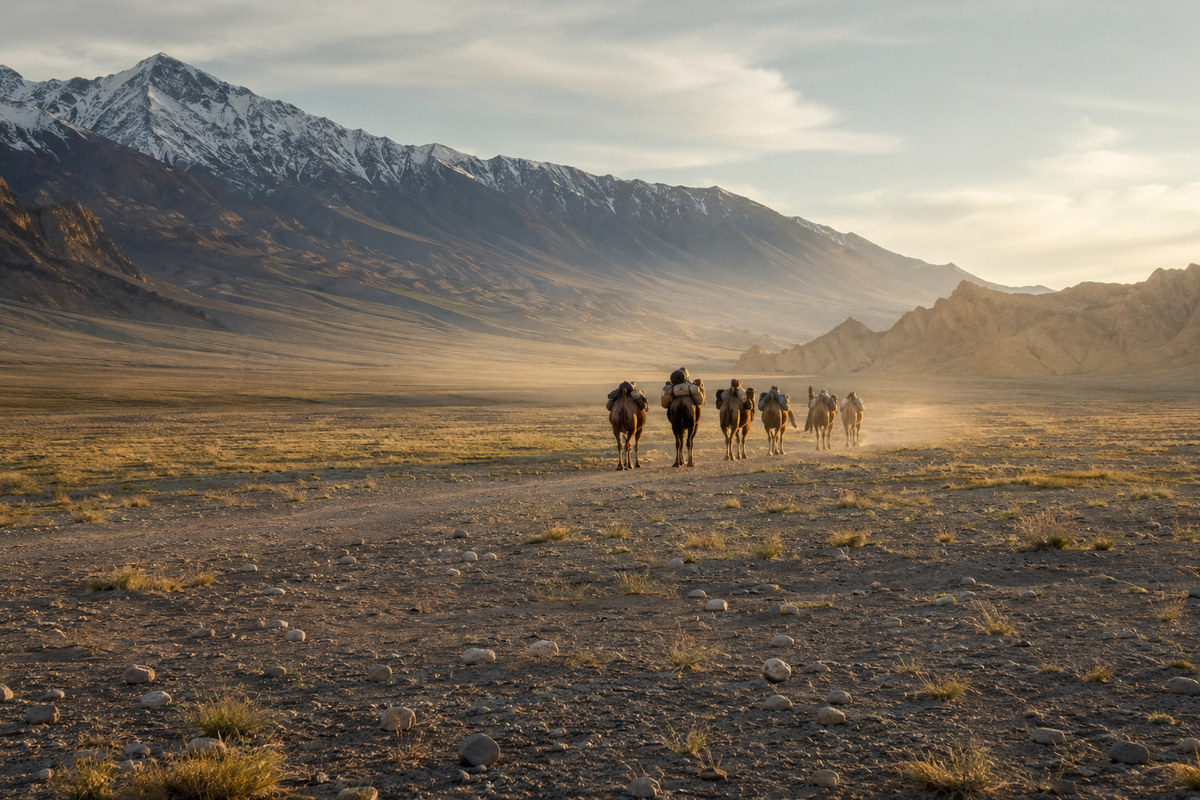
In 126 BC an envoy named Zhang Qian came back to the Han court after thirteen years in the west, and the road he described became the most famous trade route in history. Silk went one way, glass and horses and Buddhism came the other, and every popular account of the Silk Road since has treated it as a great mixer of peoples. This article tests that directly. It takes 1,269 dated ancient individuals from the corridor, from the Hexi to the Tian Shan, and measures how genetically varied the people buried in each cemetery actually were. The variation rises steadily across five thousand years. It does not rise faster after the route opens. And at the one Han cemetery best placed to record an effect, a test that would have caught a single foreigner among nine burials caught nothing at all.
The claim, and why it is hard to test
The Silk Road is not one road and it was never called that until a German geographer coined the term in 1877. It is a shifting bundle of routes running from the Chinese capitals through the Hexi Corridor, around either edge of the Taklamakan, over the Pamirs and into Sogdiana, and it operated in fits and starts from the Han dynasty to the Mongol peace. Nobody disputes that goods moved along it. The question here is narrower and more awkward: did people?
The difficulty is that the corridor was busy long before 130 BC and stayed busy long after. Steppe pastoralists reached the Tian Shan in the Bronze Age. The Xiongnu confederation dominated the region for three centuries. Turkic and Uyghur polities arrived in the seventh, the Mongols in the thirteenth. Any of these leaves ancestry behind, and all of them are candidates for a signal that a careless analysis would credit to trade. Finding western ancestry in a Chinese cemetery proves nothing on its own. The question has to be sharper than that.
So here is a sharper version. Trade and migration leave different fingerprints. A migration replaces or dilutes a population, and everyone in the cemetery shifts together. A trade network, if it moves people at all, moves a few of them: a merchant, a soldier, a wife brought back from three hundred miles away. Those people do not shift the average. They widen it. A community that has absorbed outsiders is more genetically varied inside itself than one that has not, and that variation is measurable without any reference to where the outsiders came from.
Data and method
Everything below uses Global25 scaled coordinates, with individual-level samples drawn from the dated ancient sample file. Distances are scaled Euclidean distances. The measure used throughout is intra-site dispersion: the mean distance from each buried individual to the average of the people buried alongside them. A cemetery of close relatives scores low. A cemetery of strangers scores high.
The corridor is defined generously: the Hexi and Gansu, Xinjiang, Shaanxi, Ningxia, Inner Mongolia, Kazakhstan, Kyrgyzstan, Uzbekistan, Tajikistan, Turkmenistan and Mongolia. After removing technical duplicates and every sample below fifteen per cent genomic coverage, 1,269 dated individuals remain. Seventy-one archaeological sites have at least five of them, which is the working minimum.
Dispersion depends on how many people you measure, so every site is rarefied: five individuals are drawn at random, dispersion is computed, and the process is repeated five hundred times. This removes the effect of sample size almost completely. The correlation between raw dispersion and sample count is minus 0.005; after rarefaction it is minus 0.024. Coverage is a weaker confounder than one might fear, correlating with dispersion at plus 0.168, and removing it by regression leaves the ordering of periods unchanged.
Two honest notes before any number is used. Frequencies in ancient DNA are frequencies in cemeteries, not in populations, and excavators do not sample at random. And the corridor has uneven temporal coverage: the centuries between the fall of the Han and the rise of the Tang are represented by a single site with five or more individuals, so nothing below can date a transition finely.
Five thousand years, one slope
The measurement, all seventy-one sites at once.
Every corridor site with at least five dated individuals, plotted against its mean date. The dashed line marks the opening of the route. The trend passes straight through it.
Dispersion rises across the whole transect. Spearman correlation between site date and rarefied dispersion is plus 0.702 across the seventy-one sites, with a p-value of 9.2 times ten to the minus twelve. Communities in this corridor became steadily more internally varied over five millennia, and that much is not in doubt.
The problem for the Silk Road story is where the rise happens. Split the sites at 130 BC and the trend is significant on both sides. Across the forty-two sites that predate the route, rho is plus 0.500 with a p-value of 0.0007. Across the twenty-nine that follow it, rho is plus 0.401 with a p-value of 0.031. The slope does not steepen. There is no inflection at the vertical line, and no inflection anywhere else that the data can locate.
Grouping the sites by period makes the same point from the other direction.
The same seventy-one sites grouped by period, with intervals from bootstrapping over sites. The Han bar is barely above the Iron Age bar it follows.
Permutation tests on these groups return one significant contrast between adjacent periods, and it is the wrong one. Iron Age against Han, which is the test the whole article turns on, gives a difference of plus 0.0115 with a p-value of 0.36. Han against Tang gives plus 0.0368 at p equal to 0.11. The only adjacent pair that clears significance is the earliest, before farming against the Bronze Age, at a p-value of 0.0005.
That last result deserves saying plainly rather than burying. The best-attested increase in genetic variety anywhere in this corridor happened more than a thousand years before the Silk Road existed. Whatever process is driving the long rise, it was already running.
The cemetery that should have shown it
A flat line is a weak result if the instrument is blunt. So the next question is what the test could have seen, and the way to answer it is to build the effect artificially and check whether it shows up.
Heishuiguo is the ideal test case. It is a Han military town in the middle of the Hexi Corridor near modern Zhangye, one of the four commanderies the Han established to hold the road open, and the nine individuals with usable coordinates date from 82 BC to AD 33. If the Silk Road moved people, this is where and when it should be visible.
The simulation takes a homogeneous local pool, the Han-period burials of Ningxia and Heishuiguo combined, and a donor pool of Iron Age and Han-period Central Asians. The two pools sit 0.4371 apart in coordinate space, which is an enormous separation. Cemeteries of nine are then assembled with zero, one, two, three or four migrants and the dispersion measured each time, four thousand replicates apiece. A site counts as detected if it exceeds the ninety-fifth percentile of purely local simulations.
Simulated dispersion against number of injected migrants, with the observed Heishuiguo value beneath. One foreigner in nine is enough to break the threshold every time.
A single Central Asian individual among nine burials raises simulated dispersion from 0.0249 to 0.0926 and is detected in one hundred per cent of replicates. The test is not blunt. It is close to saturated.
The observed value at Heishuiguo is 0.0252, against a purely local expectation of 0.0249. Not one individual out of nine, in a garrison town on the Silk Road at the height of Han operations, carries detectable Central Asian ancestry, and the method would have found one with certainty.
The published models agree
A negative result from one method on one site is worth very little. This one does not stand alone.
Xiong and colleagues sequenced the Heishuiguo and Foyemiaowan cemeteries and modelled them with qpAdm on a 1.2 million SNP panel, which is a far more powerful instrument than a coordinate calculator. Lv and colleagues, reporting on Tang-period Chang'an, summarise the outcome for the central and eastern Hexi in the historical period as no detectable contribution from any non-Yellow River lineage. Two methods sharing nothing but the underlying biology return the same verdict on the same cemetery.
The uniparental work points the same way and adds a direction. Xiong and colleagues typed thirty-one Han individuals from Heishuiguo on 485 Y-chromosome markers and complete mitogenomes, and found a male-dominated migration into the corridor from the middle and lower Yellow River. The one population movement securely documented at Heishuiguo in the Han period runs from east to west, which is to say it is Chinese frontier colonisation rather than anything arriving along the trade route.
The Ningxia transect closes the case for the Han period more broadly. Chang and colleagues sequenced eighty-nine individuals from twenty-three sites, of which twenty-two Han-period genomes from nine cemeteries. Every group except one clusters with Late Neolithic Yellow River farmers. The single exception carries steppe and BMAC ancestry, and admixture dating places its arrival twelve to fourteen generations before that individual died, which is to say before the Han dynasty and before the road. Even the exception is not an exception.
The capital is the most inbred place on the map
The Tang period is where dispersion does climb, and where the popular story finally seems to get its confirmation. It is worth looking at which sites are doing the climbing.
| Site | Date | n | Dispersion |
|---|---|---|---|
| Yuanzhou Nanyuan, Ningxia | AD 744 | 8 | 0.1767 |
| Hami Lafuqueke, Xinjiang | AD 750 | 27 | 0.1202 |
| Ordos Naobaowan, Inner Mongolia | AD 692 | 30 | 0.0816 |
| Bulgan, Mongolia | AD 880 | 6 | 0.0580 |
| Arkhangai, Mongolia | AD 850 | 7 | 0.0559 |
| Chang'an Xingfulindai, Shaanxi | AD 855 | 6 | 0.0350 |
Chang'an is at the bottom. The imperial capital, a city of perhaps a million people, the eastern terminus of the road, the place every account of Tang cosmopolitanism reaches for, returns a dispersion of 0.0350. That is within the range of Neolithic farming villages four thousand years older. Yuanzhou Nanyuan, a frontier cemetery in southern Ningxia, returns five times as much.
Six individuals is not a population and this observation carries no statistical weight on its own. But it is not an isolated oddity either. Lv and colleagues found that four of their seven Chang'an genomes descend directly from Late Neolithic Yellow River farmers with no western influence whatsoever, and the three that do carry western ancestry carry between three and fifteen per cent of it, with admixture dated to the fourth to seventh centuries rather than to the Tang.
Whatever cosmopolitanism meant in Tang Chang'an, and the documentary evidence that it meant something is overwhelming, it was not producing children at a rate the graves record. The mixing was happening at Guyuan and Hami, on the frontier, not at the centre.
And it did not last
There is a real Sui and Tang signal, and the Ningxia team read it as vindication of the trade-route story. Twelve of their fourteen groups from that period carry steppe or BMAC ancestry, two individuals are more than eighty per cent western Eurasian, and one group has no Yellow River ancestry at all. Admixture dating places these events four to fourteen generations before death, so they are recent arrivals rather than inherited background. Southern Ningxia is also where the Sogdian families with the surname Shi were buried, which is about as direct a link to the merchant diaspora as archaeology provides.
Two features of that signal are worth holding onto, because together they change what it means.
The first is its structure. The admixture is sex-biased: western Eurasian men, local Yellow River women. That is not what trade looks like. That is what settlement looks like. Men arrive, stay, marry locally, and are buried where their children live. The Sogdian couple sequenced from a Chinese tomb makes the same point at the scale of one household, with a husband carrying a BMAC component introduced roughly eighteen generations earlier and a wife of entirely local ancestry.
The second is what happens next. After the Tang, the Ningxia gene pool returns to Yellow River ancestry at between fifty and one hundred per cent, averaging just under eighty, and the steppe components that remain date back at least forty generations. The recent western input is simply gone. It did not found anything. A precipitate that redissolves is not a migration.
What this method cannot see
Four limits, stated before anyone else states them.
Excavators publish unusual cemeteries. If the Tang-period sites in this dataset were selected for excavation or sequencing because they contained exotic grave goods, their dispersion is inflated by the selection rather than by history. Nothing here can rule that out.
The dispersion measure is less sensitive than qpAdm for comparing periods. The Han-to-Tang contrast fails significance here at a p-value of 0.11 while the published formal models see the difference clearly. The Tang result belongs to the literature, not to this analysis. What this method does well is the opposite scale: a detection floor at a single site, where it is extremely sensitive.
The gap between the Han and the Tang is thin. One site with five or more individuals covers the fourth to sixth centuries. A transition could be hiding there and this transect would not resolve it.
And a Global25 coordinate is an autosomal summary with no dates attached and no way to distinguish maternal from paternal contribution. Every statement above about sex bias or admixture timing comes from published work using other methods.
Myth and measurement
| The received story | What the graves record |
|---|---|
| The Silk Road opened in 130 BC and began mixing the peoples of Eurasia. | Dispersion in the corridor was already rising before 130 BC and does not accelerate after it. No inflection is detectable at the opening. |
| Han garrison towns on the corridor were meeting points between east and west. | At Heishuiguo, none of nine burials shows Central Asian ancestry, against a test that detects one in nine with certainty. The documented Han-period movement runs east to west. |
| Tang Chang'an was the most cosmopolitan city in the world. | The one sequenced Tang cemetery in Chang'an is the least genetically varied Tang site in the corridor, at Neolithic village levels. |
| The Sui and Tang influx shows the trade route reshaping China's gene pool. | The influx is real, sex-biased and consistent with permanent settlement rather than trade, and it disappears from the local gene pool within a few centuries. |
| Goods, ideas and genes travelled the same road. | Crops, metallurgy, religions and pathogens crossed the corridor repeatedly. Human ancestry did not follow them at a rate this method can detect. |
The underlying reason is not mysterious once stated. A caravan is not a migration. Merchants who travel out and back leave no descendants along the way. For a trade route to enter the genetic record, its traders have to stop trading: settle, marry locally, and die where they settled. That happened, at Guyuan and at Hami and in the Sogdian tombs of northern China, six to eight centuries after Zhang Qian came home. And when it happened, it was no longer commerce that left the trace. It was residence.
The coordinates
The nine Heishuiguo individuals that carry the central result, in Global25 scaled coordinates, for anyone who wants to reproduce the dispersion measurement in Vahaduo.
Heishuiguo_Han:FA0214,0.014797,-0.454957,0.018856,-0.057817,0.036314,0.011992,0.00376,0.000462,-0.001227,0.006014,-0.07957,-0.013638,0.022002,-0.008533,-0.011265,-0.003845,-0.004955,-0.006081,-0.007039,0.00025,0.014225,0.008532,0.001972,0.010845,-0.002515
Heishuiguo_Han:FA0210,0.015935,-0.451911,0.018102,-0.055879,0.059703,0.018965,0.0094,0.006692,-0.014112,0.000547,-0.075835,-0.007343,0.009217,-0.007982,-0.004614,0.002917,0.001434,-0.004434,-0.00088,-0.01013,0.01123,0.010263,0.015776,0.002289,0.008023
Heishuiguo_Han:FA0215,0.01935,-0.443786,0.002263,-0.064923,0.054164,0.013387,0.0094,0.009461,-0.009613,0.010934,-0.085579,-0.003897,0.009217,-0.012937,0.0019,-0.00411,0.001173,0.006588,-0.005531,-0.006253,0.016845,0.002349,0.008874,0.002651,-0.000599
Heishuiguo_Han:G30701,0.017073,-0.446833,0.00792,-0.062016,0.054164,0.026774,0.00611,-0.003692,-0.009204,0.009294,-0.063331,-0.013338,0.007284,-0.012386,-0.000407,0.000133,0.007693,0.002914,-0.006536,-0.012756,0.022959,0.001978,0.010106,-0.009399,-0.00455
Heishuiguo_Han:G30703,0.012521,-0.451911,0.009805,-0.053618,0.062473,0.021475,0.013631,-0.005538,-0.007158,-0.001093,-0.083792,-0.012739,0.012785,-0.004404,-0.005972,-0.002121,0.002477,0.005321,-0.007542,-0.017508,0.011355,0.002844,0.01023,-0.001084,0.00455
Heishuiguo_Han:G30704,0.017073,-0.448864,0.004525,-0.059432,0.067705,0.011992,-0.00564,0.013615,-0.00859,-0.005103,-0.070639,-0.010191,0.010109,-0.005367,-0.002307,-0.005569,0.006519,-0.00228,-0.009176,-0.013006,0.020464,-0.000247,0.012818,-0.001446,0.005508
Heishuiguo_Han:G30705,0.015935,-0.444802,0.00792,-0.061693,0.048317,0.018686,0.01081,0.006692,-0.003886,0.01057,-0.079083,-0.001798,0.007136,-0.006193,-0.006515,0.002519,0.009127,-0.001774,-0.008673,-0.01088,0.011979,0.010634,0.011462,0.002169,0.004431
Heishuiguo_Han:FA0201,0.025041,-0.460035,0.006788,-0.058463,0.060011,0.018128,0.005405,-0.003923,-0.011249,0.017495,-0.073887,-0.002248,0.011744,-0.004266,-0.00855,0.001989,-0.002086,0.003041,-0.009302,-0.018759,0.016845,-0.00371,0.016145,-0.014098,-0.018082
Heishuiguo_Han:FA0206,0.020488,-0.452926,0.008674,-0.062985,0.056318,0.014781,0.00564,0.000692,-0.008385,0.000547,-0.078434,-0.013188,0.011447,-0.008395,-0.011672,-0.006762,-0.010691,0.002027,-0.003017,-0.007879,0.01435,0.005688,0.016638,-0.000361,-0.000958
References
- CORRIDOR Xiong, J. et al. 2024. Inferring the demographic history of Hexi Corridor over the past two millennia from ancient genomes. Science Bulletin 69, 606 to 611.
- CORRIDOR Xiong, J. et al. 2022. Sex-Biased Population Admixture Mediated Subsistence Strategy Transition of Heishuiguo People in Han Dynasty Hexi Corridor. Frontiers in Genetics 13, 827277.
- CAPITALS Lv, M. et al. 2024. Ancient genomes from the Tang Dynasty capital reveal the genetic legacy of trans-Eurasian communication at the eastern end of Silk Road. BMC Biology 22, 267.
- NINGXIA Chang, X. et al. 2026. Multiple Genetic Shifts at the Crossroads of the Eastern Steppe and Loess Plateau Over 4,000 Years. Nature Communications 17, 6735.
- XINJIANG Kumar, V. et al. 2022. Bronze and Iron Age population movements underlie Xinjiang population history. Science 376, 62 to 69.
- XINJIANG Zhao, X., Sun, R., Li, C. and Cui, Y. 2025. Genetic History of Ancient Xinjiang Revealed by Ancient DNA Study. Nature and Anthropology 3, 10010.
- XINJIANG Zhang, F. et al. 2021. The genomic origins of the Bronze Age Tarim Basin mummies. Nature 599, 256 to 261.
- ASIA Narasimhan, V. M. et al. 2019. The formation of human populations in South and Central Asia. Science 365, eaat7487.
- STEPPE Damgaard, P. de B. et al. 2018. 137 ancient human genomes from across the Eurasian steppes. Nature 557, 369 to 374.
- STEPPE Jeong, C. et al. 2020. A Dynamic 6000-Year Genetic History of Eurasia's Eastern Steppe. Cell 183, 890 to 904.
- SYNTHESIS Ning, C. et al. 2020. Ancient genomes from northern China suggest links between subsistence changes and human migration. Nature Communications 11, 2700.
- SYNTHESIS Spengler, R. N. 2019. Fruit from the Sands: The Silk Road Origins of the Foods We Eat. University of California Press.
- DATA Global25 coordinates by Davidski, Eurogenes Blog. Population averages from the Moriopoulos 2026 collection.