
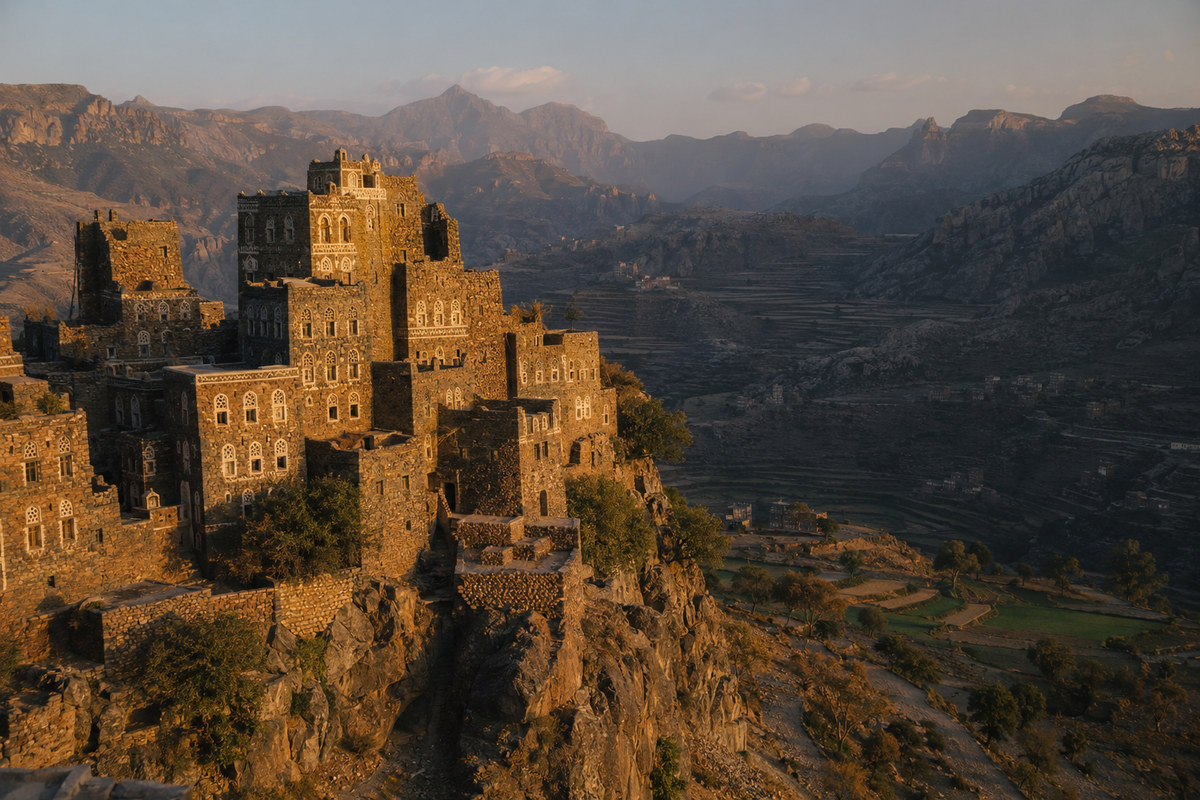
Almost everything written about the Jews of Yemen begins with the word oldest. They are said to descend from men sent by Solomon to fetch gold from Ophir, or from exiles who left Jerusalem before Nebuchadnezzar arrived, or from the Judaean diaspora of the Second Temple. They preserve a pronunciation of Hebrew that other communities lost, a vocalisation system that predates the Tiberian one, and a scribal tradition that Maimonides himself praised. The claim that follows from all of this, and that gets made constantly, is that they are the least admixed and most archaic branch of the Jewish people. This article asks what the autosomal data says about that claim, and finds that the honest answer is stranger and more interesting than either yes or no.
Two stories about how Judaism reached Yemen
The Yemenite Jewish community was almost entirely transferred to Israel between 1949 and 1950, and before that it had been continuously present in the highlands of south-western Arabia for at least fifteen hundred years and probably much longer. Its own tradition, and the tradition of the rabbinic world that received it, places the founding very early: a group that left Judaea before the destruction of the First Temple in 586 BC and therefore never participated in the Babylonian exile, which is the explanation traditionally offered for why Yemenite ritual diverges from Babylonian practice at certain points.
Against this stands a second reconstruction, and it is not a fringe one. In the late fourth century AD the kings of Himyar, who ruled almost the whole of what is now Yemen, abandoned polytheism. The change is visible in the inscriptions with unusual precision: from roughly 380 the dedications to the old South Arabian gods stop, and are replaced by invocations of a single deity called Rahmanan, the Merciful, together with Hebrew and Aramaic borrowings including shalom and amen. Some inscriptions name him Lord of the Jews. By the early sixth century the ruling house was openly Jewish, and its last king, Yusuf As'ar Yath'ar, remembered in Arabic tradition as Dhu Nuwas, massacred the Christians of Najran in 523 in a campaign that brought an Aksumite army across the Red Sea and ended Himyarite independence.
If the population of a large Arabian kingdom converted to Judaism over the course of a century and a half, then the Jews of Yemen may be South Arabians who adopted a Judaean religion rather than Judaeans who settled in South Arabia. The two accounts make sharply different genetic predictions, and for once the predictions are testable.
What the uniparental markers said
Two results framed the question before genome-wide data existed, and they pointed in opposite directions.
The maternal evidence looks local, and more than local. Non and colleagues sequenced mitochondrial control regions from 45 Yemenite Jews and 41 Ethiopian Jews in 2011 and found sub-Saharan African L haplogroups at 20 per cent in the Yemenite Jewish sample, a figure without parallel in any other Jewish diaspora community outside Africa. Near Eastern and Ashkenazi Jews carry essentially none. Their reading was nevertheless cautious and worth quoting fairly: they concluded that Yemenite Jewish maternal diversity was consistent with descent from ancient Israelite exiles combined with African and Middle Eastern ancestry, and that there was little evidence for large-scale conversion of local Yemenis. The contrast they drew was with the Ethiopian Jews, whose maternal pool looked like a subset of the general Ethiopian one, which is what conversion of local women produces.
The paternal evidence points somewhere else entirely, and it is the single most awkward fact for anyone who wants a simple answer. Shen and colleagues reported in 2004 that about 15 per cent of Yemenite Jewish men carry Y chromosome haplogroup Q. Haplogroup Q is not an Arabian lineage. It is rare to absent in the non-Jewish populations of the Arabian peninsula, and the Yemenite Jewish branch is not the same as the Q found among Ashkenazim. Meanwhile the lineage that dominates Yemen, J1-P58, runs at roughly 30 per cent in Yemenite Jews against something closer to two thirds in Yemeni and Saudi Arabs. A community formed by mass local conversion would be expected to look like its neighbours on the Y chromosome. It does not.
So the uniparental picture is already contradictory: maternal lineages that look Arabian and African, paternal lineages that include something the neighbours do not have. That is the situation the autosomal data enters.
Data and method
Everything below uses Global25 scaled coordinates, with population averages merged from Davidski's published files and the Moriopoulos 2026 collection. Ancestry proportions come from non-negative least squares with a sum-to-one constraint imposed by appending a heavily weighted row of ones, with the resulting weights normalised. The Yemenite Jewish average rests on eleven individuals, ten of whom are also available separately and are modelled one by one in a later section.
Two reference sets do the work. The distal panel is Levantine Neolithic, Iranian Neolithic, Anatolian Neolithic, Yamnaya steppe and an East African source, with a condition number of 8.13. The proximal panel is a North Arabian source, an East African source and a Bronze Age Canaanite source, with a condition number of 7.75.
One number governs how much any of this can be trusted, and it should be stated at the outset rather than buried in a caveat at the end. The separation between the Arabian pole and the Canaanite pole is 84 units. Our working threshold for a two-source model, established across earlier articles on this site, is about 100 units, below which collinearity artifacts become serious. The two populations this question requires us to separate sit just under that threshold. Every result below has to be read with that in mind, and the sections on controls exist precisely because of it.
A word on the ancient anchors, because Arabia is much better served than it was five years ago. Sirak and colleagues published thirty-nine genomes from Soqotra in 2024, spanning roughly AD 650 to 1750, and found that the medieval islanders derive about 86 per cent of their ancestry from a population resembling the modern Hadramawt. Crucially for what follows, they also found that the deep ancestry of medieval Soqotri and of the Hadramawt derives less from early Holocene Levantine farmers, and more from Late Pleistocene Levantine hunter-gatherers, than any other Arabian group. That is a real, published, independently derived statement about the difference between South Arabians and Levantines, and this article's central result is a restatement of it from a different direction.
Where the Yemenite Jews sit
The simplest measurement is also the most startling, and it does not require any modelling at all.
Every one of the fifty nearest populations to the Yemenite Jewish average is Arabian. The nearest other Jewish community is six times further away than the nearest Arab one.
The nearest population on earth to the Yemenite Jews is the Saudi Arab average, at 14 units. Then come Yemeni Arabs from Al Jawf at 17 and from Ma'rib at 18, the medieval Soqotri at 23, Yemeni Arabs from Amran and Dhamar and Negev Bedouin at 24, and the Mehri of Mahra at 31. Bronze Age Canaanites sit at 79. The nearest other Jewish community, the Paradesi of Cochin, sits at 88, and that community is itself partly of Sephardic descent. Iraqi Jews are at 109, Syrian Jews at 111, Moroccan Jews at 118, Ashkenazim at 143.
This is the pattern Behar and colleagues reported in 2010 when they identified three distinct Jewish clusters in genome-wide data and found that the Yemenite one coincided with Bedouins and Saudi Arabians rather than with the main Ashkenazi and Sephardi cluster or with the Caucasus and Middle Eastern one. Our numbers reproduce their figure closely, which is reassuring about the method rather than surprising about the result.
What has to be said immediately is that this does not settle anything. Jewish communities generally sit near their host populations: Mountain Jews of Dagestan are 10 units from Assyrians, Georgian Jews 13 from Assyrians of Hakkari, Ashkenazim 18 from Sicilians, Cochin Jews 13 from their Malayali neighbours. Proximity to the host is the norm, not the exception, and it reflects centuries of small-scale gene flow rather than wholesale conversion. The Yemenite figure of 14 is at the low end of that range but not outside it. To get further we need to ask not how close they are to Arabians but whether they carry anything Arabians do not.
The component that is missing
Here the argument stops depending on the fine distinction between Levantines and Arabians, and starts depending on an axis where the separation is enormous and the answer is unambiguous.
The same five-source panel applied to Yemenite Jews, their Arabian neighbours, the Bronze and Iron Age Levant, and four other Jewish communities.
Yemenite Jews decompose as 73 per cent Levantine Neolithic, 24 per cent Iranian Neolithic, zero Anatolian Neolithic, 0.5 per cent steppe and 2.7 per cent African. Saudi Arabs, on the identical panel, come out at 73, 22, zero, 1.7 and 2.8. Medieval Soqotri come out at 71, 26, zero, zero and 3.4. These are the same profile to within model noise.
Now look at the Levantines. Bronze Age Canaanites from Megiddo carry 7.6 per cent Anatolian Neolithic and 6.9 per cent steppe. Phoenicians from Achziv in the Iron Age carry 9.1 and 5.1. The Iron Age population of Beirut carries 22.4 and 8.8. Every Jewish community outside Arabia carries a large amount of both: Iraqi Jews 23.9 and 6.7, Syrian Jews 28.1 and 14.5, Moroccan Jews 27.4 and 20.5, Ashkenazim 37.2 and 29.5.
Combine the two into a single quantity, which we can call the northern component of the Bronze Age Levant, and the picture becomes very hard to argue with.
Anatolian Neolithic plus steppe ancestry. Every Levantine population, ancient or modern, Jewish or not, carries a substantial share. The Yemenite Jews carry half a per cent.
Bronze and Iron Age Levantines run between 13 and 31 per cent. Every Jewish community in the world outside Arabia runs between 29 and 67 per cent. The Druze, the standard control for a long-endogamous Levantine population, run at 36. Yemenite Jews run at 0.5 per cent, which is inside the Arabian range of zero to 2.6 and indistinguishable from Saudis at 1.7, Bedouin at zero, Soqotri at zero and Mehri at zero.
This is the load-bearing result of the article, so it is worth being precise about what it does and does not show. Anatolian Neolithic and steppe ancestry entered the Levant during the Bronze Age and never left. Any population descended in substantial part from Iron Age Judaeans has to carry it, because the Iron Age Judaeans carried it. The Yemenite Jews carry effectively none. A founding population of Judaean exiles contributing a large share of the modern gene pool is therefore excluded, not by a subtle argument about model geometry but by the absence of a component whose poles are hundreds of units apart and which the model measures without difficulty everywhere else.
What it does not show is that the contribution was zero. A small founder group, diluted over sixty or seventy generations, would leave a northern component of a fraction of a per cent, which is what is observed. The question therefore shifts from whether there was a Judaean founding layer to how large it could have been, and that question runs straight into the collinearity problem flagged in the method section.
Measuring the Judaean layer directly, and why it fails
The obvious next step is to model the Yemenite Jews as a mixture of local South Arabians, East Africans and Bronze Age Canaanites, and read off the Canaanite weight. Doing that returns 8.3 per cent, which is a perfectly plausible figure for a diluted founder population and would make an attractive headline. It is also, on inspection, worth nothing at all.
The same three-source model applied to Yemenite Jews and to every Yemeni Arab regional average available. The controls take more than the target does.
Yemeni Arabs from Amran, a Muslim highland population with no claim to Judaean descent whatsoever, take 26.5 per cent on the identical model. Dhamar takes 16.0, Ibb 15.4, Hadramaut 15.2, the pooled Yemeni Arab average 11.1. The medieval Soqotri, who lived on an island in the Gulf of Aden and are the closest thing we have to a pre-Islamic South Arabian baseline, take 9.1. The Yemenite Jews take 8.3, below all of them, and Ma'rib at 8.1 sits immediately underneath.
A source that assigns three times more Judaean ancestry to Muslim Yemenis than to Yemenite Jews is not measuring Judaean ancestry. It is absorbing a north-to-south gradient that runs across the whole peninsula, and the Levantine label on the sample is doing the persuading. Readers of our articles on the Bulgars and the Lemba will recognise the failure mode exactly: when a source overlaps substantially with the target's existing baseline, non-negative least squares hands it weight because doing so shaves a little off the residual, and the weight is real arithmetic describing an ancestry that is not there.
The Henschel study of 2024 explains where that gradient comes from. Working with 46 whole genomes and 169 arrays from across Yemen, its authors dated the main northern influx into the Yemeni gene pool to roughly 5,220 years ago, from the southern Levant, in the Bronze Age. That is around 3200 BC. It is two and a half thousand years before any Judaean could have set foot in Himyar, and it is what the Canaanite source in our model is picking up.
Which source does the Yemenite Jewish residual actually want?
The cleanest way to test whether a model has any power to identify a source is to offer it a menu and see what it chooses. A two-source baseline of medieval South Arabians plus East Africans was fitted to the Yemenite Jews, then twelve candidate third sources were added one at a time and the improvement in fit recorded.
Twelve candidate third sources ranked by how much each improves the fit for the Yemenite Jews. The Levantine and Jewish candidates finish at the bottom.
The winner is the Saudi Arab average, which improves the fit by 41.5 per cent and takes a weight of 85 per cent. Negev Bedouin come second at 27.3, mainland Yemeni Arabs third at 10.1, the Mehri fourth at 9.2. Late Period Egyptians manage 7.0. Only then do the Levantine candidates appear, and they appear at the bottom: Late Bronze Age Jordan at 6.2, Sidon Canaanites at 5.1, Achziv Phoenicians at 4.7, Megiddo Canaanites at 4.3. The modern Levantine Jewish communities, which are the closest available proxies for a surviving Judaean population, finish last of all: Druze 1.2, Syrian Jews 1.0, Iraqi Jews 0.8.
Run the same ladder on the Muslim Yemenis of Amran and it inverts completely. For them the Levantine candidates take the top places, with Late Bronze Age Jordan improving the fit by 50.2 per cent, Sidon by 49.8, Megiddo by 44.4, Achziv by 43.4, and even the Druze and the Syrian and Iraqi Jews by 42.5, 38.9 and 35.3. The Saudi source, which was the runaway winner for the Yemenite Jews, manages 8.4.
So the two populations want opposite things. Whatever separates the Yemenite Jews from the general South Arabian background pulls north-east towards Saudi Arabia and the Bedouin, not north-west towards the Levant. Whatever separates the highland Muslim Yemenis from that background pulls north-west. If one had to attach a story to the first pattern it would be a Hejazi or northern Arabian connection rather than a Judaean one, and the Jewish communities of the Hejaz, of Yathrib and Khaybar and Tayma, are historically well attested and were in contact with Himyar. But this is exactly the kind of story that the pole separations in this dataset cannot carry, and it is offered as a possibility rather than a finding.
How much would have been visible?
A null result is worth nothing unless the method could have produced a positive one, so the detection floor was measured rather than assumed.
Synthetic genomes built by adding a known amount of Bronze Age Canaanite ancestry to the real Yemenite Jewish average, then pushed back through the same model.
Recovery is linear and close to one to one above the 8.29 per cent baseline. Inject 3 per cent and the model reports 11.0; inject 5 and it reports 12.9; inject 10 and it reports 17.5. The method is not insensitive. The problem is not the ceiling of its sensitivity but the height of its floor, since populations with no possible Judaean ancestry already sit between zero and 26 per cent on the same instrument.
A different framing gets closer to a usable answer. Instead of asking what weight the model assigns, build synthetic populations with known Judaean fractions and ask which of them the observed Yemenite Jews actually resemble.
Distance from the real Yemenite Jewish average to synthetic mixtures of South Arabians and Bronze Age Canaanites at increasing Judaean fractions.
The curve is almost flat from zero to 15 per cent, dipping trivially from 23.4 to a minimum of 22.5 at 10 per cent and returning to 23.1 at 15. It then rises steadily: 24.4 at 20 per cent, 28.8 at 30, 41.3 at 50, 79.4 at 100. The shape carries two messages. The first is that the data cannot distinguish between a founding Judaean contribution of zero and one of 15 per cent, which is a wide and unsatisfying interval. The second is that it excludes anything above about a fifth quite firmly, and excludes the traditional picture of a community descended predominantly from Judaean exiles completely.
Eleven people, and how much they vary
Population averages hide structure, and a small sample can hide it badly. If a Judaean founder lineage had contributed to some Yemenite Jewish families and not others, an average of eleven individuals could easily dilute a real signal in two of them.
Ten Yemenite Jewish individuals run separately through the proximal three-source model.
The ten individuals available separately run from 0.0 to 21.0 per cent, with a mean of 9.9. The spread is real and it is not nothing: YemeniteJew4938 at 21.0 sits at the top of the range where the ceiling analysis says a genuine contribution would start to be detectable, while YemeniteJew4667 returns a flat zero. But there is no bimodality, no cluster of high individuals against a cluster of low ones, and the whole range falls inside the range spanned by the Muslim Yemeni regional averages on the same model.
The within-population scatter is also worth a line, because it bears on the founder-effect story that Yemenite Jewish medical genetics has made famous. The mean distance of these ten individuals from their own centroid is 22.3 units. The comparable figures are 22.8 for Iraqi Jews, 23.0 for Libyan Jews, 21.3 for Georgian Jews and 24.8 for Moroccan Jews. Yemenite Jews are about as internally homogeneous as other long-endogamous Jewish communities, and considerably more homogeneous than their Yemeni Arab neighbours at 30 and Saudis at 37. Endogamy is confirmed. Exceptional endogamy is not.
Twenty per cent African mothers, three per cent African genome
The African component deserves its own section, because it is the one place where the maternal and autosomal records disagree so sharply that the disagreement is itself the finding.
East African ancestry across Yemen, from the five-source distal model.
Yemenite Jews return 2.74 per cent East African. That is at the very bottom of the Yemeni range, below every Yemeni Arab regional average sampled, below the medieval Soqotri at 3.40, and essentially level with Saudi Arabs at 2.81 and the Mehri at 2.27. The mainland Yemeni figures run up to 7.64 per cent in Ibb, and the Henschel study dates the bulk of that influx to roughly 750 years ago and connects it to the Red Sea slave trade, which is consistent with the regional pattern here: the coastal and southern districts carry more, the northern highlands less.
Now set that against the mitochondrial result. Non and colleagues found African L haplogroups in 20 per cent of Yemenite Jewish maternal lineages. If those women had entered a founding generation and their descendants had married endogamously ever since, the autosomal share would be roughly half of 20 per cent, or 10 per cent. It is under 3.
The resolution is the one this site has now met from several directions, and it is worth stating plainly because it is the single most common error in amateur interpretation of ancestry results. A mitochondrial haplogroup frequency is a measurement at one non-recombining locus. In a small, endogamous population it is subject to enormous drift: a handful of African women entering an isolated community of a few thousand can see their matrilines expand to a fifth of all matrilines over sixty generations without contributing anything like a fifth of the genome, because every generation of daughters passes on the mitochondrion intact while passing on a halving share of the autosomes. This is the same argument that dissolves the Genghis Khan star cluster from the paternal side and that reconciles the Lemba's 74 per cent non-African Y chromosomes with a low single-digit autosomal figure. Here it runs from the maternal side and it produces the same lesson: one locus is not the genome.
What the data can and cannot decide
Pulling the strands together, the autosomal record supports the following statements with confidence. The Yemenite Jews are a South Arabian population in the same sense that the Ashkenazim are a European-Levantine one and the Cochin Jews are an Indian one. They carry none of the Anatolian Neolithic and steppe ancestry that every Bronze Age Levantine population carried and that every other Jewish community in the world retains, which excludes a majority Judaean founding contribution outright. Their East African ancestry is low by Yemeni standards, consistent with several centuries of endogamy inside Yemen rather than with a population continuously exchanging with its neighbours. Their internal homogeneity is typical of a long-endogamous community.
The record cannot decide the question the community itself cares about. A Judaean founding group of anywhere between zero and about 15 per cent of the ancestral gene pool is compatible with everything measured here, and the reason is geometric rather than statistical: the two candidate sources sit 84 units apart in a space where the target sits 14 units from one of them. That is the same situation this site described for the Lemba, where a Jewish and an Arab source 31 units apart produced identical candidate rankings whichever one had actually been used to build the target. The Lemba case was worse, but it was worse in degree and not in kind.
And the record is contradicted, in one specific and stubborn respect, by the Y chromosome. Fifteen per cent of Yemenite Jewish men carry a lineage that their Arabian neighbours essentially do not have, and they carry the dominant local lineage at half the local frequency. That is not what a population formed by mass conversion of Himyarites looks like. It is what a population looks like when a small group of outside men founded a community, married locally, and then closed the door behind them, which is precisely the demographic shape that leaves a strong paternal signature and an autosomal profile indistinguishable from the neighbours. It is also the shape the Lemba tradition describes, and the shape our article on that community modelled in detail.
So what about archaic?
The claim this article set out to test turns out to have been two claims wearing one word.
If archaic means genetically closer to the ancient Israelites than other Jewish communities are, the answer is no, and not marginally. Iraqi Jews sit 50 units from Bronze Age Canaanites, Syrian Jews 51, Kurdish Jews 51, the Druze 44. Yemenite Jews sit 79, further than the Muslim Yemenis of Amran at 72. On this measure the most archaic Jewish communities are the ones that stayed in Mesopotamia and the northern Levant, which is not a romantic answer but is the one the coordinates give.
If archaic means culturally and textually conservative, the answer is yes, and genetics has nothing whatever to say about it. The Yemenite pronunciation preserves consonantal and vowel distinctions that other traditions collapsed. The Babylonian supralinear vocalisation survived in Yemen after it had been abandoned everywhere else. Yemenite Torah scrolls track the Aleppo Codex more closely than most. The community stood outside the European rabbinic developments of the last thousand years almost entirely. None of that is a claim about descent, and none of it is weakened by anything above. A liturgical tradition is transmitted by teaching, not by autosomes, and it can be preserved perfectly by a community whose ancestors were mostly local.
The most economical reconstruction, then, is a small group of Judaean or northern Arabian Jewish men reaching south-western Arabia at some point in the Roman or late antique period, marrying local women because they had brought few of their own, and forming an endogamous religious community that afterwards absorbed converts from a Himyarite kingdom whose ruling house had adopted their religion. Both stories are true, and the proportions are what the data cannot yet fix. What the Yemenite Jews carried out of Judaea, on this reading, was a text, a liturgy and a chromosome. The rest of the genome is Arabian, and the community that preserved that text for sixteen centuries is not diminished by the fact.
Limits
Six caveats matter. First, eleven individuals is a small sample and ten is smaller still, and the Yemenite Jewish community had real internal divisions, notably between the Baladi and Shami traditions and between highland and Aden communities, which are not resolved here. Second, there is no pre-Islamic ancient DNA from mainland Yemen at all; the Soqotra series begins around AD 650 and comes from an island, and using it as a proxy for the sixth-century Himyarite highlands is an assumption rather than a measurement. Third, the Levantine and Arabian poles are 84 units apart, below our own working threshold, and the central negative result about a Judaean founder layer therefore rests on the absence of the northern component rather than on any fitted percentage. Fourth, the fit distances for Arabian targets under the distal panel are poor, around 0.07, because Arabian-specific drift is not captured by any available ancient source; the decomposition should be read as a comparison across rows rather than as a set of point estimates. Fifth, drift in a small endogamous population displaces its centroid from everything, which inflates its distance to the Levant and deflates any Levantine weight; the size of that effect is not quantified here and could plausibly account for a few points. Sixth, the Y chromosome evidence cited is twenty years old and based on low-resolution genotyping; the study that would actually settle this question is a full-sequence phylogeny of Yemenite Jewish haplogroup Q against dated branches of the Q tree, and it has not been published.
Conclusion
The Jews of Yemen are, autosomally, a South Arabian population. They sit 14 units from Saudi Arabs and 88 from the nearest other Jewish community. They carry 0.5 per cent of the Anatolian Neolithic and steppe ancestry that defines the Bronze Age Levant and that every other Jewish community in the world retains at between 29 and 67 per cent. A model built to detect a Judaean founder layer assigns them 8.3 per cent, and assigns their Muslim neighbours in Amran 26.5, which disqualifies the measurement. The honest interval on a Judaean founding contribution is zero to about fifteen per cent, and the honest description of that interval is that it is too wide to be useful.
What survives from Judaea in Yemen is not, on this evidence, a genome. It is a haplogroup, a pronunciation, a vocalisation system and a library. Those are not lesser things, and they were carried further and held longer than most genes ever are.
Yemenite_Jew_(n=11),0.051220,0.144944,-0.063905,-0.113345,-0.011862,-0.045966,-0.012498,-0.008056,0.048323,-0.007455,0.012533,-0.026227,0.054086,0.004854,0.003936,0.017164,-0.023197,0.005551,0.005794,0.022886,0.012886,0.016052,-0.006935,0.004995,-0.005683
Saudi_Arab_(n=246),0.052090,0.140143,-0.060483,-0.111449,-0.010307,-0.045575,-0.012521,-0.008698,0.052667,-0.006099,0.015309,-0.029382,0.058034,0.005754,0.003958,0.023486,-0.022397,0.005200,-0.000856,0.025372,0.010450,0.014695,-0.005302,0.005351,-0.006820
Yemeni_Arab_Amran_(n=16),0.044320,0.136335,-0.061094,-0.103158,-0.014349,-0.042653,-0.009209,-0.007975,0.045801,-0.004613,0.011976,-0.023061,0.046865,0.005513,0.004207,0.016499,-0.014114,0.004656,0.001485,0.016101,0.007152,0.009591,-0.006270,0.004421,-0.005770
Yemen_Socotra_Early-High_Medieval_(n=16),0.049229,0.129036,-0.067882,-0.106328,-0.016253,-0.045215,-0.011339,-0.007298,0.056257,-0.005980,0.011885,-0.026461,0.055488,0.004387,0.005641,0.016623,-0.017406,0.005463,0.004360,0.021018,0.011534,0.008988,-0.007534,-0.001303,-0.004116
Israel_MLBA_Megiddo_(n=6),0.089351,0.143020,-0.061785,-0.098946,-0.014362,-0.036302,-0.004152,-0.012730,0.011794,0.009051,0.013126,-0.006544,0.018087,-0.001606,-0.007646,0.004817,-0.002238,0.001520,0.001550,0.014632,0.002412,0.005544,-0.000739,0.003635,-0.001517
Lebanon_MBA_Sidon_Canaanite_(n=5),0.081270,0.146845,-0.061320,-0.097934,-0.010525,-0.038933,-0.004794,-0.006600,0.011453,0.010169,0.010490,-0.009771,0.021585,0.005505,-0.007573,0.006523,-0.000156,-0.001191,0.001509,0.004252,0.004267,0.007543,-0.001257,0.001591,-0.000503
Israel_IAII_Phoenician-Achaemenid_Achziv_(n=4),0.079961,0.150298,-0.060339,-0.099242,-0.010002,-0.037999,0.001939,-0.006865,0.016618,0.008110,0.002801,-0.007418,0.017839,-0.001239,0.000204,0.004143,-0.002086,0.004815,0.002703,0.005815,-0.000156,0.007141,-0.004714,-0.003163,0.002096
Jordan_LBA_Baq'ah_(n=8),0.087786,0.150044,-0.059915,-0.102068,-0.010156,-0.037267,-0.006786,-0.010586,0.014700,0.009727,0.010291,-0.009292,0.022801,0.000086,-0.009212,0.016226,0.002168,0.003151,0.002467,0.006831,0.004071,0.007048,-0.008165,0.000421,-0.001078
Lebanon_IAIII_Beirut_(n=8),0.086790,0.150552,-0.047234,-0.087735,-0.009771,-0.031968,-0.004847,-0.009000,0.008922,0.011663,0.006841,-0.004458,0.009737,0.000602,-0.008398,0.002536,0.000799,-0.000317,0.003441,0.000000,0.001685,0.005085,-0.003959,0.000964,-0.002455
Somali_Somalia_(n=20),-0.299128,0.093749,-0.026190,-0.070714,0.001116,-0.033156,-0.021174,0.005750,0.115733,-0.080870,-0.008559,-0.006736,0.004423,-0.000630,0.025255,-0.017788,0.016858,-0.002713,0.009722,-0.003591,0.001444,0.005276,-0.002775,-0.001094,0.000093
Israel_N_PPNB_(n=1),0.072847,0.172640,-0.030924,-0.147935,0.034468,-0.068607,-0.016451,-0.011999,0.072606,0.048839,0.010555,-0.013038,0.029583,-0.008257,-0.024837,0.007425,0.020861,-0.008615,-0.004651,0.023886,-0.000250,0.004328,0.000000,-0.005302,-0.006826
Iran_GanjDareh_N,0.043025,0.067431,-0.153488,0.005556,-0.123962,0.024375,0.015464,0.000277,-0.081605,-0.054270,-0.003248,-0.001619,0.005382,-0.007845,0.031949,0.056775,-0.005815,0.007576,0.014405,-0.032741,0.007661,-0.030048,-0.010920,-0.038777,0.022944
Turkey_N,0.117902,0.180087,0.003426,-0.101059,0.051240,-0.047969,-0.003799,-0.006846,0.036167,0.080678,0.008261,0.011309,-0.024164,0.000579,-0.042712,-0.010370,0.022556,0.001388,0.013649,-0.010448,-0.014261,0.005693,-0.004904,-0.003750,-0.004436
Russia_Samara_EBA_Yamnaya,0.125838,0.089254,0.042908,0.115456,-0.027868,0.044685,0.004491,-0.002949,-0.054858,-0.072996,0.001858,0.000350,-0.001652,-0.023610,0.037263,0.015734,0.000000,-0.001478,-0.001704,0.012506,-0.003120,0.001374,0.011229,0.018436,-0.004524
Ethiopia_LSA_Mota_4500BP_(n=1),-0.511066,0.043668,0.000754,0.000969,-0.002770,-0.011435,0.050997,-0.045229,0.089172,-0.087838,-0.012991,-0.002997,-0.031219,0.000688,0.021580,-0.029965,0.027772,0.039273,0.001760,-0.009004,0.000374,0.006183,-0.003451,-0.002410,-0.000838
Iraqi_Jew_(n=11),0.091369,0.138574,-0.065893,-0.075376,-0.025263,-0.022337,-0.000491,-0.008139,-0.010524,-0.001441,0.003956,-0.005967,0.012325,0.005005,-0.009266,0.009390,-0.005713,0.000910,0.002388,-0.009777,0.001940,-0.002169,-0.003171,-0.002213,0.001644
Syrian_Jew_(n=4),0.088213,0.140905,-0.038938,-0.068799,-0.007463,-0.024124,-0.003055,-0.003692,0.002659,0.009750,0.004141,-0.002248,0.005240,-0.000069,-0.005225,-0.001094,-0.002836,0.000824,0.000315,-0.004189,-0.000842,-0.001020,0.001386,-0.003163,0.003862
Druze_Israel_(n=42),0.085286,0.139780,-0.048227,-0.070675,-0.013995,-0.024675,-0.002037,-0.005434,-0.002483,0.005658,0.005506,-0.003765,0.007971,0.000882,-0.005112,0.005755,-0.001748,0.000630,0.001604,-0.002192,-0.001503,0.002576,-0.000578,0.000516,0.001525
Bedouin_Negev_(n=18),0.041925,0.143923,-0.059816,-0.116981,-0.009318,-0.048062,-0.014101,-0.008743,0.051540,-0.005204,0.015869,-0.030573,0.062950,0.004855,0.004396,0.028853,-0.019971,0.003660,-0.004015,0.029000,0.010967,0.015230,-0.003917,0.007103,-0.008309
Yemeni_Mehri_Mahra_(n=9),0.054256,0.136081,-0.068259,-0.121198,-0.003727,-0.056305,-0.013030,-0.008820,0.062880,-0.002045,0.016798,-0.032571,0.065741,0.005841,0.008053,0.027078,-0.021064,0.002872,-0.001913,0.024831,0.013726,0.016089,-0.008737,0.002785,-0.005229
Global25 coordinates by Davidski (Eurogenes). Population averages from the Moriopoulos Collection 2026. Models can be reproduced in Vahaduo using the block above.
References
- 2010 Behar D.M., Yunusbayev B., Metspalu M., et al. The genome-wide structure of the Jewish people. Nature 466(7303): 238-242.
- 2011 Non A.L., Al-Meeri A., Raaum R.L., Sanchez L.F., Mulligan C.J. Mitochondrial DNA reveals distinct evolutionary histories for Jewish populations in Yemen and Ethiopia. American Journal of Physical Anthropology 144(1): 1-10.
- 2024 Sirak K., Jansen van Rensburg J., Brielle E., et al. Medieval DNA from Soqotra points to Eurasian origins of an isolated population at the crossroads of Africa and Arabia. Nature Ecology and Evolution 8: 817-829.
- 2024 Henschel A., Saif-Ali R., Al-Habori M., et al. Human migration from the Levant and Arabia into Yemen since Last Glacial Maximum. Scientific Reports 14: 31704.
- Y-DNA Shen P., Lavi T., Kivisild T., et al. Reconstruction of patrilineages and matrilineages of Samaritans and other Israeli populations from Y-chromosome and mitochondrial DNA sequence variation. Human Mutation 2004; 24(3): 248-260.
- Y-DNA Chiaroni J., King R.J., Myres N.M., et al. The emergence of Y-chromosome haplogroup J1e among Arabic-speaking populations. European Journal of Human Genetics 2010; 18: 348-353.
- mtDNA Richards M., Rengo C., Cruciani F., et al. Extensive female-mediated gene flow from sub-Saharan Africa into Near Eastern Arab populations. American Journal of Human Genetics 2003; 72(4): 1058-1064.
- mtDNA Behar D.M., Metspalu E., Kivisild T., et al. Counting the founders: the matrilineal genetic ancestry of the Jewish Diaspora. PLoS ONE 2008; 3(4): e2062.
- aDNA Agranat-Tamir L., Waldman S., Martin M.A.S., et al. The genomic history of the Bronze Age Southern Levant. Cell 2020; 181(5): 1146-1157.
- aDNA Martiniano R., Haber M., Almarri M.A., et al. Ancient genomes illuminate Eastern Arabian population history and adaptation against malaria. Cell Genomics 2024; 4(3): 100507.
- History Robin C.J. The Judaism of the ancient kingdom of Himyar in Arabia. In: Diversity and Rabbinization. Cambridge: Open Book Publishers, 2021.
- History Bowersock G.W. The Throne of Adulis: Red Sea Wars on the Eve of Islam. Oxford: Oxford University Press, 2013.
- Method Tofanelli S., Taglioli L., Bertoncini S., et al. Mitochondrial and Y chromosome haplotype motifs as diagnostic markers of Jewish ancestry: a reconsideration. Frontiers in Genetics 2014; 5: 384.
- Data Global25 coordinates by Davidski (Eurogenes). Population averages from the Moriopoulos Collection 2026. Modelling with Vahaduo and scipy NNLS.