
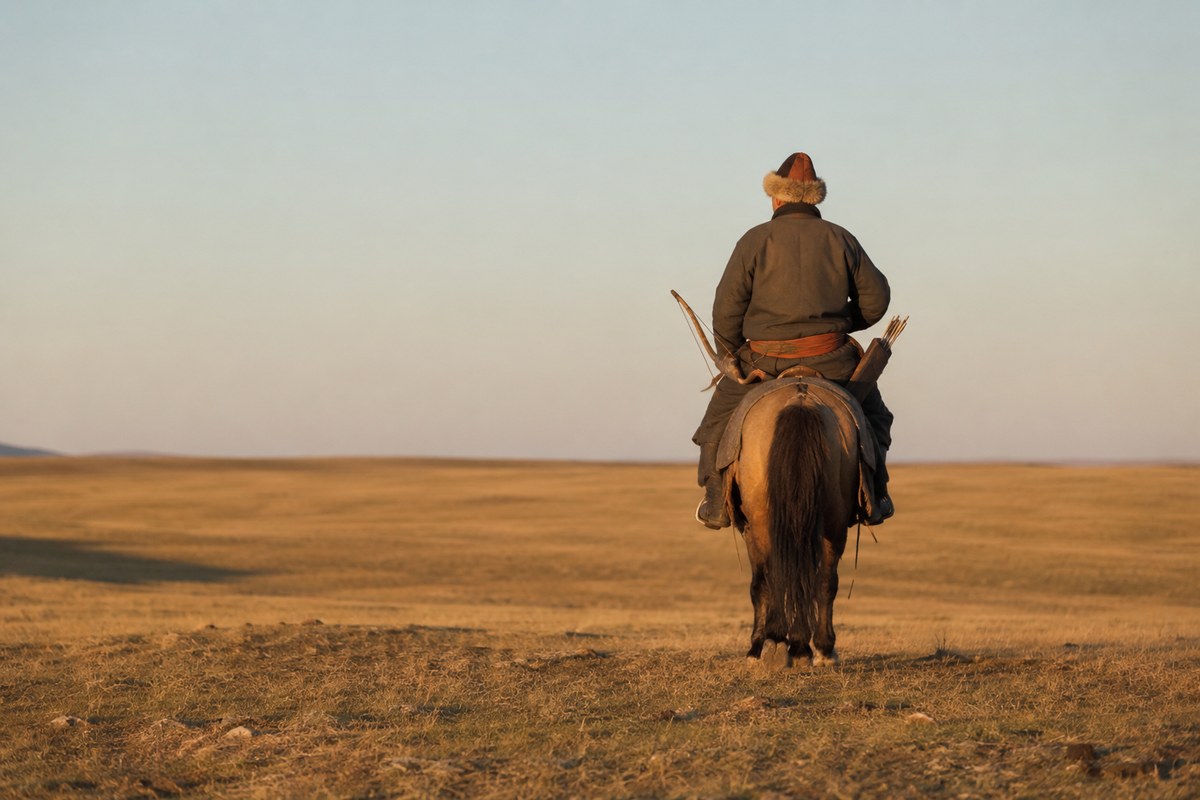
In 2003 a team from the Sanger Institute reported that about eight per cent of men across a huge swathe of Asia, roughly sixteen million alive at the time, carried nearly the same Y chromosome, and suggested that the man they descended from was Genghis Khan. It became one of the most repeated facts in popular genetics. Almost every load-bearing part of it has since been withdrawn by the field that produced it. This article sets out what the Y chromosome evidence now says, and then asks the question the Y chromosome cannot answer: how much of the Mongol Empire is actually visible in the genomes of the people it conquered.
Sixteen million men
The original observation was real and it was striking. Tatiana Zerjal, Chris Tyler-Smith and colleagues typed Y chromosomes across Asia and found a cluster of haplotypes so similar to one another, and so widely distributed, that it could only have expanded very recently and very fast. On a network diagram it looked like a star: one central haplotype with dozens of one-step neighbours radiating out from it. They called it the star cluster. Their molecular clock put the founder at roughly a thousand years before the present, and the geography of the cluster ran from Manchuria to the Caspian, tracing the shape of the thirteenth century Mongol Empire with uncomfortable neatness.
Two further details sealed the interpretation. The cluster reached its highest frequency in the Hazara of Afghanistan, a population with an oral tradition of descent from Mongol soldiers. And history offered an obvious candidate for a man whose male line could have expanded a thousandfold in eight centuries. Genghis Khan's sons ruled from Korea to Hungary; the Yuan, Ilkhanid, Chagatai and Jochid dynasties were all his patriline; Rashid al-Din records his grandson Kublai with dozens of sons. The paper was careful to call the identification a hypothesis. The world did not read it that way.
What the star cluster actually is
The reconstruction that has replaced it came from Lan-Hai Wei and colleagues in 2018, and it did what the 2003 study could not: it sequenced whole Y chromosomes rather than counting a handful of short tandem repeats. Six or seventeen microsatellite markers describe a haplotype coarsely enough that unrelated lineages can look identical, which is exactly the failure mode that also undid the Cohen Modal Haplotype in our article on the Lemba. Wei's team analysed thirty-four whole sequences of the cluster and its nearest relatives, redefined it as C2b1a3a1-F3796, and screened more than eighteen thousand men from close to three hundred populations against the resulting tree.
Two findings destroyed the original reading. First, the age. The most recent common ancestor of the cluster dates to about 2,576 years before the present, with a confidence interval running from roughly 1,975 to 3,178 years. Genghis Khan was born around 1162, some 860 years ago. The founder of the star cluster lived closer to the time of the Achaemenid Persians than to the time of the Mongol conquests. Whoever he was, he was not Genghis Khan, and he was not any of Genghis Khan's recorded ancestors either, since the Secret History of the Mongols traces the Borjigin line back only about twenty generations.
Second, the distribution. When the cluster was resolved into its sub-lineages, the populations carrying it at high frequency traced back either to an ancient Niru'un Mongol clan or, more often, to ordinary Mongol tribes rather than to the imperial house. Wei's conclusion was blunt and has not been overturned: a direct link between haplogroup C-M217 and Genghis Khan has yet to be discovered. What the cluster records is not one man's reproductive success but the dispersal of an entire people. Ordinary Mongol warriors sharing a common paternal heritage rode west and south with the conquests and left descendants everywhere they stopped. That is a more interesting story than the one it replaced, and it is also much harder to fit on a magazine cover.
The graves that were supposed to settle it
If the living cannot tell us Genghis Khan's haplogroup, the dead might. Two attempts have been made and neither has produced the answer.
The first was at Tavan Tolgoi in eastern Mongolia, where five bodies in high status graves dated to between 1130 and 1250 were analysed in 2016. The maternal lineages were East Asian, mostly haplogroup D4, and the burial goods pointed to a family of the Mongol elite. The Y chromosomes, however, came out as R1b-M343, a West Eurasian lineage, not C at all. Read at face value that result does not support the star cluster hypothesis; read cautiously it says only that one elite family of the right period and place did not carry C. Whether they were Borjigin at all is not established.
The second attempt is much more recent, and it is the reason this article exists in its present form. In early 2026 Ayken Askapuli and colleagues published genomes from four individuals excavated from mausoleums on the Kenggir river in central Kazakhstan, structures locally attributed to Jochi, the eldest son of Genghis Khan, and to Jochi's daughter. The results were a lesson in how far local tradition and physical remains can diverge. Radiocarbon dating placed the man in the Jochi mausoleum well after 1300, three generations after Jochi's death in 1227; the woman in the Bolghan Ana mausoleum was not a first or second degree relative of him; and the individual from the Alisha Khan mausoleum turned out to date from the eighteenth century, more than two hundred years after the Golden Horde had ceased to exist. Two of the four, from different mausoleums, are related as ancestor and descendant across about five or six generations, and all of them carry high runs of homozygosity, the signature of repeated cousin marriage.
All three men carried the C3 star cluster haplogroup. That establishes something useful, namely that the Golden Horde elite of the fourteenth century did carry this lineage. It does not establish that Genghis Khan did, and the authors do not claim it does. It is entirely consistent with Wei's reading, in which the lineage belongs to the Mongol people rather than to one family within them.
Data and method
Everything below uses Global25 scaled coordinates, with population averages merged from Davidski's published files and the Moriopoulos 2026 collection. Ancestry proportions come from non-negative least squares with a sum-to-one constraint imposed by appending a heavily weighted row of ones, with the resulting weights normalised.
One panel is used for every row in every chart, so that the numbers are directly comparable: Anatolian Neolithic farmers, Iranian Neolithic farmers from Ganj Dareh, Yamnaya steppe pastoralists from Samara, Balkan hunter-gatherers from the Iron Gates, and one eastern pole. The condition number of that source matrix is 4.2, which is well behaved. The default eastern pole is the eighteen-individual Mongol period average from Mongolia, dated to the thirteenth and fourteenth centuries, and a later section tests seven alternatives.
A word about what that pole measures, because it is the point on which the whole argument turns. It is chosen for its distance from the four western sources, not for its name. What it reports is the quantity of East Eurasian ancestry in a target, and East Eurasian ancestry entered western Eurasia repeatedly over three thousand years: with the Scythians and the Xiongnu, with the Huns, the Avars, the Turks, the Bulgars, the Magyars, the Kipchaks, the Mongols, the Kalmyks and the Ottomans. Calling the weight it takes Mongol ancestry would be exactly the error this article is about. Where a section needs to distinguish Mongol from pre-Mongol, it does so with dated ancient samples rather than with labels.
Who is buried in the Golden Horde mausoleums
The Kenggir genomes are in the Global25 dataset, which means the Askapuli result can be checked directly rather than taken on trust. The check is a simple distance calculation.
All four individuals sit between 54 and 70 units from the modern Mongolian average, between 122 and 176 from modern Kazakhs, and between 314 and 366 from the Kipchak nomads who were living on this exact stretch of steppe a century before the Mongols arrived. They are not local people who adopted a new dynasty's manners. They are, genetically, Mongolians buried in Kazakhstan, which is what the conquest of the Kipchak steppe by Jochi's army in the 1220s would predict. On the five-source model they run from 83 to 92 per cent East Eurasian.
Two things follow from that. The first is that the Mongol elite of the Golden Horde really did remain a distinct population, marrying among themselves, for at least a century after the conquest, which the high runs of homozygosity in the Askapuli data independently confirm. The second is that this endogamy is precisely why they left so little behind. A ruling caste that marries only its own cousins does not dissolve into the population it rules, and a caste that does not dissolve does not transmit its ancestry outward. The eighteenth century man from the Alisha Khan mausoleum, at 92 per cent East Eurasian and 176 units from modern Kazakhs, shows the pattern still holding four hundred years later.
Where the empire left a mark, and where it did not
Run the same panel across the former empire and the geography of the result is not the geography of the conquest.
The gradient is a gradient of distance from Mongolia, not a map of the thirteenth century. Mongolic-speaking populations sit between 83 and 90 per cent. The Turkic speakers of the eastern steppe follow: Kyrgyz at 69, Kazakhs at 62. The Hazara, the one population in the world with a documented tradition of Mongol military descent, come out at 51 per cent, which is high enough to take the tradition seriously and consistent with the published qpAdm estimate of about 58 per cent Mongolian-related ancestry in that population. Then the figures fall away westward through the Uzbeks at 40, the Turkmens at 29 and the Volga Tatars at 20.
And then they collapse. Iran was ruled directly by the Ilkhanate for eighty years, and Persians from Khorasan return 6.2 per cent while Persians from Fars return 1.9 and Iranian Zoroastrians 0.76. Anatolia was a Mongol protectorate after Kose Dag in 1243, and Istanbul Turks return 7.7 per cent, which is a figure our Gagauz article traced to the Seljuk migration of the eleventh century rather than to anything later. Russia paid tribute for two and a half centuries and returns 2.0 per cent. Hungary, invaded in 1241 and famously devastated, returns 0.28. Poland, raided repeatedly, returns zero. Armenia and Georgia, both conquered and both ruled for generations, return zero.
Bulgaria returns 0.52 per cent, and readers of our Bulgar article will recognise that number as the ordinary Balkan background rather than anything attributable to the Mongol raids of 1242.
The pattern is the one Yunusbayev and colleagues found for the Turkic expansions and the one we have now met repeatedly on this site: political conquest and demographic replacement are different things, and the second is much rarer than the first. What varies across this chart is not how long a region was ruled by Mongols but how close it is to Mongolia and how much steppe nomad ancestry it had already absorbed before 1206.
Does the label on the eastern source matter?
This is the objection that has to be answered with numbers rather than reassurance, because the entire argument depends on it. If the eastern pole is genuinely reading Mongol ancestry, replacing it with a source that has nothing to do with the Mongols should degrade the result badly. Seven alternatives were tried while the four western sources were held constant.
Nothing happens. Substituting the Slab Grave culture of eastern Mongolia, dated to roughly 700 BC and separated from Genghis Khan by nineteen centuries, moves the Kazakh figure from 62.3 to 61.0 per cent and the Hungarian figure from 0.28 to 0.26. Substituting Nganasans, Arctic reindeer herders of the Taymyr peninsula who never went anywhere near the Mongol Empire, gives Kazakhs 54.3 and Hazaras 43.8. Substituting Han Chinese from Beijing gives 57.8 and 48.6. The ranking is identical under all eight sources, every time.
What the eastern fraction of the source controls is the scale of the numbers, not their order. A source that is itself only partly East Eurasian has to be admitted in larger quantities to explain the same amount of eastern ancestry, so all the figures rise together; a source further from the western poles pushes them all down together. At no point does the choice of label change which populations have eastern ancestry and which do not.
This is worth stating as plainly as possible, because it is the single most common way that hobbyist Global25 models produce confident nonsense. A model that returns four per cent when you feed it a source labelled Mongol will return roughly four per cent when you feed it a source labelled Xiongnu, Slab Grave, Nganasan or Han. The label is doing the persuading; the geometry is doing the work. Anybody who reports a Mongol percentage from a calculator is reporting East Eurasian ancestry with a thirteenth century name attached to it, and the name was supplied by the person running the model, not by the data.
The steppe was already eastern
If the labels cannot separate Mongol from pre-Mongol, dated ancient samples can. Kazakhstan has one of the best chronological series in Eurasia, running from the Bronze Age to the eighteenth century on the same stretch of grassland, and it answers the question directly.
The Andronovo pastoralists of the Late Bronze Age were essentially West Eurasian, at 5.3 per cent. By the time of the Tasmola and Saka horsemen around 700 to 400 BC the figure is already 43 per cent, and it climbs slowly but almost without interruption from there: 44 under the Pazyryk, 49 in the Xianbei and Hun period, 45 under the Turk and Uygur khaganates, 57 under the Karluks and Karakhanids. The last pre-Mongol group in the series, the Kipchak nomads of the twelfth century, return 58 per cent. Genghis Khan had not yet been born.
The Golden Horde elite of the fourteenth century come out at 71 per cent, and the early modern Kazakhs of the seventeenth and eighteenth centuries at 71. Modern Kazakhs return 62. So the Mongol conquest is visible in this series, and it would be wrong to pretend otherwise: something on the order of ten points was added to the eastern fraction of the Kazakh steppe between 1200 and 1600, and part of that is the Mongol influx and part of it is the Kalmyk and Oirat movements that followed. But it was added on top of a baseline of fifty-eight per cent that had accumulated over the previous eighteen hundred years. Roughly four fifths of the East Eurasian ancestry of a modern Kazakh was already on the Kazakh steppe before the Mongol Empire existed.
That is the number that ought to be quoted whenever someone reads a Central Asian result and attributes it to Genghis Khan. The Saka, the Xiongnu, the Huns, the Turks, the Karluks and the Kipchaks did most of the work. The Mongols arrived late to a process that had been running since the Iron Age.
Russia: the gradient runs backwards
Russia is the best test available, because the Mongol advance there is documented street by street. Ryazan was destroyed in December 1237, Vladimir in February 1238, Kiev in December 1240. The army turned back short of Novgorod, and it never went near the Northern Dvina. If the two per cent of East Eurasian ancestry in the Russian average is a Mongol legacy, it should be concentrated in the south and east and absent in the far north.
It is the exact opposite. The three highest values in the country belong to Leshukonsky, Pinezhsky and Krasnoborsky districts in Arkhangelsk province, at 13.0, 9.8 and 7.6 per cent, in a region the Mongols never entered and never taxed. Kostroma follows at 5.8. Meanwhile Belgorod, Voronezh, Kursk and Oryol, on the steppe frontier where the Golden Horde was a permanent physical presence for two hundred and fifty years, return between 0.4 and 1.1 per cent. Ryazan, burned to the ground in the opening campaign, returns 2.2. Smolensk returns zero.
The eastern ancestry of northern Russians is Uralic. It comes from the Finnic and Permic peoples of the taiga, absorbed by Slavic colonists moving north and east between the eleventh and sixteenth centuries, and it is the same signal that makes Finns and Komi look slightly eastern on a European PCA. It has nothing to do with the Mongols, and the only reason a model would ever call it Mongol is that the person running the model asked for a Mongol source.
This inversion is worth remembering as a general diagnostic. When a proposed historical explanation predicts a geographic gradient and the data produces the reverse gradient, the explanation is wrong, and no amount of refinement to the model will rescue it.
What would we have seen if it were there?
A null result is only worth something if the method could have produced a positive one, so the detection floor was measured rather than assumed. Synthetic Hungarian genomes were built by mixing the real Hungarian average with a known quantity of the Mongol period pole, and each was then pushed back through the same five-source model.
Recovery is linear and one to one on top of the 0.28 per cent baseline. Inject one per cent and the model reports 1.28; inject three and it reports 3.27; inject five and it reports 5.27. A genuine Mongol contribution to the Hungarian gene pool of even two per cent would therefore have been plainly visible. It is not there, and the same test on Russians and Poles gives the same answer with the same sensitivity.
To be concrete about what that means: two per cent of the Hungarian population in 1250 is roughly forty thousand people. The model would have caught it. Hungary lost a large fraction of its population in 1241 and 1242, but it lost them to killing, famine and flight, not to replacement, and the Mongol army withdrew across the Carpathians in the spring of 1242 and did not return.
The Avar control
The Carpathian Basin supplies its own control, and it is a devastating one. The Avars arrived in 567, six and a half centuries before the Mongols, from the same direction and into the same landscape. Their early elite, as sampled from cemeteries in Hungary, comes out at 96 per cent East Eurasian on this model, which is about as unmixed a steppe population as ancient DNA has ever recovered in Europe. They ruled the basin for nearly two hundred and fifty years, not two winters. Their descendants intermarried locally for generations: the Avar period cemeteries also contain individuals at 37, 35, 17 and 6 per cent, a full admixture cline.
Modern Hungarians return 0.28 per cent. If a resident steppe elite of that size, that duration and that genetic distinctiveness left essentially nothing measurable in the modern population of the country it governed, the arithmetic for a Mongol army that spent fourteen months in Hungary and then left is not difficult.
One Y chromosome is not one ancestor
There remains a question of principle underneath all of this, and it is the reason the Genghis Khan story could seem plausible in the first place. Suppose, for the sake of argument, that the star cluster really were Genghis Khan's patriline, and that it really is carried by eight per cent of men across a large region of Asia. What would that imply about those men's genomes?
Much less than most people assume, and for two separate reasons.
The first is a ceiling argument. Consider a conquest in which a fraction of the men in a population are replaced by incomers, and no incoming women arrive at all. The Y chromosome frequency of the incomers is fixed at that fraction for ever, because Y chromosomes pass only from father to son and no outside men enter afterwards. The autosomal contribution, however, is halved immediately, because half of every child's genome comes from a local mother. Under random mating thereafter it stays halved. A Y lineage at eight per cent of men therefore implies at most four per cent of the autosomal genome, and that is a ceiling reached only if the founding generation contributed no women whatsoever and the population has been closed ever since. A Y lineage at half a per cent of the world's men, the figure usually quoted for the star cluster, implies at most a quarter of a per cent.
The second reason is stronger and less intuitive. Y chromosome frequencies are not a record of demographic contribution at all. They are a record of a single non-recombining locus subject to enormous drift, and a lineage attached to a hereditary military or political privilege can multiply far beyond the demographic weight of the people who introduced it. That is exactly what Wei's revised chronology implies: a lineage already two and a half thousand years old, carried by a set of Mongol clans, riding a wave of conquest that gave its carriers reproductive advantages for several centuries. Nothing about that requires one man, and nothing about it moves the autosomal needle much.
Then there is the question of what descent from a specific named individual actually delivers.
Genghis Khan died in 1227, about twenty-six generations ago at thirty years per generation. The expected number of autosomal segments a person inherits from any one specific ancestor at that remove is about three in a hundred thousand. Put the other way round, if you are one of his genealogical descendants through an ordinary line, the probability that you carry any of his autosomal DNA at all is roughly one in nineteen thousand. The collapse is fast: at ten generations, about the reign of Peter the Great, half of your genealogical ancestors have already contributed nothing to your genome. By fifteen generations it is thirty-one in thirty-two.
The Y chromosome is the exception, which is exactly why it gets used, and exactly why it misleads. It passes intact down one line among the millions of lines in a pedigree. A man who carries the star cluster carries a marker that says something real about one of his roughly sixty-seven million ancestral slots at generation twenty-six. It says essentially nothing about the other sixty-seven million minus one.
So even the strongest possible version of the 2003 claim, the version the field has now rejected, would have amounted to this: sixteen million men carrying one chromosome from one lineage, and a genome otherwise indistinguishable from their neighbours'. The autosomal data in this article is not contradicting the Y chromosome data. The two were never measuring the same thing.
Are today's Mongolians the Mongols of the empire?
The last question is the one that gives this article its title, and it has a more surprising answer than the rest.
Modern Mongolic-speaking populations really are the closest living relatives of the Mongol Empire population, and by a wide margin. Buryats sit 55 units from the imperial period average, Khalkha Mongols 79, Kalmyks 100. The nearest non-Mongolic population is the Tuvinians at 95, then Yakuts at 143, Koreans at 184, northern Han at 197. Kazakhs are at 214, Uzbeks at 334, Istanbul Turks at 529 and Russians at 565. If you want to know what the armies that crossed the Volga in 1236 looked like genetically, the answer is that they looked like the people of Ulaanbaatar and Ulan-Ude today, and like nobody else.
But the relationship is not one of simple identity, and the interesting part is in the residual. The Mongolian gene pool of the imperial period had been remarkably stable for a very long time before it: the thirteenth century average sits only 35 units from the Slab Grave population of the eighth century BC and 36 units from the late Xiongnu of the first century BC. Two thousand years of Xiongnu, Xianbei, Rouran, Turk, Uygur and Khitan rule barely moved it. What did move it was the Mongol Empire itself, and the direction of movement was inward rather than outward.
The imperial period cemeteries of Mongolia are the most heterogeneous in that country's entire ancient record. Alongside the Turanian core, which is what modern Mongolians descend from and which sits 42 units from the Khalkha average and 21 from the Kalmyk one, there are individuals with substantial Han Chinese ancestry, individuals with Tibetan ancestry, individuals with northern Chinese and Yellow Sea profiles, and one with West Siberian hunter-gatherer ancestry. This is the demography of an empire seen from its capital: administrators, monks, craftsmen, hostages and wives drawn from everywhere the armies reached, buried in Mongolia.
Most of that diversity is gone. Modern Mongolians descend overwhelmingly from the Turanian core and not from the cosmopolitan periphery, which is what one would expect after the collapse of the Yuan in 1368 and the retreat of the Mongols out of China. The empire moved a great many people into Mongolia and rather few Mongolians permanently out of it, and both halves of that sentence are visible in the coordinates.
Limits
Five caveats matter. First, the eastern pole measures East Eurasian ancestry and not Mongol ancestry, which is the central methodological point of this article and applies to its positive findings as much as to its negative ones: the 51 per cent returned for the Hazara is East Eurasian ancestry consistent with a Mongol origin, not a demonstration of it. Second, several of the ancient groups used here are very small, and the Golden Horde mausoleum series rests on four individuals from four separate structures. Third, the Kazakh chronological series pools sites across a large territory and the earlier points in particular are regionally heterogeneous, so the slope should be read as a trend rather than as a set of point estimates. Fourth, absolute percentages move by several points depending on which eastern pole is chosen, as the robustness section shows; they are a calibration scale, not qpAdm estimates. Fifth, this analysis says nothing about Mongol ancestry in China, Korea or Tibet, where the relevant sources are not separable from the local background by any method available in coordinate space.
One further limit deserves its own sentence, because it cuts against the conclusion. Absence of a broad demographic signal is not absence of individual descent. Hundreds of thousands of people in Iran, Anatolia and eastern Europe almost certainly do descend from Mongol soldiers, along a handful of lines each, and carry nothing measurable from them. Everything in this article is about population averages, and population averages are silent about individuals.
Conclusion
The star cluster is real. It is one of the most successful Y chromosome lineages in human history, it is carried by millions of men, and its expansion is genuinely bound up with the Mongol conquests. What it is not is Genghis Khan's patriline. Its founder lived around two and a half thousand years ago, some seventeen centuries before the man it was named after, and the lineage belongs to Mongol peoples in general rather than to one family. Nothing recovered from any grave has yet established what Genghis Khan's haplogroup was, and the two attempts so far have produced a West Eurasian R1b result at Tavan Tolgoi and a C3 result in Golden Horde mausoleums whose occupants turn out not to be the people local tradition names.
Below the Y chromosome, the picture is simpler than the legend and considerably less flattering to it. The Mongol Empire moved armies, not populations. Its demographic footprint is large in Mongolia, substantial among the Hazara and on the Kazakh steppe where it added perhaps ten points to an eastern fraction that was already at fifty-eight, and effectively nil in Russia, Hungary, Poland, Armenia, Georgia, Anatolia and most of Iran. The eastern ancestry that calculators cheerfully label Mongol in a Kazakh or an Uzbek was mostly deposited by the Saka, the Xiongnu, the Huns, the Turks and the Kipchaks over the eighteen centuries before Genghis Khan was born. The eastern ancestry they label Mongol in a northern Russian is Uralic, and comes from a direction the Mongols never rode.
The empire that conquered more of the world than any other in a single lifetime left a name, a script, a legal code, a trade network, a chronicle tradition and a set of borders. What it did not leave, almost anywhere outside the steppe, was people.
Reproduce this yourself
The blocks below are the exact scaled Global25 coordinates used in every model above. Paste them into the target and source panels of Vahaduo and the numbers should reproduce. The panel is Turkey_N, Iran_GanjDareh_N, Russia_Samara_EBA_Yamnaya, Serbia_IronGates_Mesolithic and one eastern pole at a time.
Mongol_Khalkha_Mongolia_(n=26),0.040276,-0.368754,0.061195,-0.032499,-0.040576,-0.024178,0.015565,0.015594,-0.000503,0.009392,-0.034714,-0.003971,0.000132,0.001286,0.000292,-0.000612,-0.002472,0.000492,0.003747,0.010611,-0.010933,-0.005850,-0.013097,-0.000765,0.001663
Buryat_(n=27),0.043590,-0.367358,0.077910,-0.026558,-0.067443,-0.039231,0.018235,0.025606,0.007014,0.012804,-0.022307,0.001543,-0.002246,0.005474,0.004222,0.003840,0.000285,-0.001999,0.005936,0.016651,-0.021259,-0.010236,-0.024207,-0.002164,-0.000461
Kazakh_(n=23),0.066562,-0.222268,0.046845,-0.008918,-0.036863,-0.014599,0.011464,0.012100,-0.004268,0.000024,-0.023003,-0.002965,0.000970,-0.000060,0.001664,-0.001447,-0.006202,0.000551,0.001366,0.005084,-0.013791,-0.004543,-0.009185,0.000126,-0.000417
Hazara_Pakistan_(n=24),0.063693,-0.174206,-0.001084,-0.000283,-0.039315,0.002719,0.009655,0.008461,-0.011862,-0.003865,-0.025881,-0.001830,0.002180,-0.002191,0.003653,0.005917,-0.002298,0.001145,0.002085,-0.000667,-0.007175,-0.002890,-0.003795,-0.001953,0.000743
Uzbek_(n=18),0.074870,-0.113119,0.002409,0.008685,-0.033784,0.005826,0.009818,0.006064,-0.014885,-0.008818,-0.016645,-0.002198,0.002602,-0.004442,0.004916,0.004766,-0.002130,-0.001386,0.000908,0.000139,-0.009102,-0.000783,-0.005060,0.001198,0.002322
Turkish_Istanbul_(Anatolian_Turk_Profile)_(n=13),0.100982,0.086157,-0.024668,-0.035314,-0.019320,-0.008666,0.005696,-0.001442,-0.020019,-0.000727,-0.000406,0.003605,-0.006421,0.000391,-0.006829,0.000108,0.008351,0.000313,0.003189,0.000770,-0.001638,-0.000060,-0.001064,0.000117,0.000172
Russian_(n=4),0.132035,0.109677,0.077687,0.067426,0.033083,0.023984,0.009107,0.010500,-0.003119,-0.026151,-0.001096,-0.008580,0.015201,0.021572,-0.012859,-0.000862,0.003651,0.000602,0.001069,0.001032,-0.000655,-0.004730,0.004714,-0.000753,0.000300
Hungarian_(n=23),0.126789,0.128398,0.054207,0.036696,0.034294,0.013605,0.007592,0.008107,0.001209,-0.004810,-0.001829,-0.002118,0.003820,0.008395,-0.004815,0.001199,0.002727,-0.000479,0.002886,-0.000299,-0.003277,0.000699,0.005546,0.002164,0.001229
Persian_Khorasan_(n=12),0.086316,0.072272,-0.064456,-0.005437,-0.048419,0.007391,0.003936,-0.001731,-0.025395,-0.016796,-0.002206,-0.000387,0.001623,-0.006319,0.007623,0.015546,-0.000641,0.001668,0.002682,-0.009036,-0.001861,-0.003473,-0.001972,-0.002681,0.006576
Turkey_N,0.117902,0.180087,0.003426,-0.101059,0.051240,-0.047969,-0.003799,-0.006846,0.036167,0.080678,0.008261,0.011309,-0.024164,0.000579,-0.042712,-0.010370,0.022556,0.001388,0.013649,-0.010448,-0.014261,0.005693,-0.004904,-0.003750,-0.004436
Iran_GanjDareh_N,0.043025,0.067431,-0.153488,0.005556,-0.123962,0.024375,0.015464,0.000277,-0.081605,-0.054270,-0.003248,-0.001619,0.005382,-0.007845,0.031949,0.056775,-0.005815,0.007576,0.014405,-0.032741,0.007661,-0.030048,-0.010920,-0.038777,0.022944
Russia_Samara_EBA_Yamnaya,0.125838,0.089254,0.042908,0.115456,-0.027868,0.044685,0.004491,-0.002949,-0.054858,-0.072996,0.001858,0.000350,-0.001652,-0.023610,0.037263,0.015734,0.000000,-0.001478,-0.001704,0.012506,-0.003120,0.001374,0.011229,0.018436,-0.004524
Serbia_IronGates_Mesolithic,0.130347,0.116891,0.182799,0.179678,0.131176,0.054759,0.014101,0.033190,0.066372,-0.009784,-0.009827,-0.017447,0.026051,-0.000218,0.033977,0.048990,0.005472,0.005439,-0.006202,0.047782,0.075006,0.010574,-0.033604,-0.122173,0.010914
Mongolia_Late_Medieval_Mongol_Period_(n=18),0.036676,-0.415069,0.091221,-0.035781,-0.077604,-0.048821,0.020381,0.026076,0.010294,0.018902,-0.029672,0.001116,-0.004840,0.008387,0.002993,0.001090,-0.001289,-0.001267,0.008170,0.022330,-0.024076,-0.017806,-0.029340,-0.004170,-0.002721
Mongolia_IA_Xiongnu_Late_(n=16),0.035001,-0.401959,0.077145,-0.028121,-0.064762,-0.040178,0.014659,0.019975,0.010776,0.012711,-0.032874,0.000449,-0.000660,-0.000903,-0.001900,0.000025,-0.000163,-0.002027,0.003457,0.013991,-0.018210,-0.005873,-0.020528,-0.004872,0.001130
Mongolia_EIA_Slab_Grave_(n=19),0.029295,-0.432883,0.083066,-0.028764,-0.073228,-0.045900,0.013693,0.023197,0.012185,0.017149,-0.033469,-0.001767,-0.000399,-0.002405,-0.001693,-0.002917,-0.000981,-0.002360,0.001833,0.017581,-0.026204,-0.000638,-0.020712,-0.004687,0.003479
Mongolia_Early_Medieval_Turkic_Period_(n=2),0.033009,-0.424999,0.078630,-0.042152,-0.063242,-0.045180,0.016451,0.019499,0.006340,0.013394,-0.039704,-0.001424,-0.005278,0.005711,0.002035,-0.000862,0.004433,0.001520,0.005594,0.026263,-0.022585,-0.022443,-0.031982,0.001566,-0.005389
Mongolia_Early_Medieval_Rouran_(n=1),0.043253,-0.459019,0.064865,-0.036822,-0.077245,-0.058288,0.026086,0.004846,-0.014521,0.007654,-0.047742,0.000300,-0.005798,0.020919,-0.000814,0.005171,0.013821,-0.003674,0.019232,0.002751,-0.035562,-0.035117,-0.033154,-0.007350,-0.014609
Kazakhstan_High_Medieval_Kipchak_Nurataldy_(n=1),0.067156,-0.041637,-0.012822,-0.005814,-0.018773,0.002789,0.001645,0.009000,-0.004500,-0.011481,-0.010880,0.000300,0.004311,0.000963,0.000271,0.016706,0.012256,-0.007601,0.006159,0.000625,-0.000749,0.002844,0.001849,0.014580,-0.006706
Kazakhstan_High_Medieval_Kipchak_Lisakovsk_(n=1),0.073985,-0.212246,0.067505,0.015181,-0.060319,-0.012829,0.009635,0.018922,-0.003068,-0.004191,-0.015102,0.000150,0.003122,-0.011147,0.001221,0.004508,0.002738,0.002914,0.005531,0.009505,-0.019590,-0.001360,-0.007272,-0.011929,0.001796
Kazakhstan_Late_Medieval_Golden_Horde_Mausoleum_of_Jochi_Khan_(n=1),0.052359,-0.338171,0.085606,-0.012274,-0.070782,-0.044623,0.008930,0.017999,0.005318,0.013485,-0.023222,0.000300,-0.004460,0.006193,0.011536,-0.007292,-0.018384,-0.003041,0.006788,0.020760,-0.031070,-0.011500,-0.019720,0.000361,-0.008742
Kazakhstan_Late_Medieval_Golden_Horde_Mausoleum_of_Bolghan_Ana_(n=1),0.045529,-0.332078,0.073916,-0.015827,-0.061858,-0.034025,0.011045,0.020076,0.004500,0.008565,-0.020948,-0.000150,0.003717,0.002477,0.000679,-0.002121,-0.010822,-0.001774,0.002765,0.018759,-0.013851,0.002844,-0.019473,-0.001807,-0.002634
Kazakhstan_Late_Medieval_Golden_Horde_Mausoleum_of_Ayakkamir_(n=1),0.047806,-0.355435,0.082212,-0.024871,-0.072629,-0.046296,0.017156,0.032768,0.006954,0.013485,-0.018675,0.001948,0.000446,0.014038,-0.000136,-0.008486,-0.008866,-0.000507,0.005405,0.010005,-0.029573,-0.017435,-0.035865,-0.004579,-0.007424
Kazakhstan_Early_Modern_Mausoleum_of_Alasha_Khan_(n=1),0.036423,-0.376761,0.085984,-0.019057,-0.078168,-0.050758,0.019271,0.026768,0.008590,0.007836,-0.024521,0.001049,-0.009812,-0.000550,0.002443,0.002387,0.000652,-0.005448,0.009302,0.018134,-0.022835,-0.009769,-0.025636,-0.004338,-0.004191
Hungary_Early_Medieval_Avar_Period_Early_(Avar_Profile)_(n=27),0.040850,-0.398915,0.092814,-0.022395,-0.084004,-0.049167,0.017217,0.026016,0.010802,0.012682,-0.015535,0.000938,-0.001988,0.003701,0.005198,0.000196,0.001024,-0.002496,0.003180,0.014933,-0.024018,-0.004461,-0.021221,-0.000540,0.000328
Global25 coordinates by Davidski (Eurogenes). Population averages from the Moriopoulos Collection 2026. Models can be reproduced in Vahaduo using the blocks above.
References
- 2003 Zerjal T., Xue Y., Bertorelle G., Wells R.S., Bao W., Zhu S., et al. The Genetic Legacy of the Mongols. American Journal of Human Genetics 72(3): 717-721.
- 2018 Wei L.-H., Yan S., Lu Y., Wen S.-Q., Huang Y.-Z., Wang L.-X., et al. Whole-sequence analysis indicates that the Y chromosome C2*-Star Cluster traces back to ordinary Mongols, rather than Genghis Khan. European Journal of Human Genetics 26(2): 230-237.
- 2026 Askapuli A., Kanzawa-Kiriyama H., Kakuda T., Kassenali A., Yessen S., Schamiloglu U., Schrodi S.J., Hawks J., Saitou N. Genomes of the Golden Horde elites and their implications for the rulers of the Mongol Empire. PNAS 123(8): e2531003123.
- 2020 Jeong C., Wang K., Wilkin S., Taylor W.T.T., Miller B.K., et al. A Dynamic 6,000-Year Genetic History of Eurasia's Eastern Steppe. Cell 183(4): 890-904.
- 2016 Lkhagvasuren G., Shin H., Lee S.E., Tumen D., Kim J.H., Kim K.Y., et al. Molecular Genealogy of a Mongol Queen's Family and Her Possible Kinship with Genghis Khan. PLoS ONE 11(9): e0161622.
- 2022 Panyushkina I.P., Usmanova E.R., Uskenbay K.Z., Kozha M.B., Dzhumabekov D.A., Akhatov G.A., Jull A.J.T. Chronology of the Golden Horde in Kazakhstan: 14C Dating of Jochi Khan Mausoleum. Radiocarbon 64(2): 323-331.
- 2012 Abilev S., Malyarchuk B., Derenko M., Wozniak M., Grzybowski T., Zakharov I. The Y-chromosome C3* star-cluster attributed to Genghis Khan's descendants is present at high frequency in the Kerey clan from Kazakhstan. Human Biology 84(1): 79-89.
- 2019 He G., Wang Z., Wang M., Hou Y., et al. A comprehensive exploration of the genetic legacy and forensic features of Afghanistan and Pakistan Mongolian-descent Hazara. Forensic Science International: Genetics 42: e1-e12.
- 2015 Yunusbayev B., Metspalu M., Metspalu E., et al. The Genetic Legacy of the Expansion of Turkic-Speaking Nomads across Eurasia. PLoS Genetics 11(4): e1005068.
- 2022 Gnecchi-Ruscone G.A., Szecsenyi-Nagy A., Koncz I., et al. Ancient genomes reveal origin and rapid trans-Eurasian migration of 7th century Avar elites. Cell 185(8): 1402-1413.
- 2016 Pankratov V., Litvinov S., Kassian A., et al. East Eurasian ancestry in the middle of Europe: genetic footprints of Steppe nomads in the genomes of Belarusian Lipka Tatars. Scientific Reports 6: 30197.
- Method Global25 coordinates by Davidski (Eurogenes). Population averages from the Moriopoulos Collection 2026. Modelling with Vahaduo and scipy NNLS.