
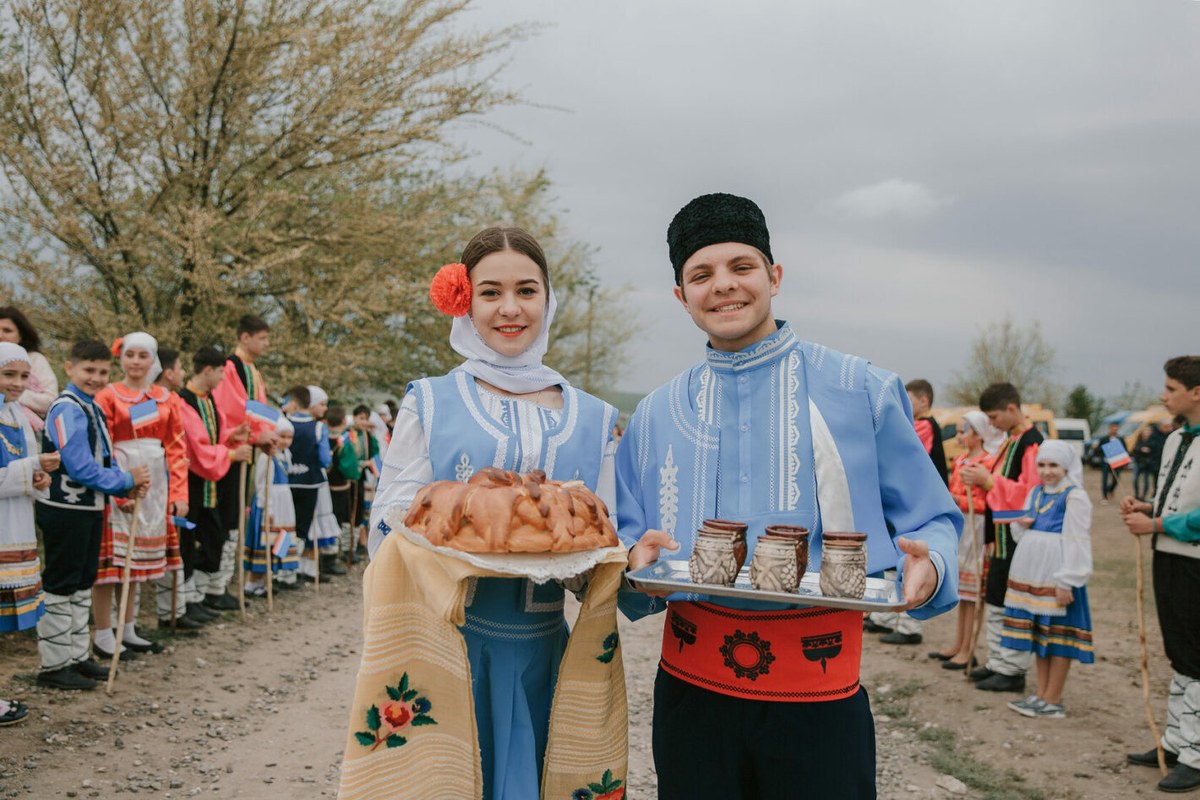
The Gagauz speak a language that a visitor from Istanbul can follow almost without effort. They are also Orthodox Christians who have lived in the eastern Balkans for at least seven centuries, and whose genomes are, to a first approximation, Bulgarian. This article puts that paradox on a numerical footing using Global25 coordinates, and asks the only question that really matters: how much medieval Turkic ancestry can we actually measure in them?
A Turkic island in an Orthodox sea
Roughly 150,000 Gagauz live today in the autonomous region of Gagauzia in southern Moldova, with smaller communities in the Budjak district of Ukraine, in northeastern Bulgaria, in Romanian Dobruja and in Greece. Their language belongs to the Oghuz branch of Turkic, the same branch as Turkish, Azerbaijani and Turkmen. Mutual intelligibility with standard Turkish is high enough that Gagauz students have long been able to study in Turkey with minimal linguistic retooling.
What makes them unusual is not the language but the combination. Almost every Turkic-speaking population that entered Europe either stayed Muslim or eventually gave up the language. The Gagauz did the opposite. They are Eastern Orthodox, they have been Orthodox since before the Ottoman conquest of the Balkans, and they kept the Turkic language anyway. That single fact is the reason their origin has been argued over for a century and a half.
Three competing origin stories
The historiography splits into three families of hypothesis, and each of them makes a different genetic prediction.
The Anatolian or Seljuk hypothesis, associated with Tadeusz Kowalski and Paul Wittek, derives the Gagauz from Oghuz Turks who followed the Seljuk sultan Izzeddin Kaykaus II into Byzantine territory. After the Mongol pressure on the Sultanate of Rum, Kaykaus II fled to Byzantium around 1261, and Michael VIII Palaiologos settled his followers in Dobruja as a frontier garrison. A fifteenth century narrative places the dervish Sari Saltuk at the head of these Turkomans. On this reading, part of the group later returned to Anatolia and part stayed, converted to Christianity, and became the Gagauz. The ethnonym itself has been read as an echo of the name Kaykaus. The genetic prediction is clear: the Gagauz should look like thirteenth century Anatolian Turkomans, which means a substantial Anatolian component plus the eastern fraction that Anatolian Turks carry.
The steppe hypothesis derives them instead from the Turkic nomads who crossed the lower Danube from the north Pontic steppe: Pechenegs, Uzes (the Torks of the Rus chronicles) and Cumans-Kipchaks. Supporting evidence is mostly onomastic and linguistic, including the Kipchak layer that sits underneath the Oghuz core of the Gagauz language and family names such as Qipcaqli. The prediction here is a detectable Northeast Asian fraction of the kind Cumans and Kipchaks carried.
The local hypothesis, argued from the nineteenth century by Georgi Rakovski and still defended by some Bulgarian scholars, treats the Gagauz as Turkified Bulgarians or Turkified Bulgars. It leans on the Ottoman era self-designation Hasli Bulgar, meaning true Bulgarians, and on the fact that Gagauz settlers in Uzbekistan in the 1930s still called themselves Eski Bulgar, old Bulgarians. The prediction is that the Gagauz should be genetically indistinguishable from their Balkan neighbours.
These are not mutually exclusive. A small Turkic-speaking military elite could have arrived from Anatolia or the steppe, imposed its language, and then been demographically swallowed. The question is how small.
What the uniparental markers already told us
Two studies framed the debate before autosomal data was available. Nasidze and colleagues in 2007 concluded from mitochondrial and Y-chromosome data that the Gagauz cluster with southeastern European populations rather than with Anatolian Turks, and titled their paper accordingly: a linguistic enclave that is not a genetic isolate. Varzari and colleagues in 2009 typed 89 Y-chromosomes from two Gagauz populations in Moldova and found a haplogroup profile that is thoroughly Balkan. The most common lineages were I-P37 at 20.2 percent, R-M17 at 19.1 percent, G-M201 at 13.5 percent, R-M269 at 12.4 percent and E-M78 at 11.1 percent.
Not one of those is an eastern marker. There is no C2, no N, no Q at meaningful frequency. I-P37 is the flagship South Slavic and Balkan lineage; E-M78 is the Balkan and southern Italian branch of E-V13 territory; R-M17 is the standard eastern European R1a. The authors did note some microsatellite haplotype sharing with Turkish lineages, which they read as weak support for a Seljuk contribution, and they noted that their two Gagauz samples were not homogeneous with each other.
The Lipka Tatar study of 2016 made the contrast explicit. Belarusian Lipka Tatars, another medieval Turkic-derived enclave in Europe, retain roughly 30 percent East Eurasian ancestry despite having lost their Turkic language entirely. The Gagauz, who kept their language, were described as virtually lacking such a signal. That is the puzzle in one sentence: the group that lost the language kept the genes, and the group that kept the language lost the genes.
Data and method
The Gagauz average used here is built from nine individuals in the Global25 scaled dataset, cross-checked against the Moriopoulos 2026 collection, which gives an identical average. All modelling is non-negative least squares in the full 25-dimensional scaled space, with a sum-to-one constraint imposed by appending a heavily weighted row of ones and renormalising the solution. Ancient and modern coordinates are all on the scaled system, so they are directly comparable.
The main model is deliberately the same architecture we used in our article on the Bulgars, so that the two sets of numbers can be read against each other: a local Iron Age source for the Balkan substrate, an Early Medieval Balto-Slavic source, a Byzantine Anatolian source, and one eastern pole. Every population in the comparison is run through that identical panel, so the rows are directly comparable.
A word on that eastern pole, because it is the part readers most often misread. It is called a Northeast Asian pole here and not a Turkic source, and the distinction is not cosmetic. In an admixture model the eastern source is chosen for maximum distance from the western sources, because that is what isolates the signal. It is not chosen for its ethnonym, and no ethnic claim attaches to it. The Rouran, who serve as the default pole below, were not a Turkic people at all; they were overthrown by the Gokturks in 552 and their language was probably Mongolic. They are used because they are far from everything European, and the section on eastern-source robustness shows that swapping them for genuine Turkic samples changes nothing.
Two numbers govern how far any of this can be trusted. The first is the condition number of the source matrix, which tells us how badly the model would amplify noise. The second is the detection floor, which is measured directly below rather than assumed.
Where the Gagauz sit
The simplest test is also the most eloquent. Euclidean distance from the Gagauz average to a panel of Balkan, Anatolian and steppe populations produces a ranking with no ambiguity at all.
Distances here are scaled Global25 units multiplied by one thousand, the same convention we used in the Vlach article, so the two charts can be read against each other. The nearest population on earth to the Gagauz is the Bulgarian average, at 12. Then come Bulgarian regional samples from Varna and Burgas, both in the historical Gagauz zone, then Macedonians at 18, the pooled Daco-Romanian at 24 and Greeks of Central Macedonia at 25. Anatolian Turks from Istanbul sit at 90, seven and a half times further away. Crimean Tatars are at 200, Nogais at 310 and Kazakhs at 368.
The Romanian point used here is the same pooled average of two hundred individuals across the eight historic Romanian provinces that anchored our article on the Vlachs, where the Gagauz already appeared on the distance chart at 24. That figure is reproduced exactly.
One detail in this table deserves attention. The Gagauz are closer to Bulgarians than they are to Moldovans, at 44, despite having lived in Moldova for two centuries. Their move from Ottoman Bulgaria to Russian Bessarabia between 1812 and 1846 was a transfer of population, not a merger with one. Endogamy has held remarkably well. The Gagauz genome is a snapshot of northeastern Bulgaria carried north and preserved.
Measuring the eastern fraction
Distance tells us where a population sits. It does not tell us whether a small minority ancestry is present. That is what the four-source model is for.
The calibration works. Lipka Tatars come out at 25.8 percent, in the range of the published estimate of roughly 30 percent. Anatolian Turks from Istanbul come out at 9.6 percent. Nogais reach 49.7 percent and steppe Crimean Tatars 31.9 percent. The model is not blind to eastern ancestry.
The Gagauz return 0.91 percent. The number that matters is not that figure on its own but the company it keeps: Bulgarians on the identical model return 0.84 percent and Romanians 1.17 percent. Readers of our Bulgar article will recognise those two values, because they are the same ones that piece reported. The Gagauz do not sit above the Balkan background. They sit inside it, among the neighbouring populations that have no Turkic-speaking history whatsoever.
Two Romanian points appear on that chart deliberately. The Moriopoulos average of eighteen individuals returns 1.17 percent, which is the value our Bulgar article published; the pooled average of two hundred individuals across the eight Romanian provinces, used in our Vlach article, returns 0.78 percent. Both are legitimate and the difference between them is a sampling artefact rather than a finding. The Gagauz figure of 0.91 falls between the two. That spread is the honest measure of how much precision these percentages carry, and it is wider than the gap between the Gagauz and anyone else on the Balkan end of the chart.
Does the choice of eastern source matter?
This is the obvious objection and it deserves numbers rather than reassurance. The whole comparison was re-run against eight different eastern poles while the three western sources were held constant: the Rouran, the Turkic Period samples from Mongolia that represent the actual First Turkic Khaganate, late medieval Mongolians from Khentii, modern Mongolians, Buryats, Nganasans from Siberia, a Golden Horde group from Kazakhstan, and a medieval Kipchak individual.
The Gagauz value moves between 0.82 and 1.73 percent. The Bulgarian value moves between 0.75 and 1.59 percent. They rise and fall together under every single pole, and the gap between them never exceeds fifteen hundredths of a point. The Kipchak source inflates both figures because that individual is himself partly West Eurasian, so a larger weight is needed to deliver the same amount of eastern ancestry; that is a scaling property of the source, not a discovery about either population.
Substituting the genuine Turkic samples for the Rouran moves the Gagauz from 0.91 to 0.89 percent. Two hundredths of a point. Whatever else is uncertain here, the answer does not depend on which eastern source is chosen.
What would we have seen if it were there?
A null result is only worth something if the method could have produced a positive one. So the detection floor was measured rather than guessed. Synthetic genomes were built by mixing the real Gagauz average with a known quantity of the Northeast Asian pole, and each synthetic genome was then pushed back through the same four-source model to see how much of the injected ancestry came back out.
Recovery is linear and very close to one to one on top of the 0.91 percent baseline. Inject three percent and the model reports 3.88; inject five and it reports 5.87. A genuine Turkic contribution of even three percent would therefore have been plainly visible, roughly four times the observed value and well outside the range produced by any choice of eastern pole. It is not there.
The trap: is the Anatolian signal really Anatolian?
There is one result that looks, at first, like support for the Seljuk hypothesis. If we model the Gagauz as Bulgarians plus Anatolian Turks, the model takes 8.0 percent Anatolian Turk and improves the fit from 0.0119 to 0.0092. An 8 percent Anatolian contribution would be a rather good match for a thirteenth century Turkoman garrison that was subsequently diluted.
This is exactly the situation where a two-source model will mislead you. Bulgarians and Anatolian Turks are separated by only 97 units in Global25 space, just under the threshold below which collinearity artefacts become serious. When two sources are that close, a small residual in any direction will be absorbed by whichever source happens to lie along it, and the fitted weight tells you about geometry rather than history.
The test is source substitution. If the 8 percent is genuinely Turkic, then replacing the Anatolian Turkish source with a pre-Turkic Anatolian population should degrade the fit badly, because a Byzantine Anatolian carries no Central Asian ancestry at all.
It does not degrade. Byzantine Anatolians, sampled centuries before any Seljuk set foot in Anatolia, absorb 7.6 percent and fit essentially as well as the Turkish source at 8.0 percent. Aegean Turks from Aydin take 6.1 percent. Greeks of Central Macedonia take 20.4 percent. All of these are simply reading the same thing: the Gagauz sit a fraction further south on the Balkan cline than the Bulgarian average does, and any southern or eastern Mediterranean source will happily fill that gap.
Meanwhile the sources that would actually demonstrate a nomadic contribution refuse to take any weight at all. The Northeast Asian pole takes 0.26 percent, Nogais 0.57 percent, steppe Crimean Tatars 0.63 percent. Put an Anatolian Turkish source and an eastern pole into the same model and the eastern weight collapses to exactly zero, because the small eastern fraction that Anatolian Turks themselves carry is already more than enough to cover the residual.
So the honest reading of the 8 percent figure is that it is an Aegean shift, not a Turkic one. The Gagauz are marginally more southern than Bulgarians. That is all it says.
Nine individuals
Population averages can hide structure. If a Turkic founder group had contributed to some Gagauz lineages and not others, an average of nine individuals could dilute a real 10 percent signal in two people down to a low overall figure. Since Varzari and colleagues explicitly reported that Gagauz samples are not homogeneous, this deserved checking directly.
The nine individuals range from 0.00 to 2.42 percent, with a mean of 0.95. Set against the Bulgarian population value of 0.84 percent on the same model, and against a detection floor that would have surfaced a three percent contribution at 3.88, that spread is ordinary individual variation. There is no bimodality and no subgroup carrying a distinct nomadic signal. GAG-196 and GAG-221, the two highest, are still below the level at which the spike-in test says a real contribution becomes unambiguous.
Nine individuals is a small sample and the caveat is real. But the uniparental data covers 89 Y-chromosomes and points the same way, with no eastern haplogroups at appreciable frequency. Two independent lines of evidence agreeing on a null is worth more than either alone.
Medieval Bulgaria fits without any help
The strongest single result in this analysis is the simplest. Take the medieval Bulgarian average from the Global25 ancient set, offer the model a Cuman source alongside it, and ask it to fit the Gagauz.
The model takes 100 percent medieval Bulgarian and 0.0 percent Cuman. Add an eastern pole and it takes 0.02 percent. Add a Byzantine Anatolian source and it takes zero. Whatever population was living in medieval Bulgaria at the time the Gagauz language arrived is a complete genetic ancestor for the modern Gagauz, with no supplement required from any direction.
It is worth noting that the ancient dataset does contain a medieval Bulgarian individual with clear East Asian admixture, which is what one expects given the Bulgar and later nomadic presence in the region. That individual is 75 units away from the modern Gagauz and takes no weight in any model. The nomads were there; they left almost nothing in this particular gene pool.
The deep view
Decomposing the Gagauz into ancient components rather than modern proxies gives the same answer from a different direction.
The Gagauz break down as roughly 51 percent Anatolian Neolithic farmer, 37 percent steppe ancestry of the Yamnaya type, 6 percent Balkan hunter-gatherer and 5 percent Iranian Neolithic, with the Northeast Asian component at 0.5 percent. The Bulgarian profile is 52, 40, 5 and 2, with 0.6 percent. The two are the same population to within model noise. The only visible difference is the slightly elevated Iranian Neolithic component in the Gagauz, 5.1 against 1.6, which is the same southern shift that showed up in the substitution test, and which is shared with Greeks of Central Macedonia at 5.1.
Anatolian Turks, by contrast, come out at 24.0 percent Iranian Neolithic and 7.2 percent Northeast Asian. If the Gagauz descended in any substantial part from thirteenth century Anatolian Turkomans, some of that profile should be visible. None of it is.
One number, two questions
A note on what these percentages mean, because the same population can honestly be described by two very different figures. The pole used throughout this article is a Northeast Asian one, so what the model reports is the quantity of Northeast Asian ancestry. That is not the same as the proportion of ancestors who were Turkic nomads, because the nomads themselves were already mixed by the time they reached Europe. Medieval Turkic samples from Kazakhstan come out at about 41 percent Northeast Asian on our own scale; Uzbeks at 45 percent.
Rebuild the model with a genuine Central Asian Turkic source in place of the Northeast Asian pole and the Anatolian Turkish figure rises from around 10 percent to around 24 percent, and the Lipka Tatar figure from around 26 to around 68. Both sets of numbers are correct; they answer different questions. Ten percent is how much Northeast Asian DNA an Anatolian Turk carries. Twenty-four percent is roughly what share of his ancestors came in with the nomads. The Gagauz stay between 0.9 and 1.7 percent under either formulation, which is why nothing in the argument above turns on the choice.
The Deliorman comparison
The cleanest control available is geographic. The Deliorman region of northeastern Bulgaria sits next to the historical Gagauz heartland. It is home to a Muslim Turkish-speaking population that has been there since roughly the same period. Same region, same language family, same centuries of Ottoman rule.
The Turks of Deliorman return 6.2 percent on the same model. The Gagauz return 0.91 percent, and their Christian Bulgarian neighbours 0.84. The distance between the Gagauz and the Deliorman Turks is 39 units, which is large by Balkan standards, more than three times the Gagauz-Bulgarian distance of 12.
The variable that separates them is not geography and not language. It is religion. Orthodox Christianity kept the Gagauz inside the Balkan Christian marriage pool for seven centuries. Islam kept the Deliorman Turks connected to the Anatolian and Ottoman one. Confession, not language, is what structured gene flow in the Ottoman Balkans, and this pair of populations is about as clean a demonstration of that as one could hope for.
So where did the language come from?
Nothing in this analysis says that no Turkic-speaking group ever arrived in Dobruja. The historical record for the Kaykaus II episode is reasonably solid, and the Kipchak substrate in the Gagauz language is real linguistic evidence for a steppe layer that has to have come from somewhere. What the genetics says is that whoever arrived was demographically negligible.
This is the elite dominance model, and it is the same model that Yunusbayev and colleagues found applies to most Turkic-speaking populations west of Central Asia: they resemble their geographic neighbours rather than their linguistic relatives. The Gagauz are simply the extreme case. Where Anatolian Turks retain a measurable share of the ancestry of the nomads whose language they adopted, and Lipka Tatars retain a great deal of it, the Gagauz retain a figure indistinguishable from that of Bulgarians and Romanians.
The most economical reconstruction is a small Turkic-speaking group, whether Oghuz from Anatolia or Uzes and Cumans from the steppe or both in sequence, settling among a Christian Balkan population in thirteenth century Dobruja, converting to or already sharing Orthodoxy, and being absorbed within a few generations. The language survived because it was the language of a settled community with a distinct confessional identity, not because the people who spoke it replaced anyone. The name Gagauz may well preserve the memory of Kaykaus. The genome does not.
Limits
Five caveats matter. The Gagauz sample is nine individuals, all from Moldova, and Gagauz communities in Bulgaria, Greece and Romania are not represented here; given the reported heterogeneity between Gagauz groups, a Bulgarian Gagauz sample could conceivably look different, though there is no positive reason to expect it to. Second, the ancient reference set for medieval Bulgaria is thin, and Bulgaria_Medieval rests on a handful of genomes. Third, the absolute percentages for the high-ancestry comparison populations depend on which eastern pole is used, as the robustness section shows; they should be read as a calibration scale rather than as point estimates. Fourth, the choice of reference average matters more than the second decimal place suggests: two defensible Romanian averages differ by 0.39 points on the same model. Fifth, NNLS on Global25 coordinates is a directional tool; the headline conclusion here is qualitative, that the Gagauz sit at the same eastern-ancestry level as their Christian Balkan neighbours, and that conclusion is robust across every model tried, but the specific percentages should not be quoted to two decimal places as though they were qpAdm point estimates.
Conclusion
The Gagauz are a Balkan population that speaks an Oghuz Turkic language. Their closest genetic relatives are Bulgarians, at a distance smaller than that separating many Bulgarian regional samples from each other. Their Northeast Asian ancestry, 0.91 percent, sits between the Bulgarian value of 0.84 and the Romanian value of 1.17, and a spike-in test shows the method would have caught a contribution as small as three percent. Medieval Bulgarians model them at 100 percent with no nomadic supplement. The apparent Anatolian signal in two-source models dissolves the moment a pre-Turkic Anatolian source is substituted in.
What survived the encounter between medieval Turkic nomads and the Christian population of Dobruja was a language and a name. The gene pool stayed where it was.
Gagauz,0.121664,0.134388,0.020029,-0.002907,0.019559,0.001333,0.006867,0.004692,-0.003636,0.003624,-0.001642,-0.002081,-0.001470,0.010123,-0.010450,-0.004744,0.003433,-0.000267,0.003603,-0.002904,-0.006489,-0.000934,0.003684,-0.004927,0.000067
Bulgaria_IA,0.125205,0.158423,0.006034,-0.052972,0.031698,-0.022590,0.004465,-0.000231,0.008590,0.032802,0.002598,0.005095,-0.014420,-0.002064,-0.016422,-0.001458,0.012126,0.004941,0.004777,-0.013256,-0.006613,0.000989,-0.004314,0.003615,-0.011256
Poland_Early_Medieval_Niemcza_(Balto-Slavic_Profile)_(n=8),0.125348,0.123895,0.075094,0.067951,0.043662,0.031480,0.011104,0.012374,-0.006366,-0.025148,-0.002253,-0.006838,0.011094,0.024428,-0.014047,-0.002851,0.002624,0.002011,-0.000031,0.006081,-0.000874,0.002056,0.006008,-0.007938,0.003742
Turkey_Byzantine,0.102314,0.147590,-0.030254,-0.059540,0.000308,-0.020824,-0.000731,-0.004282,-0.006431,0.015875,0.002887,0.002564,-0.004410,0.001866,-0.011868,0.002622,0.011836,-0.001056,0.004064,0.001779,-0.003591,0.001539,-0.000876,0.001352,-0.003699
Mongolia_Early_Medieval_Rouran_(n=1),0.043253,-0.459019,0.064865,-0.036822,-0.077245,-0.058288,0.026086,0.004846,-0.014521,0.007654,-0.047742,0.000300,-0.005798,0.020919,-0.000814,0.005171,0.013821,-0.003674,0.019232,0.002751,-0.035562,-0.035117,-0.033154,-0.007350,-0.014609
Mongolia_Early_Medieval_Turkic_Period_(n=2),0.033009,-0.424999,0.078630,-0.042152,-0.063242,-0.045180,0.016451,0.019499,0.006340,0.013394,-0.039704,-0.001424,-0.005278,0.005711,0.002035,-0.000862,0.004433,0.001520,0.005594,0.026263,-0.022585,-0.022443,-0.031982,0.001566,-0.005389
Buryat_(n=27),0.043590,-0.367358,0.077910,-0.026558,-0.067443,-0.039231,0.018235,0.025606,0.007014,0.012804,-0.022307,0.001543,-0.002246,0.005474,0.004222,0.003840,0.000285,-0.001999,0.005936,0.016651,-0.021259,-0.010236,-0.024207,-0.002164,-0.000461
Bulgarian_(n=16),0.123213,0.135002,0.025880,0.001615,0.023139,0.001569,0.005625,0.004500,-0.002531,0.005399,-0.000447,-0.000946,0.001022,0.010984,-0.013496,-0.004052,0.006030,0.000808,0.003237,-0.002829,-0.005990,0.000866,0.003020,0.000715,-0.001998
Romanian_Daco_pooled,0.124531,0.133946,0.035391,0.011247,0.026574,0.004816,0.005487,0.004567,-0.000816,0.001325,-0.000787,-0.001124,0.002808,0.011030,-0.011895,-0.001827,0.006223,0.000364,0.003718,-0.002045,-0.005452,-0.000894,0.003569,-0.000083,-0.000929
Bulgaria_Medieval,0.122360,0.133542,0.013010,-0.004038,0.011695,0.004322,-0.000353,0.001615,-0.005215,0.002551,0.000568,0.002848,0.006096,0.006399,-0.007736,0.004972,0.007562,0.000253,0.001571,-0.002626,-0.005490,-0.001051,0.006901,0.001808,-0.003593
Turkish_Istanbul_(Anatolian_Turk_Profile)_(n=13),0.100982,0.086157,-0.024668,-0.035314,-0.019320,-0.008666,0.005696,-0.001442,-0.020019,-0.000727,-0.000406,0.003605,-0.006421,0.000391,-0.006829,0.000108,0.008351,0.000313,0.003189,0.000770,-0.001638,-0.000060,-0.001064,0.000117,0.000172
Greek_Central_Macedonia_(n=38),0.120802,0.142709,0.013636,-0.017374,0.020611,-0.004308,0.002313,0.001342,0.000872,0.013529,0.000880,0.001719,-0.002739,0.008109,-0.016790,-0.004177,0.005624,0.000700,0.005706,-0.004147,-0.007083,0.000576,0.002351,-0.001240,-0.000898
Turkey_N,0.117902,0.180087,0.003426,-0.101059,0.051240,-0.047969,-0.003799,-0.006846,0.036167,0.080678,0.008261,0.011309,-0.024164,0.000579,-0.042712,-0.010370,0.022556,0.001388,0.013649,-0.010448,-0.014261,0.005693,-0.004904,-0.003750,-0.004436
Serbia_IronGates_Mesolithic,0.130347,0.116891,0.182799,0.179678,0.131176,0.054759,0.014101,0.033190,0.066372,-0.009784,-0.009827,-0.017447,0.026051,-0.000218,0.033977,0.048990,0.005472,0.005439,-0.006202,0.047782,0.075006,0.010574,-0.033604,-0.122173,0.010914
Iran_GanjDareh_N,0.043025,0.067431,-0.153488,0.005556,-0.123962,0.024375,0.015464,0.000277,-0.081605,-0.054270,-0.003248,-0.001619,0.005382,-0.007845,0.031949,0.056775,-0.005815,0.007576,0.014405,-0.032741,0.007661,-0.030048,-0.010920,-0.038777,0.022944
Russia_Samara_EBA_Yamnaya,0.125838,0.089254,0.042908,0.115456,-0.027868,0.044685,0.004491,-0.002949,-0.054858,-0.072996,0.001858,0.000350,-0.001652,-0.023610,0.037263,0.015734,0.000000,-0.001478,-0.001704,0.012506,-0.003120,0.001374,0.011229,0.018436,-0.004524
Global25 coordinates by Davidski (Eurogenes). Population averages from the Moriopoulos Collection 2026. Models can be reproduced in Vahaduo using the blocks above.
References
- 2007 Nasidze I., Quinque D., Udina I., Kunizheva S., Stoneking M. The Gagauz, a Linguistic Enclave, are not a Genetic Isolate. Annals of Human Genetics 71(3): 379-389.
- 2009 Varzari A., Kharkov V., Stephan W., Dergachev V., Puzyrev V., Weiss E.H., Stepanov V. Searching for the origin of Gagauzes: inferences from Y-chromosome analysis. American Journal of Human Biology 21(3): 326-336.
- 2015 Yunusbayev B., Metspalu M., Metspalu E., et al. The Genetic Legacy of the Expansion of Turkic-Speaking Nomads across Eurasia. PLoS Genetics 11(4): e1005068.
- 2015 Kushniarevich A., Utevska O., Chuhryaeva M., et al. Genetic Heritage of the Balto-Slavic Speaking Populations. PLoS ONE 10(9): e0135820.
- 2016 Pankratov V., Litvinov S., Kassian A., et al. East Eurasian ancestry in the middle of Europe: genetic footprints of Steppe nomads in the genomes of Belarusian Lipka Tatars. Scientific Reports 6: 30197.
- 1952 Wittek P. Yazijioghlu Ali on the Christian Turks of the Dobruja. Bulletin of the School of Oriental and African Studies 14(3): 639-668.
- 1964 Pokrovskaya L.A. Grammatika gagauzskogo yazyka. Fonetika i morfologiya. Moscow: Nauka.
- 2019 Jeong C., Balanovsky O., Lukianova E., et al. The genetic history of admixture across inner Eurasia. Nature Ecology & Evolution 3: 966-976.