
When the First Crusade reached the Levant in the late 11th century and Western European armies established the Crusader states (the County of Edessa in 1098, the Principality of Antioch and the County of Tripoli, and most famously the Kingdom of Jerusalem from 1099), they began nearly two centuries of European military, political, and cultural presence in the eastern Mediterranean. The popular memory of the Crusaders has always focused on the armored Norman, French, and German knights answering the papal call. The 2019 ancient DNA study by Marc Haber and colleagues, published in the American Journal of Human Genetics, sequenced nine individuals from a mass burial pit in the medieval port of Sidon in modern Lebanon, dated to the broader Crusader period. The results substantially complicated the simple knight-from-Europe narrative. Among the six Sidon individuals, some carried unambiguously European ancestry consistent with northern French, Norman, or Low Countries origin; others carried Iberian-style ancestry (R1b-DF27 Y-chromosome lineages typical of southwestern Europe); and others showed mixed ancestry combining European and local Levantine components, indicating that Crusader-period intermarriage with local populations had already produced admixed individuals within a generation or two. The Crusader presence in the Levant was not just a unidirectional military occupation; it was a demographic exchange that left a small but recoverable European signal in the medieval Levantine gene pool and an even larger Levantine signal in the descendants of European Crusaders who chose to remain in the East.
Key Points
- The 2019 Haber et al. study (American Journal of Human Genetics) sequenced six individuals (labeled SI-40 through SI-47) from a 13th-century mass burial pit at Sidon in modern Lebanon.
- The pit contained the remains of military casualties from one of the violent episodes of the Crusader period, identified through associated material culture and stratigraphy.
- Sample SI-47 carried Y-chromosome haplogroup R-M269 (very common in Western Europe) and autosomal ancestry consistent with northern French or Low Countries origin: a clean European Crusader profile.
- Sample SI-41 carried Y-chromosome haplogroup R-DF27, characteristic of the Iberian peninsula and parts of southwestern France, with autosomal ancestry showing already some Levantine input. This individual was probably a first or second-generation descendant of an Iberian or southwestern French Crusader who had married a local woman.
- Samples SI-40 and SI-44 showed similar admixed European-Levantine profiles, indicating Crusader-Levantine intermarriage within one or two generations of settlement.
- Samples SI-42 and SI-45 carried predominantly local Levantine ancestry, indicating that the Crusader military forces buried at Sidon also included locally-recruited troops (Christian Arab or other Levantine Christian populations who served the Crusader military).
- The Crusader-period genetic input to the modern Lebanese population is small but detectable, consistent with the relatively brief two-century European presence in the Levant and the partial expulsion of European descendants after the fall of Acre in 1291.
- The Crusader case illustrates the same pattern documented in many other medieval European migrations: small genetic legacy combined with significant institutional, religious, and cultural impact during the period of military control.
1. The Crusader military and demographic context
The First Crusade, declared by Pope Urban II at the Council of Clermont in November 1095, mobilized perhaps 60,000 to 100,000 western Europeans (mixing knights, infantry, clergy, and non-combatant pilgrims) for the journey east. The contingents came from across Latin Christendom but were dominated by French-speaking knights from northern France, Normandy, Flanders, the Norman territories of southern Italy, and adjacent regions. Smaller contingents came from southern France, Germany, England (relatively few), and Iberia (some, but Iberia was busy with its own Reconquista). The Crusaders reached Jerusalem in 1099 and established the Kingdom of Jerusalem under Godfrey of Bouillon.
The Crusader states (Kingdom of Jerusalem, County of Edessa 1098-1144, Principality of Antioch, County of Tripoli) existed for varying durations through the 12th and 13th centuries until the final fall of Acre in 1291. Throughout this period, European immigrants continued to arrive from western Europe, but their numbers were always modest. The Crusader population in the Levant probably reached its maximum at around 100,000 to 200,000 individuals of European origin, in a Levantine population numbering several million. Most Crusaders remained a demographic minority, organized in fortified cities and military castles, with the broader population continuing to be predominantly Muslim Arab and Christian Arab.
The end of the Crusader presence in 1291 was followed by the expulsion or departure of most surviving Europeans to Cyprus, Italy, and other Mediterranean refuges. Some individuals of European descent remained and integrated into the Levantine Christian populations, particularly the Maronites of Mount Lebanon and the Melkite Greek Catholic communities. The Crusader genetic legacy in the modern Levant is therefore small but recoverable, concentrated particularly in some Lebanese Christian populations.
2. The Sidon mass burial pit
Sidon (modern Saida in Lebanon) was a major Mediterranean port city throughout the Crusader period. It was captured by the Crusaders in 1110 under Baldwin I of Jerusalem and became the Lordship of Sidon, a fief of the Kingdom of Jerusalem. The city changed hands several times between Crusaders and Muslim forces, with violent episodes in 1187 (when Saladin captured most Crusader cities), 1197 (when the Crusaders briefly retook it), and the final loss in 1291.
The Haber et al. 2019 study examined a mass burial pit excavated at Sidon, containing the remains of multiple individuals deposited together in conditions consistent with rapid burial after a violent episode. The bones showed cut marks and other signs of perimortem violence; the demographic profile (all young to middle-aged adults, mostly male) fits military casualties. The stratigraphy and associated material culture dated the deposit to the late 12th or early 13th century, within the Crusader period of Sidon's history.
The team selected six individuals for whole-genome sequencing, achieving sufficient genomic coverage to perform detailed ancestry analysis on each. The six were labeled by their relationship to the broader Lebanon_Medieval reference set: SI-40 through SI-47 (with some non-consecutive numbering reflecting laboratory sample order).
3. The six Sidon Crusaders: a mixed group
The genetic analysis revealed substantial ancestry heterogeneity within the six individuals. SI-47 (the most clearly European individual) carried Y-chromosome haplogroup R-M269, the dominant Western European haplogroup, with autosomal profile most consistent with northern French or Low Countries populations. This was a textbook Crusader: a man of clearly European origin, probably born and raised in northern France, killed at Sidon during one of the Crusader period's military engagements.
SI-41 carried Y-chromosome haplogroup R-DF27, a sub-clade of R-M269 most common in the Iberian peninsula, southern France, and parts of the Italian peninsula. His autosomal profile, however, showed clear admixture with local Levantine populations, suggesting that his ancestor (one or two generations back) had been an Iberian or southwestern French Crusader who had married a local woman, and that SI-41 himself was born of mixed European-Levantine parentage. The Crusader period thus already produced first and second-generation admixed individuals within its short demographic window.
SI-40 showed a mostly European profile, while SI-44 clustered with the local Levantine individuals. SI-42 and SI-45 carried predominantly local Levantine ancestry, indicating that the Crusader military forces at Sidon included not only European-descent soldiers but also locally-recruited Levantine Christian troops who served under Crusader command.
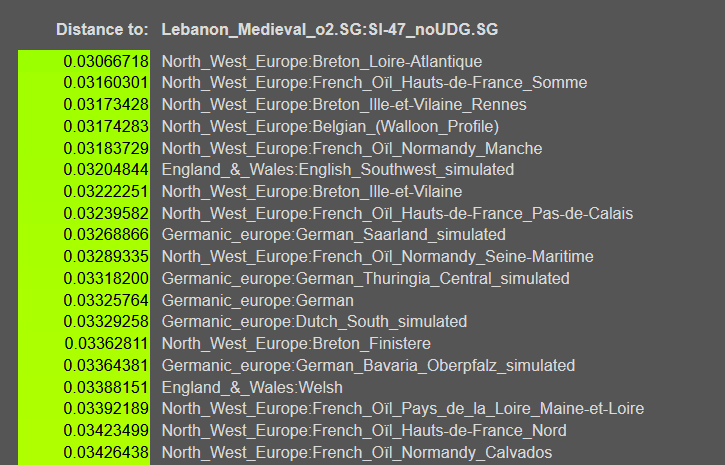
4. The G25 evidence: Sidon Crusaders on the European-Levantine axis
The six Sidon individuals' Global25 coordinates place them in a wide range across the European-Levantine ancestry continuum. SI-40 sits closest to the European end, with coordinates resembling medieval and modern northern French populations. SI-47 is also on the European side, consistent with the R-M269 Y-DNA. SI-41 sits intermediate, on the European side but with substantial Levantine component, fitting his R-DF27 Y-DNA but admixed autosomal pattern. SI-42, SI-44, and SI-45 sit closer to the Levantine end, with G25 coordinates similar to medieval and modern Lebanese populations.
The wide range of G25 positions within a single mass burial is the genetic signature of a heterogeneous military force assembled from multiple origins: some European immigrants, some first or second-generation admixed individuals born in the Crusader states, and some locally-recruited troops. This matches the historical and archaeological evidence for how Crusader military forces were actually constituted by the 13th century.
5. The Crusader genetic history in four phases
The First Crusade brought tens of thousands of western Europeans to the Levant, dominated by French-speaking knights and infantry from northern France, Normandy, Flanders, and adjacent regions. The Crusader states were established between 1098 (Edessa) and 1109 (Tripoli), with Jerusalem captured in 1099.
The Crusader presence consolidated through the 12th century, with continued European immigration and the establishment of fortified cities and military orders (Templars 1119, Hospitallers 1099, Teutonic Order 1190). Intermarriage with local Christian populations began producing first and second-generation admixed individuals. The Sidon burial captures this period.
Saladin's victory at the Battle of Hattin in 1187 and his recapture of Jerusalem began the decline of the Crusader states. Successive Crusades (Third 1189, Fourth 1202, etc.) failed to recover Jerusalem permanently. The final Crusader stronghold of Acre fell to the Mamluks in 1291, ending Latin Christian rule in the Levant.
Most European descendants left the Levant after 1291, taking refuge in Cyprus, Italy, and elsewhere. Some integrated into the Maronite, Melkite, and other Levantine Christian populations, leaving a small Western European genetic component detectable in the modern Lebanese gene pool, particularly in Christian Lebanese communities of Mount Lebanon and Beirut.
6. References
- Haber, M., Doumet-Serhal, C., Scheib, C. L., Xue, Y., Mikulski, R., Martiniano, R., et al. (2019). A transient pulse of genetic admixture from the Crusaders in the Near East identified from ancient genome sequences. The American Journal of Human Genetics, 104(5), 977-984. DOI: 10.1016/j.ajhg.2019.03.015 Crusaders Sidon
- Haber, M., Doumet-Serhal, C., Scheib, C., Xue, Y., Danecek, P., Mezzavilla, M., et al. (2017). Continuity and admixture in the last five millennia of Levantine history from ancient Canaanite and present-day Lebanese genome sequences. American Journal of Human Genetics, 101(2), 274-282. DOI: 10.1016/j.ajhg.2017.06.013 Lebanese
- Asbridge, T. (2010). The Crusades: The Authoritative History of the War for the Holy Land. Ecco. Standard modern historical synthesis on the Crusader period. History
- Riley-Smith, J. (1997). The First Crusaders, 1095-1131. Cambridge University Press. Detailed prosopographic analysis of the First Crusade participants. Crusade prosopography
- Davidski, A. (ongoing). Global25 PCA modern and ancient population averages. eurogenes.blogspot.com G25 panel
Lebanon_Medieval_o5.SG:SI-40_noUDG.SG,0.124067,0.153345,0.048649,0.003876,0.046778,0.005578,-0.016686,0.010846,0.029042,0.033167,-0.001949,0.008842,-0.013231,-0.025047,0.011129,0.008353,0.004563,0.011149,0.012444,0.01113,0.014849,-0.009274,0.001849,-0.005904,-0.001557
Lebanon_Medieval_o1.SG:SI-41_noUDG.SG,0.072847,0.148267,0.016593,-0.031977,0.040623,-0.016176,-0.011516,0.006461,0.025565,0.029522,-0.000974,0.012739,-0.002527,-0.012661,0.006107,0.000928,-0.000913,-0.003421,-0.006913,0.005753,0.001248,-0.005935,0.005423,0.003615,0.004071
Lebanon_Medieval.SG:SI-42_noUDG.SG,0.071709,0.151314,-0.046009,-0.091086,-0.005232,-0.027052,-0.00752,-0.018922,0.014521,0.010205,0.012179,-0.008093,0.012339,0.004817,-0.0076,-0.012861,-0.012517,-0.002027,0.000754,-0.013757,0.003119,0.014962,-0.005916,0.009037,0.010777
Lebanon_Medieval_o3.SG:SI-44_noUDG.SG,0.100164,0.159438,-0.038843,-0.079458,0.002154,-0.03012,-0.001175,-0.017076,-0.00634,0.022233,0.013316,-0.002548,0.001189,0.000688,-0.014658,0.001326,0.00013,-0.000253,0.016341,-0.007629,-0.005989,-0.009769,-0.000616,-0.007832,0.004071
Lebanon_Medieval.SG:SI-45_noUDG.SG,0.080814,0.149283,-0.059208,-0.081396,-0.010156,-0.034304,-0.009165,-0.010153,-0.000614,0.012939,-0.000487,-0.008243,0.003568,-0.00234,-0.006379,-0.000928,0.000261,0.000253,-0.001131,-0.001126,0.000499,-0.004699,-0.000986,-0.000723,0.00479
Lebanon_Medieval_o2.SG:SI-47_noUDG.SG,0.126344,0.137096,0.067882,0.02907,0.0397,0.009482,0.00047,0.005307,0.008181,-0.000364,-0.005521,0.011839,-0.005798,-0.014313,0.011672,0.004906,-0.002999,-0.008108,-0.011061,-0.003252,0.007112,0.006677,0.002835,-0.001446,0.007424