
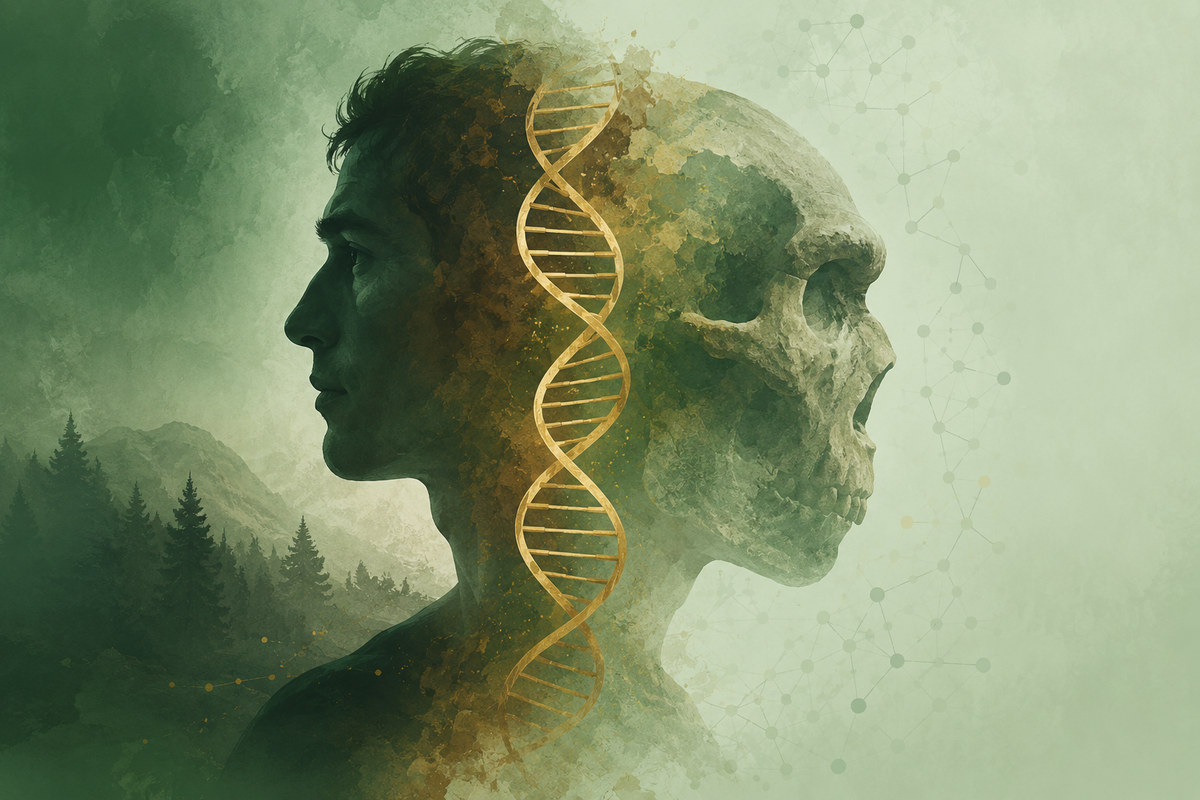
Roughly sixty thousand years ago, small groups of the people who would become every non-African population alive today interbred with Neanderthals somewhere in the Near East. The genetic trace of that contact never disappeared. Most people of non-African ancestry carry somewhere between one and two per cent Neanderthal DNA, and while most of it is scattered inert fragments, a handful of specific segments turned out to still be doing something. This article looks at four of them: a stretch of chromosome 3 that is the single strongest known genetic risk factor for severe COVID-19, a sodium channel variant that measurably raises pain sensitivity, and an immune gene cluster tied to allergy and inflammatory response. None of this is speculation. Each finding below comes from a peer reviewed study, and each is linked at the bottom of the page.
Check which Neanderthal segments you carry
What everyone actually carries
Neanderthal ancestry is not evenly distributed and it is not a single block. It arrived through a small number of interbreeding events, was diluted over roughly two thousand generations, and today survives as short fragments scattered across the genome, different fragments in different people. Most of these fragments sit in regions that do nothing measurable. A minority sit in regions that do, and those are the ones geneticists have spent the last decade mapping. The three cases below are the best documented functional consequences found so far, all from the same small circle of research groups at the Max Planck Institute for Evolutionary Anthropology and the Karolinska Institutet.
Chromosome 3: the segment that raises COVID-19 risk
In 2020, Hugo Zeberg and Svante Paabo traced the strongest genetic risk factor identified for severe COVID-19 back to a single Neanderthal haplotype on chromosome 3 (tag SNP rs35044562). The segment, roughly fifty thousand bases long, is inherited essentially intact because its component variants are tightly linked, and it closely matches the genome of a Neanderthal from Vindija Cave in Croatia. Carriers face a meaningfully higher risk of hospitalisation and respiratory failure after infection. The haplotype is not rare. It is carried by around half of people in South Asia and about one in six people in Europe, while it is almost entirely absent in East Asia and Africa, a distribution that tracks where and when the original interbreeding and its descendants spread.
Chromosome 12: the segment that lowers it
The same two researchers followed up in 2021 with the other half of the story. A separate Neanderthal derived haplotype, this time on chromosome 12 and overlapping the OAS1, OAS2 and OAS3 genes (tag SNP rs10774671), is associated with about a twenty two per cent reduction in the relative risk of severe COVID-19. These genes are activated by interferon and help the cell degrade viral RNA, and the Neanderthal version appears to do this more efficiently than the common modern human version. This variant is common too, present at frequencies of thirty per cent or higher across most of Eurasia and the Americas. Zeberg has described the overall picture succinctly: Neanderthal ancestry is a double edged sword when it comes to COVID-19, handing some people a variant to curse and others one to be grateful for, often within the same family.
Nav1.7: the variant that raises pain sensitivity
A separate 2020 study from largely the same Leipzig and Stockholm groups looked at the sodium channel Nav1.7, the protein primarily responsible for initiating pain signals in peripheral nerves. Neanderthals carried a version of this channel with three amino acid substitutions not found in most present day humans, and when the team expressed the Neanderthal version in the lab, it stayed in a ready to fire state more easily than the common variant. Using UK Biobank data on nearly two hundred thousand adults, carriers of the Neanderthal version reported more pain, an effect the lead author compared in size to being about eight years older. The genetic ancestry does not tell you how much pain someone actually experiences day to day, since that is also shaped by the spinal cord and brain, but it does lower the threshold at which peripheral nerves start sending the signal in the first place.
TLR6, TLR1, TLR10: the segment tied to allergy and immune response
A third line of work, led by Michael Dannemann and Janet Kelso in 2016 and confirmed independently the same year by Lluis Quintana-Murci's group at the Institut Pasteur, found that a cluster of three Toll-like receptor genes carries an unusually high proportion of archaic ancestry compared to the rest of the coding genome. Two of the three gene variants trace to Neanderthals and the third resembles the Denisovan version. The most studied coding variants in this cluster are rs5743618 in TLR1 and rs5743810 in TLR6. These receptors sit on the surface of immune cells and are the first line of detection for bacteria, fungi and parasites. Carrying the archaic version is associated with a stronger innate immune response and, as a side effect of that same heightened reactivity, a higher rate of allergic disease. It is the same trade off that shows up in the COVID-19 findings: a more aggressive antimicrobial defence system is not free, and the cost shows up as allergy.
What this does and does not mean for you
Carrying one or more of these segments does not determine anything about an individual on its own. Severe COVID-19 outcomes, chronic pain and allergic disease are all shaped by dozens of other genetic factors plus age, health conditions and exposure, and every study cited here reports population level risk shifts, not individual predictions. What genotyping can do is tell you whether you personally carry the specific archaic segments involved, which is a fixed fact about your genome rather than a probability. The HaploAI Neanderthal test looks at exactly these regions, among others, and reports which archaic variants show up in your own data.
References
- Nature 2020 Zeberg H, Paabo S. The major genetic risk factor for severe COVID-19 is inherited from Neanderthals. Nature 587:610-612. https://doi.org/10.1038/s41586-020-2818-3
- PNAS 2021 Zeberg H, Paabo S. A genomic region associated with protection against severe COVID-19 is inherited from Neandertals. PNAS 118:e2026309118. https://doi.org/10.1073/pnas.2026309118
- Curr Biol 2020 Zeberg H, Dannemann M, Sahlholm K, et al. A Neanderthal sodium channel increases pain sensitivity in present-day humans. Current Biology 30:3465-3469. https://doi.org/10.1016/j.cub.2020.06.045
- AJHG 2016 Dannemann M, Andres AM, Kelso J. Introgression of Neandertal- and Denisovan-like haplotypes contributes to adaptive variation in human Toll-like receptors. American Journal of Human Genetics 98:22-33. https://doi.org/10.1016/j.ajhg.2015.11.015
Test your own DNA
The four segments described above are among the archaic variants checked by the HaploAI Neanderthal test. If you have already run your raw DNA file through Global25, you can see which of these variants, and others, show up in your own results.