



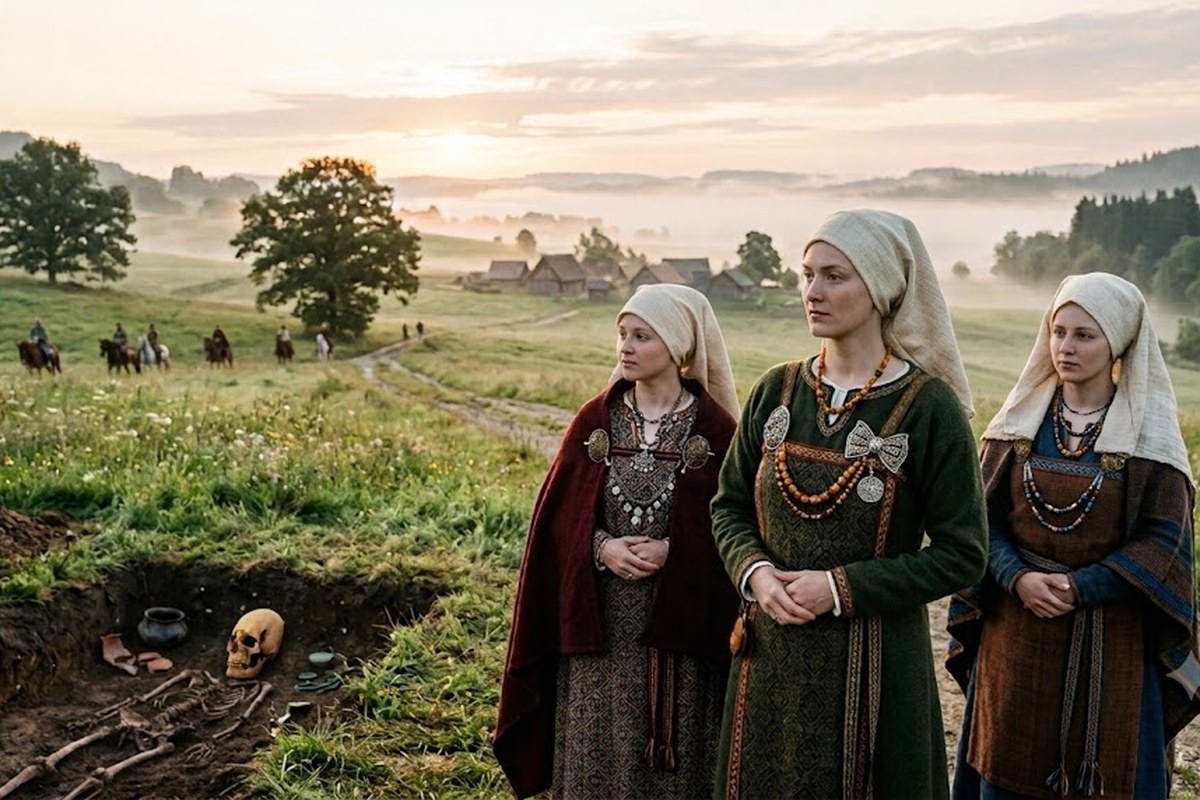
In the late 5th and early 6th century AD, several women buried in cemeteries across Bavaria were laid to rest with skulls bound in infancy into a long, sloping cone. For decades this was southern Germany's strangest archaeological puzzle: elongated crania are a hallmark of the Hunnic-era Danube, not of the Alpine foothills where these women ended up. When Krishna Veeramah and colleagues sequenced the genomes behind these skulls in 2018, the popular headline was simple: the women were foreign brides from the Balkans and the steppe. That headline is true as far as it goes, but the actual dataset is far stranger and more interesting than a single story of imported wives. Modelled in G25 against the Bavarian genomes themselves, against the newly available Gepid and Ostrogothic-era comparanda, and against the same cemetery's own second outlier, the picture splits into at least three distinct non-local ancestries, one of which turns out to have an almost exact genetic twin buried in a completely different Bavarian graveyard, and at least one skull-deformed woman whose ancestry was, in fact, entirely local.
Forty-One Graves, Six Cemeteries, One Puzzle
The 2018 PNAS study sequenced 41 individuals, including 11 whole genomes, from graves dated mostly to around 500 AD at six sites in and around modern Bavaria: Altenerding (AED), Straubing-Bajuwarenstrasse (STR), Alteglofsheim (ALH), and several smaller cemeteries in the same Erding and Straubing regions. Of the women in the sample, nine showed clear artificial cranial deformation, five more were classed as "intermediate" (four women and one man), and the remaining individuals, men and women alike, had ordinary skull shapes. The headline finding held up under full genomic analysis: men in the cemeteries carried ancestry closely resembling modern northern and central Europeans, while women showed very high genetic heterogeneity, ranging all the way from ordinary local ancestry to a profile that would not look out of place in Kazakhstan.
What the popular coverage tended to flatten is that this heterogeneity did not sort neatly by skull shape. The study itself flags the exceptions directly: some skull-deformed women carried grave goods with an "eastern" character (STR_328, ALH_1), while others did not (NW_54, STR_535, both otherwise unremarkable for the region). At least one woman with a perfectly ordinary skull, STR_266, showed the same putative eastern context in her burial. Two Straubing individuals with only "intermediate" deformation, one female (STR_355) and one male (STR_491), turned out on genomic analysis to be full siblings, meaning at least one local Bavarian family was practising partial cranial modification on some of its own children. Skull shape correlates with foreign ancestry in this dataset. It is not a perfect proxy for it.
Four Ancestries Hiding Inside "Non-Local"
The clearest way to see this is to model the Bavarian genomes themselves in G25 rather than treat "local" and "non-local" as a single split. The available coordinate averages group the cemetery sample into a local baseline and three distinct outlier clusters, labelled here o1, o2 and o3, alongside individually resolved outliers such as AED_1108. Run through a four-source NNLS model built from a local North and Central European pole, a Balkan Iron Age pole (Bulgaria), a Sarmatian steppe-Iranic pole, and a Hun-era East Asian pole (Kazakhstan), the four Bavarian groups separate cleanly, and not in the way a single "Balkan brides" headline would suggest.
The local baseline comes out almost entirely local, 97 percent, exactly what a genuine resident population should look like and a useful sanity check on the whole method. Cluster o1 is the group the original headlines were describing: 62 percent Balkan Iron Age, with a real but secondary Sarmatian layer and a smaller local component, consistent with intermarriage into the Bavarian community over one or more generations. Cluster o2, which contains AED_1108, is a different and more mixed story again: roughly a third Balkan, a third Sarmatian, and a full 20 percent Hun-era East Asian, the single largest steppe-Asian share of any group modelled here. Cluster o3, despite being flagged as an outlier group in the underlying dataset, comes out 83 percent local, with only a modest Sarmatian residue. Whatever marked these women out (a burial custom, a partial skull binding, a family tradition) it was not, on the autosomal evidence, a recent foreign origin. The label "non-local" was never a single ancestry. It was at least three.
The Balkan Layer: Roman Provincials, Not Generic Steppe
Cluster o1 deserves to be pinned down more precisely than "the Balkans." A distance ranking in G25 space places it closest not to any steppe or Sarmatian population but to a tight cluster of Roman-provincial and early medieval Balkan groups: Avar-period Austria in its Central Mediterranean-shifted profile, the Vlach-Aromanians of Greece, Roman-period Hungary in the same profile, the Greeks of Thessaly, Roman Emona in Slovenia, and Albanian populations of North Macedonia.
This is a specific and coherent signature. It is the genetic profile of the Romanised, Latin-and-Greek-speaking population of the late antique Balkan provinces, the world of Illyricum and Pannonia Secunda that supplied soldiers, administrators and, evidently, brides to the barbarian successor kingdoms after the western frontier collapsed. It sits closer to Roman Thessaly and Roman Emona than to any Sarmatian or Hunnic reference in the dataset. The women in this cluster were very plausibly drawn from the same Roman provincial world that produced the elite Ostrogothic and Gepid kingdoms which briefly ruled the middle Danube before ceding it to the Bavarii and the Lombards, not from the nomadic steppe itself.
The Steppe Layer: A Twin in Another Cemetery
Cluster o2 is the group that actually earns the "Hunnic" framing the original headlines reached for. AED_1108 is its most extreme member, and distance-ranking her individually produces the single most striking result in this reanalysis: her nearest genetic neighbour in the entire dataset is not a Sarmatian, a Hun, or a Gepid reference population. It is another Bavarian grave, from the East Asian-mixed profile recorded at Altenerding-Klettham, a separate cemetery complex from the one that produced AED_1108 herself.
A distance of 0.021 between two individually sequenced women from two different Bavarian burial grounds is not the kind of match produced by two unrelated people who both happen to carry "some steppe ancestry." It is close enough to suggest either a shared, narrow region of origin somewhere on the Hunnic-era Danube, or even a shared family group whose members were dispersed, through marriage, across more than one Bavarian community. Either reading turns AED_1108 from an isolated curiosity into evidence of a recurring, structured migration corridor rather than a single imported bride. Her next closest matches after that Altenerding pairing are, in order, Late Avar and Sarmatian-with-East-Asian-admixture populations of Hungary and a Roman-period Croatian genome with Caucasus-shifted ancestry, exactly the kind of company a genuine Hunnic-Sarmatian-era Danubian woman should keep.
What the East Germanic Kingdoms Themselves Looked Like
The 2018 dataset also included two genomes that were not Bavarian at all, sampled specifically because they came from documented Gepid and Ostrogothic-era contexts: Vim2b, a woman buried in a Gepid-period cemetery at Viminacium in Serbia, and Ker1, a woman from a late antique cemetery at Pantikapaion in Crimea, in territory later associated with Ostrogothic settlement in the region. Both carry artificial cranial deformation. Neither reads as a simple stand-in for "the Gepids" or "the Ostrogoths" as ethnic blocs, and modelling them side by side against the Bavarian clusters clarifies why the original commentary around this paper joked that the first East Germanic-associated genomes ever sequenced clustered with Turks and Kazakhs.
Vim2b models as 34 percent local European, 26 percent Balkan, 10 percent Sarmatian and a striking 29 percent Hun-era East Asian, the largest East Asian share of any individual or cluster modelled in this article, slightly ahead of Bavaria's own o2 cluster. This is consistent with the original study's own description of Vim2b as carrying "an even larger East Asian component" than AED_1108. It is a genuinely mixed profile, not a pure steppe-nomad one, and it says something important about the Gepid kingdom on the middle Danube: whatever "Gepid" meant as a political identity by the mid-6th century, it evidently included women whose recent ancestors had come from far to the east, alongside a substantial Balkan Roman-provincial layer.
Ker1: A Bosporan Greek, Not a Steppe Nomad
Ker1 tells a different and, on this evidence, more surprising story than the "Ostrogothic steppe bride" framing the original press coverage reached for. A distance ranking places her closest not to any Sarmatian, Hunnic or Gothic reference but to another individual from her own cemetery, the Late Antique burial ground at Pantikapaion, the ancient capital of the Bosporan Kingdom and, for roughly a thousand years before Ker1's own lifetime, a Greek colonial city on the northern shore of the Black Sea.
Beyond her own cemetery, her next closest matches are Roman-period Zadar in a Central Anatolian Greek-shifted profile, modern populations of Sinop on Turkey's Black Sea coast, a second Zadar Roman genome with Levantine-shifted ancestry, and the Greeks of Crete and Turkish Isparta. This is, end to end, a Black Sea and Aegean Greek colonial signature, not a steppe-nomad one. It lines up precisely with the original study's own finding that Ker1's overall profile "best matched modern Turkish individuals" and carried "significant southern European ancestry as well as South Asian ancestry." Crimea in this period was not simply Gothic or Hunnic territory; it was still, underneath the political turnover, a landscape of old Pontic Greek cities whose populations had been absorbing Anatolian, Levantine and steppe-Iranic ancestry for a thousand years before any Goth arrived. Ker1 looks like a product of that older, layered Black Sea world rather than a freshly arrived steppe migrant, even though she too wore the deformed skull that later observers would reflexively label "Hunnic."
Did the Huns Even Start This?
The original 2018 paper, and most popular coverage since, frames artificial cranial deformation in Europe as a Hunnic import, spread west and south as Attila's confederation absorbed and redistributed Sarmatian, Gothic and Alanic populations across the middle Danube from the 370s onward. The paper's own authors were more careful than the headlines: they explicitly note that cranial deformation is attested archaeologically in Romania as early as the second century AD, a full two centuries before the Huns crossed the Volga, in a context associated with Sarmatian populations already settled on the Danubian frontier. If the practice already existed among Danubian Sarmatians well before the Hunnic period, then "Hunnic" skull deformation may be better understood as a much older steppe-Iranic custom that the Hunnic conquest redistributed and intensified rather than one it invented and exported from Inner Asia. The genetic evidence in this article is consistent with either reading: the Sarmatian layer recovered in every non-local Bavarian cluster, including the ones with no detectable East Asian ancestry at all, fits a Sarmatian-era origin for the custom just as well as it fits a purely Hunnic one, and the practice's real popularity may owe as much to two centuries of Sarmatian presence on the Roman frontier as to Attila's brief and violent decade in Europe.
A Deformation Type Might Mark a Group, Not Just a Custom
A complementary line of evidence comes from a 2019 study of three adolescent male skeletons from a Migration Period cemetery at Osijek in eastern Croatia, on the same Pannonian plain the Bavarian outlier clusters ultimately trace back to. All three were interred close together and dated to the same horizon, but they carried three different cranial profiles: one undeformed, one with tabular oblique deformation, and one with circular erect deformation. Genomic analysis of the three found three different ancestries to match: the undeformed individual showed broadly West Eurasian ancestry, the tabular oblique individual showed East Asian ancestry, and the circular erect individual showed Near Eastern-associated ancestry. The study's own authors floated the possibility that deformation type itself, not deformation as a single undifferentiated custom, may have functioned as a visual marker of membership in a specific group within the mixed Hunnic-Gothic-Gepid military and political world of the Pannonian plain, with different communities favouring different binding styles. If that reading holds, the assumption embedded in most popular coverage of the Bavarian skulls, that a deformed skull equals "steppe" or "Hunnic" ancestry as a single category, was oversimplified from the start. A skull shape may have signalled which specific group a person (or their family) claimed to belong to, in a milieu where Huns, Goths, Gepids, Sarmatians and Roman provincials were all living, marrying and burying their dead within the same few hundred kilometres.
Limits and Caveats
Several caveats apply. The proxy sources used in the four-way NNLS model, a Bulgarian Iron Age population, a Hungarian Sarmatian steppe-Iranic average, and a Kazakhstani Hun-era elite genome, are directional stand-ins for deep ancestral streams rather than literal ancestor populations, and Ker1's comparatively high residual in that same model is a sign that a fourth or fifth true source (plausibly an Anatolian or Caucasus-shifted pole) is missing from this particular four-way setup; her own distance ranking, which needs no such assumption, is the more trustworthy read on her ancestry. The Bavarian cluster averages (o1, o2, o3) necessarily average over a handful of individuals apiece and should not be mistaken for precise population parameters. AED_1108's match to the Altenerding-Klettham genome is a single pairwise comparison rather than a formal kinship or shared-origin test, and while a distance this small between two individually sequenced ancient genomes is unusual, it cannot on its own distinguish a shared home region from an actual family relationship. Finally, the Osijek study's finding that deformation type tracks distinct ancestries comes from a sample of three individuals at one site and should be read as a suggestive, not a settled, pattern, however well it fits the wider Bavarian and Danubian evidence assembled here.
Conclusion
The Bavarian elongated-skull women were never a single story. Real Roman-provincial Balkan ancestry, a genuinely steppe-Asian layer with a near-exact match in a second Bavarian cemetery, an East Germanic elite genome from Serbia that turns out to carry even more of that same steppe-Asian signal, a supposedly Ostrogothic-era Crimean genome that reads as an old Black Sea Greek colonial profile rather than a steppe one, and at least one skull-deformed woman with an entirely ordinary local Bavarian genome, all sit inside what a single 2018 headline flattened into "foreign brides." The elongated skulls of early medieval Bavaria mark a genuinely mixed, genuinely mobile world stretching from the Alpine foothills to the Black Sea. They do not mark a single origin, and in at least one case here, they do not mark a foreign origin at all.
Germany_EarlyMedieval:BIM37b.SG,0.132035,0.135065,0.053551,0.059755,0.057857,0.013666,0.013631,0.010384,0.014726,-0.002369,0.003735,0.001948,-0.008325,-0.000550,0.026465,0.000133,-0.008345,0.008488,0.016341,0.004127,0.006863,-0.010140,-0.000246,0.011688,-0.002994
Germany_EarlyMedieval_o3:AED249.SG,0.132035,0.131003,0.070144,0.042959,0.046162,0.026774,0.019741,0.004154,0.000205,-0.010023,-0.007632,0.000899,-0.005946,0.001101,0.018594,-0.000530,-0.034421,-0.002407,0.000251,0.009379,0.014849,-0.010510,0.000000,0.007712,0.009340
Germany_EarlyMedieval:STR486.SG,0.124067,0.138112,0.050157,0.053941,0.043700,0.022869,0.011986,0.007846,0.010431,-0.003645,-0.002273,-0.005395,-0.014717,-0.000413,0.010043,0.001856,-0.024382,-0.006334,0.005405,0.008504,0.005865,-0.000247,-0.016145,0.010122,-0.003592
Germany_EarlyMedieval:Alh10.SG,0.133173,0.129988,0.064865,0.045866,0.042777,0.022590,0.004230,0.001846,0.004295,0.003827,0.000000,0.004496,-0.013825,0.001789,0.026058,-0.003182,-0.026207,0.007348,0.004777,-0.006628,0.005740,0.013725,-0.004314,0.016870,-0.004071
Russia_EarlySarmatian:Pr10.SG,0.118376,0.042652,0.038843,0.077843,-0.018157,0.024821,-0.000940,0.003000,-0.018407,-0.037358,0.012504,-0.010641,0.005500,-0.037433,0.027280,0.010607,-0.008084,0.002534,-0.016844,-0.007754,-0.014474,-0.023123,-0.000493,0.024943,0.000838
Germany_EarlyMedieval:STR316b.SG,0.127482,0.124910,0.070144,0.059109,0.042469,0.029841,0.015511,0.000923,0.004500,-0.001640,-0.010555,0.002398,-0.006690,-0.002615,0.029451,-0.011005,-0.018515,0.013429,0.007793,0.000375,0.002995,0.009027,0.003697,0.018557,-0.005149
Germany_EarlyMedieval:STR393b.SG,0.113823,0.122879,0.073916,0.042313,0.027082,-0.005299,0.007520,0.003000,0.003477,0.003645,0.003735,-0.002548,0.001933,-0.014588,0.001086,0.007160,0.006519,0.006081,0.005154,0.026888,0.011729,0.006059,-0.022061,0.011929,0.008861
Germany_EarlyMedieval:AED106.SG,0.132035,0.139128,0.063733,0.066538,0.036007,0.023706,-0.002115,0.009923,0.004909,-0.010934,-0.008444,0.002698,-0.015758,-0.001514,0.021580,0.008486,0.013690,-0.007728,-0.014707,0.004752,0.000499,0.014220,-0.017131,0.009399,-0.003113
Germany_EarlyMedieval:Alh1.SG,0.126344,0.132019,0.064865,0.050388,0.049240,0.021196,0.001645,0.001615,0.002454,-0.002916,-0.002761,0.004046,-0.012042,-0.011147,0.015879,0.007292,-0.001043,0.003801,0.007793,0.008129,0.010107,0.002349,0.001602,0.007109,0.000120
Germany_EarlyMedieval:AED92b.SG,0.126344,0.132019,0.065619,0.047481,0.030159,0.011156,0.019036,0.021461,0.015339,-0.003645,-0.005521,-0.000300,-0.008771,-0.016790,0.030537,-0.012463,0.003781,0.009122,-0.000251,0.016508,0.005241,0.014220,-0.001602,0.012893,-0.005029
Serbia_Medieval_Gepidian:Vim2b.SG,0.095611,0.006093,0.039598,0.005491,0.004924,-0.001952,0.000705,0.008538,0.006136,0.013485,-0.016239,0.003897,-0.006690,-0.008945,0.003257,-0.006629,-0.001695,0.005701,0.003897,-0.002001,-0.006863,0.011376,0.006162,0.007471,0.000000
Germany_EarlyMedieval:Alh3a.SG,0.133173,0.115770,0.065619,0.038437,0.036314,0.018407,0.002585,0.001385,-0.008795,-0.008747,-0.003248,-0.002548,-0.008325,0.003165,0.017779,-0.001193,-0.013169,0.003927,0.005279,0.001501,0.001622,-0.003833,0.008504,0.017834,-0.010658
Germany_EarlyMedieval:BIM33.SG,0.122929,0.139128,0.057322,0.036499,0.031698,0.021196,0.026556,-0.003000,0.003681,0.013485,-0.011042,0.015586,0.001487,0.013212,0.007465,0.001193,-0.011083,0.001647,0.013198,0.001376,0.017719,-0.007543,0.016269,-0.011809,-0.011496
Germany_EarlyMedieval_o1:AEHIb.SG,0.124067,0.158423,0.018479,-0.033269,0.033852,-0.006972,-0.013161,-0.003461,0.000205,0.017495,-0.009743,0.006444,-0.013379,-0.009771,-0.013165,-0.006099,0.006389,0.000633,0.004148,-0.013006,-0.011480,-0.016199,0.002711,0.012291,-0.008622
Germany_EarlyMedieval_o1:NW54_noUDG.SG,0.129758,0.139128,0.028661,0.000646,0.038161,-0.003626,0.001410,0.002769,0.018816,0.021686,0.009743,0.001349,-0.007136,0.005367,-0.008279,-0.009812,-0.002738,0.005574,0.009050,-0.017884,-0.002870,0.013725,0.009737,0.007350,0.009700
Germany_EarlyMedieval_o1:NW54.SG,0.129758,0.142174,0.028661,-0.003876,0.032314,-0.003068,0.002585,-0.004384,0.019839,0.019317,0.007145,0.003447,-0.010109,0.011423,-0.004614,-0.009016,-0.005867,0.007728,0.013073,-0.008629,0.001123,0.007296,0.008011,0.006507,0.006107
Germany_EarlyMedieval_o1:STR535.SG,0.102441,0.146236,0.012822,0.005814,0.015695,-0.000837,-0.000235,-0.020538,-0.005931,0.005103,0.001624,0.003597,0.001338,-0.007569,0.009229,-0.007558,-0.013951,-0.010769,0.010684,0.001000,-0.007112,-0.013107,-0.013064,0.000482,0.024070
Germany_EarlyMedieval_o2:AED1108.SG,0.100164,0.007109,0.030924,-0.009690,0.003385,-0.004183,-0.008460,0.006000,0.004295,0.009476,-0.003573,-0.010491,-0.007582,-0.001101,0.000543,0.001061,-0.010561,-0.010388,-0.014581,0.000625,-0.006364,-0.006306,-0.011462,-0.009881,-0.004431
Germany_EarlyMedieval_o2:STR328c.SG,0.109270,0.064994,0.042992,0.007106,0.004616,0.018407,0.000940,0.003692,-0.014112,-0.003645,-0.006008,0.004646,-0.002676,-0.006331,0.010315,0.007558,0.003912,-0.000507,0.001383,-0.001000,0.000000,-0.009398,-0.007765,0.005543,-0.004790
Germany_EarlyMedieval_o3:AED513.SG,0.126344,0.141159,0.032809,0.013243,0.044316,-0.005020,-0.002820,-0.004846,0.003068,-0.002005,-0.012504,-0.008692,-0.010555,0.001789,-0.003122,-0.003050,-0.022035,0.003801,0.016969,-0.003252,-0.003244,0.014096,0.001109,0.014339,-0.015088
Germany_EarlyMedieval_o3:STR228.SG,0.124067,0.121864,0.037712,0.020995,0.023697,0.008088,-0.005640,0.015922,-0.003068,0.002369,0.014777,-0.005545,0.001933,-0.001651,0.006243,0.009149,-0.003390,0.000380,0.006536,0.009379,0.003494,-0.005441,0.010599,0.002651,-0.001197
Germany_EarlyMedieval_o3:AED1135b.SG,0.110408,0.134050,0.043369,0.040052,0.021850,0.014223,0.007520,0.005538,-0.002454,-0.002005,-0.002923,0.006594,-0.002379,-0.012248,-0.003800,-0.007160,-0.011083,0.004181,0.009804,0.002751,-0.002496,0.008408,0.013927,0.003494,0.011855
Germany_EarlyMedieval_o3:STR248b.SG,0.141141,0.111708,0.052420,0.026486,0.019388,0.016176,0.018331,-0.008307,-0.011044,-0.001276,-0.008931,-0.007943,-0.009068,-0.010459,0.005022,0.009016,-0.018906,0.008995,-0.004651,0.013882,0.000499,0.005688,-0.009244,0.007591,-0.007305
Germany_EarlyMedieval_oSteppe:NW255a.SG,0.122929,0.137096,0.058454,0.046835,0.045855,0.010319,0.014571,0.021230,-0.004909,-0.003280,-0.005521,0.004346,-0.008771,-0.001239,0.028366,-0.005569,-0.024121,0.002027,0.016215,0.007003,0.006988,-0.006801,0.009737,0.022172,-0.000958
Germany_EarlyMedieval:AED1119.SG,0.135449,0.116786,0.074670,0.058786,0.045855,0.028726,0.016686,0.010384,0.000000,-0.011116,-0.000325,0.005695,-0.005203,-0.020643,0.022394,-0.009546,-0.027120,0.003927,-0.003520,-0.004252,0.024457,0.006677,-0.001356,0.016147,0.008861
Germany_EarlyMedieval:AED204.SG,0.136588,0.140143,0.078818,0.062985,0.042469,0.033467,-0.007520,0.014999,0.008795,0.006560,-0.006171,0.010790,-0.023786,-0.020919,0.031216,0.006762,-0.005085,-0.003927,0.000377,-0.010005,0.005989,0.014220,-0.010106,-0.007712,0.002874
Germany_EarlyMedieval:AED432b.SG,0.112685,0.136081,0.054682,0.049419,0.029236,0.033746,-0.009400,0.014769,-0.001841,-0.009476,-0.004872,0.006744,0.002527,-0.000963,0.025108,-0.000928,-0.024773,-0.008615,0.012444,0.009254,0.006738,0.005564,0.000616,-0.000361,-0.002155
Germany_EarlyMedieval:NW255a_noUDG.SG,0.122929,0.142174,0.062979,0.049742,0.054164,0.011713,0.011986,0.015461,0.001636,-0.010934,-0.003085,0.009142,-0.011298,0.000138,0.026601,-0.013392,-0.023600,0.008615,0.022626,0.003502,0.000873,-0.009150,0.012202,0.019762,-0.005748
Germany_EarlyMedieval:STR220c.SG,0.126344,0.132019,0.056191,0.043928,0.041546,0.013945,0.009165,0.009461,0.004090,-0.004556,-0.009256,0.000749,-0.008176,0.003853,0.011129,-0.004508,-0.006389,0.000633,-0.002011,0.007128,0.006114,0.004328,0.004807,0.013255,0.000239
Germany_EarlyMedieval:STR355c.SG,0.127482,0.135065,0.067127,0.056848,0.044008,0.022869,0.003995,0.003461,0.003068,0.002551,-0.003897,0.011690,0.001635,-0.012661,0.023208,0.019225,0.005867,0.001394,0.000126,0.009379,0.002745,0.004699,0.003328,0.015424,0.006107
Germany_EarlyMedieval:STR480.SG,0.129758,0.137096,0.062225,0.037791,0.050471,0.021753,-0.003525,0.015692,0.001227,0.005285,0.002598,0.006594,0.001635,-0.013487,0.013029,-0.000133,0.001956,0.000380,-0.003017,0.002001,0.016471,0.000989,-0.003451,0.016870,-0.000359
Germany_EarlyMedieval_o1:STR300b.SG,0.126344,0.166547,-0.004148,-0.051680,0.020927,-0.013945,0.005405,0.009692,0.000000,0.029158,0.005684,-0.000749,-0.008920,-0.003853,-0.030537,-0.003447,0.008996,-0.002660,-0.000880,-0.017133,-0.006489,0.010263,0.009490,0.004579,-0.006227
Germany_EarlyMedieval_o1:STR310.SG,0.114961,0.137096,0.024890,-0.001292,0.014464,-0.007530,0.003760,0.006461,-0.002863,0.011845,-0.000487,0.007493,-0.009812,-0.006881,-0.006243,-0.004110,0.011604,-0.006968,0.001257,0.006878,-0.000250,0.002968,-0.000863,0.001566,-0.003113
Germany_EarlyMedieval.SG,0.1276888,0.1322957,0.0612994,0.0471874,0.0424974,0.0214238,0.0068581,0.0069646,0.0023983,-0.0017229,-0.0049602,0.0049593,-0.0057032,-0.0032154,0.0164098,-0.0009041,-0.008001,0.0039505,0.0051993,0.0024216,0.0072033,0.0035523,-0.0019271,0.0135835,-0.0026344
Germany_EarlyMedieval_o1.SG,0.1240673,0.1458977,0.0159647,-0.0147503,0.023594,-0.008367,0.002585,0.0069997,0.0068857,0.0196207,0.004655,0.0040967,-0.010109,-0.0016057,-0.0126673,-0.006011,0.0046503,-0.0009713,0.0030167,-0.009755,-0.0040763,0.009892,0.007313,0.0036147,-0.0000397
Germany_EarlyMedieval_o2.SG,0.1007335,0.0330045,0.0382775,-0.006137,-0.0009235,0.0104585,-0.0045825,0.003231,-0.001943,0.000182,-0.001218,-0.0029225,-0.0046825,0.0019265,0.0085505,-0.002851,0.002738,-0.003104,-0.0063475,0.001501,-0.003057,-0.0077285,-0.0020335,0.001145,-0.0061075
Germany_EarlyMedieval_o3.SG,0.120273,0.127618,0.048397,0.0392983,0.0344677,0.0163617,0.0063453,0.0118457,-0.0049087,-0.0037663,0.0018947,-0.0004497,-0.001883,-0.002523,0.009048,0.00716,-0.011648,-0.0031673,0.008296,0.0035017,0.002038,0.0031737,0.0122017,0.005382,0.007225
Germany_Early_Medieval_Altenerding-Klettham_East_Asian_Mixed_n1,0.099026,0.012186,0.026398,-0.013889,0.003385,-0.004183,-0.00094,0.006231,0.007772,0.007472,-0.001786,-0.013488,-0.002676,0.003165,0.007057,-0.007823,-0.007823,-0.007601,-0.017346,0.004502,-0.009733,-0.0115,-0.006779,-0.009037,-0.007903
Ukraine_Crimea_Pantikapaion:Ker1.SG,0.106994,0.123895,-0.009051,-0.033269,-0.004924,-0.015060,-0.003760,-0.002769,-0.025770,-0.001640,0.007307,-0.002698,-0.006095,0.006331,-0.002307,-0.007027,0.002217,-0.011149,-0.007416,-0.000375,0.006364,0.009274,0.007395,0.006145,-0.002634
Crimea_Late_Antiquity_Pantikapaion_North_Pontic_Greek_n1,0.104717,0.127957,-0.009051,-0.037468,-0.00954,-0.015897,-0.005405,-0.000231,-0.02577,-0.001458,0.01023,-0.001798,-0.008771,0.000826,-0.001629,-0.006364,0.002477,-0.011402,-0.009302,0.00075,0.007237,0.008779,0.008751,0.00964,-0.002395
Bulgaria_EIA_Kapitan_Andreevo_n6,0.12065233,0.16146917,0.0083593333,-0.052702833,0.032313667,-0.025890333,0.001645,-0.0029231667,0.012033,0.048049667,0.0018675,0.0096915,-0.0182605,0.0016516667,-0.023525,-0.010054667,0.011213,0.0040961667,0.011208167,-0.0087541667,-0.010024,0.0014218333,-0.0033688333,0.001044,-0.0068658333
Hungary_LIA_Sarmatian_Steppe_Iranic_n4,0.11496125,0.0665175,0.03865475,0.05757475,-0.01515625,0.0222415,0.00323125,-0.001673,-0.02275325,-0.0285655,0.003248,0.0002995,-0.00196975,-0.01837225,0.0115025,0.0045745,0.00446575,-0.001932,-0.00128825,0.00425225,-0.00751825,0.0015765,0.00157125,0.00141575,-0.002784
Kazakhstan_Hun_Elite_LIA,0.056912,-0.30669,0.069767,-0.011305,-0.05878,-0.018965,-0.000235,0.001615,0.00634,-0.005467,-0.031503,-0.008692,-0.003419,0.001101,0.008143,-0.004508,-0.008475,-0.003167,-0.000754,0.014382,-0.028699,0.001113,-0.008134,0.00253,0.005029
Hungary_Late_Antiquity_Hun_Gepid_East_Asian_Mixed_n6,0.11135683,0.036559,0.038906333,0.016688333,0.004565,0.0038578333,0.0047391667,0.0083843333,-0.0035108333,-0.0035533333,-0.0079298333,0.0040216667,-0.0026015,-0.005138,0.0049763333,-0.0044638333,-0.0030205,-0.000718,0.0054256667,0.00058366667,-0.0013518333,0.0015661667,-0.0040465,0.0052413333,0.00002
Hungary_LIA_Sarmatian_East_Asian_Mixed_n4,0.09817225,-0.0058395,0.0381835,-0.00250325,-0.0030775,-0.00850625,0.006874,0.006865,0.00260775,0.00651475,-0.006252,0.00037475,-0.00724725,0.002615,-0.00603975,0.00281725,0.0058345,-0.00060175,0.007039,0.00415825,-0.0074245,-0.000433,-0.00092425,-0.00144575,-0.0017965
Austria_Early_Medieval_Avar_Central_Med_n37,0.12526689,0.14406803,0.018040595,-0.015128622,0.024436757,-0.0069722703,0.0010924865,0.0019145676,0.0011443243,0.016992351,0.000395,0.0053426486,-0.0074571351,0.0024064324,-0.011745324,-0.0033684595,0.0061667838,-0.00030132432,0.0045659189,-0.0026566486,-0.0051395135,0.002072027,0.0030912162,0.001778027,-0.0014498919
Vlach_Aromanian_Greece_n7,0.12174967,0.14773763,0.019851871,-0.013782686,0.025276929,-0.0047701143,0.0021272429,0.0015774857,0.0025737429,0.016354571,0.0026934429,0.0030950571,-0.0082657143,0.0040991571,-0.010174243,-0.0042450857,0.004629,0.00087071429,0.0071803,-0.0059828143,-0.0069395,0.0034042857,0.0010118286,0.0018619143,-0.0030657143
Croatia_Roman_Empire_Zadar_Central_Anatolian_Greek_n1,0.10927,0.139128,-0.029415,-0.041344,-0.00954,-0.018128,-0.001175,-0.007154,-0.017385,0.002551,0.001461,0.007044,0.001189,0.003028,-0.00855,-0.007292,-0.002999,-0.0019,-0.002891,-0.001751,0.004742,-0.001855,-0.000123,0.003374,0.001197
Turkish_Sinop_Northwest_n4,0.1111155,0.1223855,-0.02998625,-0.0509,-0.01529775,-0.015776,0.00267125,-0.002061,-0.0251245,0.00280525,0.0022955,0.003498,-0.001772,0.001816,-0.00935725,-0.0017385,0.0052935,0.00081475,0.0048115,-0.00328525,-0.0007875,0.00134775,0.000005,0.000996,-0.00276325
- Veeramah et al. Population genomic analysis of elongated skulls reveals extensive female-biased immigration in Early Medieval Bavaria, PNAS, 2018. pnas.org/doi/10.1073/pnas.1719880115
- Racz et al. Cranial deformation and genetic diversity in three adolescent male individuals from the Great Migration Period from Osijek, eastern Croatia, PLOS ONE, 2019. pmc.ncbi.nlm.nih.gov/articles/PMC6703674
- Trautmann et al. Between Raetia Secunda and the duchy of Bavaria: exploring patterns of human movement and diet, PLOS ONE, 2023, on cemetery locations and isotopic non-locals in the same Bavarian regions. journals.plos.org/plosone/article?id=10.1371/journal.pone.0283243
- Stony Brook University press release Medieval Barbarians Likely Imported Brides With Elongated Heads From Southeastern Europe, 2018. news.stonybrook.edu
- Eurogenes Blog Exotic female migrants in Early Medieval Bavaria, commentary and dataset notes on Veeramah et al. 2018. eurogenes.blogspot.com
- Davidski Global25 coordinates dataset.
- Vahaduo G25 analysis tool used for NNLS modelling.
- Moriopoulos 2026 collection Aggregated Global25 population averages, including the Bavarian outlier cluster averages, Gepid, Ostrogothic-era and Osijek-region comparanda used in this article.