
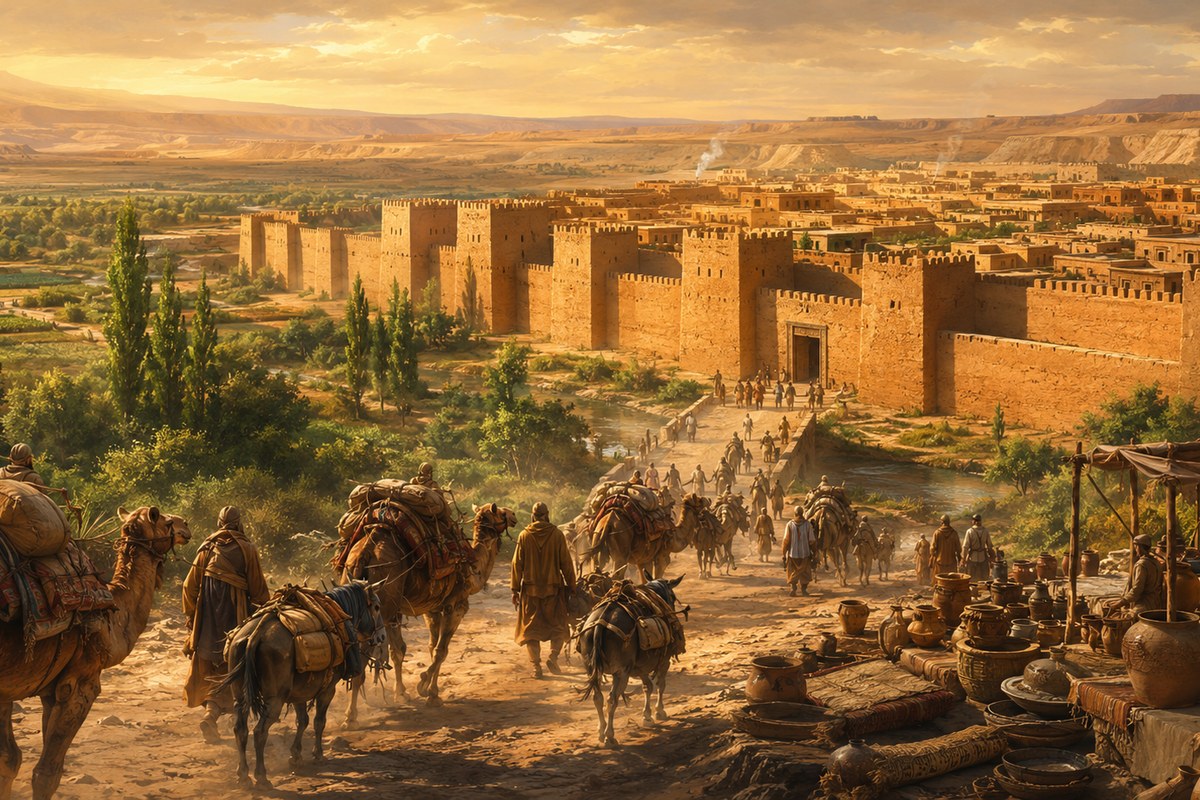
For decades, popular accounts of the Indo-Aryan migration into India have cast the Bactria-Margiana Archaeological Complex, the walled oasis cities of Bronze Age Turkmenistan and Uzbekistan, as the last staging post where steppe pastoralists picked up religion, ritual and language before pouring south into the Indus world. The archaeology genuinely supports a cultural handoff of this kind. The genetics of the BMAC people themselves tells a stranger story: a population with almost no steppe ancestry, sitting genetically closer to the Balochi and Kalash of today than to the very pastoralists it supposedly transformed, and whose clearest trace of ancient long distance travel was left not by Aryans heading south but by a handful of visitors from the Indus Valley heading north.
An Oasis Civilisation Between Four Worlds
Around 2300 BCE, a network of fortified towns and irrigated farmland rose out of the Karakum desert along the lower reaches of the Murghab and Amu Darya rivers, in what is today Turkmenistan, Uzbekistan and northern Afghanistan. Archaeologists call it the Bactria-Margiana Archaeological Complex, or simply the Oxus civilisation. Its cities, Gonur Tepe chief among them, were laid out with monumental walled enclosures, palace and temple like structures, and craft quarters producing bronze tools, seals and elaborate jewellery. Unlike its steppe neighbours to the north, BMAC left no evidence of large scale pastoral mobility. It was a settled, irrigation fed farming society, continuing a much older local Chalcolithic tradition rather than importing one.
What made BMAC historically significant was its position. It sat directly between the Eurasian steppe to the north, the Iranian plateau to the west, and the Indus Valley to the south east, and its material culture turns up at all three doorsteps. Goods and artistic motifs connect Gonur Tepe to Mesopotamia, to the Iranian sites of Shahr-i-Sokhta and Tepe Yahya, and to the Indus world, placing BMAC inside what specialists term the Middle Asian Interaction Sphere, a zone of overlapping trade and cultural contact that predates and outlives the Indo-Iranian migrations by centuries.
The Kulturkugel: A Cultural Vector, Not a Genetic One
The traditional model for how Indo-Iranian languages reached Iran and India runs through this oasis civilisation. Archaeologist J. P. Mallory named it the kulturkugel, German for culture bullet: steppe pastoralists descending from the Sintashta and Andronovo horizons absorbed the material culture, religious vocabulary and social organisation of BMAC while keeping their own Indo-Iranian language, then carried this hybrid package onward into Iran and the Indus borderlands. Certain elements of later Vedic and Zoroastrian ritual, including the soma or haoma cult, have long been proposed as BMAC contributions inherited along the way.
The kulturkugel model makes a specific, testable genetic prediction. If steppe migrants merely passed through and took over BMAC without settling in large numbers or intermarrying extensively, the BMAC population itself should look like an ordinary Central Asian farming society with little or no steppe ancestry, a genetic dead end rather than a source population. That is precisely the kind of claim Global25 and NNLS modelling can check directly against the ancient genomes recovered from Gonur Tepe and Sappali Tepe.
What the BMAC People Actually Looked Like, Genetically
Ranking every population in the dataset by Euclidean distance from the Gonur Tepe Bronze Age average gives an immediate answer. The closest population by far is Sappali Tepe in Uzbekistan, effectively the same people at a different oasis (distance 0.021), followed closely by the Iranian site of Shahr-i-Sokhta (0.036), itself part of the same interaction sphere. After that come modern Balochi at 0.068 and, more tellingly, the Zagros Neolithic farmer sample Ganj Dareh at 0.086: the BMAC average sits genetically nearer to a living Baloch population than to its own deepest Iranian farmer ancestor, a sign of several thousand years of regional drift and additional gene flow layered on top of that Neolithic base. The Sintashta steppe pastoralists, the population the kulturkugel model has migrating through and taking over BMAC, sit far down the list at 0.231, far more distant from Gonur Tepe than any of the West Asian farming populations.
A five source NNLS model, decomposing each ancient population into Iranian farmer (Ganj Dareh), Caucasus hunter gatherer (Kotias), Anatolian farmer (Barcin), steppe (Sintashta) and AASI (the deep South Asian component, proxied by the Onge), confirms the picture. Both Gonur Tepe and Sappali Tepe come out around 65 percent Iran_N, with the Anatolian and Caucasus sources splitting the remaining farmer related ancestry, a residual steppe signal of only 8 to 13 percent, and AASI at essentially zero, 1 percent or less. That small steppe figure should not be over read: Sintashta, Iran_N and CHG all share a deep Caucasus related ancestry, which makes G25 lean the steppe component slightly high in models like this one, a pattern already documented in earlier articles on this site. Published qpAdm based literature places pre 2000 BCE BMAC steppe ancestry at close to zero, and the NNLS result here is consistent with that headline figure once the collinearity is taken into account. Either way, the number is nowhere close to what a population absorbing large numbers of steppe migrants would show.
The Travelers Hiding in the Data
Buried inside the same ancient DNA record recovered from BMAC sites is a small, genetically distinct group that the original excavators and geneticists flagged as outliers: two individuals at Gonur Tepe and five at Shahr-i-Sokhta whose ancestry does not match the surrounding population at all. Narasimhan and colleagues, in the landmark 2019 study of South and Central Asian population history, identified these individuals as having ancestry consistent with the Indus Valley Civilisation, interpreting them as travelers who had journeyed from the Indus world into the Iranian and Central Asian trading network rather than as descendants of a resident local population.
The Global25 evidence supports that reading closely. Where mainstream Gonur Tepe and Shahr-i-Sokhta carry essentially no AASI, the outlier groups jump to 24 percent at Gonur and 37 percent at Shahr-i-Sokhta in the same five source NNLS model, a signature that can only come from deep South Asian ancestry. Distance confirms the direction of travel: the Shahr-i-Sokhta outliers sit at just 0.078 from modern Sindhi and 0.080 from modern Punjabi, genuinely close, while sitting at 0.160 from the mainstream population living at their own archaeological site and at 0.312 from the Sintashta steppe pastoralists. These were people whose ancestry belonged with the Indus Valley, found at trading posts hundreds of kilometres to the northwest.
The implication is a genuine reversal of the popular narrative. The clearest instance of long distance population movement connected to BMAC in the ancient DNA record does not run steppe migrants south through the oasis cities into India. It runs a handful of Indus Valley individuals north into the Iranian and Central Asian trade network, consistent with the well documented archaeological contact between the Indus Civilisation and sites such as Shahr-i-Sokhta and Gonur Tepe, and with the broader observation that the Indus periphery cline extended outward from South Asia rather than the reverse.
Where the Steppe Actually Enters South Asia
If BMAC itself carried almost no steppe ancestry, the Indo-Iranian steppe signal that shows up in South Asia today has to have entered by another route. A standard three source model, Iranian farmer (Ganj Dareh), steppe (Sintashta) and AASI (Onge), applied to a spread of modern populations across the Pakistan-Afghanistan-India borderlands returns a familiar cline: 25 to 36 percent steppe ancestry across Balochi, Kalash, Pashtun, Sindhi and Punjabi groups, rising roughly as AASI rises and Iranian farmer ancestry falls, the same ANI-ASI-plus-steppe structure reported in the published literature.
None of these populations sit anywhere near BMAC territory, and the steppe percentages here are two to four times higher than anything found inside the Gonur Tepe or Sappali Tepe genomes. The Indo-Iranian steppe wave that eventually reached South Asia bypassed the Oxus oasis gene pool rather than passing through it, arriving instead by a corridor further east, consistent with the archaeological record of Steppe_MLBA and Andronovo related material turning up at the margins of BMAC and in the Swat Valley rather than inside the walled BMAC cities themselves.
One further check is worth reporting precisely because it looks, at first glance, like it points the other way. Swapping the Iranian farmer pole for the BMAC average itself in the three source model improves the fit slightly for most of these South Asian populations, since BMAC and the Indus periphery cline share deep regional drift that the deeper Zagros Neolithic sample does not capture as well. But this improvement comes at the cost of collapsing the modelled steppe share, because the BMAC proxy already carries that same 8 to 13 percent steppe like signal identified above. Read naively, a better fitting BMAC based model could be mistaken for evidence of direct BMAC to India gene flow. Read correctly, it is a collinearity artifact, not a second migration route, and it does not overturn the formal statistical result from the qpAdm literature, which explicitly rejects BMAC as a major ancestry source for South Asians on the grounds that its Anatolian to Iranian farmer ratio is measurably too high to fit.
The Oxus Homeland Today: Diluted by Later Steppe Waves
A natural next question is which living population best represents the old BMAC gene pool today. The intuitive answer, the modern inhabitants of the same Turkmenistan and Uzbekistan territory, turns out to be wrong. A four source model adding a Mongol proxy for later East Asian ancestry to the BMAC, steppe and AASI sources shows that modern Turkmen carry around 32 percent East Asian ancestry and modern Uzbek nearly 40 percent, ancestry entirely absent from the Bronze Age Gonur Tepe genomes. Tajik populations from the Tajikistan highlands, by contrast, carry a lighter 17 percent East Asian layer and retain a larger BMAC plus steppe signal.
This dilution is a medieval story, not a Bronze Age one. The Turkic and Mongol conquests of Central Asia, from the early Turkic khaganates through the Mongol Empire and its successor states, reshaped the population of the old Oxus heartland far more than the original Indo-Iranian steppe migrations ever did. Ironically, the populations that best preserve an undiluted echo of the ancient BMAC farmer signal are not found on BMAC's own former territory at all, but further south and east among Indo-Iranian speaking groups of the Pakistan-Afghanistan borderlands, populations that never received the later Turkic and Mongol layer, even though their own ancestry is in turn reshaped by the steppe and AASI components discussed above.
Turkmenistan_BA_Gonur_Tepe_(n=12),0.079771083,0.078872833,-0.11099925,0.00831725,-0.098582333,0.021033083,0.0070111667,-0.006269,-0.063879583,-0.0407905,-0.0022328333,0.0026475833,-0.0055005,-0.0064683333,0.018310833,0.02489375,-0.0047915833,0.00073891667,0.0045461667,-0.023250833,-0.0020796667,-0.01431275,-0.0016536667,-0.015755167,0.011176667
Uzbekistan_BA_Sappali_Tepe_(n=12),0.07739975,0.086996917,-0.11659317,-0.0027993333,-0.089426917,0.01912725,0.0076768333,-0.00471125,-0.06142525,-0.036097917,-0.00175925,0.0021480833,-0.0034315,-0.00573425,0.015574,0.029832833,7.6083333e-05,0.0016575,0.0032785833,-0.019342833,0.00093583333,-0.013859417,0.0014070833,-0.015032167,0.0097594167
Iran_EBA_Shahr-i-Sokhta_(n=6),0.0736055,0.062624333,-0.1309865,0.021910167,-0.10848183,0.028400167,0.0085778333,-0.0026921667,-0.0638455,-0.036902833,-0.0050611667,0.0005995,-0.0060206667,-0.0083718333,0.021127,0.031313333,-0.0025208333,0.002196,0.0030586667,-0.024595167,0.007965,-0.016961,-0.0021363333,-0.019018667,0.0136515
Turkmenistan_BA_Gonur_Tepe_o3_(IVC_Profile)_(n=2),0.0569115,0.007109,-0.162539,0.068476,-0.112944,0.041136,0.0094,0.001846,-0.020452,-0.0112075,0.010474,0.0059945,0.000966,-0.0015135,0.0088895,0.01074,-0.0046285,0.0048145,0.0060965,-0.014257,0.010045,-0.0201555,0.002773,-0.0209665,0.003892
Iran_EBA_Shahr-i-Sokhta_(IVC_Profile)_(n=5),0.0455292,-0.0331064,-0.1690254,0.0957374,-0.103404,0.0561686,0.0075672,0.0043384,0.007772,0.0049936,-0.0033452,0.006684,-0.0024382,-0.0029452,0.0078446,0.0104482,-0.0039116,0.0024324,0.0004778,-0.0146824,0.0011976,-0.0132554,0.0003698,-0.0097362,0.0012452
Chelyabinsk_MLBA_Sintashta_(n=32),0.12527653,0.1159925,0.057569781,0.078509187,0.011655812,0.028603719,0.0054932187,0.0040022187,-0.017595375,-0.027551812,-0.002512,0.0015314687,-0.0034238125,-0.021761563,0.022313344,0.013408125,-0.0040745,0.00036025,-0.00054603125,-0.0005744375,-0.0065938125,0.0022064375,0.0027537188,0.007244875,-0.0042735938
Iran_N_Ganj_Dareh_(n=7),0.044065857,0.066154714,-0.15634357,0.0068752857,-0.124067,0.02263,0.015678714,-0.00039542857,-0.082101714,-0.054827,-0.0010208571,-0.0017127143,0.0049484286,-0.0081198571,0.033833143,0.055801143,-0.0064821429,0.0092844286,0.0096788571,-0.035034857,0.0075402857,-0.029800286,-0.011972571,-0.037320429,0.022187714
Punjabi_Hindu_India,0.07133,-0.011811,-0.111055,0.083753,-0.069426,0.04863,0.001549,0.005265,0.003363,-0.002801,-0.006544,0.000261,2.2e-05,-0.006835,0.007721,0.007494,-0.001318,-0.000127,-0.00054,-0.007286,-0.001752,-0.003206,0.003259,0.000594,-0.000594
Sindhi,0.069204,-0.002234,-0.116907,0.073838,-0.075214,0.045069,0.000658,0.005954,0.00135,-0.002187,-0.006203,-0.000929,-0.001427,-0.005285,0.008523,0.013179,0.003155,0.000709,0.003972,-0.01103,0.000175,-0.004155,-0.00106,-0.001663,0.002682
Balochi_Pakistan,0.068863,0.051876,-0.100628,0.030739,-0.072603,0.031491,0.005582,0.001577,-0.022736,-0.020805,-0.003884,-0.002148,0.003927,-0.008017,0.015958,0.030098,-0.010137,0.002924,0.007269,-0.026513,-0.001071,-0.015209,0.00037,-0.016097,0.013761
Kalash,0.083883,0.024991,-0.084032,0.066595,-0.071679,0.040306,0.003116,0.002017,-0.030927,-0.025156,-0.005592,-0.000495,-0.002392,-0.010902,0.016611,0.008762,-0.013821,0.002104,0.000672,-0.012832,-0.003922,-0.005392,0.002861,-0.003426,0.003353
Turkmen,0.083067,-0.046131,-0.008553,-0.004921,-0.0415,-0.003477,0.005955,0.003658,-0.017615,-0.010752,-0.009225,-0.001189,0.00136,-0.003397,0.002449,0.005083,-0.001049,0.000267,0.00065,-0.002703,-0.007497,-0.002191,-0.003983,-0.001954,0.002344
Uzbek,0.075271,-0.102038,-0.001164,0.007106,-0.034829,0.005372,0.008062,0.005729,-0.014619,-0.009904,-0.017058,-0.00331,0.002204,-0.003859,0.00609,0.004808,-0.002931,-0.000402,0.000973,-0.001245,-0.008181,-0.002328,-0.003681,0.000126,0.001453
Limits and Caveats
Several caveats apply to this analysis. The IVC-profile outlier groups are built from very small samples, two individuals at Gonur Tepe and five at Shahr-i-Sokhta, so their NNLS percentages should be read as directionally correct rather than precise. The Onge remain an imperfect proxy for the true, unsampled AASI source, meaning absolute AASI figures are best compared relatively across populations in this analysis rather than treated as exact ancestry fractions. The apparent 8 to 13 percent steppe signal inside mainstream BMAC is very likely inflated by the shared Caucasus related ancestry linking Sintashta, Iran_N and CHG, a known source of upward bias in Global25 based steppe estimates; the qpAdm literature's near zero figure for pre 2000 BCE BMAC steppe ancestry should be treated as the better founded estimate where the two disagree. Finally, the modern Turkmen, Uzbek and Tajik samples used here are nationwide averages that flatten real regional and ethnic substructure within each country, and the Mongol proxy captures only the general shape of the later East Asian layer rather than its specific historical source population, which likely varied by region and period.
Conclusion
The genetic evidence sharpens rather than contradicts BMAC's place in the Indo-Aryan story, but it rules out the version where the Oxus cities were themselves an ancestral homeland. The people of Gonur Tepe and Sappali Tepe were Iranian and Caucasus related farmers with a steppe signal too small, and too easily explained by shared ancient drift, to represent a real absorption of Indo-Iranian pastoralists into their gene pool, exactly what the kulturkugel model predicts for a population that transmitted culture without being demographically overwhelmed. The steppe ancestry that does eventually appear in South Asia arrived by a route that bypassed the BMAC gene pool rather than passing through it. And the clearest trace of long distance travel connected to these sites was left not by incoming Aryans but by outgoing travelers from the Indus Valley, a handful of individuals whose presence at Gonur Tepe and Shahr-i-Sokhta is now legible directly in their DNA. BMAC's real role in the Indo-Aryan arrival in India was as a cultural relay station on a route steppe pastoralists passed through, not a population whose blood, in any measurable sense, they carried south.
- Narasimhan et al. The Formation of Human Populations in South and Central Asia, Science, 2019.
- Mallory A European Perspective on Indo-Europeans in Asia, in Mair (ed.), The Bronze Age and Early Iron Age Peoples of Eastern Central Asia, 1998 (origin of the kulturkugel model).
- Sarianidi Excavations at Gonur Tepe and the archaeology of the Bactria-Margiana Archaeological Complex.
- Vincenti et al. Genetic continuity of Indo-Iranian speakers since the Iron Age in southern Central Asia, Scientific Reports, 2022.
- Davidski Global25 coordinates dataset.
- Vahaduo G25 analysis tool used for NNLS modelling.
- Moriopoulos 2025 collection Aggregated Global25 population averages from published ancient DNA studies.