
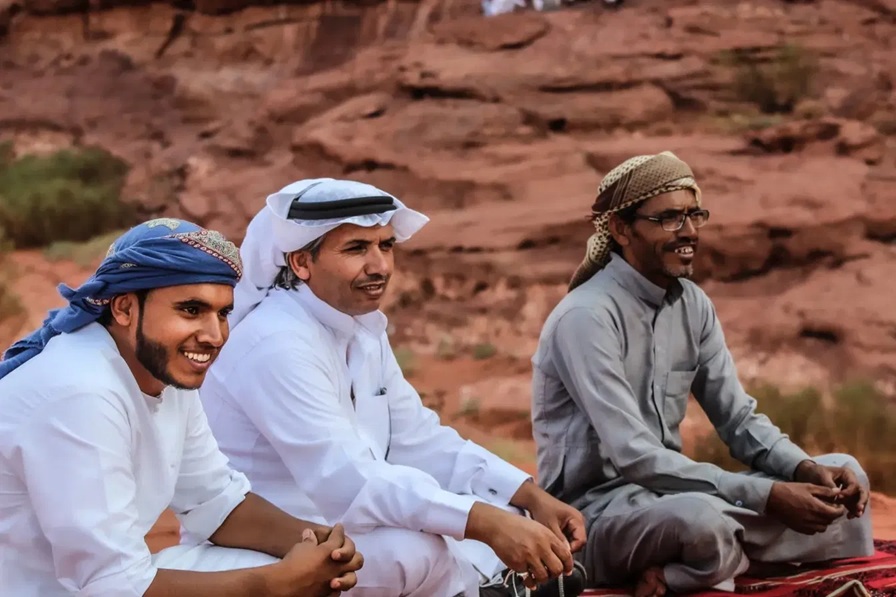
The Bedouin is one of the great romantic figures of the popular imagination: the tent in the open desert, the camel, the unbroken line back to a deep Arabian antiquity. Genetics turns the romance into something more precise and, in a way, more remarkable. The Bedouin, and above all the deep-desert cluster that the datasets label Bedouin B, really do carry the oldest layer of Arabian ancestry better than almost anyone alive. Their genome is built, to roughly seven parts in ten, from the Natufian autochthon: the pre-Neolithic, pre-Semitic, deeply West-Asian stock that the Arabian Peninsula has held onto, in its arid and isolated heart, since long before the Neolithic, long before the Bronze Age, and many centuries before the Prophet was born. On top of that ancient base sit two thinner layers, a Bronze Age eastern input that arrived with the spread of Semitic languages and the paternal lineage J1, and a late, light African layer from the last two thousand years. The headline, though, is the base. When people speak of a pre-Islamic Arabian signal, the Bedouin is where you go to read it.
- The Bedouin are the historically nomadic, camel-herding peoples of the Arabian and Syrian deserts. In the genetic datasets the HGDP Bedouin split into two clusters, here called Bedouin A and Bedouin B, and the two are not the same: Bedouin B is the deep-desert, Arabian extreme, while Bedouin A overlaps the settled Levant.
- The deep-desert Bedouin sit, among all ancient samples, closest to the Natufian and Chalcolithic Levant, within about 90 to 120 Global25 units, and far from the Anatolian farmers (about 200), the Iranian and Caucasus poles (about 290 to 310), Europeans, and Africans. The nearest living populations are other Arabians, Saudis and Yemenis.
- Modelled into deep streams, Bedouin B is about 70 percent Natufian autochthon, with roughly 12 percent Anatolian farmer and 18 percent Iranian or Caucasus farmer, and almost no African. That Natufian share is second only to the Mahra of Yemen (72 percent), and it is the pre-Islamic Arabian signal in numerical form.
- The Natufian share forms a clean gradient. It peaks in the deep desert and the far south (the Mahra of eastern Yemen, Bedouin B and the Saudis, all near 70 percent) and falls steadily toward the settled north Levant, where Anatolian and Iranian farmer ancestry dominate and the Druze sit near 16 percent Natufian.
- The work of Almarri et al. (2021) supplies the deep history: Arabians carry an excess of Natufian-like ancestry and an excess of Basal Eurasian ancestry, the legacy of a population that separated from the Levantines some 15,000 to 20,000 years ago and stayed small and isolated, with a bottleneck around the aridification of Arabia about 6,000 years ago.
- The eastern, Iranian-like slice is not an Islamic-era import. It spread south into Arabia in the Bronze Age, roughly 2,000 to 3,800 years ago, in step with the spread of the Semitic languages, and it carried the paternal lineage J1-M267 and its Arabian branch J1-P58, the iconic male marker of the peninsula.
- African ancestry in Arabians is real but late and thin. Almarri dates it to the last 2,000 years, mostly 500 to 1,000 years ago, from East African sources. In the deep-desert and Najdi averages it rounds to almost nothing; it rises toward the south-western coast, the Tihama and parts of Yemen.
- The 7th-century Arab expansions did not create this Arabian profile; they exported it. The pre-Islamic Arabian stock that the Bedouin preserve is the source-side of the ancestry that Islam then carried across the Fertile Crescent, Egypt and North Africa. The Bedouin are the living window onto what that ancestry looked like before it spread.
- Two honest cautions. The Natufian reference is a small, low-coverage average, and the Arabian populations carry a distinctive drift that no ancient source perfectly matches, so the model leaves a larger residual on the Bedouin than on the Levantines. And no ancient DNA from the interior of Arabia exists yet, so the deep Arabian pole is reconstructed, not sampled.
1. The romance and the real antiquity
The Bedouin have always carried a double image. To outsiders they are the timeless desert nomads, a people who supposedly preserve, in their tents and their genealogies, an Arabia untouched by the centuries. To the geneticist that image is half wrong and half, surprisingly, right. It is wrong in the literal sense: no living population is a frozen relic, and the Bedouin genome has layers, a Bronze Age one and a more recent African one, that were added long after any imagined origin. But it is right in a deeper sense than the romance intends. Of all the peoples one can sample today, the deep-desert Bedouin really do carry the oldest, most autochthonous layer of West-Asian ancestry in its highest concentration. The romance points, clumsily, at a real fact.
That fact is what this article is about, and it needs a name. The pre-Islamic Arabian signal is the ancient, pre-Neolithic ancestry of the Arabian Peninsula, the stock that was already there before farmers, before the Bronze Age, before Arabic and before Islam, and that the desert preserved more faithfully than the well-watered, much-travelled lands to the north. To read it, you do not look for a single gene or a single haplogroup. You look at the balance of the whole genome, and you ask which living population carries the most of the deepest layer. The answer, with unusual clarity, is the Bedouin.
2. Closest to the Natufian
Start with raw distances. The chart below measures how far the deep-desert Bedouin B average sits from a range of poles, ancient and modern. The pattern is the whole story in miniature. The nearest living populations are other Arabians, the Saudis a mere 16 units away, the Yemenis close behind. Among the ancient samples, the closest are the Chalcolithic and Natufian Levant, the deep autochthonous stock of the region. The Anatolian farmers are twice as far; the Iranian Neolithic and the Caucasus hunter-gatherers are three times as far; and the European and African poles are farther still. The Bedouin are not pulled toward Persia, not toward Anatolia, not toward Africa. They are anchored to the oldest layer of their own corner of the world.
Scaled Global25 distance from the deep-desert Bedouin B average to each pole, multiplied by 1000. The nearest poles are fellow Arabians and, among ancients, the Natufian and Chalcolithic Levant, the autochthonous stock of the region. The Anatolian, Iranian and Caucasus farmer poles are two to three times more distant, and the European and African poles farther again. The Bedouin signal points inward, to the deep West-Asian past, not outward.
3. Seventy percent autochthon
Distances show the direction; a stream model puts numbers on it. Following the framework that Almarri and colleagues used for the whole Middle East, each population can be broken into a small set of ancient streams: the Natufian autochthon of the Levant and Arabia, the Anatolian farmers who spread west and south out of what is now Turkey, the Iranian and Caucasus farmers of the Zagros, and a late African input. The result for the Bedouin is striking. The deep-desert Bedouin B is about 70 percent Natufian autochthon, second only to the Mahra of eastern Yemen (72 percent). Roughly 12 percent is Anatolian farmer and 18 percent Iranian or Caucasus farmer, and the African slice rounds to nothing.
Set the Arabian and Levantine populations side by side and the Natufian band behaves like a tide going out as you move north. It stands near 70 percent in the deep desert and the far south, the Mahra of eastern Yemen, the Bedouin B and the Saudis, and it ebbs steadily through the Najdi Saudis and the Hadramaut Yemenis, through the Palestinians and Samaritans, down to the Druze, where it is lowest and Anatolian farmer ancestry dominates. The same gradient, read the other way, is the dilution of the pre-Islamic Arabian signal by the farmer-rich ancestry of the settled, northern, much-conquered Levant. The desert kept the old balance; the sown land did not.
Deep ancestry of Arabian and Levantine populations, modelled in Global25 as Natufian autochthon, Anatolian farmer, Iranian or Caucasus farmer, and African. The Natufian band, the pre-Neolithic West-Asian stock, peaks in the deep desert and the far south and falls toward the settled north Levant. These are non-negative least-squares fits and best read as directions; the published qpAdm modelling of Almarri et al. (2021), using Levant Neolithic, Iranian Neolithic, steppe and an African source, gives the same shape and is the authority behind the headline.
4. Bedouin A is not Bedouin B
One detail matters enough to pull out on its own, because it is routinely lost. The single HGDP "Bedouin" label hides two genetically distinct clusters. Bedouin B, the one this article has been describing, is the deep-desert Arabian extreme: about 70 percent Natufian, the closest living thing to the pre-Islamic Arabian signal. Bedouin A is something else. At about 36 percent Natufian, with far more Anatolian and Iranian farmer ancestry and a touch more African, it sits essentially on top of the Palestinians, a settled, northern, cosmopolitan Levantine profile. The two Bedouin clusters are nearly 80 units apart in Global25, which is a real distance, larger than the gap between many neighbouring European nations.
The lesson is practical. Anyone who reaches for "Bedouin" as a single Arabian reference, without checking which cluster they have, is liable to get a Levantine answer when they wanted an Arabian one, or the reverse. The deep signal lives specifically in Bedouin B and its southern companions, not in the averaged or northern Bedouin. It is a useful reminder that population labels are coarse, and that the interesting structure is usually one level down.
The Natufian autochthon share, the pre-Islamic Arabian signal, across the gradient from deep desert to settled Levant. It peaks near 70 percent in Bedouin B and the far south and falls to about 16 percent in the Druze. Bedouin A, despite the shared name, sits with the settled Levantines, not with the desert Arabians. Read as directions; the exact split depends on the proxies chosen.
5. The Bronze Age layer, and the men who carried it
The roughly 30 percent of the Bedouin genome that is not Natufian autochthon is mostly an eastern, Iranian-and-Caucasus-like component, and it is tempting to assume it arrived with the great population movements of the Islamic era. It did not. The careful dating in Almarri et al. (2021) places the spread of this Iran-like ancestry into Arabia in the Bronze Age, roughly 2,000 to 3,800 years ago, moving on a north-to-south cline and overlapping in time with the origin and spread of the Semitic languages. It is a pre-Islamic layer, older than Arabic itself, older than Islam by a millennium or more.
The paternal record tells the same story in a different alphabet. The Y-chromosome lineage J1, and within it the Arabian branch J1-P58, is the signature male lineage of the peninsula, rising in frequency from the Zagros and Taurus, where its diversity is highest, toward the Arabian periphery, where it is most common. Chiaroni and colleagues (2010) read this as a southward founder-effect expansion of Neolithic and then pastoralist men, tied to the spread of Semitic and to the herders of the arid zones. So the eastern slice in the Bedouin genome and the J1 chromosomes that dominate Bedouin men are two views of the same Bronze Age event: a population that brought Iranian-like ancestry and a Semitic tongue into an Arabia whose deeper substrate was already, and would remain, overwhelmingly Natufian.
6. The African layer is late and light
The last and thinnest layer is African, and it is the one most often misjudged. There is a popular impression that Arabians, and Bedouins in particular, carry a large sub-Saharan component. The data say otherwise for the deep desert. Almarri et al. date essentially all African admixture in the Middle East to the last 2,000 years, with most signals falling between 500 and 1,000 years ago, drawn from East African sources, Bantu-speakers from the Kenya region and Nilo-Saharan speakers from the Ethiopian highlands. This is a medieval and post-medieval layer, squarely within the Islamic era, and entirely separate from the deep pre-Islamic signal.
In the populations modelled here, that layer is small. In the deep-desert and Najdi averages the African share rounds to nearly zero; even in the more southerly Yemeni samples it sits at a few percent. It rises, as one would expect, toward the south-western coast of Arabia, the Tihama and parts of Yemen with their long Red Sea contact, but it never approaches the deep ancestral layers in size. The honest summary is that the Bedouin genome is, first and overwhelmingly, an old West-Asian genome, with a real but minor and recent African addition layered late on top, not woven into its foundation.
7. Islam did not make this genome; it spread it
It is worth being explicit about the direction of cause, because it is easy to get backwards. The 7th-century Arab expansions carried Arabian ancestry, the Arabic language and Islam out of the peninsula and across the Fertile Crescent, Egypt and the whole of North Africa. When a modern Egyptian, Levantine or Maghrebi genome shows an Arabian pull, that is the trace of this outward movement. But the ancestry that moved was not created by the movement. It was already there, in the desert, ancient, when the expansions began. Islam was the vehicle; the pre-Islamic Arabian signal was the cargo.
That is what makes the Bedouin valuable as a genetic witness. They are, more than any settled population, the source-side proxy: the closest living approximation to what Arabian ancestry looked like before it was carried abroad and before the settled peninsula itself absorbed later inputs. To ask what the Arab conquests spread, in genetic terms, you look first at the deep-desert Bedouin, because they kept the oldest balance. The signal they carry is not a product of Islamic history. It is the thing that Islamic history set in motion.
8. When the proxy is soft
Two honest cautions belong on all of this. The first is about the references. The Natufian average that anchors the deep model is a small, low-coverage set of genomes, and the Arabian populations carry a distinctive drift of their own, the legacy of that long, isolated, bottlenecked history, that no available ancient source perfectly matches. The practical sign of this is that the model leaves a larger residual on the Bedouin than on the Levantines: the sources can place them, but cannot fully reproduce them, precisely because the deep Arabian autochthon is a thing we infer rather than sample. The high Natufian percentage is robust as a direction; the exact figure is soft.
The second caution is the familiar one of source degeneracy. The Natufian, the Levantine Neolithic and the Iranian Neolithic sit close enough together in the genetic space that a least-squares fit can shuffle some weight between them, so the precise split between Natufian and Iranian in any one population should not be over-read. Above all, there is still no ancient DNA from the interior of Arabia itself; the deep Arabian pole is reconstructed from the Levant and from the living desert, not yet sampled in the ground. What survives every caution is the shape, and the shape is firm: the Bedouin carry the pre-Islamic Arabian signal in its highest living concentration, an old West-Asian autochthon with a Bronze Age eastern layer and a late, light African one. The percentages will move with better Arabian ancient DNA. The story will not.
The story in steps
Claim and reality
The Bedouin are "pure Arabs", a population unchanged since deep antiquity.
No population is unchanged, and the Bedouin carry a Bronze Age eastern layer and a late African one. But the deep-desert Bedouin do carry the oldest, Natufian autochthonous layer in its highest living concentration, near 70 percent. They are not pristine; they are the closest living window onto the pre-Islamic Arabian base.
The Arabian genetic profile was created by Islam and the Arab conquests.
The opposite. The signal predates Islam by millennia: a pre-Neolithic Natufian base plus a Bronze Age eastern layer. The 7th-century expansions exported this pre-existing ancestry across the Near East and North Africa. Islam spread the genome; it did not make it.
The eastern, Iranian-like ancestry in Arabs came in with Islam from Persia.
It is older. The Iran-like layer spread into Arabia in the Bronze Age, roughly 2,000 to 3,800 years ago, with the Semitic languages and the J1-P58 paternal lineage, long before the Islamic era.
Bedouins are heavily Sub-Saharan African.
African ancestry is real but late and light. It dates to the last 2,000 years, mostly 500 to 1,000 years ago, from East African sources. In the deep desert and Najd it rounds to almost nothing; it rises only toward the south-western coast. The genome is overwhelmingly West-Asian.
"Bedouin" is a single Arabian reference you can use as one pole.
There are two distinct clusters. Bedouin B is the deep-desert Arabian extreme, about 70 percent Natufian; Bedouin A is a settled, Palestinian-like Levantine profile, about 36 percent. They are nearly 80 units apart. The deep signal is in Bedouin B specifically, not in the averaged label.
Reproduce it yourself
Paste these scaled Global25 coordinates into Vahaduo to reproduce the distances and models above. The main target is the deep-desert Bedouin B, with the other Arabians and the northern Levantines for the gradient. The deep model uses the Israel Natufian as the autochthonous pole, the Anatolia Neolithic and Iran Neolithic (Zagros) as the farmer poles, and Ethiopia 4500BP (Mota) as the African pole; the Chalcolithic Levant, the Caucasus hunter-gatherer and Somali are included for the distance comparisons. All coordinates are on the same Global25 scale. Treat every figure as a direction, not a last word, and remember that the published qpAdm modelling is the authority behind the headline.
BedouinB,0.041924,0.143923,-0.059815,-0.116981,-0.009318,-0.048062,-0.014101,-0.008743,0.05154,-0.005204,0.015869,-0.030573,0.062949,0.004855,0.004396,0.028853,-0.019971,0.00366,-0.004015,0.029,0.010967,0.01523,-0.003917,0.007103,-0.008309
BedouinA,0.028582,0.133599,-0.047601,-0.08276,-0.013883,-0.032351,-0.010706,-0.004641,0.023452,-0.00162,0.008173,-0.010724,0.024744,0.000474,0.001568,0.007057,-0.002738,-0.002238,-0.003408,0.008254,0.000208,0.002528,0.000192,0.001767,-0.001597
Saudi,0.053393,0.141712,-0.064899,-0.114607,-0.012422,-0.04693,-0.012242,-0.008727,0.050424,-0.005169,0.017405,-0.032426,0.06383,0.00314,0.003924,0.029037,-0.022568,0.004814,-0.001394,0.031481,0.013023,0.018154,-0.007462,0.008884,-0.010113
Saudi_Najd,0.058355,0.139236,-0.062099,-0.10831,-0.012883,-0.041101,-0.011535,-0.009101,0.048862,-0.002836,0.014403,-0.028644,0.058804,0.00385,0.00452,0.026069,-0.026184,0.004548,-0.000216,0.02558,0.009802,0.015019,-0.003869,0.004434,-0.007231
Yemeni_Mahra,0.054256,0.136081,-0.068259,-0.121197,-0.003727,-0.056305,-0.01303,-0.00882,0.06288,-0.002045,0.016798,-0.032571,0.065741,0.005841,0.008053,0.027078,-0.021064,0.002872,-0.001913,0.024831,0.013726,0.016089,-0.008737,0.002785,-0.005229
Yemeni_Hadramaut,0.022196,0.128972,-0.066939,-0.099969,-0.013233,-0.038905,-0.016686,-0.002192,0.052767,-0.006743,0.008119,-0.02278,0.051362,0.002615,0.004614,0.025325,-0.009388,0.003231,0.002388,0.023136,0.012104,0.005441,-0.00721,0.003193,-0.003054
Palestinian,0.045529,0.134253,-0.047329,-0.078005,-0.012649,-0.02973,-0.006228,-0.001985,0.016751,-0.00031,0.008184,-0.009636,0.020307,-0.001321,-0.00095,0.009745,-0.002008,-0.001761,8.8e-05,0.002539,0.001135,0.00528,-0.00016,0.002398,0.001844
Samaritan,0.085367,0.148674,-0.057398,-0.092508,-0.009602,-0.035029,-0.002209,-0.008169,0.016321,0.008237,0.009159,-0.009921,0.020485,0.011863,-0.005537,0.002121,-0.011239,0.001014,0.002112,-0.003652,-0.000524,0.003116,0.000567,-0.00294,0.004646
Druze,0.088782,0.140143,-0.048875,-0.072417,-0.013172,-0.023817,-0.001763,-0.004061,-0.001391,0.00687,0.005408,-0.003492,0.007522,8.3e-05,-0.006542,0.007398,-1.3e-05,0.000899,0.00455,-0.002376,-0.004205,0.002003,-0.001146,0.000374,0.00309
Israel_Natufian,0.020488,0.131003,-0.039221,-0.141475,0.027082,-0.0753,-0.017861,-0.025845,0.102671,-0.004556,0.030042,-0.020682,0.069573,-0.000963,0.020222,0.028772,-0.012647,0.008868,-0.021117,0.04252,-0.004243,-0.002597,-0.011955,-0.006386,0.011735
Israel_PPNB_Neolithic,0.07057,0.174671,-0.032809,-0.147612,0.03693,-0.068886,-0.018331,-0.00923,0.077719,0.043554,0.011205,-0.012589,0.0278,-0.006744,-0.02348,0.009944,0.02034,-0.008742,-0.001885,0.024637,0.000749,0.007048,-0.004807,-0.005422,-0.008742
Israel_Chalcolithic,0.0880991,0.1651251,-0.047643,-0.1353811,0.0135817,-0.0624529,-0.0113275,-0.0102918,0.0530262,0.0328268,0.0136732,-0.0151265,0.0326359,0.0054866,-0.0147031,0.0016176,-0.0033725,0.0034375,0.0036033,0.0109219,0.0027368,0.0093235,-0.0056283,-0.0027071,-0.0037121
Anatolia_Neolithic,0.1179017,0.1800873,0.0034255,-0.1010589,0.0512402,-0.0479692,-0.0037992,-0.006846,0.0361667,0.0806776,0.0082614,0.0113088,-0.0241636,0.0005791,-0.0427122,-0.0103696,0.0225564,0.0013883,0.0136487,-0.0104478,-0.0142612,0.0056932,-0.0049042,-0.0037505,-0.0044357
Iran_Neolithic_Zagros,0.0430252,0.0674312,-0.153488,0.0055556,-0.1239616,0.0243752,0.015464,0.000277,-0.081605,-0.05427,-0.0032476,-0.0016186,0.0053816,-0.0078446,0.0319486,0.056775,-0.0058154,0.007576,0.014405,-0.0327406,0.0076614,-0.0300476,-0.0109198,-0.0387768,0.0229438
Caucasus_HG_CHG,0.08992,0.103584,-0.088246,-0.004845,-0.089555,0.020359,0.023266,-0.001154,-0.130486,-0.080002,-0.007632,0.024878,-0.052626,0.007707,0.026465,-0.0297,0.027772,-0.010769,-0.023757,0.037518,0.030945,-0.006677,0.0053,-0.020846,0.001557
Ethiopia_4500BP_Mota,-0.517895,0.040621,-0.003017,-0.000646,-0.002154,-0.009761,0.057813,-0.049383,0.089172,-0.084375,-0.013803,-0.014987,-0.036571,-0.001651,0.02348,-0.030628,0.022817,0.041047,0.005279,-0.008629,0.00262,0.001855,-0.006039,0.001205,0.002515
Somali,-0.296623,0.093429,-0.026851,-0.069736,0.000954,-0.03408,-0.020493,0.005769,0.115392,-0.079674,-0.008948,-0.006669,0.005218,-0.001665,0.024728,-0.018616,0.014864,-0.001976,0.00998,-0.003839,0.000599,0.004946,-0.002736,-0.001241,-0.00279
References and sources
- 1 Almarri, M. A., Haber, M., Lootah, R. A., Hallast, P., Al Turki, S., Martin, H. C., Xue, Y., Tyler-Smith, C. The genomic history of the Middle East. Cell 184, 4612-4625.e14 (2021). Shows that Arabians carry an excess of Natufian-like and Basal Eurasian ancestry from a population that separated from Levantines about 15,000 to 20,000 years ago and stayed small and isolated; dates the spread of Iran-like ancestry into Arabia to the Bronze Age in step with the Semitic languages, and dates African admixture to the last 2,000 years. link
- 2 Lazaridis, I., Nadel, D., Rollefson, G., et al. Genomic insights into the origin of farming in the ancient Near East. Nature 536, 419-424 (2016). Sequences the Natufian and Neolithic Levantine, Anatolian and Iranian populations that define the deep streams of West Asia, and documents the Bronze Age arrival of Iranian-related ancestry in the Levant. link
- 3 Chiaroni, J., King, R. J., Myres, N. M., Henn, B. M., et al. The emergence of Y-chromosome haplogroup J1e among Arabic-speaking populations. European Journal of Human Genetics 18, 348-353 (2010). Documents the southward, founder-effect expansion of the J1 paternal lineage and its Arabian branch J1-P58 from the Zagros and Taurus toward the Arabian periphery, in step with Neolithic and pastoralist movements and the spread of Semitic languages. link
- 4 Global25 coordinates: Davidski (Eurogenes), with population averages from the public Global25 datasheets and the Moriopoulos 2025 collection. Global25 spreadsheet tooling: Vahaduo. G25
Ancient and modern Global25 coordinates: Davidski (Global25), with population averages from the public Global25 datasheets and the Moriopoulos 2025 collection. The deep-streams model uses the Israel Natufian as the autochthonous pole, the Anatolia and Iran Neolithic as the farmer poles and Ethiopia 4500BP (Mota) as the African pole; it is a non-negative least-squares fit and corroborates, in direction, the published qpAdm modelling of Almarri et al. (2021), which is the authority behind the headline figures. Global25 spreadsheet tooling: Vahaduo. Analysis: scaled Global25 Euclidean distances and non-negative least squares modelling in Python. Ancestry fractions are proxy-dependent and best read as directions rather than exact percentages; the Natufian reference is a small, low-coverage average, the Arabian populations carry a distinctive drift that no ancient source fully matches, and there is as yet no ancient DNA from the interior of Arabia, so the deep Arabian pole is reconstructed rather than sampled. The robust results, the highest living concentration of Natufian autochthon in the deep-desert Bedouin, a pre-Islamic rather than Islamic-era origin for the bulk of the genome, a Bronze Age eastern layer carrying J1, and a late, light African layer, are consistent across the distances, the deep model and the published study. Y-chromosome and population labels are single inherited lines and carry no information about any living person's identity, character, faith or worth.