
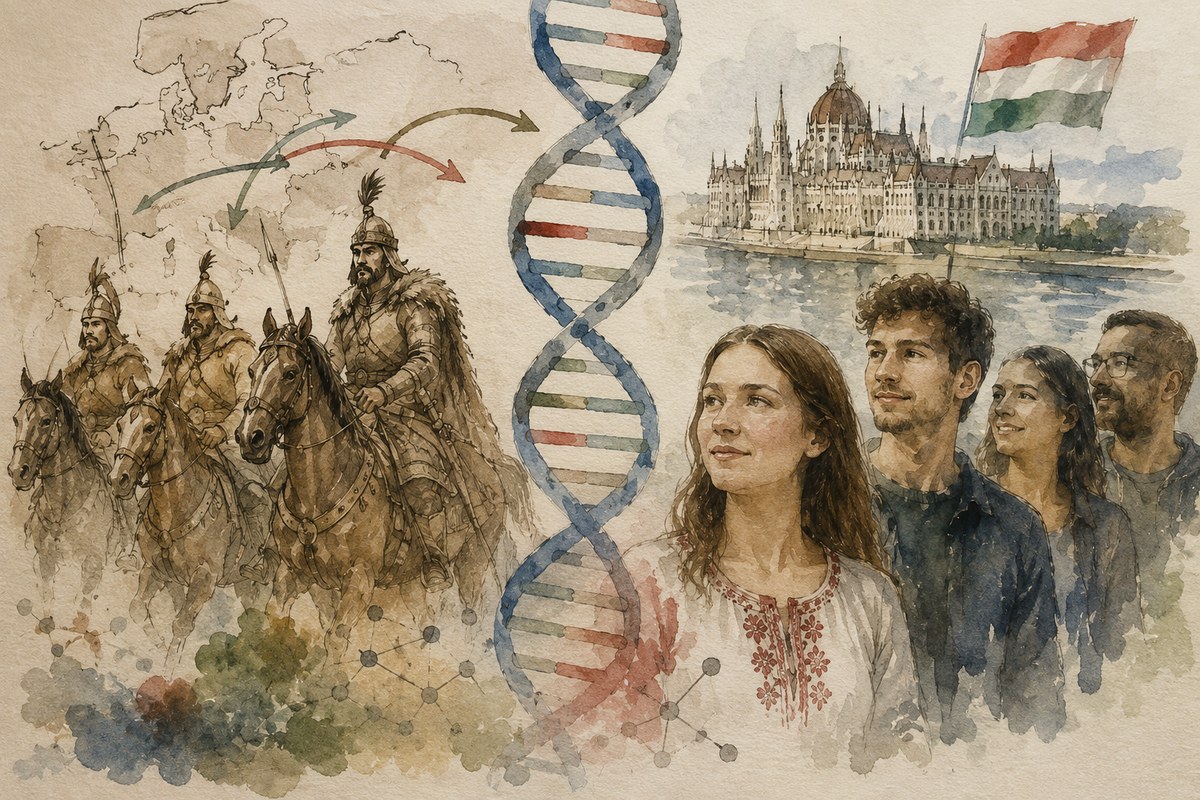
Around the year 895 a confederation of horse-riding tribes crossed the Carpathians and seized the great plain of the middle Danube. They brought a language unlike anything spoken around them, a steppe military aristocracy, and ancestry that still carried the marks of the Eurasian grasslands and the forests beyond the Urals. We have already followed that arrival. This article looks at the mirror image: what became of the conquerors afterward. The short answer is that the Magyars won the country and lost the gene pool. A modern Hungarian sits squarely among Central Europeans, a short genetic step from a Croat, a Slovene or an Austrian. The conquering elite, even at the moment of conquest, was already about half European, and its commoners more European still. From there, eleven centuries of marriage into a larger resident population diluted the eastern ancestry down to a trace. The language stayed whole. The genome became Central European.
Key points
- The conquering Magyars were a society, not a uniform population. The published groupings of the new Carpathian Basin genomes separate a conqueror Elite, a conqueror Commoner population and the slightly later Early Arpadian period, and they form a clean line from east to west.
- Even the conqueror Elite was only about half eastern. Modelled against a far-eastern (Asian Hun) pole it draws roughly 50 percent eastern ancestry; on Global25 it sits about 150 units from a modern Hungarian, the same distance as the Volga Tatars. It was a mixed aristocracy, not a band of pure steppe nomads.
- The conqueror Commoners were already about four fifths European (around 20 percent eastern), and the Early Arpadian population about 7 percent eastern. The dilution is a smooth descending staircase: roughly 50, then 20, then 7 percent.
- Modern Hungarians carry an eastern fraction that the method cannot resolve from zero: one or two percent at most. They sit nearest to Croats (about 11 units), Slovenes (14), Austrians (17) and Czechs (18).
- The deep foundation (early farmer, steppe, hunter-gatherer) is identical in Hungarians and their neighbours: roughly two fifths Anatolian Neolithic, just under half steppe, a tenth Western hunter-gatherer. The Magyar episode left it untouched.
- The far-eastern pole of the story, the Asian Hun reference individuals, sits about 230 to 250 units from a modern Hungarian. That is the steppe end of the line. Modern Hungarians are at the opposite, European end.
- The eastern legacy is real but lives mostly in uniparental lineages and a thin haplotype trace, estimated in the literature at under one tenth of the modern gene pool. Autosomally, modern Hungarians show less resolvable Siberian signal than Russians, Estonians or Finns.
1. A conquest, and what came after
The Hungarian conquest (the honfoglalas) is one of the best documented arrivals in early medieval Europe. A tribal confederation led by the house of Arpad moved off the Pontic steppe, through the lands north of the Black Sea, and into the Carpathian Basin at the close of the ninth century. They were mounted, mobile and militarily formidable, and within two generations they had raided deep into Western Europe before settling, Christianising under Stephen I around the year 1000, and founding a kingdom that would last a thousand years. The language they carried, Hungarian, is Uralic, a relative of distant Mansi and Khanty speech beyond the Urals and of Finnish and Estonian far to the north. It survived intact and is spoken by some thirteen million people today, a Uralic island in a sea of Slavic, Germanic and Romance.
The genome tells a quieter story than the language. To see it we ask three questions. Who were the conquerors, genetically? Where do modern Hungarians actually sit? And what happened in between to turn the one into the other? The answer to the last question is the oldest process in population history: dilution into a larger resident population.
2. The basin was already full
The Magyars did not ride into an empty land. The Carpathian Basin in 895 held the remnants of the Avar Khaganate, itself a layered society of an East Asian-derived elite over a large Slavic and local European majority, together with Roman provincial descendants, Gepids and other groups. Every line of evidence, archaeological, anthropological and genetic, points the same way: the resident population was substantially larger than the incoming confederation. The conquerors were a military and political aristocracy, not a folk migration that replaced the people on the ground. From the first generation, then, the eastern ancestry they brought was a minority ingredient poured into a much larger European pot. Dilution did not begin centuries later. It began at the conquest.
3. The conquerors were a society, not a race
The single most useful thing about the new Carpathian Basin genomes is that they can be sorted by social position and date. The published groupings distinguish a conqueror Elite (the richly furnished burials of the settling aristocracy), a conqueror Commoner population (the ordinary village dead of the same generations), and the Early Arpadian period that follows, around the year 1000. Read in order, they are a story in themselves.
The conqueror Elite is the most eastern of the three, and yet it is already a mixture. Modelled against a far-eastern Asian Hun pole on a European base, it draws roughly half its ancestry from the east and half from Europe. On Global25 it sits about 150 units from a modern Hungarian, almost exactly the distance to the modern Volga Tatars, and a long way short of genuinely Siberian populations such as the Mansi (about 310 units) or the Bashkirs (about 235). This matches the picture from the foundational work on the conquest genomes: the immigrant core was an older admixture of Mansi, early Sarmatian and late Xiongnu ancestry, but by the time it reached the Danube it had already taken on a great deal of European ancestry along the way. The Elite was a steppe aristocracy with one foot already in Europe.
The Commoners are more European still. They draw only about a fifth of their ancestry from the eastern pole and sit about 77 units from a modern Hungarian, nearest among living groups to Austrians and Hungarians. The eastern signal, in other words, was concentrated in the elite and was already thin among the ordinary conquerors. By the Early Arpadian period the eastern share has fallen to roughly 7 percent, and the population sits about 60 units from a modern Hungarian, essentially within the Central European range.
4. Where modern Hungarians actually sit
Now ask what a modern Hungarian is nearest to. The answer is unambiguous and it is Central European. The distances below are scaled Global25 Euclidean distances (multiplied by 1000) from the modern Hungarian average to a panel of neighbours and to the conquest-era ladder.
| From modern Hungarian to | G25 distance (x1000) | nature |
|---|---|---|
| Croatian | 11.3 | Central European neighbour |
| Slovenian | 14.4 | Central European neighbour |
| Austrian | 16.5 | Central European neighbour |
| Czech | 18.1 | Central European neighbour |
| Slovakian | 28.3 | Central European neighbour |
| Serbian | 32.2 | South Slavic neighbour |
| Polish | 36.0 | West Slavic neighbour |
| Early Arpadian (about 1000 CE) | 59.7 | post-conquest population |
| Conqueror Commoner | 77.2 | ordinary conquest-era dead |
| Conqueror Elite | 150.6 | conquest-era aristocracy |
| Asian Hun (KRY001) | 226.4 | far-eastern steppe pole |
| Asian Hun (HUN001) | 248.6 | far-eastern steppe pole |
There is a clear gap in that table. Every European neighbour sits within about 36 units. Then the conquest-era ladder climbs away: the Early Arpadian population at 60, the Commoners at 77, the Elite at 151, and the far-eastern Asian Hun pole beyond 226. A modern Hungarian is more than five times closer to a Croat than to the conqueror Elite, and more than twenty times closer than to the Asian steppe. Whatever the language preserved, the autosomes settled into Central Europe.
5. The dilution, as a descending staircase
Put the eastern share of each rung side by side and the dilution becomes a single clean descent. The eastern fraction is read against a far-eastern Asian Hun pole on a European base; the exact figures are proxy-dependent, so read them as a falling sequence rather than as precise percentages.
Eastern ancestry falls at every step, from the elite to the present
The eastern share that defined the aristocracy was already only about half. Among the ordinary conquerors it was a fifth, by the Early Arpadian period a fifteenth, and in the modern average it sits at the limit of what Global25 can resolve from zero. The eastern ancestry was not erased in a single event; it was steadily married out of the average.
The conquest-era ladder also reads as time and class at once: the aristocracy carried the most eastern ancestry, the commoners much less, and each later generation less again, as the small conquering population kept marrying into the much larger resident one.
6. The residual eastern signal, honestly
Does anything of the steppe survive in the autosomes of an average modern Hungarian? Very little that this method can resolve. When we model modern Hungarians on a deep European base (Anatolian Neolithic, steppe, Western hunter-gatherer) and offer an additional Siberian or Ugric source, the eastern weight returned is not distinguishable from zero. That is not a proof that it is exactly zero; it means any genuine eastern fraction is small enough to sit below the noise floor of Global25, on the order of one or two percent at most.
The contrast that gives this meaning is with other Europeans who do carry a resolvable eastern signal. Offered the same Ugric (Mansi) source, eastern Finns take about 14 percent, Estonians a few percent, and western Russians a small but real amount. Modern Hungarians take less than any of them. The people whose language points east show less eastern autosomal ancestry than several populations whose languages point firmly west.
Resolvable eastern (Siberian/Ugric) signal in the modern average
Bars show the eastern weight a deep European-plus-Siberian model assigns to each population. The modern Hungarian average lies among the populations with no resolvable signal, below the Estonians and well below the Finns, and far below the conqueror Elite. The legacy of the conquest is not gone, but autosomally it is a whisper.
7. The foundation never changed
Strip away the recent layers and look at the deep ancestry every European carries in some proportion: early Anatolian farmers, steppe pastoralists of the Bronze Age, and the older Western hunter-gatherers. On this foundation Hungarians are indistinguishable from their neighbours. The Magyar episode, dramatic in politics and decisive for language, barely touched the base.
Deep ancestry: Hungarians and neighbours share one foundation
All four populations resolve to roughly two fifths early farmer, just under half steppe, and about a tenth hunter-gatherer. This is the common Central European foundation, in place for some four thousand years. The conquest added nothing visible to it.
8. Where the legacy does survive
None of this means the conquest left no genetic trace. It means the trace is concentrated and faint rather than diffuse and strong. The clearest survivals are in the uniparental record: a scatter of paternal lineages such as the N-Tat group, characteristic of populations around the Urals and in Siberia, and a handful of maternal lineages of East Eurasian origin, persist at low frequency in Hungarians and at slightly higher frequency in the Szekely of Transylvania. Even there the numbers are small: a Siberian-linked paternal marker that reaches roughly an eighth in Volga-Ural and west Siberian populations is found in only a few percent of Szekely men and is essentially absent in the surrounding Indo-European populations. Haplotype-based work converges on the same order of magnitude, placing the total conqueror contribution to the modern Hungarian gene pool below one tenth.
So the legacy is genuine, and it is exactly the kind a small, militarily dominant but demographically minor population leaves behind: a preserved language, a founding dynasty and national memory, and a thin genetic thread that shows up best in specific lineages rather than in the autosomal average. The conquerors shaped the country far more than they shaped its genome.
9. So, are modern Hungarians the descendants of the Magyars?
Yes, and the qualification is the whole point. They are descendants of the conquerors in the way most modern nations descend from their founding elites: partly, and dilutely. A modern Hungarian almost certainly carries some ancestry from the people who rode in around 895, just as they carry ancestry from the Avars, the Slavs, the Romans and the Bronze Age farmers who were already there. But the conquering elite was only half eastern to begin with, its commoners less still, and the population it married into was larger from the first day. Eleven centuries later, the distinctive steppe ancestry has been folded down to a trace. What the Magyars transmitted in full was not their genome but their language and their state. The genome of a modern Hungarian is the genome of Central Europe; the tongue is the one thing the conquerors kept whole.
The story in six steps
Claim and reality
Modern Hungarians are an Asian or steppe people, set apart from their neighbours by the blood of the conquerors.
At the genome-wide level modern Hungarians are Central Europeans, nearest to Croats, Slovenes, Austrians and Czechs. Even the conqueror Elite lies about 150 units away, and the Asian steppe pole beyond 226.
The conquerors were pure steppe nomads of Asian ancestry.
The conqueror Elite was already about half European; its Commoners only about a fifth eastern. The steppe ancestry was concentrated in the aristocracy and was a mixture even there.
Because the language came from the east, the people must carry heavy eastern ancestry.
Language and genes parted ways. The Uralic language survived in full; the eastern autosomal signal is below the noise floor of Global25, smaller than what Finns, Estonians or Russians carry.
The conquest left no genetic trace at all.
A real but minor trace survives, mostly in uniparental lineages such as the Siberian-linked N-Tat paternal group, estimated at under one tenth of the modern gene pool and best seen in the Szekely.
Reproduce it yourself
Paste the coordinates below into Vahaduo (the Global25 tool by Piotr Kapuscinski) to rebuild the comparisons in this article: the conquest-era ladder (Elite, Commoner, Early Arpadian), the far-eastern Asian Hun references, the modern Hungarian average and its Central European neighbours, and the eastern references (Bashkir, Mansi). Conqueror and Hun coordinates are the scaled Global25 averages for the published groupings; modern averages were computed from the Global25 individual coordinates.
Hungarian_modern_avg_(n=14),0.127075,0.129625,0.0553559,0.0364298,0.0363804,0.0119326,0.00661379,0.00753264,0.00205971,-0.00467307,-0.00147307,-0.00271907,0.00385443,0.00874879,-0.00437221,0.000123071,-8.4e-05,-0.000389143,0.00264864,-0.00132214,-0.003378,0.0013865,0.00552857,0.00269393,0.000478929
Croatian_modern_avg_(n=10),0.128051,0.133847,0.0518917,0.0314925,0.035822,0.0125223,0.0060161,0.0067381,0.0018408,-0.0058862,-0.001153,-0.0023827,0.0047275,0.0127851,-0.0066365,-0.0022011,0.0027512,-0.0007223,0.0018101,-0.0007503,-0.005166,-0.0024236,0.0044246,-0.0010966,0.0001796
Austrian_modern_avg_(n=17),0.129089,0.135006,0.054394,0.032737,0.0347756,0.0125666,0.00722994,0.00624412,0.00282741,0.00275506,-0.00387812,0.000784706,-0.00129418,0.00278488,0.000502941,0.00369682,0.000222294,0.00079,0.00317929,0.000838471,-0.000990882,-0.00265482,0.00166747,0.00296271,-0.00102835
Bashkir_modern_avg_(n=31),0.0905077,-0.102306,0.0636604,0.0317582,-0.0361655,-0.00298681,0.00864226,0.0111657,-0.00764,-0.0200813,0.00295968,-0.00403674,0.00984997,-0.0193027,-0.00503032,-0.00300671,-0.00261606,-0.00106258,-0.00330065,-0.00256171,-0.00834826,0.00149977,-0.00224235,0.00137597,-0.00185032
Mansi_modern_avg_(n=7),0.0858551,-0.166257,0.10915,0.0617391,-0.0731126,-0.0220721,0.00896386,0.0169443,0.00125629,-0.034833,0.0522891,-0.00383229,0.0196231,-0.0715246,-0.0247981,-0.0130504,0.000596143,-0.00128486,-0.00583586,-0.0123809,-0.00267386,0.0235293,0.0147899,-0.00364929,-0.00692829
Hungary_Conqueror_Elite,0.092388,0.099011,0.061471,0.039406,0.001231,-0.000279,0.025382,-0.054921,-0.044178,-0.063783,0.005846,-0.005246,-0.001932,-0.075004,0.020766,0.014717,0.025558,0.011656,-0.000503,-0.005378,-0.010607,-0.005935,-0.012448,-0.00012,-0.001078
Hungary_Conqueror_Commoner,0.108132,0.122879,0.067128,0.040698,0.027082,0.012829,0.022797,-0.011077,-0.012704,-0.022416,-0.001624,-0.001049,-0.014123,-0.038534,0.025108,0.020817,0.014211,0.005321,0.000378,-0.001501,-0.001247,0.001855,-0.001725,0.005181,-0.001317
Hungary_EarlyArpadian,0.122929,0.131003,0.067128,0.052972,0.0397,0.018407,0.008695,0.008307,0.000409,-0.005285,-0.005034,0.005096,-0.020366,-0.025735,0.020766,0.011667,0.010561,0.005321,0.000503,0.001751,0.003244,-0.005935,-0.006902,0.009519,-0.001317
Hungary_Hun_Elite_HUN001,0.034277,-0.011171,0.026411,0.064277,-0.062781,-0.001674,0.005405,-0.077306,-0.041313,-0.078726,-0.014616,-0.005246,0.016947,-0.058353,0.022122,0.028108,0.018384,0.005954,-0.001886,-0.001626,-0.013601,0.000247,-0.012079,-0.000241,-0.005029
Kazakhstan_Hun_Elite_KRY001,0.04452,0.001016,0.034329,0.045543,-0.046162,0.006972,0.000235,-0.06692,-0.046222,-0.075626,-0.009094,-0.004496,0.014568,-0.061659,0.025108,0.026518,0.014602,0.005321,-0.001886,-0.000625,-0.012102,-0.001978,-0.014666,-0.007109,-0.005269
References and sources
- 1 Maroti, Z., Neparaczki, E., Schutz, O., et al. (2022). The genetic origin of Huns, Avars, and conquering Hungarians. Current Biology 32, 2858 to 2870. link
- 2 Neparaczki, E., Maroti, Z., Kalmar, T., et al. (2018). Mitogenomic data indicate admixture components of Central-Inner Asian and Srubnaya origin in the conquering Hungarians. PLoS ONE 13, e0205920. link
- 3 Post, H., Neparaczki, E., et al. (2019). Y-chromosomal connection between Hungarians and geographically distant populations of the Ural Mountain region and West Siberia. Scientific Reports 9, 7786. link
- 4 Fothi, E., Gonzalez, A., Feher, T., et al. (2020). Genetic analysis of male Hungarian Conquerors: European and Asian paternal lineages of the conquering Hungarian tribes. Archaeological and Anthropological Sciences 12, 31. link
- 5 Borbely, N., Dudas, D., Tapaszto, A., et al. (2024). Phylogenetic insights into the genetic legacies of Hungarian-speaking communities in the Carpathian Basin. Scientific Reports 14, 11480. link
- 6 Gnecchi-Ruscone, G. A., et al. (2022). Ancient genomes reveal origin and rapid trans-Eurasian migration of 7th century Avar elites. Cell 185, 1402 to 1413. link
- 7 Akbari, A., et al. (2026). Published Carpathian Basin genomes spanning the Avar, Magyar conquest, Carolingian and early Hungarian village periods, used here for the conqueror Elite, Commoner and Early Arpadian groupings. aDNA dataset
Modern and ancient G25 coordinates: Davidski (Global25) and published Carpathian Basin aggregates (conqueror Elite, Commoner, Early Arpadian and Asian Hun groupings). Global25 spreadsheet tooling: Piotr Kapuscinski (Vahaduo). Modern population averages computed from Global25 individual coordinates. Analysis: scaled Global25 Euclidean distances and non-negative least squares modelling in Python. Eastern fractions are proxy-dependent and read as a falling sequence rather than exact percentages.