
Population genetics · North Africa · Canary Islands · Amazigh
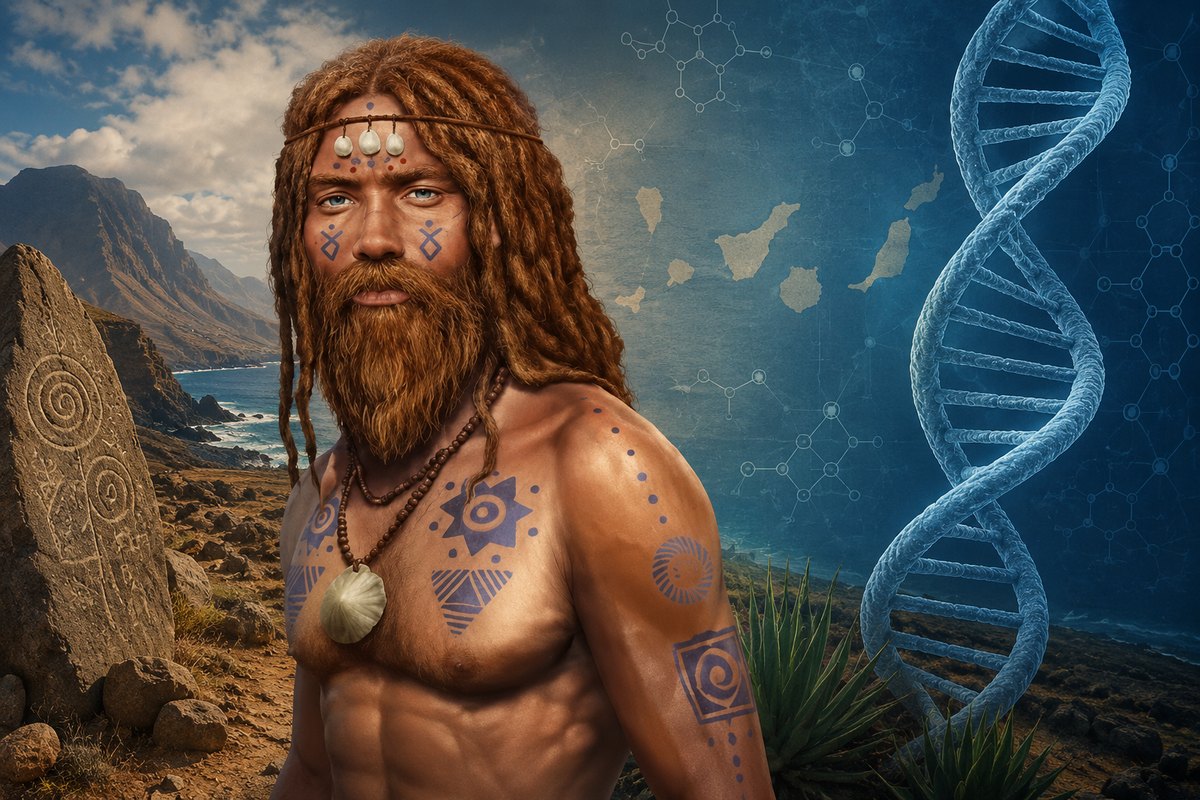
For five centuries the indigenous Guanches of the Canary Islands, sometimes fair-haired and blue-eyed, building rock-cut tombs on islands scattered beyond the Pillars of Hercules, fed one of the most durable origin myths of the Atlantic: that they were the last survivors of a sunken Atlantis. Ancient DNA has now closed the question. The Guanches were Amazigh (Berber) colonists from Northwest Africa who reached the archipelago in Late Antiquity, and today's population (Spanish_Canarias) is what remained after the Castilian conquest layered Iberian ancestry on top of theirs.
- Pre-Hispanic Guanche genomes cluster with present-day Northwest Africans (Amazigh / Berber), not with any European or "lost civilization" source.
- Their ancestry is the classic Maghrebi mosaic: a dominant endemic Iberomaurusian (Taforalt-related) base, a substantial Anatolian / Early European farmer component, and a minor Sub-Saharan fraction comparable to modern North Africans.
- Settlement signals begin around the 3rd century CE; island isolation produced founder effects and a subtle east-to-west structure.
- The Castilian conquest (1402 to 1496) added strong, sex-biased Iberian gene flow: European Y lineages rose while indigenous mtDNA lineages (U6, L) persisted.
- Modern Gran Canarians retain roughly 16 to 31% Guanche autosomal ancestry; Spanish_Canarias sits far from the Guanche centroid along PC1, the African to European axis.
- No "ghost" or unaccounted ancestry exists in any Guanche genome. The Atlantis hypothesis fails the only test that matters.
1. Atlantis beyond the Pillars of Hercules
Plato placed Atlantis in the Timaeus and the Critias (around 360 BCE): a great island beyond the Pillars of Hercules, the strait we now call Gibraltar, swallowed by the sea "in a single day and night". The Canary Islands sit almost exactly where the myth points, in the open Atlantic off the African coast. When Renaissance and then nineteenth and twentieth century writers met the islanders in the historical record, tall and robust, some blond and blue-eyed, building megalithic structures and carving spiral rock-art, isolated on mid-Atlantic islands with no boats of their own, the romantic conclusion almost wrote itself: the Guanches were surviving Atlanteans.
The beauty of the question is that it is testable. If the Guanches descended from a vanished Atlantic civilization, their genomes should carry an ancient, unplaceable component, something that cannot be reduced to the known African, European and Near Eastern sources, and ideally shared with other supposed "Atlantic survivors". Paleogenetics can check this prediction directly, and either the ghost is there or it is not.
2. Amazigh roots and a Late Antique colonization
Genome-wide analyses of pre-conquest individuals from across the archipelago place Guanche ancestry closest to Northwest Africa, the Amazigh / Berber genetic sphere, with minor inputs from earlier Eurasian farmers and a trans-Saharan source. Across every ADMIXTURE K value the Guanches behave like modern Berbers, and a Northwest-African-specific component makes up the greatest share of their autosomal ancestry, the same component that dominates in present-day Mozabite and Saharawi Berbers. Uniparental markers agree: Y-chromosome E1b1b is characteristic, and mitochondrial lineages include the autochthonous North African U6b1a alongside H, J, T and Sub-Saharan L lineages.
Archaeology and linguistics align with the genetics. Libyco-Berber inscriptions, the material culture, and the settlement record point to colonization from the Maghreb during Late Antiquity, with the first clear signals appearing around the 3rd century CE.
Northwest Africa carries an endemic Iberomaurusian (Taforalt-type) base overlaid with Neolithic farmer and minor Sub-Saharan ancestry. This is the source pool of the future islanders.
Around the 3rd century CE, Amazigh groups reach the archipelago. The genetic signal is a clean transplant of a Maghrebi population, with no exotic admixture event.
For more than a millennium the islands stay isolated, with little inter-island mobility. Founder effects amplify, producing small but consistent east-to-west differences between island groups.
The Castilian conquest (1402 to 1496) brings sustained, sex-biased Iberian gene flow. European Y lineages rise sharply while indigenous mtDNA lineages persist.
3. The genetic profile: a Maghrebi population, not a ghost
When the Guanche genomes are decomposed against ancient reference populations, every component lands on a known, dated source. The base is the endemic Iberomaurusian ancestry best represented by Taforalt (the ~15,000 year old Moroccan hunter-gatherers), the correct clean reference for autochthonous Maghrebi ancestry. On top of that sits a clear Anatolian / Early European farmer (EEF) component that entered North Africa during the Neolithic, plus a minor genuine Sub-Saharan (trans-Saharan) fraction at the level seen in present-day North Africans and in Late Neolithic Moroccans. The Taforalt base itself, however, has just been reframed by the 2025 Takarkori genomes from the Central Sahara, and that reframing matters for how the "African" signal should be read (see the note below).
These proportions are literature-calibrated (Rodriguez-Varela 2017; Fregel 2018; Salem 2025) rather than a single raw NNLS run, and the reason is worth spelling out. The older 2018 model decomposed Taforalt as roughly 63.5% Natufian-related plus about one third "Sub-Saharan". The 2025 Takarkori genomes from the Central Sahara overturn that label: the secondary component of Taforalt is not Sub-Saharan but a deeply divergent, autochthonous North African lineage that split off around the time of the out-of-Africa dispersal and stayed isolated. Takarkori and the Iberomaurusians are equally distant from Sub-Saharan groups, so gene flow from south of the Sahara into the Maghrebi base was minimal.
This has a direct modeling consequence. Commercial qpADM and G25 NNLS panels do not yet include Takarkori, so they have no handle for this ancient North African ancestry and force-fit it onto Sub-Saharan proxies. The fits look statistically excellent but are misleading: most of the "African" affinity in Taforalt-derived populations like the Guanches is this endemic divergent lineage, not Sub-Saharan admixture, which is why the genuine Sub-Saharan (trans-Saharan) fraction shown above is small. The point for the Atlantis question only sharpens: the one truly "unknown" lineage ancient DNA has turned up here is not Atlantean but an ultra-deep, homegrown North African one.
4. Island isolation: founder effects and east-to-west drift
A time transect across the islands (3rd to 16th century CE) shows strong island isolation and a subtle east-to-west differentiation. Limited inter-island mobility amplified founder effects, producing small but consistent differences between Guanche groups from island to island.
The G25 panel makes the tightness visible. Across 33 Guanche individuals the within-group dispersion is only about 0.16 weighted units around the centroid, with a narrow PC1 spread from roughly -0.061 to -0.010, all on the African side of the axis. One sample (CAN.009) sits at a strongly negative PC2 against a positive cluster median and was excluded as a projection outlier rather than a genuine signal.
5. Conquest and sex-biased admixture
After the Castilian conquest of the fifteenth century, autosomal data register substantial Iberian gene flow. Uniparental markers reveal a sex-biased pattern: European Y lineages (such as R1b) increase sharply, while mtDNA retains a higher share of pre-Hispanic lineages (U6, L), exactly the signature expected from a colonization dominated by incoming men.
On Davidski-weighted Euclidean distance (PC1=10 down to PC5=2), modern Spanish_Canarias sits about 1.19 units from the Guanche centroid, versus an internal Guanche dispersion of only ~0.16, a roughly sevenfold gap. Almost the entire distance is carried by PC1, the Sub-Saharan-to-Eurasian / African-to-European axis: the Guanche centroid sits near PC1 = -0.035 while Spanish_Canarias sits at PC1 = +0.081. That single coordinate is the post-conquest Iberian pull made numerical.
6. Myth and reality
The Guanches were the last survivors of Atlantis, a vanished Atlantic civilization beyond the Pillars of Hercules. Their fair hair, blue eyes and island isolation prove a non-African, pre-deluge origin that ordinary history cannot explain.
The Guanches were Amazigh colonists from Northwest Africa who arrived around the 3rd century CE. Light pigmentation occurs at low frequency across North African Berbers and traces to ordinary European-farmer and back-to-Africa ancestry. Every genomic component resolves to a known, dated source, and no ghost population exists in any Guanche genome.
7. Modern Canarians: related, not identical
Present-day Spanish_Canarias individuals are shifted toward Iberians relative to the ancient Guanche genomes, yet they preserve a measurable Guanche legacy: roughly 16 to 31% indigenous autosomal ancestry in Gran Canaria, retained more strongly in the maternal (mtDNA) line than the paternal (Y-DNA) one. Centuries of European input, plus maritime Mediterranean and Atlantic contacts, forged a new island-specific profile, related to the Guanches but genetically distinct from them. The islanders are not the heirs of a lost continent. They are the heirs of a North African people, half-overwritten by a fifteenth-century conquest, and that real story is the more remarkable one.
G25 Coordinates
A representative subset is shown above. The full 33-sample Guanche panel plus Spanish_Canarias is available on request.
Sources
- Rodriguez-Varela, R., Gunther, T., Krzewinska, M. et al. (2017). Genomic Analyses of Pre-European Conquest Human Remains from the Canary Islands Reveal Close Affinity to Modern North Africans. Current Biology 27, 3396-3402. cell.com Guanche aDNA Berber affinity
- Fregel, R. et al. (2018). Ancient genomes from North Africa evidence prehistoric migrations to the Maghreb from both the Levant and Europe. PNAS 115, 6774-6779. pnas.org IAM / KEB Neolithic Maghreb
- van de Loosdrecht, M. et al. (2018). Pleistocene North African genomes link Near Eastern and sub-Saharan African human populations. Science 360, 548-552. Taforalt Iberomaurusian
- Salem, N., van de Loosdrecht, M. S., Sumer, A. P. et al. (2025). Ancient DNA from the Green Sahara reveals ancestral North African lineage. Nature 641, 144-150. nature.com Takarkori Divergent North African lineage
- Serra-Vidal, G. et al. (2019). Heterogeneity in Palaeolithic Population Continuity and Neolithic Expansion in North Africa. Current Biology 29, 3953-3959. cell.com NW Africa structure
- Ancient and early-modern genomes from the Canary Islands (2023). Nature Communications. nature.com Island drift Sex-biased admixture
- Maca-Meyer, N. et al. (2004). Ancient mtDNA analysis and the origin of the Guanches. European Journal of Human Genetics 12, 155-162. mtDNA U6
- Davidski, A. (ongoing). Global25 scaled coordinates, Eurogenes Blog, used as the reference panel for all G25 distances here. eurogenes.blogspot.com G25 panel