
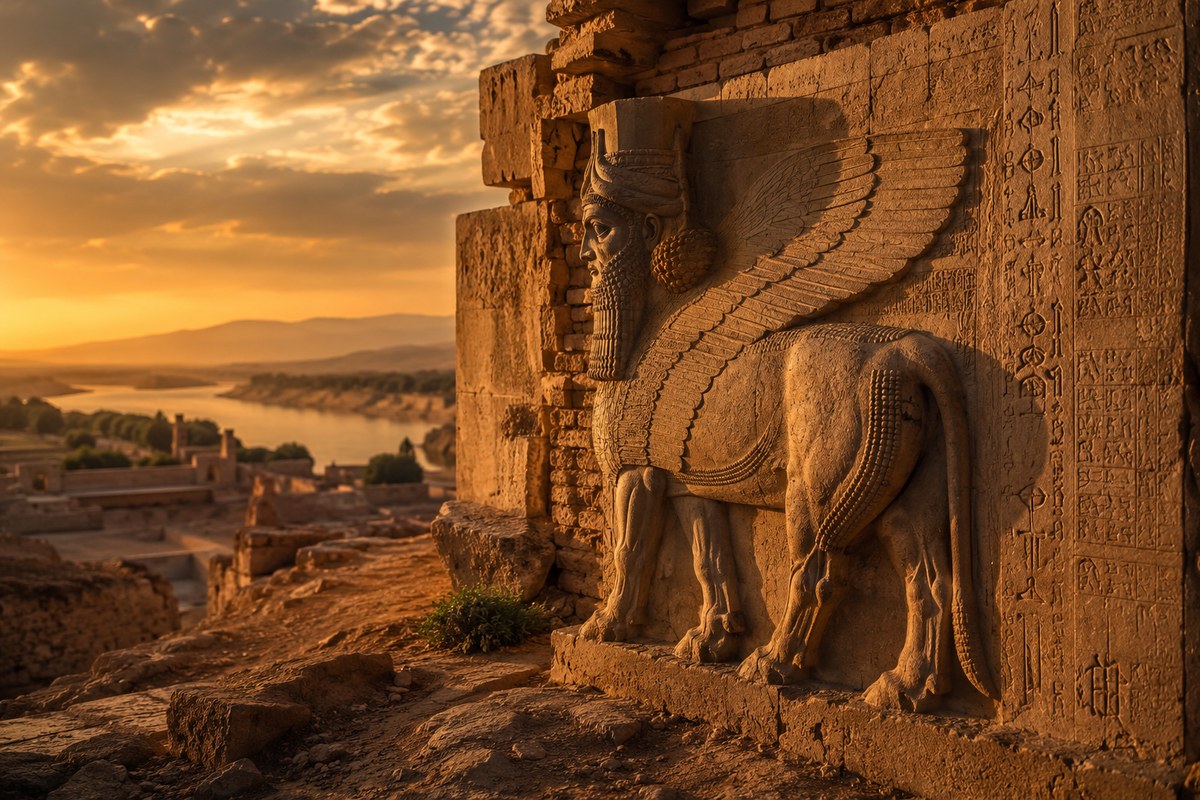
Modern Assyrians, Chaldeans and Syriacs, the Christian Aramaic-speaking communities of northern Iraq, north-eastern Syria, south-eastern Turkey and north-western Iran, describe themselves as the direct heirs of the people who built Nineveh, Ashur and Babylon. It is a claim with real political weight: it underwrites a homeland argument, a case for minority protection, and a distinct identity separate from the Arab, Kurdish and Turkish states that now surround them. It is also, unusually for this kind of ancestry claim, a claim that critics have started attacking on genetic grounds, arguing that "Assyrian" is a nineteenth-century missionary relabeling of a Christian Aramaic population with no special continuity, while neighbouring Kurds, Armenians and Chaldeans supposedly carry the real Mesopotamian signal instead. The Mandaeans, a small Gnostic community of southern Iraq and Iran's Khuzestan province, make a different and older claim again: their own tradition places their ancestors in the Jordan Valley alongside the followers of John the Baptist, only reaching Mesopotamia some twenty centuries ago. Both claims can, for once, be tested against an actual sample of the people in question, because this dataset includes a genome recovered from the Neo-Assyrian and Neo-Babylonian period itself, the seventh and sixth centuries BC, dug up in the region both communities call their homeland.
A Contested Continuity
The continuity thesis holds that Assyrian culture and identity survived the violent collapse of the Neo-Assyrian Empire in 609 BC, with modern Assyrians descending from the East Aramaic-speaking population of the empire's Mesopotamian heartland. A vocal strand of online revisionism disputes this directly, arguing that the modern Assyrian label is a colonial-era invention and that genetic studies show mixed results, with modern Assyrians clustering between the Levant and the Caucasus due to high Arab and Armenian admixture, while Chaldeans, Armenians and Kurds are said to show stronger genetic continuity with ancient Mesopotamians. Other, more measured genetic surveys point the other way, describing populations of the Mesopotamian region of Iraq and Kuwait as showing substantial genetic continuity with Bronze Age inhabitants of the Tigris-Euphrates valley, with limited later admixture. Both camps have mostly argued from Y-chromosome haplogroup frequencies and indirect proxies. What has been missing is a direct comparison against an actual ancient Mesopotamian genome from the empire period itself, which this dataset's Bakr Awa Iron Age sample, labelled here as Neo-Assyrian/Neo-Babylonian and dated to the seventh-to-sixth century BC, now makes possible.
The Mandaeans occupy a different corner of the same regional story. They are by tradition endogamous, pacifist and non-proselytizing, speak a form of Eastern Aramaic distinct from Christian Syriac, and hold a religious history that traces their community's origin to the Jordan Valley before a migration to southern Mesopotamia roughly two thousand years ago, a tradition summarised in the Iranica encyclopaedia's description of a community that migrated from Jordan/Palestine areas to Iraq and Iran, separating their gene pool from its origin for about twenty centuries. If that migration tradition left a genetic trace, it should be visible as a modest elevation in Levantine ancestry relative to the Mandaeans' Christian and Jewish Aramaic-speaking neighbours in the same region, who make no such Jordan Valley claim.
An Actual Ancient Genome, Not Just a Proxy
Most of the ancestry claims this site has tested, the Roma and the tribe of Simeon, the Pashtuns and Bani Israel, rely on distal proxies: an ancient population from somewhere else standing in for an unsampled historical group. The Mesopotamian case is different, because the Bakr Awa cemetery in northern Iraq has actually produced genomes from the relevant period. Iraq_IA_Neo-Assyrian-Neo-Babylonian_Bakr_Awa is a direct sample from the Iron Age occupation of the empire's own heartland, contemporary with the reigns of the Sargonid kings and the Babylonian captivity. An older sample from the same site, Iraq_MBA_Isin-Larsa-Old_Babylonian_Bakr_Awa, reaches back roughly a further thousand years, to the Bronze Age Old Babylonian period associated with Hammurabi. Between them they offer something closer to a real ancestral population than a proxy, and the question this article asks is simple: how far have the modern Aramaic-speaking communities of the region actually drifted from it?
Closer to the Iron Age Than to Their Living Neighbours
A straightforward distance ranking gives the first answer, and it is a striking one. Ranking every population in this dataset by distance from the Assyrians of Iraq, the ancient Neo-Assyrian/Neo-Babylonian genome from Bakr Awa sits closer than the modern Kurdish population of Iraq, closer than the modern Iraqi Arab population, and closer than Iron Age Israel, the Levantine proxy used throughout this site's Lost Tribes coverage. A twenty-six-centuries-old genome from the empire's own heartland is, in other words, a better genetic match for today's Iraqi Assyrians than the living neighbours they have shared villages, markets and, at times, marriages with for the last fourteen hundred years.
The same pattern holds, if anything slightly more strongly, for the Mandaeans of Iraq. Despite numbering only a few thousand people worldwide and having no confessional or linguistic overlap with the Christian Aramaic communities, the Mandaean sample sits closer to the Iron Age Bakr Awa genome than the modern Iraqi Kurdish or Iraqi Arab populations do, and closer to it than the Assyrians of Iraq themselves.
How Much of an Arabian Layer Actually Arrived?
Distance rankings establish that these communities have not drifted far from the ancient sample, but they say nothing about how much of the intervening fourteen centuries of Islamic-era history actually reached their genomes. A two-source NNLS model, built from the Iron Age Bakr Awa genome and a genuinely Arabian pole, the Najd population of the Arabian interior, chosen specifically to avoid the pre-existing Mesopotamian ancestry that this dataset's own Iraqi Arab labels already carry, quantifies that directly.
The Christian Aramaic and Mandaean communities cluster tightly at the low end of this scale, retaining 91 to 97 percent of their genome in the ancient Mesopotamian slot and taking on only 3 to 9 percent of the Arabian pole, a figure consistent with fourteen centuries of minority status inside an Arab-ruled and increasingly Arabized region without wholesale intermarriage into it. The Iraqi Jews, a community with its own well-documented residence in Mesopotamia since the Babylonian captivity of the sixth century BC, sit a little further along at 17 percent, plausibly reflecting the community's historically greater embeddedness in wider Iraqi urban and commercial life. The genuinely useful contrast, though, is with populations that make no continuity claim at all and did experience substantial Arabian gene flow: Palestinian Arab Christians, whose Arabic-speaking ancestors underwent real linguistic and substantial demographic Arabization after the seventh century, come out at 38 percent Arabian in the same model, and Iraqi Arabs themselves, whose very ethnonym records the process, at 31 percent. The model is not simply assigning everyone a high Mesopotamian score by default; it is registering a real, measurable difference between communities that absorbed a substantial Arabian genetic layer after the conquests and communities, Assyrian, Chaldean and Mandaean, that largely did not.
Testing the Specific Counter-Claims
The revisionist case made two testable claims: that Chaldeans, Armenians and Kurds show a stronger genetic link to ancient Mesopotamia than Church of the East Assyrians do, and that modern Assyrians carry substantial recent Armenian admixture, plausibly from the intercommunal refugee mixing that followed the Sayfo massacres of 1915. Both can be checked directly.
The first claim is half right. Assyrian Chaldean Catholics of Iraq do sit marginally closer to the Iron Age Bakr Awa genome (0.0229) than the general Assyrian Iraq sample does (0.0241), a small but real edge consistent with the Chaldean community's historically greater concentration in the Nineveh Plains heartland itself rather than the mountain refuge zones. But Kurdish Iraq (0.0328) and Armenian (0.0348) are not closer; both sit meaningfully further from the ancient sample than every Assyrian and Chaldean subgroup tested. The claim holds for Chaldeans specifically and fails for Kurds and Armenians.
The second claim runs into the same collinearity trap this site has flagged in its Pashtun and Roma coverage. A naive two-source model built from the Iron Age Bakr Awa genome and the modern Armenian population does return large Armenian shares for the Hakkari and Tur Abdin Assyrian communities, 54 and 72 percent respectively, numbers that would look, at first glance, like decisive evidence for large-scale post-genocide Armenian admixture. The problem is that the two poles are not well separated: the modern Armenian population itself sits only 0.0348 from the ancient Mesopotamian genome, barely further than the Assyrians of Iraq sit from it themselves (0.0241). When two sources are that close together in G25 space, a model with only two poles cannot reliably tell recent Armenian intermarriage apart from ordinary shared Near Eastern farmer ancestry that both populations carry independently, and it will split the difference arbitrarily rather than measure anything real. The plain distance data, where Assyrian Armenia (0.0169) sits closer to the ancient genome than the Chaldean Catholics (0.0229) do, and the general Assyrian Iraq sample only modestly further, and nowhere near the 50-plus percent shift the naive model implies, is the more trustworthy reading here. Some real, modest Armenian-community intermarriage in the Caucasus diaspora branch is plausible and even likely; a wholesale genetic replacement is not supported once the collinearity is accounted for.
Local Continuity, Not Just Regional Continuity
The dataset allows an even finer-grained test than a single generic Iraqi Iron Age sample, because it includes a Neo-Assyrian-Achaemenid genome from Batman, in the same south-eastern Turkish region where the modern Hakkari Assyrian community lives today, and a Medieval-period genome from Midyat, sitting inside Tur Abdin itself, the mountainous heartland of the modern Syriac Orthodox community.
In both cases, matching the ancient sample to the modern community's actual home region produces a noticeably closer fit than the generic Iraqi comparison does. The Hakkari Assyrians sit almost on top of the local Iron Age Batman genome, at 0.0171, closer than their distance to the Iraqi Bakr Awa sample by nearly a quarter, and the Tur Abdin Syriac Orthodox community sits closer to the medieval Midyat genome, recovered from inside their own historic heartland, than to the same generic Iraqi reference. This is a stronger and more specific result than a broad regional affinity: it suggests these communities have not simply stayed Mesopotamian in some general sense, they have stayed rooted in their own particular corner of it, mountain valley by mountain valley, for somewhere between one and two and a half thousand years.
The Mandaean Jordan Valley Tradition
The Mandaean migration tradition, a departure from the Jordan Valley roughly two thousand years ago, makes a specific prediction: if the tradition records a real demographic event, Mandaeans should carry a modest but detectable excess of Levantine ancestry relative to their Mesopotamian Christian and Jewish neighbours, in the same way the Bene Israel of Mumbai carry a real, measurable Middle Eastern excess relative to their Marathi neighbours. The comparison does not support it. Mandaean distance to Iron Age Israel, the Levantine proxy used throughout this site's coverage, is 0.0662; Assyrian Iraq's distance to the same population is 0.0656, essentially identical. If a real Jordan Valley founder population is in there, it left no signal distinguishable from the ordinary Mesopotamian Christian and Jewish background the Mandaeans have shared a region with for two millennia.
This negative result deserves an honest caveat rather than a confident debunking, because the test itself is weaker than the equivalent tests this site has run on the Roma or the Bnei Menashe. The Levant and Mesopotamia are not nearly as differentiated from each other in G25 space as South Asia is from Europe, or Tibeto-Burman East Asia is from the Middle East; the entire distance from Assyrian Iraq to Iron Age Israel is only 0.0656, a fraction of the 0.169-plus gaps that separated the Roma and Pashtun claimant populations from the Levant. A real but modest ancient Levantine founder signal, diluted across two thousand years of intermarriage with a Mesopotamian population that was not itself especially far from the Levant to begin with, could plausibly be too small for this method to resolve. The honest reading is that the data offers no positive support for the Jordan Valley tradition, not that it rules a real, smaller-scale version of it out.
A Positive Control: The Babylonian Exile Community
One further check is worth making explicit. The Iraqi Jewish community's own residence in Mesopotamia, dating to the Babylonian captivity of 586 BC, is among the best-documented continuous residences of any diaspora population anywhere, and it offers a useful positive control for the method. Distance from Iraqi Jews to the older, Bronze Age Old Babylonian genome from Bakr Awa, roughly contemporary with Hammurabi, comes out at 0.0234, the single closest match of any population tested against that particular ancient sample, closer even than the modern Assyrians of Iraq (0.0287). A community whose residence in Mesopotamia is not contested by anyone comes out as the single best match to the region's deep Bronze Age population; that is exactly the result this method should produce if it is measuring something real, and it is reassuring corroboration for the Assyrian, Chaldean and Mandaean results reported above.
Limits and Caveats
Several caveats apply. The Iron Age Bakr Awa sample is drawn from only two individuals and the Bronze Age sample from seven; single-site, small-sample ancient genomes are a reasonable direct test but should not be read as a precise population average for the entire Neo-Assyrian or Old Babylonian world. The Mandaean sample here is four individuals, and the Batman and Midyat ancient samples are single genomes each, so the fine-grained regional-continuity result, while a clean and specific finding, rests on thin ancient sampling and should be treated as suggestive rather than definitive. The two-source Arabian-layer model is a directional estimate, not a precise historical percentage, and the Armenian-admixture test above demonstrates directly how unstable a two-pole model becomes once the poles sit close together; readers should weight the plain distance rankings more heavily than any single NNLS percentage in this article. Kurdish, Armenian and Persian populations return 100 percent in the two-source Arabian model not because they are literally pure ancient Mesopotamian, but because a model with only two poles necessarily assigns the entire signal to whichever pole sits closer, and neither an Iranian-plateau nor a Caucasus-Anatolian population is well described by either of the two sources on offer here; that saturation is a property of the model's limited source set, not a claim about Kurdish or Armenian ancestry, and no such claim is made in this article. Finally, the Mandaean Jordan Valley finding is a negative result under a weak test, not a strong refutation, for the reasons set out above.
Conclusion
Where most of this site's Lost Tribes and diaspora coverage has tested and dissolved a claimed ancestral link, the Mesopotamian case runs the other way. Modern Assyrians, Chaldeans and Mandaeans sit closer, in raw genetic distance, to an actual twenty-six-centuries-old genome from the Neo-Assyrian and Neo-Babylonian heartland than they do to the modern Kurdish, Arab or even Armenian neighbours they have lived beside for the last millennium and a half, and in two documented cases, Hakkari and Tur Abdin, that continuity is specific enough to track down to the same mountain region rather than Mesopotamia in general. A real, modest Arabian genetic layer is detectable in these communities, roughly 3 to 9 percent, but it is a fraction of the 31 to 38 percent found in populations, Iraqi Arabs and Palestinian Arab Christians, whose own history records genuine large-scale Arabization. The specific claim that Chaldeans sit closer to the ancient sample than other Assyrian subgroups holds up under testing; the claim that Kurds or Armenians do does not. The Mandaean tradition of a Jordan Valley origin, by contrast, finds no support in the data, though the test available for it is weaker than the ones this site has been able to run on more geographically distant claimant populations elsewhere. On the specific, narrow question this method can answer, whether the ancestry of the people living in the Assyrian and Chaldean heartland today traces substantially to the people who lived there when Nineveh fell, the genome recovered from that very fall is about as clear an answer as population genetics is ever likely to give.
Armenian_(n=19),0.10458272,0.13774646,-0.054989395,-0.060474526,-0.029357695,-0.015261611,0.0035326526,-0.0070787158,-0.030131616,-0.0033173579,0.0028376842,0.00072491579,-0.0030976842,0.0031119474,-0.0048779158,-0.0029028,-0.00096926316,0.00073946316,0.0015813158,-0.0019689684,0.0013856842,0.0024322684,-0.0033905368,-0.0014839789,-0.0000473
Armenian_Lebanon_(n=60),0.10274428,0.13966917,-0.056222367,-0.064734583,-0.026030383,-0.017872233,0.0035916,-0.0065843,-0.025422283,-0.00027643333,0.0036049833,0.0017784,-0.0019524167,0.00185335,-0.0072497,0.00054801667,0.00388105,0.0014865667,0.0021703833,-0.00214265,0.0012852333,0.00178885,-0.00067381667,-0.0003173,0.0010039
Assyrian_Armenia_(n=5),0.100392,0.1377056,-0.0580764,-0.068153,-0.0296668,-0.0181838,0.001363,-0.004523,-0.027897,-0.0061228,-0.0005522,0.0006894,0.0022002,0.0015414,-0.007356,0.0050912,-0.0007824,0.00076,0.0024886,-0.0067782,0.0015474,0.003314,0.001134,0.0017592,0.0052688
Assyrian_Chaldean_Catholic_Iraq_(n=7),0.095611429,0.13187371,-0.063841143,-0.064553857,-0.031258714,-0.018287429,0.00033571429,-0.0067578571,-0.019108429,-0.0034882857,0.0065185714,-0.0037038571,0.0059462857,-0.0014154286,-0.0045562857,0.0091675714,-0.000074714286,0.000054285714,0.0028371429,-0.0051991429,-0.0012832857,0.0024377143,-0.0023594286,-0.00032714286,0.0033014286
Assyrian_Iran_Urmia_(n=2),0.097888,0.131511,-0.057511,-0.0646,-0.0307745,-0.020917,0.00705,-0.0019615,-0.022395,-0.0050115,0.0055215,-0.002323,0.002527,-0.004748,-0.0061075,0.013657,0.0056715,-0.001647,0.004211,-0.0060655,-0.0054275,0.0034,-0.002157,-0.002711,0.0021555
Assyrian_Iraq_(n=20),0.09720495,0.13465915,-0.06235685,-0.0659889,-0.02922075,-0.0173051,0.00270255,-0.00893035,-0.0188571,-0.0033987,0.00338585,-0.00235295,0.0064592,0.0019542,-0.00462125,0.00573445,-0.0046807,0.00235645,0.0034127,-0.00377055,-0.0016408,0.00006805,-0.0009798,-0.0020605,0.00182015
Assyrian_Syriac_Orthodox_Syria_(n=3),0.095232,0.138112,-0.060465,-0.065892,-0.026569,-0.019801,0.003995,-0.008538,-0.020043333,0.003827,0.0044926667,-0.002048,0.0031716667,-0.0035323333,-0.002443,0.0089716667,-0.00060833333,0.0040963333,0.0054886667,-0.0053776667,0.0023706667,0.0012363333,-0.0013556667,-0.0010043333,-0.001477
Assyrian_Syriac_Orthodox_Turkey_Tur_Abdin_(n=15),0.098039733,0.1414294,-0.059911867,-0.071339933,-0.025543133,-0.020284533,0.001316,-0.0074612667,-0.0183662,-0.00038873333,0.003605,0.00019993333,0.0034885333,0.0028166667,-0.0057003333,0.0088217333,0.0044939333,0.0012246667,0.0016842667,-0.0018675333,-0.00035766667,0.0026297333,-0.00085446667,0.0005622,0.0031135333
Assyrian_Turkey_Hakkari_(n=14),0.0974,0.13397721,-0.062440357,-0.065361357,-0.031698143,-0.016952571,0.0027192857,-0.0080105,-0.022687571,-0.0027595714,0.0064491429,-0.0010918571,0.0057660714,-0.000019714286,-0.0020746429,0.0070555,0.000065214286,0.0016830714,0.0043904286,-0.0052704286,0.0012387143,0.0029942143,-0.00067785714,-0.00098985714,0.00272
Iraq_EBA-MBA_Bakr_Awa_(n=2),0.093904,0.135573,-0.065996,-0.0789735,-0.0229275,-0.031654,0.006815,0.0001155,-0.010635,0.0020045,0.005846,-0.002548,0.0061695,0.0035095,-0.0046145,0.003779,0.002999,0.001077,0.0109985,-0.0006875,0.007362,0.001731,-0.002465,-0.0096395,0.0049695
Iraq_IA_Neo-Assyrian-Neo-Babylonian_Bakr_Awa_(n=2),0.0876435,0.1320185,-0.065619,-0.053618,-0.038315,-0.0167335,0.0024675,-0.006577,-0.023827,-0.010205,0.004953,-0.003222,0.0096625,0.004473,0.0008145,0.011734,-0.005411,0.0013935,0.0002515,-0.00544,0.002246,-0.0059975,-0.0023415,-0.0026505,0.004311
Iraq_LBA_Middle_Assyrian_Nemrik_9_(n=1),0.087644,0.138112,-0.068259,-0.08398,-0.020311,-0.024542,0.002585,-0.001615,-0.015748,-0.000547,0.003897,-0.006145,0.012933,0.00523,-0.003122,-0.004906,-0.019297,0.011149,-0.001383,-0.004752,-0.000624,0.01286,-0.009983,-0.011206,0.002155
Iraq_MBA_Isin-Larsa-Old_Babylonian_Bakr_Awa_(n=7),0.088456857,0.13840214,-0.074723857,-0.083011,-0.031742143,-0.022271429,0.0022828571,-0.0069557143,-0.018962286,0.00049471429,0.0036421429,-0.0041537143,0.010958429,0.0013958571,-0.0011825714,0.0077471429,-0.0077485714,0.0091398571,0.0043812857,-0.0035551429,0.0054904286,-0.0019961429,-0.0069724286,-0.0083831429,-0.0018645714
Iraqi_Arab_(Mesopotamian_Arab_Profile)_(n=22),0.051892955,0.11706273,-0.0622935,-0.060958909,-0.028340818,-0.018318,-0.0031938636,-0.0040803182,0.0036442727,-0.0061049545,0.0042220455,-0.010511045,0.019670591,-0.0013261364,0.0018323636,0.015127227,-0.0054109091,0.0032824091,0.0011598182,0.0008925,0.0032613182,0.0023380909,-0.0031092727,0.00083254545,0.00052804545
Iraqi_Arab_(Syrio-Mesopotamian_Arab_Profile)_(n=15),0.071860267,0.11468727,-0.056819533,-0.053639533,-0.029297667,-0.017663,-0.00036033333,-0.0039076667,-0.0069810667,-0.0061353333,0.0040922,-0.0053651333,0.0098907333,0.00039453333,0.0017192,0.0056129333,-0.0058325333,0.0013514,0.0020782,-0.0020927333,0.0017718667,0.0020115333,0.00055873333,-0.0011003333,-0.00025546667
Iraqi_Jew_(n=11),0.091368818,0.13857355,-0.065893182,-0.075376455,-0.025263364,-0.022336545,-0.00049136364,-0.0081394545,-0.010523636,-0.0014414545,0.0039563636,-0.0059673636,0.012325455,0.0050045455,-0.009266,0.0093898182,-0.0057131818,0.00090972727,0.0023882727,-0.0097774545,0.0019396364,-0.0021694545,-0.0031708182,-0.0022127273,0.0016439091
Kurdish_(n=19),0.095256673,0.11409872,-0.062090185,-0.034382126,-0.042092088,-0.0051059389,0.0049564011,-0.0040244968,-0.029849351,-0.014417162,0.00075194211,-0.0000069610526,0.0033439132,-0.0010004553,0.0037408805,0.011742291,-0.0019601495,0.0020602237,0.00098607632,-0.00912953,-0.000087443158,-0.00404653,-0.000042122105,-0.0020420842,0.0035850853
Kurdish_Iraq_(n=7),0.089269571,0.10909686,-0.059962143,-0.038067857,-0.038996143,-0.0069722857,0.0025178571,-0.0062635714,-0.023724857,-0.011350857,0.00078857143,0.00066371429,0.0064984286,-0.0045417143,0.0032185714,0.012558286,-0.0048614286,0.0024974286,0.0034478571,-0.0073607143,0.000053571429,-0.00074171429,-0.0032395714,-0.003546,0.0048414286
Mandaean_Iraq_(n=4),0.09048925,0.129226,-0.06825875,-0.0631465,-0.03162125,-0.0184065,-0.00005875,-0.005192,-0.01155525,-0.0036905,0.00296325,-0.00385925,0.0082135,0.00010325,-0.00040725,0.01359025,-0.0001305,0.00281875,0.003645,-0.0049085,0.0007485,-0.0055025,-0.00166375,0.0006025,0.001886
Turkey_Mesopotamia_Early_Medieval_Dara_(Mixed_Assyrian+Levantine_Profile)_(n=2),0.0921965,0.142682,-0.062602,-0.0809115,-0.0160025,-0.0257975,0.001645,-0.0074995,-0.012169,0.0027335,0.005927,0.0005245,0.006095,0.0043355,-0.0007465,0.0001325,-0.0202745,0.000253,0.005845,-0.0101925,-0.002433,0.004204,-0.000616,-0.0016265,0.0059275
Turkey_Mesopotamia_Early_Medieval_Midyat_(Mixed_Assyrian+Levantine_Profile)_(n=1),0.092197,0.142174,-0.063356,-0.077197,-0.016311,-0.029005,-0.001175,-0.006,-0.008999,0.008383,0.011692,-0.003447,0.012042,0.004129,-0.005836,0.013392,-0.000391,-0.001394,-0.000628,-0.002501,0.000998,0.004575,-0.000986,-0.003735,0
Turkey_Mesopotamia_IA_Neo-Assyrian-Achaemenid_Batman_(Mesopotamian_Profile)_(n=1),0.099026,0.139128,-0.070144,-0.065892,-0.030775,-0.021196,0.00282,-0.007615,-0.018407,-0.008747,0.002923,-0.003297,0.003568,0.003028,-0.002036,0.002917,-0.004824,0.00114,0.005782,-0.008004,-0.001123,0.000866,0.003204,-0.004699,-0.000479
Turkey_Mesopotamia_IA_Neo-Assyrian-Achaemenid_Nevali_Cori_(Syrio-Mesopotamian_Profile)_(n=1),0.088782,0.147252,-0.04714,-0.079781,-0.025235,-0.010319,-0.00188,-0.003461,-0.016975,0.006743,0.000812,0.00015,0.004311,0.004129,-0.002579,-0.007425,-0.011213,-0.00152,0.005154,-0.000125,-0.002246,0,0.00419,-0.002048,0.000359
Yazidi_Iraq_(n=4),0.09618075,0.1132315,-0.059255,-0.0353685,-0.0376225,-0.00400875,0.00276125,-0.0047885,-0.02689475,-0.0143055,0.0031665,-0.0006555,0.00524,-0.00051625,-0.00015275,0.00895,-0.0047915,0.0046715,0.00677175,-0.00692525,0.0001245,-0.00009275,0.00305075,-0.001476,0.00255975
Israel_IA,0.084229,0.147252,-0.063356,-0.09367,-0.016311,-0.047969,-0.008695,-0.003923,0.01084,0.009294,0.008607,-0.005995,0.022596,0.005367,-0.008279,0.001458,-0.024773,0.006081,0.007416,-0.00988,0.003119,-0.002844,-0.002958,-0.001566,-0.005748
Russia_MLBA_Sintashta,0.1258883,0.1166166,0.0574481,0.0786397,0.0113353,0.0290976,0.0058203,0.0043614,-0.0174254,-0.0282708,-0.0023059,0.0012189,-0.0021903,-0.0212305,0.0228779,0.0124501,-0.0050112,0.0003377,-0.0003519,-0.0003377,-0.0058895,0.0018218,0.0026744,0.0069286,-0.0036603
Turkey_Barcin_LN.SG,0.112685,0.182795,0.010936,-0.10013,0.055087,-0.046854,-0.00235,-0.002769,0.046836,0.081642,0.008607,0.010191,-0.015758,0.006193,-0.040173,-0.020021,0.00352,0.000507,0.011816,-0.014132,-0.008735,0.006306,-0.010969,-0.00494,-0.00467
Saudi_Arab_Najd_(n=16),0.057950625,0.13694631,-0.062342563,-0.10618569,-0.013198,-0.043737625,-0.013241562,-0.0087779375,0.047378562,-0.0065645625,0.013764313,-0.02849125,0.058584875,0.0037919375,0.0043161875,0.023631437,-0.024332375,0.00591,-0.0010865,0.024357313,0.0091581875,0.014434813,-0.005340625,0.0064899375,-0.006394
Druze_Lebanon_(n=26),0.085542462,0.14088523,-0.050258423,-0.071668731,-0.015849,-0.023995231,-0.0014642308,-0.0051298846,-0.0026116154,0.0064063077,0.0060459231,-0.0037467308,0.0094856538,0.001514,-0.0061648846,0.0058034231,-0.0020961538,0.0010670385,0.0026783077,-0.0014574615,-0.0003935,0.0010272692,-0.00050246154,0.0023218462,0.000078384615
Palestinian_Arab_Christian_(n=24),0.084784875,0.14659458,-0.053305542,-0.085640583,-0.012178833,-0.031584458,-0.002395375,-0.0042453333,0.0079980833,0.010399542,0.0078512083,-0.0078538333,0.014452833,0.001318625,-0.006834,0.0054434167,-0.0014909583,0.004436,0.0025777917,-0.00094283333,-0.00038945833,0.0027579583,0.000057791667,0.002832625,-0.00098166667
Persian_Fars_(n=13),0.084666846,0.10182569,-0.068490846,-0.025179692,-0.044173846,0.0013087692,0.0037238462,-0.0031951538,-0.027997462,-0.016611462,0.0010367692,-0.00079538462,0.0027216923,-0.0019478462,0.0065668462,0.012392077,-0.0048243077,0.0016079231,0.0020305385,-0.010937846,0.0011518462,-0.0034813077,0.00030330769,-0.0045231538,0.0040436154
- Wikipedia contributors Assyrian continuity. en.wikipedia.org/wiki/Assyrian_continuity
- Kurdish-history.com The Myth of Assyrian Continuity: Unraveling the Modern Invention of an Ancient Identity, commentary representing the revisionist claim addressed in this article. kurdish-history.com
- Grokipedia Genetic history of the Middle East, on Mesopotamian genetic continuity and Y-chromosome haplogroup distributions. grokipedia.com/page/Genetic_history_of_the_Middle_East
- Dogan et al. A glimpse at the intricate mosaic of ethnicities from Mesopotamia: Paternal lineages of the Northern Iraqi Arabs, Kurds, Syriacs, Turkmens and Yazidis, PLOS ONE, 2017. pmc.ncbi.nlm.nih.gov/articles/PMC5669434
- Encyclopaedia Iranica Mandaeans iv. Community in Iran, on Mandaean migration tradition and endogamy. iranicaonline.org/articles/mandaeans-4
- Haber et al. Genome-Wide Diversity in the Levant Reveals Recent Structuring by Culture, PLOS Genetics, 2013. journals.plos.org/plosgenetics/1003316
- Davidski Global25 coordinates dataset.
- Vahaduo G25 analysis tool used for NNLS modelling.
- Moriopoulos 2026 collection Aggregated Global25 population averages, including the Bakr Awa, Batman and Midyat ancient Mesopotamian genomes used in this article.