
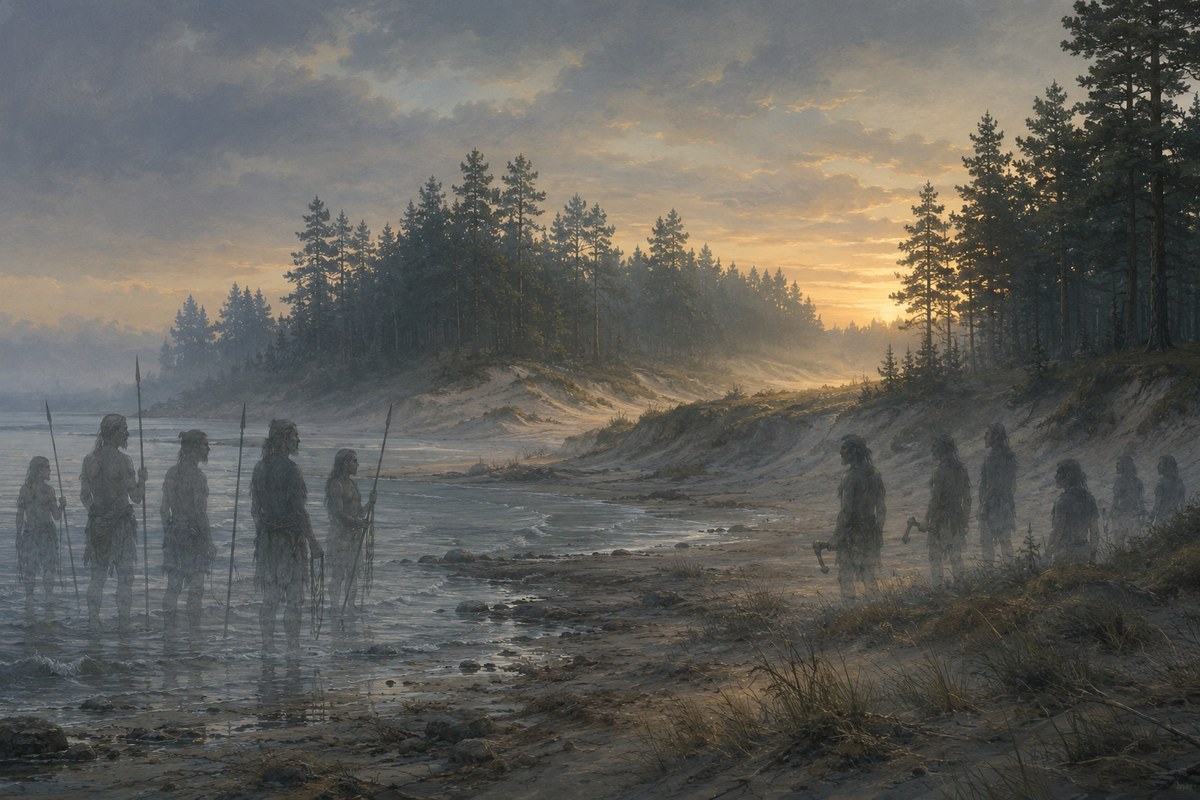
Estonians, Latvians and Lithuanians are routinely grouped together as one genetic package, the Baltic cluster that European population genetics has long flagged as carrying the highest hunter-gatherer signal on the continent. The published literature is unambiguous on the headline claim and unusually specific about who leads it: Lazaridis and colleagues found the eastern Baltic to carry the largest western hunter-gatherer, or WHG, share of any modern European population, and a dedicated Lithuanian genome study went further, naming Lithuanians themselves as the single most WHG-shifted nation on the continent. G25 modelling confirms the broad picture and complicates the specific claim. It also uncovers something the three-nation grouping usually glosses over: Estonia's own deep ancestry pool was not simply diluted WHG, it was a genuinely different hunter-gatherer population, one that leaned toward the eastern, Siberian-adjacent side of the Mesolithic map, until a wave of Corded Ware steppe pastoralists arrived, comparatively late by regional standards, and folded all three territories into a single, much more homogeneous profile.
Two Foraging Worlds, One Sea Between Them
Before any farmer or steppe pastoralist reached the eastern Baltic, the region was already split along a genetic line that ran roughly north to south. To the south and west, in what is now Lithuania and much of Latvia, the Kunda and then Narva culture foragers descended from populations closely related to western hunter-gatherers, the same broad ancestry recovered from the Loschbour rock shelter in Luxembourg. Further north, in Estonia, the Comb Ceramic culture foragers carried a markedly different profile: subsequent ancient DNA work found them closest to Eastern hunter-gatherers, the reverse of the affinity seen at the earlier Baltic sites further south, which leaned toward Western hunter-gatherers instead. Mittnik and colleagues, working directly from ancient genomes recovered at these sites, quantified the split precisely: Baltic Mesolithic-Neolithic individuals from the Latvian sites modelled at roughly 65 to 76 percent WHG with 24 to 35 percent EHG, the Lithuanian sites further south came out at 88 to 100 percent WHG with 0 to 12 percent EHG, and separately, the Baltic Middle Neolithic Comb Ceramic population showed a significantly higher affinity to EHG, in the range of 68 to 99 percent.
A two-source NNLS model built around the same two poles, the Loschbour genome for WHG and the Karelia hunter-gatherer genome for EHG, reproduces this gradient directly rather than merely citing it.
The direction of the published findings holds up cleanly: Lithuania's Mesolithic and Narva period foragers sit furthest toward the WHG end, Latvia's Zvejnieki population sits in between, and Estonia's Comb Ceramic population sits furthest toward EHG, essentially a mirror image of its southern neighbours on the same two-source axis. The absolute percentages here run somewhat more moderate than Mittnik's own qpAdm figures, Lithuania comes out at 78 percent WHG rather than the 88 to 100 percent range reported from direct ancient genome analysis, which is expected: a single Loschbour genome and a single Karelia genome are coarser proxies for what were, in reality, structured regional forager populations, and G25's coordinate-based NNLS is a blunter instrument than a full qpAdm rotation. The ranking, which is the part that actually matters for the argument, agrees with the published record throughout.
A Region That Skipped Its Own Neolithic
What makes the eastern Baltic genuinely unusual on a European scale is not just which hunter-gatherer population it carried, but how long it kept carrying it undiluted. Across most of the continent, farming arrived by the sixth or fifth millennium BCE and began mixing Anatolian-derived farmer ancestry into local forager populations centuries before any steppe pastoralist appeared. In the eastern Baltic that first dilution event essentially did not happen. Modelling the same Narva, Kunda and Comb Ceramic populations against a three-way choice that includes an Anatolian farmer source returns a farmer share indistinguishable from zero at every site tested here, confirming that the region's Neolithic, such as it was, remained a forager economy in genetic terms.
That is the context worth keeping in mind for the archaeological literature's own framing of the region's agricultural transition: farming-based economies are consistently described as arriving comparatively late in Northeast Europe, with the genetic consequences of that late arrival only clarified by ancient DNA rather than by the archaeological record alone. The eastern Baltic was not a region where farmers slowly diluted foragers over three or four thousand years, the way it happened in Germany or Iberia. It was a region where an essentially unmixed hunter-gatherer gene pool persisted for millennia, waiting for a single, later and much more disruptive wave to arrive directly from the steppe.
The Corded Ware Wave: Late, and Total
That wave was the Corded Ware culture, and it arrived in the eastern Baltic later than in the areas of Central Europe usually credited as its source region. The earliest Corded Ware radiocarbon dates come from Kujawy and Lesser Poland, pointing to a start around 3000 BCE, while radiocarbon dates place the beginning of the Corded Ware culture in the eastern Baltic region in the interval 3000 to 2700 cal BCE, and in Estonia specifically the local Corded Ware group is dated from around 2800 cal BCE onward, several centuries after the culture's first appearance further south and west. When it did arrive, its genetic impact was not gradual. Saag and colleagues, sequencing Estonian hunter-gatherers and farmers directly, found that the first Corded Ware farmers of Estonia carried steppe ancestry alongside a smaller, sex-specific genetic contribution from descendants of Anatolian farmers, a package that displaced the region's own multi-millennial forager gene pool within a few generations rather than blending into it slowly.
The earliest Baltic Corded Ware graves modelled here still carry a real residual local signal, 20 to 26 percent EHG in the earliest Latvian and Lithuanian burials, before that figure collapses toward the same 90 to 96 percent steppe share found in Poland and Germany. The pattern is consistent with what Saag's team observed independently at the Y-chromosome level: an incoming, steppe-dominated paternal lineage replacing what had been, for thousands of years, a genetically stable regional population. The Baltic's local hunter-gatherer heritage did not fade out over a long Neolithic transition. It held on, essentially untouched, right up until a single later wave arrived and swept most of it away within a handful of generations.
From Bronze Age to the Present: A Slow Partial Recovery
The steppe-dominated profile left by the Corded Ware wave did not remain stable. Tracking the same three sources, WHG, EHG and steppe, from the Corded Ware period through the Baltic Bronze Age and Iron Age and into the present shows the local hunter-gatherer signal creeping back up rather than continuing to erode. Estonia's Corded Ware population modelled at essentially zero residual WHG and a bare few percent EHG; by the Bronze Age that had recovered to roughly 14 percent WHG and 13 percent EHG, and modern Estonians sit at a broadly comparable level. The likely mechanism is not a second migration but simple local intermarriage over the following two thousand years, incoming steppe lineages mixing back into whatever forager-descended population remained on the ground, in both Estonia and its southern neighbours alike.
The Lithuanian Mystery, Tested Directly
This is where the specific claim in the Lithuanian genetics literature deserves a direct test rather than a repetition. Urnikyte, Molyte and colleagues, working from high-density SNP data rather than G25 coordinates, reported that Lithuanians preserve one of the highest proportions of western, Scandinavian and eastern hunter-gatherer ancestry of any European population studied, a finding widely repeated since as Lithuania specifically, rather than the Baltic trio generally, carrying Europe's single highest WHG share. A four-source distal NNLS model, adding an Anatolian farmer source alongside WHG, EHG and steppe to properly account for the region's later farmer-adjacent ancestry, lets that specific claim be checked against Estonia and Latvia directly rather than assumed.
The regional-cluster part of the claim holds up without qualification: Estonian, Latvian and Lithuanian WHG shares, at 7.8, 9.1 and 8.1 percent respectively in this model, all sit clearly above Poland and Belarus, at 5.9 percent each, and further still above the East Finnish and Karelian populations, which fall to 3.8 to 4.0 percent, and the Volga-Finnic Mordovians, at 0 percent. The specifically Lithuanian part of the claim does not hold up as cleanly. In this four-source G25 reconstruction, Latvia's modern average carries marginally more WHG than Lithuania's, not less, and all three Baltic nations sit within about 1.3 percentage points of one another, a gap well inside the noise floor of a coordinate-averaged, two-population-proxy model like this one. Reproducing a nationally specific ranking this fine grained would need the kind of dense, individually genotyped SNP panel that Urnikyte's team actually used, not population-average G25 coordinates run through a four-source NNLS. The honest reading is that the Baltic trio as a bloc is confirmed as an outlier for WHG retention in Europe; which single nation inside that bloc holds the absolute record is a question this dataset is simply not built finely enough to settle.
A regional breakdown of the six Lithuanian sample groups in the underlying dataset adds a small, geographically sensible wrinkle to that same uncertainty. The western, Samogitian-associated regions return a slightly higher WHG share, 8.0 to 9.5 percent, than the eastern, Aukstaitian-associated regions, at 6.8 to 8.1 percent, a pattern that lines up with the archaeological seed point of the region's earliest forager settlement along the west Lithuanian coast. The difference is real in direction but modest in size, and it sits inside the same broad Baltic WHG band as Estonia and Latvia rather than clearly outside it.
Where Modern Lithuanians Actually Sit
Ranking every population in the dataset by Euclidean distance from the modern Lithuanian average gives an unambiguous answer to a simpler, related question: who is Lithuania's closest genetic neighbour today.
Latvia is the closest population to Lithuania in the entire dataset, closer than any Lithuanian regional sub-sample is to the national Estonian or Latvian averages of its own neighbours, and closer by a wide margin than the ancient Corded Ware population that reshaped the region only four and a half thousand years ago. Belarusian and northwestern Russian populations, themselves shaped by later Slavic-period demographic history, sit closer to modern Lithuania than Estonia does, a reminder that political and linguistic borders do not track the genetic ones especially closely in this corner of Europe. The ancient Corded Ware sample, the population responsible for the very steppe ancestry that today makes up close to 60 percent of the Lithuanian genome, is nonetheless one of the more distant entries on the list, a measure of just how much local admixture has happened in the forty-five centuries since that wave first arrived.
Limits and Caveats
Several caveats apply. Loschbour and Karelia_HG are themselves single-genome proxies for what were, in reality, structured Mesolithic populations with their own internal variation, so the two-source percentages in the first section should be read as directionally reliable rather than as exact reproductions of the qpAdm figures published by Mittnik and colleagues. The Estonia_MN_Comb_Ceramic, Estonia_EMN_Narva and Latvia_MN_Zvejnieki samples used throughout are built from only one to eight individuals each, and their NNLS percentages carry correspondingly wide uncertainty. Russia_MLBA_Sintashta, used here as the steppe source, is itself a mixture of EHG-related and Caucasus-related ancestry, a collinearity flagged in earlier articles on this site; it likely absorbs some of the true local EHG signal in the Corded Ware and modern models, which is the most probable reason the four-source distal model in this piece returns lower absolute WHG and EHG figures for Lithuania than the SNP-based Urnikyte study, and it is also the most likely reason the three Baltic nations fail to separate cleanly from one another on that same axis. Finally, Latvia_Corded_Ware_Early and several other ancient groups used here are represented by a single individual, so any single-population comparison built on them should be treated as suggestive rather than definitive.
Conclusion
The Baltic trio's reputation as Europe's most hunter-gatherer-shifted population survives direct G25 modelling intact at the regional level: Estonians, Latvians and Lithuanians all sit well above their Polish, Belarusian and Finnic neighbours on the WHG axis, exactly as Lazaridis and colleagues reported over a decade ago. What the modelling also shows is a genuine internal split that the three-nation grouping usually erases: Estonia's own deep ancestry was not simply a diluted version of Lithuania's, it was a distinct, EHG-leaning forager population until the Corded Ware wave, arriving some centuries later here than in Central Europe, swept virtually all of it into a single, steppe-dominated profile within a few generations. The specific claim that Lithuanians alone carry Europe's single highest WHG share is harder to confirm on this evidence than the frequency of its citation suggests; a coordinate-based four-source model puts all three Baltic nations within a percentage point of each other, with Latvia, if anything, marginally ahead. What is not in doubt is which of the three is now genetically closest to Lithuania. It is Latvia, by a wide margin, a fact the shared prehistory recounted above makes entirely unsurprising.
Estonian,0.132945,0.114146,0.087756,0.083302,0.042777,0.029758,0.011375,0.014446,0.000409,-0.028447,0.000065,-0.012349,0.01946,0.021359,-0.006664,0.00171,0.000222,-0.002483,0.001345,0.002214,0.001385,-0.001867,0.004264,0.000747,0.003054
Latvian,0.135449,0.122473,0.088774,0.089471,0.043208,0.034025,0.012597,0.014076,-0.002168,-0.036885,-0.003573,-0.013818,0.023221,0.031378,-0.010559,0.004057,0.002712,-0.00038,0.001609,0.004302,-0.002795,-0.005713,0.009071,-0.009327,0.002634
Lithuanian_PA,0.133742,0.124148,0.07962,0.074613,0.042162,0.029109,0.008725,0.013413,-0.003733,-0.02631,-0.003512,-0.009104,0.018675,0.026647,-0.011876,0.003497,0.004286,0.001029,0.003928,0.001235,-0.006052,-0.003292,0.009398,-0.006552,-0.000284
Lithuania_Mesolithic,0.134311,0.108662,0.181395,0.186695,0.136949,0.061077,0.010575,0.034383,0.071174,-0.007472,-0.013153,-0.016935,0.029286,0.000138,0.039495,0.060063,0.005215,0.001267,-0.00352,0.048523,0.072248,0.013231,-0.036235,-0.136525,0.012574
Lithuania_EMN_Narva_(n=7),0.13268514,0.10982243,0.18085614,0.182819,0.11887943,0.052033143,0.012354714,0.028515429,0.059136571,-0.018718143,-0.0054285714,-0.018176714,0.028160571,0.0042858571,0.031293143,0.046406429,0.0030175714,0.0057732857,-0.005387,0.043163286,0.067238429,0.0068538571,-0.027149714,-0.11037686,0.010794429
Latvia_Mesolithic_Zvejnieki_(n=8),0.13018513,0.09952175,0.1805935,0.19787888,0.1061735,0.057242375,0.007990125,0.020220125,0.054147625,-0.026902375,-0.0039785,-0.01599825,0.0288215,-0.0085325,0.035016,0.0487765,0.003340875,0.00551075,-0.005075125,0.042426625,0.061298,0.010603125,-0.02765375,-0.11016625,0.006840625
Estonia_EMN_Narva_(n=2),0.1291895,0.096983,0.161219,0.1849185,0.0890935,0.0591245,-0.0015275,0.017884,0.043768,-0.031618,-0.0036535,-0.0131885,0.0300295,-0.01273,0.03203,0.031954,-0.011669,0.0011405,-0.0060335,0.034954,0.038557,0.0134785,-0.022308,-0.093447,0.004251
Estonia_MN_Comb_Ceramic_(n=2),0.1314655,0.0741335,0.1455685,0.180558,0.0435465,0.0546625,-0.015393,-0.0041535,0.0084875,-0.0528485,0.0069015,-0.0221055,0.0264615,-0.0194735,0.028162,0.0167065,-0.0164285,-0.008995,-0.0022,0.0226985,0.0143495,0.0106345,-0.009798,-0.0451875,-0.0003595
Lithuania_Corded_Ware_(n=2),0.1223595,0.0974905,0.054494,0.091732,0.0027695,0.0345825,0.0036425,0.0025385,-0.027202,-0.0371765,-0.00203,-0.0038965,-0.0055005,-0.014519,0.026398,0.011933,0.0071715,-0.0084245,-0.0071015,0.007316,-0.0085475,0.0079135,0.00493,0.0092185,0.001856
Estonia_Corded_Ware_(n=6),0.12425667,0.10916933,0.055876833,0.086887,0.0050778333,0.034675167,0.0070503333,0.0054996667,-0.019532167,-0.030828333,-0.000433,0.0011238333,-0.010232833,-0.013441,0.025040167,0.0066736667,-0.0034768333,0.0020271667,0.0037711667,0.001188,0.002641,0.0019165,0.0030811667,0.0022491667,-0.0014171667
Latvia_Corded_Ware_Early_(n=1),0.132035,0.093429,0.050534,0.128878,-0.010156,0.052989,-0.003525,0.013615,-0.040291,-0.071983,-0.014777,0.005395,0.003717,-0.021607,0.027687,-0.003447,-0.011865,0.000633,0.001006,0.008379,-0.011105,-0.006183,0.010969,0.027594,-0.002874
Russia_Karelia_HG,0.1257745,0.03402,0.1318035,0.212535,-0.0066165,0.056196,-0.019741,-0.0212295,-0.001125,-0.088293,0.016807,-0.020157,0.035158,-0.0330985,0.0170325,0.0286395,-0.0204705,0.001837,-0.0064105,0.009817,-0.008797,0.0129215,0.0082575,-0.023859,-0.007185
Luxembourg_Loschbour.DG,0.130897,0.109677,0.203645,0.198,0.162492,0.059125,0.015041,0.038075,0.100217,0.016219,-0.015427,-0.017235,0.019921,-0.001239,0.061346,0.07067,0.002608,0.007348,-0.008925,0.065406,0.117543,0.010387,-0.049422,-0.173639,0.019519
Russia_MLBA_Sintashta,0.1258883,0.1166166,0.0574481,0.0786397,0.0113353,0.0290976,0.0058203,0.0043614,-0.0174254,-0.0282708,-0.0023059,0.0012189,-0.0021903,-0.0212305,0.0228779,0.0124501,-0.0050112,0.0003377,-0.0003519,-0.0003377,-0.0058895,0.0018218,0.0026744,0.0069286,-0.0036603
- Lazaridis et al. Ancient human genomes suggest three ancestral populations for present-day Europeans, Nature, 2014. nature.com/articles/nature13673
- Mittnik et al. The genetic prehistory of the Baltic Sea region, Nature Communications, 2018. nature.com/articles/s41467-018-02825-9
- Saag et al. Extensive Farming in Estonia Started through a Sex-Biased Migration from the Steppe, Current Biology, 2017. cell.com/current-biology
- Urnikyte, Molyte et al. Patterns of genetic structure and adaptive positive selection in the Lithuanian population from high-density SNP data, Scientific Reports, 2019. nature.com/articles/s41598-019-45746-3
- Nordqvist & Kriiska et al. The Corded Ware culture in the Eastern Baltic: new evidence on chronology, diet, beaker, bone and flint tool function, Estonian Journal of Archaeology, 2018. sciencedirect.com/S2352409X18302566
- Comb Ware cultures study Comb Ware cultures in the eastern Baltic, 2025. academia.edu/129449887
- Davidski Ancient human genomes suggest (more than) three ancestral populations for present-day Europeans, Eurogenes Blog. eurogenes.blogspot.com
- Davidski Global25 coordinates dataset.
- Vahaduo G25 analysis tool used for NNLS modelling.
- Moriopoulos 2025 collection Aggregated Global25 population averages and individual ancient genomes from published studies.