
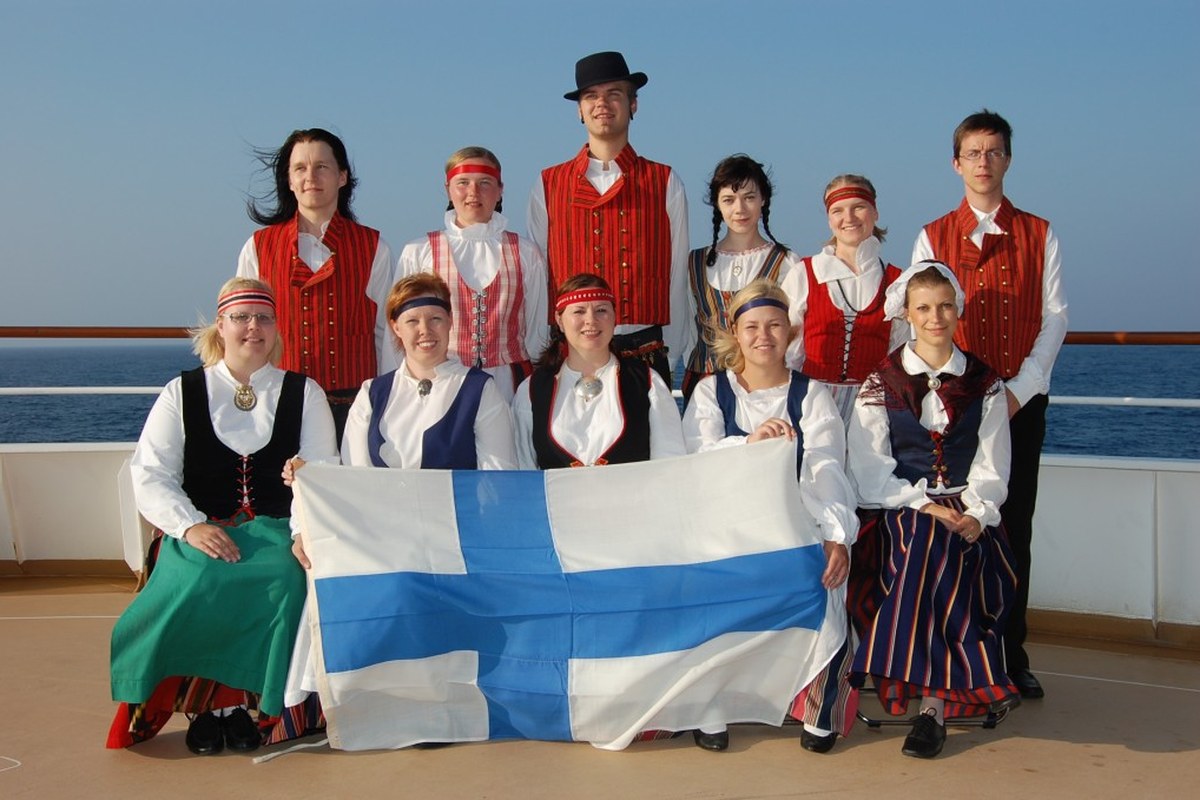
Finland has fascinated medical geneticists for decades because of a paradox: a population that looks, on a map, like just another corner of Northern Europe, but that carries a set of 36 recessive diseases found almost nowhere else at comparable frequency, the so called Finnish Disease Heritage. The standard explanation is a small founding population and a sharp bottleneck. The genetics adds a twist the popular version usually skips. The deep Siberian ancestry that gives Finland its distinctive genetic profile was not a late arrival riding in with the founders of the disease heritage. It was already present, at a high level, a thousand years before the bottleneck that mattered most. What actually happened after the Iron Age was not an infusion of new ancestry but a dilution of an older one, and the timing of that dilution turns out to matter more for the disease story than the ancestry itself.
Thirty-Six Diseases and a Well Documented Bottleneck
The Finnish Disease Heritage is a real and clinically important phenomenon. Rare recessive conditions that stay rare in a large, continuously mixing population can become locally common when a small founding group expands rapidly with limited outside input. Norio's landmark 2003 catalogue described 36 such diseases, essentially absent or vanishingly rare elsewhere, that recur in Finland at rates high enough to matter for public health. FinnGen, the national biobank initiative, has since turned this same history into a research asset: recent exome sequencing work found that despite carrying fewer variable genetic sites overall than other Europeans, Finns carry more low frequency loss of function variants and complete gene knockouts, a direct genetic fingerprint of a population that grew fast from a small base.
The uniparental record backs this up independently. Sajantila and colleagues, working from paternal and maternal lineages, identified a clear founder signature in the Finnish population as early as 1996. Kittles and colleagues followed in 1998 with a finding that gets less popular attention than it deserves: Finnish Y chromosomes come from two genuinely distinct sources, not one, an eastern lineage now known as N1c, linked to Uralic speaking populations further east, and a western lineage, I1, shared with Scandinavia. That dual origin is not a minor footnote. It turns out to be the key to understanding both the disease heritage and the deeper ancestry question.
The Siberian Signal Is Older Than the Bottleneck That Made It Famous
The natural assumption is that Finland's distinctive Siberian genetic layer, the signal that separates Finns and Saami from other Europeans and that underlies part of the disease heritage story, arrived together with, or shortly before, the demographic bottleneck that produced the 36 diseases. The G25 data says otherwise. A two source model, decomposing each population into a Baltic-like base, represented by Latvian, a population with no detectable Siberian signal, and a Siberian source proxied by the Nganasan of the Taymyr Peninsula, shows that Siberian ancestry was already substantial in the Kola Peninsula by the Bronze Age, roughly 1500 BCE, at the site of Bolshoy Oleni Ostrov: 46.5 percent. This matches the published aDNA literature closely. Lamnidis and colleagues, analysing the same site in 2018, dated the first arrival of Siberian related ancestry in the Fennoscandian genetic record to at least 3,500 years ago, and identified it as the deep source of the signal that would later spread through Uralic speaking populations across the region.
By the time of the Iron Age burials at Levanluhta, in Isokyro, dated to roughly 300 to 800 CE, the Siberian share had settled at 28.9 percent, statistically indistinguishable from the 27.6 percent found in modern Saami populations. That is the headline result of this section: the population living in Finland during the Iron Age was, on this axis, already a Saami-like population. What follows in the Medieval period is not a further Siberian migration. It is the opposite, a steady decline: 8.8 percent by the High Medieval period, and 5.9 to 8.9 percent across modern Finnish regions. The signal did not arrive late. It arrived early and was substantially diluted late.
Iron Age Finland Was, Genetically, Saami
A distance ranking makes the same point more directly, and reproduces one of the more striking claims in the published literature. Ranking every population in the Global25 dataset by Euclidean distance from the Levanluhta Iron Age average, the closest populations by a wide margin are Saami, Saami Sweden and Saami Norway, all within 0.019, followed by the historical Chalmny-Varre Saami cemetery population from the Kola Peninsula at 0.035. Modern Finns, by contrast, sit far down the list: the Finnish East average at 0.129, the national Finnish average at 0.139, Finnish Southwest at 0.154, and Estonian further still at 0.174.
This is exactly what Lamnidis and colleagues reported from direct ancient DNA analysis of the Levanluhta skeletons in 2018: several individuals from the site formed a genetic clade with modern Saami to the exclusion of modern Finns, indicating that Saami speaking populations, or at least Saami related populations, occupied a much larger part of Finland during the Iron Age than they do today. Historical sources add texture rather than contradiction: parish records from the 1500s still describe Lapp speaking communities living in central Finland, some of whom appear to have been Finns who had adopted a hunting and fishing economy rather than agriculture, alongside genuine Saami speakers, with documented intermarriage between the two groups. The linguistic and cultural shift from Saami to Finnish across this territory is well attested. The genetic data shows that shift was accompanied by, or followed by, a real change in ancestry, not just in language.
A Second Bottleneck, Layered on the First
The decline from 28.9 percent Siberian ancestry in Iron Age Levanluhta to roughly 6 to 9 percent in modern Finnish populations did not happen evenly across the country, and this is where the Finnish Disease Heritage reconnects with the ancestry story. The dual Y chromosome origin identified by Kittles and colleagues, an eastern N1c lineage and a western Scandinavian derived I1 lineage, maps directly onto a genetic gradient still visible in G25 today. Finnish Southwest, closest to the historical channels of Scandinavian contact across the Gulf of Bothnia, comes out at 5.9 percent Siberian ancestry in this model. Finnish East, settled later and more sparsely, comes out at 8.9 percent, alongside Karelian at 8.8 percent, a population historically and linguistically closer to the Uralic speaking populations further east.
The gap is modest in absolute percentage terms but the overall East-West divide it sits inside is not modest at all. The G25 distance between Finnish East and Finnish Southwest comes out at 0.0427, nearly double the distance separating two entire, well studied Western European nations, English and German, at 0.0218. This matches what population geneticists have reported from other marker systems: the genetic distance between Eastern and Western Finland exceeds the distance between some pairs of European countries, and it correlates with a documented history, a late, sparse settlement of the eastern interior, much of it from the sixteenth century onward, by a comparatively small number of founding families who then experienced their own separate bottleneck on top of the national one.
That second, more localised bottleneck is precisely what the clinical genetics literature independently confirms. Regional studies of linkage disequilibrium in the Finnish population, and the geographic clustering of specific Finnish Disease Heritage conditions, point to eastern Finland as an isolate within an isolate, a founder population settled from a founder population. The Finnish Disease Heritage is not, on this evidence, the product of a single bottleneck at the moment Uralic speakers first arrived in Finland. It is the product of at least two, stacked centuries apart, the older one diluting a Saami-like Iron Age population into the modern Finnish one, the younger one carving Eastern Finland's founding families out of that already reduced pool.
Limits and Caveats
Several caveats apply. Latvian is used here as a Siberian-ancestry-free Baltic proxy rather than as a literal ancestral source population for Finland; it stands in for the pre-Uralic, non-Siberian genetic background against which the Nganasan-related signal is measured, and the resulting percentages should be read as relative indicators of a Siberian-related layer rather than as a formal, qpAdm-validated ancestry model. The Nganasan themselves are a modern Taymyr population and an imperfect proxy for the true, unsampled deep Siberian source that reached Fennoscandia three and a half thousand years ago, in line with the caveat raised in the original Lamnidis study itself. The ancient samples from Levanluhta and Bolshoy Oleni Ostrov are drawn from a small number of individuals, four and nine respectively, so their NNLS percentages are best read as directionally reliable rather than exact. Finally, the medieval Finnish samples used here come from a single site, Palkane, and should not be over-generalised to the whole country during that period; the broader Iron Age to Medieval transition across Finland as a whole would benefit from additional ancient genomes, a point the original aDNA literature makes explicitly as well.
Conclusion
The Finnish Disease Heritage is real, well documented, and genuinely the product of a founder effect. What the G25 evidence revises is the timing usually attached to the story. The Siberian ancestry that marks Finland and the Saami as genetically distinct from the rest of Europe was not a late addition riding in with the population that would go on to found the disease heritage. It was already at Saami levels by the Iron Age, and the population living in Finland at that time was, on this evidence, substantially Saami itself. What followed was a slow dilution, sharper in the southwest than in the east, that produced the modern Finnish profile, followed by a second, more local bottleneck in the sparsely settled eastern interior that helped fix the specific disease variants now studied worldwide. Two bottlenecks, not one migration, and a Siberian signal that arrived early rather than late: that is the more accurate version of a story medical genetics has been telling, slightly wrong, for decades.
Finnish_Southwest,0.131323,0.096856,0.086313,0.07211,0.033737,0.022974,0.008549,0.014047,0.004474,-0.020889,0.003897,-0.005807,0.011465,0.008584,0.005293,-0.008569,-0.020112,0.001441,0.001587,-0.000219,0.006863,0.000526,0.002773,0.005121,0.003907
Finnish_East,0.12615392,0.077011,0.093148667,0.082741833,0.027671667,0.022078833,0.0084210833,0.014499333,0.0041755833,-0.030752417,0.0062925833,-0.00925425,0.018111833,0.0024885,-0.0021940833,0.0055245833,0.0060736667,-0.00115075,-0.0023883333,0.0055964167,0.0094105,0.001288,0.0021671667,0.00603475,0.0030235
Karelian,0.127309,0.076811,0.093286,0.080839,0.027557,0.022472,0.010248,0.015216,0.00176,-0.029412,0.005231,-0.011031,0.018929,0.00895,-0.00445,0.001326,-0.002375,-0.001409,-0.001844,0.003782,0.006466,-0.000974,0.001154,0.000697,0.003814
Estonian,0.132945,0.114146,0.087756,0.083302,0.042777,0.029758,0.011375,0.014446,0.000409,-0.028447,0.000065,-0.012349,0.01946,0.021359,-0.006664,0.00171,0.000222,-0.002483,0.001345,0.002214,0.001385,-0.001867,0.004264,0.000747,0.003054
Saami,0.111262,-0.030212,0.111722,0.079781,-0.009329,0.008297,0.008137,0.01386,0.002966,-0.032096,0.022288,-0.007475,0.018071,-0.019826,-0.004004,0.002693,0.001157,-0.001489,-0.005986,0.004494,0.015816,0.001345,-0.002565,0.002658,0.000344
Saami_Kola,0.115388,0.014598,0.105877,0.078812,0.003808,0.014921,0.010546,0.014653,0.005011,-0.029203,0.016706,-0.011203,0.017858,-0.003733,-0.006701,0.000779,0.001402,-0.000792,-0.003331,0.000922,0.012618,0.00068,-0.000031,-0.001582,0.001721
Finland_IA_Levanluhta,0.10471725,-0.03579725,0.106254,0.07808525,-0.0115405,0.008297,0.00564,0.016615,0.00470425,-0.0301145,0.03280225,-0.00738075,0.01854525,-0.01930175,-0.00658225,-0.0025525,-0.00003275,-0.00364225,-0.00590775,0.000469,0.0159405,-0.00170025,-0.00228,0.00304275,0.00161675
Russia_Bolshoy_Oleni_Ostrov_BA,0.086505444,-0.14273833,0.117913,0.106483,-0.061720889,-0.002758,-0.0033944444,-0.0020256667,-0.0029998889,-0.044809778,0.032622111,-0.0097412222,0.019441444,-0.050400333,-0.0029256667,0.0061581111,-0.0027378889,0.0020271111,-0.002081,0.0020427778,0.0016916667,0.0065398889,0.0028894444,-0.0097335556,-0.00038588889
Latvian,0.135449,0.122473,0.088774,0.089471,0.043208,0.034025,0.012597,0.014076,-0.002168,-0.036885,-0.003573,-0.013818,0.023221,0.031378,-0.010559,0.004057,0.002712,-0.00038,0.001609,0.004302,-0.002795,-0.005713,0.009071,-0.009327,0.002634
Nganasan,0.044992,-0.411402,0.155635,0.00035,-0.160996,-0.09019,0.028671,0.0413,0.029406,0.013354,0.101939,0.0091,-0.004018,-0.02658,-0.020354,-0.010464,0.001934,0.013971,0.025496,-0.000886,0.042481,-0.012956,0.032291,0.000321,0.013
Swedish,0.132193,0.125885,0.072642,0.058972,0.040264,0.02079,0.00638,0.009294,0.003649,-0.006663,-0.004203,0.000533,-0.003045,-0.003352,0.014593,0.005865,-0.005106,0.001622,0.002991,0.005015,0.006773,0.002526,0.001253,0.011594,0.000212
- Lamnidis et al. Ancient Fennoscandian genomes reveal origin and spread of Siberian ancestry in Europe, Nature Communications, 2018.
- Norio The Finnish Disease Heritage III: the individual diseases, Human Genetics, 2003.
- Sajantila et al. Paternal and maternal DNA lineages reveal a bottleneck in the founding of the Finnish population, PNAS, 1996.
- Kittles et al. Dual origins of Finns revealed by Y chromosome haplotype variation, American Journal of Human Genetics, 1998.
- Lim et al. Distribution and medical impact of loss-of-function variants in the Finnish founder population, PLOS Genetics, 2014.
- FinnGen consortium Unique genetic insights from combining isolated population and national health register data, medRxiv, 2022.
- Salmela et al. Genetic markers and population history: Finland revisited, European Journal of Human Genetics, 2009.
- Davidski Global25 coordinates dataset.
- Vahaduo G25 analysis tool used for NNLS modelling.
- Moriopoulos 2025 collection Aggregated Global25 population averages and individual ancient genomes from published studies.