
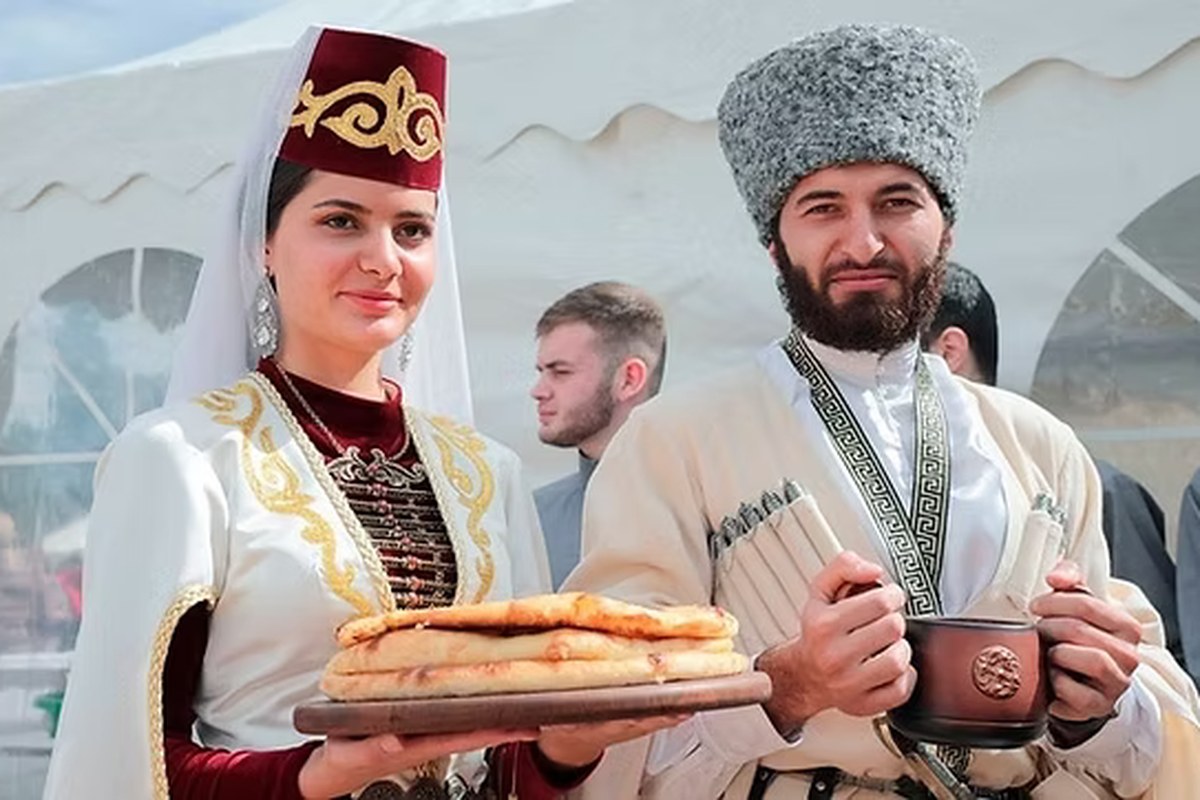
Ossetians are usually introduced as the last living heirs of the Alans, Iranian-speaking Sarmatian horsemen who dominated the medieval North Caucasus and gave the region its old name of Alania. The ancient DNA record does support a real Alan contribution to the modern gene pool, and it can even be measured. What the same data also show is less flattering to the tidy version of the story. Every non-Iranian speaking neighbour tested here, Circassians, Chechens, Kabardins, even the Georgian highlanders of Svaneti, sits genetically closer to modern Ossetians than the sampled Alans themselves do. The Alanic signal has not vanished. It has been diluted into a regional profile that the whole central and western Caucasus now shares, Iranian speakers and non-Iranian speakers alike.
Sarmatians, Alans, and an Iranian Island in the Caucasus
Ossetian belongs to the Eastern Iranian branch of Indo-European, spoken today by roughly half a million people split between North Ossetia-Alania in the Russian Federation and the partially recognised territory of South Ossetia. It is, by a wide margin, the only Iranian language still spoken anywhere in the Caucasus, and its presence there is a direct legacy of the Sarmatians, an eastern Iranian nomadic confederation that dominated the Pontic-Caspian steppe from roughly the third century BCE. One Sarmatian sub-tribe, the Alans, is first recorded by Roman and Greek authors in the first century CE, pushing into the North Caucasus foothills and eventually founding a kingdom, Alania, that controlled the Darial Pass, the single most important trade and military corridor linking the steppe to Transcaucasia and the Middle East.
Alania reached its height between the ninth and thirteenth centuries, Christianised under Byzantine and Georgian influence, prosperous on Silk Road transit trade, and powerful enough to intermarry with Georgian and Rus royal houses. That kingdom was broken twice. The Mongol invasion of 1238 to 1239 shattered the Alan plains state outright, and the raids of Timur at the end of the fourteenth century finished off what remained of lowland Alan society. Survivors retreated into the high gorges of the central Caucasus, where they lived in relative isolation for four centuries before re-expanding onto the plains under Russian imperial protection from the eighteenth century onward. Two Alanic diaspora branches also survive linguistically assimilated elsewhere, the Jász of Hungary and the Asud of Mongolia, but only the Ossetians kept the language and the Alanic self-identification alive.
Two Alans, Centuries Apart
Ancient genomes recovered from securely dated Alan burial contexts span roughly nine centuries, which makes it possible to track the population, not just the label, through time. An early group comes from Migration Period cemeteries in Ingushetia, Chechnya, and Kabardino-Balkaria, dated to the third and fourth centuries CE, close to the historically attested arrival of Alan groups in the Caucasus foothills. A later group comes from Saltovo-Mayaki era catacomb burials in Russia and Ukraine and from coastal medieval graves near Anapa, spanning the seventh to eleventh centuries, well inside the historical Alania kingdom. Two individuals from the Saltovo-associated Ukrainian cemetery were excluded from the later group as clear outliers, their profiles sit far closer to East Asian admixed steppe populations than to either Alan cluster, consistent with the mixed Alan and Bulgar character already noted for that particular site in the published literature.
The three source model, Caucasus hunter-gatherer (Kotias), Iranian farmer (Ganj Dareh), and steppe (Sintashta), shows how quickly the Alans lost their steppe purity. A generic Pontic-Ural Sarmatian population models at roughly 81 percent steppe. Even the earliest sampled Alans, barely a century or two removed from that steppe population by the historical chronology, already sit at only 53 percent, with Caucasus hunter-gatherer related ancestry making up most of the difference. The later, Saltovo period Alans are statistically indistinguishable from the early group on this axis, around 53 percent as well, meaning most of the shift toward a Caucasus profile happened fast, in the first few generations after arrival, not gradually across the following centuries. A Bronze Age Caucasus baseline population, over two thousand years older than either Alan group and unrelated to the Iranian migrations, comes out at 39 percent on the same model, a reminder that the collinearity between CHG, Iran_N, and steppe sources inflates every one of these steppe figures somewhat, so the absolute numbers are best read as relative to each other rather than as literal ancestry fractions.
Where Do Modern Ossetians Actually Sit?
Ranking every population in the Global25 dataset, several thousand entries, by Euclidean distance from the modern Ossetian average gives an answer that undercuts the simple version of the origin story even further. The single closest population in the entire dataset is Adygei, a Circassian group with no historical Iranian or steppe identity at all. North Ossetian, essentially the same population sampled separately, comes second. After that, the next dozen closest populations are, in order, Balkar, Ingushian, Circassian, Karachay, Abkhasian, Georgian Svaneti, Cherkes, Georgian Tush, Kabardin, Abazin, Karata, and Chechen, an unbroken run of North Caucasus neighbours and Georgian highlanders. No Alan sample, early or late, and no Sarmatian sample appears anywhere near the top of that list.
This is not a subtle effect. Every one of the non-Iranian speaking Caucasus populations tested here, none of which have any documented Alanic ancestry claim, sits closer to modern Ossetians in G25 space than either the early or the late Alan samples do. The Alans are closer to the Ossetians than a generic Sarmatian population or the Sintashta steppe source is, which is the expected direction, but they are still less close than the Ossetians' own present-day neighbours.
How Much Alan Is Left?
A proximal NNLS model makes the point precisely rather than just visually. Modelled against a two-way choice of Late Alan and the deep Bronze Age Caucasus baseline, modern Ossetian comes out at roughly 58 percent Late Alan and 42 percent local baseline, North Ossetian at 72 percent Alan and 28 percent baseline, both reasonable fits. But offered a different two-way choice, Late Alan against a modern average of Circassian, Chechen, Kabardin and Ingushian, the model drops Alan to zero. The modern Caucasus neighbour average alone fits the Ossetian profile at least as well, in fact marginally better, than any combination that includes an Alan source.
The two results are not contradictory, they describe different comparisons. Against a population from a thousand years before any Iranian speaker set foot in the Caucasus, an Alan-like steppe contribution is clearly visible and substantial. Against the Ossetians' own living neighbours, that same contribution becomes statistically invisible, because the neighbours picked up an equivalent steppe-related layer of their own somewhere in the same broad window, whether from Scythians, Sarmatians, Alans, Khazars, Kipchaks, or some combination of all four passing through the same corridor over two thousand years. The Alan contribution to the Ossetian gene pool is real. It is just not exclusive to the Ossetians.
A Second Model, the Same Pattern
An independent eight source rotational model, run separately with a broader reference panel, Anatolian farmer, Kura-Araxes period Caucasus, Taforalt, WHG, Nganassan, Han, and Yamnaya from Samara standing in directly for the steppe pole instead of Sintashta, reaches the same conclusion from a different angle. Modern Ossetian comes out at only 10.4 percent Yamnaya, the lowest figure of any population in the comparison. Every neighbour scores higher, Circassian at 18.2 percent, Kabardin at 19.8 percent, Chechen at 28.6 percent, and so do both Alan groups, at roughly 25 percent each. The Bronze Age Caucasus baseline used earlier in this piece as a pre-Alan proxy scores 25 percent Yamnaya as well, confirming directly what the collinearity caveat above only implied, that baseline population already carried a substantial steppe layer of its own, almost certainly from Maykop and Catacomb era steppe contact centuries before any Scythian, Sarmatian or Alan migration. Two unrelated source panels, one built around Sintashta, one built around Yamnaya, converge on the same ranking, modern Ossetians do not stand out from their neighbours on the steppe axis, they sit at or below them.
A Corroborating Y Chromosome
Published Y-DNA surveys of the Ossetians report a strong majority carrying haplogroup G2a, close to seventy percent overall and higher still among the Iron dialect group than among the Digor. That lineage is not a signature steppe pastoralist marker, Scythian and Sarmatian period Y-DNA from the Pontic-Caspian steppe runs overwhelmingly to R1a, R1b and J1 instead, it is instead a haplogroup with deep roots in the autochthonous Caucasus population. The same G2a lineage has been reported from Alan burials associated with the Saltovo-Mayaki archaeological horizon, meaning that by the time those later Alans were being buried, several centuries into their settlement of the Caucasus, their own paternal lineages already looked substantially local. That is an independent confirmation, from a completely different kind of marker, of exactly the pattern the autosomal G25 data shows, an Alan population absorbed into its Caucasus surroundings faster and more completely than the historical narrative of a conquering Iranian elite would suggest.
A Kingdom Twice Destroyed
The historical record explains why the genetics looks this way. Alania was not a demographically closed, self-perpetuating steppe colony sitting on top of the Caucasus, it was a plains state built out of a comparatively small mobile pastoralist population ruling over, trading with, and increasingly marrying into a much larger settled Caucasus population beneath it. When the Mongols broke that state in 1238 to 1239 and Timur finished the job at the end of the fourteenth century, the lowland political structure that might have kept an Alan elite demographically distinct disappeared. What survived fled into the high gorges of the central Caucasus and lived there for roughly four centuries in the same small, intermarrying highland world as their Ingush, Circassian, and Georgian mountain neighbours, before Russian imperial expansion allowed a return to the plains only from the eighteenth century onward. Four centuries of shared mountain refuge, not any single migration event, is the most plausible mechanism behind a signal this thoroughly regionalised.
Ossetian,0.107942,0.098676,-0.037083,-0.026594,-0.035801,-0.002138,0.008656,-0.002384,-0.062107,-0.02849,-0.002679,0.009666,-0.022051,0.00445,0.004207,-0.021258,0.003868,-0.005785,-0.013031,0.016904,0.009171,0.000185,-0.002157,-0.010283,-0.00014
North_Ossetian,0.104148,0.088859,-0.031112,-0.025113,-0.038315,0.005717,0.011751,-0.000692,-0.053994,-0.029158,-0.002355,0.007493,-0.020069,-3.4e-05,0.011095,-0.022607,0.002738,-0.005954,-0.009899,0.018884,0.006052,0.001948,-0.000739,-0.008405,-0.002724
Early_Alan_avg_(3rd-4th_c_CE,_n=8),0.108559,0.113232,-0.0234285,-0.00528913,-0.0281975,0.00327713,0.00916537,-0.000173125,-0.0466826,-0.025946,-0.0010555,0.0092355,-0.0114841,-0.0029245,0.00700662,-0.00798838,0.00860525,-0.00232787,-0.007966,0.00939513,0.005974,0.000448375,0.0012325,-0.00658213,-0.0017515
Late_Alan_avg_(7th-11th_c_CE,_n=12),0.108037,0.0935133,-0.0206788,-0.0105244,-0.0320314,0.000418333,0.00661942,-0.0047305,-0.0471598,-0.0216707,0.000730833,0.0071935,-0.0131441,-0.00541308,0.00425267,-0.0065965,0.00845325,-0.00466633,-0.00692383,0.00572142,0.00396175,0.000463667,-0.0013865,-0.00203842,2e-05
Russia_Caucasus_Medieval,0.110408,0.0832733,-0.0214957,-0.0169037,-0.0338523,-0.000186,0.0067367,-0.002769,-0.0509947,-0.0165837,-0.003302,0.0073937,-0.014222,0.0031193,-0.0009953,-0.005392,0.0209483,-0.0035473,-0.00595,0.0081707,0.0027033,-0.0018547,-0.0032457,-0.003173,0.002395
Circassian,0.109397,0.084627,-0.023046,-0.018447,-0.032861,-3.1e-05,0.006972,-0.001846,-0.049495,-0.024075,-0.001877,0.006394,-0.014387,0.002844,0.002111,-0.016191,0.004056,-0.004617,-0.00905,0.015132,0.005213,0.001676,0.000301,-0.008984,-0.001384
Chechen,0.112685,0.104668,-0.030371,-0.008527,-0.035761,0.006786,0.008398,-0.004908,-0.055917,-0.032608,-0.002014,0.008223,-0.016719,-0.00612,0.010496,-0.009087,0.005737,-0.006427,-0.008992,0.013098,0.003086,0.002391,0.003936,0.006298,-0.004654
Kabardin,0.108448,0.082088,-0.022544,-0.01633,-0.028433,-0.001627,0.008669,-0.003179,-0.043711,-0.02122,-0.002346,0.007393,-0.01518,0.004595,0.004139,-0.016861,0.004926,-0.003259,-0.0072,0.011561,0.004492,0.000591,0.003081,-0.006159,-0.001317
Russia_North_Caucasus_MBA,0.111547,0.123556,-0.0447517,-0.0033377,-0.0495477,0.007623,0.0101837,-0.0062307,-0.0688563,-0.0406387,0.0003247,0.0106403,-0.0216053,-0.0071563,0.0117173,-0.016618,0.007432,-0.000127,-0.007542,0.0158823,0.0141003,0.000948,-0.001479,-0.008274,-0.0017963
Limits and Caveats
Several caveats apply. The ancient Alan groups are built from small samples, eight individuals for the early, third to fourth century group and twelve for the later, seventh to eleventh century group after excluding two clear outliers, so their NNLS percentages should be read as directionally correct rather than exact. The CHG, Iran_N and steppe sources used in the distal model share deep ancestry, which is known to inflate absolute steppe estimates in G25 based models; the relative gap between the Sarmatian, Alan and baseline figures is more reliable than any single percentage taken in isolation. The Bronze Age Caucasus baseline used as the pre-Alan local proxy is itself over two thousand years removed from the Alanic period, and an independent Yamnaya-based model confirms it already carried around 25 percent steppe-related ancestry of its own, most likely from Maykop and Catacomb era contact centuries before any Scythian, Sarmatian or Alan migration, which means the true Alan-specific contribution to modern Ossetians is somewhat higher than the baseline comparison alone suggests. No South Ossetian population is present in this dataset, so all conclusions here concern the North Ossetian and general Ossetian samples specifically, though the two available modern averages agree closely with each other throughout. Finally, the label Sarmatian used here refers to Pontic-Ural steppe populations rather than to a dedicated pre-Alanic Caucasus based Sarmatian genome, which is not available in this dataset.
Conclusion
The genetic evidence supports the Ossetians' claim to Alan descent, and it lets that claim be measured rather than simply asserted. Even the earliest sampled Alans in the Caucasus already carried a steppe signal well above the pre-Alan local baseline, and that signal persists, diluted, in the modern Ossetian profile. But the same evidence rules out the idea that this makes modern Ossetians genetically distinct from their neighbours. Every non-Iranian speaking population tested here, from Circassians to Georgian highlanders, sits as close to or closer to the Ossetians than the Alans themselves do, and a two thousand year old regional steppe layer, not an exclusive Ossetian inheritance, is what the data is actually detecting. What has genuinely survived, uninterrupted, is the language and the Alanic identity built around it. On the ground, in the DNA, the Ossetians are simply Caucasians, which is exactly what four centuries in the same mountain refuge as their neighbours would produce.
- Nasidze et al. Genetic Evidence Concerning the Origins of South and North Ossetians, Annals of Human Genetics, 2004.
- Krzewinska et al. Ancient genomes suggest the eastern Pontic-Caspian steppe as the source of western Iron Age nomads, Science Advances, 2018.
- North Pontic crossroads study Mobility in Ukraine from the Bronze Age to the early modern period, Science Advances, 2025 (Saltiv culture Alan burial data).
- Southern Caucasus genomic history study The genetic history of the Southern Caucasus from the Bronze Age to the Early Middle Ages, Cell, 2025.
- Foltz The Ossetes: Modern-Day Scythians of the Caucasus, Bloomsbury, 2022.
- Davidski Global25 coordinates dataset.
- Vahaduo G25 analysis tool used for NNLS modelling.
- Moriopoulos 2025 collection Aggregated Global25 population averages and individual ancient genomes from published studies.