
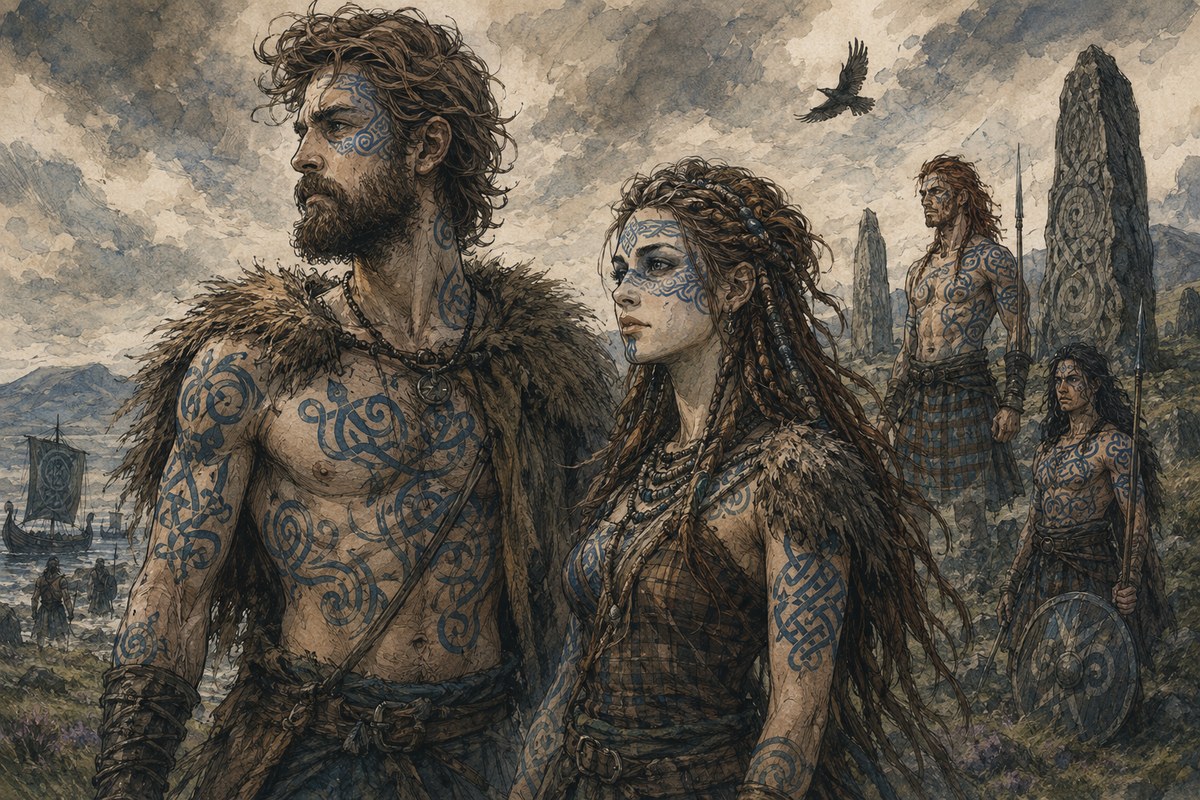
For more than a thousand years the Picts were a mystery wrapped in a legend. The Venerable Bede, writing in the eighth century, sent them sailing in from Scythia, the far eastern edge of the known world; later writers made them wild, tattooed barbarians from somewhere exotic, a people apart from the rest of Britain. In 2023 the first proper Pictish genomes were sequenced, and the legend collapsed. The Picts were not strangers from the east. They were local Iron Age Britons, and when you trace their ancestry back it runs, almost undiluted, to the Bell Beaker people who remade Britain in the Bronze Age. Genetically the Picts are close to seven-eighths Bell Beaker, the small remainder being the ordinary farmer drift that every British population picked up, with no eastern thread at all. They are about as Beaker as any British population, and Scotland as a whole escaped the later continental influx that softened the south. The painted people, it turns out, were Bell Beaker to the bone.
- The Picts ran the first kingdoms of eastern and northern Scotland from roughly AD 300 to 900. Famous for their carved symbol stones and absent from most written records, they were long imagined as a people of exotic, even eastern, origin.
- The first extensive analysis of Pictish genomes (Morez et al. 2023), from cemeteries at Lundin Links in Fife and Balintore in Easter Ross, found the opposite: the Picts descend from the local Iron Age population of Britain, and share the most ancestry with people living today in Scotland, Wales, Northern Ireland and Northumbria.
- In Global25 the Pictish average sits right inside the British Isles cloud, within about 20 units of Iron Age Britain and of every modern British and Irish population, but more than a hundred units from the eastern steppe. There is no signal of a far-eastern origin.
- Iron Age Britain, and therefore the Picts, descend overwhelmingly from the Bell Beaker migration of about 2400 BC, which replaced roughly ninety percent of the Neolithic gene pool of Britain and carried in high levels of steppe ancestry and the paternal lineage R1b-M269.
- Modelled as a simple two-source mixture, the Pict comes out about 86 percent Bell Beaker and 14 percent added early-farmer ancestry, the latter being the gradual Bronze Age farmer resurgence shared across Britain, not an exotic input. Scotland Early Bronze Age is about 93 percent Beaker, modern Scots about 88 percent.
- The deep ancestry shows the Beaker fingerprint kept almost unchanged for three thousand years: about half steppe, with the rest early-farmer and a little hunter-gatherer, the textbook post-Beaker British profile, statistically the same as Bronze Age Scotland and as modern Scots.
- Scotland may hold the least-diluted Beaker descent in Britain. The Late Bronze Age influx of continental farmer ancestry that reshaped England and Wales (Patterson et al. 2022) did not reach northern Britain, so Scotland, and the Picts after it, held on to a more steppe-rich, more Beaker-like make-up than the south.
- One caution runs through the modelling. The British Bronze Age, Iron Age and nearby continental sources sit so close together in Global25 that a least-squares fit can shuffle weight between them, even handing the Picts a large false "Danish" slice. The robust results, a local Beaker origin and no eastern ancestry, come from the distances, the deep model and the published study, which all agree.
1. The myth of the eastern Picts
Few peoples of early Britain have attracted as much legend as the Picts. They built the first documented kingdoms of eastern Scotland, fought off Rome, and left behind a scatter of carved stones covered in symbols that no one has fully deciphered. What they did not leave behind was much in the way of written records, and into that silence other people poured their imaginations. Bede, the great English historian of the eighth century, reported that the Picts had arrived by sea from Scythia, a vast and vague eastern land that in the medieval mind stood for everything wild and foreign. Later traditions painted them as tattooed barbarians, a separate stock from the other inhabitants of the island, even as a matrilineal society organised quite unlike their neighbours.
These were testable claims, and for a long time there was no way to test them. The name itself, from the Latin Picti, "the painted ones", encouraged the sense of a people set apart. The symbol stones, the lack of sources and the half-remembered classical geography all combined into a single picture: the Picts as exotic outsiders, dropped onto the north of Britain from somewhere far away. The genome was the one witness that had never been called, and when it finally was, it told a flatly different story.
2. Morez 2023: local after all
In 2023 a team led by Adeline Morez and Linus Girdland-Flink published the first extensive analysis of Pictish DNA. They sequenced high-quality genomes from two Pictish-era cemeteries, Lundin Links in Fife in southern Pictland and Balintore in Easter Ross in the north, and compared them, using identity-by-descent and haplotype-sharing methods, against ancient genomes and the modern population. The result was unambiguous. The Picts showed clear genetic affinity with the Iron Age people of Britain, supporting a local origin, and they shared the most haplotypes with present-day populations of western Scotland, Wales, Northern Ireland and Northumbria. Bede's eastern voyage was, in the words of the team, a matter of myth and fantasy.
The Global25 coordinates tell the same story at a glance. The chart below measures how far the Pictish average sits from a range of candidate poles. The whole British Isles, Iron Age and modern alike, forms a tight knot around the Picts: Iron Age Britain, modern Scots, Welsh and Irish, and the Scottish Bronze Age are all within a few tens of units. The eastern steppe, the place Bede sent them, is more than a hundred units away. Whatever the Picts were culturally, biologically they were Britons.
Scaled Global25 distance from the Pictish average to each pole, multiplied by 1000. Every British Isles population, Iron Age and modern, clusters within roughly 20 to 43 units; the eastern steppe poles, a Kazakh Sarmatian and Yamnaya, are 124 and 158 units away. The Picts are a local British population, not an eastern import. The nearness of Iron Age Denmark reflects how close all of north-west Europe sits in Global25, a point that matters for the modelling in section 6.
3. The Bell Beaker foundation
To see where the Picts ultimately come from, you have to go back a long way before them, to the event that reset the genetics of Britain entirely. Around 2400 BC the Bell Beaker complex reached the island, and with it came people. The genome-wide study of the Beaker phenomenon (Olalde et al. 2018) showed that this was not a movement of pots alone: the spread of the Beaker complex into Britain introduced high levels of steppe-related ancestry and was associated with the replacement of about ninety percent of the existing Neolithic gene pool within a few centuries. The Neolithic builders of Stonehenge, descended from early Anatolian farmers, were almost entirely overwritten. The paternal landscape flipped from the farmers' lineages to R1b-M269, which has dominated British men ever since.
Everything genetic in Britain after that point, the Bronze Age, the Iron Age, the Picts, the medieval and modern populations, is built on that Beaker foundation. The deep-ancestry chart below breaks each population into the three streams that make up Europeans: steppe ancestry from the Yamnaya world, early-farmer (EEF) ancestry from Anatolia, and the older western hunter-gatherer (WHG) line. The Bell Beaker people of Britain carry about sixty percent steppe. Three thousand years later the Picts still carry close to half, and so do modern Scots. The proportions drift a little, the farmer share creeping up over time, but the fingerprint is the same one the Beakers brought.
Deep ancestry of the Bell Beaker, Bronze Age, Pictish and modern Scottish populations, modelled in Global25 as steppe (Yamnaya), early farmer (EEF, Anatolian) and hunter-gatherer (WHG). Steppe ancestry stays near or above half the whole way through; the early-farmer share rises gently from the Bronze Age onward. The Picts carry the standard post-Beaker British profile, indistinguishable from Bronze Age Scotland and from modern Scots. The WHG pole is a single genome and that slice is the noisiest part of the model.
4. Almost pure Bell Beaker
The deep model shows the Beaker signature surviving; a simpler two-source model puts a number on it. If you rebuild each British population out of just two ingredients, the Bell Beaker population of Britain and a pure early-farmer source standing in for the later continental drift, the Picts come out about 86 percent Bell Beaker and 14 percent added farmer. The Scottish Early Bronze Age, the Beaker people's immediate descendants, is about 93 percent Beaker; the Scottish Late Bronze Age about 92 percent; Iron Age England about 89 percent; and modern Scots about 88 percent. The Picts sit squarely in that band. The 14 percent that is not Beaker is not exotic and not eastern: it is the same gradual farmer resurgence that nudged every British population in the same direction across the Bronze Age.
The decisive test is what happens when you offer the model an exotic eastern origin and a local one side by side. Give the fit a genuinely local Beaker-derived source on one hand and an eastern steppe Sarmatian on the other, and the Sarmatian share collapses to nothing: the Picts model as one hundred percent local Beaker-derived ancestry, zero steppe nomad. Bede's Scythians simply are not in the genome. The bars below show the two-source split for each British population, with the Picts among them.
Two-source Global25 model: each population rebuilt from the Bell Beaker population of Britain plus a pure Anatolian-farmer source representing the later continental drift. The Picts are about 86 percent Bell Beaker. The remaining slice is the ordinary Bronze Age farmer resurgence shared by all Britons, not an eastern or foreign component. When an eastern steppe source is offered against a local Beaker source, the Picts take zero from the east. Read the percentages as directions; the exact split depends on the proxies chosen.
5. Why Scotland stayed more Beaker than the south
There is a final twist, and it makes the Picts more Beaker, not less. The British genome did not stop changing after the Bronze Age began. A large study of Bronze and Iron Age Britain (Patterson et al. 2022) found that between about 1000 and 875 BC the share of early-farmer ancestry rose sharply in southern Britain, England and Wales, as migrants genetically close to ancient France moved in across the Channel. Those migrants contributed something like half the ancestry of Iron Age England and Wales, and may have carried the early Celtic languages with them. Crucially, that influx is detected in the south but not in the north: Scotland did not receive it.
That single fact reshapes the picture. Southern Britain was topped up with continental farmer ancestry in the Late Bronze Age; northern Britain was not. So the populations of Scotland carried, into the Iron Age and beyond, a more steppe-rich and more Beaker-like profile than their southern neighbours, having skipped the dilution. The Picts are the heirs of that northern line. When people search for the most direct, least-altered descendants of the Bell Beaker folk who transformed Britain, they tend to look to the islands of the far north and west. The Picts belong in that same conversation: a people who, by an accident of geography, lived in the part of Britain that kept the Bronze Age make-up most faithfully.
6. When the proxy is soft
One honest caution belongs on all of this, and it is the same one that haunts any attempt to model closely related populations. North-west Europe is genetically crowded. The British Bronze Age, the British Iron Age, Iron Age Denmark and the Beaker population itself all sit within a few tens of Global25 units of one another and of the Picts. When a least-squares model is handed several of these near-identical sources at once, it does not know which one history actually used, and it will spread the weight among them to chase the closest numerical fit. Offer the Picts an unconstrained menu of British and continental Bronze and Iron Age sources, and the model will cheerfully assign them a large "Iron Age Denmark" slice, as if half their ancestry were Scandinavian. It is not. The Picts predate the Anglo-Saxon and Norse arrivals, they are northern, and the apparent Danish signal is the model swapping one near-collinear north-west European source for another. It is an artifact, not a migration.
What survives every caution is the shape, and the shape is firm. The Picts are a local British population, sitting inside the Iron Age and modern British cloud and far from the eastern steppe. They descend overwhelmingly from the Bell Beaker people who remade Britain, carrying their steppe-rich fingerprint almost unchanged, with a modest farmer drift shared by all Britons and no detectable eastern or exotic input. The exact percentages move with the proxies; the story does not. Bede sent the Picts in from Scythia. The genome brings them home.
The story in steps
Claim and reality
The Picts came from the east, from Scythia or the Eurasian steppe.
No. The Pictish genomes are local Iron Age Britons. They sit inside the British Isles cluster and more than a hundred units from the eastern steppe. Offered an eastern source against a local one, they take zero from the east. Bede's Scythian voyage is myth.
The Picts were a people apart, biologically distinct from other Britons.
They were not. The Picts share the most ancestry with present-day people of Scotland, Wales, Northern Ireland and Northumbria, and descend from the same Iron Age British stock as their neighbours. Their distinctiveness was cultural, in symbols and language, not genetic.
Being so ancient and mysterious, the Picts must be hard to place genetically.
They are easy to place. They are about 86 percent Bell Beaker in a simple model, carrying the steppe-rich post-Beaker profile of Bronze Age Britain almost unchanged. The remainder is ordinary British farmer drift, not an exotic component.
The Picts were less "pure" Beaker than the English heartland.
The reverse. The Late Bronze Age farmer influx that diluted England and Wales did not reach Scotland, so the Picts kept a more steppe-rich, more Beaker-like make-up than the lowland English. Scotland as a whole kept more of the Beaker profile than the south.
A model showing a big "Danish" component proves Scandinavian Pictish ancestry.
It proves nothing of the kind. The British and continental Bronze and Iron Age sources are near-identical in Global25, so the model swaps one for another. The Picts predate the Norse, are northern, and carry no real Scandinavian signal. It is a proxy artifact.
Reproduce it yourself
Paste these scaled Global25 coordinates into Vahaduo to reproduce the distances and models above. The target is the Pictish average; the local Beaker-derived sources are the Scottish Early and Late Bronze Age and Iron Age Orkney, with the Bell Beaker population of Britain as the founding pole. The deep model uses the Yamnaya steppe, the Anatolian early farmer and a western hunter-gatherer. The exotic-origin test uses the Kazakh Sarmatian, and Iron Age Denmark is included to show the north-west European source degeneracy discussed in section 6. All coordinates are on the same Global25 scale. Treat every figure as a direction, not as a last word.
Pict_Scotland,0.1314655,0.128972,0.063545,0.0473195,0.040469,0.014363,0.0019975,0.001154,0.0063405,0.009112,-0.0107175,0.007119,-0.0201435,-0.0147945,0.0205615,-0.0000665,-0.0141465,-0.0004435,0.003268,-0.0031265,0.0072375,0.0015455,-0.0065935,0.0033135,0.00006
Bell_Beaker_Britain,0.127078,0.12284626,0.063575258,0.068569774,0.026188387,0.023525677,0.0022287097,0.0031785161,-0.0044994839,-0.010781323,-0.003122,0.0034952903,-0.010195323,-0.015329419,0.025883194,0.0099228387,-0.006515,0.001937129,0.0023639677,0.0059302258,0.0061906129,0.0028240968,0.00034190323,0.0055001613,-0.0010159677
Scotland_Early_Bronze_Age,0.12357929,0.12665114,0.061794143,0.059893429,0.029675857,0.017370714,0.00010057143,0.0016154286,0.0026004286,-0.003046,-0.00074242857,0.0011772857,-0.012317714,-0.016986429,0.022509857,0.014565857,0.0026264286,0.0043075714,0.00059242857,0.0026977143,0.010713,0.002049,-0.0059685714,0.0010842857,-0.0068598571
Scotland_Late_Bronze_Age,0.1295308,0.1322218,0.0632808,0.0554268,0.0346526,0.0184626,0.0047472,0.0025844,0.0021272,-0.0040094,-0.0054886,0.006804,-0.0160258,-0.0153862,0.0244568,0.0105278,-0.0087618,0.003066,0.0023128,0.0013504,0.0049412,0.0040556,-0.0015778,0.0059524,0.0022274
Scotland_Orkney_Iron_Age,0.128051,0.131511,0.054871,0.0502265,0.039084,0.0154785,0.003055,0.008769,0.008488,-0.000182,-0.0006495,0.003747,-0.007879,-0.0158955,0.0254475,-0.0051045,-0.001043,0.0050675,0.007416,0.0135065,0.0022465,0.0097685,-0.0007395,0.015002,-0.006107
England_Iron_Age,0.12904688,0.1326535,0.060245,0.054304375,0.04093075,0.015792125,0.001145625,0.00395175,0.006186875,0.004555875,-0.006353625,0.0067815,-0.011706875,-0.0131945,0.021681375,0.005618375,-0.007806625,0.000253375,-0.000062875,0.003564,0.004382875,0.003724875,-0.000123125,0.006190375,-0.002425
Scottish_modern,0.13154697,0.13390483,0.0622034,0.047517914,0.038785057,0.017362886,0.0032296,0.0052613429,0.003997,0.0031500571,-0.0058227714,0.0053352857,-0.012118086,-0.012791,0.023049171,0.0045156571,-0.0096521143,0.0026134571,0.0024888571,0.0021010571,0.0036934286,0.0034834286,-0.00058808571,0.014466714,-0.0013925143
English_modern,0.13146568,0.13735032,0.060287909,0.042643341,0.040231227,0.016315114,0.0041498864,0.0064927727,0.00507125,0.0052558409,-0.0058090455,0.0053407045,-0.013190205,-0.010062091,0.0201915,0.0063281818,-0.0074407955,0.0024761136,0.0032082045,0.0031633864,0.0058362955,0.0026640909,-0.0018038636,0.012427659,0.00027495455
Welsh_modern,0.1319779,0.13816285,0.0601319,0.0430236,0.04059215,0.0166218,0.0033135,0.00639205,0.0062789,0.0043372,-0.00423025,0.00591215,-0.0129112,-0.01097545,0.02059545,0.00570795,-0.00870315,0.00235635,0.003086,0.00200715,0.0049849,0.0038518,-0.00001235,0.0112243,0.00080825
Irish_modern,0.13344489,0.13441601,0.06166691,0.049182697,0.037691102,0.019438802,0.0031798748,0.0046997592,0.0036947909,0.0026563634,-0.0067064453,0.005798327,-0.014129458,-0.01385664,0.025809459,0.0053095901,-0.010685086,0.0018854713,0.00089969292,0.0017385994,0.0049843558,0.0015737045,0.00067841634,0.014585013,0.00086631433
Orcadian_modern,0.1328152,0.13317931,0.063291629,0.048699171,0.039462286,0.017817143,0.0025648571,0.0061712857,0.0045637429,0.0020670857,-0.0060362286,0.0058576286,-0.012071286,-0.011874886,0.022452,0.0051823714,-0.010777143,0.0013174571,0.0018388571,0.0023367714,0.0047951143,0.0031266,-0.0008944,0.013230714,-0.00022925714
Denmark_Iron_Age,0.125585,0.129649,0.068761667,0.061800667,0.038673667,0.017198333,-0.002977,0.010769,0.0074993333,-0.010083667,-0.0036266667,0.0038466667,-0.012041667,-0.0085783333,0.02642,0.0036243333,-0.017601667,0.0063343333,0.0066203333,0.0048356667,0.0052406667,0.010428,-0.0031223333,0.014901667,-0.001038
Yamnaya_steppe,0.12265421,0.08898131,0.044110172,0.11446552,-0.027262276,0.045545793,0.0040274483,-0.0023793448,-0.054727793,-0.074653966,0.00097427586,-0.0005477931,-0.00097403448,-0.021706448,0.036808138,0.012134207,-0.0064877586,-0.0017474828,-0.002513931,0.01092769,-0.003807931,0.001262069,0.0098003448,0.019886379,-0.0044801724
Anatolian_farmer_EEF,0.11884159,0.18104118,0.0035483182,-0.100835,0.051743727,-0.046397318,-0.0051914091,-0.0073214545,0.036860909,0.080971,0.0091897273,0.012064182,-0.023278818,0.00098209091,-0.041820318,-0.0091064091,0.021590318,0.00069668182,0.011752773,-0.0094704091,-0.013101909,0.0067503182,-0.0046665909,-0.0034506818,-0.0054648636
WHG_Loschbour,0.130897,0.109677,0.203645,0.198,0.162492,0.059125,0.015041,0.038075,0.100217,0.016219,-0.015427,-0.017235,0.019921,-0.001239,0.061346,0.07067,0.002608,0.007348,-0.008925,0.065406,0.117543,0.010387,-0.049422,-0.173639,0.019519
Sarmatian_east_steppe,0.106994,0.053823333,0.038466667,0.065246,-0.024004333,0.030213,-0.0020366667,-0.002923,-0.025156333,-0.029765333,-0.006225,-0.004146,-0.0031716667,-0.020643,0.018548667,0.014275333,-0.00047833333,0.008784,-0.0015503333,-0.0023763333,-0.0047416667,0.0029263333,-0.0052996667,0.0051813333,-0.0030336667
References and sources
- 1 Morez, A., Britton, K., Noble, G., Gunther, T., Gotherstrom, A., Rodriguez-Varela, R., et al. Imputed genomes and haplotype-based analyses of the Picts of early medieval Scotland reveal fine-scale relatedness between Iron Age, early medieval and the modern people of the UK. PLoS Genetics 19, e1010360 (2023). The first extensive analysis of Pictish genomes, from Lundin Links and Balintore: demonstrates a local Iron Age British origin, the highest haplotype sharing with modern Scotland, Wales, Northern Ireland and Northumbria, and rejects the exotic far-eastern origin of Bede's account. link
- 2 Olalde, I., Brace, S., Allentoft, M. E., et al. The Beaker phenomenon and the genomic transformation of northwest Europe. Nature 555, 190-196 (2018). Documents the Bell Beaker migration into Britain, the replacement of about ninety percent of the Neolithic gene pool, the influx of steppe ancestry and the rise of R1b-M269 to dominance. link
- 3 Patterson, N., Isakov, M., Booth, T., et al. Large-scale migration into Britain during the Middle to Late Bronze Age. Nature 601, 588-594 (2022). Shows that early-farmer ancestry rose in southern Britain (England and Wales) between about 1000 and 875 BC through migration from populations close to ancient France, while northern Britain (Scotland) did not receive this influx. link
- 4 Cassidy, L. M., Martiniano, R., Murphy, E. M., et al. Neolithic and Bronze Age migration to Ireland and establishment of the insular Atlantic genome. PNAS 113, 368-373 (2016). Establishes the Bronze Age steppe-rich genome of the Atlantic fringe of the British Isles, the wider context for the persistence of Beaker-derived ancestry in the north and west. link
- 5 Global25 coordinates: Davidski (Eurogenes), with population averages from the public Global25 datasheets and the Moriopoulos 2025 collection. Global25 spreadsheet tooling: Vahaduo. G25
Ancient and modern Global25 coordinates: Davidski (Global25), with population averages from the public Global25 datasheets and the Moriopoulos 2025 collection. The Pictish average is the named Global25 average derived from the Morez et al. 2023 genomes; the Bell Beaker, Scottish Bronze Age, Iron Age and modern points are named population averages on the same scale. Global25 spreadsheet tooling: Vahaduo. Analysis: scaled Global25 Euclidean distances and non-negative least squares modelling in Python. Ancestry fractions are proxy-dependent and best read as directions rather than exact percentages; the split between near-identical north-west European Bronze and Iron Age sources is the soft part of the modelling, because these sources share so much ancestry that a least-squares fit can shuffle weight between them and even produce a spurious Scandinavian slice. The robust results, a local Iron Age British origin, an overwhelmingly Bell Beaker ancestry and no eastern or exotic input, are confirmed by the distances, the deep ancestral model and the published genome-wide study. Y-chromosome and population labels carry no information about any living person's identity, character or worth.