
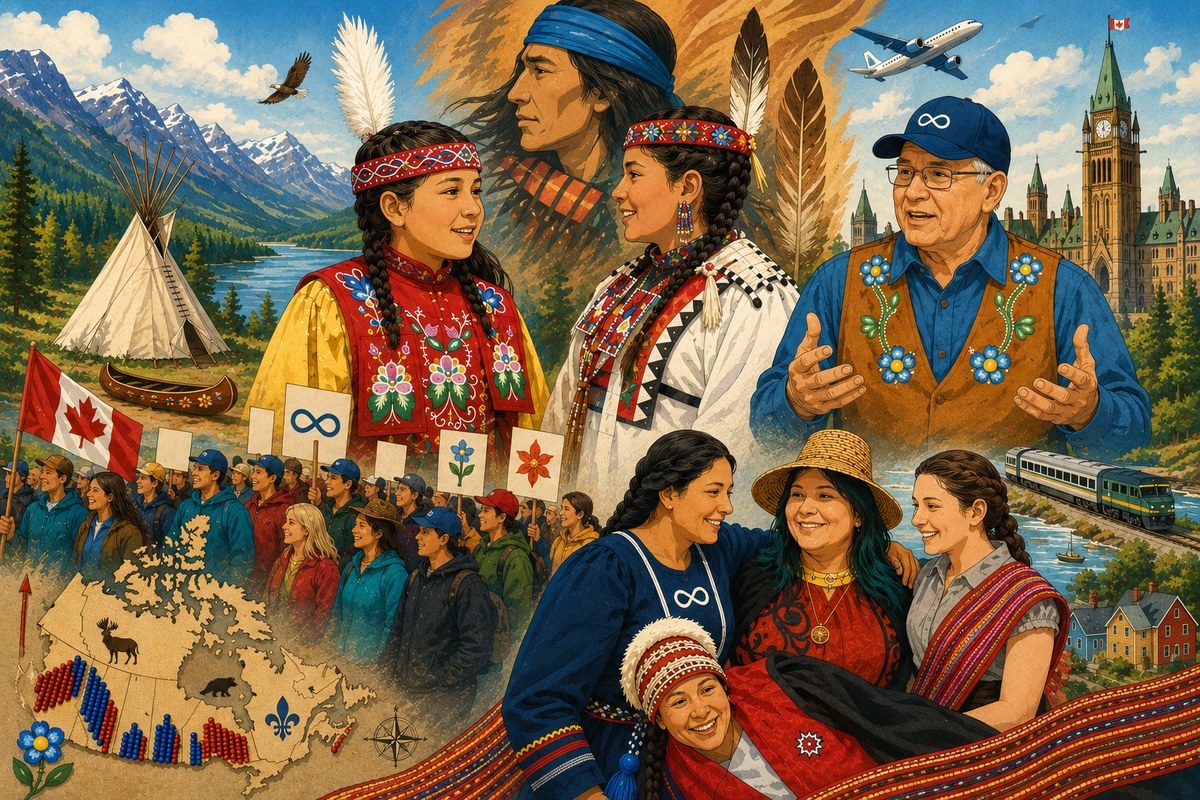
A claim drifts around the internet, sometimes well meant, sometimes not: that the Metis are a people you can read off a genome, a "genetically defined" nation of mixed European and Indigenous blood. The genetics tells a more interesting and more honest story. The Metis are indeed an admixed people, born on the fur-trade frontier from European fathers and First Nations mothers, and their DNA carries the unmistakable, strongly sex-biased fingerprint of how they were made. But that fingerprint records a process, not a passport. There is no Metis gene, no Metis cluster, no DNA test that can make someone Metis, and the people themselves, their courts and their scholars all say so plainly. What the genome shows is how the Metis came to exist. Who is Metis is decided by kinship, community and history, the things genes cannot see.
- The Metis are one of the three recognised Aboriginal peoples of Canada, alongside First Nations and Inuit. They emerged in the late eighteenth and nineteenth centuries across the fur-trade Northwest, with a historic heartland on the Red River, as a new people with their own language (Michif), their own institutions and their own national identity.
- Their genome was built the same way every fur-trade creole was: European men, mostly French-Canadian voyageurs and Orkney and Scottish men of the Hudson's Bay Company, partnered with Cree, Ojibwe and Saulteaux women. The result is a strongly sex-biased blend.
- The signature is the familiar one. The maternal line (mitochondrial DNA) is overwhelmingly Indigenous, carrying the founding Native American haplogroups A, B, C, D and X. The paternal line (the Y-chromosome) carries the European signal, dominated by West-European lineages such as R1b. Mothers Indigenous, fathers European.
- Autosomally the Metis are a real blend, but a blend with no clean reference point. There is no published Metis Global25 average. Modelled through the closest available proxies, admixed Algonquian samples, the European share lands in the rough range of twelve to thirty percent, with the bulk of the genome Indigenous. These figures are soft and proxy-dependent.
- The references are themselves a problem. Indigenous genomes from Canada are almost absent from the big reference databases, and even the public "Cree" sample is already fur-trade-admixed (about a third European-shifted in our model). There is no pristine Indigenous pole and no Metis target, which is exactly why a tidy genetic "definition" cannot be built.
- Identity is not the genome. Under the Supreme Court's Powley test, a Metis person self-identifies, has an ancestral connection to a historic Metis community, and is accepted by that community today. No blood quantum, no percentage, no test.
- This matters in practice. The misuse of distant or trace Indigenous DNA to claim Metis identity and rights, often called race-shifting, is a live harm to the actual Metis Nation. An article that treated the Metis as "genetically defined" would feed exactly that error.
- The Metis are a textbook case of ethnogenesis: admixture supplied the raw material, but it was culture, kinship and political will that made a people. The genome is the how. It is not the who.
1. A people made on purpose
The Metis are unusual in that we can watch them come into being. Through the seventeenth and eighteenth centuries the fur trade pushed European men deep into the interior of what is now Canada, far ahead of any settler families. Two streams of men dominated. From the French and Canadian trade came the voyageurs, the canoe-men of the North West Company and the independent traders, overwhelmingly French-Canadian and Catholic. From the English trade came the servants of the Hudson's Bay Company, a strikingly large share of them recruited from the Orkney Islands off the north coast of Scotland, with other Scots and Englishmen alongside. These men partnered, in the country marriages known as marriage a la facon du pays, with Cree, Ojibwe, Saulteaux and other First Nations women.
What grew from these unions did not stay a collection of mixed individuals. Over two or three generations, especially in the Red River settlement, it became a people: a community that married within itself, spoke its own language, ran its own bison hunt, flew its own flag and, by 1869, fielded its own provisional government under Louis Riel. The language, Michif, is itself the perfect emblem of the process, splicing French nouns onto Cree and Ojibwe verbs in a way no simple "mixing" would predict. The sash, the floral beadwork that earned the Metis the name "the flower beadwork people", the fiddle and the Red River jig are not diluted versions of other traditions; they are a new culture's own. This is ethnogenesis, the birth of a people, and admixture was only its starting material.
2. The sex-biased signature
Because the Metis were founded by incoming men and resident women, their DNA is split unevenly between the lines that record fathers and the lines that record mothers. This is the same asymmetry that marks the Atlantic creoles of Cape Verde, colonial Brazil and, in a far older key, the steppe expansions: when a population is built by one sex arriving and the other already being there, the two uniparental markers tell opposite halves of the story.
The maternal line, mitochondrial DNA, is passed only from mother to child, and in the Metis it is overwhelmingly Indigenous. It carries the founding Native American mitochondrial haplogroups, the A, B, C, D and X lineages that entered the Americas at the end of the Ice Age and that mark Cree, Ojibwe and Saulteaux women. The paternal line, the Y-chromosome, is passed only from father to son, and here the European signal is concentrated, dominated by the West-European lineages such as R1b that the voyageurs and the Orkney men carried. The diagram below shows the two parents of the Metis genome and the lines each one left behind.
The two parental lines of the Metis genome. The Y-chromosome traces the European fathers, the voyageurs and the Orkney and Scottish men of the fur trade; the mitochondrial DNA traces the First Nations mothers, carrying the founding Native American haplogroups. The direction of the bias is documented by the genealogy of Metis ethnogenesis and by the wider record of sex-biased European contact in North America; population-wide Metis uniparental frequencies are only sparsely published, so this is shown as the direction rather than as exact percentages.
3. The autosomal blend, and the missing average
Set the uniparental lines aside and read the whole genome, and the Metis are a genuine blend, but one that is far harder to pin to a number than the headline "mixed" suggests. The first obstacle is simple: there is no Metis Global25 average to point at. The Metis are not in the public datasheets as a population, and Indigenous genomes from Canada are almost entirely absent from the large reference collections, a gap that researchers working with First Nations, Metis and Inuit communities have flagged directly, and one tied up with real questions of data sovereignty and consent.
What we can do is model the closest available proxies: samples that the Global25 collections label as admixed Algonquian, the "European-mixed" Cree and Ojibwe averages, which capture the same fur-trade process even though they are not the Metis Nation. The distance chart below places one such proxy against the candidate poles. The result is telling. The proxy sits very close to the Indigenous references and very far from the European ones; autosomally, these admixed Algonquian samples are still mostly Indigenous, with a real but minority European pull. The voyageur and Orkney poles, French-Canadian and Orcadian, are more than four hundred units away.
Scaled Global25 distance from an admixed Algonquian proxy (the "European-mixed" Cree average) to each candidate pole, multiplied by 1000. The proxy sits within a few tens of units of the Indigenous references and more than four hundred from the European ones: autosomally it is mostly Indigenous, with a minority European component. Pre-contact Mikmaq and Wendat are Eastern proxies for a clean Indigenous pole; no clean pre-contact Plains or Subarctic sample is available.
Turning the distances into a least-squares model puts rough numbers on the European share, and rough is the operative word. Modelled against clean pre-contact Indigenous references plus the European sources, the admixed Algonquian proxies come out somewhere between about twelve and twenty-three percent European, the rest Indigenous. The single most revealing row is the last one: the ordinary public "Cree" reference, the one people reach for as an Indigenous pole, is itself about a third European in the same model. The fur trade admixed everyone, and it left no untouched modern reference to measure against.
Non-negative least squares on clean pre-contact Indigenous references (pre-contact Mikmaq and Wendat) plus the European sources (French-Canadian and Orcadian). The European share runs from roughly twelve to twenty-three percent in the admixed Algonquian proxies, and reaches about twenty-nine percent in the ordinary public Cree reference, showing that no modern Indigenous pole here is unmixed. Read as directions, not as Metis percentages: there is no Metis average, the European fraction cannot separate French-Canadian from Orkney, and it is inflated by the mismatch between Eastern pre-contact references and Plains or Subarctic Indigenous ancestry (see section 5).
4. Why genetics cannot define the Metis
Everything above describes how the Metis genome was assembled. None of it defines who is Metis, and this is not a soft cultural footnote, it is the explicit, legal and scholarly position. When the Supreme Court of Canada set out who holds Metis rights in the Powley decision of 2003, it built the test out of three things and none of them was a genome: a person must self-identify as Metis, must have an ancestral connection to a historic Metis community, and must be accepted by a Metis community that exists today. There is no blood quantum, no percentage, no marker.
Scholars of the Metis have spent years arguing the same point in stronger terms. The historian Chris Andersen has made the case that defining the Metis as simply "mixed" people misreads them entirely: the Metis are a nation, with a specific birthplace in the historic Northwest and Red River, not a catch-all label for anyone of dual ancestry. The anthropologist Kim TallBear, writing on Native American DNA more broadly, has shown why ancestry tests cannot confer Indigenous belonging at all: belonging is relational, a matter of who claims you and whom you are accountable to, not a readout from a chromosome. A person can carry a deep Indigenous maternal line and a European surname and Y-chromosome, exactly the Metis pattern, and that genetic fact settles nothing about their nationhood on its own.
This has teeth today. Across Canada there has been a documented surge in people invoking a distant or even trace Indigenous ancestor, sometimes surfaced by a consumer DNA test, to claim a Metis identity and the rights that come with it. The phenomenon, often called race-shifting, is experienced by the Metis Nation as a direct harm: it dilutes a specific people into a vague category of "mixedness" and lets the genome stand in for the community's own say over its membership. An article that called the Metis "genetically defined" would be handing that error a scientific-sounding banner. The honest genetics points the other way. Because there is no Metis gene and no clean Metis cluster, DNA is precisely the wrong tool for the question of who belongs.
5. When the proxy is soft
The modelling here carries more than the usual caution, and it is worth being plain about why. Three different kinds of softness stack up. First, there is no Metis target at all, so the autosomal numbers describe stand-in admixed Algonquian samples, not the Metis Nation. Second, the clean Indigenous references available are Eastern and pre-contact, Mikmaq and Wendat, while the Metis maternal ancestry is Plains and Subarctic Cree, Ojibwe and Saulteaux; that mismatch can push some genuinely Indigenous variation into the "European" slice and inflate it. Third, the two European sources, French-Canadian and Orcadian, sit so close together in Global25 that the model cannot tell the voyageur contribution from the Hudson's Bay one, even though history says both were there.
What survives all of that is the shape, and the shape is robust and not subtle. The Metis are a real, recent, strongly sex-biased blend of European men and First Nations women: Indigenous on the maternal line, European on the paternal line, and on the whole genome a substantial Indigenous majority with a minority European component. That shape is solid. The exact percentages are not, and more to the point, no percentage, however exact, would tell you who is Metis. The genome records the founding of a people. The people decide their own membership.
6. A nation on the world stage
If proof were needed that the Metis are a nation rather than a genetic category, it has been on public display. The Metis National Council is one of the three national Indigenous bodies in Canada, beside the Assembly of First Nations and Inuit Tapiriit Kanatami. In the spring of 2022 Metis delegations travelled to the Vatican, in sashes and floral beadwork, to confront the legacy of the residential schools and to receive, with the other delegations, an apology from Pope Francis. They went not as carriers of a haplogroup but as representatives of a people, the Otipemisiwak, a Michif word meaning "the people who govern themselves". That self-government, not a strand of DNA, is what defines them.
The story in steps
Claim and reality
The Metis are a genetically defined people.
No. There is no Metis gene, no Metis cluster and no published Metis genetic average. The Metis are defined by nationhood, kinship and community acceptance. The genome records how they formed; it does not define who belongs.
Anyone of mixed European and Indigenous ancestry is Metis.
Mixed ancestry is common and is not Metis identity. The Metis are a specific nation rooted in the historic Northwest and Red River. The Powley test requires connection to, and acceptance by, a historic Metis community, not merely dual ancestry.
A DNA test can tell you whether you are Metis.
It cannot. A test may reveal an Indigenous maternal line or a European Y-chromosome, the typical Metis pattern, but belonging is relational: it depends on community and kinship, not on a percentage. Using trace ancestry to claim identity is the race-shifting the Nation actively resists.
The "mixed" label means the Metis are roughly half European.
The admixture is strongly sex-biased and, on the whole genome, Indigenous-majority. The maternal line is almost entirely Indigenous; the European signal is concentrated on the Y-chromosome; autosomally the European share in the available proxies is a minority, roughly fifteen to thirty percent and soft.
We can just compare a person to a clean Metis reference genome.
There is no such reference. Indigenous Canadian genomes are largely absent from public databases, and even the standard "Cree" sample is already fur-trade-admixed. The absence of a clean reference is not a gap to be filled; it reflects that the question of who is Metis is not a genetic one.
Reproduce it yourself
Paste these scaled Global25 coordinates into Vahaduo to reproduce the distances and models above. There is no Metis average, so the targets are admixed Algonquian proxies: the "European-mixed" Cree and Ojibwe averages, plus the ordinary public Cree reference for comparison. The European sources are French-Canadian (the voyageur stock) and Orcadian (the Orkney HBC men); the clean Indigenous poles are the pre-contact Mikmaq and Wendat averages, with Chipewyan as a near-unmixed Dene reference. All coordinates are on the same Global25 scale. Treat every figure as a direction, not as a definition of who is Metis.
Cree_admixed_proxy,0.0722778,-0.217831,0.0978627,0.0674262,-0.078553,-0.0076695,-0.163509,-0.192972,-0.00388625,-0.01426,-0.00073075,-0.00217325,0.00159825,0.00144525,-0.007804,0.00430925,0.0073015,0.00069675,0.0062535,0.004377,-0.00252675,-0.00649175,0.000832,0.0059645,0.00191575
Ojibwe_admixed_proxy,0.0652583,-0.257945,0.106725,0.0740747,-0.090068,-0.0143163,-0.19451,-0.231837,-0.0107717,-0.018892,-0.00129933,-0.00949167,-0.000743333,0.008074,-0.008053,0.00163533,0.002825,0.000295667,0.004274,0.00154233,-0.003494,-0.001154,-0.00324567,-0.000803667,0.00351233
Cree_modern_reference,0.075692,-0.188888,0.096731,0.062501,-0.070321,-0.009761,-0.150524,-0.177339,-0.003988,-0.014943,0.001056,-0.001948,0.003791,0.002133,-0.007668,0.00358,0.007693,0.00228,0.003582,0.006065,-0.005303,-0.005255,0.006902,0.009459,-0.000299
Chipewyan,0.054635,-0.321923,0.107857,0.068799,-0.102942,-0.016455,-0.181898,-0.214491,-0.011249,-0.025422,0.010393,-0.00592,0.007805,-0.000895,-0.012418,-0.00179,-0.000652,0.002597,0.009993,0.009942,0.004243,-0.009398,0.001171,0.00494,0.006227
Mikmaq_400BP_ancient,0.052359,-0.319892,0.120679,0.091409,-0.10125,0.004183,-0.208689,-0.249682,-0.00225,-0.026789,-0.000974,-0.002548,-0.003717,0.018441,-0.000407,0.021612,0.008996,0.012289,0.00264,-0.00988,-0.006364,-0.01014,-0.009244,0.005422,0.009819
Wendat_500BP_ancient,0.052359,-0.308721,0.108988,0.094639,-0.09571,-0.006693,-0.235481,-0.275065,-0.024543,-0.021686,0.00341,0,0.003717,0.009083,-0.003936,0.008618,-0.007953,0.001267,-0.006536,-0.01013,-0.003619,0.007543,0.006039,0.00494,-0.001437
French_Canadian,0.127292,0.138958,0.0496541,0.02261,0.0409306,0.00753003,0.000744163,0.00273077,0.0122374,0.0187399,-0.00535906,0.00264771,-0.0129583,-0.00887687,0.0141374,0.00132579,-0.00515021,0.00173158,0.00219979,-0.00168846,-0.00101914,0.00368919,-0.00398511,0.00578391,0.00313337
Orcadian,0.130669,0.134253,0.062979,0.04845,0.038715,0.017542,0.001786,0.003923,0.005031,0.001786,-0.006837,0.004811,-0.011908,-0.010831,0.022353,0.003036,-0.012386,0.003471,0.002677,0.0003,0.004954,0.00225,-0.002157,0.010038,-0.000599
References and sources
- 1 R. v. Powley, 2003 SCC 43, [2003] 2 S.C.R. 207. The Supreme Court of Canada decision setting the test for Metis rights: self-identification, ancestral connection to a historic Metis community, and acceptance by a contemporary Metis community. No blood quantum or genetic criterion. link
- 2 Andersen, C. Metis: Race, Recognition, and the Struggle for Indigenous Peoplehood. UBC Press (2014). Argues that the Metis are a nation defined by peoplehood and a specific historic origin, not a residual category of "mixed-race" people, and critiques the conflation of mixedness with Metis identity. link
- 3 TallBear, K. Native American DNA: Tribal Belonging and the False Promise of Genetic Science. University of Minnesota Press (2013). Shows why genetic ancestry testing cannot confer Indigenous belonging, which is relational and political rather than molecular. link
- 4 Verdu, P., Pemberton, T. J., Laurent, R., et al. Patterns of Admixture and Population Structure in Native Populations of Northwest North America. PLoS Genetics 10, e1004530 (2014). Genome-wide documentation of European, male-biased admixture into Indigenous North American populations, the wider context of the fur-trade contact pattern. link
- 5 Torroni, A., Schurr, T. G., Cabell, M. F., et al. Asian affinities and continental radiation of the four founding Native American mtDNAs. American Journal of Human Genetics 53, 563-590 (1993). Establishes the founding Native American mitochondrial haplogroups A, B, C and D (with X added later), the maternal lineages carried by the First Nations mothers of the Metis. link
- 6 "Indigenous Peoples and genomics: Starting a conversation". Journal of Genetic Counseling (2019). Documents the near-absence of First Nations, Metis and Inuit genomes from major reference databases such as gnomAD, and the data-sovereignty concerns around Indigenous genomic data in Canada. link
- 7 Global25 coordinates: Davidski (Eurogenes), with modern population averages from the public Global25 datasheets and the Moriopoulos 2025 collection. Global25 spreadsheet tooling: Vahaduo. G25
Modern and ancient Global25 coordinates: Davidski (Global25), with population averages from the public Global25 datasheets and the Moriopoulos 2025 collection. There is no Metis Global25 average; the autosomal models use admixed Algonquian proxies (the "European-mixed" Cree and Ojibwe averages) as stand-ins for the shape of the admixture, not as a definition of Metis identity. The clean Indigenous poles are pre-contact Mikmaq and Wendat averages, which are Eastern proxies for a Plains and Subarctic Indigenous ancestry that has no clean pre-contact reference in these datasets. Global25 spreadsheet tooling: Vahaduo. Analysis: scaled Global25 Euclidean distances and non-negative least squares modelling in Python. Autosomal fractions are proxy-dependent and best read as directions rather than exact percentages; the European share cannot separate French-Canadian from Orkney ancestry and is inflated by the Eastern-versus-Plains reference mismatch. The maternal and paternal directions follow the documented genealogy of Metis ethnogenesis and the wider record of sex-biased European contact in North America; population-wide Metis uniparental frequencies are only sparsely published. Above all, who is Metis is determined by self-identification, community connection and community acceptance under the Powley test, not by any genetic measurement. Y-chromosome and mitochondrial lineages are single inherited lines and carry no information about a person's identity, nationhood, appearance or worth.