
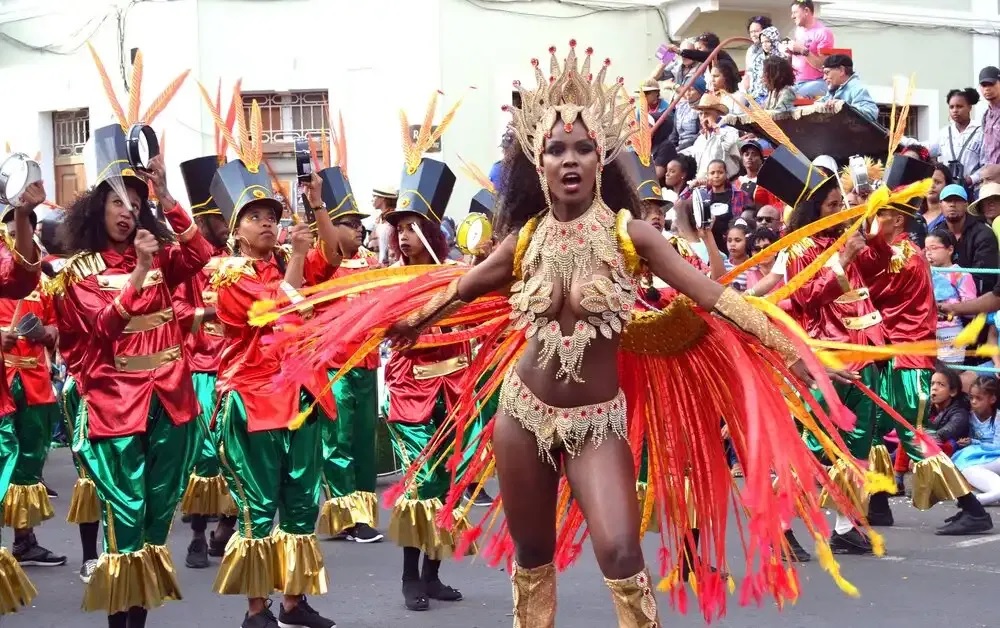
Some time around 1462 a Portuguese ship dropped anchor off an island that had never held a human footprint. Within a lifetime that island, Santiago in the Cape Verde archipelago, had become a wholly new kind of place: a society built from scratch out of two continents, a small number of European men and a far larger number of enslaved Africans, fused into a people who spoke a new language and answered to a new name. A generation later the same thing happened a thousand miles to the south, on the empty equatorial islands of Sao Tome and Principe. These were the first Atlantic creoles, the prototypes of every plantation society that the New World would later copy. Their genomes still carry the blueprint of how they were made: a strongly sex-biased blend of European fathers and African mothers, each archipelago drawing its African half through a different door of the slave trade, and, hidden in the forested south of Sao Tome, a runaway-slave people whose own origin story turns out to be half legend and half truth.
- The Cape Verde islands (settled from about 1462) and Sao Tome and Principe (settled in the 1490s) were uninhabited when the Portuguese arrived. The populations living there today were created entirely after settlement, by admixture between European colonists and enslaved Africans. They are the earliest examples of the Atlantic "plantation complex" and the first creole societies.
- All of these populations were built by the same engine and it left the same fingerprint: a strongly sex-biased admixture between European men and African women. Across the board the maternal line (mitochondrial DNA) is almost entirely African, while the European signal is carried by the paternal line (the Y-chromosome).
- Cape Verdeans average roughly 57 percent West African and 43 percent European ancestry, with wide variation between islands. The African half is Senegambian, from Upper Guinea: in Global25 the Cape Verdean point sits closer to the Mandenka of Senegal than to any other African source, and a clean two-source model rebuilds them as about half Senegambian, half Portuguese.
- The Sao Tome creoles are far more African. The Forros, descendants of freed slaves, carry only about 13 percent European ancestry genome-wide (and around a third on the Y-chromosome), and their African ancestry comes from the Gulf of Guinea (Nigeria and Benin) plus Congo and Angola, in a ratio of roughly two to one.
- Each creole was drawn through a different door of the slave trade. Global25 distances show the African sources fall into three distinct nodes: Senegambia in the far west, the Gulf of Guinea in the centre, and the Congo-Angola (Bantu) zone in the south. Cape Verde came through the Senegambian door; Sao Tome came through the Gulf of Guinea and Angolan doors.
- The Angolares, a community in southern Sao Tome, were long said to descend from the survivors of a wrecked Angolan slave ship. Genome-wide data rejects this: they are a mixed maroon isolate, founded by escaped slaves of the same Gulf of Guinea plus Angola stock as their neighbours, and then shaped by extreme genetic drift and inbreeding.
- One Angolan thread did survive, though, on the male line. A single Y-chromosome lineage of likely Angolan origin is carried by most Angolar men, with a common ancestor about 500 years ago, around the time the first Angolan slaves arrived. It was amplified by socially dominant headmen, the same kind of male-biased lineage explosion seen on the steppe and in colonial Brazil.
- One caution runs through the modelling. In Global25 the African sources partly overlap, so a least-squares model can shuffle the African slice between a Senegambian and a Bantu source. The robust conclusions, the Senegambian source for Cape Verde and the Gulf of Guinea plus Angola source for Sao Tome, come from history, uniparental lineages and formal published studies, which all agree.
1. Empty islands, full ships
The Atlantic creoles are unusual among the world's peoples because we know, almost to the decade, when they began. Both archipelagos were genuinely empty when Europeans first saw them: no earlier inhabitants, no substrate population, nothing to mix with except whoever the ships brought. Cape Verde, four hundred miles off the Senegalese coast, was settled from about 1462, the first permanent European settlement in the tropics. Sao Tome and Principe, sitting almost on the equator in the Gulf of Guinea, were settled in the last decade of the fifteenth century. In both cases the Portuguese installed the same economic machine, sugar cultivation worked by enslaved Africans, and in both cases the human result was the same: a brand-new population that did not exist before the islands were occupied.
This is why these islands matter far beyond their size. The plantation society they pioneered, a few European owners and a mass of imported African labour producing a sugar crop for export, was the template that Brazil and the Caribbean would scale up enormously over the next three centuries. The creole languages that emerged, Cape Verdean Kriolu and the Portuguese-based creoles of Sao Tome, were the first of a whole family. And the genetic process that built these peoples, asymmetric admixture between incoming men and a resident enslaved population, is written into their DNA in a form clean enough to read almost directly, because there was no older population to blur it.
2. The same engine, three doors
Although both archipelagos were made by the same kind of admixture, they did not draw on the same Africa. The Atlantic slave trade was not one undifferentiated flow; it tapped different stretches of the African coast at different times, and the islands closest to a given stretch tended to receive its people. Cape Verde, anchored off Senegal, was the entrepot for the Upper Guinea trade, drawing Wolof, Mandinka, Serer, Balanta and their neighbours from Senegambia. Sao Tome, far to the south, first drew on the Gulf of Guinea, in particular the Kingdom of Benin in what is now Nigeria, and then increasingly on the Congo and Angola as the trade shifted south after about 1510.
Global25 makes this geography concrete. The African source populations are not interchangeable; they fall into three clearly separated nodes. The Senegambian groups (Mandenka, Wolof, Serer) form one tight cluster in the far west. The Gulf of Guinea groups (Yoruba, Esan of Nigeria) form a second. The Congo-Angola Bantu groups (Kongo, Umbundu) form a third. The distances below show how distinct these doors are, and the map traces which door fed which island.
Schematic of the slave-trade geography behind the two archipelagos. The African source populations fall into three well-separated Global25 nodes: Senegambia, the Gulf of Guinea, and the Congo-Angola Bantu zone. Cape Verde was fed through the Senegambian door; Sao Tome through the Gulf of Guinea and, increasingly, the Angolan door. Distances are scaled Global25 Euclidean distances multiplied by 1000; routes are schematic.
3. Cape Verde: a Senegambian-Portuguese creole
Of the two archipelagos, Cape Verde is the cleaner two-source mixture, and the easier to model. The published genome-wide work puts the average Cape Verdean at about 57 percent West African and 43 percent European, with the African share running higher on the older, more African islands such as Santiago and lower on islands such as Fogo and Brava that drew more European settlers. A simple Global25 model agrees: rebuilding the Cape Verdean average out of just two sources, Senegambian (Mandenka) and Portuguese, splits them almost evenly, close to half and half, with the African share landing only a little below the published figure.
The crucial point is which African source fits. The distance chart below measures how far the average Cape Verdean sits from each candidate pole. Among all the African sources, the closest by a clear margin is the Mandenka of Senegal, the Senegambian door, and the Portuguese pole is at almost the same distance on the European side, exactly what you expect from a roughly even mixture of those two. The Gulf of Guinea and Angolan sources are all further away. The Senegambian groups themselves form a single tight knot in Global25, with Wolof, Serer and Mandinka all sitting within a handful of units of each other, so the model cannot and need not distinguish which particular Senegambian people contributed; the door is Upper Guinea, and that is what history records.
Scaled Global25 distance from the Cape Verdean average to each ancestral pole, multiplied by 1000. The two nearest poles, Senegambian Mandenka and Portuguese, sit at almost identical distances, the signature of a near-even two-source mixture. The other African sources, from the Gulf of Guinea and Angola, are all further away. Cape Verde's African ancestry is Senegambian.
4. Sao Tome: deeper into Africa
Sao Tome tells a different version of the same story. The dominant creole community, the Forros, takes its name from the Portuguese for "freed", because they descend largely from slaves who were granted manumission over the long history of the island. Genome-wide, the Forros are much more African than Cape Verdeans: only about 13 percent of their ancestry is European, against more than 40 percent in Cape Verde. And their African ancestry comes from a different place. Where Cape Verde drew on Senegambia, Sao Tome drew first on the Gulf of Guinea, especially the Kingdom of Benin in present-day Nigeria, and then increasingly on the Congo and Angola as the trade moved south. The Forros sit, genetically, between the Esan and Yoruba of Nigeria on one side and the Bantu peoples of Angola on the other, in a Gulf of Guinea to Angola ratio of roughly two to one.
The bars below set the creoles side by side, colour-coded by which African door each ancestry slice came through. The contrast is the whole point. Cape Verde is a tall European band over a Senegambian base. The Sao Tome groups have only a thin European band, or none, over an African base that is a blend of the Gulf of Guinea and Angola. These are not different proportions of the same mixture; they are different mixtures, assembled from different stretches of Africa.
Ancestry composition of the Atlantic creoles, with the African share split by source region. Cape Verde figures follow the published genome-wide average (about 57 percent West African, here Senegambian); the Sao Tome figures follow the genome-wide study of the archipelago, which gives the Forros about 13 percent European ancestry and Gulf of Guinea to Angola ratios of roughly 66:34 (Forros), 76:24 (Principenses) and 58:42 (Angolares). The Principense European slice (about 3 percent) is too thin to label. Read as directions; the Gulf of Guinea versus Angola split is the soft part of the model (see section 8).
5. The sex-biased signature
Every population on these islands was built the same way, and the way shows. When a small number of incoming men father children with a large resident population of women, the result is a genome-wide blend in which the two parental ancestries are split unequally between the sex chromosomes and the mitochondria. The mitochondrial DNA, passed only from mother to child, records the mothers, and here it is almost purely African: in Sao Tome the maternal pool is fully African, with essentially no European lineages at all, and Cape Verde shows the same strong African maternal bias. The Y-chromosome, passed only from father to son, records the fathers, and here the European signal is concentrated. Across the Sao Tome archipelago the European share of Y-chromosomes is about 24 percent, even though European mitochondrial lineages are absent.
The chart below makes the asymmetry visible for the three Sao Tome communities. The paternal European share towers over the maternal one, which is effectively zero everywhere. The genome-wide European share sits in between, much closer to the maternal floor than to the paternal peak, because the genome averages the two. This is the same pattern, in a gentler colonial key, that marks the steppe expansions and the founding of Brazil: incoming men, resident mothers, and a paternal line that carries far more of the newcomers' signal than the genome as a whole.
European ancestry split by inheritance line for the three Sao Tome communities. The paternal (Y-chromosome) European share is large; the maternal (mitochondrial) share is essentially nil; the genome-wide share, shown for the Forros, sits between the two. Y-chromosome figures follow the published study of the archipelago; the maternal pool is reported as fully African. The same asymmetry, in the same direction, holds in Cape Verde.
6. The Angolares and the shipwreck that probably never was
In the forested south of Sao Tome lives a community apart: the Angolares, fishers who speak their own creole, Lunga Ngola, and who carry a famous origin legend. The story, repeated since the eighteenth century, is that they descend from the survivors of an Angolan slave ship wrecked on the rocks off the southern coast, who swam ashore and founded a free community in the forest. It is a dramatic tale, and it has a close cousin in the Caribbean, where the Garifuna of Saint Vincent tell a near-identical story of shipwrecked Africans. The trouble is that the genetics does not fit it.
If the Angolares really descended from the cargo of a single Angolan ship, they should look specifically Angolan, drawn from one stretch of the African coast. They do not. When their strong genetic drift is accounted for, the Angolares turn out to carry the same two-part African ancestry as the rest of Sao Tome, a blend of Gulf of Guinea and Angola, only with the Angolan share running a little higher (around 42 percent against the Forros' 34). They are genetically closer to the Forros and Principenses than to any mainland African population. In other words they were assembled on the island, from the same pool of slaves as everyone else, not delivered whole from Angola. The most widely accepted explanation, and the one the genetics supports, is that the Angolares are a maroon community: the descendants of slaves who escaped the plantations into the mountainous interior, where marronage and rebellion are documented from the earliest days of the colony.
What sets them apart is not a separate origin but a separate history after their founding. The Angolares carry the genetic marks of a small, isolated, inbred population: unusually low genetic diversity, long runs of homozygosity, and a level of inbreeding higher even than Angolan groups that practise cousin marriage. They are an admixed isolate, founded by a handful of escapees and then sealed off, drifting away from their neighbours not because they came from somewhere else but because they were few and stayed apart.
7. The Angolan thread on the male line
And yet the legend is not pure invention. Buried in the Angolar gene pool is one genuinely Angolan thread, and it runs, as so often, down the male line. Most Angolar men, fifteen out of twenty-five in the study sample, carry a single Y-chromosome lineage. When that lineage is matched against reference databases, its closest affinities are Angolan: Angola accounts for a large share of its matches while making up only a small share of the comparison samples. The common ancestor of the lineage dates to roughly 500 years ago, with a wide error range, which places its arrival around the time the first slaves from the Congo and Angola reached Sao Tome, after about 1520.
The interpretation is a familiar one in this field. A single founding patriline reaches such a high frequency only when its carriers have far more sons than other men, generation after generation. The Angolar community was led by powerful headmen, the so-called captains, whose authority and likely polygyny would have given one man, or a small group of related Angolan men, a disproportionate reproductive success that they passed to their sons along with their status. The result is the same kind of male-biased lineage explosion that put R1a-Z93 into most North Indian men from a modest steppe migration, or that gave colonial Brazil its skewed European paternal line. The Angolares are not the children of a shipwreck. They are the children of a maroon settlement, shaped by drift and isolation, on whom one dominant Angolan father left an outsized paternal mark, just enough of an Angolan thread to give a legend something to grow from.
8. When the proxy is soft
One caution belongs on the modelling, and it is the same caution that recurs whenever closely related sources are involved. The African source populations used here are not as far apart, in genetic terms, as a European and an African source are, and the Senegambian, Gulf of Guinea and Angolan nodes share a great deal of common African ancestry. When a least-squares model is given a heavily European-shifted target such as Cape Verde, together with several African sources at once, it can shuffle the African slice between them in ways that do not reflect history. Hand it a Bantu source alongside the Senegambian one, and it will happily reassign much of Cape Verde's African ancestry to Angola, even producing a slightly tighter numerical fit, despite the fact that Cape Verde's African ancestry is Senegambian beyond any historical doubt. This is a modelling artifact, not a discovery, and it is exactly why the headline figures in this article lean on the two-source models, the distance rankings, the uniparental lineages and the formal published studies rather than on a greedy multi-source fit.
What survives every caution is the shape of the thing, and it is robust. Two empty archipelagos were peopled from scratch by European men and African women, leaving a sex-biased signature that is unmistakable in every group. Cape Verde was drawn through the Senegambian door and is close to half European; Sao Tome was drawn through the Gulf of Guinea and Angolan doors and is mostly African. And in the south of Sao Tome a maroon people carry, on the father's line, the one Angolan thread that their famous legend remembers and exaggerates. The Global25 models here are a clear, reproducible picture of that shape, not an accounting to the last percentage point.
The story in steps
Claim and reality
The Cape Verdeans and Sao Tomeans are simply African peoples.
They are admixed creoles created after the islands were settled. Cape Verdeans are close to half European; the Sao Tome Forros carry about 13 percent European ancestry and a third European Y-chromosomes. The admixture is real, recent, and strongly sex-biased.
All these African creoles drew on the same African source.
They came through different doors. Cape Verde's African ancestry is Senegambian, from Upper Guinea; Sao Tome's is from the Gulf of Guinea plus Congo and Angola. In Global25 these are three clearly separated African nodes.
The Angolares descend from survivors of a wrecked Angolan slave ship.
Genome-wide data rejects a single Angolan origin. The Angolares carry the same Gulf of Guinea plus Angola blend as their neighbours and are genetically closest to them. They are a maroon isolate of escaped slaves, shaped by drift and inbreeding, not castaways.
So there is nothing specifically Angolan about the Angolares.
One Angolan thread survives, on the male line. A single Y-chromosome lineage of likely Angolan origin is carried by most Angolar men, with a common ancestor around 500 years ago, amplified by dominant headmen. The legend remembers a real Angolan father and turns him into a ship.
A large European Y-chromosome share means heavy European ancestry overall.
No. The admixture was sex-biased. The Sao Tome Y-chromosome pool is about a quarter European while the maternal pool is essentially fully African and the genome-wide European share is modest. The Y-chromosome overstates the European contribution, just as it does on the steppe and in Brazil.
Reproduce it yourself
Paste these scaled Global25 coordinates into Vahaduo to reproduce the distances and models above. The Cape Verdean average is the target; Portuguese is the European source, Mandenka (with Wolof and Serer as Senegambian companions) the Upper Guinea source, Yoruba and Esan the Gulf of Guinea source, and Kongo and Umbundu the Congo-Angola source. Sao Tome and the Angolares are discussed from the published literature, since they are not present as Global25 averages. All coordinates are on the same Global25 scale.
Cape_Verdean,-0.2607705,0.111911,0.026840571,0.0046151429,0.020991429,0.0041039286,0.0009335,0.0061472857,-0.001868,0.027214357,0.00087807143,0.0021271429,0.0011125714,-0.0043095714,0.0064884286,-0.0014160714,-0.00098564286,-0.00065242857,-0.0032452143,0.000335,0.0014857857,-0.0020999286,0.00018985714,0.000036285714,0.00049457143
Portuguese,0.106174,0.144611,0.036007,-0.004432,0.042137,-0.004049,-0.003741,0.00276,0.025598,0.029741,-0.000734,0.007421,-0.012737,-0.011263,0.012557,-0.000398,-0.001132,-0.000887,-0.005762,-0.000245,0.001138,-0.002572,0.001301,-0.001133,-0.000105
Mandenka_Senegambia,-0.607499,0.063866,0.018269,0.010695,-0.000222,0.009048,-0.037954,0.038562,-0.030804,0.025857,0.005079,-0.001224,0.019499,-0.000994,0.016535,-0.012125,0.010916,-0.000267,-0.001941,-0.002202,-0.001795,-0.005647,0.000596,-0.001004,0.001497
Wolof_Gambia,-0.60458366,0.065211411,0.017657384,0.0080461607,0.00069514286,0.0074154911,-0.039200714,0.041233848,-0.027979616,0.024818268,0.0046323929,-0.0012550982,0.018793625,-0.0016097054,0.013528357,-0.012294143,0.010811384,-0.0021718036,-0.0038562232,-0.0014862054,-0.0024276339,-0.0054108839,0.0026597857,-0.0014341161,0.001932
Serer_Gambia,-0.60392262,0.0633893,0.01756634,0.01058794,0.0013848,0.0082886,-0.03860302,0.03938602,-0.0289074,0.02438328,0.0033549,-0.00115692,0.01778878,-0.00134044,0.01436736,-0.01053558,0.0093824,-0.00130742,-0.0027955,-0.00253622,-0.0016646,-0.00359332,0.00124728,-0.00097838,0.00269186
Yoruba_Nigeria,-0.630062,0.062501,0.022113,0.016708,0.000503,0.012474,-0.044417,0.047767,-0.048881,0.032769,0.004621,0.00079,0.023056,0.000951,0.012523,-0.009607,0.007076,0.000449,0.006022,-0.00299,0.001554,0.002316,-0.001759,-0.000471,-0.000425
Esan_Nigeria,-0.632145,0.064613,0.02324,0.01829,-0.003193,0.014677,-0.041215,0.046412,-0.051054,0.035035,0.008262,-0.001461,0.023358,0.003269,0.012147,-0.009513,0.006747,0.003294,0.006065,-0.003533,0.00039,0.001283,-0.000724,-0.000256,-0.000928
Kongo,-0.628304,0.064994,0.020365,0.017442,-0.000615,0.016176,-0.016451,0.020076,-0.033746,0.020228,0.008607,-0.003147,-0.001933,0.001514,-0.006786,0.00769,-0.009648,0.00114,0.001257,0.003502,-0.002496,-0.000989,0.001109,-0.001084,-0.006826
Umbundu_Angola,-0.626255,0.063267,0.021741,0.016053,0.001477,0.011658,-0.014512,0.023318,-0.033061,0.016884,0.001965,-3e-04,-0.002728,0.000537,-0.009351,0.006252,-0.00562,0.003003,-0.004582,0.002063,0.000262,0.000779,0.001676,-0.000108,-0.00018
References and sources
- 1 Beleza, S., Campos, J., Lopes, J., et al. The Admixture Structure and Genetic Variation of the Archipelago of Cape Verde and Its Implications for Admixture Mapping Studies. PLoS ONE 7, e51103 (2012). The reference admixture study of Cape Verde: 845 individuals from six islands, a mean West African ancestry of about 57 percent with wide between-island variation, and confirmation from X- and Y-chromosome markers that the admixture was sex-biased, European male and African female. link
- 2 Korunes, K. L., Soares-Souza, G. B., Bobrek, K., et al. Sex-biased admixture and assortative mating shape genetic variation and influence demographic inference in admixed Cabo Verdeans. G3 Genes Genomes Genetics 12, jkac183 (2022). A genome-wide reassessment of Cape Verdean admixture and population structure, quantifying the sex bias and assortative mating and confirming Santiago as the oldest island population. link
- 3 Laurent, R., Gineau, L., Utge, J., et al. A genetic and linguistic analysis of the admixture histories of the islands of Cabo Verde. eLife 12, e79827 (2023). Links genetic and linguistic admixture across the archipelago and resolves the African source as Upper Guinea / Senegambian and the European source as Iberian. link
- 4 Trovoada, M. J., Pereira, L., Gusmao, L., et al. Pattern of mtDNA variation in three populations from Sao Tome e Principe. Annals of Human Genetics 68, 40-54 (2004); and Trovoada, M. J., et al. Dissecting the Genetic History of Sao Tome e Principe: A New Window from Y-Chromosome Biallelic Markers. Annals of Human Genetics 71, 77-85 (2007). The uniparental portrait of the archipelago: a fully African maternal pool, a 23.9 percent European Y-chromosome share overall (Forros 33.3, Tongas 27.3, Angolares 14.5 percent), and the first genetic case against the Angolar shipwreck legend. link
- 5 Coelho, M., Coia, C. A. V., Luiselli, D., et al. Human Microevolution and the Atlantic Slave Trade: A Case Study from Sao Tome. Current Anthropology 49, 134-143 (2008). Detects the strong genetic differentiation of the Angolares and frames the marronage hypothesis for their origin. link
- 6 Almeida, J., Fehn, A.-M., Ferreira, M., Machado, T., Hagemeijer, T., Rocha, J., Gaya-Vidal, M. The Genes of Freedom: Genome-Wide Insights into Marronage, Admixture and Ethnogenesis in the Gulf of Guinea. Genes 12, 833 (2021). The genome-wide study of Forros, Principenses and Angolares with new Angolan data: shows the Angolares as an admixed maroon isolate with extreme drift and inbreeding, rejects the shipwreck origin, and identifies the dominant Angolar Y-lineage of likely Angolan origin with a TMRCA of about 500 years. link
- 7 Global25 coordinates: Davidski (Eurogenes), with modern population averages from the public Global25 datasheets and the Moriopoulos 2025 collection. Global25 spreadsheet tooling: Vahaduo. G25
Modern Global25 coordinates: Davidski (Global25), with population averages from the public Global25 datasheets and the Moriopoulos 2025 collection. The Cape Verdean point is a named modern Global25 average; the Senegambian, Gulf of Guinea, Congo-Angola and Portuguese points are named modern population averages. Sao Tome and the Angolares are not present as Global25 averages and are described from the published literature cited above; their ancestry figures come from genome-wide and uniparental studies, not from the Global25 models. Global25 spreadsheet tooling: Vahaduo. Analysis: scaled Global25 Euclidean distances and non-negative least squares modelling in Python. Ancestry fractions are proxy-dependent and best read as directions rather than exact percentages. The split of the African ancestry between Senegambian, Gulf of Guinea and Bantu sources is the soft part of the modelling, because these African sources share much common ancestry and a least-squares fit can shuffle the African slice between them; the robust results, the Senegambian source for Cape Verde and the Gulf of Guinea plus Angola source for Sao Tome, are confirmed by history, uniparental lineages and the formal published studies. Uniparental, genome-wide and admixture figures for the Sao Tome communities follow the cited studies. Y-chromosome and mitochondrial lineages are single inherited lines and carry no information about appearance, character or worth.