
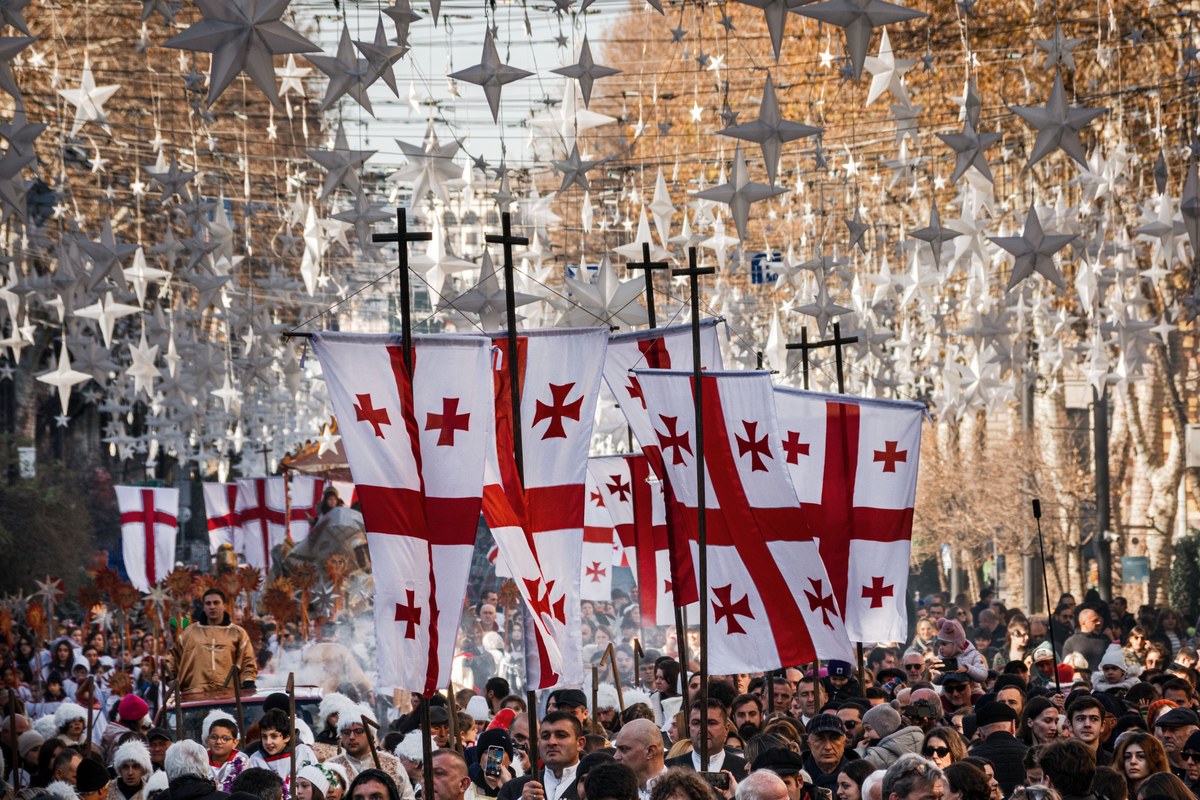
In two caves in the wet green hills of western Georgia, archaeologists found the bones of men who had been dead for more than ten thousand years. When their genomes were read, they turned out to belong to a population that no one had ever described: not the western hunter-gatherers of Ice Age Europe, not the first farmers of the Near East, but a third, separate strand of humanity that had split off near the dawn of the modern European world and then sat almost untouched for fifteen thousand years behind the wall of the Caucasus mountains. These were the Caucasus hunter-gatherers, CHG for short, and they are one of the great ancestral sources of the entire western half of Eurasia. Their blood runs in the Yamnaya horsemen who carried Indo-European speech into Europe, in the farmers of the Iranian plateau, and across central and south Asia. But the people who kept the most of them, who still sit closest to those cave-dwellers on every genetic map, never left. They are the Georgians and their neighbours in the South Caucasus, the living heirs of an Ice Age refuge.
- The two CHG type genomes come from western Georgia: Satsurblia cave, a man dated to about 13,300 years ago, and Kotias Klde cave, a man dated to about 9,700 years ago. The landmark 2015 study that sequenced them showed CHG to be a distinct, deeply divergent strand of Eurasian ancestry, split from the western hunter-gatherers around 45,000 years ago and from the ancestors of the first Near Eastern farmers around 25,000 years ago, at the Last Glacial Maximum.
- CHG is its own basal source, not a mix of anything older we can sample. In scaled Global25 it sits far from the western hunter-gatherers (about 556 units) and is closest to Neolithic Iran (about 189), its sister lineage, but it cannot be cleanly rebuilt out of the other deep poles. The Caucasus acted as a glacial refuge where this lineage survived in isolation while the rest of Europe was repeatedly overwritten.
- The refuge did not stay sealed. CHG ancestry flowed out and helped build the western half of Eurasia. The Yamnaya steppe herders, the people behind the Indo-European expansion, were roughly half CHG and half Eastern hunter-gatherer; through them CHG ancestry reached almost every European population. A parallel CHG-related stream fed the Neolithic farmers of Iran and, beyond them, south and central Asia.
- Modern Georgians sit closer to the CHG cave samples than to any other ancestral pole, about 147 scaled units from CHG against 209 from the Anatolian and Iranian farmers and a distant 356 and 508 from the Eastern and western hunter-gatherers. A modern Georgian is, to a first approximation, a Caucasus hunter-gatherer who took up farming.
- A deep six-source model rebuilds the average Georgian as close to half CHG (about 47 percent), a third Anatolian Neolithic farmer (about 31 percent), and small slices of Iranian and Levantine farmer, with almost no steppe and zero western hunter-gatherer. The South Caucasus is the only region on Earth where the CHG share of living people is still this high.
- The whole Caucasus, not only the Georgians, is the CHG retention zone. By the same model the CHG share runs from over half in Ossetians and Abkhazians, through the high forties in Georgians and Chechens, down to the low twenties in Armenians and Azeris, then falls off a cliff outside the mountains: around ten percent in Europe and effectively zero in Sardinia. The mountains held the lineage in place.
- This CHG substrate cuts straight across language. Georgians speak a Kartvelian language, an isolate family unrelated to anything else on Earth; Ossetians speak an Iranic (Indo-European) language; Abkhazians and Circassians speak Northwest Caucasian; Chechens speak Northeast Caucasian. They share the deep CHG ancestry regardless. Language and genes are telling two different stories, as so often.
- One caution runs through the models. CHG and Neolithic Iran are sister lineages, close together in the genetic space, so the algorithm can shuffle ancestry between them. The exact CHG-versus-Iran split in any one population is soft and proxy-dependent. The robust result, confirmed by formal published studies, is the enormous CHG-related signal in the Caucasus and its sharp drop-off outside.
1. Two caves in western Georgia
The story begins underground. Satsurblia is a karst cave in the Imereti region of western Georgia; Kotias Klde is another, a little to the south. From these two sites came the remains of men who lived in the long cold tail of the Ice Age and its immediate aftermath, one around 13,300 years ago in the Late Upper Palaeolithic, the other around 9,700 years ago in the Mesolithic. When the 2015 study sequenced their genomes, the result was a surprise. They did not cluster with the western hunter-gatherers who roamed Ice Age Europe, nor with the early farmers spreading out of the Near East. They formed their own tight cluster, off on their own, and the two of them, separated by more than three thousand years, were almost identical. The same people had lived in the same hills, barely changed, across that entire span.
That continuity is the first clue to what the Caucasus was: a refuge. During the Last Glacial Maximum, when ice and tundra made much of the northern world hostile, the southern flanks of the Caucasus stayed liveable. A population could shelter there and persist, cut off from the dramatic comings and goings that churned the gene pools elsewhere. The two cave men are snapshots of that sheltered population near the beginning and the end of its long isolation, and they look almost the same because, for them, almost nothing had changed.
2. A lineage apart
What made CHG so striking was not just that it was new, but how deep its roots ran. The 2015 analysis estimated that the CHG lineage had split from the western hunter-gatherers around 45,000 years ago, very soon after modern humans first spread into Europe, and from the ancestors of the first Near Eastern farmers around 25,000 years ago, right at the Last Glacial Maximum. In other words, by the time farming was invented, CHG had already been a distinct strand of humanity for tens of thousands of years.
The Global25 distances tell the same story in numbers. CHG sits a vast 556 scaled units from the western hunter-gatherer pole, almost the maximum separation in this part of the world. Its nearest relative is Neolithic Iran, only 189 units away, its sister lineage on the eastern side of the ancient Near East. It lies a middling distance from the Anatolian and Levantine farmers and from the Eastern hunter-gatherers of the Russian forest zone. And when you try to rebuild CHG as a mixture of all those other deep populations, you cannot: the best attempt leaves a large residual, far worse than the clean fits you get for any modern group. CHG is not a blend of things we already know. It is its own source.
Schematic lineage tree of the deep West Eurasian populations. CHG branches off early, roughly 45,000 years ago from the western hunter-gatherers and roughly 25,000 years ago from the ancestors of the first farmers, then survives in isolation in the Caucasus refuge. Its closest relative is Neolithic Iran; it is farthest of all from the western hunter-gatherers. Split times follow the 2015 type study; distances are scaled Global25 Euclidean distances multiplied by 1000.
3. The refuge that helped build Eurasia
A lineage that sat still for fifteen thousand years might sound like a dead end. It was the opposite. When the refuge finally opened, CHG ancestry poured out and became one of the foundation stones of the western half of the continent, and it did so along two great roads.
The first road ran north, onto the Pontic-Caspian steppe. There, CHG-related people met the Eastern hunter-gatherers of the Russian forest-steppe, and out of that meeting came the steppe ancestry that would change the world. The Yamnaya herders, the people most associated with the spread of Indo-European languages, carried nearly half their ancestry from CHG, balanced against roughly an equal share of Eastern hunter-gatherer. In our own modelling the Samara Yamnaya come out as about 60 percent Eastern hunter-gatherer and 40 percent CHG, and the published Southern Arc study puts it at close to half and half. Either way, when the Yamnaya rode into Europe and seeded ancestry from Ireland to India, they were carrying the Caucasus refuge with them. A large fraction of the steppe ancestry now found in nearly every European is, at one remove, CHG.
The second road ran south and east, into the Iranian plateau. CHG and the Neolithic farmers of the Zagros mountains are sister lineages, and the farming peoples of Iran carried a heavily CHG-related ancestry onward into central and south Asia. Through them, this Caucasus strand reached far beyond the mountains, leaving its mark from the steppes of Kazakhstan to the Indus. The diagram below traces the refuge and its two outflows, from the sealed Ice Age homeland to the populations it ultimately fed.
Schematic of the Caucasus refuge and its outflows. CHG ancestry flowed north into the Yamnaya steppe population, where it made up close to half the ancestry and rode westward into Indo-European Europe, and south into the Neolithic farmers of Iran and onward into Asia. Meanwhile the largest CHG share simply remained where it began, in the South Caucasus. Proportions are schematic; the Yamnaya CHG share follows our modelling and the published Southern Arc study.
4. Modern Georgians sit on the CHG pole
If the Georgians really are the people who stayed, they should sit closer to the CHG cave samples than to anyone else. They do, by a wide margin. The distance chart below measures how far the average Georgian sits from each ancestral pole in scaled Global25 units. The nearest by far is CHG itself, at about 147 units. The Anatolian and Iranian Neolithic farmers come next, both around 209, because Georgians do carry real farmer ancestry on top of their CHG base. The Yamnaya steppe sits at a similar distance, no surprise given that the Yamnaya are themselves part CHG. Then the gap opens up: the Eastern hunter-gatherers are a remote 356 units away, and the western hunter-gatherers, the people of Ice Age Europe, are a distant 508. A modern Georgian is, to a first approximation, a Caucasus hunter-gatherer who learned to farm, with very little added from any of the other ancient sources.
Scaled Global25 distance from the average Georgian (a mean of eleven Georgian regional groups) to each ancestral pole, multiplied by 1000. CHG is the closest by a wide margin, with the Anatolian and Iranian farmers next. The Eastern and especially the western hunter-gatherers are remote. Georgians barely register any western hunter-gatherer ancestry at all.
5. Half hunter-gatherer, half farmer
Distances point in a direction; a model puts numbers on it. Rebuilding the average Georgian and their neighbours as a mixture of six deep sources, CHG, the Anatolian, Iranian and Levantine Neolithic farmers, the Eastern hunter-gatherers and the western hunter-gatherers, gives the breakdown below. The Georgian comes out close to half CHG, about a third Anatolian farmer, and small remainders of Iranian and Levantine farmer, with a sliver of steppe-related Eastern hunter-gatherer and no western hunter-gatherer at all. That is an extraordinary figure. Nowhere else on Earth do living people carry so much ancestry directly from a local Ice Age hunter-gatherer population. Most Europeans retain only a thin trace of their own western hunter-gatherers; Georgians retain nearly half of theirs.
Non-negative least squares models of each modern group on six deep sources. Georgians, Abkhazians and Ossetians are the most CHG-heavy, close to or above half; Armenians and Azeris carry far more Anatolian and Iranian farmer ancestry and roughly half the CHG. Note that no group takes any western hunter-gatherer, and steppe-related ancestry stays small except in the north (Chechen). The CHG-versus-Iranian split is the soft part of these models (see section 8); read the figures as directions, not exact percentages.
6. The whole Caucasus kept the CHG
The Georgians are not alone in this. The same model run across the wider region shows that the entire Caucasus is a CHG retention zone, and that the lineage fades sharply the moment you leave the mountains. The bars below rank populations by their modelled CHG share. At the top sit the Ossetians and Abkhazians, above half; then the Georgians and Chechens in the high forties; then a step down through the Lezgins; then the South Caucasus borderlands of the Armenians and Azeris in the low twenties, where Anatolian and Iranian farmer ancestry has diluted the old substrate. Beyond the immediate region the signal collapses. Anatolian Turks and Iranians sit near a fifth or less, mainland Europeans around a tenth, and Sardinians, those near-pure descendants of the first Anatolian farmers, essentially nothing. The Caucasus mountains did for CHG what they did for so much else in the region: they held it in place while the surrounding world was made and remade.
Modelled CHG share from the same six-source model. The gradient is geographic: highest in the heart of the Caucasus, fading through the South Caucasus borderlands, and near zero beyond West Asia. Sardinians, the closest living proxy for the first Anatolian farmers, carry essentially no CHG. Figures are proxy-dependent and read as directions, not exact percentages.
One detail in that ranking is worth dwelling on. The single most CHG-heavy groups here, the Ossetians and Abkhazians, edge out the Georgians themselves. This is not a contradiction. The CHG type specimens happen to come from Georgian soil, but CHG was a regional population, and several Caucasus peoples preserve its ancestry in very high amounts. The honest statement is not that Georgians are uniquely CHG, but that the Caucasus as a whole is the great CHG reservoir, with the Georgians sitting near the very top of it and standing, quite literally, on the ground where the lineage was first found.
7. Language and continuity
The genetics of the Caucasus carry a lesson that runs through so much of this field: language and ancestry are not the same thing. The peoples who share this deep CHG substrate speak languages from four utterly unrelated families. Georgian belongs to the Kartvelian family, a small isolate group found nowhere else on Earth and unrelated to any other language, Indo-European or otherwise. Ossetian, by contrast, is an Iranic language, a branch of Indo-European carried into the mountains relatively recently. Abkhazian and Circassian belong to the Northwest Caucasian family; Chechen and the Dagestani tongues to the Northeast Caucasian. Four families, one shared deep ancestry. A people can change its language without changing its blood, and the Caucasus is one of the clearest demonstrations of it: the Iranic-speaking Ossetians are, in their genome, among the most CHG-rich and therefore among the most anciently Caucasian of all.
None of this means the Caucasus was frozen. Real ancestry did arrive from outside. The substantial Anatolian Neolithic farmer share in every Georgian is the genetic record of farming spreading into the region from the southwest. Later movements added the Iranian and Levantine traces, and a thin steppe signal. The point is not that nothing changed, but that against this backdrop of normal, gradual mixing, the CHG core was never swept away. In most of Europe the local hunter-gatherers were largely replaced, first by farmers and then by the steppe; in the Caucasus the local hunter-gatherers simply became the local farmers, and then the local moderns, with the newcomers blending in rather than washing them out.
8. When the proxy is soft
A warning belongs on these numbers, the same kind of warning that belongs on every admixture model. CHG and the Neolithic farmers of Iran are sister lineages, very close together in the genetic space, separated by only about 189 scaled units, the smallest gap of any pair in this analysis. When two sources sit that close, the model cannot always tell them apart cleanly, and it will shuffle ancestry between them depending on tiny features of the target and the exact reference samples chosen. That is why, in the tables above, the precise division between the CHG slice and the Iranian-farmer slice should be read with caution. A few points of one could in reality belong to the other.
What survives this caution is the big picture, and it is not subtle. Whether you assign the eastern part of the ancestry to CHG or to Neolithic Iran, the combined CHG-plus-Iranian signal in the Caucasus is overwhelming and unmistakable, and it falls away sharply outside the region. The formal published studies, which use rigorous statistical tests rather than Global25 geometry, reach the same conclusion: the Caucasus is the place where the CHG lineage is most strongly preserved, and the Georgians are at the heart of it. The Global25 models in this article are best read as a clear, reproducible picture of that shape, not as a precise accounting to the last percentage point.
The story in steps
Claim and reality
Caucasus hunter-gatherers were just another branch of European hunter-gatherers.
They were a deeply distinct lineage that split from the western hunter-gatherers around 45,000 years ago and from the ancestors of the first farmers around 25,000 years ago. In Global25 they sit about 556 units from the western hunter-gatherers, almost the maximum separation in the region.
A population that hid in a refuge for millennia could not have mattered much.
CHG was one of the foundation sources of western Eurasia. It made up close to half the Yamnaya steppe ancestry that spread Indo-European languages into Europe, and a CHG-related stream fed the Neolithic farmers of Iran and beyond into Asia.
Modern Georgians are a typical West Asian farmer population.
They sit closer to the 10,000-year-old CHG cave samples than to any farmer pole, about 147 units from CHG against 209 from the Anatolian and Iranian farmers. A modern Georgian is close to half CHG, the highest local hunter-gatherer retention of any living people.
Only Georgians carry this deep Caucasus ancestry.
The whole Caucasus is the CHG reservoir. Ossetians and Abkhazians model as even more CHG than Georgians; Chechens are close behind. The lineage fades through Armenians and Azeris and collapses outside West Asia. Georgians sit near the top of a regional cline, not alone on it.
The Kartvelian language proves the Georgians are a uniquely isolated people.
The deep CHG ancestry is shared across the Caucasus regardless of language. Ossetians speak an Indo-European tongue yet are among the most CHG-rich of all. Language and ancestry are separate histories; the Kartvelian isolate is striking, but it is not what makes Georgian DNA old.
Reproduce it yourself
Paste these scaled Global25 coordinates into Vahaduo to reproduce the distances and models above. The modern Caucasus groups are the targets; the CHG cave samples, the Neolithic farmer sources, the Eastern and western hunter-gatherers and the Yamnaya are the sources. All coordinates are on the same Global25 scale.
Georgian,0.109467,0.129580,-0.053641,-0.041956,-0.040166,-0.005401,0.009620,-0.006266,-0.059098,-0.021112,-0.000322,0.010645,-0.023537,0.003208,0.003730,-0.018736,0.007288,-0.004284,-0.008481,0.013353,0.010991,0.002682,0.001324,-0.005552,-0.001385
Armenian,0.104036,0.137871,-0.056471,-0.059948,-0.029781,-0.015266,0.004371,-0.006089,-0.030786,-0.004093,0.003038,0.002206,-0.003190,0.002448,-0.004757,-0.001181,0.001377,0.000358,0.001869,-0.002288,0.001598,0.001993,-0.000986,-0.001188,0.001056
Azeri,0.096637,0.088785,-0.044855,-0.037593,-0.032777,-0.007871,0.005228,-0.004358,-0.029522,-0.010230,-0.001746,0.000707,-0.003213,-0.000653,0.000896,0.001802,-0.000572,0.001187,0.001358,-0.004505,-0.000690,-0.001158,-0.000470,-0.001199,0.002457
Ossetian,0.107942,0.098676,-0.037083,-0.026594,-0.035801,-0.002138,0.008656,-0.002384,-0.062107,-0.028490,-0.002679,0.009666,-0.022051,0.004450,0.004207,-0.021258,0.003868,-0.005785,-0.013031,0.016904,0.009171,0.000185,-0.002157,-0.010283,-0.000140
Abkhasian,0.109270,0.116673,-0.047894,-0.040662,-0.038948,-0.006570,0.011385,-0.006333,-0.061516,-0.022293,-0.001931,0.009875,-0.024331,0.004679,0.002368,-0.024190,0.009127,-0.005448,-0.011508,0.019732,0.014280,0.002047,0.003245,-0.009051,-0.001943
Chechen,0.112685,0.104668,-0.030371,-0.008527,-0.035761,0.006786,0.008398,-0.004908,-0.055917,-0.032608,-0.002014,0.008223,-0.016719,-0.006120,0.010496,-0.009087,0.005737,-0.006427,-0.008992,0.013098,0.003086,0.002391,0.003936,0.006298,-0.004654
Lezgin,0.110029,0.098506,-0.029415,0.008290,-0.037443,0.007902,0.009009,-0.005692,-0.052017,-0.032863,0.001624,0.006694,-0.006838,0.000367,0.012079,-0.001370,-0.008171,0.000465,-0.006955,-0.004711,-0.001040,-0.000536,0.001479,0.011287,0.003752
CHG_Satsurblia_13000BP,0.092197,0.101553,-0.093526,-0.000969,-0.092633,0.020917,0.030786,-0.001615,-0.139281,-0.085833,-0.002923,0.024278,-0.058424,0.009634,0.036373,-0.022938,0.044591,-0.008488,-0.027025,0.042896,0.045170,-0.009521,0.001849,-0.030245,-0.002515
CHG_Kotias_9700BP,0.091058,0.102568,-0.083344,-0.003230,-0.086170,0.020638,0.024911,-0.001846,-0.128236,-0.074717,-0.006333,0.023979,-0.054856,0.004404,0.026601,-0.032750,0.023860,-0.013429,-0.022249,0.034767,0.033815,-0.007048,0.006532,-0.025787,-0.002036
Anatolia_Neolithic,0.117902,0.180087,0.003426,-0.101059,0.051240,-0.047969,-0.003799,-0.006846,0.036167,0.080678,0.008261,0.011309,-0.024164,0.000579,-0.042712,-0.010370,0.022556,0.001388,0.013649,-0.010448,-0.014261,0.005693,-0.004904,-0.003750,-0.004436
Iran_Neolithic_GanjDareh,0.043025,0.067431,-0.153488,0.005556,-0.123962,0.024375,0.015464,0.000277,-0.081605,-0.054270,-0.003248,-0.001619,0.005382,-0.007845,0.031949,0.056775,-0.005815,0.007576,0.014405,-0.032741,0.007661,-0.030048,-0.010920,-0.038777,0.022944
Levant_Neolithic_PPNB,0.070570,0.174671,-0.032809,-0.147612,0.036930,-0.068886,-0.018331,-0.009230,0.077719,0.043554,0.011205,-0.012589,0.027800,-0.006744,-0.023480,0.009944,0.020340,-0.008742,-0.001885,0.024637,0.000749,0.007048,-0.004807,-0.005422,-0.008742
EHG_Russia,0.117238,0.029450,0.126335,0.204460,-0.018773,0.058009,-0.017626,-0.029306,-0.004704,-0.083464,0.019324,-0.016036,0.029881,-0.050370,0.022122,0.030496,-0.001956,0.005448,0.001257,0.017008,-0.003494,0.022010,0.015159,-0.014942,-0.012933
WHG_Loschbour,0.130897,0.109677,0.203645,0.198000,0.162492,0.059125,0.015041,0.038075,0.100217,0.016219,-0.015427,-0.017235,0.019921,-0.001239,0.061346,0.070670,0.002608,0.007348,-0.008925,0.065406,0.117543,0.010387,-0.049422,-0.173639,0.019519
Yamnaya_Samara,0.125838,0.089254,0.042908,0.115456,-0.027868,0.044685,0.004491,-0.002949,-0.054858,-0.072996,0.001858,0.000350,-0.001652,-0.023610,0.037263,0.015734,0.000000,-0.001478,-0.001704,0.012506,-0.003120,0.001374,0.011229,0.018436,-0.004524
References and sources
- 1 Jones, E. R., Gonzalez-Fortes, G., Connell, S., et al. Upper Palaeolithic genomes reveal deep roots of modern Eurasians. Nature Communications 6, 8912 (2015). The type study of CHG: sequences the Satsurblia (about 13,300 years old) and Kotias (about 9,700 years old) genomes from western Georgia, shows CHG split from western hunter-gatherers around 45,000 years ago and from early-farmer ancestors around 25,000 years ago, and that CHG contributed to the Yamnaya and to modern populations from the Caucasus to South Asia. link
- 2 Wang, C.-C., Reinhold, S., Kalmykov, A., et al. Ancient human genome-wide data from a 3000-year interval in the Caucasus corresponds with eco-geographic regions. Nature Communications 10, 590 (2019). Forty-five Eneolithic and Bronze Age Caucasus genomes; documents a stable genetic separation between mountain and steppe, the CHG-rich Caucasus cline, and the role of CHG in forming steppe ancestry. link
- 3 Lazaridis, I., Nadel, D., Rollefson, G., et al. Genomic insights into the origin of farming in the ancient Near East. Nature 536, 419-424 (2016). Shows the first farmers of the Levant and of the Zagros (Iran) were strongly differentiated, and frames the CHG and Iranian Neolithic lineages and their Basal Eurasian component. link
- 4 Lazaridis, I., Alpaslan-Roodenberg, S., et al. The genetic history of the Southern Arc: a bridge between West Asia and Europe. Science 377, eabm4247 (2022). A 727-genome study of West Asia and the Caucasus; finds the Yamnaya drew nearly half their ancestry from CHG, with an essentially equal CHG-EHG balance, and maps the deep Caucasus contribution to the steppe. link
- 5 Haak, W., Lazaridis, I., Patterson, N., et al. Massive migration from the steppe was a source for Indo-European languages in Europe. Nature 522, 207-211 (2015). The foundational steppe-migration study, establishing Yamnaya as a mixture of Eastern hunter-gatherer and a southern, Caucasus-related source, and the vehicle that carried that ancestry into Europe. link
- 6 Global25 coordinates: Davidski (Eurogenes), with modern and ancient population averages from the public Global25 datasheets and the Moriopoulos 2025 collection. Global25 spreadsheet tooling: Vahaduo. G25
Modern and ancient Global25 coordinates: Davidski (Global25), with population averages from the public Global25 datasheets and the Moriopoulos 2025 collection. The Georgian point is the average of eleven Georgian regional groups; the Armenian and Azeri points are averages of the named regional groups; the CHG point is the average of the Satsurblia and Kotias samples; the farmer, hunter-gatherer and Yamnaya points are the named published averages. Global25 spreadsheet tooling: Vahaduo. Analysis: scaled Global25 Euclidean distances and non-negative least squares modelling in Python. Ancestry fractions are proxy-dependent and best read as directions rather than exact percentages. The split between the CHG and Iranian-Neolithic shares is the soft part of the modelling, because the two are sister lineages; the robust result, in line with the published studies cited above, is the very high combined CHG-related ancestry of the Caucasus and its sharp drop-off beyond the region. Split times follow the 2015 type study.