
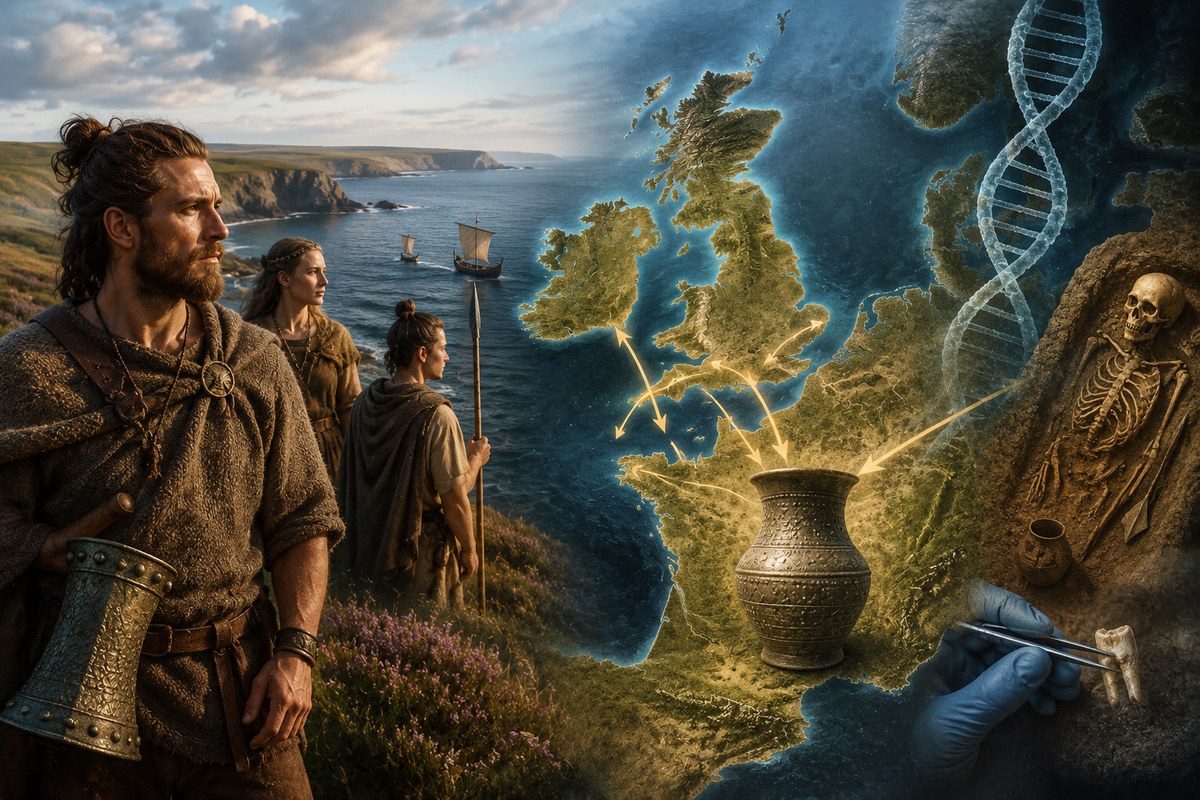
Ask which Y-chromosome lineage is the signature of the Atlantic fringe, and the answer is always the same: R-L21. It is the dominant male line of Ireland, the great lineage of Scotland, Wales and Brittany, and it runs heavily through England and western France. So it feels natural to ask where the very first L21 man was born, and two camps have spent years at war over the answer. One says he was born on the Continent, in the Lower Rhine world that later sent the Bell Beaker people across the sea. The other says the evidence for that is an absence, and that absence is not proof. This article lays out what the ancient DNA actually shows, where the weight of the evidence falls, and the one thing that would settle the argument for good.
Key points
- R-L21 (also written R-M529 or R-S145) is a branch of the steppe-derived Bell Beaker lineage P312, sitting just below R-Z290. Almost every living L21 man belongs to one explosive sub-branch, R-DF13. Today it peaks in Ireland and is the leading line of the whole Celtic-speaking west.
- The founder of L21 is dated by the genealogy companies to roughly 2650 BC, with a wide margin of error. Bell Beaker, and with it the first steppe ancestry of any kind, does not reach Britain until about 2450 BC. On those numbers the L21 man is about two centuries older than the arrival of his descendants in Britain.
- Before Beaker, Britain had no steppe ancestry and no R1b at all, and Corded Ware, the culture that carried L21's parent lineage, never reached the island. The earliest L21 skeletons anywhere are British and Irish Beaker burials of about 2450 to 2150 BC.
- The people who brought Beaker to Britain came from the Lower Rhine. In Global25 the British Beaker average sits right on top of the Dutch Beaker average, about 10 units away, far closer than any other continental group.
- The mainstream reading: L21 most likely formed on the Continent, in the Lower Rhine Corded Ware and early Beaker world, a couple of centuries before its bearers crossed to Britain. This rests on convergent reasoning from dating, archaeology and ancestry, not yet on a single early continental L21 skeleton.
- The honest caveat: no securely dated continental L21 older than the British ones has been found. Its likely homeland is a region of acid soils that destroy bone, so the absence is expected, but an argument from an expected absence is weaker than a positive find.
- Modern continental L21, in Brittany, Iberia or Scandinavia, proves nothing about the origin. Most of it is later back-migration out of the Isles, during the Atlantic Bronze Age, the Iron Age and the historic period.
1. The lineage everyone wants to claim
R-L21 is one of the most successful male lineages in western Europe. It is a sub-branch of P312, the dominant paternal line of the Bell Beaker people, which is in turn a branch of the great steppe lineage R-M269 that spread across Europe in the third millennium BC. Below L21 sits one enormous clade, R-DF13, which accounts for well over ninety nine percent of all living L21 men. When people speak loosely of the Atlantic Celtic or Insular Celtic Y-line, this is what they mean.
Its modern map is lopsided toward the sea. L21 is the leading lineage of Ireland, very strong in Scotland, Wales and Brittany, common in England, and present down the Atlantic coast into western France and Iberia, with a scatter into Scandinavia and the Low Countries. That distribution is exactly why the origin question is so charged. A lineage this iconic to the British and Irish, and to the Celtic world generally, carries an emotional pull: people would like its founder to be one of their own. The genetics does not care about that pull, and the answer it gives is more interesting than either side's flag-planting.
2. A question of dates
The whole argument turns on two numbers and the gap between them. The first is the age of the L21 founder, the single man from whom every L21 carrier descends. The genealogy firms estimate his birth at around 2650 BC from FamilyTreeDNA's Discover tool, or about 2500 BC from YFull, both built from the accumulated mutations of thousands of living testers. These are estimates, not readings off a calendar, and their confidence intervals are wide, running several centuries on either side. That width matters, and we will come back to it.
The phylogeny is firmer than the clock. L21 sits immediately below R-Z290, which sits below P312, which sits below the steppe-derived L151. So the father of the first L21 man was a Z290 man, and his father a P312 man, and that whole sequence is steppe-ancestry Beaker-world material. Wherever L21 was born, its immediate male-line ancestors were not Neolithic farmers but the incoming steppe-derived population of the later third millennium. That single fact does a lot of work in what follows.
3. The British wall: nothing steppe before Beaker
Here is the hardest fact in the case, and it is archaeological as much as genetic. Before the Bell Beaker culture arrived, Britain had no steppe ancestry and no R1b lineages at all. Its Neolithic people were descended from early farmers and resembled the Neolithic populations of Iberia and southern France, the builders of the great megalithic monuments. The landmark 2018 study of the Beaker phenomenon showed that when Beaker arrived, about ninety percent of the British gene pool was replaced within a few centuries by incoming continental migrants. The first steppe ancestry, the first R1b, and the first L21 all enter Britain together, as part of that single transforming event, and the archaeology dates the start of it to about 2450 BC.
Two further facts close the wall. The first is that Corded Ware, the culture that carried L21's parent lineages on the Continent, never reached Britain or Ireland at all: there is no Corded Ware pottery, no Single Grave burial tradition, and no pre-Beaker steppe DNA on the island. The second is that the earliest L21 skeletons we have anywhere are British and Irish Beaker burials, not continental ones. The man buried beside the Amesbury Archer near Stonehenge, dated to about 2456 to 2146 BC, was L21; a Beaker man from Westbourne in Sussex of similar date was L21; the earliest British Beaker genome from Low Hauxley was already DF13, a step below L21. In Ireland, Bronze Age burials such as those on Rathlin Island carried DF13 by about 2000 BC.
4. Where the people came from: the Lower Rhine
If the L21 men entered Britain with Beaker, the next question is where on the Continent that Beaker population itself came from. The ancient DNA answer is specific: the Lower Rhine. A large 2025 study of the Rhine-Meuse region, published in 2026, showed that the Bell Beaker population formed locally there, in the wetlands and river country of the western and central Netherlands, Belgium and western Germany, when incoming Corded Ware groups mixed with a distinctive local population that had kept an unusually high share, about half, of older hunter-gatherer ancestry. The British Beaker people are autosomally closest to individuals from this Lower Rhine world, the Dutch site of Oostwoud in particular.
The Global25 distances tell the same story bluntly. Measured against the British Bell Beaker average, the single closest continental group by a wide margin is the Dutch Bell Beaker average, about ten units away. Every other Beaker group, from the Grand Est of France to Bohemia to Bavaria, is two to four times further. The Corded Ware groups, the parent complex, sit further still, because British Beaker carries the extra Lower Rhine hunter-gatherer ingredient that pure Corded Ware lacks. The chart below ranks them.
Scaled Global25 distance from the England Bell Beaker average to a range of continental groups. The Dutch Beaker average is the clear nearest neighbour, which is the autosomal fingerprint of a Lower Rhine origin for the British Beaker population. This pins down where the people came from. It does not, by itself, prove where the L21 mutation was born, which is the separate question the next sections take up.
5. The case for a continental origin
Now the deduction. If the L21 founder was born around 2650 BC, and Beaker with its steppe ancestry does not reach Britain until about 2450 BC, then for roughly two centuries the entire L21 lineage existed somewhere that was not Britain. There was no steppe population in Britain for him to be born into before 2450 BC, because the island was still Neolithic. His male-line ancestors were Corded Ware and early Beaker people of the Continent, and the population that eventually carried his descendants to Britain formed in the Lower Rhine. Put those together and the founder almost has to have lived on the Continent, most plausibly in the Lower Rhine Single Grave Corded Ware and early Beaker milieu, before his descendants crossed the Channel.
This is not one argument but three pointing the same way: the lineage's estimated age predates Beaker in Britain, the archaeology rules out a pre-Beaker steppe presence on the island, and the autosomal source of British Beaker is squarely continental. None of the three depends on the others. When dating, archaeology and ancestry all point to the same place, the inference is strong even without a labelled skeleton. And there is a ready reason no such skeleton has turned up: the likely homeland, the sandy uplands of the Netherlands and the Single Grave heartland, has highly acidic soil that dissolves bone, and the relevant coastlines have since been submerged. The Corded Ware burials there leave barrows and pottery but almost no testable human remains.
6. The honest objection
The skeptical case deserves a fair hearing, because its core point is sound. No securely dated continental L21 older than the British samples has ever been found. The continental-origin argument therefore rests on a deduction plus an expected absence, and an expected absence is not a positive result. Absence of evidence is not evidence of absence, and a model that explains away every failure to find continental L21 by appealing to acid soil starts to look hard to disprove. If the only evidence that could ever change the picture is a sample from precisely the places where samples cannot survive, then the claim risks becoming unfalsifiable in practice.
The dating gives the skeptic real room too. The 2650 BC figure is a central estimate with a confidence interval that runs several centuries younger, comfortably overlapping the arrival of Beaker in Britain. If the true date sits at the young end, the gap that powers the whole deduction narrows or closes, and an Isles formation, with L21 arising among the very first Beaker settlers and then exploding in the founder-friendly conditions of a freshly settled island, stops being absurd. The fairest statement is that the continental reading is the better-supported inference, not a proven fact, and that the people defending it are on firmer ground when they argue from convergence than when they wave away every continental absence in advance.
7. Why modern continental L21 proves nothing
One argument needs setting aside, because it sounds powerful and is not. L21 is common today across the Continent: in Brittany, Normandy, the Atlantic coast of France, Iberia, the Low Countries and Scandinavia. Surely, the argument runs, a lineage that widespread on the Continent must have been born there. It does not follow. The modern distribution is the product of more than four thousand years of movement after the founder lived, and most of the continental L21 we see is back-migration out of the Isles, not survival from a continental homeland.
The routes are well known. The Atlantic Bronze Age trade networks carried British and Irish lineages down the western seaways. Iron Age and Roman period contacts moved more. Brittany takes its name and a large share of its L21 from the migration of insular Britons across the Channel in the fifth and sixth centuries AD, fleeing the Anglo-Saxon settlement of Britain. Norse colonies in Scotland and Ireland later carried Isles L21 into Scandinavia and Iceland. So the continental L21 on the map today is mostly a record of where the Isles exported men, not where the lineage first arose. The origin question can only be answered with ancient DNA from the third millennium BC, and there the continent is, so far, nearly empty of L21 while Britain is full of it.
8. What would settle it
This is a scientific question, so the right way to hold any position is to say in advance what would change it. Two kinds of find would settle the matter cleanly. A securely dated continental L21 sample, older than the earliest British ones and ideally from the Lower Rhine or Single Grave world, would confirm the continental origin outright and end the argument in its favour. Conversely, evidence of steppe ancestry, Corded Ware material, or an L21 or Z290 lineage in Britain before about 2450 BC would break the British wall and make an Isles formation genuinely possible. A substantial downward revision of the L21 founder's date, into the Beaker period proper, would do similar work by erasing the chronological gap.
On the evidence in hand, the balance tips clearly toward the Continent. The lineage is, on its best date, older than Beaker in Britain; the island had no steppe population for it to be born into beforehand; and the people who carried it across the sea came demonstrably from the Lower Rhine. The continental reading is the one that needs the fewest special assumptions. But it is held up by reasoning rather than by a single early continental skeleton, and an honest answer names that gap rather than hiding it. The first L21 man was, in all likelihood, a continental Beaker-world ancestor whose grandchildren and great-grandchildren sailed to Britain and there, in a nearly empty island, multiplied into the lineage that would one day define the Atlantic west. Likely. Not yet proven. And the people who keep asking for the proof are doing science a favour, not a disservice.
The story in five steps
Claim and reality
Reproduce it yourself
Paste these Global25 coordinates into the Vahaduo Global25 tool and set the England Bell Beaker average as the target to reproduce the distance chart above. All coordinates are on the same Global25 scale.
England_Bell_Beaker,0.127078,0.12284626,0.063575258,0.068569774,0.026188387,0.023525677,0.0022287097,0.0031785161,-0.0044994839,-0.010781323,-0.003122,0.0034952903,-0.010195323,-0.015329419,0.025883194,0.0099228387,-0.006515,0.001937129,0.0023639677,0.0059302258,0.0061906129,0.0028240968,0.00034190323,0.0055001613,-0.0010159677
Netherlands_Bell_Beaker_LowerRhine,0.12719725,0.122456,0.06294775,0.072863417,0.02556875,0.024705083,0.0014491667,0.00449975,-0.00690275,-0.014624417,-0.00466875,0.0042585833,-0.00681375,-0.014954917,0.02416975,0.0082979167,-0.0071929167,-0.002597,-0.00052375,0.0057110833,0.0056878333,0.0028233333,-0.00128375,0.0054625,-0.0013571667
France_Bell_Beaker_GrandEst,0.1295308,0.1269414,0.0586046,0.0592382,0.029236,0.0196896,0.002679,0.0027692,0.0067902,-0.0108612,-0.0041896,0.0029672,-0.0106736,-0.0172304,0.020711,0.0129406,0.0084488,0.001039,0.005732,0.0080038,0.0070378,0.0029184,0.0007886,0.0078802,0
Germany_Bell_Beaker_SaxonyAnhalt,0.12719725,0.13011463,0.060056625,0.049297875,0.033813875,0.0189995,-0.000146875,0.004499875,0.00613575,0.00161725,-0.005744625,0.003672,-0.008101875,-0.012059375,0.020443125,0.008767625,-0.00389525,-0.0010135,0.003440875,0.006409375,0.00634825,0.007032625,-0.006331875,-0.003705125,0.000119625
Czechia_Bell_Beaker_Late,0.12659914,0.13108618,0.054313143,0.046076939,0.031886571,0.015333286,0.0031269796,0.0040736531,0.0015735306,0.0025326939,-0.00032477551,0.0045603265,-0.012869776,-0.013414,0.014078857,0.0092136122,0.00049489796,0.0010419388,0.0027576531,0.0036931837,0.0041686531,0.0043253469,-0.00089542857,0.0010279184,-0.0015444898
Germany_Bell_Beaker_Bavaria,0.12600207,0.13063097,0.055713233,0.045682967,0.033493333,0.015134567,0.0015197,0.0017845667,0.0029997,0.0052118667,-0.0020677667,0.0074183667,-0.0098710667,-0.013202633,0.014291267,0.0097807667,0.0025512333,0.0026436333,0.0016634,0.0057027333,0.0038972667,0.0024318333,-0.000719,0.00023693333,-0.0012692667
Germany_Corded_Ware,0.12947392,0.1112005,0.057762333,0.090978583,0.00489825,0.033443667,0.00074416667,0.0017115833,-0.028752667,-0.04004625,-0.00012183333,0.00243525,-0.007978,-0.01120475,0.02510825,0.00702725,-0.013038417,0.0047719167,-0.0021996667,0.00643025,0.0018925833,0.00065941667,0.0069635,0.017391917,0.00028933333
Czechia_Corded_Ware_Early,0.12364031,0.11069275,0.056497313,0.08567575,0.00696275,0.0313055,0.0034221875,-0.000923,-0.025297125,-0.036640937,-0.002344375,-0.0023135625,-0.0044040625,-0.017056625,0.027101625,0.0072510625,-0.008312125,0.0026525,0.000337875,0.00596375,0.0005305,0.0030526875,0.003581875,0.010581188,-0.0040339375
References and sources
- 1 Olalde, I., Brace, S., Allentoft, M. E., et al. (Reich, D.). The Beaker phenomenon and the genomic transformation of northwest Europe. Nature 555, 190-196 (2018). Genome-wide data from over 400 ancient individuals; documents the arrival of Beaker in Britain about 2450 BC and the replacement of roughly ninety percent of the British gene pool, the event that introduced steppe ancestry, R1b and L21 to the island. link
- 2 Olalde, I., Altena, E., Bourgeois, Q., et al. (Reich, D.). Lasting Lower Rhine-Meuse forager ancestry shaped Bell Beaker expansion. Nature (2026). Preprint: bioRxiv 2025.03.24.644985 (2025). Shows the Bell Beaker population forming locally in the Rhine-Meuse region from Corded Ware plus a persistent local hunter-gatherer ancestry, and finds British Beaker closest to Lower Rhine individuals. link
- 3 Cassidy, L. M., Martiniano, R., Murphy, E. M., et al. (Bradley, D. G.). Neolithic and Bronze Age migration to Ireland and establishment of the insular Atlantic genome. PNAS 113(2), 368-373 (2016). Reports Bronze Age Irish genomes, including R-L21 and DF13 carriers, by about 2000 BC. link
- 4 FamilyTreeDNA Discover and YFull YTree. Time to most recent common ancestor estimates for R-L21 (R-M529): about 2650 BC (Discover) and about 2500 BC (YFull, version 13), each with wide confidence intervals built from the mutation counts of present-day testers. Phylogeny: P312 > Z290 > L21 > DF13. link
- 5 Global25 coordinates: Davidski (Eurogenes), with ancient averages from the public Global25 datasheets and the Moriopoulos 2025 collection. Global25 spreadsheet tooling: Vahaduo. G25
Ancient Global25 coordinates: Davidski (Global25), with averages from the public Global25 datasheets and the Moriopoulos 2025 collection. The British Beaker point is the England Bell Beaker average; continental points are the named Beaker and Corded Ware averages. Global25 spreadsheet tooling: Vahaduo. Analysis: scaled Global25 Euclidean distances in Python. Distances place populations relative to one another and indicate the source of the British Beaker people; they do not by themselves date or locate the birth of a single Y-chromosome lineage, which is argued here from the combination of phylogenetic dating, archaeology and ancestry. Lineage age estimates are statistical and carry wide confidence intervals.