
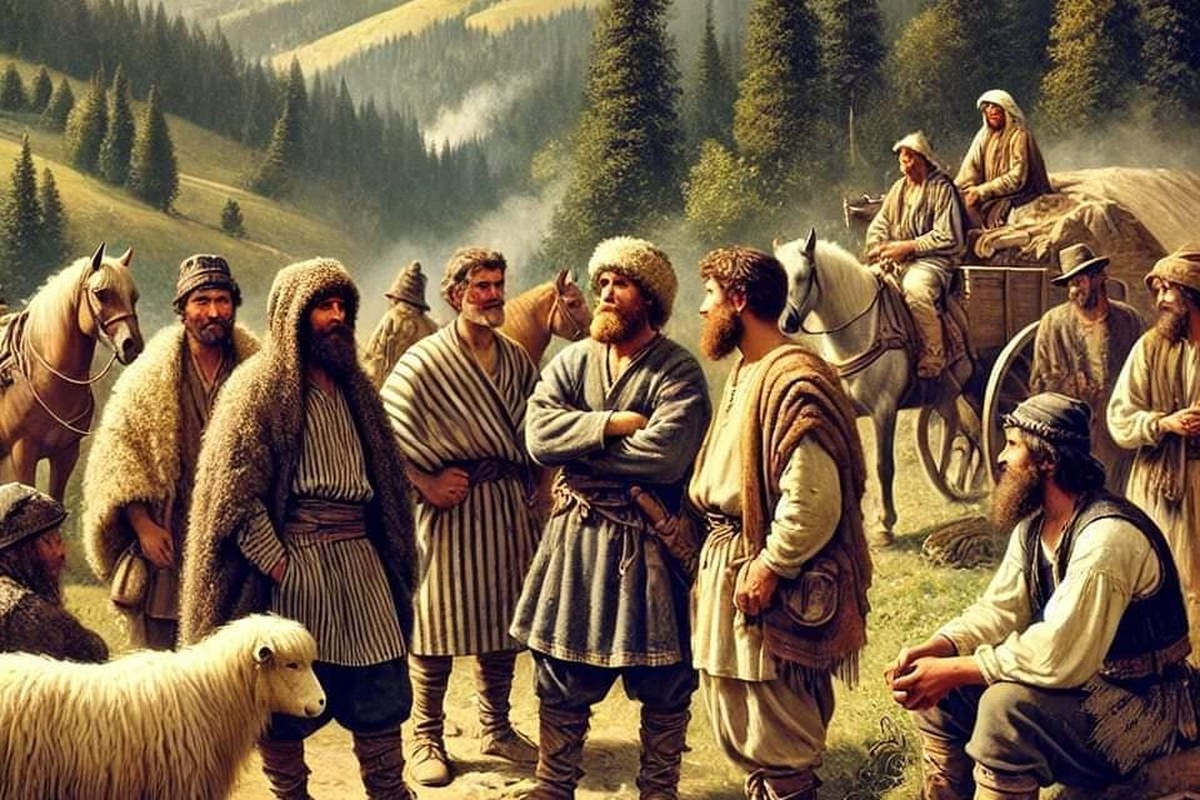
Across the mountains of Greece, Albania, North Macedonia, Bulgaria and Romania lives a scattered people who count, pray and curse in a daughter of Latin. The Aromanians of the south call themselves Armani; the Romanians of the north are their larger cousins; together with the smaller Megleno and Istro communities they are the Vlachs, the last Latin speakers of the Balkans. For centuries the romantic guess has run the same way: that they are the stranded descendants of Roman soldiers and colonists, a splinter of Italy left behind when the legions marched home. The genome keeps the language and sends the legionaries home. The Vlachs are not transplanted Romans. They are the old Balkan natives of the Iron Age, the Dacians and Thracians of the Danube and their southern neighbours, who took the Latin tongue of their conquerors and kept the genes of their own ancestors. The actual Romans of imperial Italy turn out to be the single most distant people on the whole chart.
Key points
- A pooled Daco-Romanian, the densely sampled northern Vlach, sits packed among its Balkan neighbours: about 11 scaled Global25 units from a Serbian, 14 from a Macedonian or a Moldovan, 15 from a Bulgarian. The imperial Romans of Italy, the people who would actually have been the colonists, are the farthest reference on the entire chart, roughly 115 to 122 units away.
- A two-source model rebuilds a Romanian as about half local Iron Age Dacian-Thracian substrate and half medieval Slavic, with no Italian or Roman ingredient required at all. The Latin language arrived without the Latin genes.
- The Geto-Dacian-Thracian substrate is itself a thoroughly Balkan population, about 25 units from the Iron Age Bulgarians and 30 from the Iron Age Macedonians, but 83 from imperial Rome. The thread of continuity runs through the local Iron Age Balkans, not through Italy.
- Becoming a Roman province imported a language, not a population. Roman-era provincials from Croatia, Montenegro and Macedonia sit about 36 to 40 units from the local Balkan Iron Age and 80 to 138 units from imperial Italian Rome. The locals stayed local and learned Latin.
- The southern Aromanians are barely sampled, but the landmark Balkan study found them genetically indistinguishable from their Greek, Albanian and Macedonian neighbours, with a significant Roman contribution explicitly ruled out. The southern Balkan cluster they belong to models as mostly local Aegean substrate with a lighter Slavic layer, the same recipe as the north with the dial set further south.
- What separates the northern Romanians from the southern Aromanians is mostly the Slavic dose and the latitude of the substrate, not any Roman input. The north carries more Slavic and the Danubian Dacian substrate; the south carries less Slavic and an Aegean substrate, and sits with the Greeks.
- The isolated Aromanian mountain communities do show real genetic drift in their paternal and maternal lineages, the mark of small founder groups living apart, but no signal of an Italian source. Their distinctiveness is isolation, not foreign blood.
- The romantic claim that the Vlachs are the children of Roman colonists does not survive the data. The Roman inheritance is a language and a name. The genome is Balkan from the Iron Age down. Distances and model fractions are proxy-dependent and read as directions; the published estimates are preferred where the layers blur.
1. A people read off their language
The Vlachs are the loose ends of the Roman Empire in the Balkans. When Rome conquered the lower Danube and the southern Balkans, Latin spread as the language of administration, trade and the army, and in pockets of the peninsula it never died. The northern pocket grew into the Romanians, a nation of some twenty million; the southern pockets survived as the Aromanians of the Pindus and Macedonia, the Megleno-Romanians of the Vardar valley, and the tiny Istro-Romanian community of Croatia. Outsiders called all of them Vlachs, a medieval word for the Romance-speaking shepherds of the mountains, and the name stuck to a people defined entirely by a tongue.
A tongue invites a tidy story. If they speak a daughter of Latin, the reasoning went, they must be the children of the men who brought Latin, the colonists and veterans whom Rome settled across its provinces. The Aromanians in particular, dark and isolated in their high villages, were imagined as a lost shard of Italy preserved in the Balkan mountains. The honest way to test that is not to listen to the language but to read the genome, and the Balkans are now sampled densely enough, from Mycenaean and Iron Age bones through Roman-era provincials to the living nations, to ask the only question that matters: when a Vlach took the Latin language, did a Roman come with it?
2. Closer to every Balkan neighbour than to Rome
The cleanest single test is distance. Using Global25, the coordinate system published by Davidski of the Eurogenes blog, each population becomes a point in a twenty-five dimensional space, and the scaled Euclidean distance between two points measures how genetically far apart they are. The chart below gives those distances, multiplied by one thousand, from a pooled Romanian (a weighted average of two hundred individuals across the historic Romanian provinces, the best-sampled Vlach population) to a spread of neighbours, ancestral sources, and the Roman and Italian world.
Scaled Global25 distance (multiplied by 1000) from a pooled Romanian. The nearest points are not Italian or Roman but the living Balkan neighbours, Serbs, Moldovans, Macedonians and Bulgarians, who share the same two-ingredient recipe. The two ancestral sources, the Dacian-Thracian substrate and the medieval Slav, sit at moderate distance, the way ancestors always sit from an admixed descendant. The Roman and Italian world lies farthest of all, and the actual imperial Romans of Italy close the chart.
The order is the argument. A Romanian is nearest to the modern Balkan populations that grew from the same history, a Serbian at about 11 units, a Moldovan and a Macedonian at 14, a Bulgarian at 15. Only past those do we reach the two sources that actually build a Vlach, the local Iron Age Dacian-Thracian substrate and the medieval Slavic wave, each at moderate distance because each is an ancestor rather than a living twin. And then, far out beyond everything, sits the Roman and Italian pole: modern southern Italians near 87 units, and the genomes of imperial Rome itself near 115 to 122, the most distant points on the chart. If the Vlachs were the children of Roman colonists, the needle would swing toward Rome. Instead it swings hard into the Balkans, and Rome is the one place the Vlachs are not.
3. The recipe: a Dacian substrate, a Slavic wave, no Roman graft
What ingredients build that position? A non-negative least squares model on the Global25 coordinates gives a clean two-part answer for the northern Vlach. Take the local Iron Age population of the lower Danube, the Geto-Dacian-Thracian substrate, and the medieval Slavs who washed over the whole Balkans in the sixth and seventh centuries, and ask how much of each it takes to rebuild a modern Romanian. The model reaches for almost equal parts, and it never reaches for Rome.
Two ingredients, one dial that slides north into the Slavic world and south into the Aegean
The same two ingredients, mixed at different settings, rebuild the whole Balkan and Vlach world. A Romanian is close to half local Dacian-Thracian substrate and half Slavic. The deep-southern groups that the Aromanians live among, the Albanians and the Greeks of Macedonia, carry more local substrate (about two thirds) and less Slavic; the more northerly Serbs and Macedonians carry more Slavic. A third source standing for Rome or Italy is simply not needed: the local substrate and the Slavic wave account for these populations on their own. Figures are proxy-dependent Global25 outputs and read as directions, not exact percentages; the published estimates land in the same range.
The decisive fact is the absence. When a southern, Roman-like or Italian source is offered to the model it can absorb a little signal, but only because it shares the deep Anatolian-farmer ancestry that the Balkan substrate already carries, and it is never required to fit these populations. There is no Vlach-specific pull toward Italy that the local ingredients fail to explain. The Latin language sits on top of a genome that two purely Balkan and East European sources reconstruct without any help from Rome.
4. The substrate is Balkan, not Italian
The continuity story stands or falls on the substrate, the pre-Roman natives of the lower Danube. If the Geto-Dacian-Thracian population were itself some Italian-shifted group, the whole argument would collapse. It is the opposite. The Dacian-Thracian substrate sits about 25 units from the Iron Age Bulgarians, 30 from the Iron Age Macedonians and 37 from the Mycenaeans, a tight cluster of Balkan Iron Age peoples, and fully 83 units from imperial Rome. The Dacians and Thracians whom the Romans conquered were quintessential Balkan natives, an Iron Age population woven from the same Anatolian-farmer and steppe threads as their neighbours across the peninsula, with nothing Italian about them.
This is why the Daco-Roman continuity that Romanians cherish is real, but not in the way the romantic version means. The continuity is genetic continuity of the local Dacian-Thracian natives, the people who were already there, who took Latin and held the Carpathian and Danubian ground through every later storm. It is not continuity from Rome. The line runs back to the Iron Age Balkans, picks up a heavy Slavic layer in the early Middle Ages, and arrives at the modern Romanian. Rome contributed the words, not the blood.
5. Romanization imported a language, not a people
If Latin spread without Italians, the Roman-era graves of the Balkans should show it: the provincials buried under Roman rule should look like the locals who came before them, not like the population of Italy. They do. The chart below sets three Roman-period provincial groups, from Croatia, from Doclea in Montenegro and from Hellenistic and Roman Macedonia, against two yardsticks at once: how far each sits from the local Iron Age Balkans, and how far each sits from imperial Rome in Italy.
Scaled Global25 distance (multiplied by 1000) from three Roman-era Balkan provincial groups to the local Iron Age Balkans (green) and to imperial Rome in Italy (blue). In every case the provincials sit close to the local Iron Age population, about 36 to 40 units, and far from imperial Italian Rome, 80 to 138 units. Roman rule changed the language and the names on the tombstones, not the people in the graves.
The pattern is unambiguous. A Roman-era Croatian or Montenegrin or Macedonian is a Balkan native who happens to be living in a Roman province, three to four times closer to the Iron Age people of the region than to the citizens of Rome. The cosmopolitan, eastern-shifted population of imperial Rome itself, drawn from across the Mediterranean and especially its Greek and Levantine east, never settled the Balkan countryside in any number that the genome can see. Romanization was a cultural and administrative process, a spread of language and law and trade, laid over populations that stayed firmly in place. The Vlachs are the linguistic fossils of exactly that process: locals who kept the Latin and kept their genes.
6. The southern Aromanians: indistinguishable from their neighbours
The northern Vlachs can be tested directly because they are a nation with thousands of samples. The southern Aromanians cannot: there is no public Global25 average for them, a gap that itself reflects how small and scattered these mountain communities are. But the question was answered two decades ago by the landmark study of the Balkan gene pool, which typed Albanians, Romanians, Macedonians, Greeks and five separate Aromanian communities, and looked specifically for any genetic layer matching the Roman cultural layer.
It found none. The Balkan populations were so homogeneous, the study concluded, that the precise origin of the Aromanians could not even be pinned down against their neighbours, because they are not distinct from them, and a significant Roman contribution could be ruled out. The Aromanians are Balkan natives who took Latin, exactly as the Romanians are, only further south. The cluster they sit in, with the Greeks and Albanians and Macedonians, models in our own data as mostly local Aegean and Balkan substrate with a lighter dusting of Slavic than the north, which is precisely where their southern mountains would place them. The language travelled to the Pindus; the people were already there.
7. Two branches, one process: what the Slavic dial does
Set the northern and southern Vlachs side by side and the only real axis between them is the Slavic one. The Romanians of the Danube absorbed a heavy Slavic wave in the early Middle Ages, the same wave that made Bulgarians and Serbs, and it pulls them toward the northern Balkan cluster. The Aromanians of the southern mountains caught far less of it and stayed closer to the older, un-Slavicised southern Balkan profile, the world of the Greeks and Albanians. The substrate differs too, Danubian Dacian-Thracian in the north and more Aegean in the south, but neither end carries a Roman or Italian signature. Two branches of one process: indigenous Balkan populations, separated by a few hundred kilometres and a different dose of Slavs, both of whom learned to speak Latin and never stopped.
Even inside Romania the dial is visible. The Romanians of Wallachia and Oltenia, in the south, sit closest to the old Dacian-Thracian substrate; those of northern Moldavia sit closest to the Slavic pole, the most Slavic-shifted of all the provinces. The gradient runs with geography, not with any imagined distance from Rome, because Rome was never one of the poles to begin with.
8. The colonist trap
It is tempting to take the Latin language, the Roman name, and the dark isolation of the Aromanian villages and read them together as the visible trace of a Roman colony preserved in amber. This is the same trap that catches readers of every people with a prestigious name, and it is worth naming. A language is not a genealogy. The Vlachs carry a Roman tongue the way a Mexican village carries a Spanish one: it marks a historical conquest, not a wave of settlers from the conquering homeland. The genetic drift that makes the small Aromanian communities look distinctive from one another is the signature of isolation and small founder numbers, of a few families holding a high valley for centuries, and not of any thread reaching back to Italy. Reading the Latin as Roman ancestry mistakes the most superficial layer of a people, the words in their mouths, for the deepest, the genes in their cells.
9. So, lost Romans?
The romantic version said the Vlachs were the stranded descendants of Roman legionaries and colonists, a fragment of Italy you could hear in every Latin word they spoke. The honest version keeps the words and discards the legionaries. The Vlachs, north and south, are the Iron Age natives of the Balkans, the Dacians and Thracians of the Danube and the Greeks and Illyrians of the south, who took the Latin language of Rome during the centuries of the empire and held onto it while their genes stayed exactly where they had always been. They picked up a heavy Slavic layer in the early Middle Ages, more in the north than the south, and they drifted apart into the scattered communities of today. But the Roman inheritance was never in the blood. It was in the grammar. The actual Romans of imperial Italy are the most distant people on the chart, and the Vlachs are what they always were beneath the Latin: a Balkan people, continuous from the Iron Age, wearing a borrowed Roman name.
The story in five steps
Claim and reality
The Vlachs are the stranded descendants of Roman legionaries and colonists.
They are Iron Age Balkan natives. A Romanian rebuilds as local Dacian-Thracian substrate plus Slavic, with no Roman ingredient needed, and the imperial Romans of Italy are the most distant people on the chart.
Because they speak a daughter of Latin, they must descend from the people who brought Latin.
Language and ancestry parted company. Romanization spread the tongue across populations that stayed firmly in place, the way Spanish spread through native Latin America.
Daco-Roman continuity means Romanians descend from Rome.
The continuity is genuine but local. It runs from the Iron Age Dacian-Thracian natives, not from Italy. The substrate sits 25 units from the Iron Age Bulgarians and 83 from imperial Rome.
The isolated southern Aromanians are a preserved shard of Italy.
The landmark Balkan study found them indistinguishable from their Greek, Albanian and Macedonian neighbours, with a Roman contribution ruled out. Their distinctiveness is founder drift from isolation, not Italian blood.
The northern and southern Vlachs are two different kinds of people.
They are two branches of one process. The main axis between them is the Slavic dose and the latitude of the substrate, heavier Slavic and Dacian in the north, lighter Slavic and Aegean in the south. Neither carries Rome.
Reproduce it yourself
Paste the coordinates below into Vahaduo, the Global25 spreadsheet tool, to rebuild the comparisons in this article: the pooled Daco-Romanian, the Geto-Dacian-Thracian and Geto-Dacian substrate, the medieval Slav and a Balkan-profile Scythian, the living Balkan neighbours (Greek, Albanian, Macedonian, Bulgarian, Serbian, Moldovan, Gagauz), the Iron Age and Bronze Age substrate references (Macedonia and Bulgaria Iron Age, Mycenaean), the Roman-era provincials (Macedonia Hellenistic and Roman, Greece Roman, Croatia and Montenegro Doclea), and the Roman and Italian poles (imperial Rome at Casal Bertone, Isola Sacra and Pompeii, with modern Calabria and Tuscany). The Romanian point is the weighted average of the named regional Romanian groups; the substrate and Slav points are the named groupings supplied for this article; the remaining coordinates are scaled Global25 from the public Global25 datasheets and the Moriopoulos 2025 collection.
Romanian_Daco,0.124531,0.133946,0.035391,0.011247,0.026574,0.004816,0.005487,0.004567,-0.000816,0.001325,-0.000787,-0.001124,0.002808,0.011030,-0.011895,-0.001827,0.006223,0.000364,0.003718,-0.002045,-0.005452,-0.000894,0.003569,-0.000083,-0.000929
Geto_Dacian_Thracian_substrate,0.119894,0.152724,0.013262,-0.039137,0.028450,-0.017136,0.000679,-0.001295,0.008192,0.036305,0.002779,0.006053,-0.014693,0.001170,-0.018285,-0.008884,0.006056,0.002344,0.009092,-0.006996,-0.009400,0.004582,-0.002349,0.001580,-0.005103
Geto_Dacian_substrate,0.119641,0.144318,0.018814,-0.024656,0.025133,-0.012147,0.002089,-0.000410,0.005636,0.029765,0.001750,0.003697,-0.011595,0.000474,-0.013180,-0.004714,0.005331,0.000366,0.009316,-0.004752,-0.008055,0.005097,-0.001479,0.000683,-0.003739
Slav_Medieval,0.129241,0.127864,0.074430,0.066744,0.044232,0.023123,0.008717,0.012545,-0.000372,-0.023260,-0.002480,-0.009264,0.014974,0.018879,-0.008304,0.001374,0.006614,-0.001589,0.003440,0.003297,-0.004708,-0.003136,0.004627,-0.005379,0.000239
Scythian_Balkan,0.119335,0.137845,0.019074,-0.012427,0.022012,-0.007148,0.000087,-0.000559,-0.000786,0.019566,0.000590,0.003234,-0.008090,-0.000775,-0.011236,-0.000733,0.006945,-0.000953,0.008230,-0.002679,-0.003599,0.004269,0.000305,0.002746,-0.002004
Byzantine_WestAnatolia,0.107780,0.150095,-0.031171,-0.063772,0.000951,-0.023077,-0.000248,-0.005236,-0.004856,0.019658,0.003549,0.003382,-0.006419,0.002152,-0.013841,-0.002290,0.007192,0.000905,0.004774,-0.004225,-0.004419,0.002406,-0.001358,0.000035,-0.001254
Greek_Macedonia,0.121563,0.142851,0.013476,-0.016495,0.018896,-0.004871,0.002945,0.002877,-0.000041,0.012173,0.001970,0.001289,-0.002309,0.010322,-0.015336,-0.006249,0.001843,0.000659,0.006980,-0.005253,-0.006514,0.000412,0.002416,-0.001036,-0.000599
Albanian,0.122240,0.143591,0.017566,-0.015768,0.026394,-0.007339,0.002499,0.001469,0.001507,0.017312,-0.000863,0.003573,-0.006240,0.006284,-0.019308,-0.002097,0.011999,0.000537,0.007400,-0.006184,-0.008088,0.001409,0.002835,0.003358,-0.003032
Macedonian,0.125205,0.141362,0.030547,0.004264,0.027328,0.005522,0.006392,0.003738,0.000286,0.003353,-0.000032,0.000060,0.002646,0.011588,-0.015744,-0.001193,0.007980,0.000659,0.004299,-0.004477,-0.011654,-0.000668,0.003993,-0.000988,-0.000335
Bulgarian,0.124750,0.134862,0.025644,0.005362,0.024620,-0.000837,0.005499,0.003046,-0.000286,0.006998,-0.003345,0.000899,0.002111,0.008643,-0.014305,-0.002228,0.007093,0.002002,0.003142,-0.003702,-0.004617,-0.000544,0.002810,-0.002482,-0.001078
Serbian,0.127311,0.137587,0.039943,0.015698,0.032068,0.004895,0.004653,0.006411,0.000508,0.001488,-0.001378,-0.001474,0.002859,0.012297,-0.013746,-0.001772,0.005830,0.000289,0.005910,-0.002357,-0.007726,-0.000998,0.005020,-0.000207,-0.001579
Moldovan,0.123932,0.127666,0.040145,0.020065,0.027646,0.008353,0.007173,0.006615,-0.000974,-0.002031,-0.001744,-0.001970,0.005033,0.014087,-0.010887,-0.003700,0.004119,-0.000356,0.003415,-0.001129,-0.004067,0.000271,0.003510,-0.000485,-0.000319
Gagauz,0.121664,0.134388,0.020029,-0.002907,0.019559,0.001333,0.006867,0.004692,-0.003636,0.003624,-0.001642,-0.002081,-0.001470,0.010123,-0.010450,-0.004744,0.003433,-0.000267,0.003603,-0.002904,-0.006489,-0.000934,0.003684,-0.004927,0.000067
Macedonia_IA,0.125888,0.152533,0.021534,-0.019315,0.027359,-0.008450,-0.000282,-0.001292,0.003272,0.031527,0.003053,0.007448,-0.016338,-0.007803,-0.013382,0.000437,0.009844,0.003737,0.007102,-0.007166,-0.010319,0.005565,-0.000653,0.006603,-0.002359
Bulgaria_IA,0.125205,0.158423,0.006034,-0.052972,0.031698,-0.022590,0.004465,-0.000231,0.008590,0.032802,0.002598,0.005095,-0.014420,-0.002064,-0.016422,-0.001458,0.012126,0.004941,0.004777,-0.013256,-0.006613,0.000989,-0.004314,0.003615,-0.011256
Greece_BA_Mycenaean,0.116782,0.162180,-0.008183,-0.060950,0.022835,-0.026411,-0.001058,-0.003323,0.005502,0.043609,0.007827,0.012664,-0.014628,0.000702,-0.020643,-0.007611,0.014603,0.001723,0.009666,-0.004115,-0.006813,0.004390,-0.004498,0.000374,-0.002048
Macedonia_Classical_Hellenistic,0.121791,0.153683,0.012068,-0.029931,0.021337,-0.012550,-0.005797,-0.007384,0.003409,0.019621,0.004872,0.009492,-0.012240,0.006468,-0.007012,-0.014938,-0.004955,0.000253,0.006746,-0.003168,-0.008443,0.001360,-0.000945,0.000201,-0.001836
Greece_Roman,0.104717,0.145221,-0.027907,-0.064277,0.000000,-0.024821,-0.001645,-0.002308,-0.000409,0.007654,0.012017,0.005395,0.005649,0.001239,-0.008007,0.011403,0.020340,-0.003801,0.006788,0.003126,-0.005366,-0.004328,0.002958,-0.000964,-0.006826
Croatia_Roman,0.126344,0.154360,0.027907,0.001292,0.027082,-0.006414,-0.005875,-0.005307,0.011453,0.016766,0.003735,0.007793,-0.014569,-0.004404,-0.003664,-0.010209,-0.007041,0.000760,0.004399,-0.010630,-0.004742,0.003215,-0.006286,-0.005663,0.005508
Montenegro_Doclea_Roman,0.130214,0.139737,0.049403,0.025711,0.030405,0.015841,0.004277,0.007015,-0.002986,-0.003608,-0.001267,-0.003567,0.000743,0.012854,-0.011699,0.001299,0.011839,0.001470,0.005405,-0.001876,-0.007212,-0.003215,0.002539,-0.002265,0.000263
Italy_CasalBertone_RomanImperial,0.091817,0.140820,-0.033941,-0.061155,-0.003488,-0.013666,0.000862,-0.003077,-0.007227,0.009841,0.003843,0.006494,0.001487,-0.002431,-0.001855,0.012287,0.008779,-0.001647,0.002682,-0.004252,0.000957,0.002926,-0.003163,0.003575,0.002675
Italy_IsolaSacra_RomanImperial,0.102014,0.148775,-0.029745,-0.067709,0.001770,-0.023148,-0.001116,-0.005625,-0.005190,0.019112,0.002192,0.002023,-0.005928,-0.001067,-0.010586,0.001690,0.008263,0.000016,0.003755,-0.003689,-0.004492,-0.001020,-0.000755,-0.000105,-0.000509
Italy_Pompeii_Roman,0.097888,0.144205,-0.035449,-0.068476,0.003385,-0.018128,-0.002350,0.001385,0.008590,0.017859,0.016239,-0.000749,-0.000595,0.005230,0.003664,-0.016706,-0.006650,-0.000127,-0.006662,-0.009505,-0.007112,0.003710,0.001479,-0.006989,0.006466
Italian_Calabria,0.103437,0.148140,-0.010324,-0.046997,0.012618,-0.015025,-0.002438,-0.001586,0.004448,0.021231,0.002213,0.002997,-0.004887,-0.001737,-0.006549,-0.002784,0.005802,0.000728,0.002938,-0.005362,-0.002605,-0.000325,0.000339,0.000015,-0.002425
Italian_Tuscany,0.118810,0.147784,0.013882,-0.021011,0.025294,-0.008938,-0.001063,-0.001626,0.005649,0.023239,-0.000309,0.006066,-0.011475,-0.003703,-0.002243,-0.000814,0.002154,0.000290,0.003334,-0.003829,-0.001967,0.001407,-0.000734,0.003196,-0.001226
References and sources
- 1 Bosch, E., Calafell, F., Gonzalez-Neira, A., et al. (Comas, D.). Paternal and maternal lineages in the Balkans show a homogeneous landscape over linguistic barriers, except for the isolated Aromuns. Annals of Human Genetics 70(4), 459-487 (2006). Types Albanians, Romanians, Macedonians, Greeks and five Aromanian communities; finds the Aromanians indistinguishable from their neighbours, with significant Roman contribution ruled out and drift differentiating the isolated communities. link
- 2 Olalde, I., Carrion, P., Mikic, I., et al. (Reich, D., Pinhasi, R.). A genetic history of the Balkans from Roman frontier to Slavic migrations. Cell 186(25), 5472-5485 (2023). Documents local genetic continuity from the Iron Age across the Balkans alongside major migration from outside the region, with the demographic formation of present-day groups largely complete by 1000 CE. link
- 3 Modi, A., Nesheva, D., Sarno, S., et al. (Caramelli, D.). Ancient human mitochondrial genomes from Bronze Age Bulgaria: new insights into the genetic history of Thracians. Scientific Reports 9, 5412 (2019). Places the Thracian substrate in an intermediate position between early Neolithic farmers and steppe pastoralists, a Balkan link between Eastern Europe and the Mediterranean. link
- 4 Cocos, R., Schipor, S., Raicu, F., et al. Genetic affinities among the historical provinces of Romania and Central Europe as revealed by an mtDNA analysis. BMC Genetics 18, 20 (2017). Finds Wallachia, Moldavia and Dobruja genetically aligned with the Balkans and Transylvania closer to Central Europe, the regional gradient seen here. link
- 5 Kovacevic, L., Tambets, K., Ilumae, A.-M., et al. Standing at the gateway to Europe: the genetic structure of Western Balkan populations based on autosomal and haploid markers. PLOS ONE 9(8): e105090 (2014). Shows the genetic uniformity of the Western Balkan populations across ethnic and linguistic lines on genome-wide data. link
- 6 Global25 coordinates: Davidski (Eurogenes), with modern and ancient averages from the public Global25 datasheets and the Moriopoulos 2025 collection. The Geto-Dacian-Thracian, Geto-Dacian, medieval Slav and regional Romanian groupings were supplied for this article. Global25 spreadsheet tooling: Vahaduo. G25
Modern and ancient Global25 coordinates: Davidski (Global25), with averages from the public Global25 datasheets and the Moriopoulos 2025 collection. The Romanian point is the sample-size-weighted average of the named regional Romanian groups (Wallachia, Oltenia, Transylvania, Maramures, Dobruja and the three Moldavian groups, 200 individuals in total); the Geto-Dacian-Thracian and Geto-Dacian substrate, the medieval Slav and the Balkan-profile Scythian are the named groupings supplied for this article. No public Global25 average exists for the southern Aromanians, who are therefore read here through their well-sampled Balkan neighbours and through the published Bosch et al. result, not through a direct distance. Global25 spreadsheet tooling: Vahaduo. Analysis: scaled Global25 Euclidean distances and non-negative least squares modelling in Python. Ancestry fractions are proxy-dependent and best read as directions rather than exact percentages; a southern or Roman-like source is never required to fit these populations, and the local substrate plus Slavic model is preferred where the layers blur.