
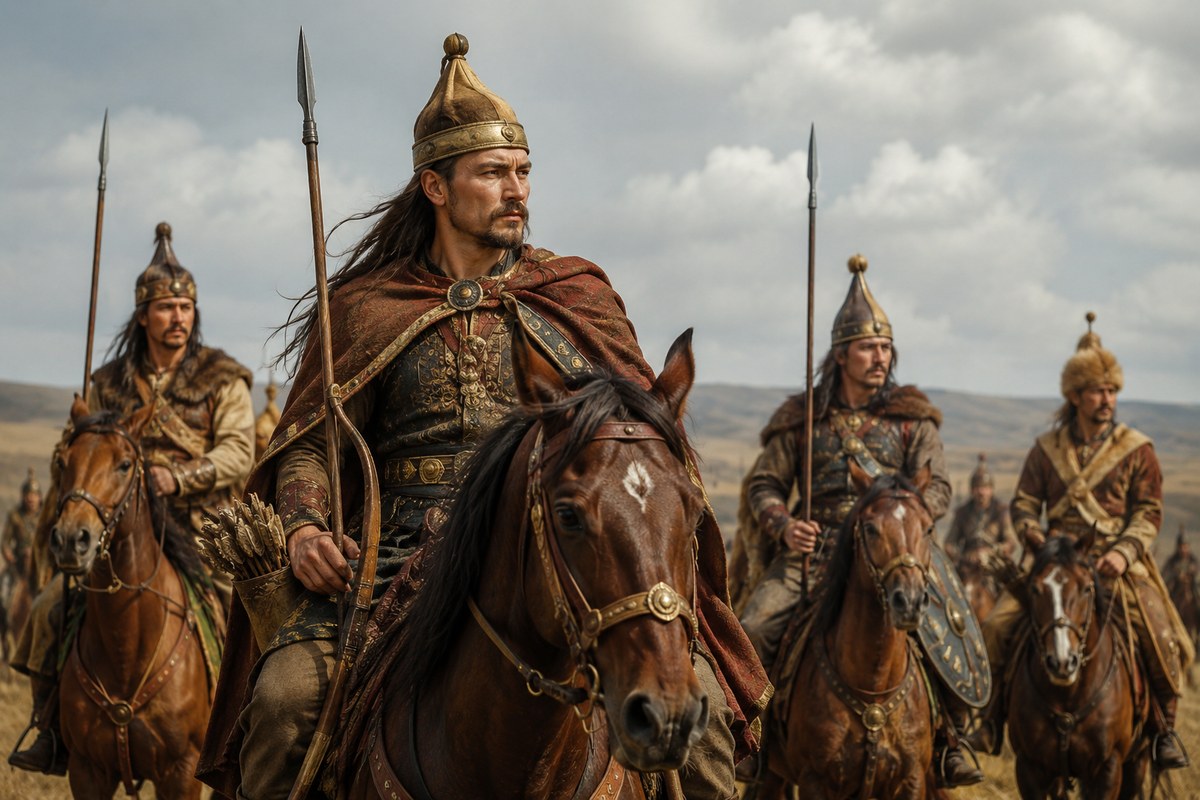
For two thousand years the Sarmatians have been filed under a single word: Scythians. Same sea of grass, same horse, same bow, same Iranian tongue, the same Greek and Roman authors describing the same fur-clad riders. The DNA accepts the family resemblance and rejects the family tree. The Sarmatians were not the children of the Scythians who came before them. They were a separate people, born of a related but distinct Bronze Age steppe stock in the southern Urals, who rode west and replaced the Scythians rather than inheriting from them. They carried a heavier dose of the Iranian south and the Siberian east, they pushed that signature as far as the Danube and the Carpathians, and they left their purest living heirs not among the Slavs who now farm their old pastures but in a single mountain people of the Caucasus who still speak their language.
Key points
- A steppe Sarmatian sits closest to the Middle and Late Bronze Age steppe herders, about 83 scaled Global25 units from Srubnaya and 85 from Sintashta, the gene pool it descends from. It is further from the Scythians it replaced (96 from the western Pontic Scythians, 132 from the eastern Saka) than from its own Bronze Age ancestors.
- A three-source model rebuilds a steppe Sarmatian as roughly 70 percent Middle-Late Bronze Age steppe ancestry, 17 percent Iranian (BMAC) ancestry and 12 percent Siberian and East Asian (Baikal) ancestry. This reproduces almost exactly the published figure of about 70 percent steppe, 18 percent BMAC and 12 percent Baikal.
- The Sarmatians are cousins of the Scythians, not their descendants. No Scythian group is a direct ancestor of the Sarmatians; both rise separately from a shared Late Bronze Age steppe substrate, and within Europe the Sarmatian arrival shifted the gene pool toward the Iranian south and the Siberian east.
- The western Pontic Scythians the Sarmatians displaced carried more European farmer ancestry (about a quarter) and almost no East Asian ancestry. The incoming Sarmatians brought a fresher steppe, Iranian and Siberian package and very little farmer, the visible signature of an eastern people moving in.
- When the Sarmatians reached the Carpathian Basin (modern Hungary and Romania) they diluted back toward European, picking up local farmer ancestry, but kept a small, diagnostic East Asian trace that sets them apart from the Celts and Scythians already there. They descended from the steppe Sarmatians of the Ural and Kazakh region, with the Romanian Sarmatians as a genetic bridge.
- The Carpathian Sarmatians were heavily male-biased, mostly men from the steppe carrying steppe Y-lineages (predominantly R1a-Z93), who took local wives. Their reach extended to the very edge of the Roman world, with at least one Sarmatian-related individual recovered from Roman Britain.
- The last living Iranic relic of the Sarmatian world is the Ossetians of the Caucasus, descendants of the Alans (a late Sarmatian group). A modern Ossetian sits only about 41 to 43 units from an Alan, while every other tested modern population sits more than 130 units away. The Ossetic language is the last surviving Scytho-Sarmatian tongue.
- The romantic claim that the Sarmatians are simply late Scythians, or that they are the ancestors of the Polish nobility, does not survive the data. The genetic and linguistic continuity runs to the Ossetians, while broader Eastern Europe carries only a thin, diffuse trace. Distances and model fractions are proxy-dependent and read as directions; the published estimates are preferred where the layers blur.
1. A people filed under the wrong name
The Sarmatians were the second great Iranian-speaking nomad power of the Eurasian steppe. They emerged in the southern Urals between the fourth and second centuries BCE, identified by archaeologists with the Prokhorovka culture, and over the following centuries they rolled westward across the Pontic steppe, displacing the Scythians who had dominated it for half a millennium. By the first century CE they were the most influential force on the eastern fringe of the Roman world, fielding the armoured lancer cavalry that would later inspire the cataphracts of Rome and the knights of the medieval imagination. Then, around 400 CE, the Goths and the Huns broke them, and they vanished from the record so completely that no modern European nation now claims them. They became, in the phrase of their most recent students, a forgotten people.
Because they shared the steppe, the horse, the bow and the Iranian language with the Scythians, the two have been treated almost interchangeably, the Sarmatians read as a sequel, a late and slightly more eastern edition of the Scythians. The way to test that is to read the genome rather than the silhouette on a vase. The ancient steppe is now densely sampled, from the Bronze Age herders that preceded both peoples to the Sarmatians themselves and the Scythians they replaced, and we can line them all up and ask the only question that matters: who actually descends from whom.
2. Closer to the Bronze Age than to the Scythians
The cleanest single test is distance. Using Global25, the coordinate system published by Davidski of the Eurogenes blog, each population becomes a point in a twenty-five dimensional space, and the scaled Euclidean distance between two points measures how genetically far apart they are. The chart below gives those distances, multiplied by one thousand, from a steppe Sarmatian average (pooled from the southern Urals and Kazakhstan) to a spread of ancient and living populations.
Scaled Global25 distance (multiplied by 1000) from a steppe Sarmatian average. The closest points are not the Scythians but the Middle and Late Bronze Age steppe herders, Srubnaya, Sintashta and Yamnaya, the stock the Sarmatians actually descend from. The Iranian BMAC pole and the Siberian Baikal pole, the two ingredients grafted onto that base, sit far to the right.
The order tells the story. A steppe Sarmatian is nearest to the Bronze Age steppe herders of the Srubnaya and Sintashta horizons, the Middle and Late Bronze Age stock from which it grew, and to the deeper Yamnaya beyond them. Only after those ancestors come the Scythians, and even there the western Pontic Scythians (96) are closer than the eastern Saka (132), because the Sarmatian itself is a western, steppe-rich population. The modern Russians, Hungarians and Ossetians who now live across this old range sit further still, and the two ingredients that make a Sarmatian distinct from a plain Bronze Age herder, the Iranian BMAC pole and the Siberian Baikal pole, lie far out to the right. The Sarmatian is a Bronze Age steppe genome with an eastern and a southern seasoning, not a Scythian with a new name.
3. The recipe: a steppe base, an Iranian south, a Siberian east
What ingredients build that position? A non-negative least squares model on the Global25 coordinates gives a clean three-part answer for the steppe groups. Take a Middle-Late Bronze Age steppe source (Sintashta), an Iranian-related source from the oasis civilisation of Central Asia (the Bactria-Margiana complex, BMAC), and a Siberian and East Asian source (Lake Baikal), and ask how much of each it takes to rebuild each Iron Age nomad. For the western groups, which had absorbed European farmers, a fourth, farmer source is added.
Four sources, one dial that slides east and south across the steppe
The steppe Sarmatian sits at roughly 70 percent Bronze Age steppe, 17 percent Iranian and 12 percent Siberian, almost exactly the published figure. The eastern Saka push the Siberian and East Asian share far higher, to nearly 40 percent. The western Pontic Scythians the Sarmatians replaced carry instead a quarter European farmer ancestry and almost no East Asian. The Carpathian Sarmatians, settled on the Hungarian plain, have diluted back toward the European farmer end but keep a small East Asian trace. Figures are proxy-dependent Global25 outputs and read as directions, not exact percentages; the published qpAdm estimates for the steppe Sarmatians (about 70 percent steppe, 18 percent BMAC, 12 percent Baikal) are preferred where the layers blur.
The decisive contrast is between the Sarmatian and the people it replaced. The Sarmatian leans on the Iranian south and carries a real, if modest, East Asian component. The western Pontic Scythian leans instead on European farmers and is almost untouched by the east. These are not two settings of one population. They are two different recipes, which is exactly what we expect if the Sarmatians were a separate people arriving from the east rather than the Scythians evolving in place.
4. Cousins, not children
The most important negative result in the steppe literature is the one that keeps coming back: no Scythian group is the direct ancestor of the Sarmatians, and no Sarmatian group is a simple mixture of Scythians and their neighbours. The two peoples are genetically related, as everything on the Iron Age steppe is related, but they branch separately from a shared Late Bronze Age substrate rather than one giving rise to the other. The Sarmatian gene pool was already formed and widespread in the southern Urals and Kazakhstan during the early phases of the Sarmatian culture, before the westward expansion, and it stayed remarkably homogeneous across a vast area and more than five centuries.
This is why the replacement of the Scythians by the Sarmatians, vivid in the Greek and Roman sources as a story of conquest and displacement, also shows up in the genome as a genuine change of population on the western steppe and not merely a change of dynasty or fashion. The Scythians did not become Sarmatians. A related people came out of the east and took their place, and the gene pool of the Pontic steppe shifted toward the Iranian south and the Siberian east as it did so. The label that lumps the two together hides the single most interesting fact about them.
5. What the Sarmatians carried west
Set the western Pontic Scythian and the incoming Sarmatian side by side against the deep poles and the direction of the shift is unmistakable. The Scythian is closer to the European and Anatolian farmers; the Sarmatian is closer to the Yamnaya steppe, closer to the Iranian BMAC and closer to the Siberian Baikal. In plain terms, the Sarmatians brought a fresher and more easterly steppe genome into a western steppe that had been drifting, over centuries of contact with settled Europe, toward the farmer end of the spectrum.
The Iranian component is the quietest but the most telling. A share of ancestry related to the oasis civilisations of Central Asia, the BMAC world south of the steppe, runs through the Sarmatians at around 15 to 20 percent and links them to the broader Iranian-speaking world to which their language belonged. The Siberian and East Asian component, modest in the western Sarmatians but unmistakable, is the leading edge of a process that would intensify after them, as the Xiongnu, the Huns and later steppe empires poured ever more eastern ancestry into the western grasslands. The Sarmatians sit at the hinge of that long eastward turn, the last great Iranian nomads before the steppe became, genetically and linguistically, increasingly Turkic and Mongolic.
6. The Carpathian frontier: mostly men from the steppe
The Sarmatians did not stop at the Don. From the first century CE they pressed across the Carpathians onto the Great Hungarian Plain, where they held a frontier against Rome for three hundred years. The largest genetic study of this western Sarmatian world, built on more than a hundred and fifty genomes from first to fifth century Hungary and the Carpathian foothills, shows what happens to a steppe people on the edge of settled Europe. The Carpathian Sarmatians model as mostly European, much like the Celts and Scythians already living there, but they carry a small and diagnostic East Asian trace that the locals lack, the faint genetic fingerprint of their Ural and Kazakh origin. They descend from the steppe Sarmatians, with the Sarmatians of Romania serving as a genetic bridge between the deep steppe homeland and the Hungarian plain.
The migration was also strikingly male. The incoming Sarmatians were overwhelmingly men, carrying steppe paternal lineages (predominantly the R1a-Z93 branch typical of the eastern steppe) and taking local women, so that the East Asian and steppe signal is strongest on the male line and dilutes on the female. This is the classic shape of a warrior migration, a mobile, armed, male population settling among and marrying into an existing one. Their reach was extraordinary: Rome itself recruited Sarmatian cavalry, and at least one individual of Sarmatian-related ancestry has been recovered from Roman Britain, a single horseman or his descendant carried to the far northwestern corner of the empire. The Sarmatians touched the whole breadth of the late ancient world, from the Tian Shan to the Tyne.
7. The Alans and the Ossetians: the last Iranic relic
If the Sarmatians vanished as a name, did they vanish as a people? Almost, but not quite. One late Sarmatian group, the Alans, survived the Hunnic storm by retreating into the northern Caucasus, and there, sheltered by the mountains, a fragment of the Sarmatian world held on. Their descendants are the Ossetians, and they still speak Ossetic, the last living language of the Scytho-Sarmatian branch of Iranian, a direct linguistic descendant of the tongue the steppe nomads spoke. The genome confirms what the language asserts.
Scaled Global25 distance (multiplied by 1000) from a Russia Alan individual to a range of modern populations. The Ossetians sit dramatically closer to the Alans than anyone else, around 41 to 43 units, while every other tested population, from Hungarians to Russians to Bashkirs, lies beyond 130. The Sarmatian-Alanic legacy survives, concentrated, in one mountain people.
The gap is enormous and it is the whole argument. A modern Ossetian is about 41 to 43 units from an Alan; the next nearest modern population, the Hungarians whose plain the Sarmatians once held, is three times further away, and the Russians, Ukrainians and Poles who now farm the old Pontic pastures are further still. This is not a diffuse, shared steppe background. It is a tight, specific continuity, a population that absorbed the Alan gene pool, took on a Caucasus character around it, and carried the Iranian language of the steppe nomads down to the present day. The Sarmatians did leave living heirs. They are not spread thinly across Eastern Europe. They are gathered in the high valleys of the central Caucasus, speaking a Scythian tongue.
8. The Sarmatism trap
It is tempting to take the wide sweep of the Sarmatian world, from the Urals to the Danube, and read it as a broad genetic legacy underlying the Slavs, or to revive the old Polish noble ideology of Sarmatism, which held that the szlachta were the descendants of Sarmatian conquerors. That is the same trap that catches readers of every prestigious ancient people, and it is worth naming. The Sarmatians were genuinely widespread and genuinely influential, but a wide political and military reach is not the same as a deep genetic imprint. Their autosomal legacy in modern Eastern Europe is real but thin and diffuse, diluted by fifteen centuries of Slavic, Germanic, Turkic and other movement across the same ground. The concentrated inheritance, the one that shows up as a short genetic distance and a surviving language together, runs to the Ossetians and almost nowhere else. Sarmatism mistook a borrowed prestige for an ancestry.
9. So, late Scythians?
The convenient version says the Sarmatians were Scythians by another name, a later and more eastern chapter of one continuous steppe people. The honest version keeps the family resemblance and discards the descent. The Sarmatians were a distinct Iranian-speaking nomad people who grew from a related but separate Bronze Age steppe stock in the southern Urals, carrying a heavier Iranian and Siberian seasoning than the Scythians, and who rode west to replace those Scythians rather than to inherit from them. They pushed their steppe genome and their armoured cavalry to the edge of the Roman world, even to Britain, mostly as bands of men marrying into the peoples they settled among. And when their empire broke, the purest thread of their inheritance survived in one mountain people of the Caucasus who still answer, in a Scythian language, to the name the Greeks once gave their cousins. The Sarmatians were not late Scythians. They were the Scythians' replacements, and their last living word is Ossetic.
The story in five steps
Claim and reality
The Sarmatians are simply late Scythians, the same steppe people under a new name.
They are cousins, not children. No Scythian group is a direct ancestor of the Sarmatians; both arise separately from a shared Bronze Age steppe stock, and the Sarmatians carry more Iranian and Siberian ancestry.
The Sarmatian takeover of the Pontic steppe was just a change of ruling elite.
It was a real shift of population. The western gene pool moved away from European farmers and toward the Iranian and Siberian east as the Sarmatians replaced the Scythians.
The Carpathian Sarmatians were a fully eastern, Asian-looking population set down in Europe.
They were mostly European, like the Celts and Scythians around them, but carried a small diagnostic East Asian trace and steppe paternal lineages. The migration was male-biased and married into the locals.
The Sarmatians are the deep ancestors of the Slavs, or of the Polish nobility.
Their concentrated legacy runs to the Ossetians of the Caucasus, who sit about 41 units from the Alans. The trace in broader Eastern Europe is thin and diffuse. Sarmatism borrowed prestige, not ancestry.
The Sarmatian world left no living people behind.
The Ossetians are the closest living genome to the Alans by a wide margin and speak Ossetic, the last surviving Scytho-Sarmatian language. The relic is real, and it is in the mountains.
Reproduce it yourself
Paste the coordinates below into Vahaduo, the Global25 spreadsheet tool, to rebuild the comparisons in this article: the steppe Sarmatian and Carpathian Sarmatian averages, the western Pontic and eastern Saka Scythians, individual Sarmatian groups (Ural, Kazakhstan, Late Sarmatian), the Alans, the modelling sources (Sintashta and Srubnaya steppe MLBA, Yamnaya, the Gonur BMAC Iranian pole, the Lake Baikal Siberian pole and an Anatolian farmer), and the modern comparisons (Ossetian, North Ossetian, Bashkir, Hungarian, Russian, Ukrainian, Polish). The Sarmatian and Scythian points are averages of the named ancient groups; all coordinates are scaled Global25 from the public Global25 datasheets and the Moriopoulos 2025 collection.
Sarmatian_Steppe,0.110726,0.047875,0.033048,0.067791,-0.024894,0.026253,0.001969,-0.002759,-0.026995,-0.036490,-0.004548,0.000658,0.001008,-0.021216,0.020024,0.014736,-0.001982,-0.002340,-0.002473,0.004077,-0.007345,0.000522,0.003214,0.005866,-0.000972
Sarmatian_Carpathian,0.126235,0.126554,0.039616,0.021518,0.023403,0.004476,0.000895,0.002538,0.000204,0.005328,-0.001655,0.005702,-0.005706,-0.003513,-0.002372,-0.003883,-0.000646,0.001140,0.004944,-0.005074,-0.005253,0.000053,0.002917,-0.000327,-0.003877
Scythian_Western_Pontic,0.117933,0.104205,0.033354,0.026863,0.013216,0.007174,0.001123,0.000885,-0.008704,-0.002855,0.000036,-0.001973,-0.008994,-0.002485,0.002285,0.005318,0.003658,0.002829,0.004148,0.000028,-0.004964,0.000227,0.000931,-0.003421,-0.000619
Scythian_Eastern_Saka,0.085936,-0.076185,0.049322,0.050470,-0.039337,0.010155,0.001178,-0.000761,-0.016339,-0.024884,-0.009017,-0.002916,0.000732,-0.020884,0.017409,0.007755,-0.003555,-0.001232,0.001129,0.002598,-0.016375,0.003639,-0.002651,0.003192,0.001619
Russia_Ural_EarlySarmatian,0.112685,0.053316,0.031301,0.071383,-0.019080,0.026773,0.008343,0.002308,-0.033440,-0.038726,-0.007307,0.000000,-0.002155,-0.030002,0.019951,0.019888,0.007105,-0.002787,0.002954,0.006566,-0.007736,0.002350,0.004745,0.004217,-0.000838
Kazakhstan_Sarmatian_IA,0.107511,0.050777,0.035518,0.069093,-0.026159,0.025151,0.001560,-0.001951,-0.024580,-0.035105,0.000236,-0.000599,-0.000041,-0.020181,0.020802,0.014645,-0.003414,-0.000034,0.000948,-0.001694,-0.007306,0.001956,-0.000392,0.007263,-0.002765
Russia_LateSarmatian,0.110408,0.050522,0.035261,0.065004,-0.025620,0.021753,-0.000881,-0.002596,-0.030832,-0.033349,-0.004993,0.000525,0.000409,-0.020781,0.016524,0.013657,-0.001760,-0.002027,-0.003645,0.001625,-0.007175,0.003586,0.003236,0.007983,0.003952
Ukraine_IA_WesternScythian,0.116479,0.074134,0.033187,0.045435,0.001539,0.011435,-0.001410,0.006231,-0.014112,-0.013243,0.000974,-0.005295,-0.010307,-0.009083,0.011627,0.001282,0.002651,0.005110,-0.002430,-0.001042,-0.005116,-0.005194,0.000534,-0.005784,-0.002195
Kazakhstan_Saka_IA,0.086506,-0.082258,0.053300,0.050926,-0.038161,0.013852,0.001802,0.000692,-0.011726,-0.020107,-0.005413,-0.000300,0.005104,-0.023304,0.017056,0.005745,-0.006302,-0.003674,0.001760,0.004961,-0.014891,-0.000948,-0.003985,-0.001606,-0.002395
Russia_Alan,0.109498,0.104193,-0.024437,-0.008592,-0.028251,0.003904,0.007191,-0.006046,-0.044954,-0.025076,0.003443,0.010551,-0.016234,-0.006496,0.005782,-0.002678,0.005189,-0.005752,-0.005757,0.003752,0.003594,0.004402,0.001750,0.000048,-0.002515
Russia_MLBA_Sintashta,0.125888,0.116617,0.057448,0.078640,0.011335,0.029098,0.005820,0.004361,-0.017425,-0.028271,-0.002306,0.001219,-0.002190,-0.021230,0.022878,0.012450,-0.005011,0.000338,-0.000352,-0.000338,-0.005889,0.001822,0.002674,0.006929,-0.003660
Russia_Srubnaya,0.124998,0.114847,0.056191,0.080545,0.007330,0.032427,0.004679,0.004448,-0.019058,-0.031394,-0.000384,0.001581,-0.001946,-0.015702,0.023517,0.008341,-0.013086,0.000564,0.000891,0.001080,-0.002564,0.004879,-0.001804,0.007306,-0.000555
Russia_Samara_EBA_Yamnaya,0.125838,0.089254,0.042908,0.115456,-0.027868,0.044685,0.004491,-0.002949,-0.054858,-0.072996,0.001858,0.000350,-0.001652,-0.023610,0.037263,0.015734,0.000000,-0.001478,-0.001704,0.012506,-0.003120,0.001374,0.011229,0.018436,-0.004524
Turkmenistan_Gonur_BMAC,0.079487,0.079042,-0.111439,0.008210,-0.098608,0.021521,0.007618,-0.005865,-0.063539,-0.040669,-0.003045,0.002186,-0.005067,-0.006572,0.018322,0.025844,-0.005248,0.000000,0.004777,-0.023459,-0.002839,-0.013200,-0.001407,-0.016026,0.010368
Russia_LakeBaikal_N,0.047237,-0.364067,0.101069,0.024225,-0.101865,-0.044483,-0.006463,-0.005654,0.007567,-0.007016,0.015021,-0.000449,0.003270,-0.034131,0.001561,-0.001989,-0.004955,-0.000760,0.007102,0.012131,-0.035687,0.009274,0.007086,-0.011026,-0.009340
Turkey_N_AnatoliaFarmer,0.117902,0.180087,0.003426,-0.101059,0.051240,-0.047969,-0.003799,-0.006846,0.036167,0.080678,0.008261,0.011309,-0.024164,0.000579,-0.042712,-0.010370,0.022556,0.001388,0.013649,-0.010448,-0.014261,0.005693,-0.004904,-0.003750,-0.004436
Ossetian,0.107942,0.098676,-0.037083,-0.026594,-0.035801,-0.002138,0.008656,-0.002384,-0.062107,-0.028490,-0.002679,0.009666,-0.022051,0.004450,0.004207,-0.021258,0.003868,-0.005785,-0.013031,0.016904,0.009171,0.000185,-0.002157,-0.010283,-0.000140
North_Ossetian,0.104148,0.088859,-0.031112,-0.025113,-0.038315,0.005717,0.011751,-0.000692,-0.053994,-0.029158,-0.002355,0.007493,-0.020069,-0.000034,0.011095,-0.022607,0.002738,-0.005954,-0.009899,0.018884,0.006052,0.001948,-0.000739,-0.008405,-0.002724
Bashkir,0.090508,-0.102306,0.063660,0.031758,-0.036166,-0.002987,0.008642,0.011166,-0.007640,-0.020081,0.002960,-0.004037,0.009850,-0.019303,-0.005030,-0.003007,-0.002616,-0.001063,-0.003301,-0.002562,-0.008348,0.001500,-0.002242,0.001376,-0.001850
Hungarian,0.127076,0.129625,0.055356,0.036430,0.036380,0.011933,0.006614,0.007533,0.002060,-0.004673,-0.001473,-0.002719,0.003855,0.008749,-0.004372,0.000123,-0.000084,-0.000389,0.002649,-0.001322,-0.003378,0.001387,0.005529,0.002694,0.000479
Russian,0.130897,0.115770,0.071087,0.064802,0.034160,0.023113,0.010399,0.012144,-0.003247,-0.025559,-0.001807,-0.008018,0.018322,0.020678,-0.012775,0.001210,0.001614,-0.000887,0.002310,0.001282,-0.002558,-0.004019,0.005115,-0.005814,-0.001721
Ukrainian,0.130441,0.116380,0.069767,0.059271,0.035914,0.021307,0.011351,0.011976,-0.002782,-0.023199,-0.002923,-0.009831,0.015862,0.022336,-0.010613,0.001047,0.003129,0.001533,0.002514,0.000250,-0.004405,-0.005503,0.004412,-0.002434,0.000730
Polish,0.131840,0.129270,0.069868,0.057738,0.040676,0.021713,0.008678,0.010863,-0.000933,-0.018553,-0.004349,-0.006419,0.013093,0.018629,-0.007024,-0.000560,0.001546,-0.000074,0.002695,0.001287,-0.003129,-0.003119,0.005606,-0.003333,-0.000088
References and sources
- 1 Schutz, O., Maroti, Z., Tihanyi, B., et al. (Torok, T.). Unveiling the origins and genetic makeup of the "forgotten people": a study of the Sarmatian-period population in the Carpathian Basin. Cell 188(15), 4074-4090.e11 (2025). 156 genomes from first to fifth century Hungary and the Carpathians; Carpathian Sarmatians descend from steppe Sarmatians of the Ural and Kazakh region, carry a minor diagnostic East Asian component, and arrive as a male-biased migration. link
- 2 Schutz, O., Maroti, Z., Tihanyi, B., et al. Unveiling the origins and genetic makeup of the "forgotten people". bioRxiv 2024.10.04.616652 (2024). The preprint of the above, with the three-source model (about 70 percent steppe MLBA, 18 percent BMAC, 12 percent Baikal) for the steppe Sarmatians and the R1a-Z93 paternal signal. link
- 3 Jarve, M., Saag, L., Scheib, C. L., et al. An individual with Sarmatian-related ancestry in Roman Britain. Current Biology 33(23), 5057-5065.e4 (2023). Identifies a person of Sarmatian-related ancestry in Roman Britain, documenting the western reach of the Sarmatian world to the edge of the empire. link
- 4 Gnecchi-Ruscone, G. A., Khussainova, E., Kahbatkyzy, N., et al. Ancient genomic time transect from the Central Asian Steppe unravels the history of the Scythians. Science Advances 7(13), eabe4414 (2021). Shows the Sarmatians forming a homogeneous, west-shifted cluster requiring steppe MLBA plus Iranian ancestry, distinct from the more East-Asian eastern Scythians. link
- 5 Krzewinska, M., Kilinc, G. M., Juras, A., et al. Ancient genomes suggest the eastern Pontic-Caspian steppe as the source of western Iron Age nomads. Science Advances 4(10), eaat4457 (2018). Finds that no Iron Age nomad group (Cimmerian, Scythian, Sarmatian) is a direct ancestor of the next, with all Sarmatians falling in a shared steppe cluster. link
- 6 Global25 coordinates: Davidski (Eurogenes), with modern and ancient averages from the public Global25 datasheets and the Moriopoulos 2025 collection. Global25 spreadsheet tooling: Vahaduo. G25
Modern and ancient Global25 coordinates: Davidski (Global25), with averages from the public Global25 datasheets and the Moriopoulos 2025 collection. The steppe Sarmatian point is the average of the named Ural and Kazakh Sarmatian groups; the Carpathian Sarmatian, western Scythian and eastern Saka points are averages of the named published groups; the Alan is the published Russia Alan individual. Global25 spreadsheet tooling: Vahaduo. Analysis: scaled Global25 Euclidean distances and non-negative least squares modelling in Python. Ancestry fractions are proxy-dependent and best read as directions rather than exact percentages; the steppe Sarmatian fractions reproduce the published qpAdm estimate (about 70 percent steppe, 18 percent BMAC, 12 percent Baikal), which is preferred where the layers blur. The Alan three-source fit is noisy because the Alans also carry Caucasus ancestry not captured by the steppe sources, so the Alan is read here through distance rather than through a precise mixture model.