
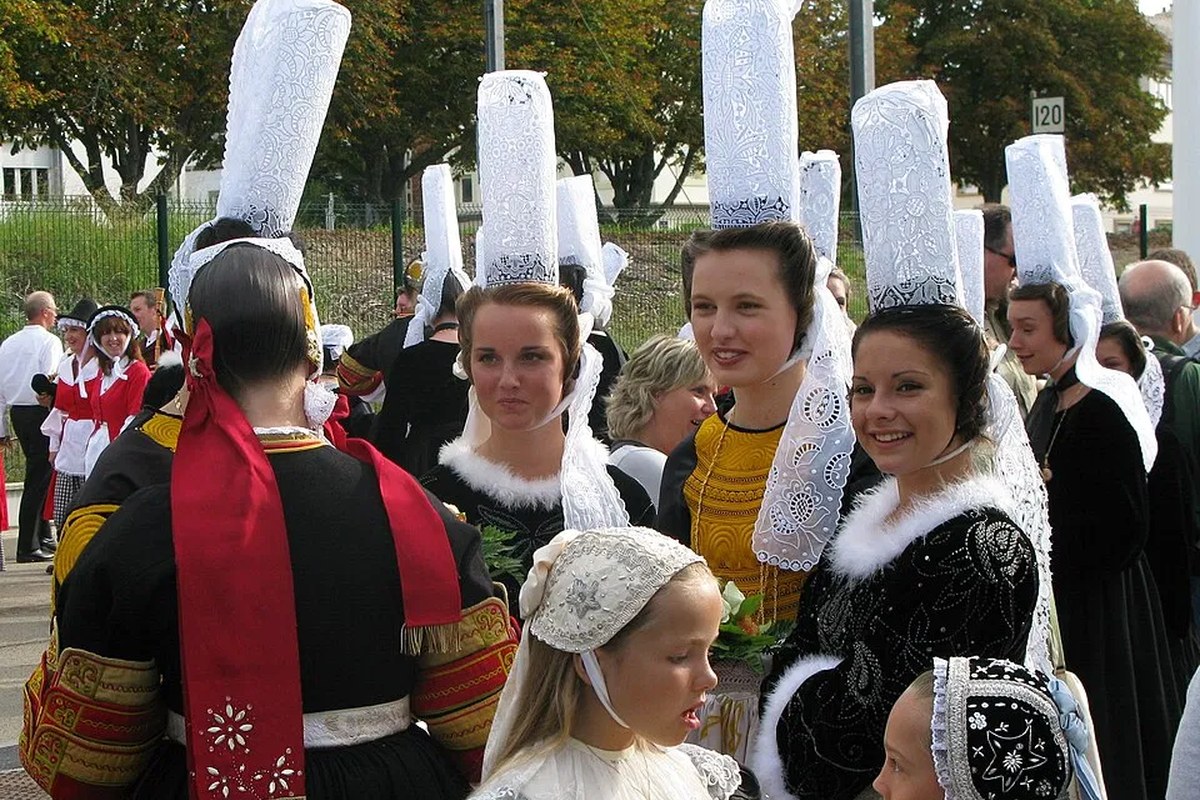
Cross the Channel from Cornwall and you land among people who, on a genetic map, are almost impossible to tell apart from the Cornish and the Welsh. A present-day Breton sits closer to a Welshman than to a Parisian. For a long time that single fact seemed to close an old question: the Bretons must be the children of Britons who fled the southwest of the island in the fifth to seventh centuries, carrying their Brythonic Celtic speech across the water to Armorica. The ancient DNA tells a quieter, stranger story. The Bretons were already close to the islanders long before any boat of refugees set sail, because the whole Atlantic facade of France had belonged to one shared gene pool since the Bronze Age. The migration brought a language. It did not invent a people.
Key points
- A modern Breton sits about 8 scaled Global25 units from a Welshman, 11 from a Cornish person and 15 from an Irish one, but about 27 from a Parisian. On distance alone the Bretons look more "insular" than French.
- That same Breton is just as close to the pre-Saxon people of Britain (England Late Bronze Age 15, England Iron Age 16) and to the Iron Age Gauls of northwestern France (16 to a Normandy and northern French average, 25 to the Urville-Nacqueville port itself). The affinity is to a whole Atlantic Bronze and Iron Age world, not specifically to fifth-century Cornwall.
- The shared signal is deep. It is the Bell Beaker steppe legacy that arrived around 2500 BCE and was preserved on both sides of the Channel. A modern Breton models as roughly 48 percent steppe ancestry; the Iron Age people of Urville-Nacqueville in Normandy already carry about the same, centuries before the Breton migration.
- It is not only Brittany. The whole Channel and Atlantic facade, from Finistere through Normandy to Picardy, sits close to the insular British, with Western Brittany simply at the extreme. The cross-Channel exchange documented archaeologically from the Bronze Age onward left its mark all along the coast.
- Urville-Nacqueville, a La Tene port in Normandy, shows maternal genetic continuity from the Bronze to the Iron Age and shared lineages with Bronze Age Britain and Iberia. Northwestern France was a long-standing genetic contact zone with the islands long before the Dark Ages.
- The Breton language really is Brythonic, really did come from southwestern Britain. The legend is right about the speech. It is wrong only when it turns a language transfer into a population replacement.
- Brittany and the Basque Country are the two ancient anchors of France, at the northwestern and southwestern corners. Both are built from the same three deep European sources with no detectable later overwriting, and both stay close to their own Iron Age ancestors. They differ only in the dial setting: the Bretons are steppe-rich, the Basques farmer-rich.
- Distances are unusually small here, so Global25 cannot finely separate a real Dark Age migration from the shared Atlantic background. Figures from the mixture models are proxy-dependent and read as directions, with the published estimates preferred where the layers blur.
1. A people named for a language from across the sea
Brittany is the granite peninsula at the far northwest of France, the last land before the open Atlantic, and the only part of the mainland that still speaks a Celtic language. Breton is not a survival of ancient Gaulish. It is a Brythonic tongue, sister to Cornish and Welsh, and it surfaces in Armorica only in the early medieval centuries, exactly when written sources describe Britons crossing the sea to escape the upheavals that followed the end of Roman Britain. The name itself, the land of the Britons, records the event. From this the simplest of stories was built: the Bretons are transplanted islanders, and their genome should look like a slice of Cornwall or Wales set down on the wrong side of the Channel.
The way to test that is direct. Take the people who lived on this Atlantic facade across the last four thousand years, line them up against living Bretons and living islanders, and measure who descends from whom. France is now well enough sampled, and the British Isles superbly so, to put the migration story and its rival, deep Armorican continuity, side by side and let the distances decide.
2. Closer to the Welsh than to Paris
The cleanest single test is distance. Using Global25, the coordinate system published by Davidski of the Eurogenes blog, each population becomes a point in a twenty-five dimensional space, and the scaled Euclidean distance between two points measures how genetically far apart they are. The chart below gives those distances, multiplied by one thousand, from a present-day Breton average to a spread of living and ancient populations.
Scaled Global25 distance (multiplied by 1000) from a modern Breton average. The living islanders sit closest, but the pre-Saxon people of Britain and the Iron Age Gauls of northwestern France are right behind them, and both are nearer than a Parisian. The Bell Beaker pole and the Neolithic farmers, the two deep ingredients, lie far to the right.
The order is the whole argument. The Bretons are extraordinarily close to the living islanders, closer to a Welshman or a Cornish person than to a Parisian, which is exactly what a naive reading of the migration story predicts. But look at what sits immediately behind those islanders: the Late Bronze Age and Iron Age people of Britain, before any Saxon arrived, and the Iron Age Gauls of northwestern France. A Breton is about as close to the Gauls of Normandy and the Channel coast as to the pre-Roman Britons across the water. The closeness is not to one source on one shore. It is to a whole Atlantic world that straddled the Channel for two thousand years before the Breton language was ever spoken in Armorica.
3. The recipe: a deep Atlantic Bell Beaker genome
Where does that shared Atlantic profile come from? From the same three streams that built almost all of Europe, but mixed in a distinctly northwestern proportion. Modelled as a blend of Western hunter-gatherers, early Anatolian-derived farmers and steppe pastoralists of the Yamnaya horizon, the Breton genome is unusually rich in steppe ancestry, the legacy of the Bell Beaker people who reached the northwest around 2500 BCE.
Three deep sources, mixed the Atlantic way
The modern Breton, the modern Cornish, the pre-Saxon Iron Age English and the Iron Age people of Normandy all sit at almost the same setting, close to half steppe ancestry. A Parisian carries less steppe and more farmer, and the farmer share keeps rising as you move inland and south. The Basque, at the far southwestern corner, is the mirror image: same three sources, but farmer-rich and steppe-poor. The original Bell Beaker pole was higher in steppe still, and the modern populations have drifted back toward more farmer ancestry since. Figures are proxy-dependent and read as directions, not exact percentages.
4. Nacqueville: the contact zone was already open in the Iron Age
The most telling point in the distance chart is the one nobody expects: the Iron Age people of Urville-Nacqueville, a port on the Normandy coast occupied around 120 to 80 BCE, already carry the Atlantic profile. The largest Iron Age maternal gene pool yet recovered in Europe came from this single cemetery, and it shows two things at once. First, maternal continuity running back through the Bronze Age, a transition driven by slow local change rather than by any flood of newcomers. Second, shared maternal lineages with Bronze Age Britain and with Iberia, the genetic echo of the cross-Channel and Atlantic exchange that the archaeology documents in shipwrecks, shared pottery, British-style round houses and even British-tradition burials laid out on the French shore.
In other words, the contact zone the Breton migration is supposed to have created was already wide open six centuries earlier. The people of Nacqueville modelled here at close to half steppe ancestry are part of the same Atlantic gene pool as the pre-Roman Britons, sharing women, goods and rituals across a Channel that functioned as a road and not a wall. When Britons did later sail to Armorica, they were not arriving among strangers. They were rejoining relatives.
5. Not only Brittany: the whole Channel facade
If the affinity were really the fingerprint of a fifth-century landing in the Breton peninsula, it should be confined to Brittany. It is not. Measure the distance from the living islanders to the modern populations of each northwestern French department and a clean coastal gradient appears, with Western Brittany at the extreme but the whole Channel facade close behind.
Scaled Global25 distance (multiplied by 1000) from the modern Welsh to the modern populations of selected French departments. The closeness to the islanders is not a Breton peculiarity but a property of the entire northwestern facade, fading steadily toward the eastern and southern interior of France.
Western Brittany is the closest point on the continent to the Welsh, but Normandy, the Loire estuary and Picardy follow immediately, and only when you move east into Alsace and south into the Rhone valley and Provence does the insular signal drop away. This is the genetic shadow of the Manche-Mer du Nord world, the Bronze and Iron Age cultural complex that bound both shores of the Channel into a single exchange network. The exchange never really stopped. The Breton migration is one late chapter in a relationship thousands of years old, not its opening line.
6. What the migration actually carried
None of this means the migration was a myth. The Breton language is unambiguously Brythonic, the closest living relatives of Cornish and Welsh, and it genuinely crossed the sea with people in the centuries after Roman Britain fell. What the genetics corrects is the scale. When whole genomes of medieval individuals from western France, spanning the Migration Period, are examined, they do not reveal the kind of wholesale population replacement that the dramatic version of the story imagines. They sit within the existing Atlantic range. The newcomers blended into a population that already shared most of their ancestry, reinforcing an old kinship rather than overwriting a native genome.
So the honest reconstruction is a language transfer riding on top of a deep continuity. A Brythonic-speaking elite and its followers, perhaps numerous in places, settled an Armorica whose people were already their Atlantic cousins, and the language took hold where the genes barely shifted. This is the same pattern seen again and again once ancient DNA is brought to bear: a tongue can travel a sea route and be adopted by people who were genetically close to its speakers to begin with. The map of languages and the map of genomes are drawn by different hands.
7. Two ancient anchors: Brittany and the Basques
Step back from Brittany and a larger symmetry appears. France has two corners where a population has held on to a deep, old genome while the interior was reshuffled by two thousand years of movement: the northwest, in Brittany, and the southwest, among the Basques. They make an instructive pair precisely because they are not the same.
Both are built from the identical three deep European sources, Western hunter-gatherer, early farmer and steppe, and neither carries any meaningful trace of the later inputs, North African, eastern Mediterranean or central European, that touched many of their neighbours. Both stay remarkably close to their own Iron Age ancestors: the Bretons to the pre-Roman Atlantic cluster, the Basques to the Iron Age population of the Spanish interior. In that sense the intuition is right. They are among the oldest continuities in France, two relics of an Iron Age genetic landscape.
But the dial is set in opposite directions, and the distance between them is large, about 64 units, far greater than the gap between a Breton and a Welshman. The Bretons sit at the steppe-rich end of the Atlantic facade, near half steppe ancestry, carrying the full Bell Beaker legacy of the northwest. The Basques sit at the farmer-rich end, well over half early-farmer ancestry with much less steppe, a population that absorbed the Bronze Age steppe input on the male line but kept an older, more Neolithic autosomal balance. Same ingredients, no late overwriting, opposite recipe. They are the two book-ends of deep French ancestry, and the contrast between them is as informative as the continuity within each.
8. The affinity trap
It is tempting to take the tiny Breton-to-islander distance and read it as proof of a recent crossing, the genetic receipt for a boatload of Cornish refugees. That is the same trap that catches readers of every closely related pair of populations, and it is worth naming. A short distance measures shared ancestry, but it cannot, on its own, date that sharing or assign it a direction. Bretons, Cornish, Welsh and the Iron Age Gauls of the Channel coast are all so close together that Global25 simply cannot resolve a fifth-century migration sitting on top of a Bronze Age substrate they already held in common. The small number is real, but most of it is old. The Dark Age migration is a thin, late layer on a thick, deep foundation, and the distance chart shows the foundation, not the layer.
9. So, islanders from the southwest?
The romantic version says the Bretons are Cornish and Welsh exiles who carried their genome and their language together across the sea. The honest version keeps the language and discards the rest. The Bretons are an Atlantic people of deep local continuity, part of a gene pool that straddled the Channel from the Bronze Age, steppe-rich like their Cornish and Welsh cousins because all of them inherited the same Bell Beaker legacy of the European northwest. Iron Age Normandy already carried this profile; the whole Channel facade carries it still. Onto that ancient foundation a Brythonic language was grafted in the early medieval centuries by settlers who were, in genetic terms, coming home. The Bretons did not arrive in Armorica. They were already there, and so, in a sense, were the islanders. They are not migrants from the southwest. They are one shore of an Atlantic world that never fully recognised the sea as a border.
The story in five steps
Claim and reality
The Bretons are Cornish and Welsh migrants who replaced the native Armoricans in the fifth to seventh centuries.
Bretons share a deep Atlantic gene pool with the islanders that predates the migration by two thousand years. The Brythonic language crossed the sea; the population was already continuous and already kin.
Being closer to the Welsh than to Parisians proves the Bretons are essentially islanders.
That closeness is the shared Bell Beaker legacy of the whole Atlantic northwest. Iron Age Gauls of Normandy are about as close to a Breton as the pre-Roman Britons are, and the affinity spans the entire Channel facade.
The insular affinity is a Breton peculiarity created by the migration.
Normandy, the Loire estuary and Picardy share it too, fading only toward the eastern and southern interior. It is a property of the Bronze Age Channel world, not of one Dark Age event.
Bretons and Basques, as France's two old populations, must have much the same ancestry.
They share the same three deep sources with no late overwriting, but at opposite settings: Bretons steppe-rich, Basques farmer-rich, about 64 units apart. Same ingredients, opposite recipe.
Reproduce it yourself
Paste the coordinates below into Vahaduo, the Global25 spreadsheet tool, to rebuild the comparisons in this article: the four Breton departmental averages (Finistere, Morbihan, Cotes-d'Armor, Ille-et-Vilaine), the living islanders and continental French neighbours, the Iron Age port of Urville-Nacqueville in Normandy, the pre-Saxon British timeline from Bell Beaker to Iron Age, the Bell Beaker and Neolithic poles of France, the three modelling sources, and the Basque counterpoint. The four Breton departmental points are averages of ExploreYourDNA academic samples; the Nacqueville point is an average of the published Urville-Nacqueville individuals. All coordinates are scaled Global25 from the public datasheets and the departmental and academic collections.
Breton_Finistere_(n=12),0.131845,0.136081,0.061062,0.042609,0.037853,0.015966,0.005366,0.005442,0.003886,0.006196,-0.006590,0.004546,-0.016823,-0.014657,0.021794,0.006055,-0.006248,0.001235,0.002849,0.003898,0.004201,0.002452,0.000811,0.010734,0.000629
Breton_Morbihan_(n=5),0.129986,0.136893,0.058303,0.039794,0.040192,0.012717,-0.000517,0.003139,0.005604,0.007326,-0.006495,0.006474,-0.018285,-0.013459,0.019028,0.007266,-0.005059,0.003167,0.003042,0.004477,0.002920,0.002473,-0.002169,0.010748,0.000646
Breton_Cotes-d-Armor_(n=5),0.130214,0.136284,0.058831,0.040892,0.038161,0.013275,-0.000094,0.004477,0.010226,0.010497,-0.007924,0.004975,-0.011477,-0.013927,0.019408,0.001140,-0.011004,0.001115,0.000980,0.001601,0.002520,0.005639,-0.000074,0.011182,0.001485
Breton_Ille-et-Vilaine_(n=2),0.131466,0.138620,0.056757,0.032300,0.042315,0.010319,0.002938,0.008885,0.011249,0.008566,-0.005116,0.003671,-0.010704,-0.013281,0.009569,0.004508,-0.000326,-0.002407,0.000879,-0.001375,0.006613,0.008100,-0.000925,0.012773,0.000598
Nacqueville_Normandy_IA_(n=3),0.136967,0.133711,0.063608,0.054695,0.033237,0.017570,0.002899,0.002000,0.012067,0.009051,-0.002328,0.007693,-0.019474,-0.012982,0.015834,0.001503,-0.009127,0.003294,0.002221,0.000292,0.005158,0.002761,0.000534,-0.001285,-0.005788
French_Brittany,0.131466,0.138340,0.057850,0.039285,0.039169,0.015813,0.003155,0.004211,0.008186,0.009490,-0.005131,0.005590,-0.014368,-0.013102,0.018343,0.004399,-0.007302,0.001280,-0.000462,0.001773,0.004467,0.001787,-0.001254,0.010547,0.000659
English_Cornwall,0.130197,0.139752,0.061355,0.043183,0.041901,0.016412,0.003435,0.006390,0.006482,0.006967,-0.004634,0.006479,-0.013745,-0.010248,0.020755,0.003172,-0.012527,0.002115,0.003761,0.003242,0.004809,0.003871,-0.000758,0.014367,0.000691
Welsh,0.131978,0.138163,0.060132,0.043024,0.040592,0.016622,0.003314,0.006392,0.006279,0.004337,-0.004230,0.005912,-0.012911,-0.010975,0.020596,0.005708,-0.008703,0.002356,0.003086,0.002007,0.004985,0.003852,-0.000012,0.011224,0.000808
English,0.131855,0.137043,0.061788,0.044013,0.039230,0.016748,0.004985,0.005745,0.005264,0.005678,-0.004769,0.005616,-0.012589,-0.010351,0.020615,0.003552,-0.010369,0.004094,0.003685,0.002962,0.005937,0.003404,-0.003269,0.013794,0.000031
Scottish,0.131466,0.134232,0.062265,0.047043,0.039106,0.017281,0.003550,0.005176,0.003572,0.002825,-0.005614,0.005047,-0.011680,-0.011973,0.023024,0.003125,-0.011255,0.002774,0.002550,0.001452,0.004225,0.003308,-0.000656,0.013556,-0.000770
Irish,0.133361,0.134098,0.061169,0.048864,0.037788,0.019352,0.003293,0.004713,0.003568,0.002927,-0.006971,0.005840,-0.014189,-0.014076,0.025935,0.005215,-0.011145,0.001894,0.000597,0.001776,0.005114,0.001279,0.000293,0.014407,0.000661
French_Paris,0.127171,0.141436,0.050431,0.023990,0.040903,0.009305,0.002799,0.005454,0.011602,0.018174,-0.007706,0.006812,-0.012906,-0.010384,0.013770,0.006063,-0.001825,0.004664,0.002708,-0.000978,0.002201,0.003575,-0.001232,0.011141,-0.001905
French_Pas-de-Calais,0.127861,0.140481,0.054305,0.026809,0.042162,0.012736,0.004152,0.001308,0.008522,0.012453,-0.008011,0.002198,-0.010010,-0.012019,0.013663,0.008132,-0.000478,0.001816,-0.003645,0.004252,0.009982,0.001443,-0.002547,0.005904,-0.001437
England_BellBeaker,0.127735,0.123048,0.064341,0.071078,0.025902,0.022699,0.003460,0.003256,-0.004375,-0.010023,-0.003311,0.003880,-0.011001,-0.016255,0.027099,0.010585,-0.005795,0.001541,0.002465,0.007170,0.007903,0.002267,-0.000233,0.007464,0.000033
England_EBA,0.121791,0.128972,0.064488,0.051680,0.031083,0.007530,0.011045,0.004154,-0.004500,-0.022051,-0.003085,-0.001798,-0.005352,-0.015964,0.030266,0.015778,-0.009779,0.003041,-0.019609,0.026888,0.014474,-0.009027,0.005176,-0.008917,0.002515
England_LBA,0.126431,0.132175,0.061761,0.047556,0.036457,0.017291,0.001139,0.004065,0.003147,0.002607,-0.003498,0.006248,-0.014717,-0.016356,0.020713,0.008251,-0.003159,0.002105,0.001306,0.004242,0.008264,0.005916,-0.003783,0.007944,-0.000617
England_IA,0.130214,0.135167,0.061735,0.054006,0.040592,0.016455,0.000846,0.002931,0.005318,0.003681,-0.003329,0.007328,-0.014405,-0.012730,0.022882,0.005728,-0.006259,0.001102,-0.000503,0.002926,0.003768,0.003400,-0.001775,0.007543,-0.000323
England_Roman,0.127482,0.123895,0.061471,0.047158,0.031698,0.025379,0.015041,0.003923,-0.003068,0.003827,-0.002273,0.004946,-0.014569,-0.016515,0.016286,0.018960,0.020861,-0.000380,0.000754,-0.000375,0.007861,-0.002349,0.002835,0.009158,0.006945
Wales_IA,0.130897,0.131003,0.066750,0.043605,0.039392,0.018686,-0.006345,0.005077,0.000818,-0.003098,-0.007957,0.013788,-0.007730,-0.019405,0.015201,0.024131,0.011474,0.003167,0.005908,0.006378,0.006239,0.006059,0.001972,0.004458,-0.008382
Ireland_EBA.SG,0.125585,0.127280,0.061848,0.063308,0.030980,0.019150,0.005327,0.006769,-0.002250,-0.001883,0.000271,0.008243,-0.013033,-0.027983,0.033975,0.024529,0.000956,0.007517,0.000922,0.011339,0.008859,0.009356,0.000370,0.014219,0.005788
France_BellBeaker,0.133173,0.123895,0.059491,0.057898,0.028082,0.021545,0.005111,0.002884,0.003272,-0.008793,-0.002476,0.001574,-0.009626,-0.016343,0.019612,0.009812,0.007725,0.001077,0.005405,0.009661,0.005365,0.003895,0.000123,0.006206,-0.001467
France_EBA,0.126723,0.141159,0.057825,0.024709,0.046726,0.004881,-0.000353,0.001923,0.021645,0.027609,-0.003302,0.007693,-0.015708,-0.015849,0.009139,0.013193,0.007823,0.001879,-0.000566,0.005065,0.003598,0.003874,-0.005772,-0.007672,-0.002954
France_N,0.126571,0.170406,0.059283,-0.029651,0.085185,-0.021251,-0.004230,0.001985,0.066143,0.090899,-0.001429,0.015167,-0.031635,-0.015249,-0.006134,0.004031,0.006858,0.002280,0.004978,-0.001051,0.014624,0.004081,-0.015036,-0.038921,0.003784
Italy_North_Villabruna_HG,0.121791,0.115770,0.185920,0.185726,0.156029,0.060798,0.017626,0.041537,0.093467,0.017859,-0.015752,-0.015886,0.020961,-0.005092,0.053610,0.064041,0.007562,0.004181,-0.009050,0.053401,0.099949,0.012489,-0.044123,-0.169904,0.018801
Turkey_Barcin_LN.SG,0.112685,0.182795,0.010936,-0.100130,0.055087,-0.046854,-0.002350,-0.002769,0.046836,0.081642,0.008607,0.010191,-0.015758,0.006193,-0.040173,-0.020021,0.003520,0.000507,0.011816,-0.014132,-0.008735,0.006306,-0.010969,-0.004940,-0.004670
Russia_Samara_EBA_Yamnaya,0.125838,0.089254,0.042908,0.115456,-0.027868,0.044685,0.004491,-0.002949,-0.054858,-0.072996,0.001858,0.000350,-0.001652,-0.023610,0.037263,0.015734,0.000000,-0.001478,-0.001704,0.012506,-0.003120,0.001374,0.011229,0.018436,-0.004524
References and sources
- 1 Alves, I., Giemza, J., Blum, M., et al. Genetic population structure across Brittany and the downstream Loire basin provides new insights on the demographic history of Western Europe. bioRxiv (2022). Whole-genome study finding the highest steppe ancestry in France in Western Brittany, strong Bell Beaker allele sharing comparable only to the northwestern edges of Europe, and medieval genomes that show no wholesale Migration-Period replacement. link
- 2 Fischer, C.-E., Lefort, A., Pemonge, M.-H., Couture-Veschambre, C., Rottier, S., Deguilloux, M.-F. The multiple maternal legacy of the Late Iron Age group of Urville-Nacqueville (France, Normandy) documents a long-standing genetic contact zone in northwestern France. PLOS ONE 13(12): e0207459 (2018). The largest Iron Age maternal gene pool in Europe, showing Bronze-to-Iron Age continuity, cross-Channel and Atlantic gene flow, and affinity with modern northwestern France and the British Isles. link
- 3 Olalde, I., Brace, S., Allentoft, M. E., et al. The Beaker phenomenon and the genomic transformation of northwest Europe. Nature 555, 190-196 (2018). The arrival of steppe-rich Bell Beaker ancestry that transformed Britain around 2500 BCE and underlies the shared Atlantic genome. link
- 4 Brunel, S., Bennett, E. A., Cardin, L., et al. Ancient genomes from present-day France unveil 7,000 years of its demographic history. PNAS 117(23), 12791-12798 (2020). Genome-wide transect of French prehistory framing the steppe versus farmer balance across the country. link
- 5 Cunliffe, B., de Jersey, P. Armorica and Britain: Cross-Channel Relationships in the Late First Millennium BC. Oxford University Committee for Archaeology (1997). The archaeological case for continuous Armorica-Britain exchange long before the Breton migration. B
- 6 Global25 coordinates: Davidski (Eurogenes), with modern and ancient averages from the public Global25 datasheets, alongside the ExploreYourDNA departmental and academic French collections. Global25 spreadsheet tooling: Vahaduo. G25
Modern and ancient Global25 coordinates: Davidski (Global25), with averages from the public Global25 datasheets and the ExploreYourDNA departmental and academic French collections. The Breton point is the average of ExploreYourDNA academic samples from Finistere, Morbihan, Cotes-d'Armor and Ille-et-Vilaine; the Nacqueville point is the average of the published Urville-Nacqueville Iron Age individuals. Global25 spreadsheet tooling: Vahaduo. Analysis: scaled Global25 Euclidean distances and non-negative least squares modelling in Python. Ancestry fractions are proxy-dependent and best read as directions rather than exact percentages; because the relevant populations are extremely close, Global25 distance alone cannot isolate the fifth-to-seventh-century migration from the shared Bronze Age substrate, and the published formal estimates are preferred where the layers blur.