
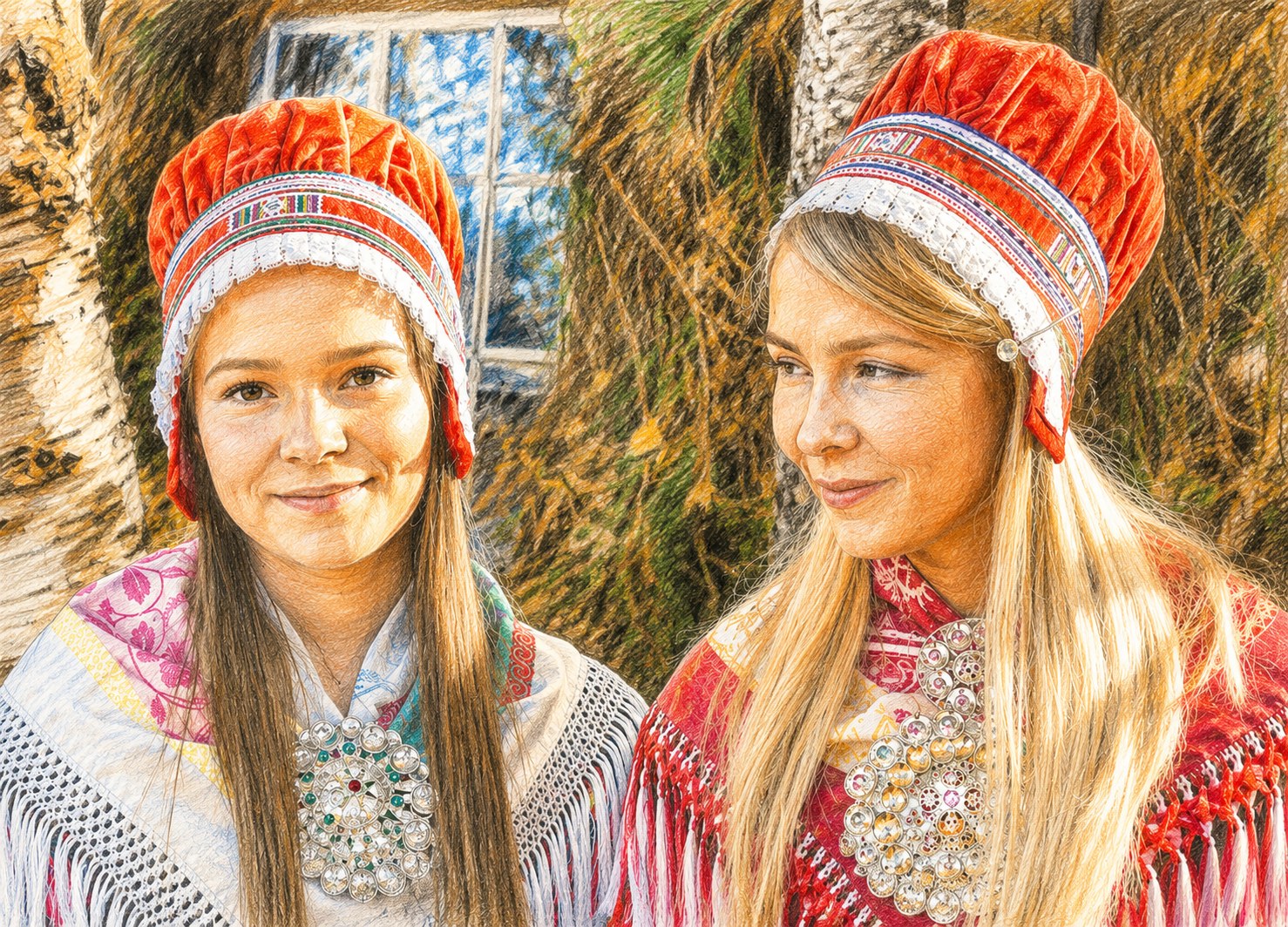
Europe is, genetically, a remarkably smooth place. Walk from Lisbon to Stockholm to Warsaw and the gene pool slides gently from one cline to the next, every population a blend of the same three ingredients: Anatolian farmers, steppe pastoralists, and a thin residue of the old hunter-gatherers. The Sami break that map. On Davidski's Global25 the Sami sit roughly 0.187 from their Norwegian neighbours and 0.198 from the English, while the Norwegians and the English are a mere 0.018 apart. The Sami are about ten times more distant from the people next door than those people are from one another. No other population native to Europe is so far from everything around it. The reason is an arrival from the east. About a quarter to a third of Sami ancestry is Siberian, a Nganasan-related component that did not exist anywhere in Scandinavia in the Bronze Age and that the genome of a pre influx Scandinavian flatly refuses when it is offered. It came in after the Late Neolithic, it was already sitting on the Kola peninsula by about 1500 BCE, and it carried with it both a language family, Uralic, and a Y chromosome, haplogroup N, that arrived together out of Siberia. The same eastern thread, much thinner, runs on into the Finns, the north Russians and, fainter still, into Scandinavia itself. The Sami are the one place in Europe where you can watch Siberia walk in.
Key Points
- The Sami (also written Saami) are the indigenous people of the European far north, spread across Sapmi, the lands that cross modern Norway, Sweden, Finland and the Kola peninsula of Russia. They speak Uralic languages of the Sami branch, related to Finnish and ultimately to the languages of western Siberia, and they are famous for reindeer herding, the joik song tradition and a culture adapted to the Arctic for thousands of years.
- On Global25 the Sami are the single most distinctive population native to Europe. Their distance to the modern Norwegian is about 0.187 and to the English about 0.198, while Norwegian to English is only 0.018. The Sami stand roughly an order of magnitude further from their neighbours than those neighbours stand from each other.
- The cause is a large dose of Siberian ancestry. Modelled as a northern European baseline plus a Siberian source (modern Nganasan as the proxy), the Sami return about 73 percent European and 27 percent Siberian (fit 0.066). This is the highest Siberian fraction of any population on the European mainland.
- The decisive control: offered the very same Siberian source, a pre influx Scandinavian Bronze Age population (Sweden Battle Axe, Corded Ware derived, about 2300 BCE) takes 0.0 percent. The Siberian ancestry is a genuine post-Neolithic arrival, not an ancient background signal.
- The arrival is datable. The Siberian component is already present, at roughly 45 percent, in the Early Metal Age population of Bolshoy Oleni Ostrov on the Kola peninsula (about 1500 BCE), the oldest Fennoscandian sample to carry it. It then settles to about a quarter to a third in the Iron Age (Levanluhta in Finland, about 28 percent) and stays there through the Viking Age Sami of northern Norway and the recent Kola Sami of Chalmny Varre to the present.
- The Y chromosome tells the same story in the male line. Haplogroup N (N-M231, in its N1a1 / N1c lineages) originated in East Asia and Siberia and spread west with the Siberian autosomal ancestry. It is a dominant Sami paternal lineage (alongside the native European I1), reaches roughly 60 percent in Finns, is very common among Balts and north Russians, and is present at low frequency in Sweden and Norway. The Bronze Age men of Bolshoy Oleni Ostrov already carried it.
- The Siberian layer forms a clean cline across the north and east: Sami about 27 percent, Kola Sami about 20 percent, north Russians (Leshukonsky, Pinega) about 11 to 15 percent, Karelians and Finns about 6 to 9 percent, Estonians about 2 percent, Balts about 1 percent, and mainstream Swedes, Norwegians, Danes and Icelanders essentially 0 percent at the population average.
- The Sami also preserve an unusually heavy hunter gatherer residue. In a deep model they read as roughly 20 percent Eastern hunter gatherer (EHG), 18 percent Scandinavian hunter gatherer (SHG), 16 percent Anatolian farmer, 23 percent steppe and 24 percent Siberian, a combined hunter gatherer fraction near 38 percent. A mainstream Norwegian on the same sources carries no EHG and no Siberian at all, its hunter gatherer share being the roughly 22 percent SHG that all Scandinavians retain.
- This reframes the popular claim that many Scandinavians have Uralic roots. The honest picture is a gradient. The deep Uralic and Siberian ancestry is overwhelming in the Sami, substantial in Finns and north Russians, and thins to near zero in mainstream Scandinavia. What Scandinavians genuinely share with the Sami is the older northern substrate, the Scandinavian hunter gatherer layer, plus a thin but real Uralic thread visible mainly in the N Y chromosome and in northern regional populations.
- The closest living relatives of the Sami, after other Sami, are not Scandinavians at all. They are the Uralic speaking peoples of the Volga and the Urals: the Udmurt (about 0.052) and the Besermyan (about 0.060), ahead of any Germanic or Baltic population. The closest ancient neighbour is Iron Age Levanluhta in Finland (about 0.018).
- An honest nuance, as always. Nganasan is an extreme modern Siberian proxy, more eastern shifted than the actual source that reached Fennoscandia, so the exact Siberian percentage is model dependent (the true ancient source, of the Bolshoy Oleni Ostrov type, was itself only about half Siberian). Profile averages smooth over real variation, and per population estimates are approximate. But the core results are robust and mutually reinforcing across the proximal model, the deep model, the ancient time transect and the uniparental record.
1. Who are the Sami?
The Sami are the indigenous people of the European Arctic and sub Arctic, the inhabitants of Sapmi, a homeland that pays no attention to modern borders and stretches across the northern reaches of Norway, Sweden and Finland and onto the Kola peninsula of Russia. Their languages belong to the Uralic family, in a branch of their own that is cousin to Finnish, Estonian and the more distant tongues of the Volga and western Siberia, and they have lived in the far north for millennia, hunting, fishing and, for much of the last thousand years, herding reindeer. To their southern neighbours they were long the great exception of the north, a people whose language, dress, song and way of life set them visibly apart from the Germanic Scandinavians who surrounded them.
What the genome now shows is that this distinctiveness is not merely cultural. The Sami are, autosomally, the most unusual population native to Europe, and the reason is a deep tie to Siberia that none of their neighbours share to anything like the same degree. That tie is the subject of this article. We will place the Sami on Global25, measure how far they sit from everyone around them, isolate the Siberian component, date its arrival against the ancient record, follow its echo in the Y chromosome, and finally ask the question that interests so many Scandinavians: how much of this eastern inheritance is in them too?
Post glacial Scandinavia is peopled by hunter gatherers, the Scandinavian hunter gatherers (SHG), a mix of western and eastern hunter gatherer ancestry. This is the oldest layer, and the Sami will preserve more of it than anyone.
The Corded Ware and Battle Axe cultures bring the Anatolian farmer plus steppe package north. Scandinavia becomes a steppe rich, farmer leavened population. There is, as yet, no Siberian ancestry anywhere in it.
An eastern, Nganasan related ancestry appears in the far north, recorded first at Bolshoy Oleni Ostrov on the Kola peninsula. It carries the Uralic language family and the N Y chromosome west into Fennoscandia.
The Siberian fraction settles at about a quarter to a third in the ancestral Sami line, seen at Iron Age Levanluhta and the Viking Age Sami of north Norway, and persisting to the modern Sami and the recent Kola Sami of Chalmny Varre.
2. The genetic question, and the data
The decisive ancient DNA work was done by Lamnidis and colleagues (2018), who sequenced ancient Fennoscandians including the Early Metal Age people of Bolshoy Oleni Ostrov on the Kola peninsula and the Iron Age population of Levanluhta in Finland, and showed that a Siberian, Nganasan related ancestry had entered the far north by the second millennium BCE and was the distinguishing ingredient of the Sami and their relatives. Saag and colleagues (2019) traced the same Siberian flow into the eastern Baltic, showing it reaching the Baltic peoples by the Iron Age, and the broader Uralic genetic story has since been filled in by work on the Volga, the Urals and western Siberia. The Y chromosome side of the story, the spread of haplogroup N, had been mapped earlier by Tambets and colleagues (2004) and refined by Ilumae and colleagues (2016).
Below we reproduce and extend the autosomal core of this picture on Davidski's Global25 (scaled coordinates), using NNLS modelling in Python (scipy), taking the modern Sami average and the Kola Sami as our worked examples and drawing the ancient and reference coordinates from the Moriopoulos 2025 collection. The result, as so often, comes out sharper on Global25 than prose alone can convey: the Sami are an outlier of a kind Europe has nowhere else, and the cause can be isolated, dated and tracked.
3. The Sami on Global25: the great European outlier
Begin with raw distance. Ranked by Euclidean distance against the Global25 panel, the Sami land beside their own ancient ancestors and a short list of Uralic speaking peoples, and a long way from the Germanic Scandinavians among whom they live.
| Reference | G25 distance to Sami | Nature of the reference |
|---|---|---|
| Finland Iron Age (Levanluhta) | 0.0176 | Ancient, Sami like, the closest of all |
| Chalmny Varre (recent Kola Sami) | 0.0243 | Recent Sami, near identical |
| Viking Age Sami, north Norway | 0.0269 | Medieval Sami profile |
| Udmurt (modern) | 0.0523 | Volga Uralic, closest living non Sami |
| Besermyan (modern) | 0.0602 | Volga Uralic |
| Khanty (modern) | 0.0662 | Ob Ugric, western Siberia |
| Finnish, North (modern) | 0.1256 | Their Finnic neighbours |
| Norwegian (modern) | 0.1865 | Their Germanic neighbours |
| English (modern) | 0.1978 | Mainstream northwest Europe |
The shape of the table is the whole point. The Sami sit almost on top of their own ancient and recent relatives, and their nearest living non Sami populations are the Udmurt and Besermyan of the Volga, Uralic speakers a thousand kilometres to the southeast, not the Norwegians next door. The distance to the Norwegian (0.187) and the English (0.198) is enormous: for comparison, the Norwegian and the English differ by only 0.018, and most pairs of mainstream European populations sit well under 0.05. The Sami are not a slightly shifted Scandinavian. They are a different kind of population that happens to live in Scandinavia.
4. The decisive test: offer Siberia, and watch the Sami take a quarter
A distance is suggestive; the rigorous test is to offer a suspected source explicitly to the mixture algorithm and read off the weight. Here we model the Sami as a two way mixture of a northern European baseline and a Siberian source, using modern Nganasan as the Siberian proxy. If the Sami were simply a cold adapted Scandinavian, the Siberian source would take little or nothing. It takes about a quarter.
The Sami modelled as northern European plus Siberian
5. The control: where Siberian ancestry is absent, it is refused
A sceptic might worry that Global25 simply sprays Siberian ancestry onto any northern population. The control disposes of that worry completely. Offer the identical Siberian source to a Scandinavian population that lived before the inflow, and to the mainstream Scandinavians of today, and the weight collapses to nothing.
The same Siberian source offered to pre influx and mainstream Scandinavians
6. The Uralic cline across the north
The Siberian ancestry did not stop at the Sami. The same eastern thread runs on through the Finnic and Russian north and, far more thinly, into the Baltic and Scandinavia, forming a clean cline. The figures below give the Siberian (Nganasan related) share of each population on a mainstream northern European baseline.
Siberian (Nganasan related) ancestry across northern and eastern Europe
7. The N chromosome: an arrow from Siberia in the male line
Autosomes record the whole ancestry; the Y chromosome records only the unbroken male line, and it tells the eastern story with unusual clarity. Y chromosome haplogroup N (N-M231), and in particular its N1a1 lineages, long labelled N1c in the older nomenclature, arose in East Asia and spread across Siberia and then west into northeastern Europe. Its distribution today traces the same path as the Siberian autosomal ancestry: it is a major Sami paternal lineage, sitting alongside the native European I1; it reaches roughly sixty percent among Finns; it is very common among the Baltic peoples and the north Russians; and it tapers off westward, present at a few percent in Sweden and Norway, higher in the north than the south. The men buried at Bolshoy Oleni Ostrov on the Kola peninsula in the second millennium BCE already carried haplogroup N, which fixes the paternal arrival to the same horizon as the autosomal one.
The point is that the language, the autosomal ancestry and the Y chromosome arrived as a package. Uralic speech, Nganasan related autosomal ancestry and haplogroup N spread together out of Siberia into the far north. Where all three are strongest, the Sami, we have the clearest case in Europe of a coherent eastern migration that did not dissolve. That haplogroup N appears at low frequency in mainstream Scandinavia is the patrilineal echo of the same thin thread the autosomes show: a real Uralic presence in the Scandinavian male line, minor in size but unmistakable in origin.
8. The deep model: the hunter gatherer residue
Decomposed into deep sources, the Sami reveal a second oddity beyond their Siberian quarter: they carry far more of the old hunter gatherer ancestry than any of their farming derived neighbours. Modelled against Eastern hunter gatherer (EHG), Scandinavian hunter gatherer (SHG, the Motala population), Anatolian Neolithic farmer, steppe (Yamnaya) and Siberian (Nganasan), the Sami come out as a deeply northern population with a heavy hunter gatherer core.
Deep model: the Sami against a mainstream Scandinavian, identical sources
9. The trajectory: from Bolshoy Oleni Ostrov to the modern Sami
Because we have ancient genomes, the Siberian arrival is not a guess but a dated sequence. Offering the same European baseline plus Siberian source to one ancient stage after another shows the component switching on and then stabilising.
The Siberian fraction through time in the far north
10. The model in one picture
The Sami model. A resident northern European population, hunter gatherer rich and then farmer and steppe leavened, fuses after the Bronze Age with a Siberian inflow that carried the Uralic language and the N Y chromosome. The result is about 73 percent northern European and 27 percent Siberian, the most eastern shifted population native to the European mainland.
11. The limits of the method
The usual caveats apply. NNLS reports proportions on the sources it is offered and cannot by itself date an inflow; the dating here comes from the ancient samples, not the algorithm. The Siberian percentage is proxy dependent: modern Nganasan is a strongly eastern shifted stand in, more extreme than the actual ancestry that reached Fennoscandia, which the Bolshoy Oleni Ostrov genome shows was itself only about half Siberian, so the Sami figure should be read as roughly a quarter to a third rather than an exact 27 percent, and formal qpAdm style estimates land in the same broad range. Profile averages smooth over real individual and regional variation, which is exactly why the cline in section 6 matters: a single Sami average conceals groups that run from the strongly Siberian to the more Scandinavian shifted. And the Scandinavian Uralic thread discussed above is real but small, visible mainly in northern regional populations and in the Y chromosome rather than in the mainstream population average. None of this disturbs the core findings, which are robust and mutually reinforcing across the proximal model, the deep model, the dated ancient transect and the uniparental record.
12. The Sami Global25 coordinate
For readers who wish to reproduce the analysis in Vahaduo or any Global25 tool, the scaled average coordinate of the Sami population used throughout this article is given below.
13. Myth versus reality
Myth
- The Sami are just a cold adapted variety of Scandinavian, a northern offshoot of the Norse.
- The Sami have always been in the far north, an unchanged relic of the first post glacial settlers and nothing more.
- Many or most Scandinavians carry substantial Sami or Uralic ancestry.
- The Sami connection to Siberia is a vague, undatable deep time affair lost in prehistory.
Reality
- The Sami are the most distinctive population native to Europe, about 0.187 from the Norwegian on Global25 where Norwegian to English is 0.018. Their closest living non Sami relatives are the Uralic Udmurt and Besermyan, not the Norse.
- They are a fusion: the old northern hunter gatherer substrate plus a post Bronze Age Siberian inflow of about a quarter to a third, which carried the Uralic language and the N Y chromosome.
- At the population average, mainstream Swedes, Norwegians and Danes take close to 0 percent Siberian. The shared inheritance is the older Scandinavian hunter gatherer layer plus a thin Uralic thread in the north and in the male line, not a major Sami component.
- The arrival is dated: zero in Late Neolithic Scandinavia, already present at Bolshoy Oleni Ostrov on Kola by about 1500 BCE, stable in the Sami line from the Iron Age onward.
14. Conclusion
Europe's gene pool is a gentle gradient, and almost everywhere you look the local population is a familiar recipe of farmer, steppe and a little hunter gatherer. The Sami are the exception that proves how unusual a true outlier looks. They sit ten times further from their Scandinavian neighbours than those neighbours sit from each other, and the reason is written plainly in the genome: about a quarter to a third of their ancestry is Siberian, a Nganasan related component that no Scandinavian carried in the Bronze Age and that a pre influx Scandinavian flatly refuses when it is offered. That ancestry arrived from the east after the Late Neolithic, it was already on the Kola peninsula by about 1500 BCE, and it brought with it a language family and a Y chromosome that travelled as a single package. In the Sami, uniquely in Europe, that package never came apart.
And the wider lesson for the many Scandinavians who wonder about their own eastern roots is a matter of honest proportion. The deep Uralic and Siberian ancestry is concentrated in the far north and east: overwhelming in the Sami, substantial in the Finns and north Russians, fading through the Baltic and into near absence in mainstream Scandinavia. What Scandinavians do share with the Sami is older and quieter: the ancient northern hunter gatherer substrate, which they preserve more of than almost anyone in northwest Europe, and a thin Uralic thread, strongest in the north and clearest in the N Y chromosome, that is a faint seasoning rather than a main ingredient. The Sami are not a footnote to the Scandinavian story. They are a different story, the story of the moment Siberia reached the edge of Europe and stayed.
References
- Lamnidis, T. C., Majander, K., Jeong, C., et al. (2018). Ancient Fennoscandian genomes reveal origin and spread of Siberian ancestry in Europe. Nature Communications, 9, 5018. DOI: 10.1038/s41467-018-07483-5 Sami and Siberian aDNA
- Saag, L., Laneman, M., Varul, L., et al. (2019). The arrival of Siberian ancestry connecting the eastern Baltic to Uralic speakers further east. Current Biology, 29(10), 1701 to 1711. DOI: 10.1016/j.cub.2019.04.026 Baltic Uralic
- Tambets, K., Rootsi, S., Kivisild, T., et al. (2004). The western and eastern roots of the Saami, the story of genetic outliers told by mitochondrial DNA and Y chromosomes. American Journal of Human Genetics, 74(4), 661 to 682. DOI: 10.1086/383203 Sami uniparental
- Ilumae, A.-M., Reidla, M., Chukhryaeva, M., et al. (2016). Human Y chromosome haplogroup N, a non trivial time resolved phylogeography that cuts across language families. American Journal of Human Genetics, 99(1), 163 to 173. DOI: 10.1016/j.ajhg.2016.05.025 Haplogroup N
- Sikora, M., Pitulko, V. V., Sousa, V. C., et al. (2019). The population history of northeastern Siberia since the Pleistocene. Nature, 570, 182 to 188. DOI: 10.1038/s41586-019-1279-z Siberian deep history
- Moriopoulos (2025). Modern and Ancient Population Collection (Global25 profile averages used for the Sami and reference coordinates). G25 dataset
- Davidski (Eurogenes). Global25 scaled coordinates, and the Vahaduo Global25 tools by Piotr Kapuscinski. NNLS modelling and distance calculations performed for this article in Python (scipy) on the scaled coordinates. G25 method