
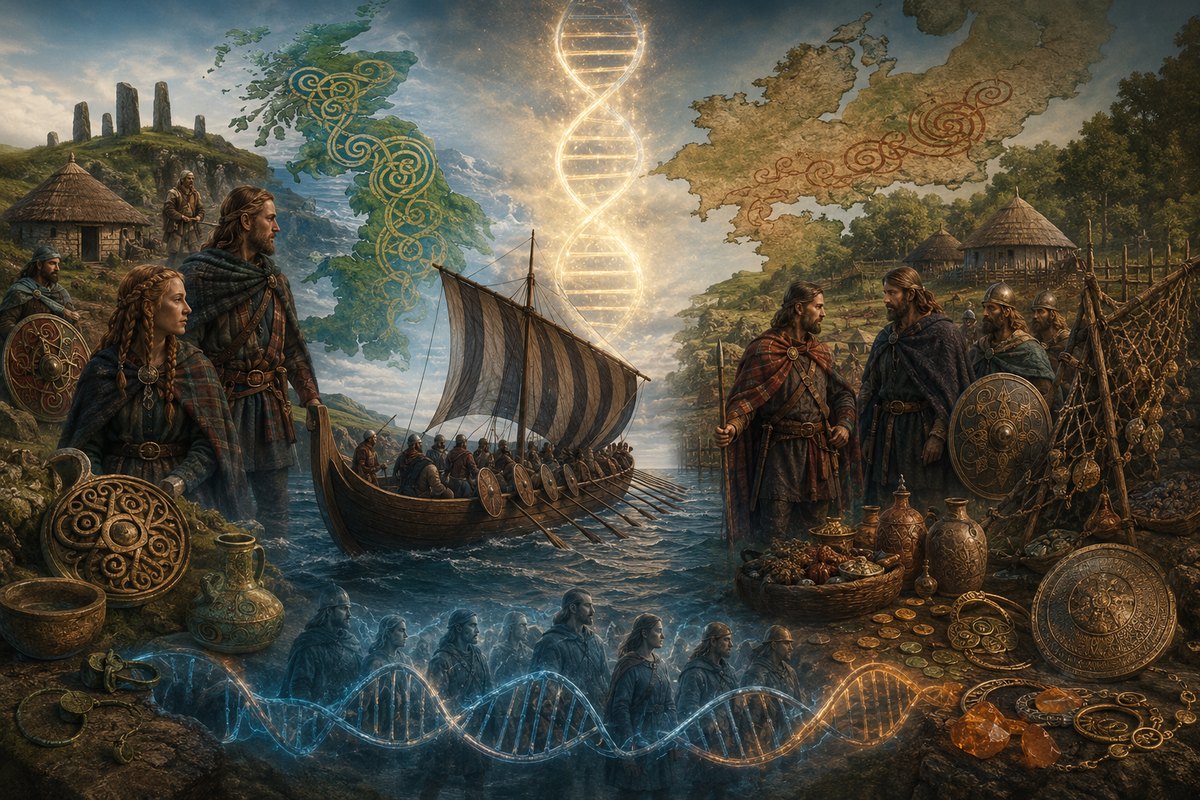
Most ancient DNA stories are about where a people came from. The Durotriges of Iron Age Dorset tell a rarer one: here it is the structure of a society that the genome records, and a real migration carried on it. In the Cassidy and Bradley study of 2025, a single cemetery at Winterborne Kingston in Dorset turns out to be the burial ground of one extended family built around one founding woman. Two thirds of its members share a single rare maternal lineage that sat rooted in that one place for some three hundred years, while the men are a genetically diverse crowd of incomers. This is matrilocality, the women stay and the husbands move in, and it had never been documented in European prehistory before. On Global25 the pattern is written in the autosomes too. The stable female core is a textbook insular Briton; the inward migrating men drag the community toward the continent, and the clearest of them is essentially a first generation Gaul. Across the whole tribe roughly a quarter of the ancestry is a fresh Iron Age inflow from across the Channel, the genomic echo of the cross-Channel world that linked Dorset to Armorica, the coast of Gaul that ran from Brittany through Normandy. The women stayed put. The men crossed the sea. And the closest living people to the Durotriges are not the English at all, but the Bretons of Armorica.
Key Points
- The Durotriges were a Late Iron Age tribe of central southern Britain, occupying roughly modern Dorset and parts of Somerset and Wiltshire from about 100 BCE to 100 CE. They are famous for their hillforts (Maiden Castle above all) and, unusually for Iron Age Britain, for burying their dead in formal cemeteries of crouched inhumations, often with the women carrying the richest grave goods.
- Iron Age human remains are rare in Britain (most people were cremated, excarnated or placed in wetlands), so the Durotrigian cemeteries are a precious window. Lara Cassidy, Daniel Bradley and the Bournemouth Durotriges Project team analysed 57 ancient genomes from Durotrigian burials, mainly the cemetery at Winterborne Kingston (WBK) in Dorset, plus two richly furnished female burials from Maiden Newton and Langton Herring.
- The headline social finding: WBK was the cemetery of one large kin group, and more than two thirds of the identified relatives (24 of 34) belong to a single rare maternal lineage of mitochondrial haplogroup U5b1, never seen before in ancient sampling. The unrelated, presumably inward migrating burials are predominantly male. This is matrilocality: the women stayed, the men married in.
- The matriline is deep and stable. Four downstream sub-lineages unique to WBK imply the haplotype had been associated with the site for many generations (the authors estimate at least 420 female births would be needed to produce that diversity), spanning from the second century BCE into the Roman period. By contrast Y chromosome diversity is high and the community was outbreeding. Matrilocality of this kind is undescribed elsewhere in European prehistory.
- On Davidski's Global25 the Durotrigian average sits squarely in the British Iron Age cluster (nearest ancient neighbour England_MIA at 0.0083). The single closest living population on Earth is French_Brittany at 0.0117, the Bretons of Armorica, ahead of the Welsh (0.0136) and the English (0.0165). The nearest relatives of the Durotriges today are continental Celts.
- The continental influx, quantified. Modelled as an insular Late Bronze Age baseline (England_LBA) plus a Channel-facing continental Iron Age source (Picardy, France_HautsDeFrance), the Durotriges are about 77 percent insular and 23 percent continental Iron Age (fit 0.0089), rising to 29 percent with a La Tene source. The control is decisive: offered the same continental source, a pre-influx Bronze Age Briton takes 0 percent. The continental quarter is a genuine Iron Age addition, not Bronze Age background.
- The influx was male biased, exactly as matrilocality predicts. The community is autosomally heterogeneous (two individuals sit 0.0768 apart, a large internal scatter), with a stable insular core and continental-shifted incomers. The founding matriarch WBK31 reads as 0 percent continental; the outlier male WBK02 reads as 80 to 100 percent continental, essentially a first generation Gaulish migrant, and he is the one man in the pedigree to found a paternal line.
- The deep model confirms the inflow from another angle. The Durotriges decompose into roughly 47 percent steppe, 40 percent Anatolian Neolithic and 13 percent western hunter gatherer, against about 56 / 31 / 13 for the Early Bronze Age Beaker folk of Britain. Steppe is diluted and farmer ancestry is raised, precisely the signature of an inflow from a more farmer-rich continent.
- The cross-Channel world was real and bidirectional. At Urville-Nacqueville on the Normandy coast, a Late Iron Age necropolis (Fischer et al. 2018) holds crouched burials in the Durotrigian style and a maternal gene pool documenting a long-standing contact zone. A Normandy Iron Age genome (UN129) falls in the British Iron Age orbit with the same insular plus continental recipe (about 72 percent insular, 28 percent continental). The Late Iron Age ports (Hengistbury Head, Poole, Le Yaudet, Alet, Port-en-Bessin) were the nodes of that network.
- An honest nuance, as always. Profile averages and individual NNLS are noisy, the continental percentage shifts with the source offered, and a single Normandy genome is illustrative rather than definitive. But the central results are robust and mutually reinforcing: a deep matriline, male-biased inward migration, and a genuine Iron Age continental influx into the southern coastal core, all consistent with the haplotype-sharing and SOURCEFIND analyses of the original paper.
1. Who were the Durotriges?
By the last century before our era, the people the Romans would call the Durotriges held the chalk downland and coast of what is now Dorset, reaching into Somerset and Wiltshire. Theirs was a landscape of great hillforts, Maiden Castle, Hod Hill, Hambledon, and of a distinctive material culture: a black-burnished pottery, a coinage of debased silver and bronze, and a tight web of farmsteads and banjo enclosures. Julius Caesar never names them, but Ptolemy does, and the archaeology gives them a sharp identity in the century either side of the Roman conquest of 43 CE.
What makes the Durotriges almost unique among Iron Age Britons is that we can dig up their dead. Across most of the island the Iron Age is a near total funerary blank: bodies were cremated, exposed, scattered or sunk in bogs, and they vanish from the record. The Durotriges, by contrast, laid their dead in formal cemeteries as crouched, flexed inhumations, frequently with grave goods. And in those graves it is repeatedly the women who carry the richest assemblages, mirrors, brooches, joints of meat, hinting at female status long before any genome was read. The Langton Herring burial, a young woman interred around the time of the conquest with a fine bronze mirror, is the showpiece of the type.
The Early Bronze Age sees Britain's gene pool overturned by Beaker-associated, steppe-rich newcomers. This sets the insular baseline: a steppe-heavy, Anatolian-farmer and hunter-gatherer mix that, across most of the island, persists with little change into the Iron Age.
The Middle to Late Bronze Age binds both shores into a single Manche-Mer du Nord cultural sphere of shared metalwork and exchange. The southern coast of Britain becomes, and stays, the most continental-facing region of the island.
The tribe of the hillforts and the crouched-inhumation cemeteries. Winterborne Kingston (WBK) is excavated by Bournemouth University's Durotriges Project; its small cemeteries become the richest single source of Iron Age British genomes yet recovered.
Were the Durotriges a closed insular population, or an open one absorbing continental newcomers? And how was their society organised around descent and marriage? A single, fully sampled cemetery can answer both at once.
2. The Cassidy and Bradley 2025 study
Published in Nature in January 2025 (with the work led from Trinity College Dublin by Lara Cassidy and Daniel Bradley, in partnership with the Bournemouth Durotriges Project of Miles Russell, Martin Smith and colleagues), the study generated genome wide data for 57 ancient individuals. The core came from 55 skeletons excavated at Winterborne Kingston in Dorset, spanning the later Bronze Age to the post-Roman period, with the bulk falling in the Durotrigian window of about 100 BCE to 100 CE. To these were added two of the celebrated well-furnished female Durotrigian burials, from Maiden Newton and Langton Herring. Forty of the WBK genomes reached coverage high enough for imputation and for the detection of segments shared identical by descent (IBD), which is what allows a family tree to be reconstructed from the dead.
The paper has two great findings braided together. The first is social: WBK is a family cemetery organised around female-line descent, the first clear case of matrilocality known from European prehistory. The second is demographic: when the British Iron Age is dissected region by region, the southern coastal core, the Durotrigian zone, shows reduced genomic continuity from the Bronze Age and evidence of continental influx during the Iron Age itself, asynchronous with the rest of the island. We reproduce and extend both on Davidski's Global25 (scaled coordinates) using NNLS modelling in Python, taking the Durotrigian average and the WBK individuals as our worked example. The two findings turn out to be one story: a stable matriline absorbing male migrants, some of whom had just crossed the sea.
3. Matrilocality: one woman, three centuries, a single cemetery
Of the 40 well-covered WBK individuals, 30 had at least one detectable relative of roughly the seventh degree or closer. WBK was not a random burial ground but the resting place of one extended kin group. And that kin group was held together by women. More than two thirds of the genetically identified relatives (24 of 34) carry the same rare lineage of mitochondrial haplogroup U5b1, a maternal line never previously seen in ancient DNA and vanishingly rare today. Four downstream mutations define sub-lineages unique to WBK, the branching of a single family tree across generations. Using a fast mitochondrial mutation rate, the authors estimate that at least 420 female births to lineage mothers would be needed to generate that internal diversity, implying the haplotype had been rooted at WBK for a very long time. The earliest carriers date to 346 to 51 BCE; the last to the Roman period, 31 to 212 CE.
The men tell the opposite story. Y chromosome diversity at WBK is high, runs of homozygosity show an outbreeding community, and of the family members who do not belong to the dominant matriline, eight of ten are male. Six individuals, all of them male, show no detectable genetic link to the kin group at all, yet several were buried in full Durotrigian fashion with local pottery, the incoming husbands and fostered sons folded into the family. The reconstructed pedigree makes it concrete: an adult woman (WBK31), her daughter (WBK22), and her adult granddaughters (WBK15 and WBK19) all lie in the same ground, the female line passing down through the cemetery while the male partners change from generation to generation.
4. The Durotriges on Global25: insular Britons whose cousins live in Brittany
Before asking where the incomers came from, we place the tribe as a whole. Ranked by Euclidean distance against the Global25 panel, the Durotrigian average lands exactly where it should, deep inside the British Iron Age cluster, and its modern affinities point straight across the Channel.
| Reference | G25 distance to Durotrigian average | Nature of the reference |
|---|---|---|
| England Middle Iron Age | 0.0083 | Mainstream southern British Iron Age |
| England Early Iron Age | 0.0103 | Insular Iron Age |
| England Late Bronze Age | 0.0132 | The pre-Iron-Age insular baseline |
| France_Brittany (modern) | 0.0117 | The Bretons of Armorica, closest living population |
| Welsh (modern) | 0.0136 | Insular Celtic |
| English (modern) | 0.0165 | Modern southern British |
| French_Pas-de-Calais (modern) | 0.0234 | The French Channel coast |
The shape of the table carries two messages. First, the Durotriges are unambiguously insular Iron Age Britons, all but identical to other English Iron Age and Late Bronze Age populations; there is nothing exotic about them at the level of the whole tribe. Second, and more revealing, the single closest living population is not the English but the French of Brittany, the modern Bretons of ancient Armorica, with the French Channel coast not far behind. The deep continuity of north-west Europe means a Dorset farmer of 50 BCE has left descendants on both shores of the sea, but it is telling that the closest of them sit in continental Celtic Brittany. The Channel was never a wall.
5. The decisive test: offer the continent, and watch the Iron Age take it
A distance is suggestive; the rigorous test is to offer a suspected source explicitly to the mixture algorithm and read off the weight. Here we model the Durotrigian average as a two way mixture of the insular Late Bronze Age population of Britain (England_LBA, the pre-Iron-Age baseline) and a Channel-facing continental Iron Age source (the La Tene population of Picardy in northern France). If the Durotriges were a closed insular population, the continental source would take nothing. It does not.
The Durotriges modelled as insular Late Bronze Age plus continental Iron Age
6. The men who married in: matrilocality written in the autosomes
The population average hides the most important fact, which is the spread. A long-settled, closed community is autosomally homogeneous. A matrilocal one, constantly taking in unrelated husbands, is the opposite: a tight local female core surrounded by genetically scattered incomers. The WBK community is textbook heterogeneous. Two of its individuals sit 0.0768 apart on Global25, a distance larger than that separating many entirely distinct populations, and when each genome is modelled one at a time as insular plus continental, the individuals form a smooth ramp from fully local to fully foreign.
From the founding matriarch to a first-generation Gaul: WBK individuals as insular plus continental
7. The cross-Channel world: Dorset and Armorica as one shore
Where did the incoming men come from? The archaeology has answered in broad terms for a century: from across the Channel, from Armorica, the Atlantic coast of Gaul that reached from Brittany through the Cotentin of Normandy, and the wider Gaulish shore. The Late Iron Age was the height of a cross-Channel trading system whose nodes were ports, Hengistbury Head and Poole on the English side, Le Yaudet and Alet in Brittany, Urville-Nacqueville and Port-en-Bessin in Normandy, through which wine, metal, coins and people moved. Durotrigian pottery turns up on the Norman coast near Caen; Armorican wares pile up at Hengistbury Head.
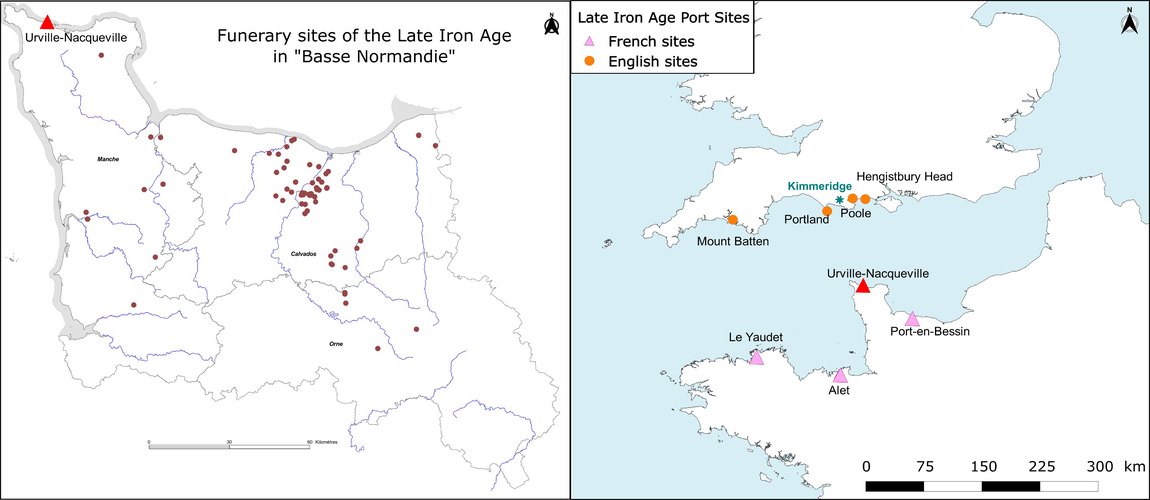
The clinching genetic evidence comes from Normandy. At Urville-Nacqueville, a Late Iron Age necropolis excavated on the Cotentin peninsula, the dead were laid out as crouched inhumations in a style that the excavators explicitly compared to the contemporary Durotrigian burials of Dorset. Fischer and colleagues (2018) read its maternal gene pool as that of a long-standing cross-Channel contact zone. When a well-covered Normandy Iron Age genome from that world (UN129) is placed on Global25, it falls within the British Iron Age orbit (0.0392 from the Durotrigian average, closest of all to the Dorset individual WBK20) and, modelled with our two sources, it carries almost exactly the same recipe as the Durotriges themselves: about 72 percent insular British and 28 percent continental. A Late Iron Age person from Normandy and a Late Iron Age person from Dorset were, genetically, the same kind of mixture. The men who married into the WBK matriline came out of precisely this shared Atlantic-Celtic sea.
8. The model in one picture
The Durotrigian model. A stable insular maternal core (the women of Dorset, carrying a single U5b1 lineage for some three centuries) takes in continental men from across the Channel. The incoming husbands shift the community toward the continent, leaving the tribe as a whole about 77 percent insular and 23 percent continental Iron Age, while the maternal line stays purely local.
9. The deep model: steppe diluted, farmer raised
Decomposed into deep sources (steppe Yamnaya, Anatolian Neolithic farmer, and western hunter gatherer, the three ingredients of every north-west European population since the Bronze Age), the Durotriges read as a classic Beaker-derived British population, but one tilted away from its Early Bronze Age ancestors in a very particular direction.
Deep model: the Durotriges against the Early Bronze Age Beaker baseline
10. The limits of the method
The usual caveats apply. NNLS reports proportions on the sources it is offered and cannot by itself date an inflow or cleanly separate two closely related continental sources; the continental percentage moves between about 23 and 29 percent depending on whether a Channel-facing Picardy source or a north-eastern La Tene source is used. Profile averages smooth over the very heterogeneity that section 6 makes central, and individual-level estimates are noisy, so the exact ancestry of any one person should be treated as approximate. The single Normandy genome (UN129) is illustrative of the cross-Channel contact zone rather than a definitive proof of it. And matrilocality, although strongly supported here by the dominant maternal lineage, the high Y diversity, the outbreeding signal and explicit simulation in the original paper, is an inference about social custom from genetic pattern, not a directly observed practice. None of this disturbs the core findings, which are mutually reinforcing across the social (uniparental), proximal and deep analyses, and consistent with the haplotype-sharing and SOURCEFIND results of Cassidy and Bradley.
11. The Durotrigian Global25 coordinate
For readers who wish to reproduce the analysis in Vahaduo or any Global25 tool, the scaled average coordinate of the Durotrigian population (52 imputed genomes used throughout this article) is given below.
12. Myth versus reality
Myth
- Iron Age British tribes were closed, isolated populations, and the Channel was a barrier separating Britain from the continent.
- Like every other European prehistoric society, the Durotriges must have been patrilocal and patrilineal, with women marrying out.
- The grave goods that placed Durotrigian women at the centre of their burials were a misreading; high female status is a romantic projection.
- If the Durotriges were continental in part, the immigrants must have been a general influx of men and women alike.
Reality
- The Channel was a corridor. The Durotriges carry roughly a quarter continental Iron Age ancestry that the Bronze Age baseline lacks, and their closest living relatives are the Bretons of Armorica.
- WBK is the first clearly matrilocal community known from European prehistory: one local maternal lineage dominates a cemetery for about three centuries, while the men are diverse incomers.
- The genetics vindicate the archaeology. A stable female core (local mtDNA) and male-biased in-migration fit exactly the female-centred burials and the Roman reports of empowered Celtic women.
- The influx was male biased. The founding matriarch is fully insular; the strongly continental individuals are unrelated males, including WBK02, a near first-generation Gaul who founds the one paternal line.
13. Conclusion
The Durotriges turn out to be something richer than a population on a map: a society whose very structure is legible in its DNA. In one Dorset cemetery, the dead record a rule of life: that women stayed and men came to them. A single maternal lineage held its ground at Winterborne Kingston for the better part of three hundred years, while generation after generation of husbands arrived from elsewhere, many of them from across the sea. The autosomes carry the same story in another key, a stable insular core shifted toward the continent by male newcomers, leaving the tribe about three quarters insular and a quarter continental, the steppe of their Beaker ancestors diluted by the farmer-rich blood of Iron Age Gaul.
And the sea that we imagine as a frontier turns out to be the opposite. A Late Iron Age person from Normandy looks like a Late Iron Age person from Dorset; the crouched dead of Urville-Nacqueville lie in the posture of the crouched dead of Dorset; the closest living kin of the Durotriges are the Bretons of the far Armorican shore. The English Channel in the Iron Age was a road, and along it moved pots, coins, wine and men, the men who married into the matrilines of southern Britain and fathered its next generation. The Durotriges were neither a pure insular relic nor a continental colony. They were a living junction of the two, a Celtic people of the Atlantic sea-road, whose women anchored a place while their world stayed open to everything that crossed the water.
References
- Cassidy, L. M., Russell, M., Smith, M., Delbarre, G., Cheetham, P., Manley, H., Mattiangeli, V., Breslin, E. M., Jackson, I., McCann, M., Little, H., O'Connor, C. G., Heaslip, B., Lawson, D., Endicott, P., Bradley, D. G. (2025). Continental influx and pervasive matrilocality in Iron Age Britain. Nature, 637(8048), 1136 to 1142. DOI: 10.1038/s41586-024-08409-6 Durotriges aDNA
- Fischer, C.-E., Lefort, A., Pemonge, M.-H., Couture-Veschambre, C., Rottier, S., Deguilloux, M.-F. (2018). The multiple maternal legacy of the Late Iron Age group of Urville-Nacqueville (France, Normandy) documents a long-standing genetic contact zone in northwestern France. PLOS ONE, 13(12), e0207459. DOI: 10.1371/journal.pone.0207459 Normandy IA
- Patterson, N., Isakov, M., Booth, T., et al. (2022). Large-scale migration into Britain during the Middle to Late Bronze Age. Nature, 601(7894), 588 to 594. DOI: 10.1038/s41586-021-04287-4 Bronze Age Britain
- Cunliffe, B., de Jersey, P. (1997). Armorica and Britain: Cross-Channel Relationships in the Late First Millennium BC. Oxford University Committee for Archaeology. Cross-Channel
- Russell, M., Cheetham, P., Smith, M., et al. (2014). The Durotriges Project, phase one: an interim statement. Proceedings of the Dorset Natural History and Archaeological Society, 135, 217 to 221. Archaeology
- Moriopoulos (2025). Modern and Ancient Population Collection (Global25 profile averages used for the Durotrigian and reference coordinates). G25 dataset
- Davidski (Eurogenes). Global25 scaled coordinates, and the Vahaduo Global25 tools by Piotr Kapuscinski. NNLS modelling and distance calculations performed for this article in Python (scipy) on the scaled coordinates. G25 method