
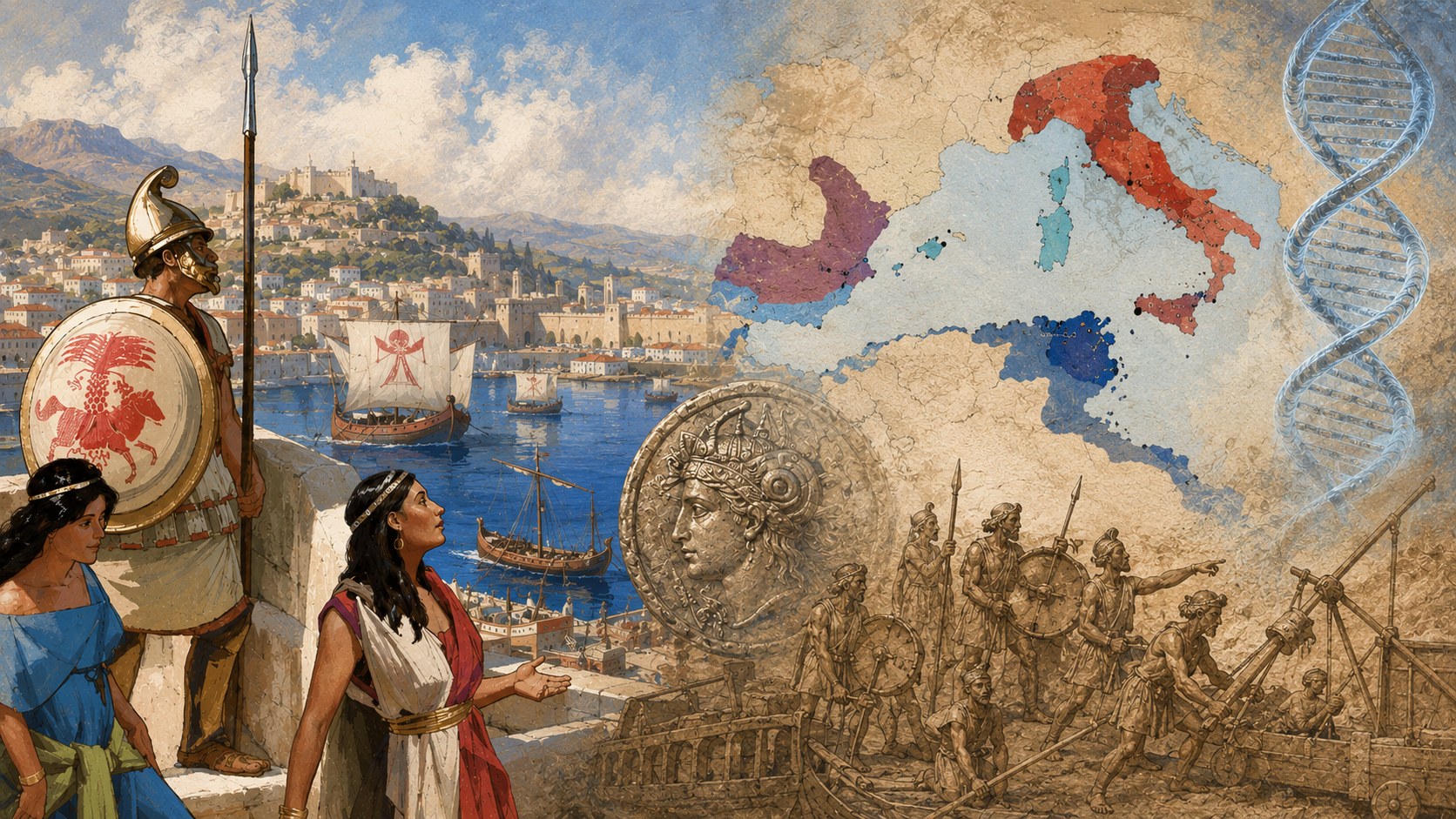
The Hittites carried an Indo-European language without the steppe genes that mark every other Indo-European people. The Beta Israel practise Judaism without the Levantine genes that mark every other Jewish people. The Philistines arrived from the Aegean, the DNA caught them, and then the Levant absorbed them. The Carthaginians complete the pattern on the grandest possible scale, and they add a twist that none of the others had. Phoenician civilisation, the alphabet, the language, the gods of Tyre and Sidon, the cult of Tanit and Baal Hammon, spread from the Levantine homeland across the entire Mediterranean to Carthage, Sardinia, Sicily, Ibiza and Iberia. Everyone assumed the people travelled with the culture, that the Punic world was a colonial diaspora of Levantine Phoenicians. The new Ringbauer and Reich paper of 2025, the largest ancient DNA study of the Phoenician and Punic world ever assembled (210 genomes from 14 sites), found the opposite. The Punic people of the central and western Mediterranean carry almost no Levantine ancestry at all. When we take the Carthage-adjacent population of Kerkouane in Tunisia, place it on Global25, and offer it a Levantine Phoenician source explicitly, the homeland receives a weight of zero. What the genome is made of instead is the surprise: roughly three quarters Sicilian and Aegean ancestry, and one quarter North African, with the deep profile reading as Anatolian Neolithic plus steppe plus an endemic Maghrebi component, and barely a trace of the Levant. The Phoenician language and religion crossed the sea. The Phoenician people, in the main, did not. The Carthaginians were a Greek, Sicilian and North African population who became Phoenician by culture, not by blood.
Key Points
- The Phoenicians were the great maritime traders of the first millennium BCE, originating in the Levantine city states of Tyre, Sidon, Byblos and Arwad (modern Lebanon and the Syrian coast). They invented the alphabet from which most modern scripts descend, and planted a vast network of colonies and trading posts across the Mediterranean. Carthage, founded near modern Tunis around 814 BCE, became the dominant western power. The Romans called the Carthaginians and their allied communities Punici (Punic), from the same root as Phoenician.
- The central historical question was simple. Was the Punic world a true colonial diaspora, a movement of Levantine Phoenician people who carried their genes west alongside their culture? Or did the culture spread faster and lighter than the people, adopted by local Mediterranean populations who never descended from Tyre? Until 2025 there was no genome scale answer.
- Ringbauer, Salman-Minkov, Olalde, Lazaridis, Gronau and Reich et al. (Nature, 2025) generated genome wide data for 210 individuals, including 196 from 14 Phoenician and Punic sites spanning the Levant, North Africa, Iberia, Sicily, Sardinia and Ibiza, dated mostly to the sixth through second centuries BCE. Their headline result: Levantine Phoenicians made little to no detectable genetic contribution to the Punic settlements of the central and western Mediterranean.
- The decisive Global25 test on the Carthage adjacent Kerkouane Punic population: modelled as Sicilian and Aegean plus North African plus a Levantine Phoenician source offered explicitly, the result is 74.0 percent Sicilian and Aegean, 26.0 percent North African, and 0.0 percent Levantine Phoenician (fit 0.0488). Offer Iron Age Israel instead of Lebanon and it likewise takes 0.0 percent. The homeland source is refused outright.
- The Punic profile is autosomally a western Mediterranean farmer derived population. The deep model returns about 63.6 percent Anatolian Neolithic, 16.0 percent steppe (Yamnaya related), 13.2 percent endemic North African (Taforalt or Iberomaurusian related), 4.5 percent Mesolithic European (WHG), and only 1.7 percent Natufian, the deep Levantine layer. A genuine Levantine Phoenician would be Natufian heavy. The Punic genome is not.
- The nearest ancient neighbours of the Kerkouane Punic population are other Punic profile samples (Sardinian and Italian), the earlier Tunisia Punic genome (0.0440), Bronze Age Sicily (0.0689), Mycenaean Pylos (0.0696) and a Numidian and Roman era Berber from Algeria (0.0703). The Levantine Phoenician homeland samples are far away: Lebanon Phoenician sits at 0.106 to 0.121, and Iron Age Israel at 0.1285, the most distant of all the candidate sources.
- The nearest living populations are western Mediterranean, not Levantine: Moroccan Moriscos (0.0428), Belmonte and Sephardic Jews (0.0451), Canary Islanders (about 0.051), Maltese (0.0584) and Moroccan Jews (about 0.058). Modern Lebanese Christians sit roughly twice as far away (0.1064). The closest people on Earth to the Carthaginians today are western Mediterranean populations such as Moroccan Moriscos, Sephardic Jews, Canary Islanders and the Maltese.
- Within a single site the spread is enormous, exactly as the paper emphasises. At Kerkouane the main Punic cluster (about 74 percent Sicilian and Aegean, 26 percent North African, 0 percent Levantine) sits alongside an East Mediterranean and mixed cluster that does carry about 13 percent Levantine, and a near pure North African individual, with the two extremes 0.18 to 0.22 apart on Global25. People of vastly different ancestry lived and were buried side by side.
- The method has working brakes. Offered the same three sources, a real Levantine Phoenician homeland sample (Iron Age Lebanon) takes 97.3 percent Levantine, and a modern Lebanese Christian takes about 88 percent. Global25 finds Levantine ancestry instantly where it genuinely exists, in the homeland, and finds essentially none of it in the colonies. The zero in the Punic west is a real absence, not a blind spot.
- The North African contribution is itself a clue to chronology. The paper argues it appears later, with the rise of Carthage as the Punic capital, while the Sicilian and Aegean ancestry is the older substrate. This matches the picture of mixing that began in Sicily and North Africa, where Greek, Sicilian and Phoenician communities were in close contact, and then radiated to Sardinia, Ibiza and Iberia.
- An honest nuance, the same one that applies to the Hittites and the Beta Israel. The data cannot exclude a small founding nucleus of Levantine Phoenician traders whose distinctive ancestry was diluted to invisibility (the co-author Ilan Gronau calls it ancestry that was effectively flushed out). What the data does exclude is any mass Levantine peopling of the west. The Punic Mediterranean was built overwhelmingly by local Mediterranean people adopting a Levantine culture, not by Levantines replacing the locals.
1. Who were the Phoenicians, and who were the Punic people?
In the early first millennium BCE the city states of the Levantine coast, above all Tyre and Sidon in what is now Lebanon, became the most accomplished sailors and traders of the ancient world. They gave humanity its first true alphabet, the ancestor of Greek, Latin, Hebrew, Arabic and almost every modern script. They traded tin, silver, purple dye and worked metal from one end of the Mediterranean to the other, and along the way they planted colonies and trading posts: Kition on Cyprus, Motya in western Sicily, Nora and Tharros on Sardinia, the island of Ibiza, Gadir (Cadiz) on the Atlantic coast of Iberia, and, most famous of all, Carthage on the Tunisian shore, founded by tradition in 814 BCE.
When Carthage grew into a great power and contested the western Mediterranean with Rome in the three Punic Wars, the Romans gave the name Punici (Punic) to the Carthaginians and the constellation of communities tied to them. Punic and Phoenician are the same word: the Punic people were, in the Roman and modern understanding, the western branch of the Phoenician world, sharing its language, its alphabet, its gods (Tanit, Baal Hammon, Melqart) and its commercial civilisation. Hannibal, who crossed the Alps with his elephants, was a Carthaginian, a Punic general of the Phoenician tradition.
It was always assumed that this shared culture rested on shared descent: that the Punic west was peopled by emigrants from Tyre and Sidon, a Levantine colonial diaspora. The alternative, that the culture had spread by trade and assimilation among populations who were not themselves Levantine, was harder to test, because the archaeology of pots, temples and inscriptions cannot by itself distinguish a migrant from a convert to a way of life. Ancient DNA can.
Tyre, Sidon, Byblos and Arwad. The Phoenician city states of the Levantine coast, autosomally a Bronze Age Canaanite and Levantine population, Natufian rich and Anatolian and Iranian farmer derived. This is the genetic baseline of a true Phoenician.
Trading posts and settlements founded across the central and western Mediterranean: Sicily, Sardinia, Ibiza, Iberia and the founding of Carthage. The window in which a Levantine population, if it migrated en masse, would have arrived.
Carthage dominates the west. The sampled Punic cemeteries (Kerkouane, Sardinian and Iberian sites) date here. Culturally and linguistically Phoenician, governed from or allied to Carthage. The population whose ancestry the new paper finally reads.
If the Punic people are Levantine colonists, they should carry a strong homeland (Lebanon, Levant Iron Age) signal. If they are locals who adopted the culture, that signal should be small or absent. The two hypotheses make opposite, testable predictions.
2. The Ringbauer and Reich 2025 study
The study, published in Nature in April 2025 and led by Harald Ringbauer with David Reich and Ilan Gronau among the senior authors, is the most ambitious genetic survey of the Phoenician and Punic Mediterranean attempted to date. The team generated genome-wide data for 210 individuals, 196 of them from 14 archaeological sites traditionally identified as Phoenician or Punic, reaching from the Levantine homeland through North Africa, Iberia and the islands of Sicily, Sardinia and Ibiza, plus an early Iron Age individual from Algeria. The bulk of the Punic samples fall between the sixth and second centuries BCE, the height of the Carthaginian world.
The team's central, and to them surprising, finding was that the Levantine Phoenicians made little direct genetic contribution to the Punic populations of the central and western Mediterranean, despite the overwhelming archaeological, linguistic and religious evidence that those populations were Phoenician in culture. Instead the Punic people were extraordinarily heterogeneous, dominated by ancestry resembling that of contemporary Sicily and the Aegean, with a substantial and apparently later North African component. As Reich put it, the Punic world showed an extraordinary genetic diversity; as Ringbauer summarised it, Phoenician culture spread not through mass migration but through a dynamic process of cultural transmission and assimilation. One of the most striking individual findings was a pair of close relatives, second cousins, one buried at a North African Punic site and one in Sicily, a direct snapshot of the cross Mediterranean web of kinship that bound the Punic world together.
Below we reproduce and extend the autosomal core of that result on Davidski's Global25 (scaled coordinates), using NNLS modelling in Python, taking the Carthage adjacent Punic population of Kerkouane in Tunisia as our worked example. The published profile averages we use are drawn from the Moriopoulos 2025 collection, which assigns the Ringbauer individuals to genetic profile clusters at each site. The picture comes out, if anything, even sharper than in the original paper.
3. Kerkouane on Global25: a western Mediterranean population
Kerkouane is a Punic town on Cape Bon in Tunisia, a short distance from Carthage itself, abandoned after the First Punic War and never rebuilt, which makes its cemetery one of the purest windows onto the Carthaginian population. When the main Kerkouane Punic cluster (seven individuals) is ranked by Euclidean distance against the Global25 panel, it lands squarely in the western and central Mediterranean, and the Levantine homeland is nowhere near.
| Reference (ancient) | G25 distance to Kerkouane Punic | Nature of the reference |
|---|---|---|
| Tunisia_Punic (earlier genome) | 0.0440 | Another western Punic population, near identical |
| Italy Sicily LBA | 0.0689 | Bronze Age Sicily, a Sicilian and Aegean pole |
| Greece Mycenaean (Pylos) | 0.0696 | Bronze Age Aegean, the Aegean pole |
| Algeria Numidian and Roman Berber | 0.0703 | Maghrebi, the North African pole |
| Lebanon Phoenician (Chhim) | 0.1063 | The Levantine Phoenician homeland |
| Lebanon Iron Age 2 | 0.1205 | The Levantine Phoenician homeland |
| Israel Iron Age | 0.1285 | The Iron Age Levant, the farthest of all |
The shape of the table is the whole argument. The two genuine source poles, Sicilian and Aegean (about 0.069) and North African (0.070), sit close. The Levantine homeland, the place from which the Phoenician culture demonstrably came, is almost twice as far (0.106 to 0.129). A Carthaginian is closer to a Bronze Age Sicilian or a Numidian Berber than to a Phoenician of Tyre. The same holds among living people: the nearest modern populations are Moroccan Moriscos (0.0428), Belmonte and Sephardic Jews (0.0451), Canary Islanders, Maltese (0.0584) and Moroccan Jews, all western Mediterranean, while modern Lebanese Christians sit roughly twice as far (0.1064). The closest living relatives of the Carthaginians are western Mediterranean peoples such as Moroccan Moriscos, Sephardic Jews, Canary Islanders and the Maltese, not the Lebanese.
4. The decisive test: offer the homeland, and watch it get refused
A distance is suggestive; the rigorous test, exactly as in our Hittite, Beta Israel and Philistine analyses, is to offer the suspected source explicitly to the mixture algorithm and read off the weight. Here we model the Kerkouane Punic population as a three way mixture of a Sicilian and Aegean source, a North African source, and a Levantine Phoenician source, and let NNLS decide how much of each is needed. If the Punic people were a Levantine diaspora, the homeland source would dominate. It receives nothing.
Kerkouane Punic modelled as Sicilian and Aegean plus North African plus Levantine Phoenician
5. The method has brakes: where Levantine ancestry truly exists, it is found at once
A sceptic might worry that Global25 simply cannot see Levantine ancestry, that the zero is an artefact. The control disposes of that worry completely. Offer the same three sources (Sicilian and Aegean, North African, Levantine Phoenician) to populations that genuinely are Levantine, and the homeland source is seized instantly.
The same three sources offered to genuine Levantine populations
6. What the Carthaginians were made of: the proximal model
If not from the Levant, then from where? The cleanest two way model of the Kerkouane Punic population is a Sicilian and Aegean majority with a North African minority, and it fits well.
Kerkouane Punic: the best fitting source model
7. The deep model: a western Mediterranean farmer genome, not a Levantine one
Decomposed into deep sources (Anatolian Neolithic, steppe Yamnaya, Mesolithic European WHG, Iranian Neolithic, Natufian, and Taforalt as the endemic Maghrebi anchor), the Kerkouane Punic population reads as a textbook western Mediterranean population of the Iron Age, with a North African minority and almost no deep Levantine layer.
Distal model of the Kerkouane Punic population
8. One site, many ancestries: the extraordinary heterogeneity
The single most arresting feature of the Punic data, and the one the paper stresses most, is the diversity within a single cemetery. The Punic world was a melting pot in the most literal genetic sense: at one site, people of utterly different ancestry lived, died and were buried together. Kerkouane illustrates this perfectly. Its individuals fall into at least three distinct genetic profiles.
Three genetic profiles at one site (Kerkouane), each as Sicilian and Aegean plus North African plus Levantine
9. The surprise mapped: where the Carthaginians actually came from
The Phoenician homeland in the Levant supplied the language, the alphabet and the religion of the Punic world, but contributed essentially none of its genes. The Carthaginians of Kerkouane drew about three quarters of their ancestry from a Sicilian and Aegean source and about one quarter from North Africa, with zero detectable Levantine Phoenician ancestry. Culture without the founders.
10. How a culture spreads without its people
How can a language, an alphabet, a religion and a commercial civilisation cross the entire Mediterranean while the people who originated them stay home? The paper's authors sketch a coherent answer, and it is worth stating plainly. The Phoenician homeland was small, a handful of city states whose population was never large enough to people half a sea. What travelled was a network: traders, craftsmen, priests and administrators, in numbers far too few to leave a population scale genetic mark, who carried the prestige culture to existing communities around the Mediterranean. Local Sicilians, Aegeans and, increasingly, North Africans adopted the Phoenician language, gods and trade, intermarried among themselves far more than with the distant homeland, and over generations became the Punic people: Phoenician in culture, western Mediterranean in descent.
The co-author Ilan Gronau adds a second mechanism. The Punic colonies may have been so successful that they pulled in local migration, while the homeland city states, conquered and absorbed by Assyria, Babylon, Persia and finally Alexander, sent fewer and fewer people west and may have had whatever early Levantine ancestry they did contribute progressively flushed out, diluted below the threshold of detection. The North African component, which the paper places later, fits this story: as Carthage rose to dominate the Punic world, the genetic centre of gravity shifted toward the Maghreb that surrounded it. The result is a civilisation whose cultural and genetic histories simply diverged.
11. The limits of the method
The usual caveats apply, and they apply here with particular force given how counterintuitive the result is. NNLS reports proportions on the sources it is offered and cannot by itself date an inflow or cleanly separate two closely related sources; this is why the Sicilian and the Aegean poles blur into a single Sicilian and Aegean ancestry rather than resolving into Sicily versus Greece. Profile averages smooth over real individual variation, which is why the heterogeneity section matters: the single average conceals a community that ranged from pure Maghrebi to East Mediterranean. And a near zero Levantine weight means undetectable at the resolution of Global25, not metaphysically absent, which is precisely the diluted founder caveat above. None of this softens the central finding, which is robust across the proximal and distal models, across alternative Levantine sources, and against the strong control showing that the method finds Levantine ancestry at full strength wherever it genuinely exists.
12. The Kerkouane Punic Global25 coordinate
For readers who wish to reproduce the analysis in Vahaduo or any Global25 tool, the scaled average coordinate of the Kerkouane Punic population (the Carthage adjacent cluster used throughout this article) is given below.
13. Myth versus reality
Myth
- The Carthaginians were Levantine Phoenicians, colonists from Tyre and Sidon who settled the western Mediterranean.
- Because the Punic world shared the Phoenician language, alphabet and religion, it must have shared Phoenician descent.
- The Carthaginians were a Near Eastern people transplanted to North Africa.
- If the Carthaginians were not Levantine, their closest living relatives should be other Near Eastern populations.
Reality
- The Punic people carry essentially no Levantine ancestry. Offered the homeland source, the Kerkouane Punic population takes 0.0 percent. The culture came from the Levant; the people, in the main, did not.
- Culture and ancestry diverged. The Punic genome is about 74 percent Sicilian and Aegean and 26 percent North African, with the deep profile dominated by Anatolian Neolithic and steppe and only about 1.7 percent Natufian.
- They were a western Mediterranean population, Sicilian, Aegean and Maghrebi, who adopted a Levantine culture. One Mediterranean site held people 0.18 to 0.22 apart on Global25.
- Their closest living relatives are western Mediterranean: Maltese (0.0584), Canary Islanders, Moroccan Moriscos and Sephardic Jews. Modern Lebanese sit roughly twice as far away.
14. Conclusion
The Phoenicians have always been the great paradox of the ancient Mediterranean: a people known almost entirely through their culture, the alphabet they gave the world, the colonies they planted, the wars Carthage fought with Rome, while the people themselves remained shadowy. The Ringbauer and Reich study resolves the paradox by deepening it. The Phoenician culture was real and it travelled the length of the sea, but the people who carried it west were not, in the main, Phoenicians at all. The Carthaginians of Kerkouane were a Sicilian, Aegean and North African population, a western Mediterranean people who took up the language of Tyre, the gods of Sidon and the trade of the whole Phoenician network, and made them their own. Where we expected the genome to point east to the Levant, it points instead to Sicily, to the Aegean, and to the Maghreb that surrounded Carthage.
This completes the lesson the series has been building. The Hittites carried a language without the genes. The Beta Israel carry a religion without the genes. The Philistines brought genes that arrived, peaked and washed away. The Carthaginians are the most spectacular case of all: an entire civilisation, the most influential commercial and literate culture of the early Mediterranean, that spread without its founders, embraced by peoples who owed it nothing by blood and everything by adoption. The history of the Phoenician culture and the history of Phoenician ancestry are two different histories. At Carthage, more than anywhere, they ran apart. The Carthaginians spoke Phoenician, worshipped Phoenician gods, and wrote in the Phoenician alphabet. The genes say they were the children of Sicily, the Aegean and Africa, who chose to become Phoenician, and in choosing, built one of the great civilisations of the ancient world.
References
- Ringbauer, H., Salman-Minkov, A., Regev, D., Olalde, I., Peled, T., ... Lazaridis, I., Gronau, I., Reich, D. (2025). Punic people were genetically diverse with almost no Levantine ancestors. Nature, 643(8070), 139 to 147. DOI: 10.1038/s41586-025-08913-3 Punic aDNA
- Haber, M., Doumet-Serhal, C., Scheib, C., et al. (2017). Continuity and admixture in the last five millennia of Levantine history from ancient Canaanite and present-day Lebanese genome sequences. American Journal of Human Genetics, 101(2), 274 to 282. DOI: 10.1016/j.ajhg.2017.06.013 Phoenician homeland
- Zalloua, P., Platt, D. E., El Sibai, M., et al. (2008). Identifying genetic traces of historical expansions: Phoenician footprints in the Mediterranean. American Journal of Human Genetics, 83(5), 633 to 642. DOI: 10.1016/j.ajhg.2008.10.012 Phoenician Y-DNA
- Lazaridis, I., Mittnik, A., Patterson, N., et al. (2017). Genetic origins of the Minoans and Mycenaeans. Nature, 548(7666), 214 to 218. DOI: 10.1038/nature23310 Aegean BA
- Fernandes, D. M., Mittnik, A., Olalde, I., et al. (2020). The spread of steppe and Iranian-related ancestry in the islands of the western Mediterranean. Nature Ecology and Evolution, 4, 334 to 345. DOI: 10.1038/s41559-020-1102-0 Western Med islands
- van Dommelen, P. (1998). On Colonial Grounds: A Comparative Study of Colonialism and Rural Settlement in First Millennium BC West Central Sardinia. University of Leiden. Punic archaeology
- Moriopoulos (2025). Modern and Ancient Population Collection (Global25 profile averages used for the Punic and reference coordinates). G25 dataset
- Davidski (Eurogenes). Global25 scaled coordinates, and the Vahaduo Global25 tools by Piotr Kapuscinski. NNLS modelling and distance calculations performed for this article in Python (scipy) on the scaled coordinates. G25 method