



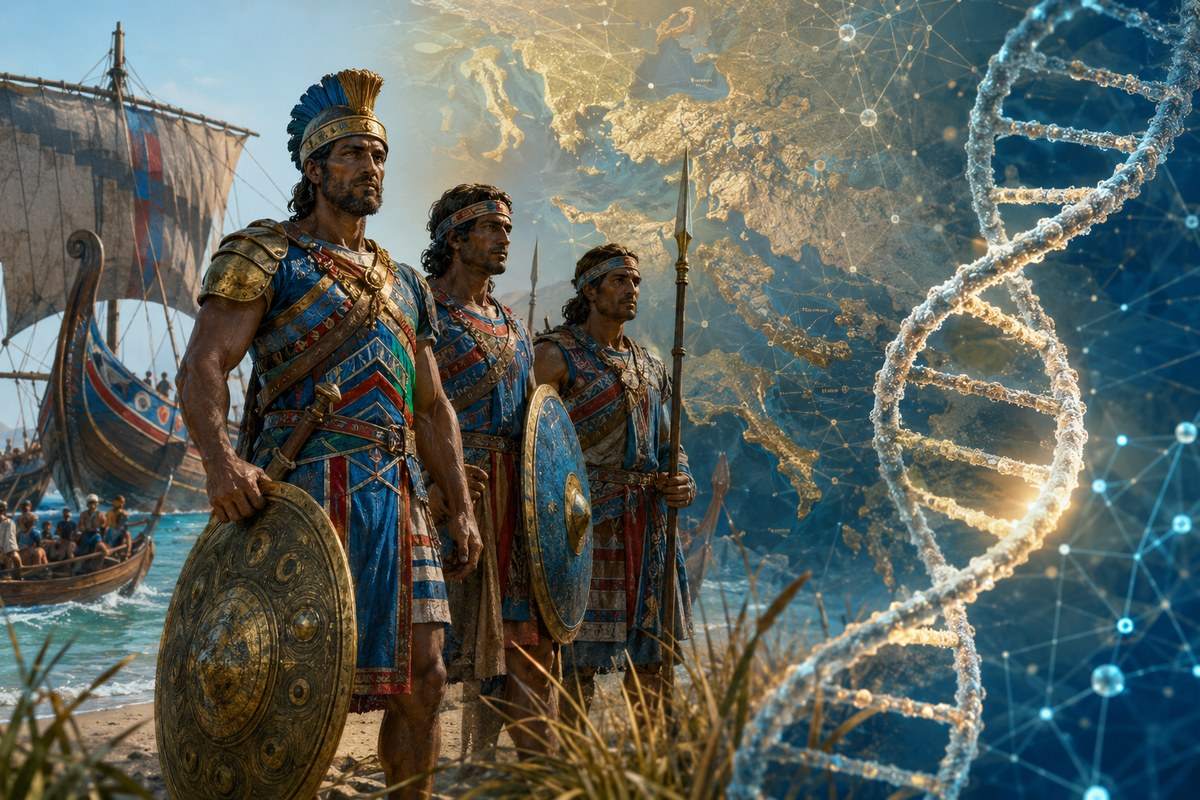
The Hittites and the Beta Israel are two negatives: a language and a religion that travelled without their expected genes. The Philistines are the positive that completes the set. Here, for once, a migration that the texts and the pots had always implied is caught red-handed in the DNA, in the act of arriving. At the port of Ashkelon, three successive populations were sequenced across the Bronze to Iron Age transition: the Late Bronze Age locals, the early Iron Age people who appear exactly when the archaeology says the Philistines arrived, and the later Iron Age population a few generations on. Modelled on Global25 as a mixture of the local Levantine population plus an Aegean source, the Late Bronze Age people take 0 percent European, the early Iron Age people take 39 percent, and the later Iron Age people fall back to 0 percent. The signal flares and dies within roughly a century and a half. One early Iron Age individual is essentially a first generation Aegean migrant (100 percent Mycenaean on Global25), her neighbours range smoothly down to fully local, and a male of the same cluster carries the Y haplogroup R1b-M269, a paternal lineage with no prior history in the Near East. This is the case that proves the method has working brakes in both directions: when there truly was a migration, Global25 sees it; and when that migration was demographically swamped, Global25 watches it vanish. The Sea Peoples reached Ashkelon. The genes prove it. And then the Levant absorbed them.
Key Points
- The Philistines were one of the so called Sea Peoples, the confederation of maritime groups recorded in Egyptian inscriptions (above all at Medinet Habu, the mortuary temple of Ramesses III) raiding the eastern Mediterranean around the collapse of the Bronze Age, near 1177 BCE. The Egyptian Peleset are universally identified with the biblical Philistines, who settled the southern coastal plain of Canaan in a pentapolis of five cities: Ashkelon, Ashdod, Ekron, Gath, and Gaza. Their early Iron Age material culture (Aegean style pottery, loom weights, hearths, pork consumption) marks a sharp break with the local Canaanite world.
- Two hypotheses competed for a century. The migration hypothesis held that a real movement of people from the Aegean or the wider southern European world brought the new culture. The cultural diffusion hypothesis held that only objects and fashions moved, adopted by locals, with no significant population change. Feldman et al. 2019 sequenced 10 individuals from Ashkelon spanning the transition and decided the question directly.
- The decisive Global25 test: modelled as the local Late Bronze Age Ashkelon population (ASH_LBA) plus an Aegean source (Bronze Age Mycenaean), the European weight is 0.0 percent in the Late Bronze Age, jumps to 39.0 percent in the early Iron Age (ASH_IA1), and returns to 0.0 percent in the later Iron Age (ASH_IA2). The foreign ancestry appears precisely with the archaeological Philistines and is gone within a few generations.
- The early Iron Age population is wildly heterogeneous, exactly as a migrant community mixing with locals should be. Modelled individually, the four early Iron Age profiles run from 18 percent Aegean (a near local) through 45 and 57 percent to 100 percent Aegean (essentially a first generation migrant). Two random early Iron Age individuals sit up to 0.1064 apart on Global25, a colossal internal scatter, while the Bronze Age and later Iron Age clusters are tight.
- The uniparental evidence agrees. The one early Iron Age individual who clusters fully with Mycenaeans is female (ASH068). A high European ancestry early Iron Age male (ASH067) carries Y haplogroup R1b-M269, a lineage that does not appear in the Near Eastern ancient record before the steppe derived expansions and which is at home in Bronze Age Europe. The other Ashkelon males carry local Levantine J (J-Z2331) and West Asian L (L-M20).
- On Global25 the Late Bronze Age people are pure Levantines (closest to Bronze Age Ashkelon itself, to Ebla, Alalakh, and modern Lebanese Christians). The early Iron Age people are pulled toward the Aegean and Anatolia (their nearest neighbours include Bronze Age Anatolia, Cypriots, and Iron Age Sicily). The later Iron Age people are Levantines again (closest to Israel_MLBA, Sidon Canaanites, and Megiddo).
- The source was southern European, and Global25 prefers the Aegean. A Mycenaean source fits ASH_IA1 at 39.0 percent (fit 0.0247) and a Cretan (Minoan) source at 36.3 percent (fit 0.0244), both better than an Iberian source (15.9 percent, fit 0.0359). This mirrors the qpAdm models of Feldman et al., where Crete worked at about 38 percent, Sardinia at about 49 percent, and Iberia at about 26 percent. The Aegean is the most economical answer; the exact homeland within southern Europe cannot be pinned down.
- The deep (distal) model tells the same story in another register. The early Iron Age spike shows up as a surge in Anatolian Neolithic ancestry (from 42 to 57 percent) and a collapse in the deep Levantine Natufian layer (from 26 to 14 percent), because the Aegean source is itself mostly Anatolian farmer derived. The later Iron Age reverts (Natufian back to 33 percent, Anatolian Neolithic back to 36 percent). The Mesolithic European (WHG) tag is only directly visible in the most Aegean shifted individual.
- An honest nuance on the WHG figure. The famous "14 percent Mesolithic European" of the original paper is a proxy number: WHG was used to tag European hunter gatherer related ancestry, not to claim the Philistines were one seventh Villabruna foragers. On Global25, the cleaner and more intuitive estimate is the proximal one, roughly 36 to 39 percent of total ancestry from an Aegean Bronze Age population, which itself carries only a few percent raw WHG.
- The same caveats that apply to every aDNA study apply here. Ten individuals is a small sample, the burials are not labelled by ethnicity, and NNLS cannot date an inflow or distinguish closely related sources. But the central result is robust across methods and uniparental lines: a real, datable, European related migration entered Ashkelon at the Bronze to Iron Age transition and was then diluted to genetic invisibility.
1. Who were the Sea Peoples, and who were the Philistines?
Around 1200 BCE the interconnected palace civilisations of the eastern Mediterranean came apart in a few decades. Mycenae and the Greek palaces fell, the Hittite empire collapsed, Ugarit burned, and Egypt itself was shaken to its foundations. Into this systemic crisis, Egyptian royal inscriptions record waves of attackers arriving by land and sea, a loose confederation that modern scholarship calls the Sea Peoples. The fullest account is carved on the walls of Medinet Habu, the mortuary temple of pharaoh Ramesses III, who claims to have defeated them in his eighth regnal year, around 1177 BCE. The reliefs name several groups: the Peleset, the Tjeker, the Shekelesh, the Denyen, and the Weshesh.
Of all these names, only one can be tied with confidence to a later, well documented people. The Peleset are the Philistines, the Pelishtim of the Hebrew Bible, who settled the southern coastal plain of Canaan and organised themselves in a pentapolis of five cities: Ashkelon, Ashdod, Ekron, Gath, and Gaza. To the Israelites they were the archetypal enemy, the people of Goliath and of Delilah, uncircumcised newcomers from across the sea. The Bible itself remembers them as immigrants, deriving them from Caphtor, a name long understood to mean Crete or the Aegean more broadly.
The archaeology of the early Iron Age coastal cities matches that memory of foreignness. At Ashkelon and its neighbours, the layers of the twelfth century BCE show an abrupt cultural rupture: locally made pottery in an Aegean Mycenaean style (the so called Philistine Monochrome and then Bichrome wares), unperforated cylindrical loom weights of an Aegean type, new hearths, a sharp rise in pork and dog consumption, and even non Semitic inscriptions. Something genuinely new had arrived. The only question was whether the new things came with new people.
A thoroughly Canaanite port in the Egyptian orbit, part of the Levantine world of Ugarit, Alalakh, and Megiddo. Its people (the ASH_LBA group) are genetically indistinguishable from the wider Bronze Age Levant. No European ancestry whatsoever.
The palace systems fall across the eastern Mediterranean. Egyptian texts record the Sea Peoples, including the Peleset. Aegean style material culture appears at Ashkelon, marking the foundation of Philistine Ashkelon.
The ASH_IA1 group, radiocarbon dated to roughly the late thirteenth to early twelfth century BCE. Genetically distinct, carrying a large and highly variable European related component. This is the genetic footprint of the migration.
The ASH_IA2 group, still culturally Philistine but genetically reabsorbed into the Levantine gene pool. The European signal is no longer detectable. Culture persisted; the foreign ancestry did not.
2. Two hypotheses: did the pots move, or the people?
Before ancient DNA, the Philistine question was a textbook case of the archaeologist's oldest dilemma. A new material culture appears in a region. Does it mean a new population has moved in, or merely that local people adopted new fashions, technologies, and tastes through trade and emulation? The same set of Aegean style pots could, in principle, be carried by migrants or simply bought and copied by Canaanites who never left home.
The maximalist reading of the texts and the Bible: a substantial body of Aegean or southern European people settled the coast, bringing their material culture with them. Predicts a detectable European genetic signal in early Iron Age Ashkelon, absent in the preceding Bronze Age.
The minimalist reading: trade, prestige goods, and stylistic emulation, with little or no population movement. Predicts genetic continuity across the transition, with the early Iron Age people looking just like their Bronze Age predecessors.
The two hypotheses make opposite, testable predictions about a single thing: the presence or absence of European ancestry in the early Iron Age population. A genetic time transect through one site, sampling before, during, and after, settles it. Ashkelon provided exactly that.
3. The Feldman 2019 time transect at Ashkelon
Feldman and colleagues recovered genome wide data from 10 individuals buried at Ashkelon, forming a rare three point genetic time series at a single site. The Late Bronze Age cohort (ASH_LBA) predates the Philistine arrival. The early Iron Age cohort (ASH_IA1) is contemporary with it, radiocarbon dated to roughly 1250 to 1130 BCE. The later Iron Age cohort (ASH_IA2) comes a few generations afterward, from a Philistine period cemetery of the tenth to ninth centuries BCE. All three, the authors found, derive most of their ancestry from the local Levantine gene pool. But the middle cohort was different: it carried a clear, statistically strong, and highly variable affinity to European derived populations that neither flanking cohort possessed.
Their original analysis used qpAdm with Iran_ChL, Levant_ChL, and WHG as sources, and found that the European hunter gatherer (WHG) tag was needed only in the early Iron Age group, where it reached about 14 percent. When real southern European populations were offered as candidate sources, Crete, Sardinia, and Iberia all produced acceptable fits. The signal then disappeared in the later Iron Age, which was statistically symmetric with the Bronze Age. We reproduce and extend this on Global25 below, using the scaled coordinates and NNLS, and find the same picture in sharper relief.
4. Ashkelon on Global25: three populations, three genetic worlds
When each Ashkelon cohort is ranked by Euclidean distance against the full Global25 panel, the three groups land in three different parts of the map, and the journey out and back is written directly into the nearest neighbour lists. The Bronze Age people are Levantines, the later Iron Age people are Levantines again, and the early Iron Age people are visibly dragged toward the Aegean and Anatolia in between.
| Cohort | Nearest neighbours on Global25 (with distance) | Genetic character |
|---|---|---|
| ASH_LBA (Late Bronze Age) | Bronze Age Ashkelon (0.0147), Lebanese Christians (0.0226), Syria Ebla EMBA (0.0247), Alalakh MLBA (0.0255), Samaritan (0.0241) | A pure Bronze Age Levantine, at home among north Levantine and modern Lebanese populations |
| ASH_IA1 (early Iron Age, Philistine) | Turkey_EBA (0.0302), Cypriot (0.0304), Iron Age Sicily (0.0312), Lebanese Christian (0.0319), Anatolia EBA Ovaoren (0.0338) | Pulled off the Levantine cluster toward Anatolia and the Aegean, sitting among east Mediterranean intermediates |
| ASH_IA1_o (early Iron Age outlier) | Mycenaean Greece (0.0396), Greek Early Iron Age Argolid (0.0424), Mycenaean Aegina (0.0444), Cycladic EBA (0.0448) | Essentially an Aegean individual: closest in the whole panel to Bronze Age Mycenaeans |
| ASH_IA2 (later Iron Age) | Iron Age Philistine Ashkelon (0.0209), Israel_MLBA (0.0222), LBA Megiddo (0.0223), Sidon Canaanite (0.0243) | Back to a pure Levantine, indistinguishable from the surrounding Bronze and Iron Age Levant |
The contrast between ASH_LBA and ASH_IA2, the two flanking Levantine cohorts, and the early Iron Age cohort in the middle is the whole story in one table. The Bronze Age population sits 0.0986 from Bronze Age Mycenaeans; the early Iron Age population closes to 0.0651, and its outlier individual to 0.0453; then the later Iron Age population swings back out to 0.1138, farther from the Aegean than the Bronze Age people had been. The genome travelled west and came home.
5. The decisive test: an Aegean source, offered period by period
A distance is suggestive; the rigorous test, exactly as in our Hittite and Beta Israel analyses, is to offer the suspected source explicitly to the mixture algorithm and read off the weight. Here we model each Ashkelon cohort as a two way mixture of the local Late Bronze Age Ashkelon population and a Bronze Age Aegean (Mycenaean) source, and let NNLS decide how much Aegean each period needs. The result is the cleanest possible demonstration of a transient migration.
Each Ashkelon cohort modelled as local Levantine (ASH_LBA) plus an Aegean source
6. A community caught mid mixture: the heterogeneity of the early Iron Age
The single most telling feature of the early Iron Age population is not its average but its spread. A long settled population is genetically homogeneous; its members cluster tightly. A migrant population in the first generations of contact with locals is the opposite: it contains near pure migrants, near pure locals, and every blend in between, because intermarriage has not yet had time to average everyone out. The early Iron Age Ashkelon cohort is textbook heterogeneous. Two of its individuals sit 0.1064 apart on Global25, a distance larger than that separating many entirely distinct populations, while the Bronze Age and later Iron Age cohorts form tight, ordinary clusters.
Modelled one profile at a time as local Levantine plus Aegean, the early Iron Age individuals form a smooth ramp from almost local to almost foreign, exactly what a snapshot of an admixing community should look like.
The four early Iron Age individual profiles, modelled as local Levantine plus Aegean
7. The wave that came and went
The Aegean component at Ashkelon over three sampled periods. It is absent in the Late Bronze Age, peaks at 39 percent in the early Iron Age cohort contemporary with the Philistine arrival, and is gone again by the later Iron Age. The migration was real and datable, but its genetic trace was diluted away while the Philistine culture endured.
8. The uniparental evidence: a Mycenaean woman and an R1b-M269 man
The autosomal verdict is confirmed on the uniparental lines, and in a way that puts faces to the statistics. Of the early Iron Age individuals, the one who clusters most completely with Bronze Age Mycenaeans on Global25 (our ASH_IA1 outlier, ASH068) is female, a near pure Aegean woman buried at Ashkelon. A high European ancestry early Iron Age male, ASH067, carries the Y chromosome haplogroup R1b-M269. This lineage is the dominant paternal marker of Bronze Age western and central Europe, and it does not appear in the Near Eastern ancient record before the steppe derived expansions that seeded it across Europe. Its presence at early Iron Age Ashkelon is precisely what an Aegean or wider European migration would deposit, and precisely what no purely local Levantine population would contain.
The other Ashkelon males carry the expected local lineages: J-Z2331, a thoroughly Levantine branch of haplogroup J, and L-M20, a West Asian lineage. So the paternal picture is itself a microcosm of the admixture: foreign R1b-M269 alongside local J and L, in the same small early Iron Age community. The mitochondrial lineages are broadly Mediterranean and do not contradict the autosomal reading. Both a foreign mother and a foreign father can be pointed to by name, which is about as direct as ancient DNA evidence for a migration ever gets.
9. Where in southern Europe? The Aegean is the best, but not the only, answer
Granting that the source was European, can Global25 say which part of Europe? Within the limits of the available reference populations, it points most economically to the Aegean. Offered as alternative sources for the early Iron Age cohort, a Mycenaean population fits best, a Cretan (Minoan) population almost as well, and an Iberian population noticeably worse, both in the weight it requires and in the quality of the fit.
Which southern European source fits the early Iron Age cohort best?
10. The deep model: the Aegean signal as a surge of Anatolian farmer ancestry
Decomposed into deep sources (Natufian, Anatolian Neolithic, Iranian Neolithic, Caucasian hunter gatherer, and Mesolithic European WHG), the three cohorts tell the same story in a different vocabulary. The early Iron Age spike does not appear mainly as raw WHG. It appears as a surge in Anatolian Neolithic ancestry and a collapse in the deep Levantine Natufian layer, because the Aegean source is itself overwhelmingly Anatolian farmer derived, with only a thin WHG seasoning. The later Iron Age then reverts almost exactly to the Bronze Age baseline.
Distal model through time: Natufian / Anatolia_N / Iran_N / CHG / WHG
11. What the Philistines teach us
The Philistines complete a triptych whose theme is the loose coupling between culture and ancestry. The Hittites carried an Indo-European language with none of the steppe ancestry that marks every other Indo-European people: culture without the genes. The Beta Israel practise a Jewish religion with none of the Levantine ancestry that marks every other Jewish people: culture without the genes. It would be easy to conclude from those two that genetics simply cannot track the movement of peoples, that ancestry and culture float free of one another. The Philistines are the necessary corrective. Here a migration really happened, and Global25 caught it instantly, quantified it at 39 percent, named the Aegean as its source, found a Mycenaean woman and an R1b-M269 man in the cemetery, and then watched the whole signal dissolve into the Levantine background within a few generations.
The lesson is therefore not that culture and genes are unrelated, but that their relationship is contingent and must be tested case by case. Sometimes a culture spreads with almost no people (the Hittites, the Beta Israel). Sometimes people arrive in force and leave a strong genetic mark that nonetheless fades while their culture endures (the Philistines). The genome of early Iron Age Ashkelon is the proof that the method has teeth: it does not invent migrations where there were none, as the Hittite and Beta Israel cases show, and it does not miss them where they occurred, as Ashkelon shows. The Philistines are remembered in the Bible as eternal foreigners, the uncircumcised men from across the sea. For a century and a half, the DNA agreed. Then the sea people became Levantines, and the only thing that stayed foreign was the name.
12. The early Iron Age Ashkelon Global25 coordinate
For readers who wish to reproduce the analysis in Vahaduo or any Global25 tool, the scaled average coordinate of the early Iron Age (Philistine) Ashkelon population used throughout this article is given below.
13. Myth versus reality
Myth
- The Philistine pottery and culture could just be fashions copied by locals, with no real migration of people.
- If the Philistines were a fleeting episode, their DNA should look the same before, during, and after.
- Since the later Iron Age Ashkelon people look fully Levantine, no European migration ever happened.
- The "European" ancestry in the Philistines means they were Mesolithic style hunter gatherers from northern Europe.
Reality
- The early Iron Age population carries 39 percent Aegean ancestry, absent before and after. A real movement of people, not just objects, brought the new culture.
- The genome changes sharply across the transition: 0 percent Aegean, then 39 percent, then 0 percent. The migration is datable to the Bronze to Iron Age boundary.
- The signal washed out by dilution, not because it was never there. One early Iron Age individual is 100 percent Aegean and a male carries European R1b-M269.
- The source was a Bronze Age Aegean population, itself about three quarters Anatolian farmer ancestry; the WHG figure is a proxy tag, not a literal forager fraction.
14. Conclusion
The Sea Peoples have always hovered between history and legend: a confederation half remembered in Egyptian propaganda, a biblical enemy, a convenient scapegoat for the collapse of the Bronze Age. The one group among them we can follow, the Philistines, turns out to be visible not only in pots and texts but in the genome itself. At Ashkelon, a Late Bronze Age Levantine population is replaced, in the early Iron Age, by one carrying roughly two fifths Aegean ancestry, with a near pure Mycenaean woman and a European R1b-M269 man among its dead, and a heterogeneity that betrays a community still in the act of mixing. A few generations later that ancestry is gone, reabsorbed into the Levant, even as the Philistine culture continues. This is the precise opposite of the Hittite and Beta Israel paradoxes, and that is exactly why it matters: it shows that when a migration really occurs, Global25 records it cleanly, and when that migration is demographically swamped, Global25 records its disappearance just as cleanly. The Philistines came from across the sea, as the Bible always said. The DNA caught them arriving, and then it caught the Levant quietly making them its own.
References
- Feldman, M., Master, D. M., Bianco, R. A., Burri, M., Stockhammer, P. W., Mittnik, A., Aja, A. J., Jeong, C., Krause, J. (2019). Ancient DNA sheds light on the genetic origins of early Iron Age Philistines. Science Advances, 5(7), eaax0061. DOI: 10.1126/sciadv.aax0061 Philistine aDNA
- Agranat-Tamir, L., Waldman, S., Martin, M. A. S., et al. (2020). The genomic history of the Bronze Age Southern Levant. Cell, 181(5), 1146 to 1157. DOI: 10.1016/j.cell.2020.04.024 Bronze Age Levant
- Haber, M., Doumet-Serhal, C., Scheib, C., et al. (2017). Continuity and admixture in the last five millennia of Levantine history from ancient Canaanite and present-day Lebanese genome sequences. American Journal of Human Genetics, 101(2), 274 to 282. DOI: 10.1016/j.ajhg.2017.06.013 Canaanite continuity
- Lazaridis, I., Mittnik, A., Patterson, N., et al. (2017). Genetic origins of the Minoans and Mycenaeans. Nature, 548(7666), 214 to 218. DOI: 10.1038/nature23310 Aegean BA
- Master, D. M., Aja, A. J. (2017). The Philistine cemetery of Ashkelon. Bulletin of the American Schools of Oriental Research, 377, 135 to 159. Archaeology
- Cline, E. H. (2014). 1177 B.C.: The Year Civilization Collapsed. Princeton University Press. Bronze Age collapse
- Moriopoulos (2025). Modern and Ancient Population Collection (Global25 averages used for reference coordinates). G25 dataset
- Davidski (Eurogenes). Global25 scaled coordinates and the Vahaduo Global25 tools. NNLS modelling and distance calculations performed for this article in Python (scipy) on the scaled coordinates. G25 method