
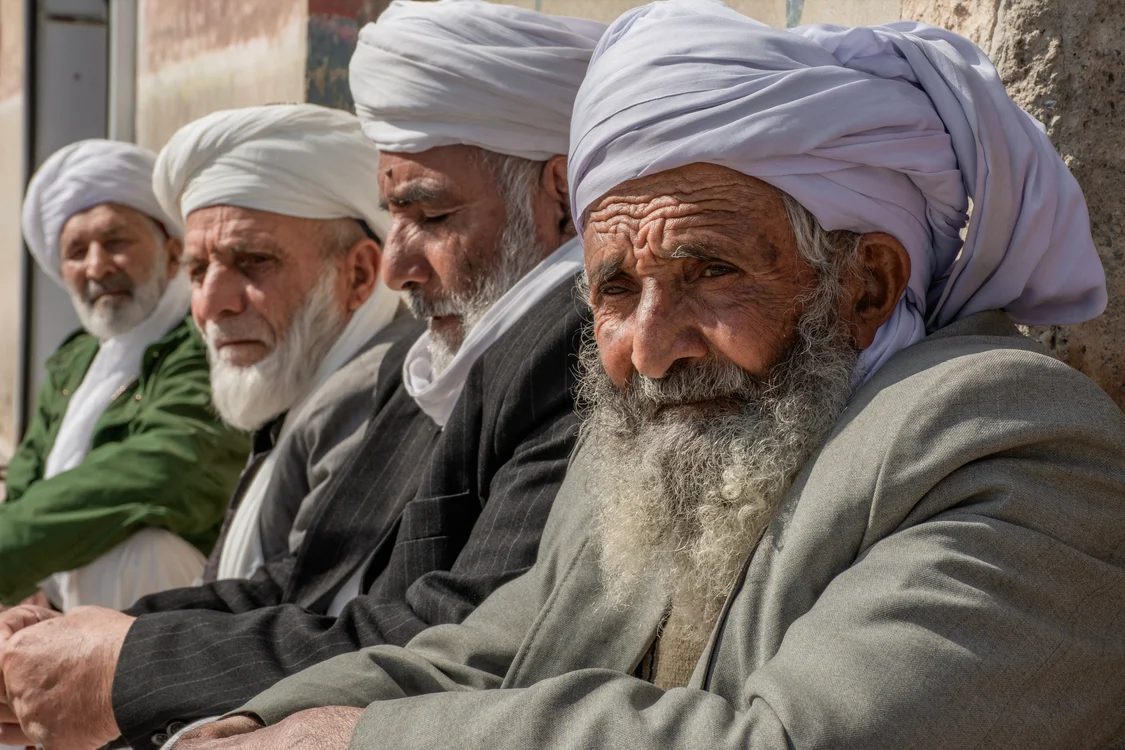
The Druze are among the most genetically distinctive populations of the modern Levant. As a religious community that formally closed to new conversions in 1043 CE and maintained a high degree of endogamy thereafter, they have preserved a genetic profile that remained relatively insulated from many of the demographic processes that affected neighbouring populations over the last millennium.
Today, approximately 1.25 million Druze live primarily in Syria, Lebanon, Israel, and Jordan, with smaller diaspora communities abroad. Genetic studies consistently place the Druze within the broader Levantine genetic landscape while also highlighting their distinctive affinity to populations of northern Syria, southeastern Anatolia, Upper Mesopotamia, and the wider northern Near East. Their genetic profile differs in important respects from those of neighbouring Levantine populations and reflects a history shaped by both Levantine and northern Near Eastern influences.
Across both modern and ancient datasets, Druze samples frequently show close relationships to populations associated with Late Antique and Medieval Syria and Lebanon, southeastern Anatolia, and Upper Mesopotamia. Several studies have suggested that the ancestors of the Druze emerged from a mixture of local Levantine populations and groups originating farther north in the Near East, before becoming increasingly endogamous after the establishment of the Druze faith.
Rather than serving as a direct proxy for all ancient Levantines, the Druze appear to preserve one particular historical strand of the region's diversity: a northern Levantine and Near Eastern profile situated at the intersection of the Levant, northern Mesopotamia, and southeastern Anatolia. Their long history of endogamy makes them especially valuable for studying aspects of the population structure that characterized parts of the Levant and Near East during Late Antiquity and the medieval period.
This continuity also makes the Druze a useful comparative population when examining the ancestry of other Levantine groups, as they provide a genetic snapshot in time and space. They should be understood as representing one branch of the region's historical diversity rather than the entirety of it. Like all modern populations, the Druze are the product of a complex historical process that preserved some ancestral components while transforming others over time.
Key Points
- The Druze religion closed to new conversions in 1043 CE and has practiced endogamy ever since, for nearly a thousand years. The community has elevated runs of homozygosity and a documented catalogue of founder mutations, the expected signature of a long-closed population.
- On Global25 the Druze fall within the northern Levantine range, shifted toward the Syro-Mesopotamian populations of the upper Euphrates and northern Mesopotamia relative to the Iron Age Levant.
- The ancient samples closest to the Druze are Roman to early medieval populations of the Syro-Mesopotamian interface (Nevali Cori, Midyat) together with the late antique population of Ej-Jaouze in Lebanon. The Iron Age Phoenician and Beirut samples sit somewhat further away.
- In a distal Global25 decomposition the Druze carry roughly 21 percent Natufian, a Caucasus hunter-gatherer fraction of about 13 to 14 percent, and a small East European hunter-gatherer trace of about 1.7 percent, a composition consistent with northern Levantine ancestry plus a Syro-Mesopotamian element.
- In proximal models that include an antithetic distance control (ADC, 1x) to limit overfitting, the Druze draw a large share of their ancestry from a Syro-Mesopotamian source and little or none from Iron Age southern Levantine sources, consistent with their position on the cline.
- The biogeographical analysis of Marshall, Das, Pirooznia and Elhaik (2016, Scientific Reports) placed the proto-Druze in the mountainous regions of southeastern Turkey, northern Iraq, and southeastern Syria. The Global25 placement described here is consistent with that northern Near Eastern origin.
- The Druze share part of their ancestry with the Mesopotamian Jewish communities, which also carry substantial ancient Mesopotamian ancestry. This shared northern component explains much of their genetic proximity to those communities.
- Druze_Israel and Druze_Lebanon sit about 0.0086 apart on Global25, the signature of marriage networks maintained across modern political borders for a thousand years.
1. Who are the Druze?
The Druze are a religious community of approximately 1.25 million people concentrated in the Levant, with roughly 700,000 in Syria (chiefly in the Jabal al-Druze of As-Suwayda and on Mount Hermon), 280,000 in Lebanon (the Chouf, Aley, the Wadi al-Taym, and the Matn), 150,000 in Israel (the Galilee, Mount Carmel, and the Golan Heights), 25,000 in Jordan, and a diaspora of about 100,000 in the Americas, Australia, and West Africa. They speak a Levantine dialect of Arabic indistinguishable from that of their neighbours and identify culturally with the broader Arab world, while maintaining a religious and social closure under which no member has been added through conversion in nearly a thousand years, and a member who marries an outsider, along with their descendants, leaves the community.
The religion they profess is called al-Tawhid (the Unity). The doctrine is unitarian, monotheistic, esoteric, and reserved: only a minority, the Uqqal (the initiated), have access to the full texts and rituals, while the Juhhal (the uninitiated majority) live by its moral precepts. The faith emerged from Ismaili Shia Islam and integrates Neoplatonic and other strands, including the transmigration of souls. The texts are the 111 Epistles of Wisdom (Rasa'il al-Hikma), compiled in the eleventh century. This continuous closure since 1043 CE is what shapes the Druze genetic profile.
2. The religious genesis and the 1043 closure
The Druze religion began in 1017 CE in Fatimid Cairo under the sixth Fatimid Caliph al-Hakim bi-Amr Allah. A small group of Ismaili theologians, including al-Darazi (from whom the name Druze likely derives, though he was later declared a heretic by the community), Hamza ibn Ali, and al-Muqtana Baha'eddin, developed a doctrine identifying al-Hakim as a manifestation of the divine Unity. After al-Hakim disappeared during a nocturnal walk in 1021, the movement was persecuted and went underground. Hamza ibn Ali and al-Muqtana Baha'eddin moved to the Wadi al-Taym in the southern Anti-Lebanon, where the Epistles of Wisdom were composed. In 1043 CE, al-Muqtana Baha'eddin issued the final epistle, closing the community to new conversions. The community has been self-sustaining through endogamy ever since.
The doctrine is preached publicly under al-Hakim. Converts are drawn from the educated classes of Egypt, Syria, and Lebanon, from a wide Near Eastern pool rather than from the southern Levant specifically.
Hamza ibn Ali and al-Muqtana Baha'eddin establish themselves in the Wadi al-Taym, in the foothills of Mount Hermon. The faith spreads through the Lebanese, southern Syrian, and northern Palestinian mountains, among communities of the northern Levant.
The community is closed to new conversions. The doctrine is transmitted only within established Druze families thereafter, one of the longest unbroken endogamy regimes documented in human history.
Through the Crusader, Mamluk, and Ottoman periods, and across the modern Syrian, Lebanese, Israeli, and Jordanian borders, the Druze maintain endogamy. Marriage networks span the range from Mount Lebanon to the Galilee to the Jabal al-Druze, which is why the modern subpopulations remain genetically close.
3. The Druze on Global25
When ancient samples are ranked by Euclidean distance from the Druze, the nearest are populations of the Syro-Mesopotamian interface and the Roman to early medieval Levant. For Druze_Lebanon the closest include the Parthian to Roman Mesopotamian population of Nevali Cori (0.0212), the Roman-era Nevali Cori of southeastern Anatolia (0.0232), the Mesopotamian profile of Midyat (0.0235), and the late antique population of Ej-Jaouze in Lebanon (0.0251). The pattern for Druze_Israel is similar.
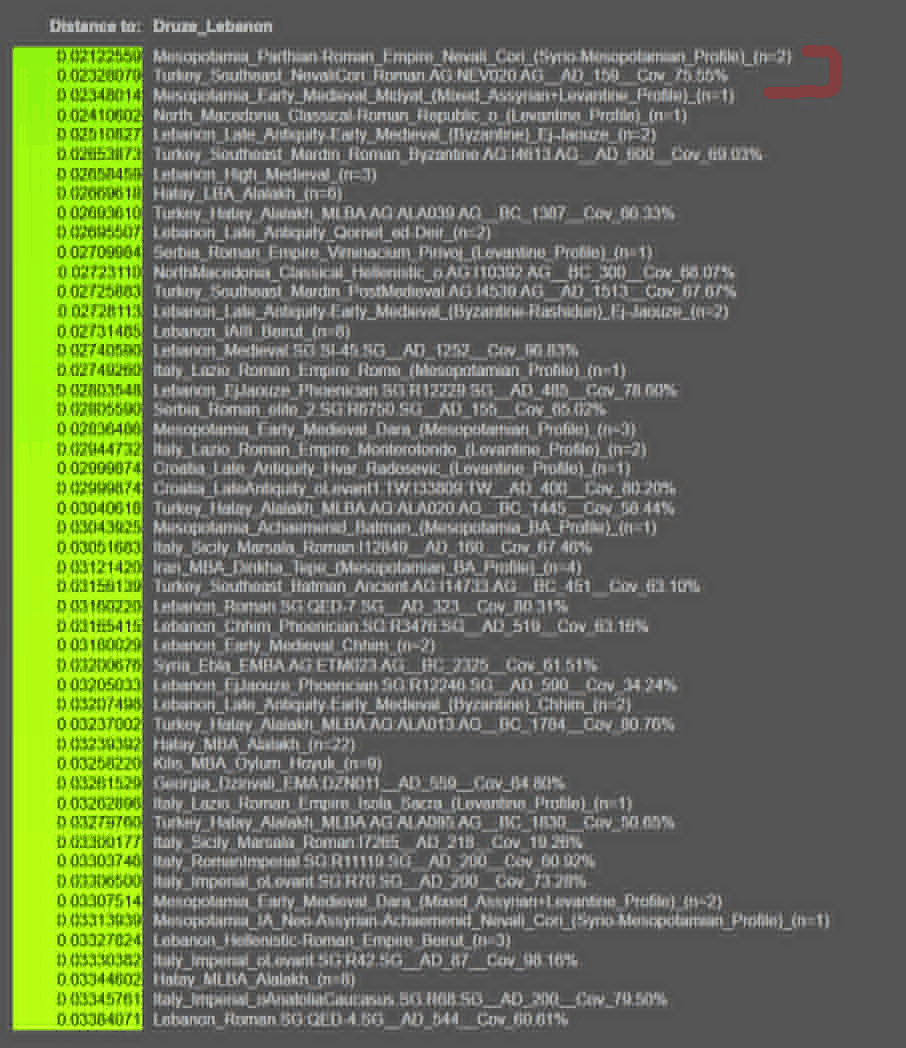
Ancient samples closest to Druze_Lebanon on Global25, led by Syro-Mesopotamian and Roman to early medieval populations.
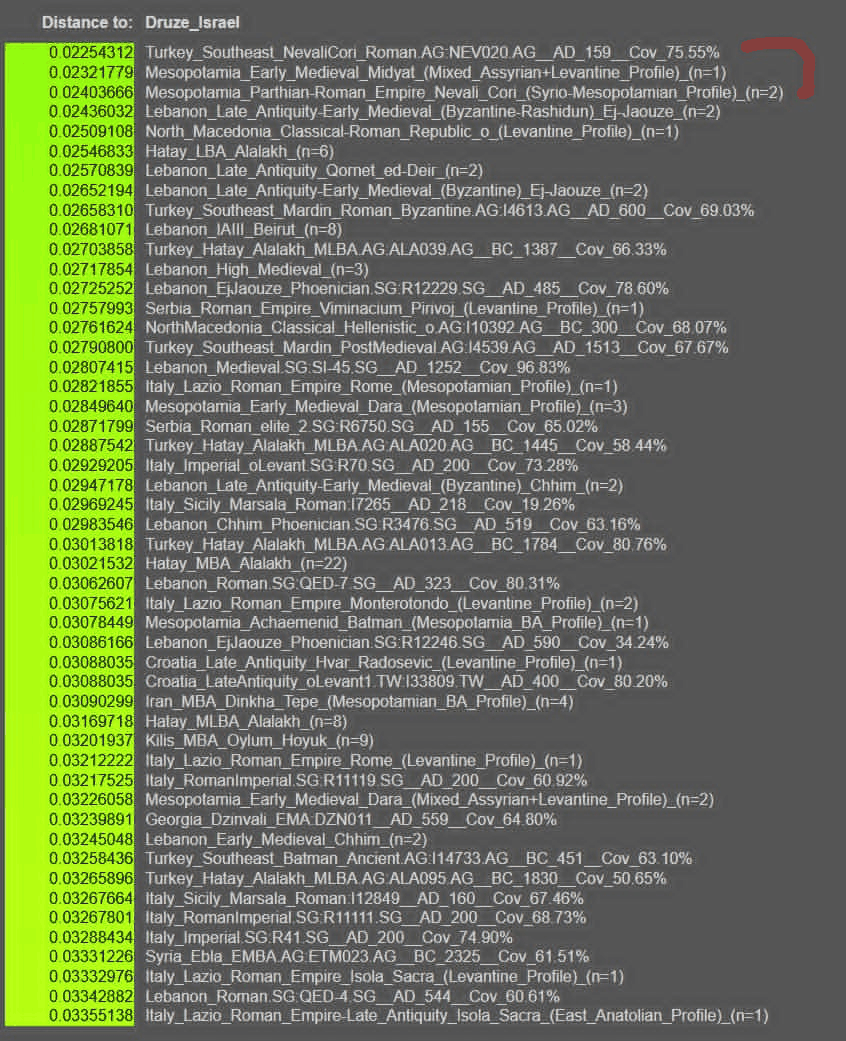
The same picture for Druze_Israel: the nearest ancient samples come from the Syro-Mesopotamian interface and the late antique Levant.
A note on sample naming is useful here. Two Global25 samples carry the word Phoenician in their names, Lebanon_EjJaouze_Phoenician.SG (R12229) and Lebanon_Chhim_Phoenician.SG (R3476), but are radiocarbon-dated to AD 485 and AD 519, that is the late antique period rather than the Iron Age. The Iron Age Phoenician and Levantine samples are Lebanon_IA2 (about 770 BCE), Lebanon_IA3 (about 435 BCE), and the Beirut Iron Age series. These distinctions matter when interpreting which period the Druze most resemble.
4. The position relative to the Iron Age Levant
Measured against the averaged Iron Age Levantine populations, the Druze sit at the outer edge of the surviving Levantine communities. They are closer to the Roman to early medieval northern Levant than to the Iron Age Levant of either the north or the south. This is consistent with a population that formed in the medieval period from the mountain communities of the northern Levant and the Syro-Mesopotamian interface, after the gene flow of the intervening millennium.
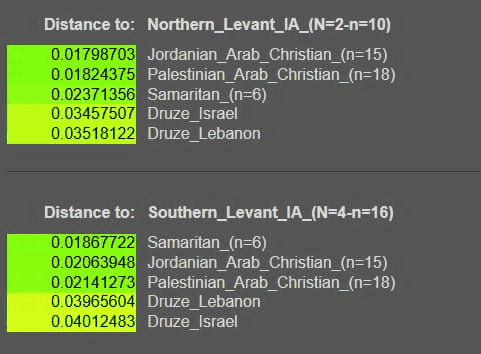
Distance from each modern community to the Northern and Southern Levant Iron Age averages. The Druze fall at the outer edge of the surviving Levantine communities on both measures.
5. The distal model
Decomposed into the standard Global25 calculator components, the Druze profile is northern Levantine with a Syro-Mesopotamian element. The Natufian fraction is about 21 percent, the Caucasus hunter-gatherer fraction about 13 to 14 percent, and there is a small East European hunter-gatherer trace of about 1.7 percent. The reduced Natufian and the small eastern European trace together point to a northern, partly Syro-Mesopotamian ancestry, in contrast to the higher Natufian fractions seen in the southern Levantine samples.
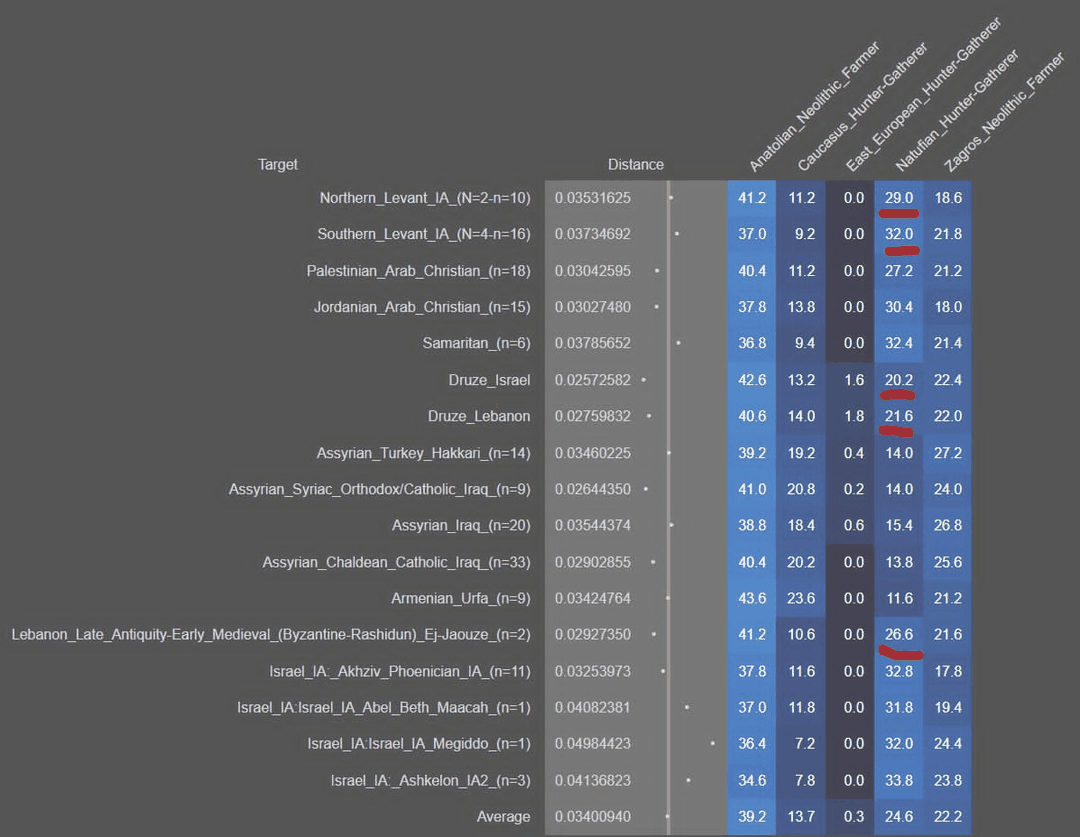
Distal Global25 components. The Druze carry a lower Natufian fraction than the southern Levantine samples and a small East European trace, consistent with a northern, partly Syro-Mesopotamian ancestry.
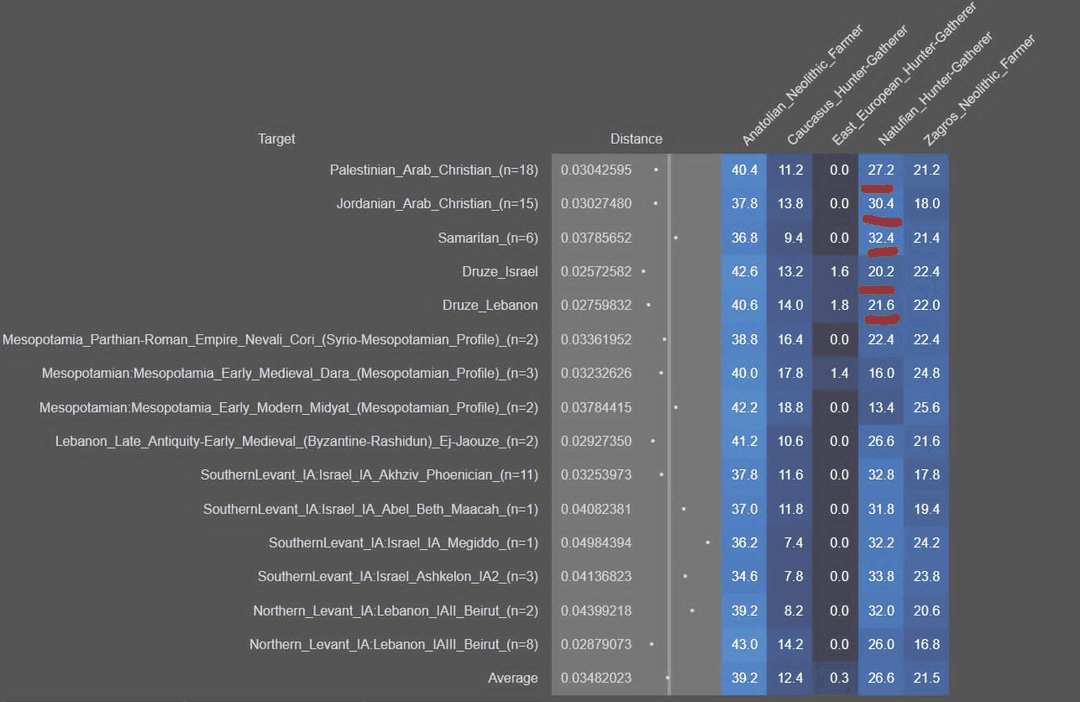
The same comparison with the Mesopotamian profiles (Nevali Cori, Dara, Midyat) included. The Druze Natufian fraction falls between the Iron Age Levantine and the Mesopotamian values.
6. The proximal models
Proximal models use sources close in time and place to the target. Run with an antithetic distance control (ADC, 1x) to limit overfitting, and offered a late antique Levantine source (Ej-Jaouze), a Syro-Mesopotamian source (Parthian to Roman Nevali Cori), and Iron Age Northern and Southern Levantine sources, the Druze draw a large share of their ancestry from the Syro-Mesopotamian source and little or none from the Iron Age southern Levantine sources. The same model run on the Levantine Christians and the Samaritans draws little or no Mesopotamian weight.
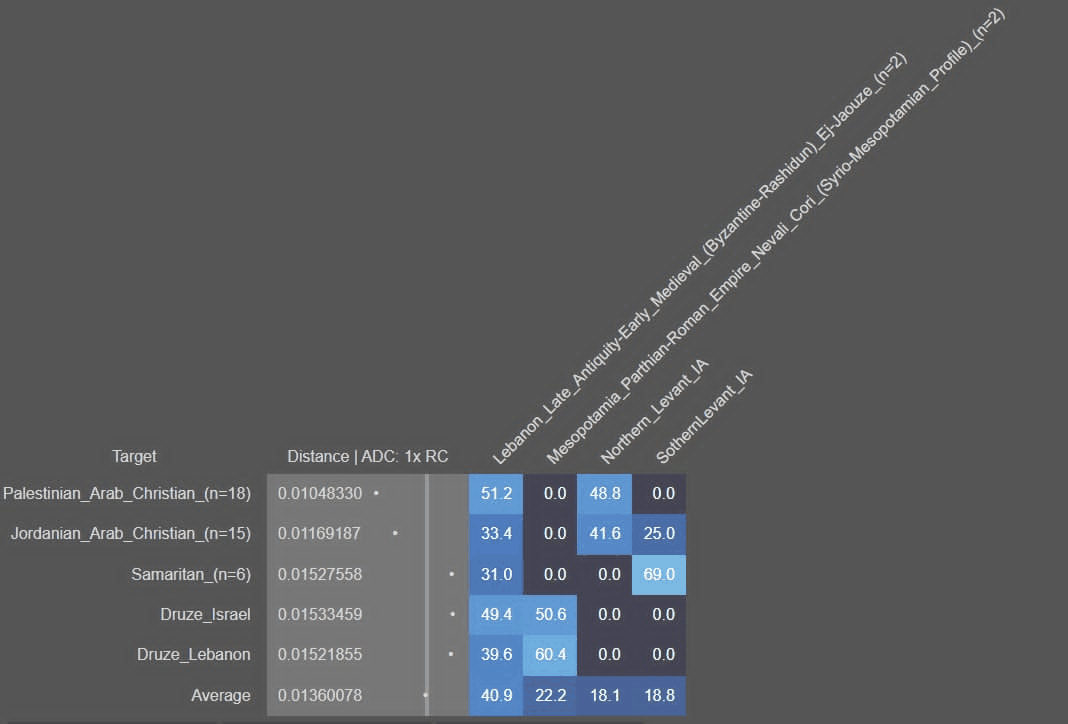
Proximal model with ADC (1x). The Druze draw a substantial share from the Syro-Mesopotamian source; the Christians and Samaritans draw little or none.
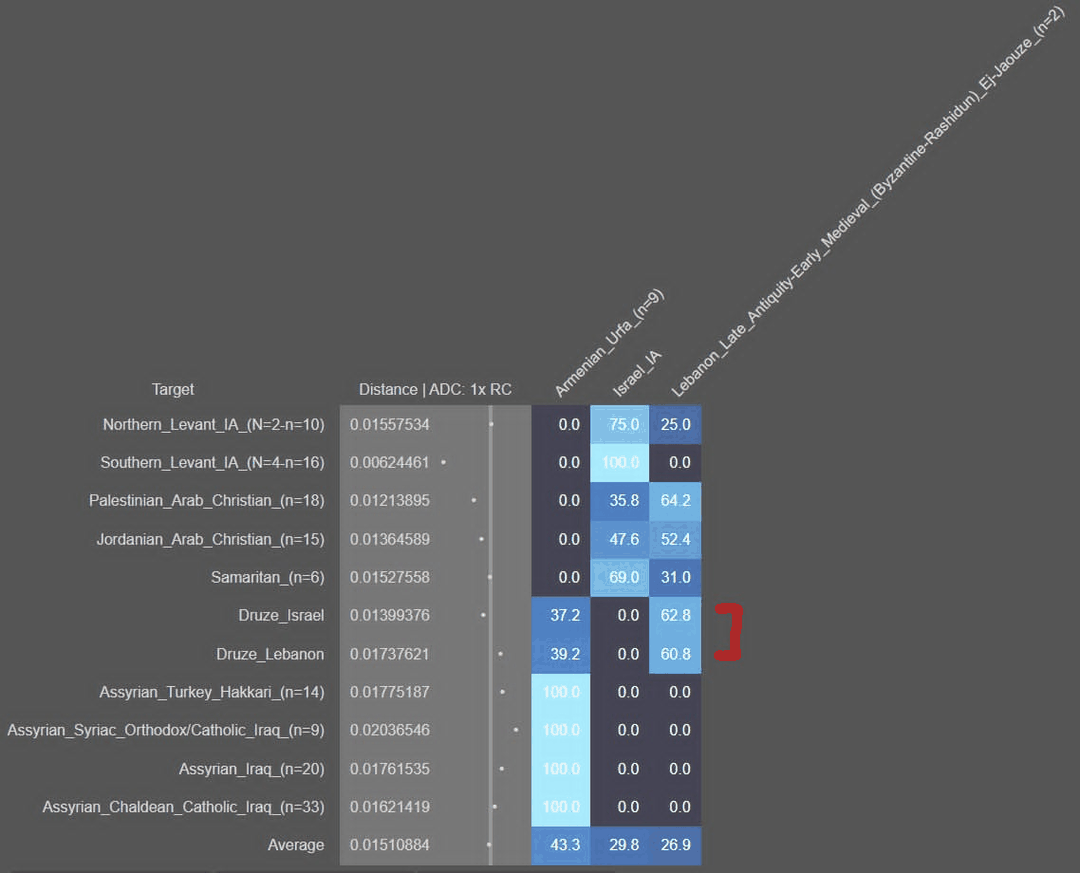
A second proximal model with ADC (1x). Offered an Armenian source, Iron Age Israel, and the late antique Ej-Jaouze, the Druze take a notable Armenian share, consistent with their northern position.
7. An independent published result: Marshall and Elhaik 2016
The northern Near Eastern placement of the Druze is consistent with published work. Marshall, Das, Pirooznia and Elhaik (2016), Reconstructing Druze population history, in Scientific Reports (article 35837), used a biogeographical method to localise the proto-Druze to the mountainous regions of southeastern Turkey, northern Iraq, and southeastern Syria. The Global25 placement described in this article points in the same direction.
8. The Druze as a religious isolate: runs of homozygosity
Nearly a thousand years of endogamy have produced a genome rich in long runs of homozygosity (ROH), stretches in which the two parental chromosomes are identical because both parents share recent common ancestors. Carmi et al. (2014) found Druze ROH comparable to Ashkenazi Jews and above non-isolate reference populations. Vahaba et al. (2020) documented frequent first-cousin and second-cousin marriage in the modern Israeli Druze and identified the community as a medical genetics isolate for more than a dozen autosomal recessive disorders, including familial Mediterranean fever and several lipid metabolism conditions. These are the expected consequences of a long-closed marriage pool.
9. Internal homogeneity across borders
Druze_Israel (the Galilee and Carmel) and Druze_Lebanon (Mount Lebanon and the Chouf) sit about 0.0086 apart on Global25, comparable to the distance within a single regional population and smaller than the distance between neighbouring European regional groups. Despite a century of administrative separation across closed or hostile borders, the two subpopulations remain genetically close, reflecting marriage networks maintained across the whole Druze range from Mount Lebanon to the Galilee to the Jabal al-Druze.
10. Relationship to the Mesopotamian Jewish communities
The Druze share part of their ancestry with the Jewish communities of Mesopotamia. The Mesopotamian Jewish communities carry substantial ancient Mesopotamian ancestry alongside a Levantine element, and are among the better-preserved living reservoirs of that ancient Mesopotamian ancestry. Because the Druze also carry a Syro-Mesopotamian component, the two groups share part of their northern ancestry, which accounts for much of their genetic proximity. This is a useful observation for anyone modelling either community: a close fit between the Druze and a Mesopotamian Jewish population reflects in large part this shared northern ancestry, rather than a specifically Judean connection.
11. The Druze Global25 coordinate
For readers who wish to reproduce the analysis in Vahaduo or any Global25 tool, the scaled average Druze coordinate is given below.
12. Conclusion
The Druze are a long-closed religious community whose genome offers a clear view of one part of the Near Eastern past. On Global25 they fall within the northern Levantine cline, carrying a Syro-Mesopotamian element that brings them close to the Roman and early medieval populations of the upper Euphrates and northern Mesopotamia and to the Mesopotamian Jewish and Christian minorities. Their reduced Natufian fraction, their small East European trace, and the preference of proximal models for a Syro-Mesopotamian source all point to a population formed in the medieval period at the northern Levantine and Syro-Mesopotamian interface, then held in place by religious closure. Read in this way, the Druze are a window into the northern Levant of late antiquity, and a useful reference point for the genetic history of the wider region.
Acknowledgements
I am grateful to RZ for sharing detailed Global25 analyses and careful corrections that shaped this article. The distance rankings and admixture models reproduced here are his; the interpretation, and any remaining errors, are mine.
References
- Marshall, S., Das, R., Pirooznia, M., Elhaik, E. (2016). Reconstructing Druze population history. Scientific Reports, 6, 35837. DOI: 10.1038/srep35837 Druze origins
- Haber, M., Doumet-Serhal, C., Scheib, C., et al. (2017). Continuity and Admixture in the Last Five Millennia of Levantine History from Ancient Canaanite and Present-Day Lebanese Genome Sequences. American Journal of Human Genetics, 101(2), 274 to 282. DOI: 10.1016/j.ajhg.2017.06.013 Levantine continuity
- Agranat-Tamir, L., Waldman, S., Martin, M. A. S., et al. (2020). The Genomic History of the Bronze Age Southern Levant. Cell, 181(5), 1146 to 1157. DOI: 10.1016/j.cell.2020.04.024 Bronze Age Levant
- Carmi, S., Hui, K. Y., Kochav, E., et al. (2014). Sequencing an Ashkenazi reference panel supports population-targeted personal genomics and illuminates Jewish and European origins. Nature Communications, 5, 4835. DOI: 10.1038/ncomms5835 ROH, Jewish origins
- Vahaba, D. M., et al. (2020). Studies of the Druze as a medical genetics isolate and founder population. European Journal of Human Genetics. Founder mutations
- Davidski (Eurogenes). Global25 scaled coordinates. Vahaduo Global25 tools by Piotr Kapuscinski. Distance and NNLS modelling for this article performed in Vahaduo and in Python (scipy). G25 method